
Manual Soul vs. Automatic Pragmatism: The Core Choice
When choosing between the RM35-01 and RM35-02 super clones, the decision isn’t about which looks cooler in a photo—it’s about which fundamental philosophy of watch ownership aligns with your daily reality. At the heart of this choice lies a non-negotiable divergence: manual winding versus automatic winding. This isn’t a trivial specification to be checked off a list; it’s a philosophical chasm that dictates every subsequent experience, from the morning ritual to the long-term reliability story in the replica world. The movement type is the single most important factor, overshadowing even case material or dial color, and for chronograph complications such as those in the RM011, achieving super clone precision is notably more demanding, as referenced in the RM011 replica guide, because it defines the watch’s core behavioral contract with its owner.
The Architecture of Intent: What the Original Movement Design Demands
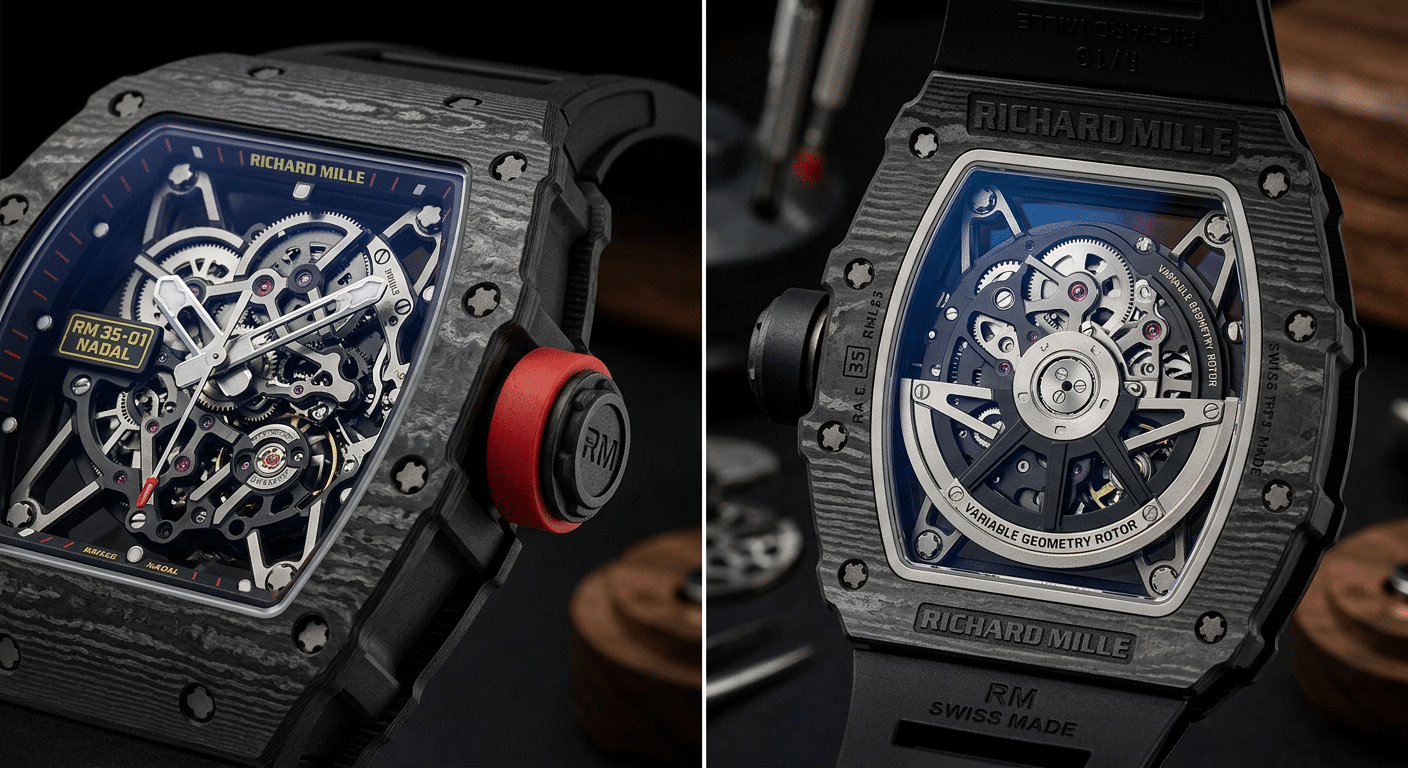
The RM CALIBRE RM35-01 is a masterpiece of subtraction. It is a manual-winding, ultra-thin skeletonized movement engineered for visual purity and minimalism, with no automatic mass to disturb its skeletal elegance or add a single unnecessary millimeter. Its architecture is an exercise in restraint, where every component is exposed and serves a single, visible purpose. The RM CALIBRE RM35-02, by contrast, introduces an automatic winding module—typically a peripheral or micro-rotor. This addition is not a minor feature; it is a fundamental re-architecture. It inherently introduces a separate gear train for winding, a rotor assembly, and often a different mainspring barrel configuration, all of which add layers of complexity, thickness, and a shift in visual weight distribution across the movement plate.
For super clone factories, this divergence creates two entirely different replication challenges. Copying the RM35-01’s manual caliber means achieving flawless, bare-bones skeletonization and maintaining that extreme thinness without the structural “excuse” of an automatic module. Copying the RM35-02 means perfectly simulating the functional ballet of the rotor—its silent rotation, its correct weight, its integration with the winding gears—while also disguising the additional mechanical layers beneath a dial that must still feel open and architectural. The automatic version demands a higher order of functional mimicry, not just visual replication.
The Daily Ritual vs. The Daily Habit: Operational Realities
This architectural difference manifests as a daily behavioral split. The RM35-01 manual requires engagement. It asks for a daily ritual: a few turns of the crown each morning to build its ~70-hour power reserve, mindful setting of the time, and an awareness of its running down. It is a watch with a schedule. The RM35-02 automatic operates on a different principle—it is a “set-and-forget” piece. Its rotor captures kinetic energy from your natural wrist motion, maintaining power indefinitely as long as you wear it regularly. The ritual is replaced by a habit.
For the super clone buyer, this translates directly into a risk calculus. The manual watch’s primary point of failure is its engagement mechanism: the winding stem and crown pipe sealing. In a replica, where case machining tolerances and gasket quality can vary, this is a potential ingress point for moisture or dust. The automatic watch trades that specific risk for a different set: potential rotor noise (from poor bearing implementation or an unbalanced weight), a slight but perceptible increase in weight, and a more complex movement assembly that is inherently harder to service or regulate to a high standard at the clone level. A poorly executed automatic module can introduce timing inconsistencies or a gritty winding sensation that a simpler manual movement, if well-made, simply does not have.
Expert Authentication Insight
Physical diagnostic: Examine the winding action through the caseback. Place the watch crown-up and gently operate the winding mechanism. On a top-tier RM35-01 super clone, the manual winding should feel exceptionally smooth, with a precise, audible, and evenly spaced click from the winding pinion—a sensation of dense, controlled mechanics. There should be no gritty resistance or variation in tension. On an RM35-02, the focus shifts to the rotor. With the watch held dial-down, give it a gentle rotary shake or rotate your wrist slowly. The rotor should wind silently and freely with a slight, even rocking motion. Any audible “clunk,” gritty grinding, or uneven rocking as it settles suggests poor bearing implementation, an incorrectly mounted rotor weight, or an out-of-spec gear train—clear signs of factory immaturity in executing the automatic complication.
Visual Tension and Structural Presence: What Your Eyes Actually See
The movement architecture doesn’t just dictate mechanics; it fundamentally sculpts the dial-side aesthetic and the watch’s physical presence on the wrist. For a replica buyer, “wrist presence”—the perceived size, thickness, and how the watch integrates with the arm—is the ultimate metric, far more important than any spec sheet. The RM35-01 and RM35-02, while sharing a case family, deliver profoundly different experiences in this regard due to the mechanical hearts within them.
Skeletonization Density and Dial “Openness”
The RM35-01’s dial is, in essence, the movement’s mainplate itself. This creates the maximum possible skeletonization and a profound sense of depth, where the gears and bridges appear to float in a void, directly under the crystal. The visual tension comes from the stark, open architecture and the intricate hand-beveled edges catching the light. The RM35-02’s dial is a separate, slightly more substantial component that sits above the automatic mechanism. This creates a different, often slightly more layered sense of depth—a shadow play where the dial markers and the machinery beneath are distinct planes. The “openness” is inherently compromised by the need to house the rotor and winding gears. Super clone factories vary wildly in their ability to replicate the crucial hand-beveling and fine graining that creates this visual tension. A top-tier ZF or APSF version will have crisp, reflective bevels that mimic the genuine’s light-play; a lower-tier copy will have dull, rolled, or chemically washed edges that flatten the design and betray its origins immediately under closer inspection.
Thickness, Weight, and the Illusion of Ultra-Thin
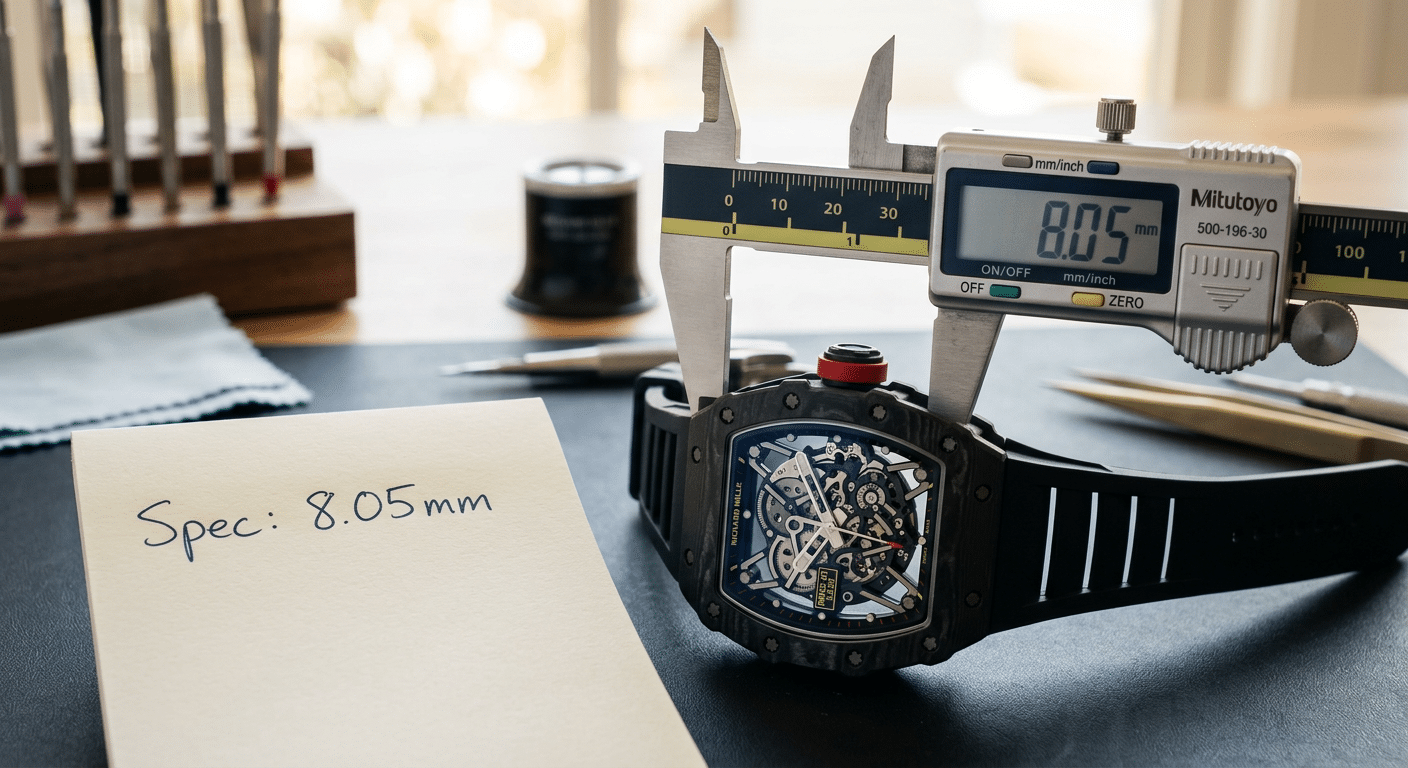
The absence of an automatic module allows the RM35-01 to achieve a marginally thinner case—approximately 8.05mm compared to the RM35-02’s ~8.25mm. This 0.2mm difference, combined with the RM35-01’s typically lighter weight (no rotor, slightly less movement mass), creates a tangible difference in how the watch integrates with the wrist. The 01 feels like a seamless extension of the arm, almost “weightless” in its balance. The RM35-02, with its rotor and additional gearing, carries a subtle but definite heft and a slightly higher profile. This “substantiality” can be perceived as premium presence or as unwanted bulk, depending entirely on the wearer’s wrist size and preference for a minimalist versus a declarative feel. In the super clone context, such as the benchmarks defined in the RM055 super clone guide, case thickness can deviate significantly from genuine specs, and this difference is often magnified. A poorly made RM35-02 replica can easily exceed 9mm, destroying the ultra-thin illusion entirely, while a well-executed RM35-01 stays closer to its target.
Expert Authentication Insight
Physical diagnostic: Use a precise digital caliper to measure the caseback-to-crystal height at the 12 o’clock position—the case’s absolute thinnest point. Compare this measurement to the official Richard Mille specification for the specific model. A super clone that measures more than 0.3mm thicker than spec at this critical point has failed in its core ultra-thin construction promise. This indicates a movement plate that is too thick, incorrectly positioned, or an improperly seated crystal—a fundamental flaw that affects both the watch’s aesthetic integrity and its wearability. This measurement is a non-negotiable red line for quality.
The Super Clone Amplification Effect: Why Differences Are Magnified
This is the pivotal understanding for any serious replica buyer. In the world of super clones, the original design differences between the RM35-01 and RM35-02 are not merely preserved; they are systematically amplified by the constraints, economics, and technical bottlenecks of the cloning process. A minor nuance in the genuine watch becomes a major, sometimes decisive, factor in the replica market. The complexity gap between a manual and an automatic movement, while significant in Switzerland, becomes a chasm in Guangzhou or Dandong.
Factory Maturity and Movement Stability
The RM35-02’s automatic mechanism is a more complex assembly of gears, bearings, and a precisely weighted rotor. For a super clone factory, this means more variables to perfect: rotor weight distribution, bearing friction, gear meshing under load, and the synchronization of the winding transmission. A rotor that is fractionally out of balance or a bearing that is microscopically too tight will manifest as audible noise, inconsistent winding efficiency, or subtle timing errors. The RM35-01’s “simpler” manual-winding caliber presents a far smaller target for error. Its core challenge is visual—the perfection of skeletonization and beveling—not the functional integration of multiple moving subsystems. Consequently, a competent factory can achieve a higher baseline of mechanical reliability and silence with the RM35-01 clone than with the RM35-02, where even a top-tier APSF or ZF version may exhibit a faint rotor whisper that a genuine would not.
Maintenance Reality: The Unseen Cost of Ownership
The operational difference extends to the grim reality of long-term maintenance. Servicing a manual movement in a clone is a relatively straightforward procedure: disassembly, cleaning, oiling, and replacing the mainspring as needed. The parts are generic and the procedure is well-understood by any watchmaker familiar with basic manual calibers. Servicing an automatic movement adds the entire rotor bearing system (ceramic or ruby bearings), the winding transmission gears, and the often more complex mainspring barrel. In the super clone ecosystem, finding a watchmaker with specific experience in these cloned automatic movements (like the Dandong RMUL2 variants) is difficult. More critically, proprietary parts—a specific rotor axle, a unique winding pinion—are virtually non-existent. A failure in the automatic winding system rarely means a simple repair; it usually means sourcing a complete replacement movement, which itself may be a challenge if that particular factory version (e.g., ZF V6 vs. APSF V2) is out of production. The RM35-02 carries a hidden, potentially higher lifetime cost of ownership.
Expert Authentication Insight
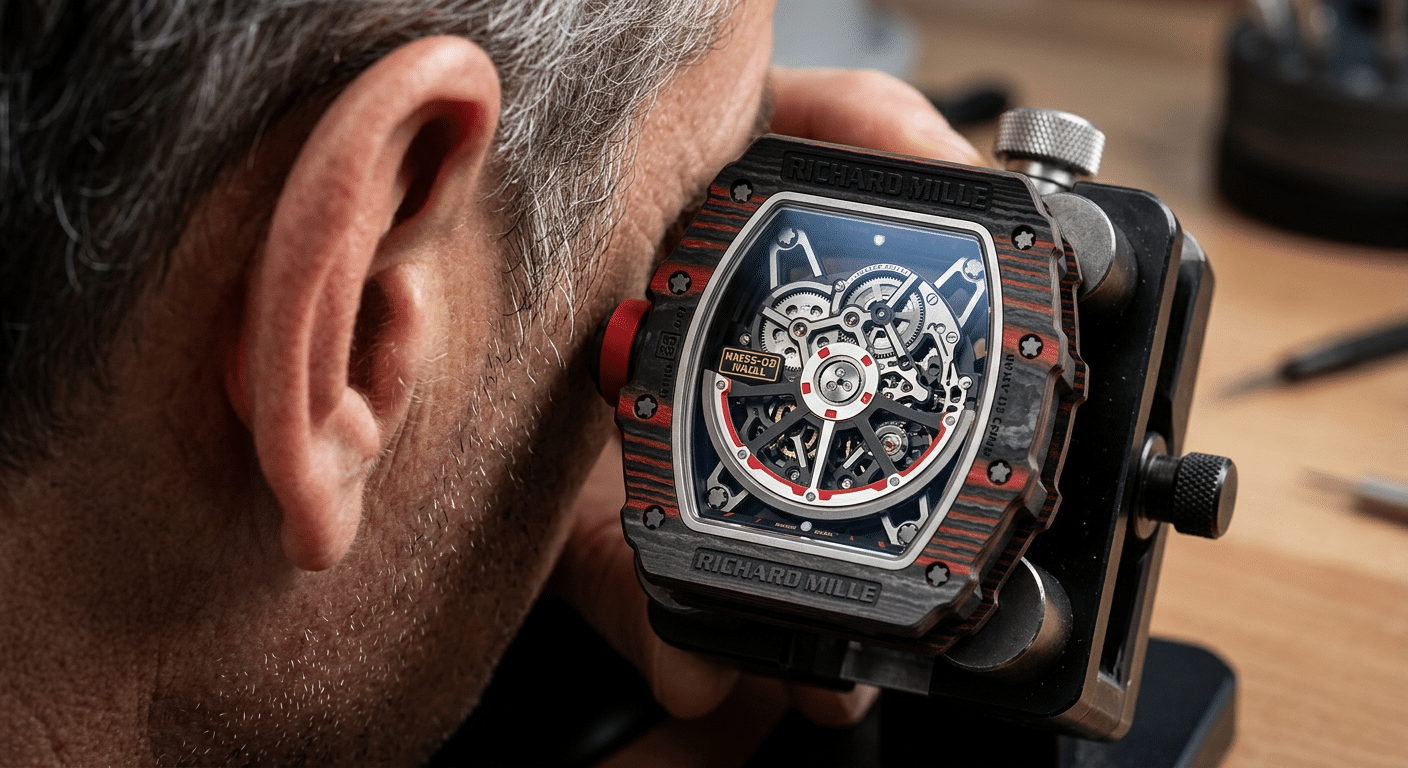
Physical diagnostic: Listen to the rotor’s character. Place the watch on a soft, quiet surface with the dial facing up. Gently rotate the watch in a slow, clockwise circle. A high-quality clone of the RM35-02 will have a near-silent rotor with a very slight, smooth “whir” or “whoosh” as it spins up, followed by a silent coast. A lower-quality clone will produce an audible “clunk,” “thunk,” or gritty sound with each rotation of the watch, or a persistent grinding noise. This indicates poor lubrication, oversized or misaligned bearings, or an unbalanced rotor weight—a definitive sign of factory immaturity in the automatic module’s implementation. The silence of the rotor is a direct proxy for the precision of its engineering.
The Decision Framework: Which One Makes Sense FOR YOU?
At this point, the technical distinctions are clear. The real question is which set of trade-offs aligns with your actual use case. This isn’t about which watch is “better” in a vacuum; it’s about which one creates fewer friction points for you. The decision collapses into two distinct buyer profiles, with a clear, tactile test to confirm what you’re really getting.
Profile 1: The Purist & The Connoisseur
This is the buyer who looks at the RM35-01 and sees more than a watch—they see a specific statement of horological philosophy. The appeal is the uncompromised skeletal architecture, the direct visual connection to the movement’s gears, and the absolute thinness achieved by removing the automatic module entirely. For this person, the daily ritual of manual winding isn’t a chore; it’s an engagement with the mechanism. They value the historical authenticity of the manual-winding concept in Richard Mille’s racing-inspired lineup.
The trade-offs are accepted, not overlooked. They understand that the crown and winding stem seal represents the most common point of failure in daily wear. They are prepared for potentially more complex servicing in the clone ecosystem, where a manual movement is simpler in theory but still demands precision. They prioritize visual purity and “soul” over the marginal gains in convenience. For this profile, the RM35-01 is the only logical choice—it’s the piece that connects them most directly to the original design intent.
Profile 2: The Pragmatist & The Daily Rider
This buyer’s primary goal is a high-impact statement piece that requires minimal mental overhead. They want their Richard Mille to be a reliable tool, not a fragile object of contemplation. The “set-and-forget” nature of the RM35-02, a feature extensively covered in the Richard Mille super clone models guide, eliminates the daily winding ritual and, more importantly, removes the crown seal as the primary vulnerability. The slightly heftier on-wrist feel—often a result of the rotor and a marginally thicker case—is perceived not as a flaw but as a positive, lending a sense of substance and presence that many find more reassuring.
From a super clone practicality standpoint, the automatic configuration benefits from more mature factory support. Because the RM35-02 is the higher-volume model, factories like ZF and APS have invested more heavily in perfecting its clone movement (the RMUL2) and case construction. The perceived robustness, combined with slightly easier serviceability (though still a niche concern), aligns perfectly with a “wear it and forget it” mentality. The tiny sacrifice in the purest skeletonized depth is a fair price for major gains in daily usability and peace of mind.
Expert Authentication Insight
Physical Diagnostic: The Weight Distribution “Wiggle” Test. This is the final, non-negotiable differentiator you can perform yourself. With the watch securely on your wrist, place your elbow on a table and gently tilt your hand up and down at the wrist.
- RM35-01 (Manual): You will feel a very neutral, almost “weightless” pivot. The balance is centralized around the movement and the fixed winding stem. There is no internal swinging mass. The watch tilts cleanly.
- RM35-02 (Automatic): You will feel a subtle but unmistakable “swing” or shift in balance as you tilt. The off-center rotor (or peripheral rotor system) is a free-moving weight inside. As you move your wrist, the rotor lags slightly and then catches up, creating a minute but detectable change in the watch’s inertial center. This is the tactile signature of the automatic complication. A high-quality clone will have a smooth, silent swing; a poor clone may have a gritty or clunky feel.
This test bypasses visual inspection and goes straight to the core mechanical difference. If you feel the swing, you have an automatic (RM35-02). If the watch feels completely neutral and dead-balanced, it’s manual (RM35-01). This is a definitive, experiential filter.
Final Verdict: The Risk-Adjusted Choice
The conclusion must be rooted in the unique economics and constraints of the super clone market, not in abstract horological ideals. When you factor in failure points, factory maturity, and long-term ownership friction, the path for the majority of buyers becomes starkly clear.
For the vast majority of super clone buyers—those seeking a high-impact, low-fuss statement piece—the RM35-02 is the smarter, risk-adjusted choice. Its automatic winding system eliminates the single most common daily failure vector in a manually-wound watch: the crown and winding stem seal, which is constantly stressed and a frequent source of moisture ingress and stem misalignment. Furthermore, the RM35-02’s status as the more popular, higher-volume model means that top-tier factories (ZF, APS, and formerly BBR) have poured more development resources into perfecting its clone movement (the Dandong RMUL2) and case tolerances. The support ecosystem, from parts knowledge to service familiarity, is simply more mature for this configuration.
The RM35-01, therefore, is not a “worse” watch—it is a specialist’s tool. It is the trophy for the buyer who actively cherishes the manual winding ritual and is fully prepared to manage its specific care requirements. It is for the connoisseur who will accept the higher theoretical maintenance complexity and the crown-seal vulnerability in exchange for the unparalleled visual purity and historical authenticity of the manual-winding, skeletonized concept.
Choose the RM35-02 for sense. It offers the superior blend of visual impact, daily reliability, and factory-backed maturity for the clone buyer.
Choose the RM35-01 for soul—and only if you fully understand and are willing to shoulder the commitment that soul demands.