
The Chronograph Complexity Paradox: Why More Functions Mean Higher Failure Rates
When evaluating a Richard Mille replica, the chronograph complication on a model like the RM011 is not merely an added feature—it is the single greatest point of failure. The pursuit of visual parity often collapses under the mechanical reality of a fully integrated timing system. A simple three-hand watch operates on a single, relatively straightforward gear train. A column-wheel chronograph, however, introduces an entire secondary gear train, a coupling clutch, a series of intermediate wheels, and a reset hammer mechanism. Each of these components must not only exist but must interact with micron-level precision within the exact same case envelope that houses the base movement. This isn’t a simple “add-on”; it’s a mechanical ecosystem. Replica factories, especially those using modified base movements like the Shanghai 7750, face a non-linear increase in problems. Tolerance stacking—where the slight imperfection of one part magnifies the error of the next—becomes catastrophic in a system where a coupling wheel must slide perfectly into mesh. Spatial conflicts arise as the chronograph module is forced into a case designed for a different movement architecture, often leading to compromised pusher alignment or caseback integration. The material science challenge is equally severe; the repeated stress of engaging and disengaging a clutch demands specific steel hardness and spring tempering that is economically unfeasible to replicate at the sub-$500 tier. The chronograph is, therefore, the ultimate stress test: it exposes whether a replica is a coherent mechanical system or a collection of aesthetic approximations glued together.
From Simple to Complex: The Exponential Difficulty Curve
The engineering gap between a basic automatic movement and a column-wheel chronograph is not additive; it is multiplicative. A standard three-hand calibre, like those found in many simpler replicas, has one primary gear train driving the hands from a single mainspring barrel. The entire mechanism is a linear transfer of power. Introduce a chronograph, as in the genuine RMAC1 movement that powers the RM011, and the architecture explodes in complexity. A separate chronograph gear train must be overlaid onto the base movement. This requires a column wheel—a precisely milled, star-shaped component that acts as the logic hub—to orchestrate the start, stop, and reset functions. A coupling clutch (a mobile wheel with teeth) must slide in and out of engagement with the fourth wheel to drive the chronograph seconds hand. Separate wheel trains for the chronograph minute and hour counters must be added. Finally, a reset hammer, often a spring-loaded “heart piece,” must strike all three chronograph hands back to zero simultaneously. Every one of these added layers must be packaged within the same height constraint as the base movement. For a replica factory starting with a bulky, pre-existing base like the Shanghai 7750, this packaging is a compromise from the start. They must either thin components (risking weakness) or, more commonly, accept a significantly thicker case—a dead giveaway against the genuine’s 16.15mm profile. The difficulty curve is exponential because the reliability of the whole system is dictated by the weakest interaction point between any two of these new components.
The “Gestalt” Problem: Systems Over Parts
The critical failure mode for most RM011 replicas is a misunderstanding of the chronograph as a system. Replica production often follows a parts-list approach: copy the shape of the pusher, install a chronograph module that runs, print three subdials. This misses the entire point. A genuine chronograph is a synchronized ballet. The pusher’s travel distance and pressure are calibrated to engage the column wheel with a specific mechanical advantage, which then rotates to position the correct coupling wheel. The lever that transfers this motion must have a jeweled pivot to minimize friction and wear. The reset hammer’s strike must be perfectly timed with the cam that controls its return; a mis-timed strike causes the hands to reset to 12:00, 12:01, and 11:59—a classic fault. The coupling clutch’s engagement must be firm and precise; any lateral play (“slop”) causes the chronograph seconds hand to jump or wobble on startup and stop. Replicas, particularly those based on the Shanghai 7750, often have these interactions working in sequence but not in harmony. The pusher might feel loose because the lever is a stamped steel piece instead of a precisely milled component. The reset might be inconsistent because the hammer spring is too weak or the cam surface is rough. The system’s “gestalt”—its emergent, cohesive functionality—is absent. You have the words but not the poetry.
Expert Authentication Insight
Physical diagnostic: The “pusher consistency test.” This is a direct probe into the system’s integration quality. Take two RM011 replicas from different factories (or one you own and a friend’s). Wind both fully. Using only the 2 o’clock pusher (which controls the chronograph minute counter), press it firmly and quickly 20 times in rapid succession. Do not reset between presses. Your focus is on the tactile and auditory feedback of each individual press. A genuine RMAC1 movement will produce a crisp, uniform, and loud “click” with each actuation. The travel will be short, firm, and consistent from press 1 to press 20. The sound will not degrade. This proves the pusher spring is correct, the lever pivot is low-friction, and the column wheel engagement is precise. A poorly integrated replica will reveal its flaws under this stress test. You may feel varying resistance—some presses are firm, others are mushy or require more travel. You may hear a grinding or gritty sound as tolerances wear unevenly under repeated stress. The “click” may become dull or disappear after several presses as the coupling mechanism heats up or shifts. This test isolates the precision of the lever-column wheel engagement, which is the core of the chronograph’s operational integrity. A watch that fails this test has a fundamental flaw in its heart, regardless of how perfect the dial or case may appear.
Subdial Layout & Spatial Integrity: The “Ferrari Dashboard” Illusion
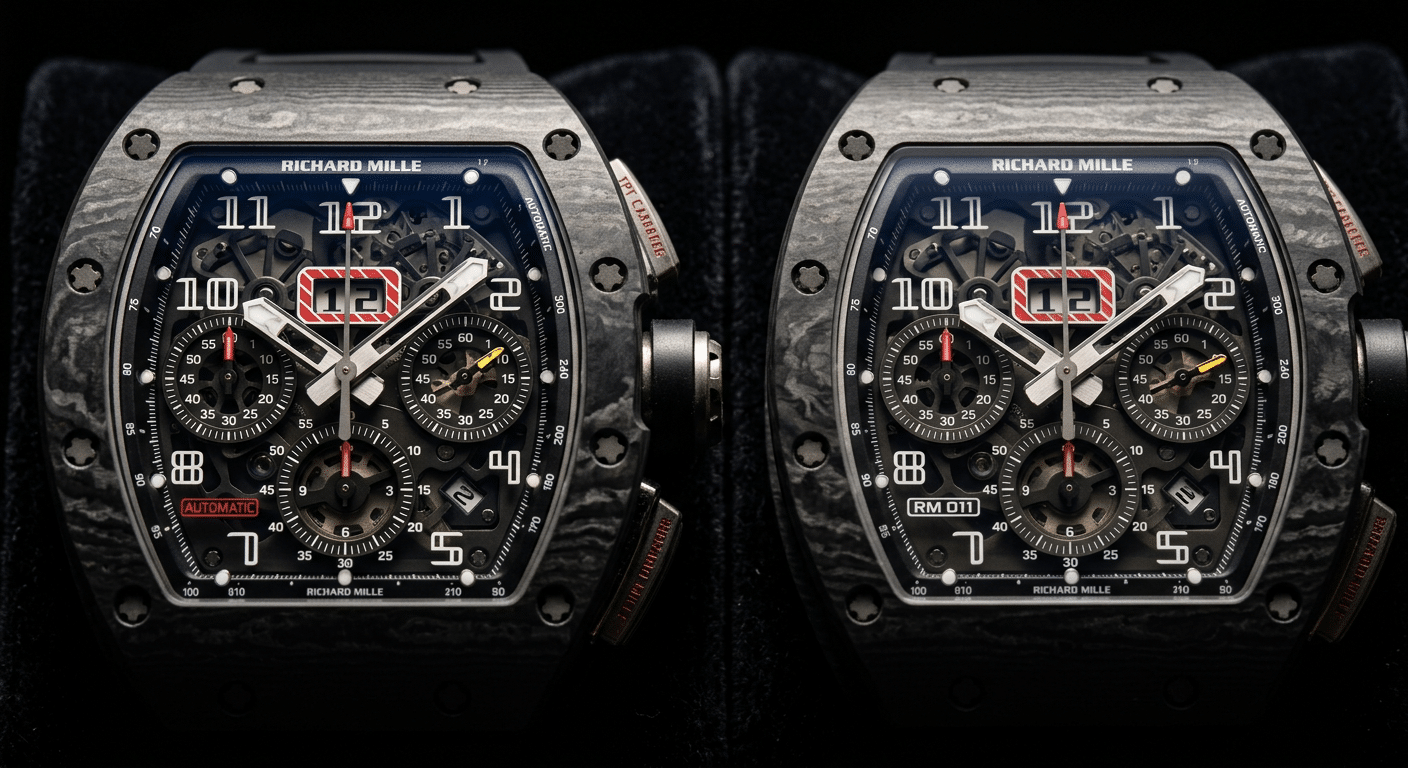
The RM011’s iconic three-subdial layout is often mistaken for pure styling. It is, in fact, a masterclass in engineered legibility and visual balance within the constraints of a tonneau case. The arrangement is not arbitrary. The centers of the 3 o’clock (chronograph minutes), 6 o’clock (chronograph hours), and 9 o’clock (running seconds) subdials form an equilateral triangle with the center of the main dial. This creates a dynamic, balanced asymmetry that guides the eye. Furthermore, the subdials are not created equal. The 9 o’clock running seconds subdial is typically slightly smaller in diameter than its 3 and 6 o’clock chronograph counterparts. This subtle size hierarchy reinforces the functional importance of the timing functions. Replicas, in their quest for manufacturing simplicity, almost universally make all three subdials identically sized. This single change breaks the intended visual rhythm, making the dial appear static and cluttered, like a generic sports watch rather than a precision instrument. The illusion of a “Ferrari dashboard”—a cockpit of focused, distinct gauges—is shattered, replaced by a homogenous, confused plane. This error is so fundamental that it makes the watch look “off” even to someone who cannot pinpoint why; the brain senses the lack of intentional hierarchy.
The Mathematics of the Triangle: Minute vs. Hour vs. Small Seconds
The precise geometry starts with the triangle. The distance from the main dial center to the center of each subdial is calculated to create equal spacing and visual weight. The 3 and 6 o’clock subdials, being primary chronograph functions, are given more real estate—both in diameter and often in the prominence of their minute tracks. The 9 o’clock subdial, indicating continuous seconds, is a secondary reference and is therefore often fractionally smaller (by 0.5-1.0mm in diameter). This size difference is a critical detail. Replica factories, using a single subdial stamping or mold for all three positions to save on tooling costs, eliminate this differentiation. The result is a dial that feels flat and lacks the deliberate, racing-inspired hierarchy. The triangle is also subtly distorted if the subdial centers are not placed with millimeter accuracy. A shift of just 1mm in the placement of the 6 o’clock subdial will make the entire composition feel “leaning” or unbalanced, a flaw that is immediately subconscious but difficult to articulate. The engineering intent is to create a sense of motion and focus; the replica error creates static confusion.
Printing, Indices, and the Gap Problem
Even with correct subdial sizes, the battle is half-won. The finishing of the dial’s surface is where factory maturity is truly revealed. Each subdial ring is not just a painted circle; it is a precisely machined recessed track with a painted minute scale. The gap between the outer edge of this subdial ring and the main dial’s flange or chapter ring is a specific, uniform width—often less than 0.5mm. This gap is essential; it separates the registers, creating depth and clarity. Replicas frequently suffer from two related problems. First, the subdial rings themselves are often slightly oversized due to less precise stamping or printing registration. This “bridges” the gap, causing the paint from the subdial ring to touch or even overlap the main dial flange. Under a desk lamp at an angle, this manifests as a loss of a crisp shadow line—the dial looks like one congested piece of metal instead of three distinct, layered registers. Second, the printing of the minute indices and numerals within the subdials must be flawless. The font is a specific, modified Helvetica variant. The application method (high-precision pad printing or enamel) must produce a paint layer that is thin, even, and has razor-sharp edges. A slightly thicker paint line, a fuzzy edge, or a misaligned numeral by 0.2mm creates immediate visual “clutter.” The dial stops looking engineered and starts looking applied. This is the “gap problem”: the loss of intentional, negative space that defines luxury dial-making.
Expert Authentication Insight
Physical diagnostic: The “squint test.” This test exploits the way light interacts with surface transitions. Hold the watch at a 45-degree angle under a single, directional light source like a desk lamp. You are not looking at the dial head-on; you are looking for shadows and highlights. On a genuine RM011 dial, you will see a clean, sharp, and consistent shadow line separating the edge of each subdial ring from the main dial flange or chapter ring. This line is the physical gap, and it should be uniform in width all the way around each subdial. The transition is crisp. On a replica dial, due to the “bridging” problem (oversized rings or mis-registered printing), this shadow line will be broken, uneven, or completely absent in spots. Paint from the subdial ring will appear to “flow” into the main dial area. The entire dial surface will look like one congested, flat plane without the intended layered depth. This test is devastatingly effective because it bypasses the need to know the exact font or size; it simply assesses whether the fundamental spatial relationship between the subdials and the main dial was respected. A failure here indicates a basic failure in dial manufacturing precision, which is a hallmark of lower-tier replication.
Pusher Feedback & Tactile Deception: The Missing Engineering
The pushers on a Richard Mille are not decorative buttons. They are the primary human-machine interface for the watch’s signature complication. The tactile experience—the short, definitive “thunk” and travel—is a engineered signature. Genuine RM pushers use a complex cascade: a pusher stem compresses a specially tempered spring steel spring, which in turn actuates a tiny, jeweled lever. This lever pivots on a bearing and engages a heart-shaped cam on the column wheel. The geometry of this lever, the temper of the spring, and the precision of the column wheel’s teeth dictate the iconic feel. Replicas almost universally fail here because this internal mechanism is hidden and extremely difficult to copy. They often replicate the external pusher shape and the functional outcome (the chronograph starts), but the journey is wrong. The result is a pusher with long, mushy travel, a muted or silent actuation, and inconsistent feel from press to press. This is not a minor detail; it is the most immediate and frequent point of contact the user has with the complication. A cheap-feeling pusher betrays the entire watch instantly upon use, making it a far more significant flaw than a slightly off font that only a loupe can reveal.
Spring Steel vs. Phosphor Bronze: Material Matters
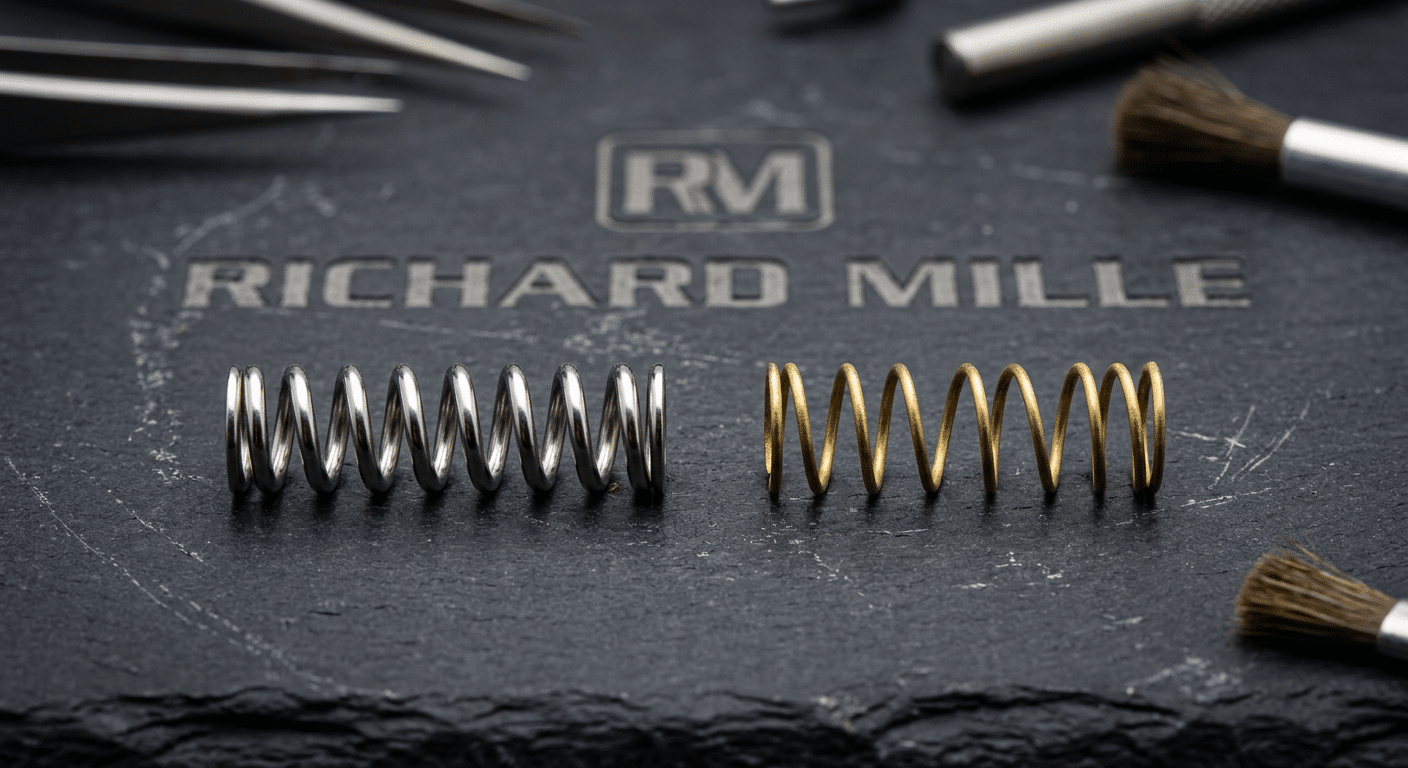
The source of the pusher’s character is its spring. Genuine Richard Mille uses a specifically alloyed and tempered spring steel. This material is chosen for its high yield strength and its ability to provide a sharp, immediate snap-back. The spring is machined or stamped to a precise thickness and shape that gives the pusher its famously short travel and firm stop. Replica factories, seeking cheaper and easier-to-machine materials, commonly use phosphor bronze (a copper-tin alloy) or even plain, soft stamped sheet steel. Phosphor bronze is a common material in watchmaking for certain applications because it is non-magnetic and has good corrosion resistance, but it is not a spring steel. It has a lower modulus of elasticity, meaning it deforms more easily and provides a dampened, “spongy” resistance. It fatigues faster, losing its tension after a few hundred cycles. A soft sheet metal spring will bottom out with a dull thud and may even deform permanently with aggressive use. The material choice is a direct cost-cutting measure that fundamentally alters the tactile signature. You cannot replicate the crisp “TICK” of a genuine pusher with a soft bronze spring; the physics are wrong.
The Hidden Lever Geometry
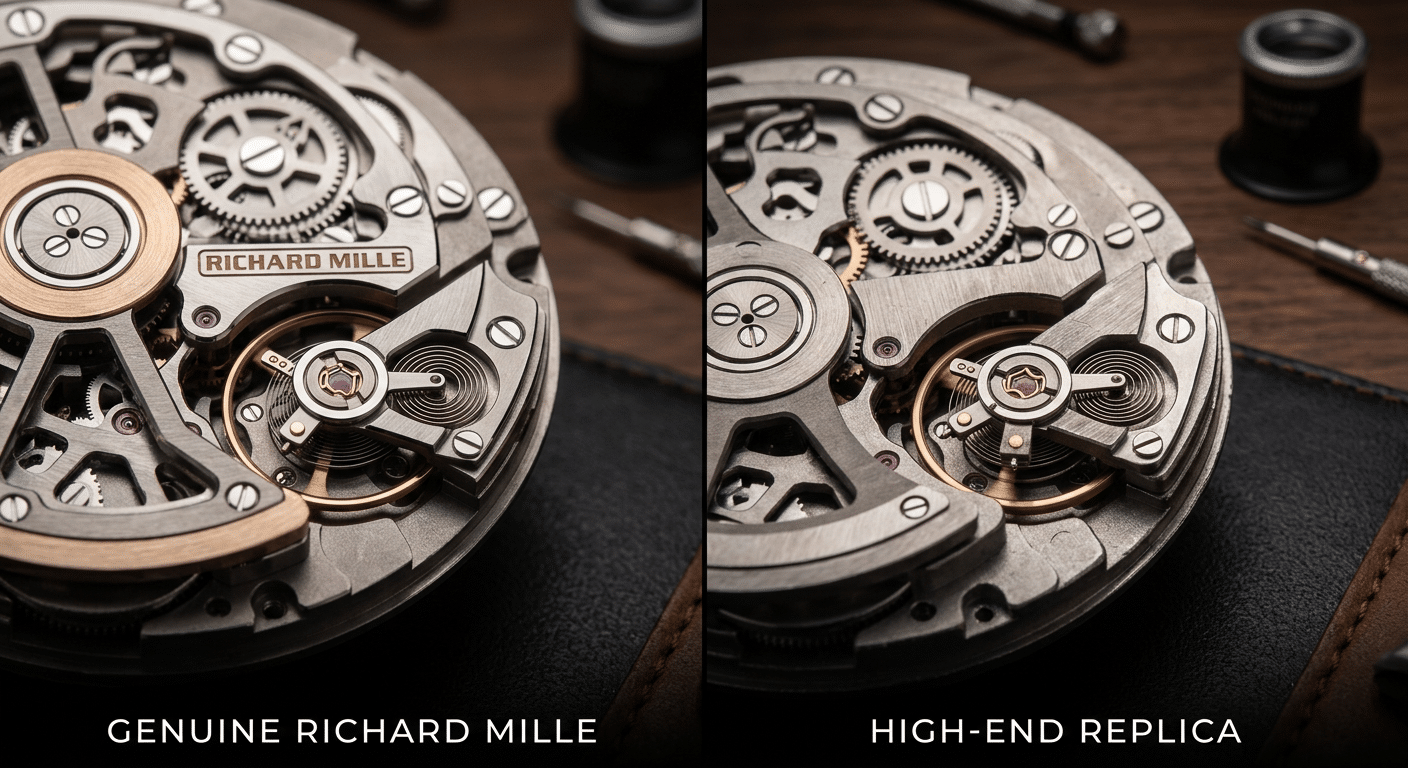
Beyond the spring lies the lever, the true translator of pusher motion into chronograph function. In a genuine RMAC1 movement, this is a miniature marvel. It is a precision-milled component, often with a complex, curved profile to optimize the mechanical advantage. It pivots on a tiny, synthetic ruby or sapphire jewel to eliminate friction and wear. The length of the lever arm from pivot point to engagement point, and the angle at which it strikes the column wheel, are calculated for instantaneous, clean engagement. Replica movements, especially those based on the Shanghai 7750, use a dramatically simplified part. It is typically a stamped, flat piece of metal, sometimes with a basic pivot hole but no bearing. It is not adjustable. This simplification creates two problems. First, the mechanical advantage is wrong, leading to a “spongy” start—the pusher travels a millimeter or two before the lever actually engages the column wheel. Second, without a jeweled pivot, friction is higher and wear is accelerated. Under repeated use, the stamped lever will develop play, making the pusher feel increasingly vague. The lever geometry is the hidden heart of the pusher feel, and it is almost always the part sacrificed for manufacturing ease in replicas. Its failure means the entire actuation sequence is compromised from the first millimeter of travel.
Expert Authentication Insight
Physical diagnostic: The “blindfold test.” This is the purest test of pusher mechanics because it removes all visual cues. Have a trusted friend hold two identically cased RM011 watches (one genuine, one replica) behind their back. They should not know which is which. Instruct them to use only the 2 o’clock pusher to start, stop, and reset the chronograph (if it’s a flyback) or just start/stop. Their task is to focus solely on the button’s feel and sound. The genuine watch will deliver an immediate, definitive, and loud “TICK-TACK” or “click” with each press. The travel will be short—perhaps 0.5mm—and firm, with a solid mechanical stop. The sound will be sharp and consistent. The replica will feel vague. It will require noticeably more pressure to actuate, and the travel will be longer (1.0mm or more) before engagement. The sound will be quieter, a dull “thunk” or a soft “click,” and may vary in character from press to press. Some presses might feel crisp, others mushy. This test isolates the entire internal pusher mechanism—spring, lever, and column wheel engagement—from any preconceived notions about the watch’s appearance. It is a brutal, objective assessment of one of the most important functional elements of a chronograph. A replica that fails this test has a fundamental mechanical deficiency that no amount of case or dial finishing can overcome.
Case Thickness & The Illusion of Proportion: Sacrificing Wearability for Feasibility
The RM011’s thickness is not an aesthetic choice but an engineering mandate. The genuine model measures approximately 16.15mm at its thickest point, a direct consequence of housing the sophisticated RMAC1 automatic chronograph movement. This dimension is a primary differentiator, and the moment a replica factory attempts to thin the case to meet a perceived “wearability” demand, it triggers a cascade of structural compromises that fundamentally alter the watch’s character and durability. The pursuit of a slimmer profile is not an upgrade; it is a fundamental deviation from the original design’s integrity, often trading long-term reliability for a superficial metric.
The Stack-Up Problem: From Bezel to Back
Case thickness is the sum of several non-negotiable layers: a domed sapphire crystal (typically ~2mm at the center), the bezel ring, the main tonneau case body, the height of the movement itself, and the caseback. The RMAC1 movement, with its integrated chronograph module and calendar complications, has a height of roughly 7.5mm. This leaves a precise envelope for the remaining components. To achieve a thinner watch, replicas must make a critical sacrifice in one of these layers. The most common and damaging shortcut is thinning the crystal, making it flatter and less domed. This not only increases glare and distorts the intended optical depth of the skeleton dial, as per the RM35-01 vs RM35-02 super clone, but also reduces the crystal’s ability to withstand impact. A more severe compromise involves modifying the movement height itself, shaving down plate heights or using a different base movement altogether. This directly leads to misalignment of wheels, poor gear meshing, and increased stress on components, fundamentally undermining the chronograph’s reliability from the start.
Caseback Integration & The “Hollow” Sound
The integration of the sapphire display caseback is a precise exercise in fit and finish. On a genuine RM011, the caseback sits flush against the movement carrier, with the movement’s mounting screws perfectly aligned and securely torqued. The entire assembly feels monolithic. When a case is thinned, this integration is almost always compromised. The distance between the movement and the caseback increases, or the caseback itself is made thinner and more flexible. This creates a subtle but telling acoustic signature. Tap the caseback gently with a fingernail. A genuine watch produces a solid, high-pitched “ping,” indicative of a tightly coupled system. A replica with a compromised caseback emits a lower, duller “thud,” often with a slight reverberation. This “hollow” sound is a direct physical manifestation of internal clearance and poor structural coupling, signaling that the movement is not properly supported within the case—a major red flag for long-term durability and shock resistance.
Expert Authentication Insight
Physical diagnostic: The ruler and feel test. First, measure the case thickness at two critical points: the 12 o’clock lugs (the absolute thinnest section of the tonneau) and at the 6 o’clock (the thickest, central point). A genuine RM011 exhibits a significant differential, often 3-4mm, created by the pronounced, flowing curvature of the tonneau shape. A replica that has been artificially thinned to a more “wearable” 13-14mm will have a much flatter profile across its entire length, losing the iconic silhouette. Second, wear the watch for at least one hour with the chronograph running intermittently. A well-proportioned, correctly thick case distributes its substantial weight evenly across the wrist. A poorly thinned case, however, will feel “tippy” or unbalanced; the lugs may dig in because the center of gravity has shifted unnaturally due to the altered mass distribution and structural rigidity. This discomfort is not just an ergonomic issue—it is a symptom of the case’s compromised architecture.
Movement Packaging: The RMAC1 Ghost and Its Simulacrum
The genuine RMAC1 movement is a masterpiece of dense, three-dimensional architecture where every component is meticulously packed into a minimal space. This is the core of the replication challenge. At the “super clone” level, factories attempt to create a movement that mimics the RMAC1’s layout. The vast majority, however, rely on a modified Chinese chronograph base, most commonly the Shanghai 7750. This base movement is fundamentally different in dimensions and layout. To shoehorn it into an RM011 case, manufacturers must employ a series of hacks: shifting the dial and hands, extending the pinion for the pushers, and hiding the entire base under a skeletonized “dummy” mainplate. This creates an inherent spatial conflict, a ghost of the genuine architecture that looks similar from above but is built on a completely different, and incompatible, foundation.
The Bridges & The “Skeleton” Lie
The skeletonization of genuine RM bridges is an art form, not a drilling exercise. The cuts are flowing and organic, following stress lines and creating a sense of weightless geometry. Finishing includes hand-beveled edges and perlage (circular graining) on flat surfaces. The key lies in the negative space—the gaps are thoughtful, aesthetic, and functional. Replica “skeletonized” bridges, even on top-tier clones, are often produced through CNC milling with straight, utilitarian cuts. The holes are there to remove material and reveal the gears beneath, but they lack the graceful, intentional design language of the genuine. They are functional cost-saving measures, not artistic expressions. Under magnification, the difference in the quality of the cut, the consistency of the bevels, and the purpose of the apertures is stark and immediate.
Rotor Integration and Winding Efficiency
The micro-rotor on the RMAC1 is a precisely engineered component with a specific weight, diameter, and inertia. It is mounted on ceramic bearings and its winding path is optimized for smooth, silent engagement with the twin barrels. Replica rotors, even in custom clones, frequently suffer from being too light, too small, or having an incorrect mass distribution. This leads to inconsistent winding efficiency and a distinct auditory profile. A genuine micro-rotor winds with a smooth, almost silent, viscous motion. There is no clunk, no gritty friction. A replica rotor often produces a faint, gritty sound as it spins or a noticeable “clunk” as the clutch engages and disengages. This is not just a noise issue; it indicates a poorly tuned coupling system that can lead to inconsistent power reserve and accelerated wear on the clutch mechanism.
Expert Authentication Insight
Physical diagnostic: The “power reserve shake.” Fully wind the watch until the crown stops. Then, holding it vertically with the crystal facing you, give it a firm but gentle shake side-to-side, mimicking the motion of your arm while walking. On a genuine watch with an efficient, well-coupled micro-rotor, you should feel and hear a faint, smooth, and consistent ratcheting sensation as the mainspring winds. It feels precise and mechanical. On a replica with a poorly tuned or imbalanced rotor, the sensation is vague. You may feel a loose rattling of internal components or a sloppy, inconsistent engagement that lacks the defined “clicks” of a properly meshing system. This simple test isolates the rotor’s coupling quality and weight distribution, directly probing the heart of the movement packaging’s fidelity.
Functional Coupling & Chronograph Logic: Where Replicas Actually Break
A chronograph is not a feature; it is a synchronized mechanical ballet. The interaction between the pusher, the column wheel, the coupling clutch, and the reset hammer must occur with millisecond precision. Replicas often replicate the *steps* of the sequence but fail on the *timing*. This is where functionality diverges into outright failure, not just in feel but in long-term mechanical health. The problems are subtle in a quick test but catastrophic over time, causing accelerated wear, misalignment, and eventual breakdown of the chronograph system.
The Coupling Clutch: Engagement and Slop
When the chronograph is started, a coupling clutch—a mobile wheel with fine teeth—must slide smoothly and firmly into mesh with the fourth wheel (which drives the seconds hand). In a genuine RMAC1, this engagement is a crisp, precise action with virtually no lateral play (slop). The clutch teeth engage deeply and securely. In replicas, especially those based on modified 7750 movements, the clutch often has excessive play. This manifests as a visible “jump” or wobble in the chronograph seconds hand the moment it starts or stops. More critically, this slop causes the teeth to hammer against each other under load, not mesh cleanly. This accelerates wear dramatically, leading to a chronograph that becomes increasingly imprecise and eventually fails to engage or disengage properly. It is a silent, grinding failure mode built into the core of the replication compromise.
Reset Hammer Synchronization
The reset function is controlled by a heart-shaped cam and a hammer (or “heart piece”) that must strike the three chronograph hands (seconds, minutes, hours) simultaneously to return them precisely to zero. The geometry of this cam and the travel of the hammer are exquisitely calibrated. A mis-timed or mis-dimensioned reset mechanism, common in replicas, results in the hands resetting to slightly different positions. You might see the seconds hand land on 12:00, the minute hand on 12:01, and the hour hand on 11:59. This is not a minor imperfection; it indicates a fundamental flaw in the reset cam profile or the hammer’s strike point. It means the chronograph can never be truly reset, accumulating error with every use, and places uneven stress on the reset mechanism, leading to premature wear and misalignment that worsens with each reset cycle.
Expert Authentication Insight
Physical diagnostic: The “high-speed photography test.” This test uses a smartphone’s slow-motion video function (240fps or higher) to expose coupling inconsistency. Set the watch to a known time. Start the chronograph and let it run for exactly 10 seconds. Stop it. Immediately without resetting, start it again. Repeat this rapid start-stop cycle as many times as possible within 3 seconds (aim for 5 cycles). A genuine movement will maintain perfect alignment; the chronograph seconds hand will stop at the exact same position every single time (e.g., precisely at the 10-second mark). The clutch engagement is so precise and consistent that there is zero cumulative play. A replica with clutch slop will show the seconds hand stopping at slightly different positions on each cycle (e.g., 10.0s, 10.1s, 9.9s, 10.2s). This visually proves the inconsistent engagement and internal play that defines a compromised chronograph system. It is the most damning evidence of a functional failure hidden beneath a working exterior.
Factory Maturity Spectrum: Why “Super Clone” RM011s Still Vary Wildly
The RM011’s chronograph complexity creates a stark divide in the replica market. Not every watch marketed as a “super clone” occupies the same tier. The fundamental split is between factories that attempt a full movement-clone approach and those relying on a modified base movement—a compromise that fundamentally dictates the watch’s long-term viability. This tiering is less about aesthetic perfection and more about whether the core mechanical system can sustain its own operation without premature failure.
Tier 1: The “Movement-Clone” Benchmark
At the apex are factories that invest in a ground-up clone of the genuine RMAC1 calibre. This involves replicating the entire architecture: the bridge layout, the micro-rotor integration, and the column-wheel chronograph system. The goal is to mimic the *coupling logic*—the precise sequence where the pusher engages the clutch wheel, which then drives the chronograph seconds, before the reset hammer strikes all three hands simultaneously. These clones (found in certain ZF V6 iterations and APSF versions) succeed in creating a functional system that *behaves* correctly. Their failures are subtler: material finishing on bridges may lack hand-beveled perfection, the micro-rotor’s inertia might be slightly off, and ultra-fine tolerances in the lever geometry still lag behind genuine standards. However, they have moved beyond the “hack” stage and into true system replication, making them the only RM011 replicas with a plausible path to medium-term reliability.
Tier 2: The “Modified Base” Compromise
The overwhelming majority of RM011 replicas fall here. They use a heavily modified Shanghai 7750 chronograph base—a workhorse movement with a fundamentally different layout. The 7750 is wider, with its wheel train arranged differently from the RMAC1. To shoehorn this into the tonneau-shaped RM011 case, Richard Mille super clone models guide, manufacturers must perform a series of compromises: the dial and hands are shifted off-center to accommodate the wider movement; the pushers are extended with longer stems to reach the movement’s correctors; and the entire base movement is hidden beneath a skeletonized “dummy” mainplate that visually mimics the genuine’s openworked bridges. This is not integration—it’s camouflage. The spatial conflicts are inherent: the extended pusher stems can bind, the shifted dial disrupts the subdial symmetry, and the dummy plate adds height. More critically, the 7750’s chronograph module, while robust, is not designed for the RM011’s specific geometry. The coupling clutch, reset hammers, and column wheel are all operating under misaligned stresses, leading to accelerated wear, inconsistent engagement, and a higher probability of chronograph failure within years of ownership.
Expert Authentication Insight
The most immediate visual red flag for a modified-base replica is the “dial-to-pusher alignment” check. On a genuine RM011, the 2 o’clock subdial (the chronograph minute counter) is positioned with mathematical precision. An imaginary line drawn from the *exact center* of that subdial should point directly to the *exact center* of the 2 o’clock pusher. This alignment is a byproduct of the RMAC1 movement being centrally mounted within the case, with the dial feet and pusher correctors in their intended positions. On a modified-base replica, because the wider 7750 movement is shifted within the case to make room, the dial is mounted off-center to maintain visual balance. This creates a measurable misalignment. Using a loupe and a fine straightedge (or even the edge of a business card), you can often detect a 1–2mm deviation. The 2 o’clock pusher will appear “pulled” toward the crown relative to the subdial it’s meant to control. This is a dead giveaway that the watch is not using an integrated movement but is instead a case-hacked assembly. It’s a quick, non-destructive test that separates the true movement-clone attempts from the vast majority of modified-base watches.
Wearability & Real-World Compromises: The Hidden Cost of a Bad Clone
A Richard Mille replica that looks correct in a photograph can still be a failure on the wrist. The RM011’s dramatic tonneau shape and substantial presence are integral to its identity. When replication efforts cut corners on structural integrity—particularly in case thickness and weight distribution—the wearing experience betrays the watch more clearly than any dial imperfection. Poor ergonomics for a timepiece of this boldness are a more glaring flaw than a slightly off font because they are felt daily, not just seen.
The “Tonneau Trap”: Lug-to-Lug and Wrist Size
The RM011’s case is a complex, curved tonneau with long, sweeping lugs that arch over the wrist. This shape distributes weight effectively *only if* the case thickness profile is correct. A genuine RM011, at ~16mm thick at its thickest point, has a pronounced curvature that allows the lugs to sit flush and comfortably. When a replica factory thins the case—often to chase a more “wearable” number or to accommodate a bulkier movement—they typically flatten the entire profile. This has two consequences. First, the lugs become more rigid and lose their natural bend, causing them to protrude and dig into the wrist, especially on smaller wrists (under 7 inches in circumference). Second, the center of gravity shifts upward and outward, making the watch feel “tippy” or top-heavy. The substantial weight of a brass/steel movement (vs. genuine titanium) exacerbates this. The result is a watch that looks imposing but becomes a source of irritation after just a few hours, fundamentally undermining the luxurious experience it seeks to imitate.
Chronograph Use as a Stress Test
The act of using the chronograph is the ultimate real-world stress test for the entire watch. On a well-executed replica with a properly integrated system, pressing the pusher produces a crisp, definitive click and the seconds hand starts smoothly. On a compromised watch, the experience is worse than just a bad button feel. The internal components—a misaligned clutch, a sloppy lever, a poorly tensioned reset hammer—mesh imperfectly. This isn’t just audible; it’s tangible. When you start and stop the chronograph, you may feel a faint vibration through the caseback or a sense of “looseness” in the entire watch as these components knock against each other with excessive play. This is a major red flag for long-term durability. That vibration isn’t just a quirk; it’s accelerated wear on gear teeth, brassings on clutch wheels, and stress on the pivots. A chronograph that feels or sounds uncertain is a chronograph that is actively damaging itself with each use.
Expert Authentication Insight
To isolate this internal play, perform the “one-hour chronograph stress test.” Wear the watch normally and use the chronograph continuously for 60 seconds—time a simple task like a phone call or a coffee brew. Then stop the chronograph and immediately place the watch on a hard, quiet surface (a wooden desk or table). Bend down and place your ear close to the sapphire caseback. Listen carefully. A genuine movement with tight tolerances will come to a complete, silent stop within one or two seconds of being set down. The internal energy dissipates cleanly. A replica with significant internal clearance—especially one with a modified base movement and extended pusher stems—will often produce a faint, lingering rattle or a low-frequency buzz that persists for several seconds. This is the sound of components (likely the reset hammer or clutch wheel) settling back into their positions with too much free play. It’s an acoustic signature of a compromised system. If you hear it, the watch has already failed a basic durability test.
Conclusion: The RM011 as a Benchmark for Replication Skill
The RM011 is not just another model to replicate; it is the ultimate stress test for a Richard Mille replica factory. Its flyback chronograph complication, housed within the challenging tonneau form, exposes every weakness in a manufacturer’s engineering and integration capabilities. Success or failure on this specific model is a direct, unfiltered indicator of that factory’s overall technical maturity. For the buyer, this means the RM011 should not be evaluated in isolation from the factories that produce it. The model’s inherent difficulty creates a clear hierarchy: only a handful of operations have the expertise to approach a “safe” replication, and they command prices that reflect that investment. The rest are selling compromised goods with hidden liabilities.
Prioritizing the Deal-Breakers: What to Inspect First
Given the RM011’s complexity, your inspection must be ruthless and hierarchical. Do not get lost in minor dial printing details before confirming the core systems. The order of evaluation is critical:
- Pusher Feel & Audibility: The most immediate and non-negotiable test. A crisp, short-throw click with a audible “tick-tack” is mandatory. Mushiness, long travel, or silence are instant fails.
- Subdial Layout Spacing: The most visual and subconscious cue. The 3-6-9 triangle must be perfectly balanced with specific size hierarchy. Identical subdial sizes or cramped spacing ruin the watch’s visual rhythm.
- Case Thickness Profile: The most structural indicator. The genuine ~16mm with pronounced curvature. A flattened, thinner case (~13-14mm) means a hacked movement or compromised integrity.
- Movement Bridge Finishing: The most detailed and least immediately damning. Poor skeletonization (drilled holes vs. flowing cuts) or incorrect material color (silver brass vs. black titanium) confirms a lower tier, but by this point you’ve likely already passed or failed on the first three.
If the first two criteria are wrong, the watch is a reject regardless of price or carbon pattern. You are looking at a factory that has not solved the fundamental integration problems.
The “Safe” vs. “Risky” RM011 Purchase
A “safe” RM011 purchase exists only at the intersection of three conditions: a factory with a proven track record on movement-clone technology, a price point that reflects that R&D investment (typically $800+ for the highest tiers), and explicit marketing about their chronograph system’s reliability. Factories like APSF (with their integrated RMUL2-based clones) and the most advanced ZF iterations operate in this narrow band. They are still compromises in material science and long-term durability compared to genuine, but they have addressed the core functional coupling.
Conversely, the cheapest “super clone” RM011—often found in the $300–$600 range and labeled with vague factory names—is almost certainly a modified-base watch. It uses the Shanghai 7750, with all the inherent spatial conflicts and reliability issues. The lower price is not a deal; it’s a reflection of the fundamental, un-engineering compromise at its heart. You are paying for a visual copy that will likely develop chronograph malfunctions, feel wrong on the wrist, and reveal its nature under basic tactile tests.
Expert Authentication Insight
The final synthesis is the “three-way inspection.” This transforms buying from a gamble into an engineering audit. You must verify all three sensory channels:
- VISUAL: Step back and squint. Do the three subdials form a clean, balanced triangle with appropriate sizing? Is there a crisp shadow line separating each subdial ring from the main dial flange?
- TACTILE: Perform the blind pusher click test. Have a friend hold two watches behind their back. Operate the 2 o’clock pusher repeatedly. Is the click sharp, short, and uniform? Or is it mushy, long, and inconsistent?
- ACOUSTIC: Listen to two moments: first, the sound of the winding rotor (a genuine micro-rotor is nearly silent; a replica often has a faint grit or clunk). Second, the post-chronograph silence from the stress test—a genuine movement settles instantly; a replica may buzz.
Pass all three, and you have a candidate from the highest replication tier. Failure in any one category reveals the specific structural compromise you are accepting: poor subdial layout (visual failure), bad pusher linkage (tactile failure), or internal play/weight issues (acoustic failure). This triad cuts through marketing claims and gets to the mechanical heart of the watch.