
Who Actually Buys a Super Clone Richard Mille (and Why)
You don’t wake up one morning and “accidentally” buy a super clone Richard Mille. It usually starts much earlier, and it usually starts on a screen. Maybe it’s midnight, you’re scrolling through short videos, and a driver or rapper waves an RM past the camera. Maybe it’s a tennis match, and the commentator keeps talking about the watch on someone’s wrist instead of the score. A few nights later you catch yourself opening a new tab and typing “Richard Mille super clone” just to see what shows up, how much it costs, how close it looks. At that point you are no longer just curious about watches; you are testing how far your taste and your budget are willing to go for something this loud.
When people search “super clone Richard Mille” for the first time, they often think they are just “researching.” In reality they are asking a quieter question: “Am I the kind of person who can actually wear this?” A Richard Mille, even as a clone, is not a safe or invisible object. It sits high on the wrist, it looks different from almost everything else, and it tells other people something about you whether you planned that or not. That is why this type of watch is rarely an impulse purchase. It is a decision you carry into your daily life, your social circle, and sometimes into arguments with yourself.
Late-Night Scrolling, Loud Watches, and the First “RM” Search
If you think back, your first contact with an RM probably wasn’t in a boutique. It was on a screen that you held too close to your face when you should have been sleeping. You saw a driver getting out of a car, a fighter walking to the ring, or an artist shooting a music video. The watch looked more like a small machine than a dress accessory. You paused the clip. You zoomed in. You took a screenshot and sent it to a friend with a short message like “what watch is this?”
The gap between that screenshot and your first search for a Richard Mille super clone is usually not very long. One day you just type it into Google or YouTube to check a simple thing: “Is there any way to get this look without millionaire money?” You open a few pages, you see prices that feel high but still possible, and you close the browser with the same sentence in your head: “Let me think about it.” From那 moment on, the watch is not only on that celebrity’s wrist. It has moved into your own decision space, whether you buy it or not.
The Three Types of People Who Consider a Super Clone RM
Most of the people who end up asking about a super clone RM fall into three loose groups, even if they never say it aloud. The first group is made of people who grew up with posters, wallpapers, or phone backgrounds of race cars and bold watches. For them, an RM shape is part of a childhood picture finally coming close to real life. They are not chasing a brand name as much as they are chasing a feeling they have carried for years.
The second group treats the watch as a tool for attention. They create content, run businesses, or move in scenes where one loud object on the wrist can start a conversation faster than any introduction. For them, the watch is part of the frame. It is a prop, a signal, and sometimes a shortcut. They know that an RM shape in a video thumbnail will pull more clicks than a small silver dress watch ever will, even if both pieces tell time the same way.
The third group already owns other watches and wants to test their own limit. They have worn classic pieces, maybe a diver or a dress watch, and those feel safe now. A super clone Richard Mille is not about filling a basic need; it is about exploring the edge of their own style and comfort. They know this piece will not disappear under a cuff. They know some friends will say it is “too much.” That discomfort is part of the attraction. If you recognize yourself in more than one of these groups, you are closer to being a real RM buyer than someone who only “likes the design.”
If You Only Want a “Safe” Watch, RM May Not Be for You
There is nothing wrong with wanting a watch that never raises questions. Many people want something that goes to the office, to dinner, to family events, and never makes anyone look twice. If that is your main priority, a Richard Mille — real or super clone — may not fit your life as well as you hope. The shape, the colors, and the stories around the brand all pull attention toward your wrist, and you cannot turn that effect off once you step outside.
This doesn’t mean a super clone RM is a bad idea. It means you should be honest about what you expect from it. If you want quiet, predictable, and low profile, there are many other super clone options that will give you that with less pressure and less risk. If you still feel drawn to something this loud after thinking about your daily routine, your work, your family, and your city, then at least you know you are not buying it by accident. You are buying it with open eyes.
What “Super Clone” Really Means in the Richard Mille World
Most people hear “super clone” and imagine a perfect copy of every screw and every bridge. That idea works for simple watches, but it breaks quickly with Richard Mille. An RM super clone watch is built around the overall structure — the case shape, the skeleton depth, the layers of the dial — because that is what your eyes lock onto first. Only after the shape and presence feel right does the factory decide how much detail it can realistically match. If you search with the expectation of a museum-grade 1:1, you will never be satisfied. If you look for the visual language and the wrist presence, the whole category starts to make sense.
China Richard Mille super clone makers aren’t trying to reverse-engineer the entire original movement. They are trying to recreate a feeling: a lightweight case that curves around the wrist, a set of bright screws framing the dial, and a skeleton layout that looks like a small engine running under glass. The value of a skeleton Richard Mille super clone isn’t that every component is identical — it’s that the watch delivers the same energy and boldness when you see it from one meter away or when you catch it in a mirror.
Case Shape, Materials, and That “Richard Mille Look”
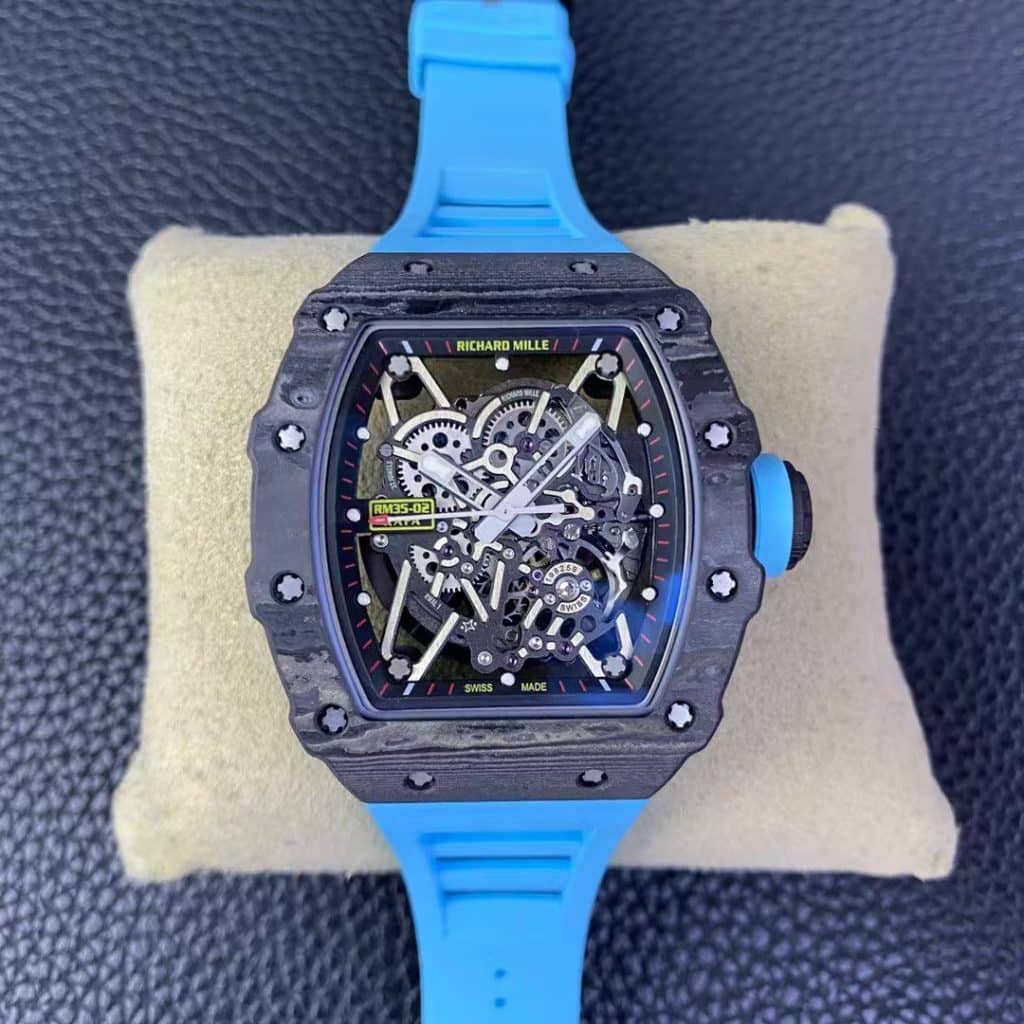
A Richard Mille is recognizable long before you see the logo. The tonneau case bends in more than one direction and tapers toward the strap, which gives the watch its signature stance on the wrist. A good RM super clone watch tries to get that curve right. If the case is too flat or too chunky, the watch loses the look even if the dial is perfect.
Materials are the next part of the equation. Originals use carbon composites, titanium, TPT layers, and ceramics that reflect light in specific ways. A super clone can’t match every recipe, but it can recreate the surface language: carbon-style textures, matte ceramic faces, and the contrast between brushed and polished metal. You won’t mistake the clone for the real thing when you hold them side by side, but across a table or in daily use, the impression lines up surprisingly well.
And then there’s the strap. Richard Mille doesn’t hide behind metal bracelets. A bright rubber or textile strap is part of the identity, and it anchors the whole design. It also makes the watch louder in public. If you want something “office quiet,” this is not it — clone or real.
Skeleton Dials and Layered Movements – Where Clones Try to Impress You
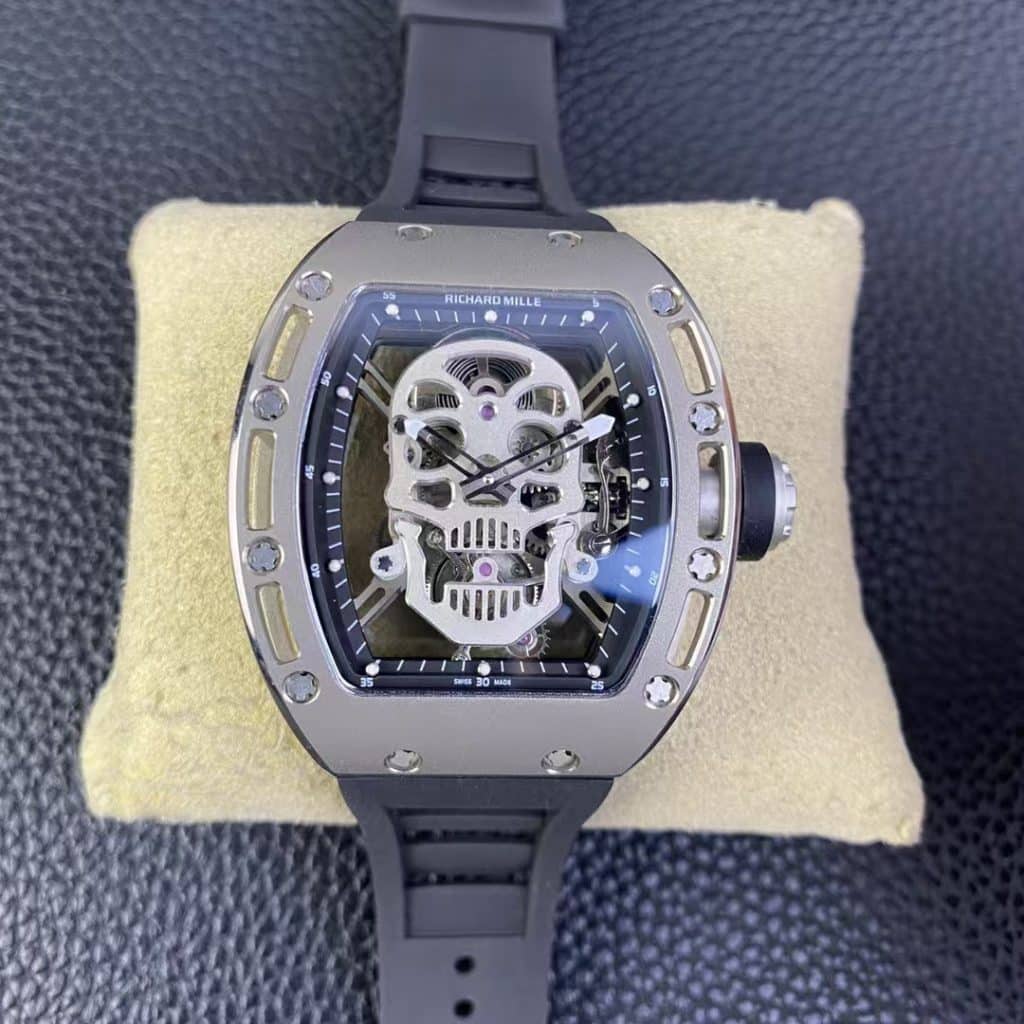
The skeleton dial is the main stage of any RM, and this is where factories put most of their effort. A good China Richard Mille super clone doesn’t simply cut holes in a plate. It stacks bridges, markers, and visible wheels so the watch feels alive when you tilt it under light. You see shadows, reflections, and small moving parts that catch your eye even when you don’t expect it.
Factories know this is what sells the dream, so they invest in visual depth even when the underlying movement is much simpler. Some bridges are decorative. Some wheels spin only for show. Sometimes a “power reserve” indicator is more of a visual meter than a mechanical function. But when the layers align and the geometry looks right, the watch delivers the same thrill that made you search for a skeleton Richard Mille super clone in the first place.
The trick is to judge the front view for what it is: a crafted illusion. Not fake — just designed for the eye, not for a watchmaker’s bench.
Where Super Clones Still Take Shortcuts
Even the best factories draw a line somewhere, and you can see that line if you look closely. Carbon patterns may repeat more than they should. Edges may feel softer or less sharply cut. Screw positions might be off by half a millimeter, which doesn’t matter in daily use but becomes obvious when compared to reference photos.
Turn the watch over and the story continues. Engravings can look slightly deeper or shallower. Font spacing may drift. The bridges visible through the caseback might mimic the architecture of the original but lack the fine finishing that gives the true watch its crisp look. None of these shortcuts ruin the experience on the wrist, but they do remind you this is a super clone — and that honesty makes it easier to decide what matters to you and what doesn’t.
Why “Perfect 1:1” Is More of a Slogan than a Fact
No modern Richard Mille is simple. The cases, the materials, and the movements take years to develop, and they use technology most clone makers don’t have. That’s why “perfect 1:1” lives mostly in product titles, not in real life. A super clone can get close in the areas that define the overall look, but it will always simplify something underneath.
The real question isn’t whether a clone is “perfect.” It’s whether the watch gives you the look, the feel, and the reaction you’re chasing without pushing you into expectations it can’t meet. When you judge it on those terms, buying — or not buying — becomes a much calmer decision.
How Factories Actually Build a Super Clone Richard Mille
When people imagine a China super clone RM being made, they often picture a single hidden factory where a group of experts reverse-engineer every screw of the original. The truth is far more ordinary and far more fragmented. A super clone Richard Mille from China is not the product of one “master workshop.” It is the result of a supply chain — a network of case makers, strap suppliers, movement assemblers, engravers, and finishing shops that each handle a part of the watch. The final piece only comes together at the last stage, where everything is aligned, tested, and packed.
Understanding this reality makes the whole category less mysterious and easier to judge. It also explains why two watches from the “same factory” can look slightly different, why new batches sometimes improve small details, and why delays or shortages happen even when demand is high.
Not One Magic Factory – A Network of Case, Strap, and Movement Suppliers
RM cases are complex. They curve in multiple directions, use several materials, and require tight fitting between the bezel, mid-case, and caseback. Very few workshops can do all of that under one roof. In practice, one supplier handles the case shell, another machines the screws and metal parts, and a third produces the rubber or fabric straps. A separate team builds the skeleton-style dial components. The movement may come from a general-purpose mechanical base, then travel to another shop where decorative plates, bridges, and visible wheels are added.
Only at the end does everything arrive at what people casually call an “RM factory” — which is more of an assembly and quality-check stage than a single creator. This is why the idea of a secret underground super factory doesn’t match reality. The system is closer to how smartphones or sneakers are made: many suppliers working side by side, with the final product depending on how well those pieces fit together.
This also explains price differences. Sometimes the same assembly line will use cases from one supplier for the first batch and another supplier for a later batch. Both are similar but not identical. Someone new to super clone Richard Mille watches might not notice the difference, but an experienced collector will.
Why Richard Mille Super Clones Are Harder Than Super Clone Rolex
Super clone Rolex pieces succeed because the shapes are stable, the movements are enclosed, and the cases are easier to machine with consistency. A China super clone RM faces a different set of challenges. The tonneau curves need precision, or the watch feels too flat or too bulky. The skeleton dial must create depth — not just a single layer of cut-out metal. And the bright straps and colorful components make every small mistake more visible.
The movement adds another layer of difficulty. A Rolex super clone usually hides the movement under a full dial. A Richard Mille exposes it. If a wheel looks fake, if a bridge sits too high, or if a screw angle feels wrong, the illusion breaks immediately. Factories spend most of their time trying to balance visual engineering with the reality of lower-cost mechanical bases. That’s why a good RM super clone is harder to produce, more expensive, and more inconsistent batch-to-batch.
There is much less room for shortcuts. A tiny flaw on a classic diver can hide under a reflection. A flaw on a skeleton RM sits in the center of the watch, staring back at you every time you look down.
Version Numbers, “Upgrades,” and What They Really Mean
Many buyers get excited about version numbers — V2, V3, V4 — as if each new release represents a complete redesign. In reality, these “versions” usually mark small but noticeable adjustments. A case curve might be corrected. A bridge shape might be closer to the original. The carbon texture may be updated. The screws may sit more evenly. Sometimes the upgrade is as simple as improving the print quality on the back engraving.
A version number rarely means the movement architecture changed. Most of the time, the mechanical base remains the same, and the factory adjusts the visual components around it. This is why you shouldn’t choose a watch solely because the title says “V3.” Instead, look at the real photos, check the case shape, compare the depth of the skeleton, and see whether the dial looks clean and balanced. Those details tell you far more than any version label.
Treat version numbers as a roadmap, not a promise. They show direction — not perfection.
Why Production Is Often Limited and Delays Are Common
A super clone Richard Mille from China is never produced in the same volume as steel sports watches. The parts are more complex, the rejection rate is higher, and suppliers often run out of components mid-batch. This means delays — sometimes weeks, sometimes longer. It also means that even popular models may disappear for a while until the supply chain resets.
Factories prioritize models they can make reliably. Low-volume or exotic colorways may take extra time or arrive in inconsistent batches. This is not a sign of dishonesty. It is simply the reality of building a visually complex watch with a fragmented network of suppliers.
If you have ever waited for an RM piece longer than expected, you now know why. It’s not drama. It’s the supply chain breathing in and out.
Movement Reality: Tourbillons, Chronographs, and “Display Only” Functions
Movements are where most people misunderstand super clone Richard Mille watches. The dial is loud, the case is dramatic, and the whole watch feels like a small machine on the wrist — so many first-time buyers assume the mechanics inside must be just as complex. The truth is simpler, and sometimes a little uncomfortable. An RM super clone movement focuses on visual impact first, and mechanical depth second. Some parts are real and functional. Some are semi-functional. Some are purely decorative. Knowing which is which helps you understand what you are actually buying, rather than what a video angle wants you to believe.
Whether you’re looking at an RM tourbillon super clone or a skeleton tourbillon from China, the question is not “Is this identical to the original?” It’s “What part of this movement is real work, and what part is for the eye?” Once you break the watch down that way, the whole category becomes easier — and more honest — to navigate.
The Tourbillon Question – Real, Semi-Real, or Just for Show?
Tourbillons are the part everyone loves to talk about. In videos, you often see a large rotating cage spinning fast at the six o’clock position. It looks dramatic and expensive, and it usually is. A real mechanical tourbillon in a super clone costs far more to make than the rest of the watch combined. These pieces exist, but they are rare, heavy on labor, and priced much higher than standard clones. If someone is offering a “real RM tourbillon super clone” at a bargain, you should pause and ask why.
The second category is the semi-real tourbillon — a modified movement with a spinning module that mimics a tourbillon’s motion without matching the original’s engineering. The rotation is genuine, and the module is mechanically driven, but the architecture is simplified. This option delivers visual excitement without the cost or fragility of a true complication.
The third category is the one most people don’t realize exists: decorative tourbillons. The spinning part turns, but it is not connected to the timekeeping train. It spins for show, not accuracy. Under wrist-level conditions, it still looks impressive, but you should not mistake it for a high-end mechanism. There is nothing wrong with choosing one — as long as you are choosing it knowingly, not because a seller threw the word “tourbillon” into a title.
Chronographs and Pushers – What Actually Works on a Super Clone RM
Chronographs are where expectations often fall apart. On many models, the pushers look functional — they click, they move, and they suggest a deep mechanical system underneath. But the inside reality changes depending on the movement base. Some super clone Richard Mille movements link one or two pushers to simplified mechanisms that create motion on the dial, such as a spinning wheel or a jumping indicator. Others connect the pushers only to decorative modules that create the impression of action without real chronograph timing.
A smaller number of clones use a basic working chronograph, but this often comes with layout differences, since the original RM placement of subdials and hands cannot be perfectly matched with generic movements. This is where careful testing matters. If you press a pusher and nothing happens, or if something moves but does not reset cleanly, you are probably looking at a display-oriented function rather than a mechanical one. You can test most of this in simple ways: observe whether a hand moves smoothly or jumps in wide steps, check if the reset brings the hand back to the exact marker, and compare the layout with reference photos. On a skeleton RM, everything is visible, which makes fakery harder but also makes simplification much easier to spot when you know where to look.
Power Reserve, Daily Accuracy, and What You Should Expect
Even if the dial looks like a spaceship, the beating heart of most RM super clones is a standard mechanical movement — typically Asian automatic calibers in the 21,600–28,800 bph range. They do the job, but they are not miracles. A normal daily accuracy window is +10 to +30 seconds per day. Some run better; some run worse. A few lose consistency after months of use because of dust or lubrication issues.
Power reserve also sits in a normal range. Expect 36–48 hours on most models, though skeleton builds sometimes lose a little stamina because of added visual components. If a seller promises 70–100 hours from a basic clone movement, approach with caution.
The key is to compare expectations. You are not buying the true RM movement with its extreme architecture. You are buying a mechanical engine that supports the look of the watch. Treated with that mindset, the whole experience becomes more grounded and less stressful.
A Simple At-Home Movement Check (Without Opening the Case)
You don’t need tools to judge a super clone movement. A few simple checks tell you more than any sales description.
Winding feel:
Turn the crown slowly. A clean, even resistance usually means the movement is in good shape. A gritty or uneven feel suggests dust or poor assembly.
Time-setting:
Pull the crown and move the hands. They should glide without jumping. If the hands hesitate or wobble, the stem or gear train may be loosely fitted.
Rotor sound:
Gently move the watch side to side. A soft whirr is normal. A loud, metallic rattle can mean the rotor is loose or hitting the case.
Dial behavior:
Look at any rotating elements — tourbillons, wheels, or small indicators. They should spin or move smoothly, not stutter or shake.
These small checks won’t give you the full truth, but they will tell you if the watch you’re holding matches the promises made in the listing. In the world of skeleton tourbillons from China, those few minutes often save you weeks of regret.
Price vs. Risk: What You Usually Get at Different Budget Levels
The first shock for many people is simple: a Richard Mille super clone price is not “entry level” by any standard. You are not shopping in the same range as a basic homage or a simple steel diver. You are looking at a watch that is big, loud, fragile in some ways, and always sitting close to legal and shipping grey zones. When you ask “how much is a super clone RM,” the real question hiding behind it is “how much risk can I carry without losing sleep?”
Most buyers end up somewhere between 200 and over 1,000 dollars. On paper that is just a wider number. In real life, each step up or down changes what you see, what you feel on the wrist, and how much pressure you will live with after the payment leaves your account.
Why Super Clone Richard Mille Is Never a “Cheap Experiment”
There are super clone categories where a cheap experiment makes sense. You buy a simple piece for a couple of hundred dollars, you wear it, and if it fails, it hurts but does not burn. A super clone Richard Mille does not really live in that world. Even at the lowest bracket, the watch is still a big object on your wrist and a big number on your bank statement.
The case is more complex, the skeleton dial needs more parts, and the movement has to carry more decoration. All of that costs money before anyone talks about shipping or risk. If you approach an RM clone with a “let me just try one and see” mindset, you may find yourself stuck between two bad feelings: the fear of losing the watch in transit, and the disappointment if the cheapest option looks and feels far below the image in your head.
That doesn’t mean you must spend the maximum. It means you should treat any RM super clone as a considered purchase, not a casual experiment you forget after a week.
What Changes When You Go from a $300 to a $1,000 Super Clone RM
Imagine three tables in front of you. On the first is a piece around the 200–400 dollar range. On the second, something in the 500–800 zone. On the third, a build that reaches or passes 1,000. All three claim to be a super clone RM. On a screenshot, they might even look similar. In the hand, the story changes.
At the low end, the watch can still deliver that general RM shape and a busy skeleton dial, but the details start to betray the price. The carbon or forged-style case may feel lighter than you expect, with patterns that repeat or look printed rather than layered. The rubber strap may have a strong factory smell and feel stiff around the lugs. The movement runs, but the decoration on the front looks more like a cover plate than a real structure. The packaging is usually basic, sometimes just a generic box and bubble wrap.
Move into the 500–800 range and the improvements become more obvious. The case curves tend to sit better on the wrist. The surface textures show more life under light. The skeleton dial has more layers; bridges cross over each other instead of sitting flat. On some models, the Richard Mille super clone movement receives more care in finishing, so you see fewer rough edges and more consistent screw work. Straps start to feel softer and more tailored to the case shape instead of being “one rubber fits all.” Packaging may still be modest, but the overall impression when you open the parcel is closer to what you see in high-quality review videos.
Once you cross into four digits, you are paying for detail and selection. Some pieces in this tier use better movements, more complex decorative modules, and tighter case tolerances. Carbon patterns look more natural. Edges feel crisp when you run a fingertip along the bezel. Logos, print, and engravings line up more accurately with reference photos. You may also find more specialized builds: skeleton tourbillons, limited color combinations, or cases that mimic very specific RM references rather than “generic RM style.” None of this turns the watch into the real thing, but you can feel where the extra money went when you handle them side by side.
The Hidden Costs – Customs, Seizure, and Fixing Problems Locally
The price you see on the screen is only part of the bill. The rest shows up in places that do not have a “buy now” button. Customs is the first one. Any package that looks like a high-value watch can attract attention. Sometimes it passes. Sometimes it is opened, taxed heavily, delayed for weeks, or simply seized. In those moments, the difference between a 300 dollar watch and a 900 dollar watch is not just quality. It is the size of the knot in your stomach.
Then there is the cost of fixing problems locally. A Richard Mille-shaped case is not something every watchmaker enjoys opening. The screws are different, the gasket layout is unfamiliar, and many professionals simply refuse to touch obvious replicas. Those who do may charge more because it takes longer and carries more risk. A cheap watch that needs a full service or a botched repair very quickly stops being “cheap.”
You also pay in time and energy. Arguing with shipping companies, checking tracking numbers at three in the morning, and trying to explain to a local watchmaker what this piece actually is — all of that has a cost. When you think about how much a super clone RM costs, it is worth adding these parts into your personal equation, not just the number in the seller’s message.
One Simple Budget Rule Before You Decide
A simple rule that has helped many people: if losing the full amount — to customs, to damage, or to a bad batch — would stop you sleeping well for more than a night or two, the level of RM you are considering is probably too aggressive for your current situation.
What Photos and Videos Can and Cannot Tell You About a Super Clone RM
Most people meet a super clone RM through a screen, not in a hand. You scroll, you see a curved case and a busy skeleton dial, and you tap into what looks like a super clone RM video review. Real photos of Richard Mille super clone pieces are useful. They can help you filter out the worst options and spot basic problems before you send money. But they also have clear limits. A camera can show light, angles, and surface details. It cannot show weight, comfort, or the way a movement behaves after six months. Treat photos as a strong first filter, not as a safety guarantee.
When we shoot a watch, our goal is simple: show enough of the reality that you can make a calm decision, even if you still decide not to buy. That means we try to point the lens at the parts that usually fail first on bad clones, not just at the logo or the one flattering angle. The more you learn to read those details, the less you rely on promises in text.
Carbon Patterns, Edge Finishing, and Dial Depth – What We Try to Show
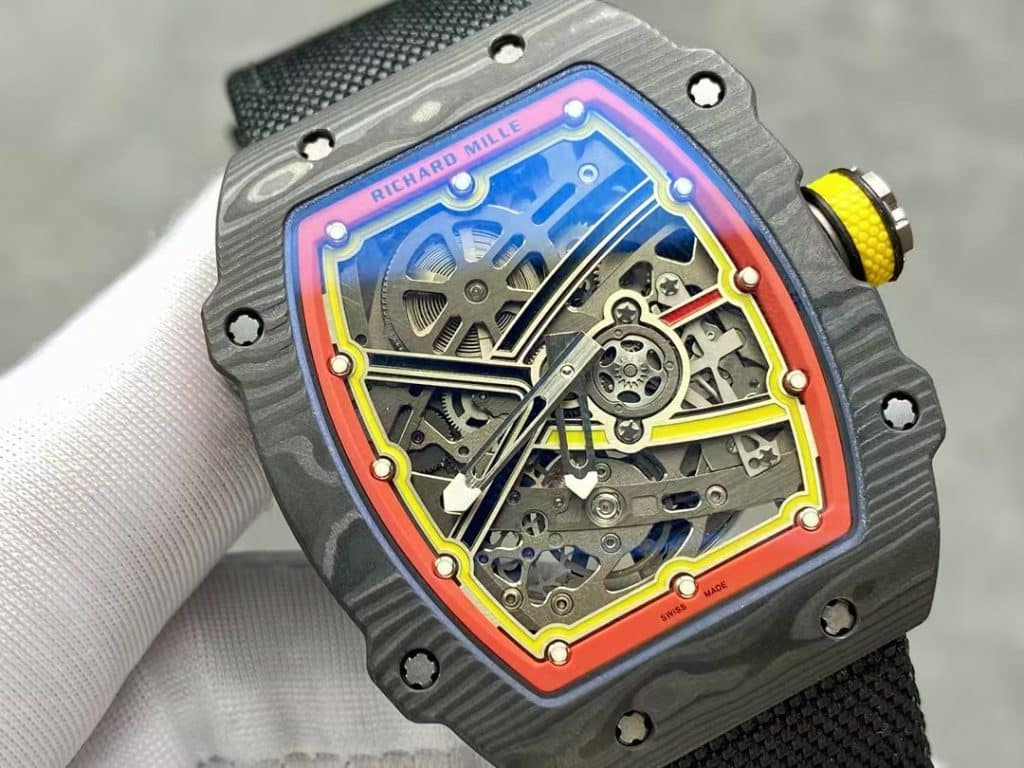
On an RM-shaped watch, the case is the first truth. In our photos we try to hold the watch so the carbon or forged-style material is clear, not blown out by light. You should be able to see how the patterns flow around the curves, whether they look layered or printed, and whether the surface has life when the wrist turns. If every photo hides the case in shadow, you lose one of the main clues about quality.
Edge finishing is the second point. We like to shoot the watch from the side and at a slight angle so you can see the line where the bezel meets the mid-case, the sharpness of the chamfers, and the way the screws sit in their seats. A rough or overly rounded edge may not bother a casual buyer, but someone who has handled several pieces will notice immediately. If a seller claims “top finish” and never shows a close side view, that gap is worth noting.
Dial depth is where most of the drama lives, so real photos of Richard Mille super clone pieces should make that depth obvious. In our shots we tilt the watch so bridges overlap, hands cross over skeleton parts, and light passes through small gaps. This lets you see whether the movement looks like a layered structure or a flat plate with a few cutouts. A good RM clone should look like a small machine, not a printed picture of one.
What the Camera Hides – Weight, Strap Comfort, and Noise
Even the most honest photos cannot tell you everything. A video can show how a skeleton wheel spins, but it cannot tell you how the watch feels after eight hours on your wrist. Weight is the first hidden factor. Some people expect a heavy “luxury” feel and are surprised when a carbon-style RM clone feels light. Others love that low weight but only discover after wearing it that the case sits high and catches on sleeves more than they like.
Strap comfort is another invisible piece. A shot on the table may show color and shape, but not how the rubber hugs your skin on a hot day or how the buckle digs into your wrist when you type. We can film a wrist shot to show how close the case hugs the arm, yet we cannot transmit how the strap smells, softens, or reacts to sweat. Those details only appear after real use, not in a super clone RM video review.
Noise is almost completely hidden. Some movements run quietly with only a soft rotor whisper. Others rattle more than you expect when you move your hand quickly. Photos never show that. Even most videos miss it unless they are recorded in a very quiet room with the microphone close to the case. This is why a watch that looks perfect online can still feel “off” to you in person, even if no one else notices.
Red Flags in RM Super Clone Photos
There are patterns we see over and over again in bad listings. One is the full-template gallery: every model in the store uses exactly the same set of photos with only the color changed in software. The watch might still arrive, but you have no idea which batch you are actually getting. Another is heavy filters. If every shot looks like a fashion ad, with crushed shadows and blown highlights, it becomes impossible to check the carbon pattern, the edge finishing, or the true dial color.
Angles matter too. When a seller only shows straight-on shots from the front, never the side, never the caseback, never a real wrist, it usually means one of two things: either the finishing is weak, or the photos are not of their actual stock. Blurry close-ups are a similar warning sign. Everyone’s hands shake a little, but if every important detail — engraving, screws, small text — is soft and out of focus, that is rarely an accident.
None of these red flags prove a watch is bad. They simply mean you are being asked to trust words instead of evidence. The more money you are sending, the less comfortable that trade should feel.
How We Shoot Our Richard Mille Super Clone Pieces – and Why
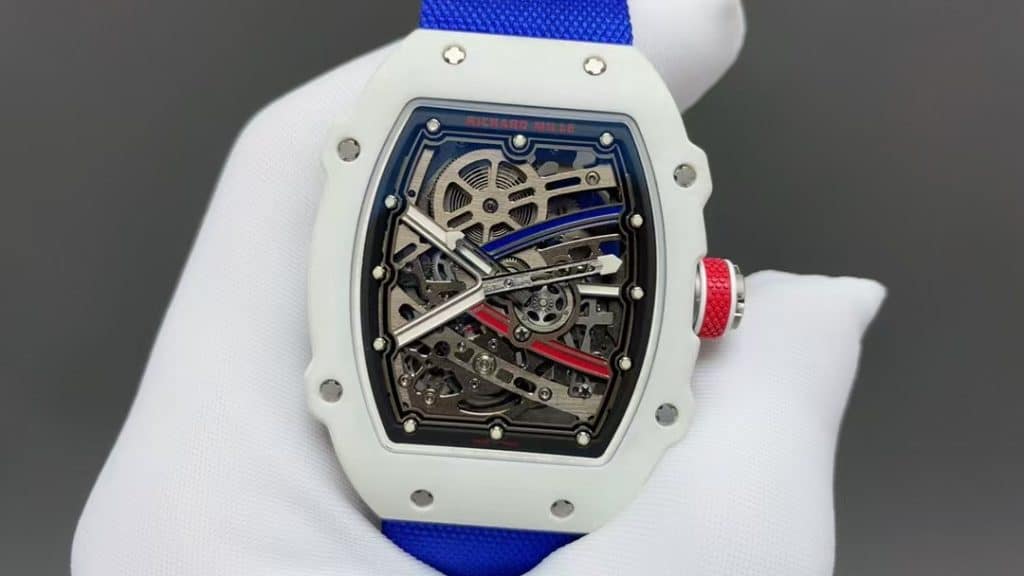
When we shoot an RM-style piece, we try to cover three basic views: full front, honest side, and real wrist. The front shot is for layout and color. The side shot is for case curves and finishing. The wrist shot is for size and presence. We avoid heavy filters because they make it easier to sell a dream and harder to show a watch. Natural light or soft indoor light is usually enough.
For video, we like slow, simple movements. We turn the watch, tilt it, and let the skeleton dial and carbon pattern speak for themselves. If a client asks for a specific angle — a close-up of a tourbillon cage, a macro of the back engraving, or a clear shot of the strap fit — we try to provide that too. The idea is not to prove that a super clone is perfect. It is to give you enough reality on screen that, whatever you decide next, you can say you made the call with open eyes.
Real-World Problems: Comfort, Reactions, Security, and After-Sales
Looking at photos is fun. Wearing a super clone Richard Mille every day is something else. The case is big, the shape is unusual, and the whole watch sends a message whether you like it or not. Daily use RM super clone stories are rarely about “timekeeping only.” They are about sleeves catching on the case, family asking questions at dinner, colleagues staring in meetings, or that small moment of tension when you walk through a quiet street at night. If you imagine the watch on your wrist in real life, not just on your screen, you’ll make a much clearer decision.
How a Super Clone RM Actually Feels on a Normal Wrist
On a flat photo, every wrist looks the same. In real life, many people who try an RM-shaped watch for the first time are surprised by how it sits. The tonneau case curves, but it is still long and tall. On a small or medium wrist, the lugs can reach close to the edges of your arm. When you bend your hand back to type on a laptop, you may feel the case push into the top of your hand. When you wear a jacket, the cuff might never cover the watch fully, no matter how you pull it.
Weight is another quiet factor. Some cases are carbon-style and feel lighter than you expect, which is comfortable but can also make the watch feel less “serious” if you still carry the image of a heavy luxury piece in your head. Others, especially metal-heavy builds, can feel like a small block on one side of your arm. You only notice this after a whole day of wearing a super clone Richard Mille, not during a 10-second wrist shot.
The rubber strap adds its own story. A good strap hugs the wrist without pinching, stays stable when your arm gets warm, and doesn’t leave deep marks after a few hours. A stiff strap can do the opposite: dig into the skin near the buckle, trap sweat on hot days, and squeak a little when you move. Driving, using a computer, carrying bags, opening doors — all those small movements tell you whether your daily use RM super clone is a partner or a constant reminder that there’s a big object hanging off your arm.
Family, Friends, and Colleagues – How People React to an RM on Your Wrist
Watches don’t live alone. They live in families, offices, gyms, and group chats. Some people around you will see an RM-style watch and just say “Wow, that looks cool.” Others will jump straight to “Is that real?” A few will not notice at all, which can be a relief or a disappointment, depending on why you wanted the watch in the first place.
At home, reactions can be sharper. A partner might ask how much you paid, or why you need such a loud piece when bills and real life are still there. Parents or older relatives may worry more about safety than about style. In some circles, an obvious RM shape on the wrist sends a strong money signal, even if you know it’s a super clone. You have to decide in advance whether you want to deal with those conversations or avoid them.
In the office or with clients, it can cut both ways. Some people in creative or sports-related fields love seeing something this bold; it becomes a conversation starter. In more conservative environments, a Richard Mille-style watch can look out of place next to laptops and shirts. A few colleagues might quietly judge. A few might respect the confidence. Many will Google the price of the real one at their desk later. None of that is right or wrong on its own, but it is part of the real-world cost of wearing a super clone Richard Mille instead of something easier to ignore.
After-Sales Reality – What We Can Fix and What We Cannot
No matter how careful you are, watches live hard lives. Straps age, screws back out a little, and dust finds ways into cases over years. Some of these things are easy to fix. Rubber strap replacements, for example, are straightforward. Screws that work themselves slightly loose during shipping or wear can often be tightened with the right tools and a steady hand. Basic movement regulation — making a watch run a bit faster or slower — is also possible when the movement is a common mechanical base.
The harder part is everything beyond that. Complex skeleton decoration is fragile. If a decorative bridge comes loose or a visible wheel gets damaged, repairing it can be more expensive and less predictable than buying a new piece. Serious water damage is even more painful. Many RM super clones are not designed for heavy water use, no matter what a seller writes. A shower or a pool session that goes wrong can mean fogged crystals, rusted parts, and a watch that will never quite be the same.
And then there is the local watchmaker question. Some professionals refuse to touch obvious replicas. Others will work on the basic movement but avoid any promise about decorative modules. If we are honest, there is a clear line: simple things — straps, screws, light adjustments — are very fixable. Deep mechanical or cosmetic surgery on a Richard Mille super clone movement is not guaranteed, and it is something you should think about before you order, not after something breaks.
Security Concerns – When a Watch Becomes a Target
A loud watch can make you happy in a bar, and very uncomfortable in a dark parking lot. The RM silhouette is now strongly linked in many minds with big money, whether the watch is real or not. Most days, nothing happens. Sometimes, in the wrong place, at the wrong time, a watch on your wrist becomes the most valuable object in the area.
Some buyers lean on this logic in a different way. They choose a very convincing super clone — for example, an RMF top-tier Richard Mille clone that can pass as real in a quick street glance — precisely because they do not want to risk wearing a genuine piece. In an extreme situation, if someone demands the watch, handing over a clone is far easier than arguing or resisting. The watch is replaceable. You are not.
We are not here to tell you how to handle crime, and we are not saying a clone is a magic shield. We are simply saying that if you live or travel in places where watch theft is a real concern, the security side of the decision matters as much as the aesthetics. If you ever find yourself thinking “Would I be comfortable giving this up in a worst-case moment?”, your answer to that question will tell you a lot about whether a super clone RM is the right choice for your life right now.
Our Honest View as a China-Based Seller of Super Clone Richard Mille
By this point you already know the theory: case shape, skeleton depth, tourbillons, risks, price. This is where we talk about ourselves for a moment. We are based in China. We make a living in this grey part of the watch world. We like good watches, and we enjoy seeing a strong piece land on the right wrist. But we also see what happens when someone buys a super clone RM with the wrong expectations and then spends weeks stressed, disappointed, or angry.
If you want to buy Richard Mille super clone from China, we would rather you know exactly where we stand. We are not here to promise miracles. We are here to pick workable pieces, say “no” when something feels too unstable, and stay honest when a buyer’s budget or expectations don’t match what the factory can really deliver. Our experience with RM super clone buyers is simple: the most satisfied people are not the ones who chased the loudest promise; they are the ones who walked in with clear eyes about what a clone can and cannot be.
The Kind of Super Clone RM We Are Comfortable Sending Out
There are RM-style builds that look exciting in photos but make us nervous in real life. When we choose what to offer, we start from a boring question: “Can this piece survive real use without turning into a headache in three months?” If the answer feels shaky, we step back, even if the photos are good enough to sell.
We are comfortable with super clone RM pieces where the case shape and dial depth are convincing, the movement is at least based on a known caliber, and the finishing is consistent from batch to batch. That doesn’t mean “perfect.” It means the watch looks right from normal distance, behaves like a decent mechanical piece, and does not rely on fragile tricks just to look dramatic on camera. For extremely wild colors, exotic materials, or complex displays, we will usually add a warning before we agree to supply them. If a model is known for a high return rate, we treat that as a red flag, not as a sales challenge.
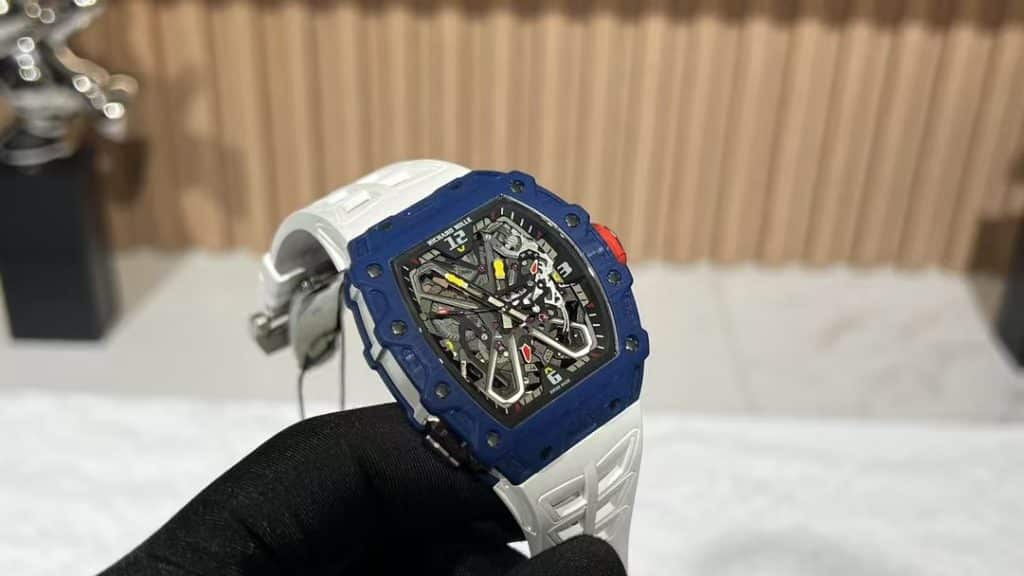
Sometimes this means we pass on a model that could sell fast on social media. We would rather send out a slightly less crazy RM that we have seen behave well on real wrists than a “wow” piece that gives you problems the first time you bump it on a door frame.
When We Suggest You Choose a Different Watch Instead
There are moments when, after a few messages, we realize that an RM super clone is not the right match for someone — at least not right now. If your budget is already stretching to the point where a loss would hurt badly, we will say so. When a buyer tells us they want “zero risk, zero stress, zero problems,” we know that no Richard Mille-shaped watch, real or clone, can meet that standard. In those cases, we often recommend a simpler super clone first, something easier to wear and easier to support.
We also hesitate when someone’s first mechanical watch ever is planned to be a very complex RM with decorative tourbillon, display functions, and a fragile skeleton layout. There is nothing wrong with aiming high. But in our experience, jumping straight into the deep end makes it more likely you will worry about every small sound, every second of time drift, and every mark on the case. Sometimes we suggest starting with a more forgiving model, then coming back to RM once you know how you feel about daily mechanical watch life.
Saying “maybe not this one” is not us rejecting you as a buyer. It is us trying to protect both sides from the kind of sale that looks exciting on day one and becomes a long complaint thread on day thirty.
What We Promise – and What We Never Promise
There are things we are comfortable promising, and there are lines we will not cross. We can promise real photos and videos of the actual style or batch, not catalog images stolen from somewhere else. We can promise that we will point out known weak spots — a stiff strap, a noisy rotor, a decorative tourbillon — before you send money, not after a surprise. We can promise that if there is a clear problem on arrival, we will talk to you like an adult and try to find a fair solution instead of pretending nothing happened.
What we will not promise is just as important. We will never claim that a super clone RM will “definitely” clear customs in every country. That is not in our control, and anyone who says otherwise is telling you what you want to hear, not what you need to hear. We will not say that every detail is 100% identical to the original under a loupe. We know it isn’t, and you deserve to hear that before you buy, not after you compare it with high-resolution macro photos on a forum.
We also won’t promise that your friends, coworkers, or dealers will all believe it is real. Some will. Some won’t. A clone is still a clone, no matter how carefully it is made. Our job is to give you enough reality upfront that, if you decide to go ahead, you can own that choice.
If You Write to Us About an RM Super Clone
When someone messages us about a super clone RM, we don’t start with “pay now.” We start with questions. We usually ask about your wrist size, because that changes how the case will sit and which references make sense. We ask about your budget range, not to push you higher, but to see which level of build quality is realistic without putting you under unhealthy pressure.
We also ask where and how you plan to wear the watch. Daily office use is different from occasional weekend photos. A noisy movement matters more if you work in a quiet room than if you wear the watch mostly in loud social spaces. We sometimes ask how you feel about customs risk in your country, and whether you have owned mechanical watches before.
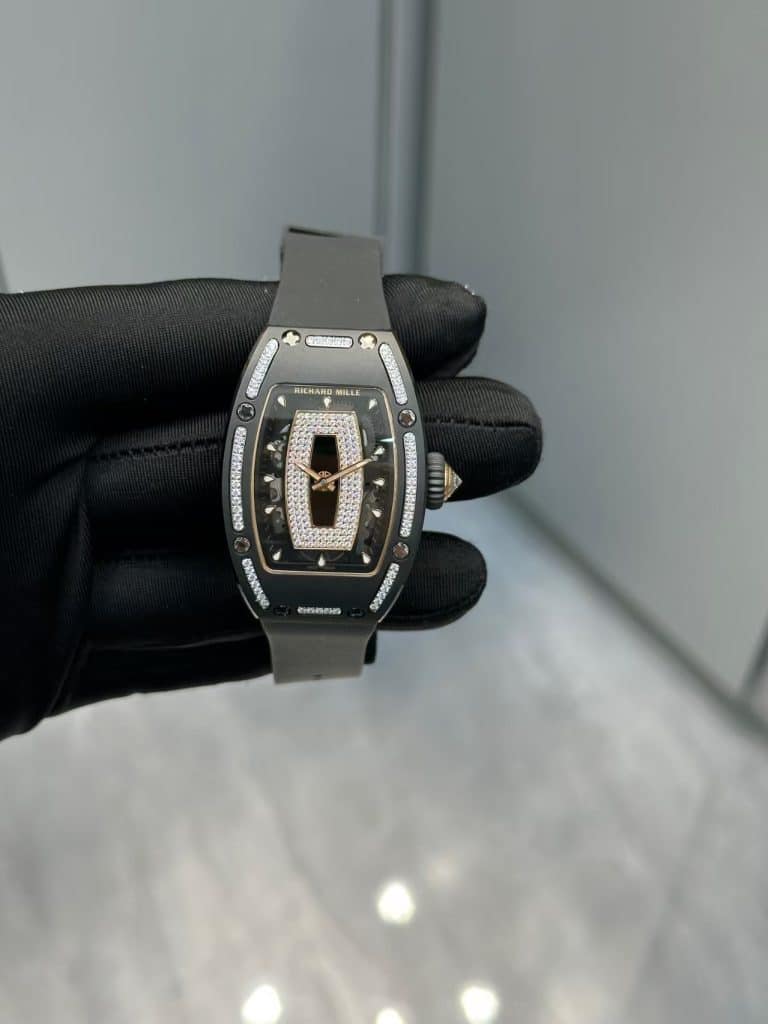
These questions are not a test. They are a filter to see if an RM super clone fits your real life or if another choice would leave you happier. If, after that conversation, you still want to buy Richard Mille super clone from China through us, at least we both know the decision was made with clear expectations on the table — not just with a nice photo and a fast promise.
Richard Mille Super Clone FAQs – Questions People Actually Ask
By now you’ve probably had some of these thoughts yourself — the quiet, slightly nervous ones that don’t always show up in product listings. Here are some of the most common questions people ask us, often after they’ve scrolled for hours, watched every YouTube review, and still feel unsure. These aren’t the polished questions. They’re the ones people actually write to us at 1 a.m. when they’re about to hit “buy.”
Can People Tell That My Richard Mille Is a Super Clone?
Some can. Most won’t. It depends on where you are, who you spend time with, and what kind of attention the watch gets. If you’re wearing a skeleton RM in a small circle where no one knows what the real thing costs, people will likely assume it’s expensive — whether clone or not. In social scenes where fashion moves fast, many people will just see “a cool watch” and move on.
But if you wear it around collectors, serious dealers, or people who handle luxury pieces daily, they may spot small differences: carbon texture, dial depth, printing details, case thickness, or even how the movement ticks. A few might ask directly, others will silently note it. The most important thing is how you feel when those moments happen — proud, nervous, defensive, or calm. That reaction tells you more about whether this watch fits your personality than any technical detail.
Is a Super Clone RM a Bad Idea for a First High-End Watch?
It depends on your reasons. If you’re curious about the RM look and want to see how it feels in real life — how the case sits, how people react, how skeleton dials wear — then yes, a super clone can be a useful first step. You’ll learn a lot about your own taste without risking the price of a car.
But if you expect flawless finishing, rock-solid reliability, and zero stress, then maybe start somewhere simpler. RM super clones are bold, but they come with quirks: strap fit issues, skeleton movement dust, pushers that don’t do much. Some first-time buyers love it. Others get overwhelmed and blame the watch. It’s not “a bad idea,” but it’s not an easy one either. Think about whether you want your first experience with mechanical watches to be something this complex.
How Many Years Can a Super Clone Richard Mille Last If I Wear It Often?
With reasonable care, 1–3 years of regular use is very possible — sometimes more. Most of the common movements inside RM super clones are based on reliable mechanical designs. The problems usually come from decoration layers, dust buildup, or minor parts loosening over time.
Wearing it daily means you’ll need to wipe it down, avoid heavy water exposure (most aren’t truly waterproof), and probably do a basic service or cleaning after a year or two. If you treat the watch gently, store it safely, and accept that it’s a mechanical piece — not a digital tool — it can stay sharp for quite a while. But it’s still a clone, not a sealed luxury tank. Don’t expect it to power through five years of abuse with no help.
What Happens If Customs Stops a Richard Mille Super Clone Package?
There are a few possible outcomes, and we’ve seen all of them. Sometimes the box clears without issue, especially when it’s shipped discreetly and the paperwork is simple. Other times, customs inspects the package, sees that it’s a watch with a “branded” design, and either charges high import fees or holds it for verification.
In stricter countries, especially in Europe or certain Middle Eastern regions, we’ve seen cases where customs seizes the item entirely and notifies the buyer. That doesn’t always mean legal trouble, but it does mean the watch is gone and recovery is unlikely. In a few rare cases, buyers have received warning letters or been asked to explain the import.
We never guarantee clearance. If you choose to buy a Richard Mille super clone from China, you are taking that risk — and we respect you more if you do so knowing what might happen. We do our best to package discreetly, but the final mile is out of our hands.
Will a Super Clone RM Hold Any Resale Value?
Short answer: not really. This is not an investment. It’s a personal item with very limited secondhand demand and no mainstream resale platform. The market is informal, often peer-to-peer, and prices drop quickly the moment a watch is worn or a new “V3” version comes out.
There are buyers who want used super clones at a discount, but they’re usually very price-sensitive and skeptical. You may get back 30–60% of what you paid if the watch is still in good shape, but that’s not guaranteed. Most people who resell do it for closure, not for profit. If you’re thinking resale from day one, this may not be the right type of product for you.
One Thought to Keep in Mind Before You Send a Big Payment
Your Money, Your Wrist, and Your Level of Peace
If you’ve read this far, you already know we are not neutral. We live in this grey corner of the watch world. We talk to factories, we compare batches, we argue about case curves and skeleton depth, and yes — part of our income comes from sending a super clone Richard Mille from China to people who really want that shape on their wrist.
Because of that, we owe you something more than hype.
We’ve seen good stories: someone saves, thinks carefully, orders once, and then wears the watch for years with a quiet smile every time it catches the light. We’ve also seen the other side: people who send money in a rush, don’t think about customs, don’t think about how loud the watch will feel in their city, and then spend weeks refreshing tracking pages and regretting a decision they made in one late-night scroll. The watch itself is always just a watch. You are the one who has to carry the risk, the reaction from people around you, and the feeling in your chest when you check your banking app afterwards. No skeleton case, no flying tourbillon and no bright rubber strap is worth losing your rent money, your savings, or your sleep. So before you send a big payment, ask yourself a few simple questions in a quiet moment: Would I still feel like myself wearing this every day? If something went wrong in shipping, could I recover without panic? Am I buying this because I really want it, or because a photo made me feel I had to prove something?
If, after all of that, you still feel calm, informed, and honest with yourself about a super clone RM, then it’s your wrist and your call. We’ll do our best to show you the reality and not hide the weak points. If instead you feel more pressure than excitement, walking away is also a smart decision. That decision costs nothing, and sometimes it is the clearest sign that you’re actually in control — not the photos, not the sellers, and not the watch.
Learn more about replica Richard Miller
- Richard Mille Replica Factory Guide: VS, APS, Clean & Other RM Super Clone Makers Explained
- Richard Mille Super Clone Models Guide
- Richard Mille China Super Clone: Inside the Guangzhou High-End Replica System
- Richard Mille Super Clone vs Cheap Replica: Full Comparison, Prices & Buyer Guide
- Richard Mille Replica Movements Explained: Skeleton Engineering, Calibers & What Really Matters