
You see a Richard Mille replica for $280. You see another that looks nearly identical for $1,200. A third option pops up at $2,500. For a newcomer, this isn’t a pricing spectrum—it’s a minefield. The instinct is to believe you’re looking at the same product with varying degrees of “quality,” where spending more just gets you finer polishing. That assumption, without considering the hidden risks of replica ownership related to movement noise, case fragility, and long-term serviceability, will lead you straight into disappointment.
With Richard Mille replicas, more than any other brand, your budget doesn’t just buy better finishing; it dictates an entirely different construction philosophy. A $300 watch and a $1,500 watch aren’t different versions of the same thing. They are fundamentally different objects built to solve different problems. One is an RM-shaped object; the other is an attempt at an RM clone. Understanding this distinction—the discrete plateaus of execution, not a smooth curve—is the only way to navigate this market without wasting your money.
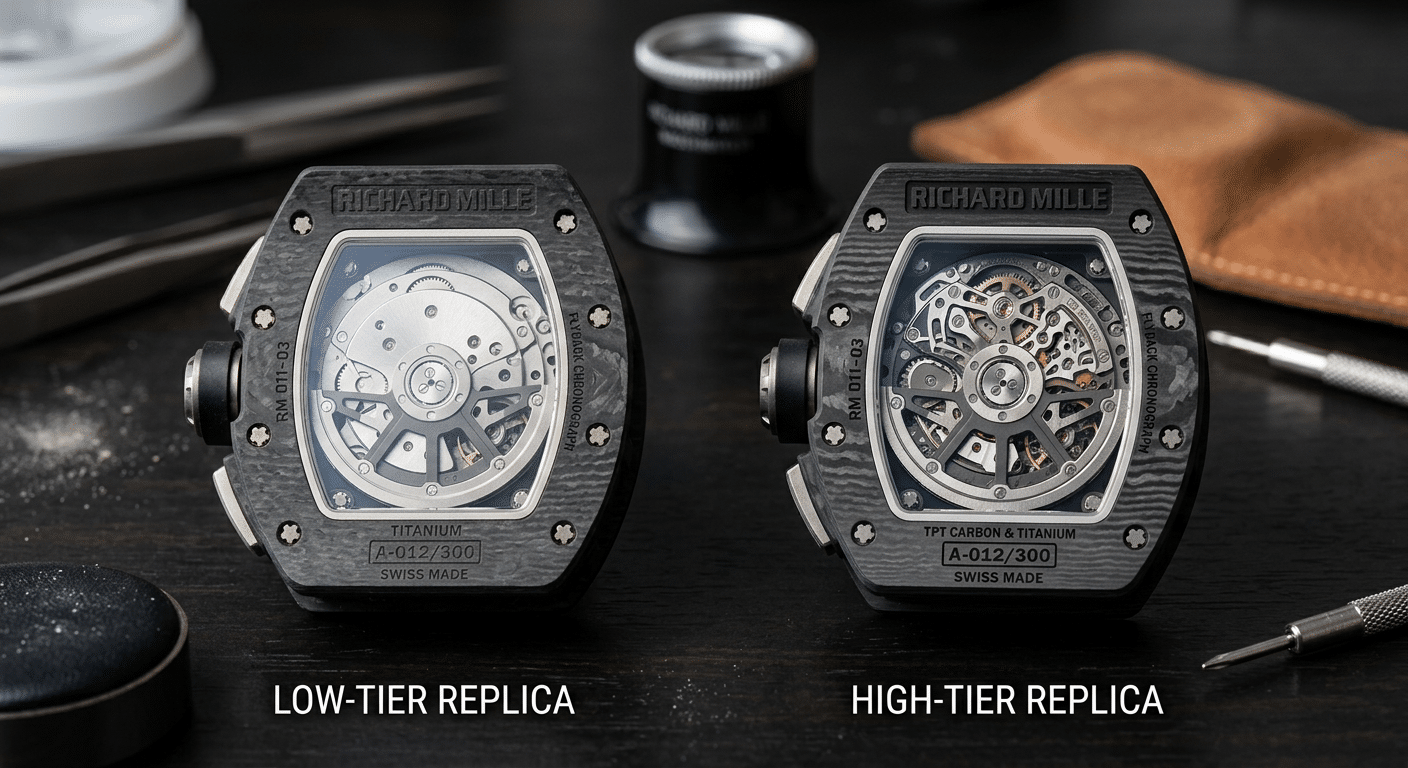
Every single Richard Mille replica, from the $150 DHgate special to the $2,500 custom build, lives or dies by three core elements. Fail at one, and the entire illusion collapses.
1. Case Architecture (The Hard Part): Richard Mille’s tonneau case is an exercise in sculptural, ergonomic engineering. Replicating its specific curvature, the seamless integration of bezel and caseband, and—most critically—its sleek thickness is the single greatest technical hurdle. Get this wrong, and the watch immediately wears like a clumsy toy, no matter what’s inside.
2. Movement Visuals (The Expensive Part): An RM is defined by its skeletonized heart. This isn’t just a display caseback; it’s the entire face of the watch. The cost jump from a printed plastic dial over a blank movement to a fully decorated, functioning gear train is astronomical. This is where the biggest chunk of your money goes as you climb the price ladder.
3. Material Illusion (The Subtle Part): Carbon fiber, ceramic, titanium—these aren’t just marketing terms for RM. They define the watch’s weight, texture, and light play. A cheap “carbon” pattern printed on resin feels and looks like a child’s toy. The pursuit of something that even vaguely approaches the look and heft of the real materials is a slow, expensive grind for replica makers.
The “Budget Determines Philosophy” Rule
This is the cardinal rule. Factories at different price points aren’t doing the same thing, better. They’re doing different things.
At the $250-$500 level, the factory’s goal is simple: create a wristwatch that, from across a room, reads as “Richard Mille.” They use the most cost-effective methods possible—thick, simple cases; printed dials; lightweight alloys. The philosophy is pure silhouette recognition.
Jump to the $600-$900 range, and the goal shifts. Now, the factory is trying to create a functional illusion. The watch must not only look like an RM from a distance but also behave like one up close. Gears must turn, the crystal must be clear, the case must have some heft. The philosophy is about creating a convincing mechanical object.
At $1,200 and above, the philosophy becomes about specific model accuracy. Factories are no longer making a generic “skeleton RM.” They are reverse-engineering a specific reference—the RM 055 or RM 35-02—and investing in custom parts, better base movements, and material R&D to shrink the measurable gaps. The goal is technical mimicry.
Expert Authentication Insight
The single fastest, most universal tell across all budget tiers isn’t the movement or the carbon—it’s the caseback profile and bezel screw alignment. Low-tier reps have a flat, dead caseback with shallow, misaligned screws that look like an afterthought. Mid-tier watches often get the screw spacing and finish right, but the curved profile of the caseback is still too flat. Only at the high-tier do you see a properly sculpted, multi-level caseback with perfectly aligned, deeply seated screws that mirror the genuine article’s architectural integrity. It’s the first place an experienced eye looks.
The $250 – $500 Range: The “RM-Shaped Object”
Let’s be clear: the watches in this bracket exist for one purpose. They are for the buyer who wants the outrageous, geometric look of a Richard Mille on their wrist for the price of a weekend dinner, and who fully accepts that it is a visual prop. This is the realm of the RM-shaped object. It screams “Richard Mille” from ten feet away but whispers “costume jewelry” upon closer inspection. There is a place for this—if you know exactly what you’re getting.
What you’re getting is a product built around fundamental, non-negotiable shortcuts. The goal here isn’t replication; it’s recognition at the lowest possible cost.
Case & Crystal: Where the Illusion Breaks Down First
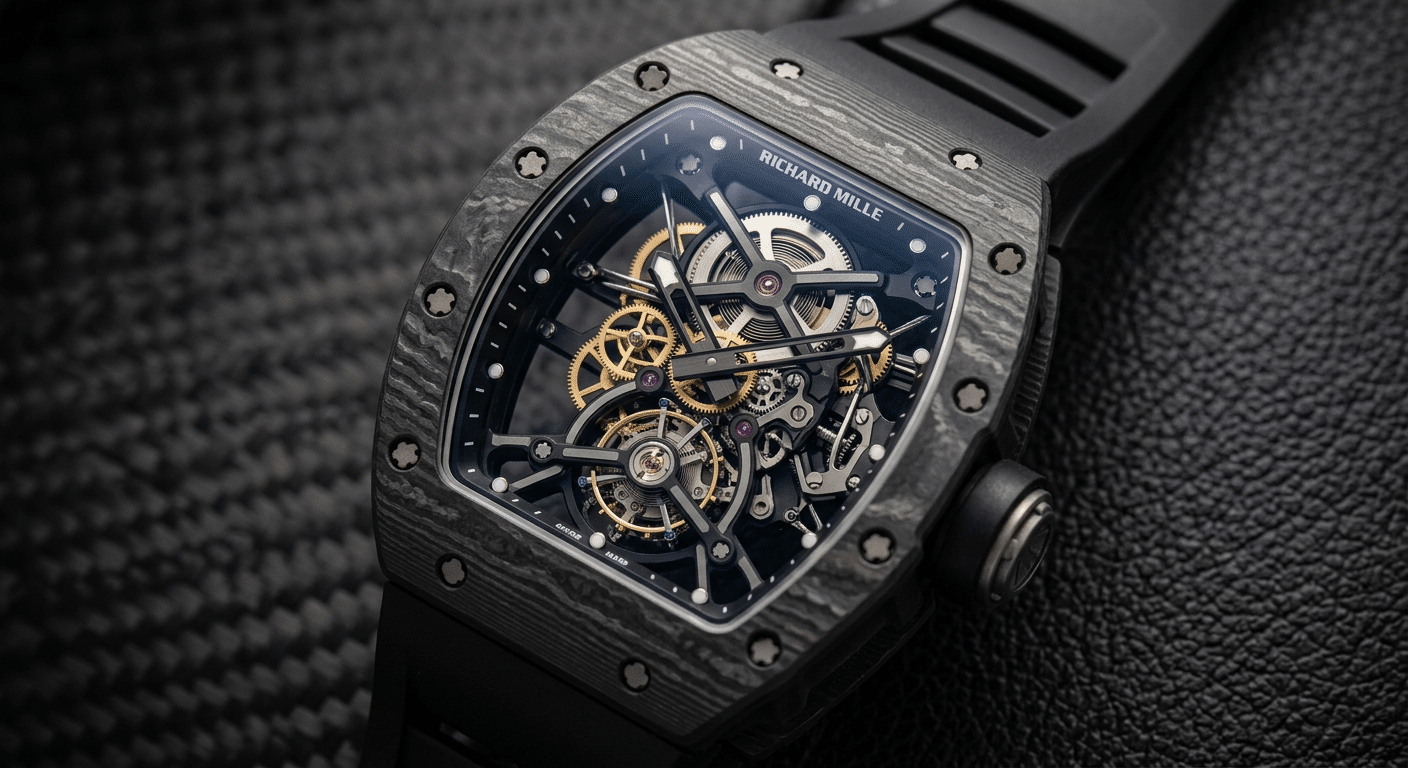
The flaws here are structural, not cosmetic. The case will typically measure between 16mm and 18mm thick—losing the sleek, technical profile that defines a genuine RM and instead wearing like a chunky hockey puck on the wrist. The tonneau shape lacks sharp, defined edges; it’s often a soft, blobby curve. Sitting atop it is a flat, highly reflective mineral crystal that distorts the dial beneath and catches scratches if you look at it sideways. It lacks the virtually invisible clarity and beveled edge of sapphire, creating a visible “window” effect that immediately looks cheap.
The “Skeleton” Facade: Printed Dials and Ghost Movements
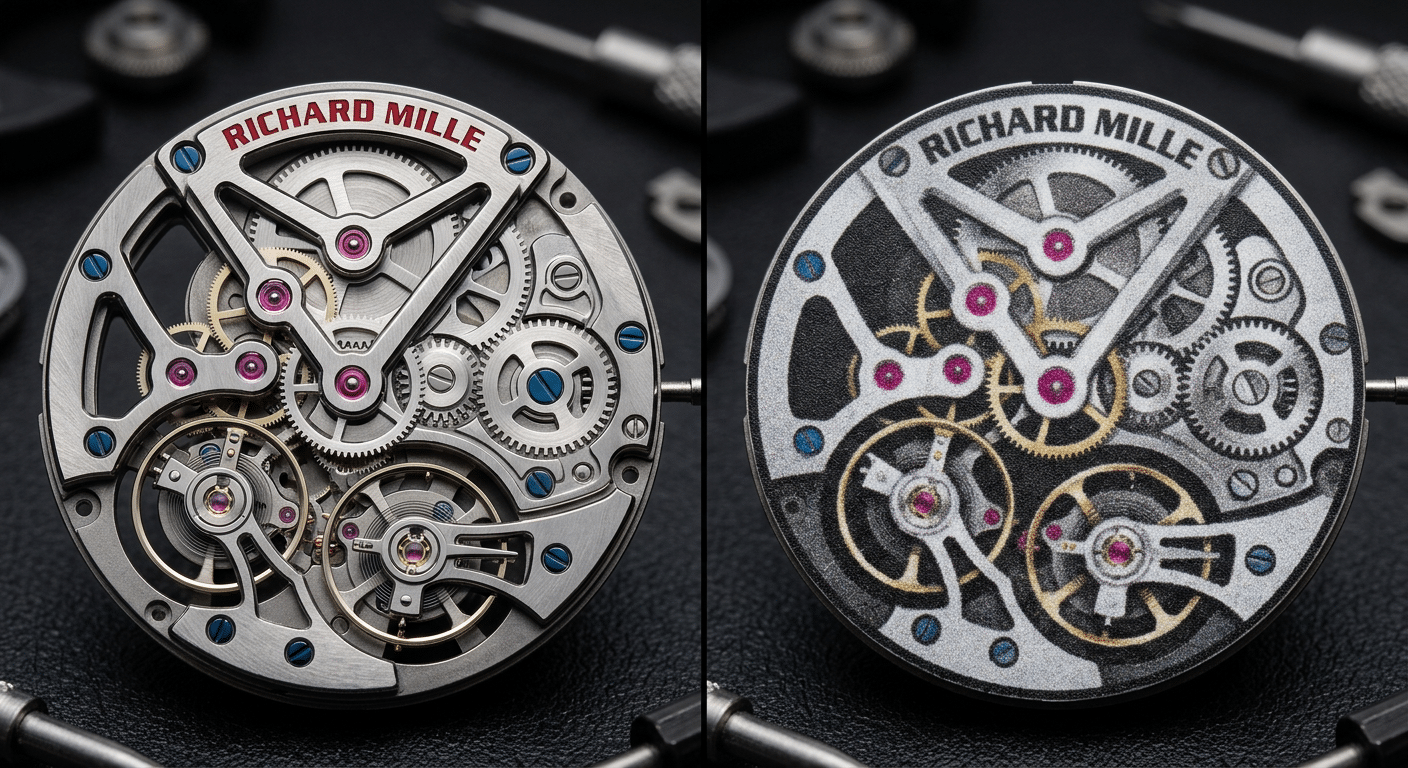
This is the heart of the charade. Open the caseback of a genuine RM, and you see the movement. Open this one, and you’ll likely find a generic, closed-case Chinese automatic movement like a Seagull ST6. The “skeleton” dial you see through the crystal is a single piece of metal or plastic with the gears and bridges printed or etched onto it, a crucial detail highlighted in a comprehensive replica movement reality check. It’s a static image. The second hand may be attached to a real moving post in the center, but it sweeps over a dead, flat landscape. The placement of these printed “barrels” and “gears” is often a fantasy layout, bearing little resemblance to any real RM caliber.
Materials & Strap: The Feel of Cheap
Pick it up. This is the most telling test. The watch will feel suspiciously light and hollow, often because the “carbon” or “ceramic” case is actually a lightweight alloy or even painted resin. The strap is the ultimate giveaway: stiff, plasticky PVC or low-grade rubber that doesn’t drape around the wrist. The buckle is usually a crude, cast piece with sharp edges and a poor finish. Every tactile interaction reinforces its true nature.
Expert Authentication Insight
Weight and Sound. Conduct this simple two-part test. First, weigh it in your hand. A genuine RM, even in ultra-light carbon, has a dense, substantial presence. This will feel like a hollow toy. Second, give it a gentle shake next to your ear. You will almost certainly hear the distinct, gritty rattling of a loose, un-damped rotor spinning freely inside the oversized case. A genuine RM (and a proper high-tier replica) has a quiet, refined mechanical presence. This tier is audibly and palpably cheap.
The $600 – $900 Range: The “Functional Illusion” Tier
This is where the game changes. For the buyer who isn’t just after a look but wants a convincing mechanical object, the $600-$900 bracket is the most critical jump. This is the “Functional Illusion” tier. Your money is no longer buying just a shape; it’s buying the experience of complexity. The watch transitions from a static prop to a dynamic device that mimics the genuine article’s core behavior. For the serious beginner, this is where the journey really begins.
The upgrades here are fundamental and perceptible. This is the minimum entry point for a replica that feels like a watch, not a bracelet with a dial glued on.
The Movement Leap: From Printed Plate to Working Gear Train
The single biggest cost driver here is the movement. Gone is the printed facade. In its place is a real, skeletonized automatic movement—often a decorated Seagull ST2555 or a modified Hangzhou caliber. When you look through the crystal, you see actual gears turning, balance wheels oscillating, and auto-winding rotors spinning. The visual effect is one of believable mechanical busyness.
The critical caveat? While it’s a real movement, the layout is usually generic. The bridges are decorated to look vaguely technical, but they don’t replicate the specific architecture of a genuine RM RMUL2 or CRMA caliber. It’s a convincing “skeleton watch” movement, not a true RM clone. However, the difference from the previous tier is night and day; there’s actual horological life inside the case.
Proportion Correction: Thickness, Case Shape, and Crystal
The case undergoes a significant correction. Thickness often drops into the 14-15mm range, starting to approach the wearability of the genuine article. The tonneau shape becomes sharper and more defined, with better transitions between the bezel, caseband, and caseback. Most importantly, the crystal is almost always upgraded to sapphire with anti-reflective coating. This eliminates the cheap “glass box” look, providing stunning clarity that makes the skeleton dial pop and brings the watch visually into a higher league.
Material Upgrades: Weight, Finish, and Strap Realism
The hollow, toy-like feel disappears. Cases are typically machined from solid stainless steel or use ceramic coatings over a metal base, giving them proper heft. The finish on details like the bezel screws improves dramatically—they’re actually machined and fitted, not just glued-on dots. The strap is the other major upgrade, moving to a softer, more pliable fluororubber or textured rubber that mimics the genuine RM strap’s look and feel far more closely. The buckle is better finished and functions smoothly.
Expert Authentication Insight
Rotor Noise and Beat Rate. The movement is better, but it’s not silent or gen-spec. Two quick checks: First, listen. The rotor may still have an audible, albeit smoother, winding sound. Second, and more telling, observe the seconds hand. Use your phone’s slow-motion video mode. A genuine RM (and a true super clone) beats at 28,800 vibrations per hour (8 ticks per second), creating a very smooth sweep. Most movements in this tier beat at 21,600 vph (6 ticks per second). That slightly jerkier sweep is a dead giveaway under scrutiny, revealing the movement’s more pedestrian origins.
The $1200 – $2000 Range: The “Super Clone” Ascent
Crossing the thousand-dollar threshold changes the entire proposition. You are no longer buying a replica; you are funding targeted research and development. Factories like ZF, APSF, and BBR (while it was active) operate at this level. Their goal shifts from making a generic “Richard Mille-shaped watch” to replicating a specific reference with surgical precision. The price jump from $800 to $1500 is less about a dramatic quality leap and more about buying corrections to the last few, most stubborn flaws. This is the realm of the RM super clone, where the watch is engineered to withstand scrutiny at handshake distance.
Model-Specific Fidelity: Case Dimensions and Materials
This is where the money shows up on your wrist, not just in the movement. A super clone from ZF or APSF gets the case right. For example, a top-tier RM 055 replica will measure within 0.3mm of the genuine’s 13.5mm thickness—a critical achievement that eliminates the “hockey puck” wrist presence of cheaper tiers. The tonneau curve is sharp, not blobby. The materials transform: the “carbon” is now a true multi-layer forged carbon or NTPT-style composite with genuine visual depth, not a printed pattern. Bezels are machined from solid ceramic or complex composites. The watch has heft and density that mimics the genuine article’s feel, often weighing within 10-20 grams of the real thing, a stark contrast to the hollow lightness of a $500 piece.
Movement Mimicry: Beyond Generic Decoration
This is the heart of the ascent. Forget the decorated Seagull movements of the mid-tier. Here, factories use high-beat movements (28,800 vph) like the Miyota 9015 or, crucially, the cloned Dandong RMUL2 calibre. The key is integrated decoration. Instead of slapping a fake plate on top, they fabricate custom bridges and plates that are mounted to the base movement, creating a gear train layout that visually echoes the genuine RM architecture. The balance wheel beats at the correct, smoother 8 ticks per second. While it’s not a true free-sprung variable-inertia balance (a $1500 watch won’t have a $50,000 movement), the visual effect through the sapphire caseback is lightyears ahead of the lower tiers. You’re paying for the illusion of authentic mechanical integrity.
The Details That Separate Good from Great: Buckles, Screws, Gaskets
At this price, the details are no longer afterthoughts. The screw heads on the bezel are properly finished titanium or steel, not painted alloy. The crown tubes are rubber-clad for a more authentic look and feel. The buckle features precise engraving with correct font depth and a spring mechanism that doesn’t feel cheap. Even the gaskets—though you should still never swim with it—are of a higher grade. These are the touches that complete the tactile experience, moving the watch from a visual replica to a holistic object that feels expensive in the hand.
Expert Authentication Insight
Forged Carbon/NTPT Pattern Consistency. On a genuine RM, the layered carbon or NTPT pattern is continuous. It flows seamlessly from the bezel, across the caseband, and onto the caseback as if milled from a single, perfect block. On even the best replicas, there is almost always a slight mismatch in the pattern at the seams where these components meet, a critical detail often highlighted in a comprehensive Richard Mille super clone guide. It’s a microscopic tell, visible only under a loupe or intense scrutiny, but it’s the kind of flaw that exists because achieving perfect, continuous grain alignment across separately machined parts is astronomically difficult and costly. It represents the final 1% of the puzzle.
The reality of this tier is that you are buying a watch that is 95% of the way to genuine in appearance and feel. The remaining 5% encompasses these microscopic tolerances, the exact metallurgy of the screws, and the proprietary movement technology. This is also the tier where “franken” projects become feasible; the build quality is often high enough to accept genuine straps, buckles, or even crystals for those seeking absolute perfection. However, the law of diminishing returns is now in full effect. The jump from $1500 to $2000 often buys marginal improvements in finish or a different colorway, not a fundamental step-change in authenticity.
The $2500+ Niche: Custom Builds, “Fully-Forged,” and the Law of Diminishing Returns
Welcome to the fringe. When your replica budget crests $2500 and pushes toward $5000, you have left the realm of practical buying and entered a niche of obsession, passion projects, and, frequently, diminishing returns. This price bracket is a mix of ultra-rare factory “ultimate editions” and one-off custom builds from independent watchmakers. The value proposition mutates from “accuracy” to “using the best possible components, regardless of cost.” It’s for the collector who views the replica not as a substitute, but as a complex, expensive hobby in itself.
The “Fully-Forged” Carbon Dream (And Reality)
The term “fully-forged” is often used as marketing sizzle. True forged carbon, where carbon fiber sheets are molded under intense heat and pressure, is expensive but not mythical. The reality is that many watches advertised with this label are using high-quality compression-molded carbon, which is excellent, but not fundamentally different from what top-tier factories use. The astronomical cost here isn’t just for the material; it’s for the painstaking, low-volume CNC machining of a solid block of that material into a perfect, one-piece case middle—a process with a high failure rate. You’re paying for exclusivity and theoretical perfection, not a magical material unavailable to ZF or APS.
Custom Movement Projects: Swiss Hearts in Replica Bodies
This is the pinnacle of the replica-as-hobbyist-project. Builders source genuine Swiss ETA 2892 or Sellita SW300 movements—renowned for their reliability and smooth sweep—and then engineer custom plates, bridges, and rotors to make them fit and look like an RM caliber. The pros are real: superior timekeeping, proven durability, and easier servicing. The cons are significant: the movement is often too thick, forcing case dimension compromises. The custom work is expensive and done by individuals, not factories, leading to insane lead times (6-18 months) and zero warranty. And the fundamental irony remains: you’ve spent $3000+ to put a $500 Swiss movement inside a fake watch case. It’s a marvel of engineering, but it’s still not a Richard Mille.
Why This Tier Exists: For Collectors, Not Wearers
Let’s be blunt: if your goal is to wear a convincing Richard Mille, a $1500 super clone from a major factory is 90% as good as a $4000 custom build for 99% of situations. This top tier exists for a different audience: the technical hobbyist who gets more joy from the pursuit and ownership of a “perfect” forgery than from the watch itself. It’s about bragging rights in niche forums, the challenge of the build, and the satisfaction of owning something unique. It is not a rational value proposition. It is horological cosplay at its most expensive and dedicated.
Expert Authentication Insight
The Ultimate Test: Serviceability. A watch in this price bracket should, in theory, be assembled and serviced to genuine standards. Ask any prospective builder for detailed photos of the movement’s gear train before casing, or a service sheet from the watchmaker who assembled it. If they balk or can’t provide it, you are not dealing with a master horologist—you’re dealing with a marketer. This tier is rife with overpromises. The ability to document the build process and component quality is the only real safeguard against paying a fortune for a fancy shell with a standard, unmodified movement inside.
The Practical Buyer’s Framework: Matching Budget to Expectation
Analysis is useless without a decision. Forget vague notions of “quality.” Your budget dictates your experience. Here’s how to match your goals to your wallet, with no sugar-coating.
Profile 1: The “Fashion Statement” Buyer ($300-$500)
Who you are: You want the bold, avant-garde RM look for a party, a photo, or just to see how it feels on your wrist. You have low risk tolerance and high fun expectation.
What you get: An “RM-shaped object.” It’s thick (16-18mm), light, and has a printed skeleton dial over a cheap movement. The carbon is a pattern, not a material.
What you must accept: It will not fool anyone upon closer inspection. The rotor will rattle. It feels like a toy. It’s a visual effect from 10 feet away.
Best for: RM 011 styles from KU Factory. Don’t overthink it; this is disposable fashion.
Profile 2: The “Enthusiast on a Budget” ($600-$900)
Who you are: You appreciate mechanics and details. You want a watch that functions like a luxury item—with a smooth rotor, a clear sapphire crystal, and a case that approximates the correct shape. You’re willing to save for a meaningful upgrade.
What you get: A functioning illusion. A proper decorated automatic movement, a case around 14-15mm thick, real sapphire, and better materials (ceramic, forged carbon). It feels substantial.
What you must ignore: The movement decoration is generic, not model-specific. The caseback engraving is shallow. The beat rate is still 6 ticks/sec, not 8.
Best for: BBR’s ceramic RM 055 or early ZF models. This is the minimum viable product for a convincing daily wear.
Profile 3: The “Perfectionist” ($1200-$2000)
Who you are: You hate obvious tells. You value precision and will notice the 0.5mm difference. You want the watch that gets as close as possible to the genuine article without entering the absurd.
What you get: A super clone. Model-specific accuracy from factories like APSF or ZF. 1:1 case dimensions, high-beat movements, custom-fabricated movement plates, and materials that look and feel authentic.
Why stop here: This is the peak of the mass-production value curve. You get 95% of the genuine appearance and feel. The remaining 5% costs more than the first 95% to chase. This tier is for wearing with confidence.
Best for: APSF RM 35-02, ZF RM 055 NTPT. This is where the smart money stops.
Profile 4: The “Unlimited/Project” Buyer ($2500+)
Who you are: A tinkerer, a hobbyist, or someone with more money than sense. You are not buying a watch to wear; you are funding a technical challenge.
What you get: Theoretically, the absolute best: custom-machined cases, Swiss movements, hand-assembly. In reality, you get a risky project with long waits, no warranty, and no guarantee it’s better than a $1500 APSF.
The frank assessment: This is not for beginners. It is not for value seekers. It is for the 0.1% of the replica community for whom the journey is the point. For everyone else, it’s a fantastic way to burn cash.
Expert Authentication Insight
The “One-Meter Rule” Test. Cut through the specs with this simple metric: At what distance does the watch pass? Tier 1 ($300): 5+ meters (across a room). Tier 2 ($800): 1-2 meters (social conversation). Tier 3 ($1500): Handshake distance. Tier 4 ($3000+): Loupe distance. Your budget buys you a specific radius of believability. Choose accordingly.
The Final Verdict: If you remember one rule from this guide, let it be this. Your entire budget should first be allocated to securing two non-negotiable elements: the correct case thickness and a convincing movement visual. If the watch is 3mm too thick or has a dead, printed dial, no amount of perfect carbon fiber or exquisite strap stitching will save it. These are structural, fundamental flaws. Therefore, aim for the tier where these are solved—the $800+ range. Every dollar you spend beyond that should be viewed as paying for luxury finishing and marginal gains, not core authenticity. Spend to fix the skeleton, then worry about the skin.