
Introduction: The Post-Purchase Reality Check for Richard Mille Replicas
The story usually starts with a video. A dealer’s hand rotates a “super clone” Richard Mille under studio lights, but the nuances of super clone photos and videos reveal what sellers strategically show versus what cameras inherently hide. The carbon fiber dances, the skeletonized gears glint, and the price—$800 instead of $300,000—feels like a secret hack. You pull the trigger. The QC photos look perfect. The tracking number arrives. This is the fantasy.
Then reality lands on your wrist. A week in, you notice it: a faint, gritty whirring sound with every turn of your arm. A month later, a deep, unscuffable scratch appears on the case edge from a casual brush against a doorframe. You need a battery for your smoke alarm, and the only ladder is in the garage; you take the watch off, fearing the dust and shock. The fantasy has curdled into low-grade, persistent anxiety. This is the ownership.
This article isn’t about which factory makes the best RM 35-02. It’s about what happens after you choose one. The replica community obsesses over pre-purchase details—movement decoration, carbon pattern, alignment—but often treats the watch as a static photograph. The real costs, frustrations, and risks are dynamic. They begin the moment the payment clears and compound with every day you wear it. We’re shifting the lens from “how close does it look?” to “what happens when—not if—something goes wrong?”
This is a risk assessment for actual use, because owning a replica of one of the world’s most complex, fragile, and meticulously engineered watches is the ultimate high-wire act of the rep game.
From QC Excitement to Ownership Anxiety
The psychological shift is profound. Pre-purchase, your focus is narrow and optimistic: pixel-peeping QC photos for a crooked ‘5’ or a speck of dust under the crystal. It’s a game of spotting flaws you can reject. Post-purchase, the focus explodes into a diffuse cloud of worries you cannot control. That perfect alignment in the photo doesn’t prevent the rotor from sounding like a coffee grinder. The pristine case finish doesn’t make it any less of a scratch magnet. The initial excitement of “beating the system” is slowly replaced by the quiet tension of living with a known liability.
You stop asking, “Is it perfect?” and start asking, “Is it broken?” “Will it break?” “Can anyone fix it if it does?” This is the core transition from buyer to owner, and for a Richard Mille replica, it’s a rocky road.
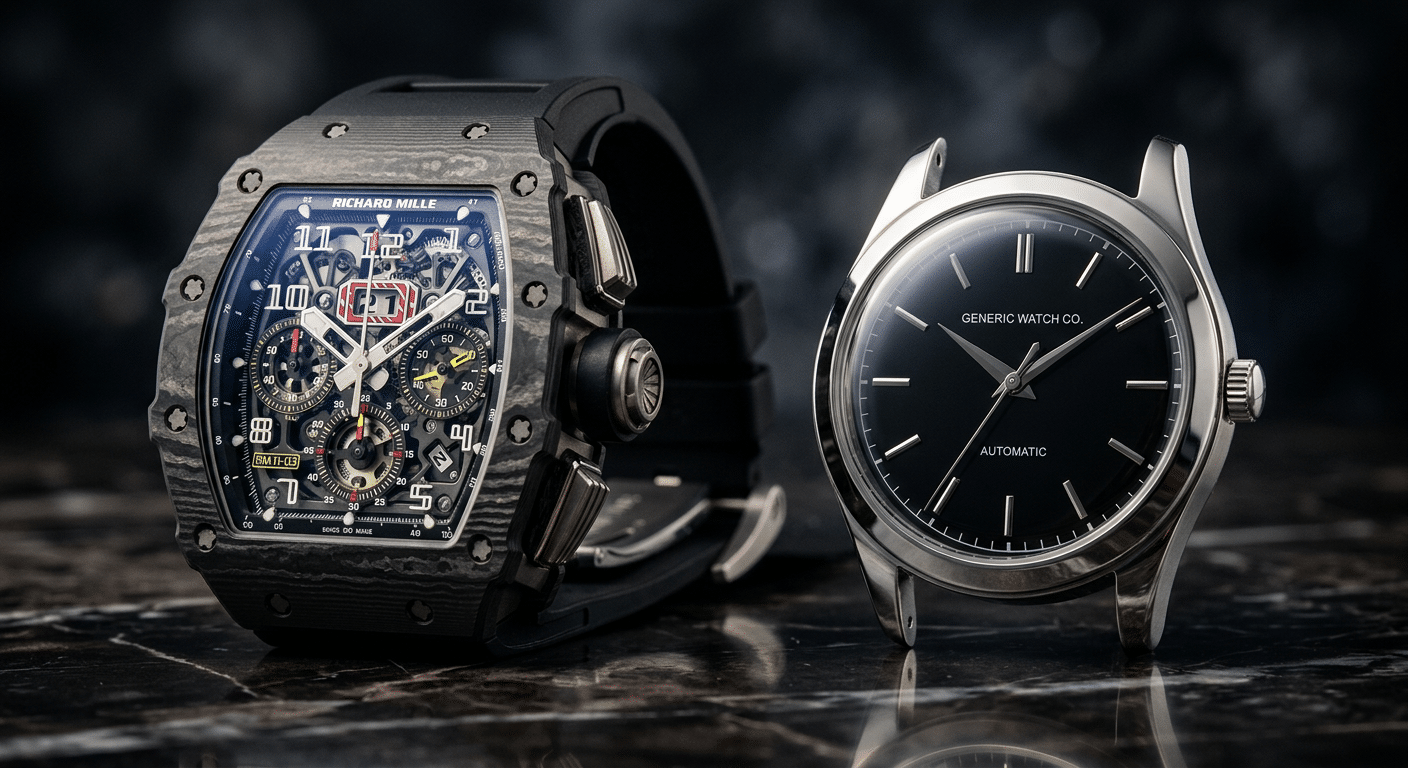
Why RM Designs Are Inherently High-Risk for Replica Ownership
The risk isn’t an accident; it’s baked into the proposition. Genuine Richard Mille watches are feats of material science and micro-engineering, built to be lightweight yet resilient, complex yet reliable. Replicas copy the breathtaking, architectural form but lack the foundational substance. They take a design philosophy predicated on advanced, proprietary materials and extreme precision, and execute it with standard alloys, generic composites, and mass-produced mechanics.
This creates a fundamental mismatch. The replica inherits all the inherent vulnerabilities of the design—the skeletonized movement exposed to dust and shock, the complex tonneau case shape that’s hard to seal and protect, the proprietary strap attachments—but none of the genuine article’s engineered solutions. You’re left with the fragility without the fortification. It’s like building a Formula 1 car’s body out of fiberglass and expecting it to survive a crash. The shape is there, but the crucial integrity is not.
Expert Authentication Insight
A trained watchmaker doesn’t need to open the case to know. The tell is often auditory and tactile. A genuine RM movement, even a base Sellita, has a specific, low-frequency rotor whirl from its high-grade bearings. A replica’s decorated Chinese caliber produces a higher-pitched, often gritty or grinding sound—a signature of lesser machining and lubrication. This isn’t just a “tell”; it’s a symptom. That sound is the audio track of accelerated wear. For any legitimate service center, this immediate sensory red flag, combined with the weight discrepancy (a replica is often 20-40 grams heavier due to brass movements instead of titanium), defines their response: refusal of service. Your repair options are dead on arrival because the machine itself announces its own illegitimacy.
The Customs and Shipping Gauntlet: Your First Unseen Hurdle
Before the watch even touches your wrist, it must run a global obstacle course where it is contraband. The journey from a Guangzhou warehouse to your doorstep is the first and one of the most financially perilous phases of ownership.
Seizure is a Total Loss, Not a Delay
Let’s be brutally clear: if customs intercepts your package, that money is gone. Trusted Dealers (TDs) typically operate on a “seizure replacement” policy, not a refund policy. If a package is lost or damaged in transit, they might resend. If it is seized by customs as counterfeit goods, you absorb the total loss. The TD has fulfilled their part by shipping; the legal risk of importing counterfeit items is yours. This isn’t a hypothetical. In 2024 alone, U.S. Customs and Border Protection seized 11 fake Richard Mille watches in one shipment with a stated MSRP of $8.8 million. For you, the loss isn’t the fantasy valuation; it’s the $800 you actually paid, vanishing into a government evidence locker.
Triangle Shipping: More Hands, More Risk of Hidden Damage
To mitigate seizure risk, TDs use triangle shipping: your watch goes from China to a “friendly” country (often in the EU or UK), then is re-packaged and shipped to you with new, “clean” paperwork. This adds weeks to delivery time and, critically, adds more handling points. Each transfer is a chance for the package to be thrown, crushed, or exposed to moisture. The delicate, multi-part case of an RM replica—with its large sapphire crystals and often poorly fitted bezels—is particularly vulnerable to shock during these opaque middle legs of the journey. A hidden crack in the caseback or a misaligned bezel from a drop might not be visible in final delivery photos, only revealing itself later.

Inadequate Packaging for a Fragile Case Design
Replica packaging has improved, but it’s designed for standard round watches. The Richard Mille’s tonneau (barrel) shape is its Achilles’ heel in transit. Its elongated, curved geometry doesn’t sit securely in standard foam cutouts, allowing it to shift and rock during rough handling. The large, often flat sapphire crystal is a massive target for direct impact. Even well-padded boxes can’t fully counteract the physics of a 50mm-long, irregularly shaped object being tossed in a mail bag. The complex construction—a bezel, caseband, and back held together by multiple screws—can be subtly compromised by a sharp impact, leading to poor water resistance or misalignment that wasn’t present in QC.
Expert Authentication Insight
Customs profiling isn’t just about opening boxes. Officials are trained to spot discrepancies in declared value, weight, and shipping patterns. A package declared as a “$25 wristwatch” that weighs 120 grams might pass. That same package declaring “$25” but weighing 150+ grams (because the replica uses a heavier brass movement and steel components instead of titanium) raises a flag. The declared material on the CN22 form (“stainless steel”) won’t match the heft of a genuine RM’s carbon composite and titanium. This weight-based profiling can trigger an inspection before anyone even looks at the watch, turning your first unseen hurdle into a hard stop.
The Unrepairable Machine: Why Local Watchmakers Say “No”
This is the single most sobering reality of owning a complex replica: when it breaks, it is very likely beyond economic repair. The common, comforting thought—”I’ll just take it to a local watchmaker”—is a fantasy for Richard Mille replicas.
The “No Replicas” Policy is the Norm, Not the Exception
Ask any established, reputable watchmaker if they work on replicas, and the answer is almost universally “no.” The reasons are threefold: liability, ethics, and practicality. First, liability: if they damage your counterfeit watch during service, the legal ground for recourse is murky at best. Second, ethics: most craftsmen want no part in the counterfeit trade. Third, and most pragmatically, it’s often a waste of their time. They know the movements are poorly constructed and likely to fail again quickly. Your broken RM rep isn’t an interesting challenge; it’s a potential headache that pays very little for the risk involved.
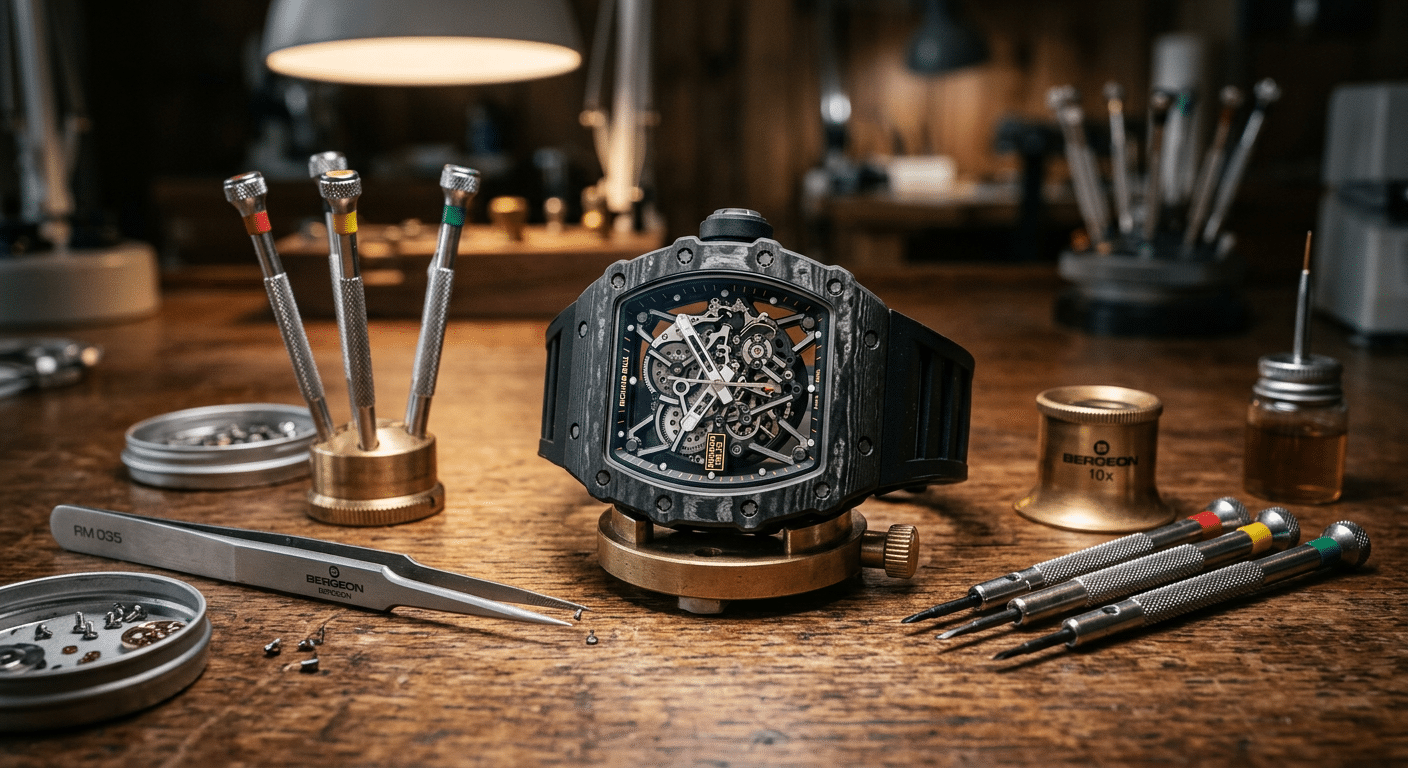
Specialized Tools and Missing Technical Diagrams
Richard Mille’s architecture is proprietary. The movement is suspended within the case on elastomer shock absorbers, not fixed to a case ring. The case itself is a multi-part sandwich held by specialized spline screws. A standard watchmaker’s toolkit doesn’t include the bespoke holders, case openers, or screwdrivers needed to disassemble it without causing damage. Even if a watchmaker were willing, without the technical service manuals (which replica factories absolutely do not have), they are working blind. One wrong turn can turn a broken crown into a shattered movement bridge.
The Spare Parts Black Hole: From Broken Crown to Paperweight
Let’s say you find a brave or indifferent watchmaker. The next question is: with what parts will they fix it? Replica factories do not sell spare parts. A broken crown, a chipped crystal, a damaged hand, or a worn gear is a terminal diagnosis. There is no official parts catalog, no supplier, no inventory. Your only hope is to find an identical “donor” watch from the same factory and batch for parts—a nearly impossible scavenger hunt that will likely cost as much as a new replica. For all practical purposes, these watches are disposable. A malfunction isn’t a repair bill; it’s a trigger to buy a whole new watch, a reality starkly illustrated in the Richard Mille super clone price guide for beginners which breaks down what you truly get at different price tiers. This disposability underscores the critical importance of understanding movement construction and service intervals before purchase.
Expert Authentication Insight
The instant a watchmaker opens the caseback, the game is over. A genuine RM movement uses grade 5 titanium bridges, finished with specific granular satinage and anglage. A replica uses brass or plated base metal with stamped, often sharp-edged finishing. The escapement is the dead giveaway: a genuine RM uses a free-sprung, variable-inertia balance wheel (visible as tiny, adjustable gold weights around the rim). Every mainstream replica, until the very latest 2025 prototypes, uses a standard, indexed regulator lever—a crude, stamped piece of metal next to the balance wheel. This isn’t a minor detail; it’s the fundamental heart of the timekeeping system. Seeing it, a watchmaker knows they’re looking at a poorly constructed counterfeit with no service history, no parts availability, and a high likelihood of repeated failure. The most rational business decision is to close the case and hand it back.
The Symphony of Flaws: Rotor Noise, Winding Issues, and Movement Anxiety
The first time you shake a Richard Mille replica, you’ll hear it. It’s not the subtle, metallic whisper of a high-end Swiss movement. It’s a sound that cuts through the initial excitement of unboxing—a gritty, grinding whirr that feels less like precision engineering and more like a small appliance protesting its existence. This is your introduction to the most common and psychologically grating flaw of RM replica ownership: a loud, unreliable movement that turns a luxury object into a source of constant, low-grade anxiety.
Decoding the Sound: From “Quiet Whir” to “Grinding Gears”
The noise isn’t uniform; it’s a spectrum of disappointment. At its “best,” it’s a persistent, high-frequency whirring, like a distant dental drill. At its worst, it’s a gravelly, uneven grind that suggests metal-on-metal contact without sufficient lubrication. This auditory signature comes from the heart of the watch: a decorated Chinese automatic movement, often based on a Seagull or Hangzhou caliber, masquerading as a Richard Mille RMUL2. The culprits are lower-grade nickel-plated brass bearings, less precise machining tolerances, and factory lubricants that are inadequate or improperly applied. Unlike the genuine article, where the rotor spins on advanced ceramic ball bearings in near-silence, the replica rotor often feels like it’s fighting its own mechanism.
Rotor Noise as a Predictor of Future Failure
This sound isn’t just an annoyance; it’s a diagnostic tool. That gritty whir is the audible symptom of accelerated wear. Each rotation with that level of friction degrades the bearing surfaces and strains the reversing wheels in the automatic winding module. What starts as a noise can evolve into a winding efficiency problem, where the rotor fails to translate wrist motion into sufficient mainspring tension. In many cases, this noise is the precursor to a complete rotor seizure—a sudden, expensive silence that means a trip to the (likely unwilling) watchmaker.
Expert Authentication Insight
A genuine Richard Mille movement, even the base Sellita-derived calibers, produces a specific, low-frequency, almost dampened rotor sound due to high-precision machining, grade 5 titanium components, and quality lubricants. The replica’s distinctive higher-pitched, gritty noise is an instant tell in a quiet room. For an expert, it’s not just a sign of inauthenticity; it’s a clear indicator of inferior materials and assembly that directly forecasts a shortened service life and potential mechanical failure.
The Winding Inefficiency Loop: Why It Stops Overnight
The logical conclusion of a noisy, inefficient rotor is a watch that can’t keep itself running. You’ll experience this as the watch consistently stopping overnight, even after a full day of wear. The movement stops overnight not because the power reserve is magically short, but because the automatic winding system is failing to bank enough energy during daily activity. This forces you into a manual winding routine for a watch that’s supposed to be self-sufficient. Each manual wind on a replica movement also places stress on its less robust stem and crown gear teeth, introducing another potential point of failure. It creates a cycle of anxiety: you’re either listening to the noise or checking to see if the watch is still ticking.
A Scratch Magnet: The Case, Crystal, and Finish Vulnerability
You buy a Richard Mille for its audacious, architectural presence. But on a replica, that same bold design becomes a liability. The complex, multi-faceted case and large crystal aren’t just aesthetic statements; they’re expansive, unprotected canvases for scratches and dings. Where a genuine RM uses advanced materials engineered for resilience, the replica substitutes looks for substance, resulting in a piece that shows wear not with patina, but with glaring damage.
Soft Materials: The Reality Behind the “Carbon” Look
This is where the material fantasy collapses. A genuine RM case might be milled from NTPT carbon, a proprietary composite with exceptional hardness, or aerospace-grade ceramic. The replica “carbon” is often a forged carbon composite or, in worse cases, a hydrographic print or coating over a soft metal base like aluminum or cheap steel. The “ceramic” might be a PVD coating. These surfaces lack the intrinsic hardness of their genuine counterparts. A genuine ceramic RM can resist desk-diving scratches that will leave permanent silver streaks on a replica’s coated case within a week. The replica scratches easily because it’s wearing a costume, not armor.
Why the RM Case Design is a Scratch Trap
The tonneau shape is a scratch magnet by geometry. Its broad, curved surfaces and sharp, angular transitions (like the iconic “wing” lugs) present more prominent edges and planes to catch on doorframes, desks, and other watches. There’s no bezel to take the first hit. Every surface is a top surface. Furthermore, the large, flat sapphire crystal—often with a subpar anti-reflective coating that scratches more easily than the crystal itself—dominates the front of the watch, inviting hairline marks that catch the light and obscure the dial.
The Point of No Return: Why You Can’t Polish It Out
On a stainless steel watch, light scratches can be polished away. On a replica Richard Mille, you have no such recourse. Polishing a matte PVD or “carbon” coating will simply remove the coating, revealing the shiny base metal underneath and creating a glaring, irreversible flaw. You cannot buff out a scratch on ceramic—replica or genuine—but on a replica, the damage is more likely to be a chip or deep gouge due to the inferior material integrity. The first major scratch isn’t a mark of character; it’s the moment the watch’s illusion of luxury permanently cracks.
Expert Authentication Insight
Genuine Richard Mille case materials have distinct, consistent textures and exceptional scratch resistance for their category. A replica’s finish failure is a key tell. A “carbon” pattern that scratches to reveal a different-colored metal underneath is an instant giveaway. Even under casual inspection, the way light reflects off a network of fine scratches on a coated surface, versus the way it interacts with a hard, monolithic material like true ceramic or NTPT, is visibly different to a trained eye.
The Perishing Point: Strap Quality and the Replacement Nightmare
If the movement is the heart and the case is the body, the strap is the watch’s point of contact with the real world. And it’s here, on your wrist, where the replica experience often falls apart most tangibly. The strap is a consumable item, and on a Richard Mille replica, it’s often the first component to perish—leaving you with an unwearable watch and a sourcing puzzle with no good solution.
Stock Strap Reality: Stiff, Smelly, and Short-Lived
The strap that arrives with the watch sets a low bar. Typical replica RM straps are made from low-grade, often overly stiff rubber or fluoroelastomer that doesn’t conform to the wrist. They can have a strong chemical odor that takes weeks to fade. The molded edges are often rough, and the buckle or clasp feels lightweight and insubstantial. Within 6 to 12 months of regular wear, these materials begin to harden, crack, or tear, especially at the stress points where the strap meets the case or buckle. This isn’t a maybe; it’s a replica strap quality certainty.
The Proprietary Lug System: A Replica Weak Point
The problem is compounded by Richard Mille’s unique, integrated strap attachment system. Genuine straps click seamlessly into the case with a specific curvature and secure, spring-loaded mechanisms. Replicas attempt to copy this, but the execution is frequently flawed. The spring bars are weaker, the tolerances are looser, and the fit is not flush. This can lead to an annoying gap between strap and case, or worse, a feeling of precarious attachment. A failed spring bar in a standard watch is a cheap fix; in a replica RM, it can mean the watch falling from your wrist or becoming completely unwearable until you find a compatible part.
The Replacement Desert: No Good Options
When the stock strap fails, you enter the Richard Mille strap replacement desert. Your options are bleak. Generic aftermarket straps almost never fit the unique, curved lugs correctly. The few specialty makers who produce “for RM” straps charge a premium, and even then, fitment on a replica case is not guaranteed due to the subtle dimensional variances. Purchasing a genuine Richard Mille strap is a financial non-starter, often costing several times the price of the entire replica watch, and it may not physically fit the replica’s case geometry. You’re left scavenging forums, hoping a dealer can source another sub-par OEM strap, or attempting a frustrating DIY modification.
Expert Authentication Insight
The strap integration is a major point of examination. Genuine RM straps have a precise, engineered curvature and thickness that creates a seamless, gapless transition from case to band. The attachment system is robust and discreet. On a replica, poor fit is immediately visible—a gap between the strap end and the case is a dead giveaway. Upon removal, flimsy spring bars and imprecise lug holes reveal the cost-cutting behind the scenes. This isn’t just an aesthetic flaw; it’s a safety compromise that no genuine watch would ever exhibit.
Not Built for Daily Abuse: Complexity as the Enemy of Reliability
We’ve dissected the individual risks—customs, repairs, noise, and scratches. Now, it’s time to confront the foundational truth that binds them all: the very design that makes a Richard Mille so visually arresting makes its replica incarnation inherently, structurally fragile. A comprehensive Richard Mille super clone guide would detail this fundamental mismatch between the sporty, aggressive appearance and the delicate, fair-weather reality. You’re not buying a watch; you’re adopting a high-maintenance artifact.
This isn’t about a single flaw you might avoid. It’s about the core engineering principle you cannot escape. A replica Submariner or Royal Oak Offshore borrows a design language built for robustness. A replica RM borrows a design language built on the razor’s edge of material science, then executes it with far weaker materials. The result is a fragile replica watch posing as a tank.
Skeletonized Weakness: Less Metal, More Fragility
Think of a watch case as a chassis. A traditional watch has a solid, monocoque-like structure surrounding the movement, absorbing and distributing impact. A Richard Mille’s skeletonized design removes vast swathes of that protective material. In a genuine RM, this is compensated for by using aerospace-grade, milled-from-solid composites like NTPT carbon and grade 5 titanium—materials with exceptional strength-to-weight ratios.
The replica uses forged carbon composites or coated metals that are, simply put, not in the same league. The complex, multi-part tonneau case construction—with its numerous screws, plates, and gaskets—becomes a liability when executed to lower tolerances with softer materials. Where the genuine watch is a feat of engineering, the replica is a feat of mimicry. The skeletonized architecture, meant to showcase technical prowess, instead exposes the movement to threats it was never built to withstand.
An Open Invitation to Dust, Moisture, and Shock
That stunning openworked dial is a vulnerability. On a genuine RM, the sapphire crystal is treated, the gaskets are precision-engineered, and the movement is fortified. On a replica, it’s a giant window for trouble.
Dust and lint find a permanent home on the movement plates and between gears. A light splash or humid day poses a real threat, as the complex case shape and myriad entry points make proper water resistance nearly impossible to achieve at the replica level. Most critically, a direct impact to the crystal has nothing to stop it from transferring force directly to the delicate, exposed hands and balance wheel. Unlike a watch with a solid dial that might just get a scratch, an RM replica can suffer a catastrophic internal failure from a single, unlucky knock against a doorframe.
Expert Authentication Insight
The ultimate test of a watch’s construction is not how it looks in a box, but how it handles the real world. A genuine Richard Mille, while visually complex, is engineered to specific shock and stress tolerances, often certified to withstand thousands of g-forces. A replica copies the form but lacks the material science and engineering rigor. An expert doesn’t just spot the visual tells; they understand that the same design, built with different materials and to different standards, is profoundly weaker. The fragility isn’t a bug; it’s a baked-in feature of the replica proposition.
The “Desk Diver” Paradox: Sporty Look, Fragile Reality
This creates the central paradox of Richard Mille daily wear. The watch screams performance, adventure, and athleticism—it’s worn by champion tennis players and race car drivers. Yet, owning a replica version demands the opposite lifestyle: a cautious, gentle, “desk-diver only” existence.
You must be hyper-aware of your surroundings. Reaching into a crowded bag, bumping into a colleague, or even vigorous hand gestures become moments of minor anxiety. The bold, in-your-face aesthetic is constantly at odds with the need to treat the watch like a piece of delicate glassware. If your vision of ownership involves forgetting the watch is on your wrist, an RM replica is a profoundly poor fit. It will remind you of its presence through its noise, its need for careful handling, and the constant background risk of a costly, unrepairable failure.
The Verdict: Who Should (and Shouldn’t) Consider an RM Replica
So, should you buy an RM replica? The answer isn’t about the watch alone; it’s about you. After dissecting the customs gauntlet, the repair dead-ends, the mechanical chorus of flaws, the cosmetic fragility, and the inherent structural vulnerability, the decision crystallizes into a question of personal risk tolerance and intention. This isn’t a generic wristwatch; it’s a high-stakes proposition that neatly divides buyers into two camps.
The Profile of the “Successful” RM Replica Owner
This buyer understands the transaction perfectly. They view the replica not as a substitute for a genuine RM, but as a complex, fascinating display piece or a short-term experience. They accept the total cost of ownership: the initial $800, the ever-present risk of seizure, the certainty of cosmetic wear, the high probability of mechanical failure, and the near-total lack of repair options. For them, the value is in the aesthetic thrill and the technical curiosity, fully aware that the watch’s lifespan is measured in years, not decades. They will handle it with kid gloves, wear it on select occasions, and shrug if it becomes a paperweight in a drawer. They bought the *idea*, fully cognizant of the compromised reality.
The Profile of the “Regretful” RM Replica Owner
This buyer is headed for replica watch regret. They are captivated by the look and the price and expect it to function as a reliable, durable timepiece. They want to wear it daily, without constant worry. They assume “any watchmaker” can fix it. They believe “super clone” implies super strength. This mismatch between expectation and reality leads to frustration: the first deep scratch on the soft case coating, the growing annoyance of the rotor’s grind, the sinking feeling when a local watchmaker turns them away, and the final resignation when a minor impact stops the watch for good. For this buyer, the money isn’t just lost; it’s a lesson in the hidden costs of complexity.
Total Cost of Ownership: Price is Just the Beginning
Frame the decision in these terms. The price tag—$500 to $1,100—is merely the entry fee. The real cost includes:
- The Risk Tax: The financial and emotional cost of a potential customs seizure (total loss).
- The Anxiety Premium: The mental energy spent babying the watch, listening for noises, and fearing damage.
- The Depreciation Curve: Unlike even a basic genuine watch, a replica’s value plummets to zero the moment it leaves the dealer, and falls further with every scratch and tick.
- The Inevitable Failure Surcharge: The near-certain future cost of a mechanical failure that cannot be economically repaired, rendering the watch a bracelet.
When you add it up, the “bargain” often feels far less compelling.
Expert Authentication Insight
From a horological perspective, the ultimate authentication of a replica is its lifecycle. A genuine Richard Mille is engineered as a machine for decades, with a service network and parts archive to support it. A replica’s lifecycle is defined by unpredictable decay and a complete lack of institutional support. Its long-term viability is near zero. The expert doesn’t just ask, “Is this real?” They ask, “Could this last?” For a replica RM, the answer is clearly no.
Here is your filter: If you read this list of risks and your first thought is “I understand, and I’m willing to pay that price for the experience,” then proceed with your eyes open. If any part of it—the fragility, the noise, the unrepairability, the anxiety—gave you pause, then your money is unequivocally better spent on a replica of a simpler, more robust design.
The true cost of a Richard Mille replica isn’t on the price tag. It’s in the quiet, gritty whir of its rotor, the first unscuffable scratch on its case, and the watchmaker’s polite, final “sorry, I can’t help you.” Choose accordingly.