
What Is the Real Difference Between a Richard Mille Super Clone and a Cheap Replica?
The real difference is not quality in a general sense, but intent. A cheap Richard Mille replica is built to resemble the idea of an RM from a distance, while a super clone is built to reproduce the engineering logic that defines the watch. One copies a silhouette; the other tries to replicate a system. That distinction explains almost every price gap, weight difference, and wearing experience people argue about.
Most buyers get confused because both types are called “Richard Mille replica” in listings, yet they are fundamentally different objects. Cheap replicas aim for fast visual recognition and low cost. Super clones accept that Richard Mille is inherently expensive to replicate and work backward from the constraints instead of fighting them. Once you understand that, the market stops feeling chaotic.
1. Case Construction: Carbon, NTPT & Forged Materials
On a Richard Mille, the case is not decoration. It is the entire philosophy of the watch made physical. If the case is wrong, nothing else matters.
Cheap RM replicas typically use resin-based cases or sprayed “carbon look” composites. The surface pattern tries to imitate randomness, but it has no structural direction. Under light, it looks flat and plasticky, and after some wear, the illusion collapses completely. These cases are light in the wrong way, the way toys are light, because there is no internal density or layered structure.
A Richard Mille super clone uses real NTPT carbon or forged carbon produced through layered compression and high-temperature curing. The visual randomness has direction because it comes from stacked fibers, not paint. CNC machining then cuts the case after compression, which is why the layers remain consistent across edges and curves. This process is slow, wasteful, and expensive, but it is also the reason the watch feels like a piece of engineered equipment rather than an accessory.
This is why Richard Mille cannot be cheap, even in replica form. You can fake color. You cannot fake structure.
2. Movement: Decoration vs True Skeleton Engineering
On most watches, the movement hides behind the dial. On a Richard Mille, the movement is the dial. That single fact is where most cheap replicas fail beyond recovery.
Cheap RM replicas rely on standard automatic movements with decorative plates added on top. Bridges are non-functional, gears do not transmit torque, and the visible “skeleton” elements are often frozen in place. The watch runs, but the display lies. Once you know what you are looking at, this kind of fake skeletonization is immediately obvious.
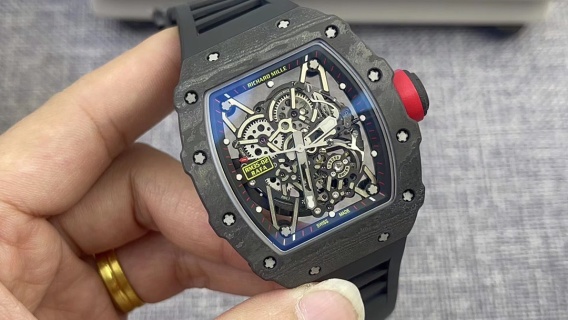
A super clone uses a purpose-built integrated skeleton movement designed to be seen. The torque path is real. The balance assembly sits where it should. Shock absorbers are not printed decorations but functional components integrated into the architecture. These movements are not Swiss and they are not ETA-based, but that is not a downgrade. In this context, “Swiss” is irrelevant. Engineering layout matters far more than geographic branding.
Experienced buyers stop asking whether a movement is Swiss and start asking whether it behaves like a Richard Mille movement when viewed, wound, and worn. That is the dividing line.
3. Weight & Wrist Feel: The Most Ignored Killer Detail
Weight is where most newcomers get misled. They assume light means cheap. With Richard Mille, the opposite is often true.
Cheap replicas feel light because they are hollow. The center of gravity floats, and the watch never quite settles on the wrist. There is no sense of balance between case, movement, and strap. After a few minutes, the watch feels more like a shell than an instrument.
A proper RM super clone is light, but it has presence. The weight distribution is intentional. The case absorbs mass where it should, the movement anchors the center, and the strap completes the balance. You notice it immediately if you have worn both. The watch does not disappear, but it also never drags. That tension between lightness and control is one of the hardest things to replicate and one of the easiest ways to spot a low-end piece.
This is usually the moment when business owners and experienced collectors stop asking questions. The wrist tells them what the spec sheet cannot.
4. Finishing Details: Screws, Sapphire, Strap & Buckle
Cheap replicas fail through accumulation, not a single flaw. One detail alone might be forgivable. Together, they become obvious.
Look at the screws first. On low-end pieces, screw slots vary slightly in angle and depth. On a super clone, alignment is deliberate, even when the screws are not meant to be perfectly symmetrical. That difference comes from machining discipline, not aesthetics.
Sapphire is another giveaway. Cheap replicas often use single-coated or untreated crystal, which reflects light harshly. A super clone uses double-sided anti-reflective coating that reduces glare without turning the dial milky. It is subtle, but once you see it, you cannot unsee it.
The strap and buckle finish the story. Low-quality rubber feels stiff, rebounds poorly, and never quite conforms to the wrist. The buckle clicks without feedback. A super clone strap flexes naturally, returns smoothly, and the buckle engages with mechanical certainty. These are small sensations, but Richard Mille is built on small sensations.
Cheap replicas copy shapes. Super clones copy decisions. That difference shows up everywhere once you know where to look.
The Price Gap Explained: Why Some RM Replicas Cost $500 and Others $5,000+
The price gap exists because these watches are not scaled versions of the same product. They are built on entirely different assumptions. A $500 Richard Mille replica is designed to survive pricing pressure. A $5,000 super clone is designed to survive physical scrutiny. Once you accept that, the numbers stop looking arbitrary.
People often assume the higher price is driven by branding, markup, or seller confidence. In reality, most of the cost difference comes from constraints that cannot be negotiated away. Richard Mille designs are hostile to shortcuts. When manufacturers try to make them cheap, the watch collapses into a hollow object. When they respect the structure, the cost rises whether they want it to or not.
Price Breakdown: Where the Money Really Goes
The case material is the first major divider. Real NTPT carbon or forged carbon is expensive before machining even begins. The raw blocks require layered compression under heat and pressure, and only a portion of each block is usable after cutting. Resin cases waste almost nothing. Carbon cases waste a lot. That waste is built into the price.
Custom movement development is the second cost wall. A skeleton movement that actually carries load, transfers torque correctly, and places the balance where it belongs cannot be adapted from an off-the-shelf automatic caliber. It must be designed, prototyped, revised, and assembled by technicians who understand what they are building. Even when production stabilizes, the per-unit cost stays high because volumes remain low.
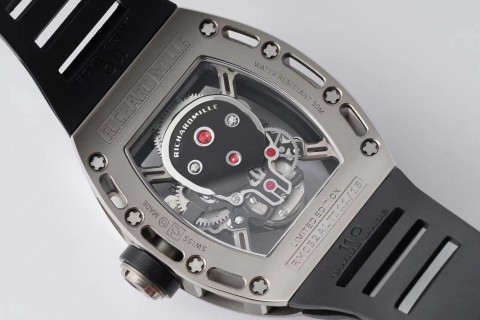
Scrap rate is the silent expense most buyers never consider. With complex cases and exposed movements, cosmetic defects are not hidden. Carbon layers misalign. Sapphire edges chip. Skeleton bridges fail tolerance checks. High-end RM super clone production discards far more parts than cheap replica production, and every discarded component has already consumed labor and material.
Low-volume production finishes the equation. Cheap replicas rely on scale. Thousands of identical cases, movements, and straps spread costs thin. Super clones do not have that luxury. Variants, updates, and limited runs prevent efficiency. The watch never becomes cheap to make because it never becomes simple.
This is why Richard Mille replicas are not “overpriced.” They are priced according to what it costs to do the job without cheating. Making them cheaper does not make them worse versions of the same thing. It makes them something else entirely.
The “Once-Charged-As-Top-Tier” Scam Explained
The most common scam in the RM replica market is not outright fraud. It is misclassification. A $500 watch is sold as a $2,000 watch by changing the story, not the product.
The usual packaging involves phrases like “factory inside version,” “same supplier as top tier,” or “internal batch.” None of these claims change resin into carbon or decoration into engineering. They exist to blur categories for buyers who lack physical reference points.
There are three fast ways experienced buyers identify this tactic. The first is case texture. Fake carbon looks random but shallow. Real NTPT has depth and directional flow that survives edge cuts. The second is skeleton layering. If bridges look flat or motionless, the movement is decorative no matter what the seller claims. The third is weight and balance. No amount of photography can hide a floating center of gravity once the watch is on the wrist.
Scams persist because many buyers have never handled a proper super clone. Once they do, the comparison ends. The problem is not that the market is dishonest. The problem is that too many people try to buy a Richard Mille without understanding why it costs what it costs.
When price feels confusing, it is usually because the category boundaries are being ignored. Cheap replicas are cheap for structural reasons. Super clones are expensive for structural reasons. Mixing those two realities is where most buyers get burned.
Is a Richard Mille Replica Worth Buying?

A Richard Mille replica is worth buying only if the buyer understands what they are buying instead of and what they are buying for. This is not a substitute for a classic luxury watch, nor is it a shortcut to status. It is a deliberate choice for people who value mechanical presence and unconventional engineering over recognition or tradition. For the wrong buyer, it will feel absurd. For the right one, it will feel obvious.
Who a Richard Mille Super Clone Is Perfect For
A high-quality RM super clone fits people who operate in environments where tools, structures, and systems matter more than symbols. Construction, real estate, engineering, and project-driven businesses tend to attract this mindset. These buyers are used to evaluating objects by how they are built, not how they are marketed.
They are not chasing logos. In fact, they often avoid watches that are instantly recognizable to everyone. Richard Mille appeals because it is legible only to people who already understand what they are looking at. The watch does not announce itself; it reveals itself under scrutiny. That quiet complexity is the point.
These buyers also tend to dislike “street watches” that have become uniform. An RM, even in replica form, does not blend into crowds. It exists outside dress codes and fashion cycles. For someone who values differentiation without explanation, a super clone makes sense.
Who Should NOT Buy an RM Replica
If price is the primary filter, a Richard Mille replica will disappoint. Cheap versions exist, but they erase the very qualities that make the design interesting. Buying one just to own the shape misses the entire logic of the watch.
If weight equals value in your mind, RM is the wrong direction. These watches are intentionally light, and that lightness feels unsettling if you associate mass with quality. The same applies to buyers who do not appreciate RM’s visual language. Skeletonized movements, exposed mechanics, and industrial forms are not universally appealing, and they are not meant to be.
Anyone who wears a suit daily should also think carefully. Richard Mille is not discreet, and it does not disappear under a cuff. Even the best super clone carries presence that clashes with formal environments. This is not a failure of the watch. It is a mismatch of context.
Real-Life Wearing Scenarios (Business, Casual, Collection)
In project environments such as construction sites or development walkthroughs, a Richard Mille makes sense. It aligns with machinery, materials, and motion. It looks intentional rather than ornamental, especially when worn casually.
In private business settings, such as closed meetings or informal gatherings, the watch becomes a conversation piece rather than a signal. People who recognize it will engage. People who do not will ignore it. That selective visibility is part of its appeal.
As part of a rotating personal collection, an RM super clone works best when it is not worn daily. It holds its impact when reserved for the right moments. Treated this way, it avoids fatigue and remains what it should be: a deliberate choice, not a default.
Final Verdict: Super Clone vs Cheap Replica — What Experienced Buyers Choose
If you understand that Richard Mille is an exercise in structural aesthetics rather than decoration, then the difference is simple: cheap replicas are hollow shells, super clones are engineered interpretations, and experienced buyers choose accordingly.
| Model / Version | Replica Tier | Case Material | Movement Type | Approx. Price (USD) |
|---|---|---|---|---|
| RM055 (Basic) | Cheap Replica | Resin / Fake Carbon | Standard automatic w/ decorative skeleton | $100 – $300 |
| RM011 (Basic) | Cheap Replica | Resin / Sprayed Carbon | Modified 7750 auto (decor) | $200 – $500 |
| RM055 (BBR V3) | Super Clone Mid | NTPT Carbon / Ceramic | Integrated skeleton (functional) | $500 – $700 |
| RM35-01 / RM35-02 | Super Clone Mid | NTPT Carbon | Integrated skeleton movement | $700 – $900 |
| RM055 (ZF V3) | Super Clone High | NTPT Carbon / Ceramic | DanDong RMUL2 skeleton | $900 – $1,100 |
| RM35-02 (ZF V7) | Super Clone High | NTPT Carbon | DanDong RMUL2 skeleton | $1,000 – $1,200 |
| RM055 (APS V2) | Super Clone Top | NTPT Carbon | Upgraded RMUL2 skeleton | $1,400 – $1,800 |
| RM52-01 (JB True Tourbillon) | Top-Tier Super Clone | Titanium / Carbon | True flying tourbillon | $1,800 – $2,500+ |
| RM001 / RM53 Complicated | Top-Tier Super Clone | Titanium / Sapphire | True complex movement | $2,000 – $3,000+ |