
Introduction: The Paradigm Shift from Skeleton Precision to Dynamic Style
You’ve done the homework. You can spot a well-executed skeleton replica from across a room—the correctly aligned gears, the proper brush on the bridges, the right font on the rotor. That knowledge, however, becomes a liability when evaluating a sport model like the RM61-01 Yohan Blake. The mental checklist that earns you confidence on an RM 35-02 will lead you to dismiss a perfect RM61-01 as “wrong.” This is the paradigm shift: for this watch, realism is not measured in horological detail but in kinetic expression. The RM61-01 isn’t a movement with a case attached; it’s a singular piece of kinetic jewelry engineered for a sprinter’s wrist. Your inspection must move from the microscope to the macro-feel, as discussed in the RM52-01 skull replica guide. Success here means capturing an aggressive, lightweight, integrated aesthetic—not replicating a decorated caliber.
The “Yohan Blake” Design Ethos: Performance Over Ornamentation
The “Yohan Blake” moniker isn’t just a marketing name; it defines the watch’s entire purpose. Blake, the “Beast” sprinter, embodies explosive power and streamlined efficiency. The watch mirrors this: it is a tool, first and foremost. The tonneau case is not a static container but a dynamic sculpture meant to hug the wrist during motion. The bold color blocking—typically a stark black, white, and yellow—serves legibility and brand shock value, not decoration. The skeletonized movement is a consequence of the weight-saving mandate, not the centerpiece. A genuine RM61-01 feels like a piece of athletic equipment, not a traditional watch. This performance-oriented ethos means the primary authenticity signals are case shape, material density, color harmony, and strap integration. If a replica nails the movement finish but gets the case weight or color tone wrong, it has failed the core mission.
Why the Standard RM Replica Checklist Fails Here
The standard RM replica evaluation—developed around skeleton models like the RM 35-02—prioritizes movement fidelity: check the wheel alignment, the polish on the bridges, the font on the rotor. On the RM61-01, these are secondary. A replica can have a perfect-looking movement clone but still feel completely “off” because the case is too thick, the Carbon TPT® looks like a sticker, or the strap is stiff and mismatched. The sport model’s identity lives in its three-dimensional form and material presence, areas where the replica industry’s margin for error is razor-thin. A skeleton watch’s beauty is in the details you inspect up close; the RM61-01’s beauty is in the overall impression it gives from a distance and the feeling it gives on the wrist. Applying skeleton-level scrutiny to this model is like judging a race car by the finish of its engine bolts while ignoring its aerodynamics.
What “Getting It Right” Actually Means for This Model
“Getting it right” for the RM61-01 means achieving a cohesive, purposeful whole. It means the watch looks and feels like it was designed as one integrated system. The case curves should flow aggressively, not look blunt or blocky. The colors—dial, case, strap—should exist in the same tonal universe, creating a sharp, athletic contrast. The strap must emerge from the case lugs as if grown from the same material, not attached. The weight should be surprisingly low for its visual bulk. The movement, when visible, should support the lightweight narrative, not contradict it with a cheap, heavy brass finish. Realism here is a holistic vibe: a fusion of aggression, lightness, and seamless integration. Missing any one of these pillars makes the watch feel like a collection of parts rather than a singular object.
Expert Authentication Insight
The “First Wrist Test.” Before you examine a single detail, put the watch on. This is the most immediate and reliable diagnostic for a sport model replica. The genuine RM61-01 in grade 5 titanium or Carbon TPT® has a disorienting lightness for its size—it feels almost insubstantial, like a piece of advanced polymer rather than metal. This is a deliberate engineering choice. A replica that uses heavier materials (common brass for the movement, denser carbon composites, or stainless steel sub-frames) will immediately feel “chunky” or “weighty” in the hand and on the wrist. That discrepancy—the sense that the watch is heavier than its visual presence suggests—is an instant red flag. It doesn’t matter if the dial printing is perfect; a weighted feel betrays a fundamental misunderstanding of the original’s material philosophy.
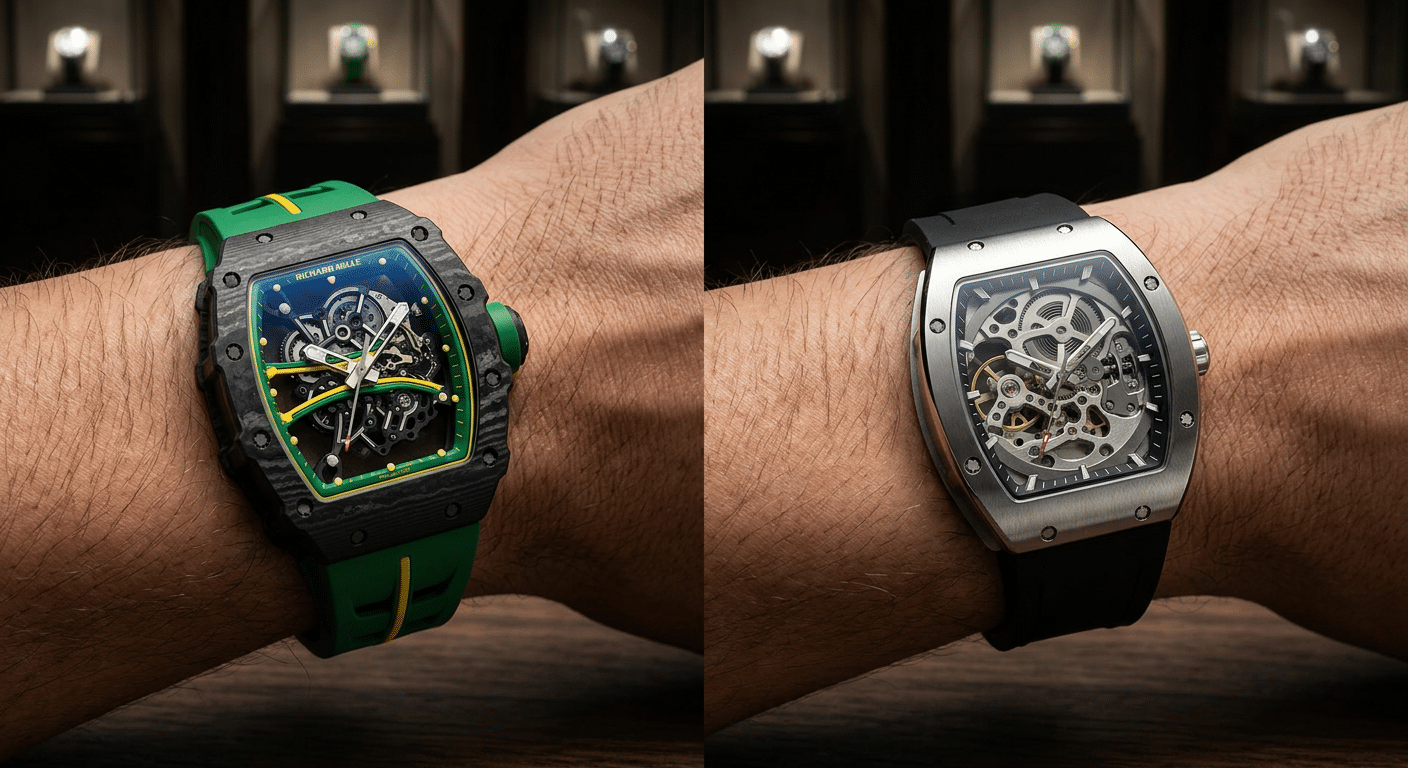
Dissecting the Sport RM DNA: What the RM61-01 Is Actually Trying to Be
To judge a replica, you must first understand the genuine article’s intent. The RM61-01 is not a reinterpretation of a classic dress watch; it is a purpose-built instrument for a specific athletic persona. Every design decision serves the goals of minimal weight, maximum impact, and total integration. Deconstructing this DNA gives you the “target feel” against which all replicas must be measured.
Case as a Dynamic Sculpture
The tonneau case of the RM61-01 is a study in aggressive curvature. Unlike the more angular, architectural skeleton cases (like the RM 35-02), the RM61-01’s lines are meant to suggest speed and fluid motion. The case middle swells, the bezels curve, and the entire profile is intentionally uneven—thicker at the crown side (16.08mm) than the opposite side (13.7mm)—to create a dynamic, non-symmetrical silhouette. This isn’t arbitrary; it’s a design language that says “performance.” The lugs are not traditional lugs but organic extensions of the case body, flowing downward to meet the strap. A replica that flattens these curves or makes the profile too symmetrical has missed the foundational sculptural intent.
The Psychology of Color Blocking in Sport Models
The RM61-01’s color scheme is brutalist branding. The stark division—often a black case and dial with white indices and a violent yellow accent (on the seconds hand, crown, or strap stitching)—serves multiple functions. First, it creates instant, long-range legibility. Second, it establishes a high-contrast, “warning color” aesthetic that aligns with sporting equipment. Third, it reinforces Richard Mille’s identity in a single glance. The colors are not harmonious; they are confrontational. A replica that gets the hues wrong—a mustard yellow instead of a neon lemon, a charcoal grey instead of true black, or a mismatched strap color—instantly loses that aggressive, purposeful energy. The color blocking must feel intentional and sharp, not like an afterthought.
The Seamless Strap Integration Mandate
This is the single most critical ergonomic and aesthetic feature. On the RM61-01, the strap is not an accessory; it is part of the case. The case lugs do not have a traditional, separate attachment point. Instead, the rubber or fluoroelastomer strap is molded to flow directly from the case middle, creating a continuous, unbroken line from the 9 o’clock side, under the case, to the 3 o’clock side. There is no visible “junction” where lug meets strap. This integration is what gives the watch its legendary comfort and its “grown” appearance. A replica that uses a separate strap with lugs—or even a molded strap with a visible seam or ridge at the attachment point—has fundamentally failed. The seam test—running a finger over the transition—should reveal nothing but a smooth slope.
Skeletonization as a Weight-Saving Feature
On a skeleton tourbillon, the open-worked dial is the main event. On the RM61-01, it is a functional afterthought. The movement is skeletonized primarily to shave grams and to provide a visual link to Richard Mille’s horological heritage, but it is not the focus. The dial’s purpose is to be legible and light. The bridges and plates are open to reduce material, not to showcase elaborate finishing. Therefore, while a clean, well-finished movement clone is preferable, minor flaws in engine-turning or screw polishing are forgivable if the case, weight, and integration are perfect. The skeleton here serves the sport, not the other way around.
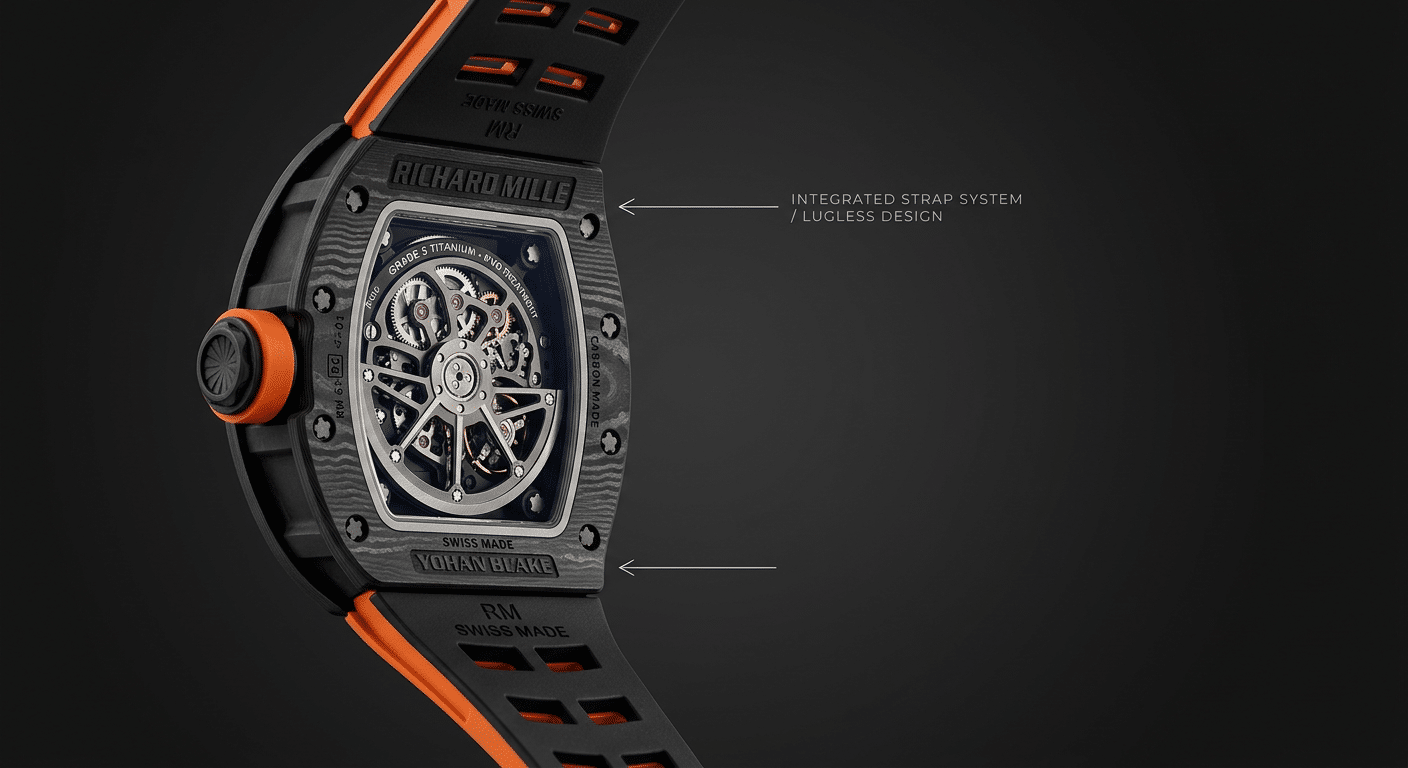
The Replication Challenge: Translating Dynamic Form into Static Manufacturing
Why is the RM61-01 such a high-risk replica target? Its design appears simple: a curved case, some color, a rubber strap. But this simplicity is deceptive. The watch’s magic lies in the precise execution of complex 3D forms, subtle material textures, and ergonomic integration—the very areas where mass production, even at the super-clone level, struggles to escape the “flat” and “blocky” trap. Understanding these manufacturing pain points explains why “photo-real” replicas so often fail in hand.
The Curvature Problem: Why Cases Look “Off” in Person
The genuine RM61-01 case is milled from a solid block of titanium or Carbon TPT®. The complex, asymmetric curves—the swell of the case middle, the aggressive bevels, the flowing lug shape—require precise 5-axis CNC machining. Even a slight deviation in the milling program or tool wear can flatten these curves, making the replica case look broader, blunter, and less dynamic. In photos, this can be masked by lighting and angle. On the wrist, under moving light, a flattened case looks cheap and geometric rather than sculptural and fluid. This is the most common visual flaw: a case that looks correct in a static studio shot but feels like a bar of soap in hand.
Material Texture vs. Graphic Print
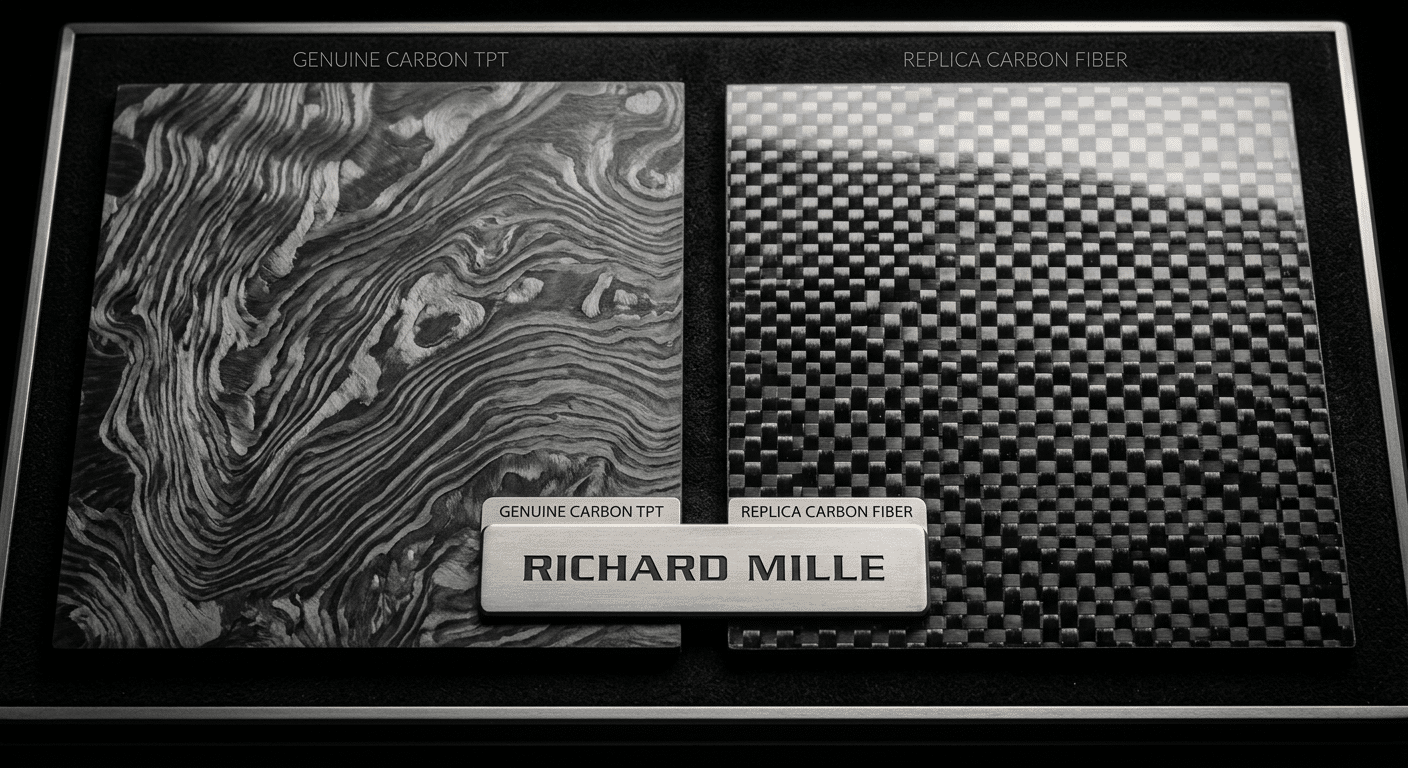
Genuine Carbon TPT® is a layered composite with a specific, slightly irregular, three-dimensional texture. The layers create a subtle, natural undulation that shifts under light. Replicas typically use one of two substitutes: forged carbon (which has a more chaotic, “marbled” pattern) or, at lower tiers, a simple carbon fiber weave printed on a flat surface. The latter is a dead giveaway. Even a good forged carbon replica can look “shiny” or “plastic” compared to the matte, depth-rich genuine material. The texture isn’t just a visual pattern; it’s a tactile and reflective quality. A replica that looks perfect in a crisp, well-lit photo will often reveal a flat, graphic-print-like surface in ambient light, destroying the material’s premium feel.
The Strap Integration Gap
Molding a rubber strap that seamlessly flows from a complex titanium or carbon case is a significant injection-molding challenge. The genuine strap is a single-piece, custom-molded component with precise hardness and a specific, slightly textured surface. Replica straps are often separate pieces attached with lugs, or molded with noticeable seams or a overly stiff, “plastic” feel. Color matching is another hurdle; the exact shade of black or yellow used by Richard Mille is proprietary. Replica straps frequently have a hue that is too light, too dark, or simply “off,” creating a jarring contrast with the case. The strap is also a primary comfort factor. A genuine fluoroelastomer strap is soft and conforming. A replica strap is often stiff, squeaky, or uncomfortably tight.
Chronograph Pushers and Crown: Functional Form
The RM61-01 is a chronograph, and its pushers and crown are integral to its sporty, tool-like character. They should feel solid, precise, and well-integrated into the case’s lines. On replicas, pushers are frequently wobbly, have excessive play, or protrude awkwardly. The crown may not screw down properly or may feel flimsy. These are functional failures, but they also break the aesthetic. The pushers should look like they belong to the case, not glued on. Their action should be crisp, contributing to the overall impression of a coherent, high-performance instrument.
Factory Landscape & Maturity: Who Actually Tries for This Model?
While the Richard Mille replica market for skeletonized models like the RM 35-02 is a tight race between a handful of elite factories, the landscape for sport models such as the RM 61-01 Yohan Blake is far more fragmented and less mature. The priorities here—lightweight feel, aggressive color blocking, and seamless strap integration—demand a different set of manufacturing capabilities that only a few workshops have truly pursued. Understanding which factories have invested in these specifics, and where they inevitably cut corners, is the critical bridge between theoretical evaluation and a successful purchase.
The Top Contenders for Sport RM Replication
For the RM 61-01, two factories dominate credible production: ZF Factory (often marketed under the “U mi” sub-brand) and APSF. ZF was the first to market with a version, establishing the initial benchmark. For the RM 67-01, the RM 67-01 super clone guide details movement calibration and case finishing. APSF followed shortly after with a competing iteration that quickly gained recognition for material refinement. These are the only two sources consistently recommended by trusted dealers for this model as of 2025–2026. Other factories, such as BBR or KV/KU, either do not produce the RM 61-01 or their versions are considered outdated and not worth considering for a sport-focused purchase.
Case & Material: The Primary Differentiator
In sport models, the case and its material are the make-or-break elements. Here, the factories diverge sharply:
- ZF’s strength lies in capturing the dynamic curvature of the tonneau case. The lines flow more naturally from the lugs into the case back, better mirroring the genuine’s sculptural intent. However, ZF’s Carbon TPT®-style composite often uses a more uniform carbon weave pattern that, while visually convincing in photos, lacks the chaotic, layered depth of genuine NTPT material. Under moving light, it can appear slightly flat.
- APSF’s strength is material texture. Their use of imported carbon fiber produces a finer, more random pattern that more closely approximates the genuine’s organic grain. The case feels more substantial in hand. The trade-off is that APSF’s case curvature, while accurate in dimensions, can sometimes feel a fraction more “blocky” or less fluid than ZF’s, especially when viewed from the side profile.
Batch-specific warning: ZF’s early 2024 production run of the RM 61-01 was noted by several Chinese reviewers for a yellow dial accent that leaned too far into neon territory, clashing with the genuine’s more subdued, athletic lemon-yellow. APSF’s initial batches reportedly had a strap color that was ever-so-slightly darker than the case’s yellow accents, breaking the tonal harmony.
Movement & Skeleton: A Secondary Concern Here
Because the RM 61-01’s skeletonized movement is primarily a stylistic choice to reduce weight and expose the mechanics—not the horological centerpiece—the movement’s finish is a secondary priority. Both ZF and APSF use modified Dandong RMUL2 clones that are visually adequate at a glance. The key is not micro-inspection of screw slots or Geneva stripes, but whether the skeletonization contributes to the overall lightweight, airy aesthetic. A movement that looks too “busy” or too “clean” can disrupt the intended performance feel. In practice, as long as the gears move and the bridges are roughly the right color, the movement passes the sport-model test. Save your scrutiny for the case and strap.
Strap & Buckle: The Often-Ignored Dealbreaker
The integrated rubber strap is where many replicas fail the “wrist presence” test. A poor strap ruins an otherwise excellent case.
- ZF’s strap is frequently cited as being too stiff out of the box, lacking the soft, skin-friendly flexibility of genuine fluoroelastomer. The color match to the case’s yellow accents can also be inconsistent batch-to-batch.
- APSF’s strap is generally softer and more pliable, offering better immediate comfort. Their color matching is more reliable, though the strap’s texture can sometimes feel slightly more “rubbery” than the genuine’s proprietary compound.
The buckle mechanism is another subtle point. Genuine Richard Mille uses a proprietary deployant that integrates flawlessly. Most replicas use a standard folding clasp that, while functional, feels less refined and can disrupt the seamless visual line when the watch is removed. For the sport RM, the strap must feel like an organic extension of the case—any stiffness, color mismatch, or clunky clasp immediately breaks the spell.
Your New Inspection Protocol: The Five Pillars of Sport RM Judgment
Forget the old checklist of dial printing and movement screw alignment. When evaluating a sport Richard Mille replica like the RM 61-01, your inspection must be re-prioritized around five pillars that measure dynamic style and wearable presence. This is your new tactical protocol.
Pillar 1: The “Eerily Light” Weight Test
What “good” feels like: The genuine RM 61-01, with its grade 5 titanium and Carbon TPT® construction, has a startlingly low density for its visual size. On wrist, it should feel almost disconcertingly light—like wearing a piece of advanced composite rather than a metal watch. The weight distribution should be even, with no heavy “head” feeling.
The common failure: Most replicas, due to substitute materials (steel instead of titanium in the movement, denser carbon composite), weigh in the 100–110g range. This isn’t dramatically heavy, but it’s enough to feel “substantial” rather than “weightless.” The moment you put it on, if your first thought is “this is lighter than it looks,” you’re on the right track. If it feels predictably heavy for its size, walk away. Target: A genuine-feeling piece should be under 90g complete, with the lightest replicas (APSF) approaching 95g. Anything over 100g is a red flag for poor material selection.
Pillar 2: Color Blocking and Tonal Harmony
What “good” looks like: The Yohan Blake model is defined by its bold, high-contrast color split: a stark white dial, deep black case, and vivid lemon-yellow accents on the dial markers, crown, and pushers. These colors must be in the correct tonal family—the yellow should be a bright, clean citrus shade, not a mustard or orange. The blocking should be crisp, with sharp boundaries between color fields.
The common failure: Replicas often get one or more colors wrong. The yellow is the most frequent culprit—too neon, too dull, or slightly off-hue. The white dial can appear grayish or dirty. The black case may have a faint blue or brown undertone. Hold the watch under natural light and compare the colors side-by-side. Do they vibrate against each other with the same aggressive energy as the genuine? If the colors look “muddy” or “off,” the replica has failed this pillar.
Pillar 3: Assessing Case Flow and Aggression
What “good” looks/feels like: The RM 61-01’s case is a dynamic sculpture. The lines should flow with purpose—the curve from the lug down into the case back should be a continuous, aggressive arc. The profile should feel sharp and technical, not rounded or bland. The asymmetric thickness (thicker at the crown side) is a deliberate design feature that should be perceptible and intentional, not a clumsy afterthought.
The common failure: Replicas often “flatten” this dynamism. The curves become too gentle or too angular, losing the genuine’s tense, aerodynamic shape. The case back may sit too flat against the wrist, or the lugs may protrude awkwardly. Run your finger along the side profile from lug to lug. Does it feel like a continuous, purposeful sweep? Or are there flat spots, abrupt angles, or a general “blockiness”? A case that looks correct in a straight-on photo but feels blunt in hand has failed this pillar.
Pillar 4: The Seam Test (Case-to-Strap Transition)
What “good” looks/feels like: The strap on a genuine RM sport model is not an accessory; it is an integral part of the case architecture. There should be no visible gap or step between the case lugs and the rubber strap. The transition must be perfectly smooth, both visually and to the touch. When you run your finger from the metal case onto the strap, it should feel like a single, continuous surface.
The common failure: This is the most frequently overlooked flaw in replicas. Almost all replicas exhibit some degree of “seam” here—a slight lip, a visible joint, or a change in texture that betrays the two-part construction. Even if the strap color matches, a poor seam destroys the illusion of monocoque integration. Perform the seam test obsessively. If you feel a catch or see a shadow line in certain angles, the replica has compromised one of the core tenets of its design.
Pillar 5: The “Wrist Presence” Gut Check
What “good” feels like: After passing the first four pillars, put the watch on your wrist and just look at it for 30 seconds. Does it project the intended athletic, high-tech energy? Does it look like a cohesive, purposeful object that belongs in a sports context? Or does it look like a collection of well-made parts that somehow don’t sing together? The genuine RM 61-01 has an undeniable “visual tension”—a sense of compressed energy and technical rigor. You should feel a visceral “yes” or “no.”
The common failure: Replicas that pass the technical checks can still fail this final, subjective pillar. The colors may be correct, the curves accurate, the seam smooth, but the overall composition feels flat, disjointed, or simply “off,” a discrepancy detailed in the [Richard Mille super clone models guide]. This is often the result of a single subtle flaw—a slightly wrong font on the dial, a pusher shape that’s 95% correct, a strap texture that’s close but not quite—that the brain registers as inauthentic. Trust this gut feeling. If the watch doesn’t feel like a Richard Mille on your wrist, it doesn’t matter how many details are correct.
Why “Photo-Real” Replicas Fail in Person: The Lighting & Material Trap
The most frustrating experience for an RM replica buyer is finding a watch that looks flawless in online photos only to feel “fake” the moment it arrives. This phenomenon is especially acute with sport models like the RM 61-01, and it stems from two fundamental gaps between 2D imagery and 3D reality.
The Studio Lighting Illusion
Replica sellers are masters of the controlled studio shot. They use diffuse, shadow-minimizing lighting that flattens every surface and hides material cheapness. In these perfect conditions:
- The dynamic curves of the case appear more dramatic and defined.
- The carbon fiber pattern looks deep and intricate.
- Colors appear vibrant and true.
- Any seams or transitions are obscured by even lighting.
This lighting creates a “perfect” but artificial representation. In real life, under natural or indoor light, shadows reveal the true geometry—flatter curves, less aggressive lines—and the material’s true reflectivity. The watch that looked like a sculpted masterpiece in the photo now looks like a flat, printed object. Skeleton models suffer less from this because their details (engraved text, painted dials) are largely 2D features that translate well to photos regardless of lighting.
Flat Prints vs. Real Material Depth
The core material deception is this: genuine Carbon TPT® has physical depth. The alternating 45-degree carbon layers create a complex, three-dimensional texture that catches light in subtle waves. Replica “carbon” is almost always a printed pattern on a smooth or lightly textured surface. In a 2D photo, that print can look remarkably similar to the real thing—the camera captures the pattern, not the depth.
But in hand, under moving light, the replica’s surface reveals itself as flat. The pattern doesn’t shift and shimmer as you tilt the watch; it stays static, like a decal. This is the single biggest giveaway for sport models. The material must have tactile, visual depth that changes with your viewing angle. If it looks the same from every angle, it’s wrong.
How Curvature is Lost in 2D
A photograph, especially a straight-on shot, cannot convey the true profile of a complex curve. The RM 61-01’s case has a pronounced wedge shape—thicker at the crown, thinner at the opposite side—and a dramatic arc from lug to back. In a 2D image, this curvature is compressed; the case looks more uniformly thick and the lines less aggressive. The replica, which already struggles to match the genuine’s exact curves, looks “correct” in the photo because the photo itself distorts the perception of shape. Only when you hold the watch and feel the asymmetry, or see it from the side in natural light, does the flatness or incorrect radius become apparent.
The “In-Person Flattening” Effect
The combined result of studio lighting and 2D flattening is what I call the “in-person flattening” effect. The replica that looked dynamic and sharp online now appears visually duller, less three-dimensional, and less aggressive on your wrist. Colors seem less vibrant, curves seem less extreme, and the whole watch seems to lose its “presence.” This is not your imagination—it is the inherent limitation of replicating a complex, light-playing physical object with a flat print and simplified geometry. For sport Richard Mille models, where the entire aesthetic is built on dynamic form and material depth, this gap is catastrophic. A skeleton model’s beauty is in its details, which photos can capture. A sport model’s beauty is in its form, which photos inevitably lie about.
Final Verdict & Buyer Strategy: Is the RM61-01 Replica Right for You?
Let’s be direct: the RM61-01 Yohan Blake replica is not for everyone. In fact, it’s a specialist purchase that demands a complete mental shift from how you evaluate other Richard Mille replicas. Your success here hinges not on finding the movement with the most accurate bridge finishing, but on capturing a specific kinetic energy—a feeling of aggressive, lightweight performance. If you cannot re-calibrate your priorities accordingly, you will be disappointed, no matter how much you paid or which factory badge is on the back. This final section provides the unflinching framework to decide if this pursuit is for you, and if so, how to avoid a costly misstep.
Who This Replica Is For
This replica exists for a very specific type of buyer. You are the right fit if:
- Your primary goal is wearable statement, not horological dissection. You want a watch that, on your wrist, conveys the same athletic, high-impact aesthetic as the genuine. You care more about the cohesive visual tension of the color-blocked tonneau on your wrist than whether the barrel arbor is polished to a mirror finish.
- You understand and accept the “style over substance” trade-off. You know the movement inside is a clone, the carbon is a composite, and the weight will be slightly off. You are buying the *illusion of form*—the silhouette, the integration, the presence—and you are willing to overlook the material and mechanical gaps that come with that illusion.
- You prioritize first-wrist feel over desk-pop inspection. The true test for you is how the watch feels in motion on your wrist during a casual day, not under a loupe on a white background. You value comfort, light weight (relative to its size), and how the strap flows with your movements.
- You have done your factory homework. You know that for the RM61-01, ZF and APSF are the only serious contenders, and you understand their specific, sport-model-centric flaws (ZF’s potential weight issue, APSF’s strap challenges). You are prepared to wait for a good example from a trusted dealer, not just grab the first listing.
If this sounds like you, the RM61-01 replica can be one of the most satisfying purchases in the entire ecosystem—because when it works, it *feels* right.
Who Should Avoid Sport Model Replicas
Walk away now if any of the following describe you. The RM61-01 will be a source of frustration, not joy:
- The Skeleton Purist. Your joy comes from examining gear teeth, screw heads, and the interplay of polished and satinated surfaces. The RM61-01’s skeletonization is a stylistic afterthought, not the main event. You will fixate on the movement’s lack of genuine titanium finish and miss the entire point of the watch. Buy an RM 35-02 or RM 055 instead.
- The Material Authenticity Stickler. You cannot tolerate that the “Carbon TPT” is a forged composite, not the Swiss-made layered ply. The knowledge that the genuine weighs 20-30 grams less will haunt you every time you lift your wrist. For you, the gap is not asymptotic; it is a chasm. No sport model replica will ever satisfy.
- The Weight-Sensitive User. If you have worn a genuine RM 61-01 (approx. 101.5g with strap) and are expecting that same eerie, almost forgettable lightness, you will be let down. Even the best replicas use denser materials and a heavier movement, adding 10-20 grams. That difference is palpable and constant. If weight is your top metric, this is the wrong model to replicate.
- The “Perfect Specs” Buyer. You want a watch that matches the genuine’s dimensions, materials, and function *on paper*. The RM61-01’s irregular thickness (16.08mm crown-side vs. 13.7mm) and integrated strap system are exceptionally hard to replicate perfectly. You will find a flaw in the curvature, a seam in the strap, or a color mismatch. Your search for perfection will be endless and fruitless.
- The Impatient Bargain Hunter. The market for good sport RM replicas is not as deep or as competitive as for skeleton models. Inventory is thin, factory runs are inconsistent, and finding a piece that passes even four of the five pillars requires significant patience and dealer relationships. If you want a quick, cheap buy, you will end up with a “flat” and unconvincing piece.
The Final 4-Point Reality Check
Before you commit to any RM61-01 replica, subject it to this brutal, on-wrist filter. This is not a list of nice-to-haves; it is a pass/fail assessment based on the Five Pillars we established. A watch must pass at least four of these five criteria to be considered a viable candidate. Failing two or more means it will not deliver the required “dynamic style” and should be returned immediately.
- The “Eerily Light” Weight Test (Pillar 1). Put it on. Does it feel disproportionately light for its substantial, aggressive presence? The genuine uses advanced materials to create a lightweight experience that defies its size. A good replica will feel surprisingly light, even if it’s 10-15g heavier than genuine. A bad one will feel solid, dense, and “chunky” like a regular sports watch. If it feels heavy and ordinary, fail.
- Color Blocking & Tonal Harmony (Pillar 2). Step back 3 feet. Do the black, white, and yellow (or other colorway) exist in the same tonal family as the genuine? Is the yellow a vibrant, athletic lemon or a dull, mustardy brown? Is the white a clean, bright white or a greyish off-white? The colors must work in concert to create high-contrast legibility and brand identity. If any color looks “off” or cheap, fail.
- Case Flow & Aggression (Pillar 3). Hold the watch in your hand and rotate it. Do the lines of the tonneau case flow from the lugs over the bezel and into the case back? Or do they look segmented, blunt, or geometrically awkward? The genuine is a study in dynamic curves. A poor replica will look like a series of flat planes welded together. The profile should feel aggressive and purposeful, not blocky. If the case lacks dynamism, fail.
- The Seam Test: Strap Integration (Pillar 4). Run your finger from the case lugs onto the rubber strap. Is there a seamless transition? The genuine’s strap is injection-molded to flow organically from the case. A good replica will have a nearly invisible joint. A poor one will have a noticeable lip, gap, or change in texture/angle. The strap should feel like an extension of the case, not an accessory. If you feel a “step,” fail.
- Overall Visual Tension (Pillar 5). This is the gut check. Look at the watch as a complete object, not a collection of parts. Does it feel like a cohesive, engineered tool for an athlete? Or does it feel like a costume piece assembled from disparate components? The genuine has an inherent tension and purpose. If the watch looks “busy,” disjointed, or fails to project a singular aggressive intent, fail.
Long-Term Satisfaction: Style vs. Detail
Here is the hard truth about long-term ownership of a sport model replica like the RM61-01: your satisfaction will be determined almost entirely by the success of the style expression, not the accuracy of the detail. With a skeleton model, you can derive endless pleasure from peering at the movement, noticing the finishing, and appreciating the mechanical art. That pleasure is detail-driven and can persist even if the case is slightly off.
With the RM61-01, there is no such consolation. The dial is sparse; the movement is a background element. The entire value proposition is in the total package—the way it sits on your wrist, the way the colors pop in sunlight, the feeling of wearing something that looks like it belongs on a sprinter. If the case shape is wrong, the strap integration is poor, or the colors are muted, you will notice it every single time you look down. There is no secondary layer of detail to fall back on. The “feeling” is the only feature.
Therefore, do not over-index on movement clones or factory reputation alone. A ZF or APSF piece that fails the Color or Strap Integration tests will be a constant source of disappointment. Conversely, a piece from a less-hyped factory that nails the four core style pillars will bring more daily joy. Your evaluation must be holistic and visceral.
Final Word: The market for convincing RM61-01 replicas is narrow and volatile. Factories come and go, and even the best versions have sport-model-specific compromises. Your strategy must be: define your non-negotiables using the 4-out-of-5-Pillar filter, identify the current factory best suited to those priorities (often a choice between ZF’s case accuracy and APSF’s movement refinement), secure a reputable dealer, and inspect the actual piece with these physical tests before acceptance. If you cannot find a watch that passes this reality check, the honest move is to save your money for a different model or a genuine piece down the line. For the RM61-01, “realism” is a feeling, not a feature list. If you can’t get the feeling, you have nothing.