
The Ultra-Thin Imperative: Why RM67-01’s Identity Hinges on Millimeters
For the Richard Mille RM67-01, “ultra-thin” is not a marketing adjective—it is the foundational principle of the watch’s entire identity. The model’s value derives from a radical, almost obsessive pursuit of vertical compaction, where every single component is engineered to minimize its contribution to the stack height. This creates a specific, extreme structural harmony. The central problem in the replica market is that this harmony is almost always broken. A replica might correctly measure 7.8mm on a ruler, but if that number is achieved by adding bulk in the caseback to compensate for a thick movement, contrary to sportier Richard Mille super clone priorities, or by raising the dial feet to sit a heavy crystal deeper in the bezel, the result is a failed copy. The watch may photograph well from above, but it loses the essential, floating elegance that defines the genuine. For the RM67-01, evaluating “thinness” is a systems engineering problem, not a single metric. Your goal is to learn to judge the relationship between the case profile, movement stack, and dial depth, not just a standalone thickness number.
The Original’s “Invisible” Engineering
The genuine RM67-01, specifically the caliber CRMA6, achieves its 3.60mm movement thickness through a philosophy of skeletal minimalism. The mainplate and bridges are machined from a single piece of grade 5 titanium, with material removed everywhere possible without compromising rigidity. The date mechanism is not a bulky module stacked on top; it is a peripheral ring or an exceptionally thin disc integrated into the dial side. The crystal is a thin sapphire lens seated with minimal depth into the bezel. The case itself is a masterpiece of three-dimensional curvature, where the bezel slopes dramatically downward and the caseback tapers to a near-knife edge. This isn’t just a thin watch; it’s a watch where the vertical envelope of every layer has been ruthlessly optimized. The engineering effort is “invisible” because the goal is to make the entire assembly seem to vanish into the wrist, creating an effect of weightless suspension.
Replica Shortcut: The Thickness Illusion
The most common replica failure mode is the thickness illusion. A factory might use a base movement that is nominally thin, but then adds a solid, non-skeletonized date bridge or a thick dial plate to simplify assembly and reduce cost. This hidden bulk—often 0.8mm to 1.2mm—must be accommodated. The caseback is made thicker, or the crystal is forced to protrude more, or both. The result is a watch that “hits” the spec sheet (e.g., “8.0mm”) but does so through a different, clumsier stack. The illusion is that the number is correct, but the proportions are wrong. The caseback may be too tall and flat, the side curvature may be flattened to hide the extra height, and the dial may sit too high, making the watch look and feel like a different object entirely. You are not looking at an RM67-01; you are looking at a thick watch that has been ground down to a thin number on paper.
Why 0.5mm Matters More Here Than Any Other RM Model
In a model like the RM35-02, which is thicker and more about carbon texture and lug shape, an extra 0.5mm in the caseback might be a minor visual note. In the RM67-01, that same 0.5mm is catastrophic. Because the design’s entire purpose is to achieve a state of near-weightlessness, any deviation is exponentially more noticeable. A 0.5mm over-thick caseback destroys the delicate downward slope of the case side, turning a dynamic curve into a static slab. A 0.5mm too-tall dial feet structure pushes the dial toward the crystal, making the dial appear cramped and breaking the illusion of depth. The tolerance for error is not just small; it is non-negotiable. This model exposes the limits of replica tooling and engineering more clearly than any other in the lineup. A “good enough” replica for other models is often a failed replica for the RM67-01.
Expert Authentication Insight
Physical diagnostic: The “Wrist Drop Test.” Place the watch on a perfectly flat, hard surface (a glass table or countertop). Observe it from the side. A correctly proportioned RM67-01 replica will sit with the caseback nearly flush against the surface, while the crystal—the highest point—will barely create a shadow. The vertical gap between the table surface and the lowest point of the lugs/caseback should be virtually zero. The gap between the table surface and the top of the crystal is your total stack height. Now, measure (or visually estimate) the difference. If the crystal protrudes more than 1.2mm above the caseback’s reference plane, it indicates a flawed caseback-to-crystal seating or a movement stack that is too tall. This single test separates replicas that understand the system from those that only know the number.
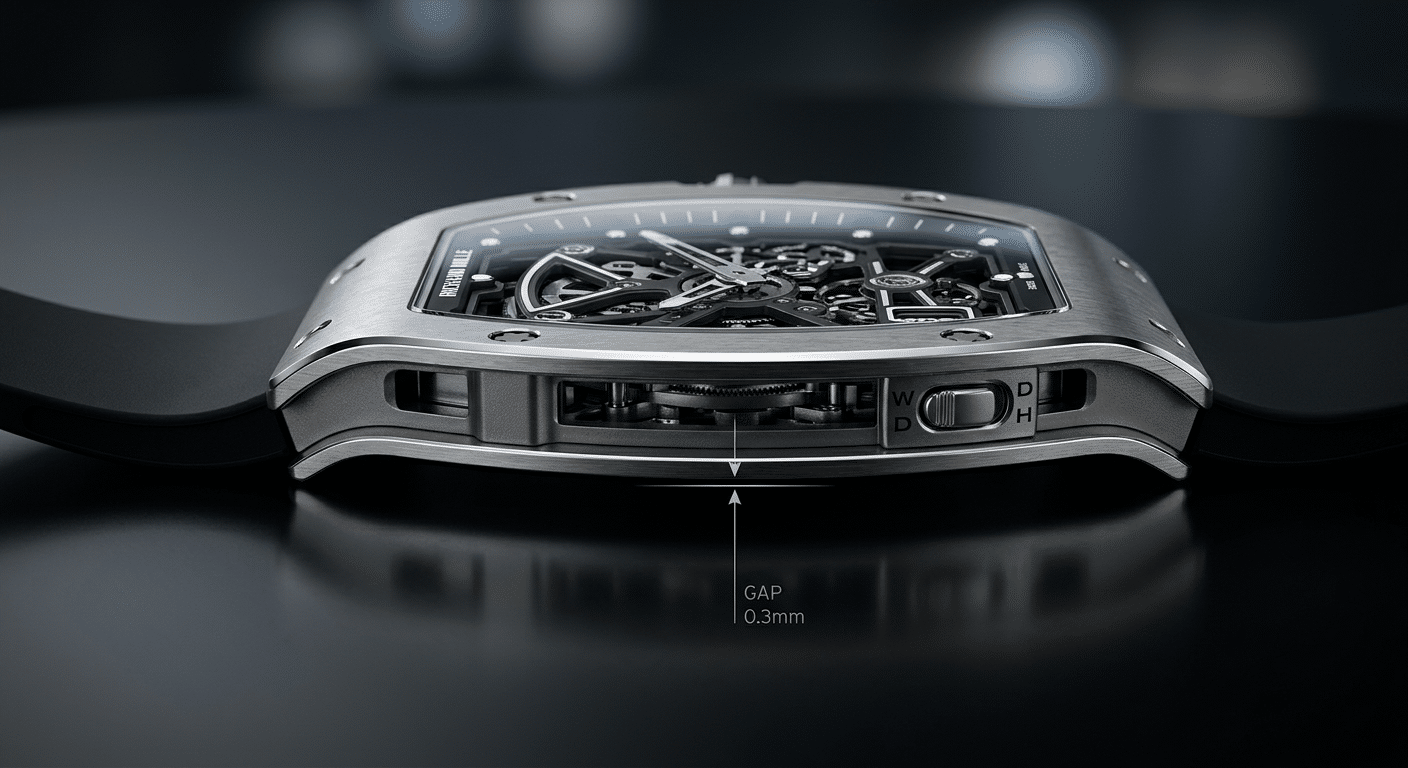
Case Profile Engineering: Replicating the Tapered Silhouette and Side Curvature
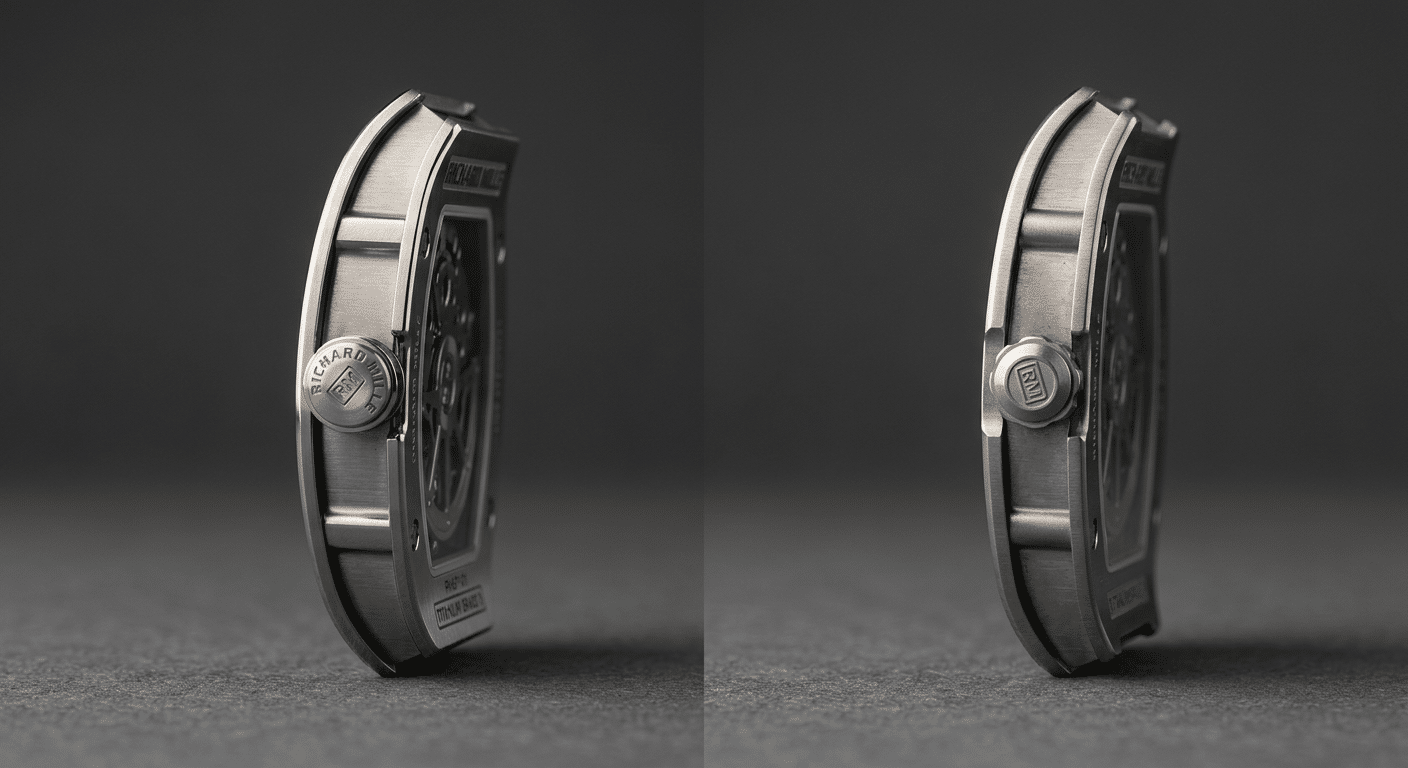
The case is the most visually dominant element of the RM67-01, and its success is measured not in “does it look thin” but in “does the case behave correctly.” The original’s magic is in its three-dimensional curvature: the dramatic, continuous downward slope from the bezel’s top edge to the caseback’s edge, and the tight radius of the side curvature that flows seamlessly into the integrated lugs. Replica tooling, constrained by multi-axis CNC limitations and cost, often simplifies these complex curves. The result is a case that may hit the 7.8mm spec but looks “chunky,” “static,” or “blocky” from the side. The side profile in a photo—especially at a slight angle—is the single most telling visual cue. A straight-on ruler shot can hide a flawed contour; a side view cannot.
The Tapered Bezel-to-Caseback Slope: A Replica’s First Test
Genuine RM67-01 cases are not vertical walls. The bezel face angles inward sharply, and the case side continues this slope all the way down to the caseback, which itself has a downward-facing bevel. This creates a continuous, tapered silhouette that visually minimizes thickness. Replicas frequently flatten this slope into a more conventional, vertical-sided profile. The bezel might be thicker, and the transition to the caseback might have a distinct, flat section. This “flattening” is the primary reason a correctly thick watch still looks wrong. It sacrifices the dynamic, floating aesthetic for static, slab-like geometry. When you look at the watch from the side, your eye should follow a single, smooth downward line. If you see a distinct “step” or a section that runs parallel to the dial, the curvature has been lost.
Side Curvature Radius: Where Tooling Shortcuts Are Most Visible
The tight radius of the case’s side curve—how sharply it bends from the bezel down to the caseback—is a direct function of machining capability. The genuine uses advanced, multi-axis CNC to achieve a small, aggressive radius. Replica tooling often uses a larger, gentler radius because it is faster, cheaper, and less prone to tool breakage. The visual impact is profound: a larger radius makes the case appear thicker and more cumbersome, even if the maximum thickness measurement is identical. This is the “chunky” factor. You can see this in photos by looking at the catchlights on the case side. On a genuine, the highlight is a thin, sharp line. On a compromised replica, the highlight is a broader, softer band, indicating a flatter, less precise surface.
Lug Integration and the Illusion of “No Bulk”
The lugs of the RM67-01 are not merely attachments; they are an extension of the case’s curvature. They are thin, sharply angled downward, and integrate so seamlessly that they appear to grow from the caseband. This design directs the watch’s weight onto a small, comfortable point on the wrist and is critical to the “no bulk” illusion. Replica lugs are often thicker, with a less acute downward angle. They can look like separate, bulky blocks welded onto the case. This breaks the visual flow and makes the watch wear larger and heavier than it is. The integration test is simple: trace the line from the top of the bezel, down the case side, and through the lug. It should be one unbroken curve. Any discontinuity—a flattening, a kink, or a sudden increase in volume—is a tooling shortcut.
Expert Authentication Insight
Physical diagnostic: The “Finger Slide Test.” With the watch in hand, gently run your fingertip from the top of the bezel, down the case side, and onto the caseback. On a genuine or a top-tier replica with correct tooling, the curve will be perfectly continuous and smooth. You will not feel any flat spot, kink, or abrupt change in angle. However, on most replicas, you will detect a distinct flat section—often 1mm to 2mm long—where the side meets the caseback. This is the telltale sign of simplified CNC tooling that could not replicate the original’s tight radius. That flat section, though small, visually “thickens” the entire watch from the side and is a non-negotiable flaw for a model whose identity is thinness.
Movement Thickness Reality: Caliber RM67-01’s 3.6mm Challenge and Replica Shortcuts
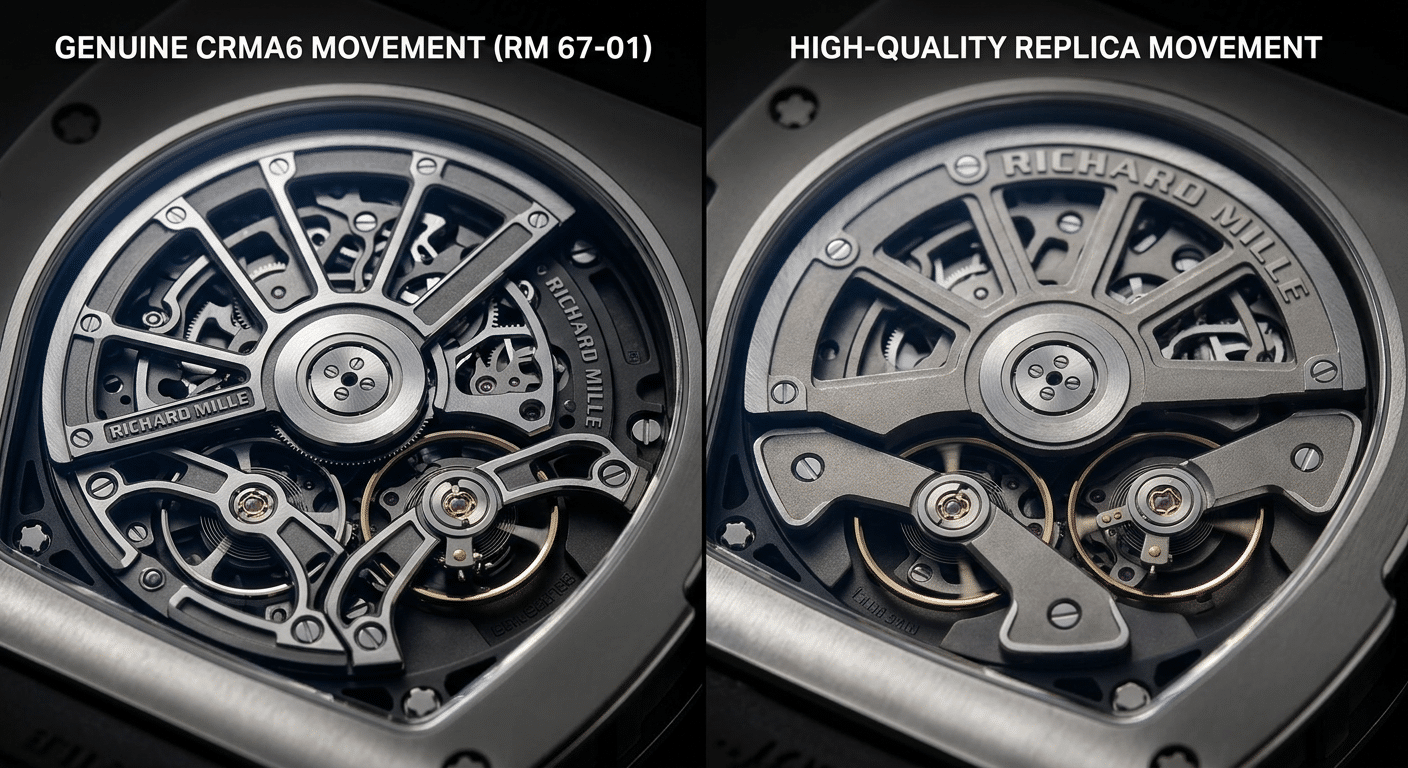
The movement is the heart of the ultra-thin claim and the source of the most stubborn replication gap. The genuine caliber CRMA6 is a marvel of skeletal, modular design, with a total thickness of approximately 3.6mm. Replica movements, even those based on the thinnest Chinese automatic bases like the TP (or “Dandong” variants), almost never achieve both this thickness and the genuine’s level of skeletonization. The movement’s height dictates the absolute minimum possible case thickness. A replica movement that is even 0.7mm taller forces a compensatory increase in caseback thickness or crystal protrusion, immediately breaking the design’s proportions. The key insight is that you cannot judge movement thinness from the dial side; you must understand the construction on the back, where hidden layers of bulk are concealed.
The Genuine RM67-01 Movement: A Study in Skeletonized Minimalism
The genuine CRMA6 movement achieves its minimal stack through a holistic approach. The mainplate and bridges are machined from a single block of titanium, with vast areas of material removed to create the skeletonized look. The date function is not a separate module stacked on top; it is a peripheral date ring or a disc so thin it adds negligible height. The gear train is arranged in a single, flat plane. The balance wheel sits low, and there is minimal vertical separation between components. The entire assembly is a study in efficiency, where every bridge and plate serves a structural purpose with zero superfluous mass. This is a movement designed from the ground up for one purpose: to be as thin as physically possible while remaining a complete, functional automatic caliber.
Replica Movement Bases: TP, Shanghai, and the “Thin” Compromise
Replica factories start with existing ultra-thin automatic base movements, commonly the TP movement or Shanghai-derived calibers. These bases are themselves engineering feats, often around 3.2mm thick. However, they are not designed for the RM67-01’s specific architecture. To convert them into a “clone,” factories must add layers: a custom skeletonized dial-side plate, a date module, and new bridges. Here lies the core compromise. To save on the immense cost of designing and machining a truly integrated, skeletonized movement from scratch, replicas use a modified base. The base is thin, but the modifications—especially the date mechanism—add significant hidden height. The “TP-based RM67-01 movement” you read about is often this hybrid: a thin core paired with a thick, conventional add-on.
The Hidden Thickness: Date Modules, Solid Bridges, and Mainplate Mass
The primary culprit in added movement height is the date module. Genuine Richard Mille movements use proprietary, ultra-thin date systems. Replicas grafting a date function onto a base movement almost always use a standard, off-the-shelf date module from the base movement’s parts bin. These modules are designed for thicker, more conventional cases and can add a full 0.7mm to 1.0mm to the stack. Furthermore, to simplify skeletonization, some factories use solid (or minimally skeletonized) bridges that are thicker than the genuine’s airy, cutaway titanium bridges. Finally, the mainplate itself, even if based on a thin design, may be made from a denser material or left thicker in non-critical areas for rigidity. This “movement sandwich” of base + thick module + solid bridges creates a vertical envelope that the case must house, forcing the caseback to bulge or the crystal to stand proud. You cannot see this from the dial side; the deception is on the reverse.
Expert Authentication Insight
Physical diagnostic: The “Balance Wheel Clearance Test.” With the watch off the wrist, examine the movement through the display back. Focus on the area above the balance wheel. On a genuine RM67-01, the clearance between the top of the balance wheel (at its highest arc) and the underside of the date wheel or the mainplate above it is minimal—often less than 0.3mm. The components are tightly packed in a single plane. On a replica with a thick date module, you will see a significant gap, or worse, a bulky, solid date bridge that obstructs the view entirely. This gap is dead weight, a direct measurement of the hidden compromise. It proves the movement is not a true integrated design but a layered assembly, and it explains why the caseback must be thicker.
Dial Stack Depth: How Replica Dial Construction Betrays Thinness
The dial is the final, often overlooked, layer in the thickness stack. A replica that gets the case profile right can still fail the ultra-thin illusion because of what sits inside: a dial assembly that is simply too tall. A thick dial feet structure, a heavy crystal, or multi-layer appliqué indices can add 0.5mm to 1.0mm of vertical height that the entire case must accommodate. For the RM67-01, a “thin” case with a “thick” dial is a fundamental contradiction. The dial must be engineered for minimalism to match the case’s intent; otherwise, the watch appears top-heavy and loses the floating, skeletal elegance that defines the original. The goal is a dial that seems to float within the case, not sit on top of it.
Dial Feet Engineering: The Invisible Height Driver
Dial feet are the tiny posts or brackets that secure the dial to the movement. Their design is a major, invisible determinant of total stack height. In the genuine RM67-01, these feet are meticulously engineered to be as short as possible, often laser-cut or micro-milled from the dial plate itself. Replica factories, seeking durability and ease of assembly, frequently use taller, more robust feet—typically soldered or screwed onto a thicker brass dial plate. These feet can add a hidden 0.3mm to 0.5mm. Because the dial must clear the movement bridges and the crystal, every tenth of a millimeter here forces a compensatory increase in caseback thickness or reduces the allowable crystal seating depth. This is the first place a replica’s “thinness” budget is wasted.
Applied Indices vs. Printed: The Weight and Height Disparity
The choice between applied indices and printed dial markers has a direct, measurable impact on dial stack. Applied indices—whether metal, ceramic, or luminous-filled—require a base that is soldered or glued to the dial plate. This base, even if thin, adds a discrete layer. More critically, to ensure a secure bond and prevent warping, replica dial plates are often made from thicker, heavier brass (for rigidity) rather than the thin, light alloys or skeletonized plates of the genuine. The genuine RM67-01’s skeleton dials eliminate this entire layer. A solid brass dial plate with applied indices can easily be 0.4mm thicker than a genuine skeleton dial. The visual consequence is not just added weight, but a dial that sits higher in the case, pushing the crystal further from the dial surface and creating a perceptible “cramped” look under the sapphire.
Crystal Seating Depth: Bezel Design vs. Crystal Thickness Trade-offs
The sapphire crystal’s thickness and how deeply it sits within the bezel are critical. The genuine RM67-01 uses a crystal that is both thin (often near the 1.0mm to 1.2mm mark) and seated shallowly, with the bezel’s inner contour holding it close to the dial. Replica crystals are frequently thicker—a cost-saving measure—or the bezel cavity is machined too deep to accommodate a thicker crystal while maintaining water resistance gasket seating. A deeper crystal seat forces the dial to be positioned lower to avoid contact, which in turn can require a taller dial feet structure or a thicker caseback to fill the void. The result is a case that, while perhaps measuring correctly at the crystal edge, has a visibly deeper “well” between the bezel and the dial, destroying the sense of depth compression that the original achieves.
Expert Authentication Insight
Physical diagnostic: The “Dial Shadow Test.” In good, direct light, place the watch at a slight angle and observe the gap between the outer edge of the dial (especially where applied indices are present) and the inner surface of the bezel. A well-executed, thin dial assembly will produce a consistent, narrow shadow line—typically 0.2mm to 0.4mm wide. This gap is the visual proof of an efficient stack. A thicker dial construction will show a wider, uneven gap, RM011 chronograph replica guide, or worse, the dial’s outer edge will be visibly closer to the underside of the crystal, making the dial appear “cramped” and the crystal overly prominent. This shadow line is a direct, non-invasive proxy for the entire dial stack’s efficiency. If the shadow is wide, the dial is too thick, the crystal is set too deep, or both—and the case must be correspondingly taller to compensate.
Wrist Integration: Why True Ultra-Thin Changes Wearability and Presence
This is the ultimate test. A watch that is technically thin on the bench but wears thick due to poor lug design, a high crystal, or bad weight distribution has failed the core promise of an ultra-thin. “Wrist presence” for the RM67-01 is about negative space—the watch should feel like an extension of the wrist, not an object strapped to it. It’s about the “forgotten watch” sensation. Achieving this requires a harmonious relationship between the case’s contour, the lugs’ angle, and the center of gravity. A replica that gets the numbers right on a ruler but has a flat caseback, overly wide lugs, or a protruding crystal will feel like a “brick” despite an 8mm measurement. True integration means the caseback makes full, comfortable contact and the watch pivots naturally with wrist movement.
The Lug-to-Thickness Ratio: Why 44mm Lug Width on 8mm Thickness Feels Wrong
The RM67-01’s lugs are not merely wide; they are engineered with a specific profile and downward angle to distribute the watch’s minimal weight over a comfortable, narrow contact patch. The ratio between lug width (approximately 44mm) and case thickness (~7.8mm) is intentional. On a genuine, this ratio creates a sense of sleekness because the lugs are thin and taper sharply into the caseback. A replica that maintains the correct thickness but uses lugs that are thicker vertically or less aggressively angled disrupts this ratio. The lugs become bulky blocks, creating a visual and tactile disconnect. The watch feels wider and heavier than its dimensions suggest because the mass is distributed over a clumsier, less ergonomic form. The goal is a lug profile that seems to disappear into the wrist, not a pair of flippers.
Caseback Contour and the “Wrist Hug” Effect
The genuine RM67-01’s caseback is not a flat slab. It features a subtle, continuous curvature that mirrors the wrist’s natural shape. This “wrist hug” ensures maximum skin contact with minimal pressure points. Replica casebacks are often flatter, either due to simpler CNC tooling or to internally accommodate a thicker movement or dial stack. A flat caseback creates a perceptible gap between the watch and the wrist, especially when the wrist is flexed. That gap is wasted space—it’s the physical manifestation of a failed integration. The watch does not conform; it perches. This gap is the first thing a wearer notices after the initial visual excitement fades: a persistent sense that the watch is “sitting on top” rather than “melting into” the arm.
Crystal Protrusion: The Silent Ruiner of Comfort
Even with a perfectly contoured caseback, a crystal that sits too high will dominate the bezel line and become a snag point. The genuine’s crystal is recessed just enough to be protected but not so much that it creates a deep well. In replicas, a thicker crystal or a deeper bezel seat (to accommodate it) causes the crystal’s edge to become the highest point of the watch. This single protrusion can catch on sleeves, desk edges, and wrist flexes. It transforms a watch designed for comfort into an irritant. The “silent ruiner” is that you may not notice it in a static photo, but within minutes of wear, the constant subtle catch of the crystal on your skin or clothing becomes a nagging reminder of the replica’s compromise.
Expert Authentication Insight
Physical diagnostic: The “Flex Test.” Wear the watch on your wrist and perform a sharp wrist flexion, as if making a tight fist. Observe and feel how the watch moves. A properly integrated ultra-thin watch will pivot cleanly on the narrow, downward-angled lugs with minimal resistance. The caseback will slide slightly, and the crystal will not dig in. A replica with a thick caseback, high crystal, or overly vertical lugs will feel “stuck.” The caseback will catch on the wrist’s ridge, or the crystal will press into the flexed skin. This test instantly reveals hidden bulk that a ruler cannot measure. The watch should rock, not snag.
Factory Maturity Spectrum: Who Actually Nails the RM67-01’s Proportions?
Not all “RM67-01 super clones” are created equal. The market is segmented by which part of the ultra-thin puzzle each factory prioritizes and executes well. This analysis moves beyond “which factory is best” to “which factory solves which part of the thinness problem best.” The hierarchy is defined by engineering choices, not just brand reputation. A Tier 1 factory invests in correct case tooling for curvature and a movement solution that maintains skeletonization and height. A Tier 2 factory may hit the spec sheet thickness number but compromise on case side curvature or dial stack efficiency. A Tier 3 factory may produce a dial with perfect color and font but accept a fundamentally flawed, thick profile. The buyer must diagnose which failure mode a given factory’s version embodies.
Tier 1: The “Systemic Thinness” Approach (Case + Movement + Dial)
These factories address the thickness cascade holistically. They invest in multi-axis CNC tooling to replicate the case’s tight radius and tapered slope. They select or modify a movement base (often a Dandong TP-based caliber) that is both thin and skeletonized, avoiding the bulky date modules or solid bridges that plague lesser versions. They engineer a dial assembly with minimal feet and a thin plate. The result is a watch where the case, movement, and dial share a cohesive vertical discipline. The thickness number is correct, but more importantly, the profile is correct. These versions are rare and command premium prices ($800–$1,100+), but they are the only ones that truly capture the original’s intent.
Tier 2: The “Spec Sheet” Approach (Correct Thickness, Flawed Execution)
This is the most common trap for buyers. These replicas measure within 0.2mm of the genuine’s 7.8mm thickness on a caliper, so they are advertised as “ultra-thin.” However, they achieve this number through compromise. They might use a thinner caseback to compensate for a dial that is too tall, resulting in a dial that sits too close to the crystal (“cramped” look). Or they might use a slightly thicker movement but machine the case sides flatter to hide it, destroying the original’s dynamic curvature. The watch looks “chunky” in profile despite the correct spec. These are deceptive because they pass the most basic buyer check (a ruler measurement) but fail the more important aesthetic and wearable tests. They represent a misunderstanding of the original’s design philosophy.
Tier 3: The “Visual Distraction” Approach (Perfect Dial, Compromised Profile)
Some factories excel at dial aesthetics—color matching, font accuracy, luminous application—and use this strength to mask fundamental thickness failures. They may produce a dial that is visually stunning but built on a thick brass plate with tall feet. The case must then be taller to fit this dial, and the side profile becomes generically slab-like to accommodate the internal bulk. The buyer is wowed by the dial details in photos but receives a watch that feels thick and clumsy on the wrist. This approach prioritizes what is easiest to photograph (the dial) over what is hardest to replicate (the integrated, flowing silhouette). For the RM67-01, this is a fatal misallocation of effort; a perfect dial on a thick case is a failed copy.
Expert Authentication Insight
Physical diagnostic: The “Factory Batch Code Cross-Reference.” The highest-tier factories for this model exhibit very specific, consistent batch codes or movement plate engraving styles that correlate directly with their thinner movement execution. These are concrete, verifiable differentiators. For example, community reports indicate that certain ARF batches for the RM67-01 (often those with batch codes starting with “T”) utilize a TP-based thin skeleton movement that maintains lower stack height. Conversely, some ZF batches (like earlier “V2” variants) are known to employ a modified solid bridge design that, while visually acceptable from above, adds approximately 0.7mm to the movement stack, forcing a thicker caseback. The buyer must request the specific batch code from the dealer and cross-reference it against the latest community consensus on forums like RWI. This code is a direct window into the factory’s engineering choice for that production run.
The Thickness Cascade: How One Layer’s Failure Breaks the Whole Design
The pursuit of ultra-thinness in an RM67-01 replica is not a single engineering challenge but a systems integration problem. A failure in one layer—be it the movement, dial, or case geometry—does not exist in isolation. It forces a compromise in the next layer, which then degrades the third, creating a compounding failure that ruins the watch’s fundamental identity. This is the thickness cascade: a domino effect where a cost-saving shortcut in one area guarantees a visible flaw in another. Understanding these cascades is critical because it shifts the buyer’s diagnosis from “this watch looks thick” to “why does it look thick?” The answer is almost always a specific, traceable engineering trade-off.
Scenario 1: The Movement Bottleneck
The movement is the foundational layer that sets the absolute minimum height for the entire watch. The genuine Caliber CRMA6 achieves a skeletal, modular construction at just 3.6mm thick. The most common replica failure starts here: using a movement base that is too tall. Factories often employ a standard thin automatic movement (like a modified TP or Shanghai caliber) but then add a solid, non-skeletonized date module or thick mainplate to save on machining and finishing costs. This adds 0.8–1.2mm of unavoidable height.
The Cost-Saving Decision: Opting for a thicker, plated movement with solid bridges and a standard date mechanism instead of investing in a custom-skeletonized, thin-base clone.
The Perceptual Fallout: That extra movement height must be accommodated. The caseback is made thicker to cover it, or the crystal is seated deeper into the bezel to maintain water resistance. This, in turn, destroys the next layer: the case side profile. To hide the bulk, the caseband curvature is flattened into a broader, less aggressive radius. The dramatic downward slope from bezel to caseback—a signature of the RM67-01—is lost. The watch now wears like a slab, despite potentially having a “correct” spec sheet thickness. The root flaw is invisible from the front but dictates everything you see from the side.
Scenario 2: The Dial Stack Mismatch
The dial is another layer where bulk is frequently added, often for reasons of durability and ease of assembly. A thick dial feet structure (the metal posts that mount the dial to the movement), a heavy brass dial plate, and tall applied indices all contribute to a “tall” dial stack. Furthermore, a sapphire crystal that sits too deep within the bezel—a common cost-saving measure for easier sealing—exacerbates the problem.
The Cost-Saving Decision: Using a robust, thick dial plate for rigidity, tall dial feet for secure mounting, and a crystal that seats deeply into the bezel to simplify case assembly and improve (theoretical) water resistance.
The Perceptual Fallout: A thick dial forces the entire case geometry to adapt. The most telling symptom is the “deep dial” look. In photos, the hour markers appear disproportionately far from the underside of the crystal, creating a visual “canyon” effect. The dial no longer appears to float within the case; it sits low, pushing the visual center of gravity upward. This also contributes to a flatter case side, as there is less vertical space to sculpt the dramatic taper. The watch looks and feels “top-heavy,” negating the low-profile illusion.
Scenario 3: The Lug-to-Thickness Disconnect
This cascade begins with a design choice that ignores the ergonomic imperatives of an ultra-thin watch. The RM67-01’s lugs are not merely wide; they are exceptionally thin, sharply angled, and integrate seamlessly into the caseband to direct the watch’s mass into a minimal contact point on the wrist. A replica may get the overall thickness number right but use lugs that are too thick, too vertical, or poorly angled.
The Cost-Saving Decision: Using generic lug designs or simplifying the complex, downward-angled lug integration to save on CNC machining time and mold complexity. The result is lugs that are bulky blocks rather than graceful extensions.
The Perceptual Fallout: Even with a thin casebody, these clumsy lugs create a wide, awkward footprint on the wrist. The watch feels like it “sits on” the wrist rather than “hugs” it. The gap between the caseback and the skin becomes noticeable, and the watch pivots poorly during wrist movement. The perceived thickness is dramatically increased because the dominant visual element—the lugs—is wrong, a conclusion supported by the Richard Mille Super Clone Models Guide. You have a technically thin watch that wears like a thick one because the interface between watch and wrist was an afterthought.
Expert Authentication Insight
Physical diagnostic: The “Layer Measurement” Method. This is the ultimate root-cause analysis tool. With a precise digital caliper (0.01mm resolution), perform these three measurements on a suspected watch:
- Total Stack (A): Caseback to the outer edge of the crystal.
- Case + Movement Stack (B): Caseback to the top surface of the dial (or dial feet).
- Dial + Crystal Stack (C): Top of the dial to the inner surface of the crystal (you must measure through the crystal opening at the bezel).
Interpretation:
- Crystal Seating Depth = A – B. A value over 1.0mm suggests the crystal is set too deep, likely to compensate for a thick dial or for easier sealing.
- Movement Height = B – C. A value over 3.8mm (for a time-only model) strongly indicates a non-skeletonized, bulky movement base or date module.
- Dial Stack = C – (some reference on movement). An unusually high value points to thick dial feet or a heavy dial plate.
A “perfect” stack for an RM67-01 replica would show: A ≈ 7.8–8.2mm, B – C ≈ 3.5–3.7mm (thin movement), and A – B ≈ 0.8–1.0mm (crystal seated just enough). Anomalies in these relative layers pinpoint exactly which part of the cascade has failed.
Buying Judgment Framework: Evaluating “True Thinness” Beyond the Spec Sheet
For the RM67-01, the spec sheet is a trap. A listed thickness of 7.9mm is meaningless if achieved by distorting the case curvature or using a dial that sits too high. True thinness is a holistic property of form and proportion. This 5-point protocol prioritizes visual and structural integrity over a single number. Execute this checklist in order when evaluating any photo or physical watch.
The 5-Point Visual Inspection Protocol
- Curvature First (The #1 Priority): Examine the side profile in a sharp, angled photo. The bezel-to-caseback slope must be a continuous, aggressive taper. There should be no flat section greater than 1mm in length where the case side meets the caseback. If the side looks like a gentle slope or has a visible “kink,” fail immediately. This is the single most important visual cue.
- Dial Float: Assess the relationship between the dial and the crystal. The dial should appear centered and equidistant from the crystal across its entire surface. The indices should look relatively close to the crystal underside. If the dial seems to “hug” the crystal on one side or the markers appear far away, creating a “deep well” effect, the dial stack is too thick.
- Lug Integration: Trace the line from the top of the bezel, down the case side, and into the lug. The transition must be smooth and downward-sloping. The lugs themselves should appear thin and sharp, not bulky or vertically oriented. If the lugs look like separate, chunky blocks attached to a thin case, the integration has failed.
- Crystal Prominence: The crystal should not dominate the bezel line. Look at the bezel’s top surface. The crystal’s edge should sit just a hair’s breadth inside the bezel’s perimeter. A crystal that sits proud, creating a distinct “lip” around the dial, is a sign of poor seating and adds perceived bulk.
- Then, Measure: Only after the watch passes the first four visual tests does the thickness spec become relevant. For a titanium RM67-01, a true thin replica should measure no more than 8.2mm. Anything over 8.5mm is a guaranteed compromise, regardless of how good the visuals are. For carbon composite, add ~0.3mm for material differences.
Core Principle: A watch that passes the first three visual tests but measures 8.2mm is a vastly more successful “true thin” replica than one that measures 7.9mm but fails the curvature test. Form integrity is the goal, not a number.
When to Trust the Spec Sheet (And When to Ignore It)
The spec sheet is useful only as a final sanity check after visual inspection. It is a measure of the outcome, not the process. A perfect silhouette with a 8.1mm thickness is a success; a distorted silhouette with a 7.8mm thickness is a failure. The spec sheet cannot reveal:
- Whether the thickness came from a truly thin movement or a thick caseback hiding a bulky movement.
- Whether the case curvature was preserved or flattened to hit the number.
- Whether the dial depth was sacrificed to make the case thinner.
Therefore, ignore the spec sheet until you have judged the form. If a listing heavily promotes “7.8mm!” but the photos show a flat case side, the spec is a lie of omission—it tells you the “what” but hides the “how,” and the “how” is everything.
Red Flags That Mean “Thickness Failure” Regardless of Number
These visual tells are absolute indicators of a flawed cascade, even if the listed thickness looks correct:
- The Flat Side: Any detectable flat zone (>1mm) on the case side between the bezel and caseback.
- The Deep Dial: A wide, visible gap between the outer edge of the dial (especially at the indices) and the inner surface of the bezel.
- The Chunky Lug: Lugs that appear thick in cross-section or that do not flow downward from the casebody.
- The Prominent Crystal Lip: A crystal edge that clearly protrudes beyond the bezel’s top surface when viewed from above.
- The High Caseback: In a side photo, if the caseback edge is visibly thick and rounded over (“knife-edge” is sharp and fine), it’s covering bulk.
If you see one of these, the watch has failed the thinness test, full stop. No movement realism or dial color accuracy can compensate for this fundamental structural flaw.
Expert Authentication Insight
Physical diagnostic: The “Mirror Test.” This is the fastest, most revealing in-person test. Place the watch caseback-down on a clean, flat mirror. Look at the reflection of the crystal’s edge. On a perfectly integrated ultra-thin watch, the reflection of the crystal edge will be a sharp, thin line lying extremely close to the reflection of the caseback’s outer edge. The gap between these two reflections is minimal and uniform. On a compromised watch, you will see a wide, blurry gap between the two reflections. This gap is the sum of all the failures: crystal seating depth, caseback thickness, and dial height. A single glance at this mirror image tells the entire thickness story.
Final Verdict: The Non-Negotiable Tolerance for an RM67-01 That Works
The RM67-01 is not a watch for compromise. Its entire identity is predicated on achieving a specific, extreme structural harmony. For a replica to be considered a credible “super clone” of this model, it must replicate the original’s structural logic with >90% accuracy. “Good enough” is a different watch—a “Richard Mille-style thin watch”—but not an RM67-01. The tolerances are tight, and the consequences of missing them are total.
The 90% Structural Rule: When “Close” Isn’t Close Enough
Here are the non-negotiable thresholds. A viable RM67-01 replica must achieve:
- Case Curvature Radius: Within 10% of the genuine’s aggressive taper. Any flatter and the silhouette is wrong.
- Movement Stack Height (dial surface to caseback): Within 0.4mm of the genuine’s ~3.6mm. This ensures the movement itself is not the bottleneck.
- Dial-to-Crystal Gap: The visual distance from the top of the indices to the crystal underside must be under 0.5mm in photos. This proves the dial stack is efficient.
- Lug Integration: The downward angle and thin profile of the lugs must be visually consistent with reference images. No bulky blocks.
Fail any one of these, and the watch has failed its primary mission. It may be a beautiful timepiece, but it is not a successful replication of the RM67-01’s core design philosophy.
Better Alternatives: Which RM Models Forgive Replica Shortcomings?
If you cannot find a replica that passes the 5-point protocol and meets these thresholds, you are better off choosing a different Richard Mille model where thickness is not the defining characteristic. The replica engineering challenges are more forgiving on models where:
- Thickness is not the headline feature (e.g., the RM35-02, where the focus is on the carbon case texture and skeleton dial, and a 14mm thickness is expected and acceptable).
- The case shape is simpler (e.g., the RM61-01, where the irregular shape is the focus, not a perfect taper).
- The movement complexity is lower (avoid chronographs like the RM011, where the base movement thickness is an unbridgeable 3mm+ over the genuine).
Models like the RM35-02 (NTPT carbon focus) and RM111 (sporty, thicker design) offer vastly higher success rates in the replica market because the factories have solved their primary replication challenges (carbon texture, dial aesthetics) without the unforgiving constraints of ultra-thin architecture.
The Ultimate Question to Ask Before Buying Any RM67-01 Replica
Before you consider price, movement type, or factory name, ask this single question and demand a “yes” based on photographic evidence:
“Does this specific watch’s side profile silhouette—the curve from bezel to caseback—match the genuine’s silhouette in your mind’s eye, when viewed at the same angle?”
If the answer is “no” or “it’s close,” walk away. No other detail matters. The silhouette is the final arbiter. It encapsulates the result of the entire thickness cascade. If the silhouette is wrong, the structural logic is broken, and you do not have an RM67-01. You have something else.
Expert Authentication Insight
Physical diagnostic: The “Genuine Side-by-Side Photographic Test.” This is the final, decisive test. Obtain a high-resolution, perfectly angled reference photo of a genuine RM67-01 (from an official source or a trusted high-quality review). Place it side-by-side, pixel-aligned, with the highest-resolution photo you can get of the replica. Do not look at the details. Look only at the outer contour. Mentally overlay the shapes. Does the replica’s case side follow the same precise curve? Does the lug integrate at the same point? Does the crystal line sit at the same relative height? If the replica’s silhouette cannot be made to match the genuine’s in a static, controlled comparison, then no amount of moving gears, perfect fonts, or carbon texture can save it. The replica must win on silhouette first. Everything else is secondary.
Final Principle: For some watch designs, getting the details right means getting the fundamentals right. The RM67-01 is that design. Its genius is in its extreme, uncompromising thinness. A replica that cannot replicate that fundamental thinness—in form, not just in number—has fundamentally misunderstood the assignment. The thickness cascade is unforgiving. One layer’s failure breaks the whole design. Your job as a buyer is to find the one watch where every layer, from movement to dial to case to lugs, works in concert. If you can’t find it, choose a different model.