
The Dial’s Topography: Sunburst Depth and Sandwich Precision
The dial of a Panerai clone watch serves as an immediate, high-fidelity indicator of its manufacturing origin and intended tier. In 2026, the era of obviously misprinted or misaligned dials is largely over; true discernment now focuses on the microscopic execution of surface treatments, printing, and the signature multi-layered “sandwich” construction. To understand the nuances of gen vs super clone Panerai differences, a truly high-grade clone does not merely approximate these features; it replicates the inherent complexities of their production, a process that demands advanced tooling and meticulous quality control.
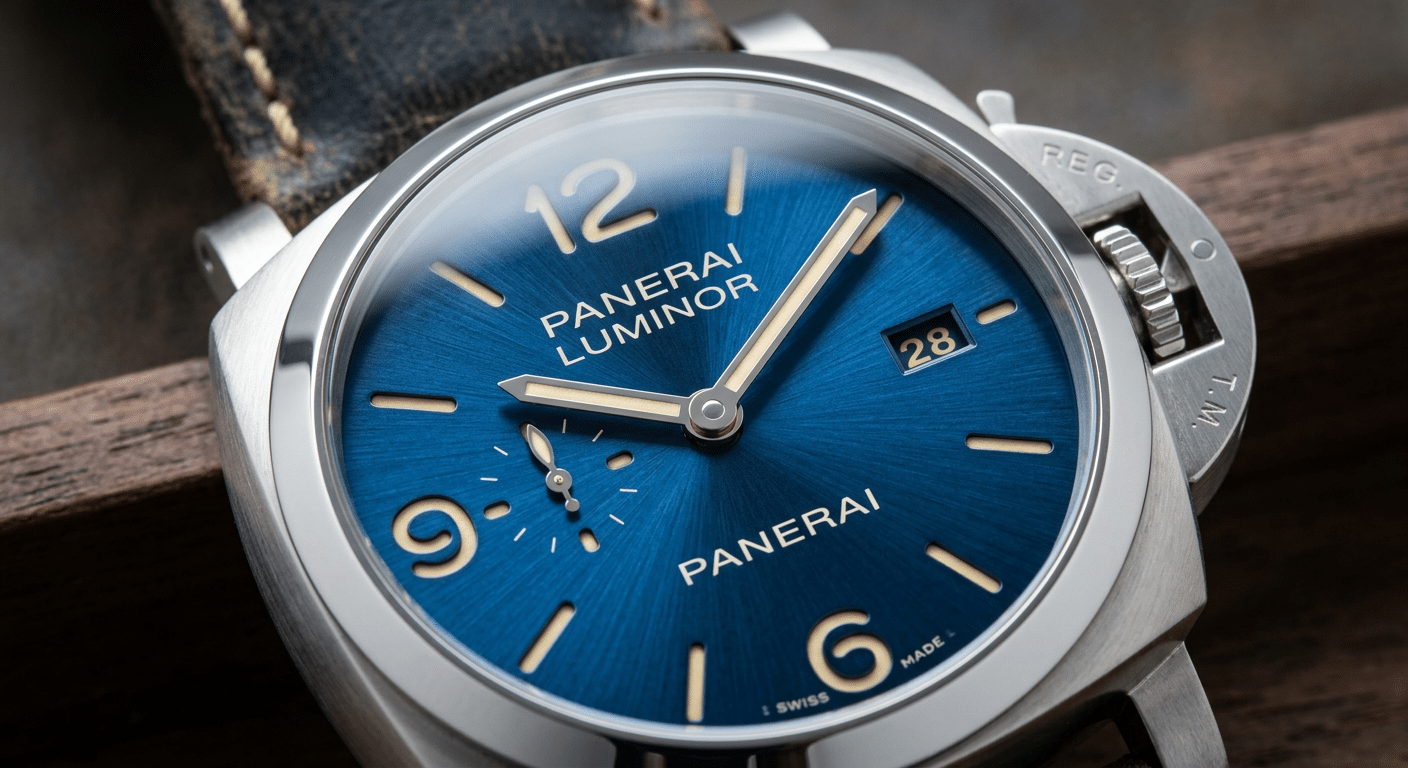
Analyzing Sunburst Finish and Grain Structure
The sunburst finish, often seen on models like the Luminor Due, is a critical aesthetic marker. Its quality is defined by the radial brushing depth and the consistency of its grain structure. Under 10x magnification, a top-tier clone, particularly from factories like VS Factory known for their modern Luminor Due lines, will exhibit a uniform, fine grain that reflects light evenly across the entire surface. This indicates precision micron-level etching, a process that is costly and technically challenging to reproduce. Lower-tier clones frequently display inconsistent brushing patterns, visible striations, or an insufficient depth that results in a dull, flat appearance, failing to capture the dynamic play of light characteristic of genuine Panerai dials. The grain alignment should track perfectly from the dial’s center outwards, without any discernible waviness or interruption.
Crispness of Sandwich Dial Cutouts and Lume Application
Panerai’s iconic sandwich dial, where luminous material is applied to a lower plate visible through cutouts in an upper plate, is a hallmark feature. The crispness of these cutouts is paramount. Factories like XF Factory, historically lauded for their mastery of this technique, achieve laser or CNC precision that results in hour marker edges that are sharp, clean, and entirely free of burring or rough textures, even under high magnification. The luminous material itself, typically Super-LumiNova BGW9 or a similar quality pigment, should be applied with absolute uniformity, presenting a smooth, slightly convex texture that fills the cutouts completely without overflow or voids. When activated with UV light, the glow should be consistent in intensity and color across all markers, without any patchy areas, indicating careful application and high-quality pigment.
Print Fidelity and Font Replication
The printed text on a Panerai dial—”PANERAI,” “LUMINOR,” depth ratings, and other inscriptions—demands rigorous scrutiny. High-tier clones meticulously replicate the correct font, weight, and spacing, ensuring that characters are sharp, opaque, and exhibit no ink bleed or feathering when examined with a 10x loupe. For instance, while VS Factory’s P.9000 clones are excellent, older batches were occasionally noted for date wheel fonts running slightly bold, a subtle deviation easily missed without direct comparison. The color of the print should match genuine specifications, and there should be no signs of “ghosting” or double printing, which are common tells of inferior production processes.
Expert Authentication Insight
To effectively assess dial topography, an experienced eye relies on specific tools. A 10x loupe is non-negotiable for inspecting print fidelity and cutout precision. Pair this with a variable-intensity LED light source to critically inspect the dial surface for uniform texture, micro-scratches, or any dust particles trapped beneath the crystal, which are often overlooked in hurried inspections. When evaluating sunburst effects, compare the perceived depth and light reflection against known genuine examples under identical lighting conditions. Observe the dial from multiple angles; a genuine or high-tier clone will maintain its visual integrity, whereas a lesser clone may reveal inconsistencies or a “flat” appearance.
Case Architecture: Material Integrity and Dimensional Accuracy
The case of a Panerai clone is not merely a housing; it’s a structural statement, and its integrity directly correlates with its manufacturing tier. Beyond superficial resemblance, a professional assessment delves into the material composition, the precision of its finishing techniques, and its adherence to the genuine article’s exacting dimensional tolerances. This includes the subtle curvature of the lugs and the seamless integration of the caseback, all of which speak to the sophistication of the manufacturing process.

CNC Machining and Surface Finishing Quality
The overall geometry of a Panerai case, particularly its cushion shape, is a complex interplay of curves and sharp angles. High-tier clones, produced through multi-axis CNC milling, achieve precise transitions between brushed and polished surfaces. Examine these transitions closely: they should be crisp, without any blurring or soft edges. The brushed surfaces must display a uniform grain, free from waviness or inconsistent patterns, while polished areas should present a mirror-like quality without visible swirls or imperfections. Factories like XF, pioneers in Panerai’s cushion-case geometry, set a high standard here, achieving proportions and finishing patterns that closely mirror the original. The grade of stainless steel, predominantly 316L for Panerai, also plays a role; top-tier clones use steel with a composition verified to industry standards, offering comparable corrosion resistance and workability.
Lug Curvature and Caseback Integration
The lug profile and curvature are crucial elements that dictate how a Panerai sits on the wrist. A high-tier clone will replicate the precise angles and ergonomic curve of the genuine lugs, ensuring a comfortable fit and correct aesthetic. Deviations here, such as wire lugs being 0.3mm thicker than genuine on some XF Radiomir models, can subtly alter the watch’s stance. Equally important is the flushness of the caseback seating. Minimal gaps where the caseback meets the mid-case are indicative of tight machining tolerances and the use of genuine-spec gaskets, which are essential for water resistance and structural integrity. Any noticeable protrusion or unevenness in the caseback’s fit suggests a lower manufacturing standard.
Crown Guard Construction and Lever Action
Panerai’s patented crown guard is perhaps its most recognizable functional feature. Its construction and the action of its lever are paramount indicators of clone quality. The crown guard should be crafted from the same high-grade material as the case (typically 316L steel) and integrated seamlessly without any visible gaps or misalignments. The lever mechanism itself is a critical diagnostic point: it must operate with a complete absence of “play” or lateral movement when engaged or disengaged. A high-quality clone will provide a definitive, reassuring “click” when the lever is closed, locking the crown securely. Any lateral instability, excessive friction, or a spongy feel indicates inferior machining and component quality. Even subtle tells, such as minor asymmetry in crown guard machining, have been observed in otherwise excellent VS Factory clones.
Expert Authentication Insight
For objective case assessment, digital calipers are indispensable. Measure the case diameter, lug-to-lug distance, and case thickness, comparing these directly against official Panerai specifications. A deviation exceeding +/- 0.05mm often signals a mid- or lower-tier clone. The crown guard lever should be actuated repeatedly, not just once. Focus on the tactile feedback: does it feel solid and precise, or loose and imprecise? Listen for that distinct, firm closure click. Any grinding sensation or lateral movement indicates a compromise in the internal mechanism’s precision or material quality.
Movement Replication: Caliber Fidelity and Operational Metrics
The movement within a Panerai clone, particularly those with display casebacks, offers a direct window into its manufacturing ambition. Discerning the internal mechanics involves more than just visual similarity; it requires a deep understanding of caliber decoration, functional performance, and, crucially, deviations in power reserve and timekeeping stability. In 2026, top-tier factories have achieved remarkable fidelity, but measurable operational metrics remain the ultimate arbiter of quality.
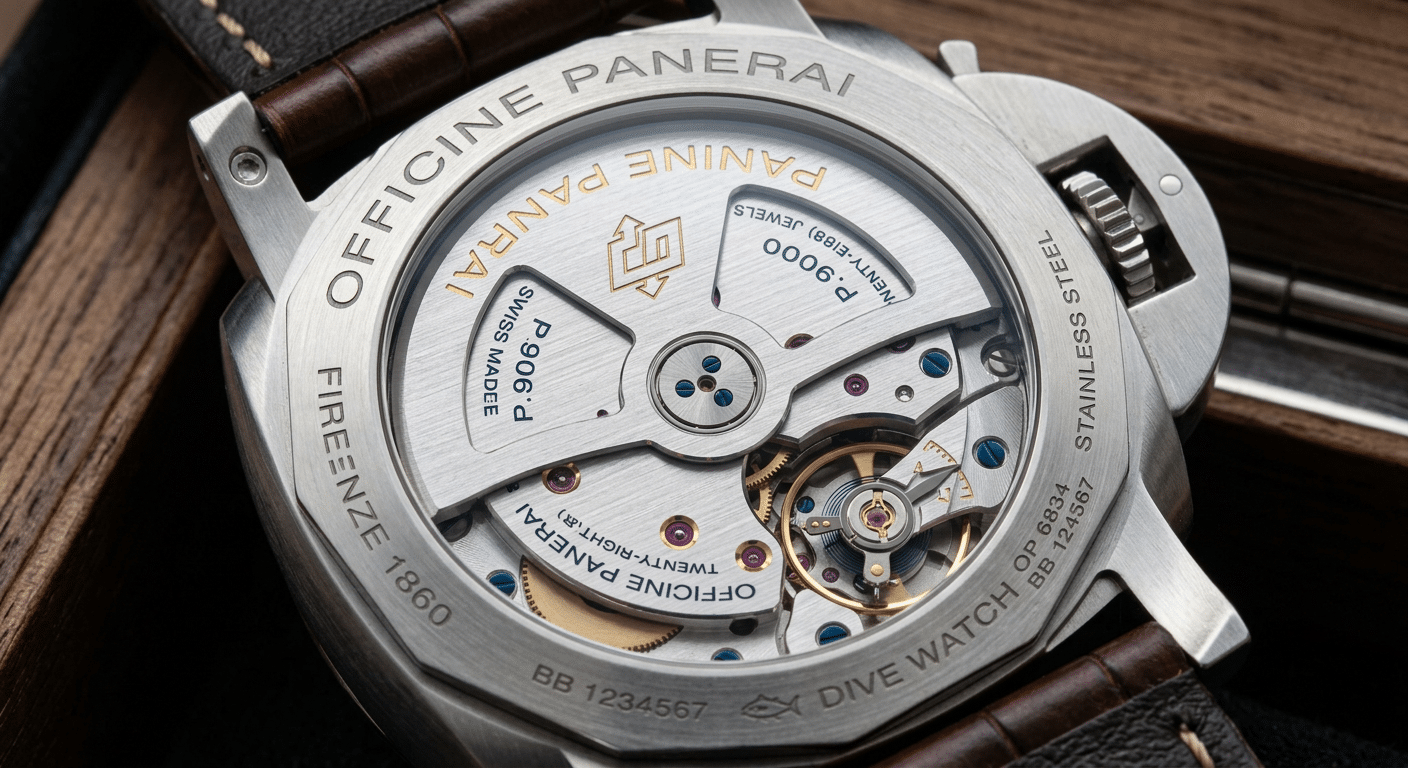
Clone Caliber Decoration and Bridge Finishing
For movements visible through a sapphire caseback, the decoration and finishing are key. High-tier clones, such as those from VS Factory with their P.9000/P.9010 series, meticulously replicate the perlage, Geneva stripes, and blued screw finishes found on genuine Panerai calibers. This isn’t just about applying a pattern; it’s about the depth, consistency, and sharpness of these decorative elements. While a clone movement may not achieve the hand-finished perfection of a genuine, the best examples will show uniform machine-applied patterns without rough edges or inconsistencies. The blued screws, for instance, should exhibit a deep, even blue hue, not a painted or inconsistent coloration. These visual cues, though often cosmetic, reflect the overall precision and attention to detail in the movement’s production.
Timekeeping Performance and Power Reserve
Beyond aesthetics, the true measure of a clone movement lies in its chronometric performance and power reserve. A VS P.9000 clone, for example, is renowned for achieving a power reserve of 70–72 hours, remarkably close to the genuine 72-hour specification. In contrast, XF Factory’s P.3000 clone typically delivers 65–68 hours, and older ETA-based alternatives often manage only 38–42 hours. This measurable difference in running time is a direct indicator of mainspring quality and winding efficiency. Furthermore, the timekeeping stability across multiple positions (dial up, dial down, crown up, etc.) should be assessed. While a clone may not achieve COSC-level certification, a high-quality example should exhibit a consistent daily rate with minimal beat error, indicating a well-regulated and robust movement.
Rotor Action and Winding Efficiency
For automatic movements, the rotor’s action and winding efficiency are critical functional aspects. A high-quality clone rotor, particularly those employing ball-bearing bidirectional winding like the VS P.9000, should move smoothly and freely with minimal noise. Excessive free play, a grinding sound during rotation, or a high-pitched whine are all red flags indicating inferior bearings, improper lubrication, or poor balance, factors critical to consider in a Panerai replica price map. The efficiency of the winding mechanism is also important; a well-engineered clone should achieve a full power reserve with reasonable wrist motion, akin to a genuine caliber, rather than requiring excessive movement or manual winding to maintain its charge.
Expert Authentication Insight
To move beyond visual inspection, a timegrapher is essential. This device measures amplitude, beat error, and the daily rate in at least five positions. A healthy amplitude for a 28,800 vph movement typically falls between 270° and 310°. Beat error should ideally be under 0.3ms. For power reserve, manually wind the watch to full capacity and then measure the exact duration until it ceases operation. Compare this directly against published specifications for the genuine caliber. These quantitative metrics provide irrefutable evidence of a clone movement’s functional fidelity, allowing for a precise evaluation of its tier.
Crystal Quality: Clarity, AR Coating, and Gasket Sealing
The sapphire crystal on a Panerai clone is more than a simple protective cover; it is a critical interface for dial legibility and a primary barrier against environmental ingress. Assessing its properties—material, anti-reflective treatment, and integration—provides immediate insight into the manufacturing tier, especially in 2026 where advanced cloning has narrowed visual discrepancies.
Sapphire Hardness and Optical Clarity
High-tier Panerai clones in 2026 consistently employ synthetic sapphire, mirroring the genuine article’s Mohs hardness of 9. This material choice is non-negotiable for superior scratch resistance and optical clarity. Lower-tier replicas, however, often betray their origin with mineral glass or inferior synthetics, which exhibit noticeable haziness or micro-scratches under direct light after minimal wear. A genuine-grade sapphire crystal offers a near-perfect transmission of light, allowing the dial’s intricate details to present without distortion or a milky cast, a characteristic that remains difficult to replicate without precise material sourcing and finishing.
Anti-Reflective (AR) Coating Application
Panerai’s typical approach to anti-reflective treatment involves a coating applied exclusively to the crystal’s interior surface. This design philosophy minimizes external reflections while protecting the delicate coating from abrasion. A high-fidelity clone will replicate this interior-only application, often presenting a subtle blue or purple hue when observed at oblique angles, a characteristic visual signature. Lower-grade clones frequently apply AR coating to both sides, resulting in an unnaturally reflection-free appearance, or they exhibit patchy, uneven coatings that can chip or smudge over time, creating noticeable imperfections that compromise legibility and aesthetic integrity.
Crystal Gasket and Water Resistance Integration
The integrity of the crystal’s seating within the bezel, mediated by a precisely engineered gasket, is paramount for both water resistance and dust prevention. In top-tier clones, the crystal should sit perfectly flush with the bezel, with no discernible gaps or unevenness around its circumference. This tight integration is a direct indicator of meticulous case machining and assembly. Any visible protrusion, recession, or inconsistent spacing suggests a compromise in manufacturing tolerances, directly impacting the watch’s functional resistance to moisture and particulate ingress. The gasket itself, typically nitrile or Viton in high-grade applications, must compress uniformly to create a reliable seal.
Expert Authentication Insight
To assess crystal quality, begin with a controlled “water drop test”: place a small bead of distilled water onto the crystal surface. On a hydrophobic, well-coated sapphire, the water should form a tight, high-domed bead without spreading, indicating a quality surface treatment. Next, observe the crystal from extreme oblique angles under varied bright light sources, such as an LED flashlight. Look for the characteristic subtle blue tint of the AR coating, ensuring it appears only on the interior (visible through the dial side) and is uniform across the entire surface. Any rainbow reflections or an absence of the blue hue suggests either a lack of AR coating, a double-sided application, or the presence of mineral glass. Micro-scratches or cloudiness under this focused inspection are immediate red flags.
Strap and Buckle Assembly: Material, Stitching, and Ergonomics
Often dismissed as mere accessories, the strap and buckle assembly play a disproportionately significant role in the overall “feel” and perceived quality of a Panerai clone. These components are in constant tactile contact with the wearer, and their material integrity, construction precision, and ergonomic design are crucial indicators of manufacturing fidelity that even advanced cloning cannot perfectly mask if corners are cut.
Leather Quality and Stitching Precision
High-tier Panerai clones utilize leathers that approximate the specific grain, pliability, and aroma of genuine calfskin, alligator, or other exotic hides. The texture should feel rich and supple, not stiff or plasticky. Crucially, the stitching must be executed with unwavering precision: tight, uniform rows with consistent thread thickness and color that matches the genuine article’s specifications. Any loose threads, uneven spacing, or misaligned stitches, particularly at the lug attachment points or around the buckle holes, immediately degrade the perceived quality and indicate a lower-tier production. The edge finishing of the strap, whether painted or folded, should also be smooth and without cracking.
Buckle Material and Engraving Fidelity
The buckle, whether a standard tang or a deployant clasp, should be crafted from the specified material—typically 316L stainless steel or titanium—with a surface finish (brushed or polished) that matches the case. The weight should feel substantial, not flimsy. A critical diagnostic is the fidelity of any engraved logos or text, such as “PANERAI” or “OP.” These engravings must be crisp, deep, and precisely formed, without any burring, shallow areas, or indistinct edges. Any sign of laser etching that lacks depth or exhibits pixelation under magnification is a clear tell. The pivot points and spring-loaded mechanisms within a deployant clasp should operate smoothly and without excessive lateral play.
Strap Attachment and Spring Bar Security
The interface between the strap and the watch lugs is a common point of failure or visual inconsistency in lower-tier clones. A high-grade clone will feature strap ends that fit snugly against the case, with minimal (ideally zero) gaps or lateral movement. The spring bars, which provide the primary attachment, should be robust and precisely manufactured to ensure secure seating within the lug holes. Weak or poorly dimensioned spring bars can lead to excessive strap play, premature wear on the lug holes, or even sudden detachment. The ease of strap changes, where applicable, should feel positive, without undue force or grinding, indicating proper lug hole alignment and spring bar quality.
Expert Authentication Insight
To evaluate the strap and buckle, begin by vigorously flexing the strap at its lug attachment points, observing for any signs of premature creasing, cracking, or weak stitching, which often manifest as fraying or visible gaps. Pay close attention to the strap’s edges; painted edges that are peeling or poorly applied suggest inferior quality. Examine the buckle’s pivot points and articulating parts for excessive lateral play or rough, unfinished edges. Actuate the locking mechanism of a deployant clasp several times, feeling for a secure, positive engagement and disengagement without grittiness or looseness. On a tang buckle, ensure the pin sits firmly in the strap holes without wobbling. Finally, check the strap-to-case fit; any gap exceeding 0.2mm between the strap end and the lug is indicative of imprecise manufacturing tolerances.
Luminescence Performance: Intensity, Duration, and Uniformity
The signature luminescence of a Panerai is not merely an aesthetic feature; it is a functional requirement rooted in the brand’s military heritage, demanding superior low-light legibility. Assessing the intensity, duration, and uniformity of the applied luminous material on a clone provides a quantifiable metric of its fidelity, revealing critical differences between high-tier replicas and their budget counterparts.
Lume Pigment Application and Color
Genuine Panerai models typically utilize high-grade Super-LumiNova, often in shades of cream/off-white for vintage-inspired designs or crisp white for modern iterations. A high-tier clone will employ a comparable pigment, such as BGW9 or C3, that accurately reproduces the color in ambient light and transforms into the correct blue or green glow when charged. Crucially, the application of this pigment must be perfectly even across all markers, hands, and any bezel dots. Any visible patchiness, inconsistencies in texture, or bleeding of the lume material onto the dial surface under magnification immediately signals a manufacturing defect. The notorious “green glow” in ambient light is an instant giveaway for budget fakes, as genuine Panerai lume typically appears white or off-white until charged.
Initial Brightness and Decay Curve
The initial brightness of the lume immediately after exposure to a light source is important, but its sustained glow duration—the decay curve—is a more stringent test. While genuine Panerai models boast 8+ hours of legible glow, top-tier clones with quality pigments like BGW9 can achieve 6–8 hours. Lower-tier clones, using inferior phosphorescent materials, often exhibit a rapid decay, becoming illegible within 1–2 hours. The goal for a high-fidelity clone, as explored in a detailed Panerai super clone guide, is not just a bright initial flash, but a consistent, slow fade that maintains legibility for a significant portion of the night, closely mirroring the performance profile of the authentic watch.
Uniformity Across Lumed Elements
A hallmark of quality lume application is its absolute uniformity across all lumed elements. This means that every hour marker, every segment of the hands, and any lumed bezel markings should glow with precisely the same intensity and color. Variations in brightness, subtle differences in hue, or areas where the lume appears thinner or thicker are clear indicators of a compromise in the application process. Such inconsistencies disrupt the visual balance of the dial in low light and are a common tell for lower-tier clones, where precise deposition of the luminous compound is often overlooked in favor of speed or cost reduction.
Expert Authentication Insight
To conduct a thorough luminescence assessment, move the watch into a completely dark room. Charge the dial for precisely 30 seconds using a powerful 365nm UV flashlight. Immediately after charging, photograph the dial. Repeat this photographic documentation at the 1-hour and 3-hour marks, and ideally again at the 6-hour mark if the lume persists. This sequence allows for a direct comparison of the initial brightness, the decay curve, and, critically, the uniformity of the glow across all lumed elements over time. Look for any markers that fade significantly faster than others, or areas that appear dim from the outset. Pay attention to the lume’s color in both charged and uncharged states, ensuring it aligns with the expected hue for the specific Panerai model. Any “hot spots” or “cold spots” in the glow pattern are strong indicators of inconsistent application.
Water Resistance: Functional Integrity and Sealing Standards
Water resistance, often cited as a core capability, is a critical functional aspect where lower-tier Panerai clones frequently fail. For a brand synonymous with maritime heritage, the ability to repel moisture is not merely a specification but a fundamental component of its operational integrity. A professional’s assessment moves beyond the stated rating to scrutinize the physical execution of the sealing system.
Gasket Material and Sealing Points
The watertight seal of any watch relies intrinsically on the quality and precise placement of its gaskets. In genuine Panerai timepieces, these seals are typically crafted from high-grade nitrile or Viton, materials chosen for their resilience against degradation from water, chemicals, and temperature fluctuations. High-tier clones, aiming for true functional fidelity, will employ gaskets of comparable material specifications and ensure their correct seating at all critical junctures: the caseback, the crown tube, and beneath the sapphire crystal. Lower-tier replicas often compromise here, utilizing cheaper, less durable rubber compounds that harden and crack prematurely, or failing to achieve uniform compression, leading to ingress points barely visible to the naked eye. The presence of genuine-spec gaskets is a non-negotiable marker for any clone aspiring to functional water resistance.
Crown and Tube Sealing Mechanism
Panerai’s distinctive crown systems, whether the traditional screw-down crown or the iconic crown guard lever, are central to its water resistance. For screw-down crowns, the quality of the threading on both the crown and the tube, coupled with the compression of the internal O-ring gaskets, dictates the seal’s efficacy. Imperfect threading, often found in mid-tier clones, can lead to cross-threading or insufficient gasket compression. The Luminor’s crown guard system, a signature element, must exert consistent, even pressure on the crown to compress its internal gaskets without introducing lateral play. Any discernible “wobble” or lack of firm engagement in the lever, or an audible grating sensation during operation, indicates poor manufacturing tolerances in the crown tube or guard mechanism, compromising water resistance at its most vulnerable point.
Pressure Testing Protocol
Evaluating water resistance in a clone watch requires a rigorous pressure testing protocol, moving beyond simple immersion. Static pressure tests, performed in a dry pressure chamber, assess the case’s structural integrity by subjecting it to compressed air, detecting deformation or leaks through micron-level pressure drops. Dynamic immersion tests, such as those performed with a Bergeon 5555 or similar wet tester, simulate real-world conditions by submerging the watch under pressure, often observing for bubble formation. It is crucial to understand that a clone’s claimed depth rating (e.g., 100m or 300m) is rarely achieved in practice. Most top-tier Panerai clones, if properly sealed, can reliably withstand 3 to 5 ATM (30-50 meters or 100-165 feet) of pressure, suitable for hand washing or light rain, but rarely for sustained swimming or diving. This functional limitation, even in the best clones, remains a significant differentiator from genuine articles.
Expert Authentication Insight
To objectively assess water resistance, utilize a professional water pressure tester capable of both dry and wet tests. For a common Luminor clone, subject the watch to a static dry test at 3 ATM for 15 minutes. A pressure drop exceeding 0.05 bar (0.7 psi) indicates a leak. Follow this with a wet test, submerging the watch in water to an equivalent of 3 ATM for 30 minutes. Post-test, place the watch on a heated plate for 10 minutes (approximately 40°C or 104°F) and immediately check the crystal for internal condensation, signaling moisture ingress. Visually inspect the dial and movement under 10x magnification for any signs of water spots or trapped droplets. This systematic approach transcends anecdotal claims, providing verifiable data on sealing integrity.
The “Feel” Factor: Tactile Feedback and Overall Cohesion
Beyond visual fidelity, the “feel” of a watch—its tactile feedback, auditory signatures, and overall cohesion—provides a crucial, often subconscious, indicator of its manufacturing quality. This subjective realm, though harder to quantify, is where the most sophisticated clones truly distinguish themselves.
Weight and Balance Distribution
The perceived heft and balance of a Panerai clone are immediate indicators of its material integrity and internal construction. Genuine Panerai Luminor Marina 44mm models, for instance, typically weigh between 160-165 grams (5.6-5.8 ounces) with a standard leather strap. High-tier clones strive to match this specific gravity, often employing solid 316L or 904L steel cases and, in some instances, internal tungsten counterweights to achieve a comparable mass. Lower-tier versions, using lighter alloys or hollowed components, will feel noticeably less substantial, often registering 10-15% lighter (e.g., 135-145 grams). The distribution of this weight is equally important; a well-balanced watch sits comfortably on the wrist without feeling top-heavy or awkward, a characteristic achieved through precise material allocation and movement integration.
Crown and Bezel Action
The operational feedback from the crown and, for dive models, the bezel, is a direct reflection of internal engineering and finishing. A high-quality Panerai clone’s crown should offer a smooth, deliberate action during winding and time-setting, devoid of grit, excessive friction, or lateral play. The “click” of the crown engaging different positions (winding, date-setting, time-setting) should be precise and confident, not vague or mushy. For Submersible clones with rotating bezels, the action should be firm, with crisp, distinct detents at each click, and, crucially, an absolute absence of back play. Any looseness, uneven resistance, or audible grinding during these operations indicates inferior machining, insufficient lubrication, or poorly toleranced components.
Auditory Signatures: Movement and Components
The often-overlooked auditory signatures of a watch can reveal much about its internal quality. The automatic winding rotor, for instance, should move with a smooth, barely perceptible whir, indicating precise bearing tolerances and effective lubrication. Excessive rotor noise—a distinct rattling or grinding sound—often points to a loosely mounted rotor, inferior bearings, or insufficient dampening. Similarly, the escapement beat, audible through a stethoscope or simply by holding the watch close to the ear, should be consistent and rhythmic. Any irregular beats, faint ticking, or noticeable variations in sound can signify issues with the movement’s regulation, lubrication, or overall assembly quality. These subtle sonic cues, though requiring a trained ear, contribute significantly to the overall perception of a watch’s mechanical integrity.
Expert Authentication Insight
To assess the “feel” factor, conduct a blind “shake test” by holding the clone watch in one hand and a known genuine Panerai of the same model (or a top-tier reference) in the other, without looking. Focus purely on the comparative weight and how the mass shifts during a gentle shake. Next, with eyes closed, operate the crown through its winding, date-setting (if applicable), and time-setting functions, paying acute attention to the tactile and auditory feedback—the smoothness, resistance, and precision of each click. For models with bezels, rotate it through its full range, noting the firmness of the detents and absence of back play. Any significant discrepancies in these sensory inputs provide objective data on the clone’s fidelity to genuine operational standards.
Closing Implication
The era of easily identifiable Panerai fakes is largely over; 2026 demands a more sophisticated approach. By systematically applying these diagnostic criteria—from the micron-level precision of a sunburst dial to the tactile integrity of a crown guard—you transition from a casual observer to an informed evaluator. This expert methodology not only allows you to precisely grade the tier of any Panerai clone but also cultivates a deeper appreciation for the exacting standards of genuine horology, providing a robust framework for assessing true value beyond mere aesthetics.