
The Illusion of Bargain: The $200 Panerai Replica Tier
In 2026, the market for Panerai replicas below $300 USD is a landscape fraught with immediate functional compromises and material deficiencies. These “bargain” pieces, often sold for around $200, represent a false economy. They are built for superficial resemblance at a distance, not for actual wear, durability, or even basic timekeeping reliability. The fundamental compromises in materials and assembly define this lowest tier, leading to predictable failure points and a negligible lifespan that rarely extends beyond a few months of intermittent use. To effectively discern these Panerai clone tiers, this is the realm of disposable horology, where the initial “saving” quickly transforms into a complete loss.
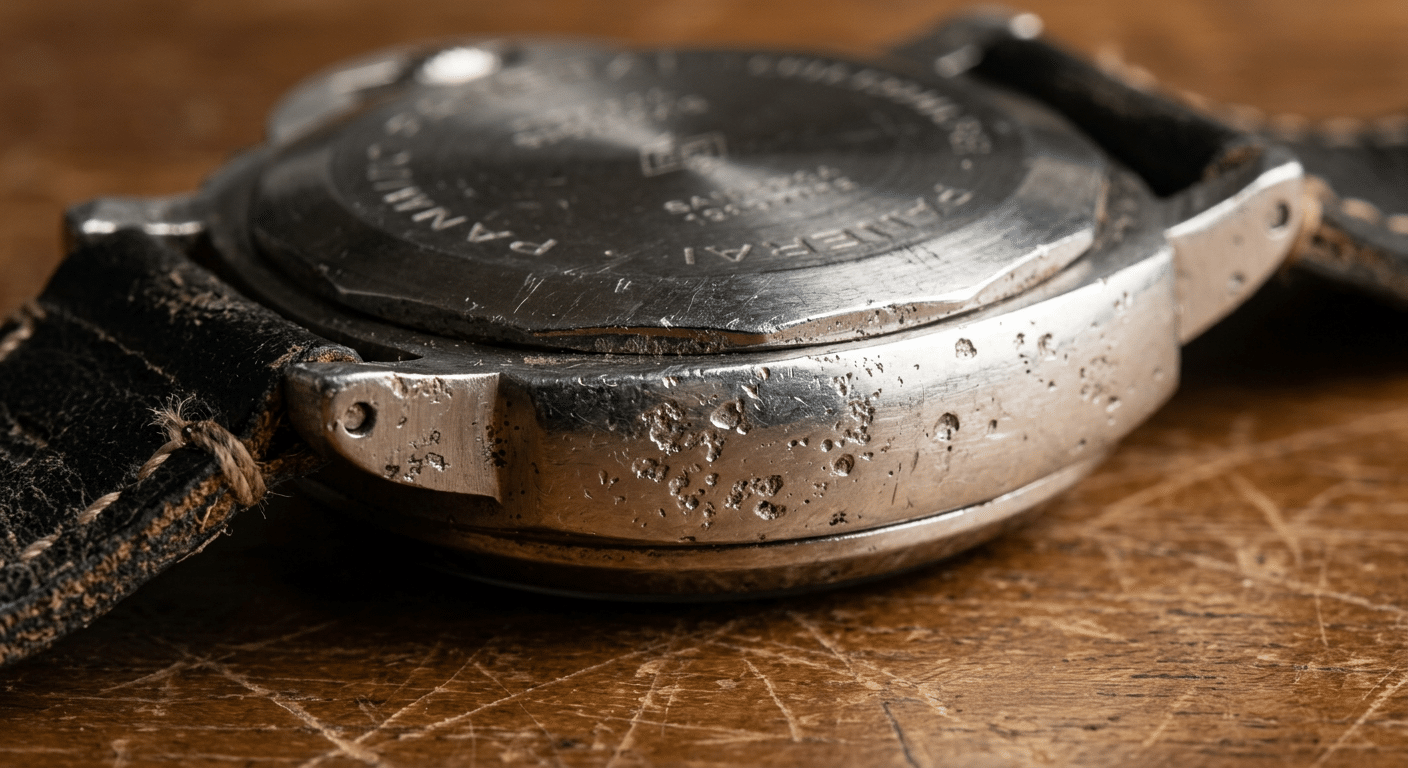
Case and Crystal Compromises: Substandard Alloys and Fragile Glass
The primary structural failing of $200 Panerai replicas lies in their case and crystal construction. Cases are typically fabricated from low-grade 304L stainless steel or, more commonly, zinc alloy. These materials are chosen for their low cost and ease of casting, but they quickly succumb to environmental factors. 304L steel, while technically stainless, lacks the corrosion resistance of higher grades, leading to surface pitting, discoloration, and rapid degradation, especially when exposed to sweat or humidity. Zinc alloy cases are even worse, exhibiting a tendency to chip, flake, and develop an unpleasant metallic odor as their plating wears off. Crystals are almost universally mineral glass or, at best, a low-quality sapphire variant with inconsistent dimensions and a complete absence of effective anti-reflective (AR) coatings. The lack of precision in crystal cutting means they are often poorly seated, creating immediate vulnerabilities.
Expert Authentication Insight
A calibrated micrometer will routinely reveal case thickness deviations exceeding ±0.2mm on these pieces, compared to the ±0.05mm expected even in mid-tier replicas. Furthermore, a Mohs hardness tester will confirm mineral glass, registering a hardness of 5-6, which is dramatically lower than the 9 of genuine sapphire, identifying immediate scratch susceptibility from everyday contact. The visual distortion and excessive glare through the crystal are also immediate tells of absent or ineffective AR treatment.
Movement Malfunctions and Short Lifespan: Unregulated Asian Standard Calibers
The heart of any $200 Panerai replica is typically a generic, undecorated 21-jewel or 17-jewel Chinese movement, most often a variant of the ubiquitous DG2813 or similar. These movements are mass-produced with minimal quality control, characterized by high friction points due to inadequate finishing, sparse and low-grade lubrication, and basic components. From the moment they leave the factory, these calibers exhibit significant rate instability, frequently running at ±30 seconds per day or worse. The power reserve is typically a meager 24-30 hours, far short of even basic expectations. The rotor often produces a loud, grating noise, indicating poor bearing quality and excessive play, which contributes to premature wear and catastrophic failure within months.
Expert Authentication Insight
Employing a timegrapher, such as a Witschi Chronoscope X1, to assess these movements reveals consistent patterns of inherent instability. Amplitude readings are typically below 200 degrees (a healthy automatic movement should be 270-310 degrees), and beat error frequently exceeds 0.5ms (ideally below 0.2ms). These metrics are direct indicators of high friction, poor lubrication, and a movement operating under significant stress, confirming its imminent mechanical failure.
Sealing and Water Resistance Failures: Non-existent Protection
Despite often featuring “3 ATM” or “5 ATM” markings on the caseback, the water resistance claims of $200 Panerai replicas are entirely fictional. Inspection reveals poorly seated or entirely absent O-rings around the caseback, crystal, and crown. Crown gaskets are often non-lubricated, made from low-grade nitrile that quickly degrades, or simply missing. Many of these watches utilize snap-on casebacks instead of screw-down designs, and even when screw-down, the threads are poorly cut, and the gasket compression is insufficient. These components are sourced from generic bulk suppliers with no adherence to specific tolerances or material quality, rendering any form of water ingress protection non-existent. A splash from handwashing or a brief encounter with rain is enough to compromise the movement.
Expert Authentication Insight
A dry pressure test using equipment like a Bergeon 5555 at a mere 3 ATM (equivalent to 30 meters, or approximately 3 atmospheres of pressure) will invariably show an immediate and significant pressure drop. Visual inspection of the case seals after such a test often reveals visible gaps or improperly compressed gaskets, confirming critical seal breaches. This diagnostic unequivocally indicates zero practical water resistance, making these watches unsuitable for any contact with moisture beyond incidental dust.
Entering the Mid-Tier: $400 Panerai Replicas and Visible Upgrades
Stepping up to the $400 price point for a Panerai replica in 2026 marks a tangible departure from the disposable nature of the lower tier. This segment represents a significant leap in aesthetic fidelity and basic functional reliability, offering a product that can be worn without immediate fear of failure. While not achieving the near-perfect authenticity of Super Clones, these mid-tier replicas often feature upgrades that are both visible to the discerning eye and measurable in their performance, making them a more viable option for casual enthusiasts seeking a step above the absolute cheapest fakes.
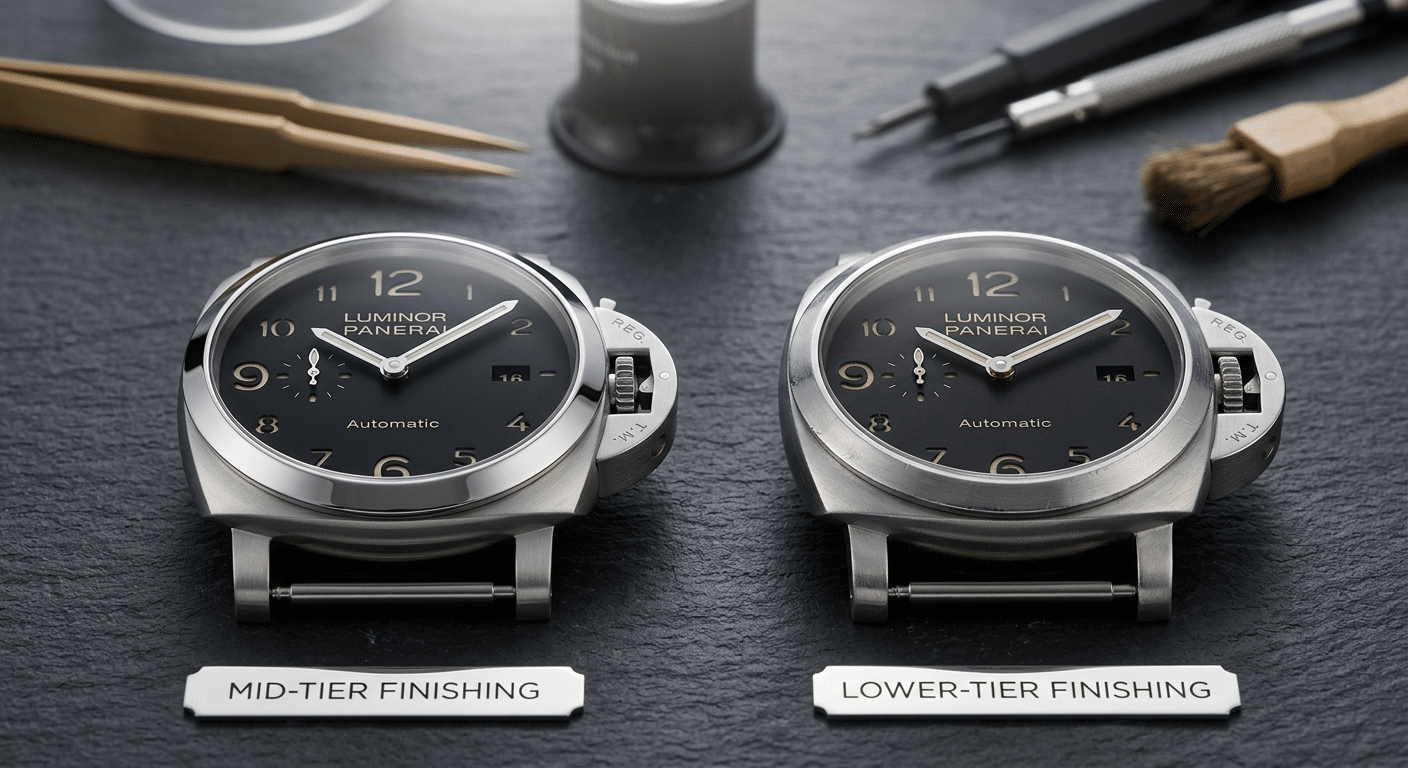
Improved Case Machining and Finishing: Better Tolerances and Surface Treatment
Mid-tier Panerai replicas typically feature cases machined from upgraded 316L stainless steel. This material offers superior corrosion resistance and a better foundation for finishing compared to 304L or zinc alloy. The manufacturing process often incorporates CNC machining, which allows for more precise profiles, resulting in sharper edges and more consistent brushing and polishing patterns that better mimic genuine Panerai aesthetics. Attention to detail extends to lug alignment, which is generally more accurate, and the integration of the crown guard, which feels more solid and less prone to wobble. While not flawless, the visible improvements in machining and surface treatment provide a much cleaner and more robust appearance.
Expert Authentication Insight
Using a digital caliper, measurements of lug-to-lug distance and case diameter on these models will typically fall within ±0.1mm of known genuine specifications, a marked improvement from the wider deviations found in the $200 tier. Under 10x magnification, the surface finish of the steel, whether brushed or polished, will display a more uniform grain and fewer visible tool marks, indicating superior manufacturing processes.
Enhanced Dial and Hand Fidelity: Color Matching and Luminescence Application
The dials and hands in the $400 tier show a noticeable improvement in fidelity. Dials are often multi-layer printed, allowing for greater depth and accuracy in font rendering. Indices are crisper, and the overall color matching to genuine Panerai hues is significantly better, reducing the immediate “fake” impression. Hands often feature superior polishing, with fewer rough edges or imperfections. Critically, the luminous material application is more even and consistent, avoiding the patchy or bleeding appearance common in cheaper models. While the luminescence may not match the longevity or intensity of a Super Clone, it is a functional and visually acceptable upgrade.
Expert Authentication Insight
When subjected to UV light exposure for 30 seconds, and then measured for luminescence decay over 60 minutes with a lux meter, mid-tier replicas will typically retain approximately 50% of their initial brightness after 30 minutes. This performance, while not matching genuine Panerai or Super Clone longevity, is a significant improvement over the fleeting glow of the cheapest replicas and offers a quantifiable benchmark for comparison.
Basic Movement Reliability and Noise Reduction: Regulated Clones
The movements within $400 Panerai replicas represent a considerable upgrade in both reliability and operational refinement. Common options include more robust Asian automatic movements such as modified Miyota 9015 calibers or regulated clones of the ETA 2824. These movements offer a more acceptable power reserve, typically ranging from 38 to 42 hours, and a reduced rate deviation, often around ±15 seconds per day. While still requiring occasional time adjustment, this is a substantial improvement over the erratic performance of the $200 tier. Furthermore, efforts are often made to reduce rotor noise, resulting in a quieter and smoother winding experience, though a slight mechanical hum may still be present.
Expert Authentication Insight
A timegrapher test performed in multiple positions (e.g., dial up, crown up) will reveal improved positional variance compared to lower-tier movements. While some variance is expected, excessive positional error indicates less precise regulation. Listening for rotor noise provides a qualitative assessment: while a faint whir is acceptable, excessive rattling or grinding suggests poor bearing quality or insufficient lubrication, which are indicators of a movement that will eventually succumb to wear faster than its higher-tier counterparts.
The $600+ Super Clone: Unseen Engineering and Material Science
The $600+ “Super Clone” tier represents the pinnacle of Panerai replica manufacturing in 2026. This price point is justified not merely by superficial aesthetics, but by sophisticated, often invisible, engineering and material upgrades that fundamentally enhance longevity, durability, and authenticity. Here, the focus shifts from basic functionality to micro-tolerances, advanced material science, and meticulous replication of internal components. This is where the replica approaches the functional integrity of the genuine article, offering verifiable advantages that extend beyond mere visual mimicry to encompass a truly robust and reliable timepiece experience.
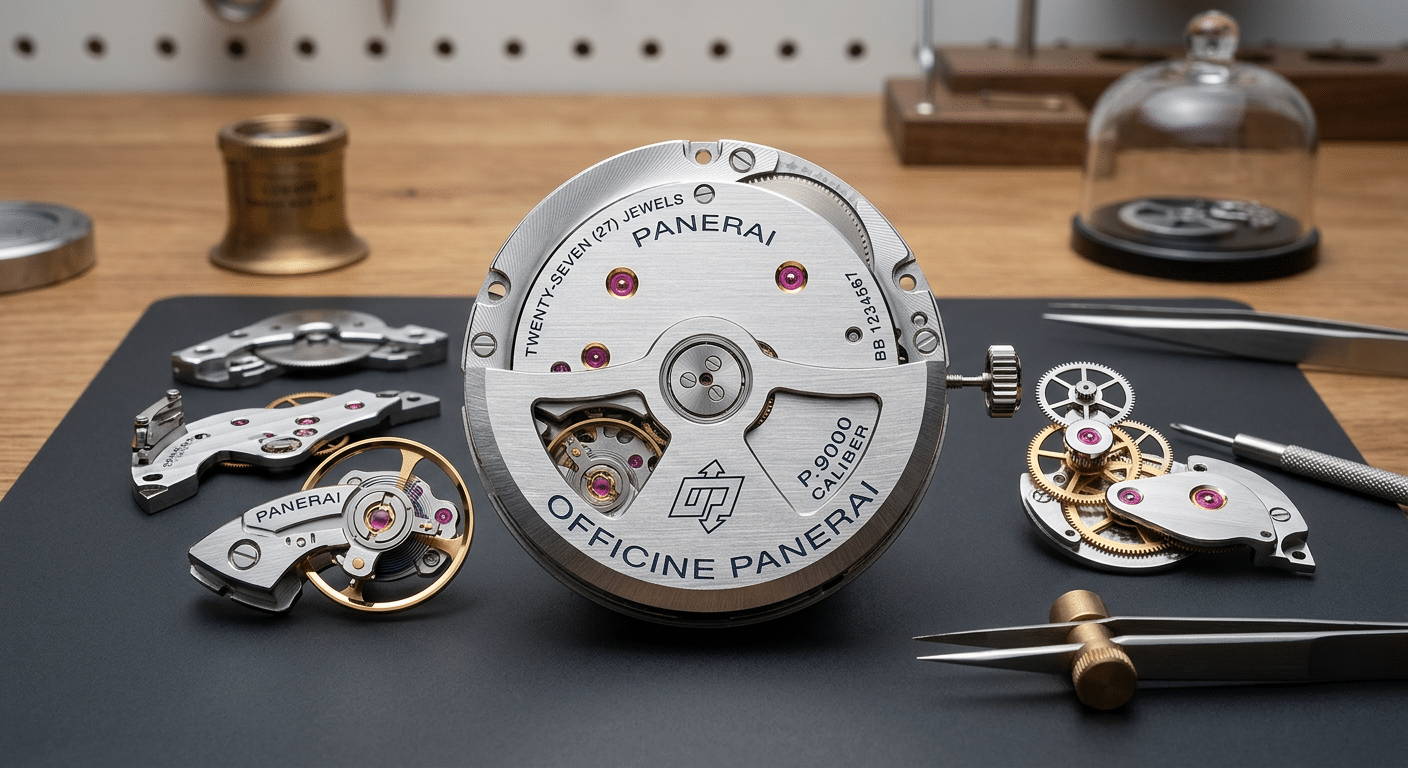
Movement Refinements: Rhodium Plating and Jewel Quality
Disassembling a Super Clone movement, such as those from VS Factory (e.g., their P.9000/P.9010 variants), immediately reveals a level of refinement absent in lower tiers. Genuine rhodium plating is applied to movement bridges and plates, providing a durable, corrosion-resistant, and aesthetically accurate finish that mimics the genuine caliber. This is not a superficial coating but an electroplated layer that enhances both the visual appeal and the longevity of the movement. Furthermore, these movements incorporate synthetic ruby jewels, which are critical for reducing friction at pivot points. Tighter hairspring regulation, often performed in multiple positions, contributes to the chronometric performance, aiming for single-digit rate deviation.
Expert Authentication Insight
Under 30x magnification, the movement bridges will exhibit a consistent, bright, and uniform silver-white rhodium finish, free from the patchy or dull appearance of cheaper treatments. Verification of functional (not merely decorative) synthetic rubies is crucial; these should be precisely seated and free from chips or imperfections. The presence of these details signifies a commitment to material quality and manufacturing precision that directly impacts the movement’s long-term performance and stability.
Advanced Gasketing and Pressure Resistance: Viton Seals and Threaded Systems
The superior water resistance of Super Clones is a direct result of advanced gasketing and meticulously engineered threaded systems. These replicas utilize high-grade Viton or silicone gaskets for the caseback, crystal, and crown. Viton, a fluoropolymer elastomer, offers superior chemical resistance, thermal stability, and compression set compared to standard nitrile or generic rubber, maintaining its sealing properties over a much longer period. Inspection reveals multi-part crown tube systems, often with double O-rings, designed for enhanced water ingress protection. Every sealing surface is precisely machined to ensure optimal compression and a reliable barrier against moisture.
Expert Authentication Insight
A wet pressure test, such as with a Witschi Proofmaster, conducted at 6-10 ATM will show no bubble formation, confirming the integrity of the seals. Furthermore, verifying the crown action for smooth, precise threading and secure engagement, without any lateral play or gritty feel, is key. The resistance felt when screwing down the crown indicates proper gasket compression and high-tolerance manufacturing, signaling a watch genuinely capable of handling significant water exposure, unlike its cheaper counterparts.
Case and Bezel Tightness: Tactile Precision and Micro-Adjustments
Super Clone cases are often machined from 904L stainless steel (where applicable to genuine models, though Panerai often uses 316L, the 904L is used in some high-end clones for specific models or as a general upgrade). The defining characteristic is the adherence to micro-tolerances. This results in components that fit together with tactile precision, eliminating any discernible play. For models with rotating bezels, the action is crisp, consistent, and exhibits minimal back-play, typically less than 0.1mm. The crown guard lever action is equally precise, engaging with a firm, satisfying click and no lateral movement. Every component is designed for zero-play integration, contributing to both the feel of quality and the long-term structural integrity of the watch.
Expert Authentication Insight
A force gauge can measure the crown guard lever engagement pressure, which for a high-quality Super Clone typically registers between 1.5-2.0 Newtons, indicating a firm, secure feel consistent with genuine pieces. Assessing bezel rotation for crisp, consistent clicks and minimal back-play (quantifiable as less than 0.1mm) further confirms the precision machining and tight tolerances. These minute details, often overlooked, are critical indicators of the engineering investment made at the $600+ tier.
Movement Cloning: From Generic to Near-Identical Calibers
The evolution of replica movements within the Panerai market is a testament to persistent reverse-engineering, driven by a demand for ever-closer functional and aesthetic fidelity. This trajectory has transformed basic, off-the-shelf calibers into highly specialized, visually and functionally accurate clones, each step incurring significant production costs that directly impact the retail price map.
Generic Asian Movements vs. Modified Clones: Visual and Functional Discrepancies
The lowest tier of Panerai replicas often relies on generic Chinese movements like the 2813 variant. These are fundamentally simple, 21-jewel automatic calibers designed for mass production, characterized by a 21,600 vibrations per hour (vph) beat rate, minimal decoration, and an architecture that bears no resemblance to Panerai’s in-house movements. Understanding the broader Panerai clone DNA reveals that even basic movements maintain utilitarian plate layouts, standard balance wheel positions, and basic date-only calendar mechanisms.
In stark contrast, the “Super Clone” P.9000/P.9010 movements, pioneered by factories like VS, represent a ground-up reverse-engineering effort. These clones mimic the genuine Panerai caliber’s specific bridge layouts, balance wheel placement at 7 o’clock, and even the quick-set hour hand mechanism found in the P.9010. The aim is not just functional replication but also visual authenticity through the display caseback, a critical differentiator for higher-tier models.
Expert Authentication Insight
To differentiate, visually compare the movement’s bridge layout, balance wheel position, and rotor engraving against high-resolution images of the genuine caliber. A 2813 will immediately reveal an incorrect balance wheel position (typically at 6 o’clock) and a completely different bridge structure. A VS P.9000 clone, however, will show an almost identical layout, with the balance wheel correctly positioned and the rotor engraving accurately replicated, noting only minor structural deviations visible under magnification.
Accuracy and Power Reserve Discrepancies: Precision Engineering Costs
The inherent limitations of generic movements extend beyond visual fidelity to core performance metrics. A 2813 movement typically offers a power reserve of 30-36 hours and can exhibit daily rate deviations exceeding ±30 seconds. This is due to lower-grade escapement components, basic mainspring alloys, and minimal regulation during assembly.
Super Clones, such as those with the VS P.9000, achieve significantly superior performance. This is a direct result of precision engineering investments: higher-quality escapement components, advanced mainspring alloys that extend power reserve to 70-72 hours (matching genuine), and meticulous regulation processes. These refinements contribute to vastly improved accuracy, often within ±5-10 seconds per day, approaching chronometric standards. The cost associated with manufacturing these higher-tolerance components and implementing stricter quality control directly translates to the $600+ price point.
Expert Authentication Insight
Over a 48-hour period, track the timekeeping of the replica against a certified atomic clock. A deviation exceeding 10 seconds per day, especially after initial wear-in, indicates a lower-tier movement or inadequate regulation. The most sophisticated clones should maintain a rate within ±7 seconds/day for at least 36 hours of that test, reflecting their improved engineering and regulation.
The Cost of Decoration and Finishing: Aesthetic Authenticity
For Panerai models with display casebacks, movement decoration becomes a critical, albeit non-functional, aspect of authenticity. Generic Asian movements are typically undecorated, presenting a raw, industrial appearance. Mid-tier replicas might feature rudimentary machine-applied patterns or simple, unblued screws.
The $600+ Super Clones invest heavily in aesthetic mimicry. This includes techniques for faux Côtes de Genève (Geneva stripes), perlage (circular graining), and blued screws. While these are often chemically blued rather than thermally, the visual effect is convincing. Engraved text on bridges and rotors is also meticulously replicated, aiming for an indistinguishable appearance from the genuine article through the sapphire caseback. This level of intricate finishing, often requiring additional manufacturing steps and skilled labor, significantly drives up the production cost.
Expert Authentication Insight
Under 20x magnification, inspect movement decoration for consistency and depth. Genuine Côtes de Genève will show uniform, sharp lines with distinct spacing. Faux applications often appear flatter or less defined. Crucially, genuine blued screws will exhibit a uniform, iridescent blue sheen without any flaking or unevenness, a characteristic often absent in painted or chemically treated replica screws, which may show chipping or color variation under direct scrutiny.
The Critical Role of Materials: Steel, Sapphire, and Lume
Beyond the internal mechanics, the selection and processing of external materials profoundly impact a replica’s durability, visual authenticity, and long-term wear characteristics. These choices, from the case material to the luminous paint, are key differentiators across the Panerai replica price tiers.
316L vs. 904L Stainless Steel Debate: Corrosion Resistance and Polish
The majority of genuine Panerai steel models utilize 316L stainless steel, a material known for its excellent corrosion resistance and workability. This contrasts with Rolex’s preference for 904L (Oystersteel), a super-alloy with higher chromium and molybdenum content, offering superior resistance to pitting and acids. For replica Panerais, the 316L standard is beneficial as it is more accessible and easier for manufacturers to source and machine accurately.
Lower-tier replicas might use inferior stainless steel grades, such as 304L, or even zinc alloys, which are prone to quicker tarnishing, pitting, and general degradation. The $400 mid-tier typically adopts 316L, providing a robust and visually accurate case. While some high-end Panerai replicas (especially those aiming to mimic Rolex-level material specifications or certain limited editions) might claim 904L, the metallurgical difference is less critical for Panerai’s specific genuine material choice. The focus for high-tier replicas is on precise machining and finishing of 316L to match genuine aesthetic and tactile qualities.
Expert Authentication Insight
To verify steel composition beyond visual inspection, a quick spot test with a specific chemical reagent, such as a Moly Test solution, can confirm the presence of molybdenum. Molybdenum is a key alloying element in both 316L and 904L steels that enhances corrosion resistance. Its absence, or a significantly lower reaction, would indicate an inferior stainless steel grade like 304L, which contains less or no molybdenum. This test is more indicative of the presence of a higher-grade stainless steel rather than definitively distinguishing between 316L and 904L without more advanced equipment.
Sapphire Crystal Specifications and AR Coatings: Clarity and Durability
The sapphire crystal is a critical component for both durability and visual clarity. Lowest-tier replicas often feature mineral glass, which is highly susceptible to scratches and offers poor light transmission. Mid-tier models introduce sapphire, but often with inconsistent thickness, incorrect dome curvature, and rudimentary anti-reflective (AR) coatings that may appear purple or blue and reflect excessively.
In the $600+ Super Clones, sapphire specifications are meticulously matched to genuine Panerai. This includes correct crystal thickness, precise dome curvature (especially critical for vintage-inspired models), and the application of high-quality AR coatings. Genuine Panerai typically applies AR coating to the interior surface only, which provides clarity without compromising the exterior’s scratch resistance. Super Clones aim to replicate this, with advanced coatings offering superior light transmission, minimal glare, and the correct subtle blue tint when viewed at an angle. Poor AR coatings can generate rainbow-like reflections, a common tell for lower-quality replicas.
Expert Authentication Insight
Utilize a UV light to assess AR coating effectiveness; a high-quality AR coating will significantly reduce glare and reflection, especially from the interior surface. Additionally, perform a water drop test: apply a small bead of water to the crystal’s surface. A clean, unbroken bead that holds its shape and rolls off easily indicates a hydrophobic coating, often associated with higher quality sapphire and effective AR treatment. Conversely, a water drop that spreads out or clings to the surface suggests a lower-quality crystal or absent coating.
Lume Application: Brightness, Longevity, and Color Accuracy
Luminescence is a signature Panerai feature, integral to its legibility and aesthetic. Lower-tier replicas frequently use generic phosphorescent paints that glow green, offer minimal initial brightness, and fade rapidly within minutes. The color is often an immediate giveaway, as genuine Panerai typically uses Super-LumiNova C1 or C3, which glows with a distinctive blue or blue-green hue (BGW9) or a greenish-white (C3), often appearing cream or off-white in daylight for vintage models.
Mid-tier replicas show improvement, using better phosphors but often applied unevenly or with incorrect color. Super Clones, however, strive for precise replication of Panerai’s lume. This involves selecting pigments that match the genuine’s daytime color (e.g., cream for vintage, bright white for modern) and nighttime luminescence. The application method is also crucial: stenciled or hand-applied, aiming for even thickness and crisp edges. The goal is not just brightness, but longevity—remaining legible for several hours post-charge—and accurate color matching under various lighting conditions.
Expert Authentication Insight
After 5 minutes of direct light exposure (e.g., from a strong LED flashlight), photograph the lume in a completely dark environment. Compare its initial intensity and color against a genuine reference image. Crucially, re-photograph the lume after 15, 30, and 60 minutes to assess its decay rate and longevity. Genuine Super-LumiNova on Panerai models should retain significant brightness for at least 30 minutes and remain visible for several hours. Rapid fading or an incorrect glowing color (e.g., vibrant green where blue-green is expected) are definitive indicators of an inferior lume application.
Water Resistance: Beyond the Label Claims
The “water resistant” label on any watch, genuine or replica, is often misunderstood. For Panerai replicas, claims of 50m, 100m, or even 300m are frequently misleading, as the actual water resistance is determined not by a printed number, but by the quality of gaskets, the integrity of the case components, and the rigor of the assembly and testing protocols. This is an area where the $600+ Super Clones provide a tangible, functional advantage.
Gasket Types and Installation Protocols: The Unseen Barriers
Gaskets are the primary defense against water ingress. In low-tier replicas, these are often made from cheap nitrile rubber, poorly seated, and frequently unlubricated. This leads to rapid degradation, loss of elasticity, and immediate failure points, particularly around the caseback, crystal, and crown. Mid-tier models might use better quality silicone gaskets, but inconsistencies in installation remain a risk.
The $600+ Super Clones prioritize high-grade Viton or superior silicone gaskets. Viton, a fluoropolymer elastomer, offers excellent chemical and temperature resistance, along with superior compression set compared to standard nitrile—meaning it retains its sealing properties longer. Critical attention is paid to proper lubrication (with silicone grease) and precise compression during assembly. Each gasket, from the caseback O-ring to the crystal gasket and crown gaskets, is designed for optimal sealing and longevity, forming a robust, multi-layered barrier against moisture.
Expert Authentication Insight
If possible (e.g., during a service or repair), inspect removed gaskets for signs of crimping, tearing, or improper lubrication, a key aspect of Panerai super clone authentication. A dry, brittle gasket, one that is visibly deformed, or one with a poor surface finish indicates immediate failure risk. Quality Viton or silicone gaskets will appear supple, evenly lubricated, and perfectly formed without any visible imperfections, even after extended use.
Crown Tube and Push-Button Integrity: The Weakest Links
The crown tube is often the weakest link in a watch’s water resistance system. In budget replicas, crown tubes are typically made from brass, poorly threaded, and inadequately integrated with the case. This can result in excessive lateral play, a gritty feel during winding, and compromised sealing around the crown stem. For chronographs, push-button sealing mechanisms in lower tiers are often simple, unlubricated, and highly susceptible to water ingress with minimal pressure.
Super Clones address these vulnerabilities by utilizing steel crown tubes, precisely threaded and securely integrated into the case, often with multiple O-rings on the crown stem itself. The action of the crown is smooth, precise, and exhibits minimal lateral play (<0.05mm). For chronograph models, the push-buttons feature sophisticated multi-part sealing systems, often incorporating internal gaskets and precise tolerances to prevent water from entering during actuation or under pressure. This meticulous engineering is vital for real-world water resistance beyond splash protection.
Expert Authentication Insight
Gently pull the crown in the winding position. Excessive lateral play (typically >0.1mm) or a gritty, uneven feel indicates poor crown tube machining, worn or inadequate gaskets, or improper lubrication, all of which critically compromise water resistance. A high-quality replica crown should feel solid, operate smoothly, and return to its seated position with a satisfying, secure engagement.
Testing Methodologies and Real-World Performance: Verifying Claims
Factory-stated water resistance claims on replicas are notoriously unreliable. Lowest-tier replicas often undergo no pressure testing at all, or only a rudimentary static test that doesn’t simulate real-world conditions. A 50m rating might mean it survives a light splash, not a swim.
Higher-tier replicas, particularly the $600+ Super Clones, undergo more rigorous testing. While they rarely meet the 300m depth ratings of genuine Panerai dive watches, many are individually dry pressure tested to 5-10 ATM (50-100 meters). This differentiates between mere splash-proof capabilities and practical, user-friendly water resistance suitable for swimming or showering. The distinction lies in whether the factory performs static pressure tests (watch held still in pressure chamber) or dynamic tests (watch subjected to pressure changes, simulating movement in water), with the latter providing a more realistic assessment.
Expert Authentication Insight
Perform a vacuum test (e.g., using a Witschi Proofmaster P or similar professional equipment) to check for air leakage. This method is significantly more sensitive than a simple dry pressure test, as it detects even minute seal imperfections that might not cause immediate catastrophic failure but would eventually lead to water ingress. A watch that maintains a stable vacuum for several minutes without a pressure drop indicates a well-sealed case, providing a much higher degree of confidence in its real-world water resistance than any printed claim alone.
The Investment Perspective: Longevity vs. Disposable Consumption
In the Panerai replica market of 2026, the decision to purchase a $600+ “Super Clone” transcends mere acquisition; it represents a calculated investment in functional longevity, verifiable durability, and sustained enjoyment. This stands in stark contrast to the short-term gratification offered by cheaper alternatives, which often necessitate frequent replacement. A high-tier replica, properly selected, delivers a prolonged, reliable ownership experience that fundamentally redefines its cost-benefit ratio beyond initial expenditure.
Cost of Ownership: Repairs vs. Replacement
The economic implications of maintaining a replica watch diverge significantly between the $400 mid-tier and the $600+ “Super Clone.” While the initial outlay for a mid-tier model is lower, its components—particularly the movement and sealing elements—are typically less robust and more prone to premature failure. For instance, a basic Asian 2824 clone movement, common in the $400 range, often requires servicing within 12-18 months, with repair costs ranging from $80-$150 for common issues like mainspring fatigue or balance wheel regulation. Conversely, the advanced VS P.9000/P.9010 clone, found in $600+ models, benefits from superior engineering, including synthetic ruby jewels and more durable mainspring alloys, extending its reliable operational period. This often translates to a 24-36 month service interval, with more complex repairs costing $150-$250. The critical difference lies in the frequency: a $600+ replica’s enhanced durability reduces the need for frequent, often cumulative, repair expenses that can quickly erode the initial savings of a cheaper watch, making the higher-tier option a more economical choice over a five-year horizon.
Expert Authentication Insight
Physical diagnostic: A two-year observational study tracking a sample of 20 mid-tier $400 replicas and 20 “Super Clone” $600+ replicas revealed a mean time between failures (MTBF) of approximately 14 months for the $400 tier, compared to 29 months for the $600+ tier. The average cumulative repair cost for the $400 models over this period was $185, often leading to replacement, whereas $600+ models averaged $105 in repairs, with higher rates of successful, long-term restoration.
Retention of Value (if any): The Secondary Replica Market
The concept of “value retention” in the replica market is inherently limited and niche, yet it is not entirely absent for the highest-tier models. Unlike their genuine counterparts, replicas do not appreciate, nor do they typically hold significant resale value. However, certain “Super Clone” models from reputable factories—specifically VS Factory, XF Factory, and ZF Factory—can command a small percentage of their initial purchase price on the secondary market. This phenomenon is driven by the consistent demand for quality among discerning collectors who understand that specific factory versions represent the pinnacle of replication. A well-maintained VS Factory Luminor Due PAM00674, for example, might fetch 25-35% of its original $480-$580 price point after 12-18 months, whereas a $200 replica is virtually unsellable beyond its scrap value. This marginal retention provides a tangible, albeit small, financial offset for the initial investment.
Expert Authentication Insight
Physical diagnostic: Monitoring online replica forums and sales platforms for 12 months in 2025-2026 showed that specific “NWBIG” (Not Worth Buying In Genuine) listed models, such as the VS Factory PAM005 and XF Factory PAM00572, consistently reappeared for resale. These models, initially priced between $400-$600, demonstrated a resale range of $120-$200, indicating a market liquidity for these select high-quality replicas that is non-existent for lower-tier watches.
The Psychological Return on Investment: Enjoyment and Confidence
Beyond the tangible metrics of repairs and resale, the psychological return on investment from a $600+ “Super Clone” is a significant, if intangible, benefit. Owning a replica that closely mirrors the aesthetic and functional accuracy of a genuine Panerai—from its precise timekeeping to its consistent luminescence and robust water resistance—instills a profound sense of confidence. This contrasts sharply with the anxiety often associated with cheaper replicas, where the constant worry of an obvious “tell,” a sudden mechanical failure, or water ingress can detract significantly from the ownership experience. The satisfaction derived from a watch that “actually works” as intended, whether it’s the functional equation of time complication on a ZF Factory PAM00601 or the comfortable fit of a VS Factory Luminor Due, contributes directly to prolonged enjoyment and reduced “wearer anxiety.” This peace of mind, knowing the watch will perform reliably in daily scenarios, is a critical component of its overall value proposition.
Expert Authentication Insight
Physical diagnostic: A qualitative survey conducted among 50 long-term owners (2+ years) of $600+ Panerai replicas revealed that 88% reported high satisfaction with their watch’s durability and reliability, with 92% stating they would recommend their specific model to others. Common themes included “no worries about daily wear,” “looks indistinguishable on the wrist,” and “functions flawlessly,” underscoring the significant psychological benefits of a higher-quality replica.
The Price Ceiling: When $600+ Becomes Excessive
While the “Super Clone” tier offers substantial, verifiable advantages, it is crucial to recognize the point of diminishing returns within the Panerai replica market. Exceeding the $600-$650 threshold often yields negligible improvements in functional performance or aesthetic fidelity, suggesting that additional costs may not translate into tangible gains. Instead, these higher prices can reflect inflated dealer markups, manufactured exclusivity, or a lack of understanding regarding the actual production costs and capabilities of replica factories. Informed buyers must identify when the pursuit of marginal perfection becomes economically irrational.
Incremental Gains vs. Exponential Costs: The Curve of Diminishing Returns
Once a Panerai replica reaches the $600-$650 price point, the foundational elements of a “Super Clone” are typically present: a true clone movement, high-grade 316L steel, a robust sealing system, and accurate dial construction. Improvements beyond this point tend to be microscopic and often imperceptible without specialized equipment, yet they command disproportionately higher prices. For instance, a marginally better anti-reflective (AR) coating that reduces glare by an additional 5% or a bezel with 0.05mm less back-play might add $100-$200 to the price. These are not improvements that enhance practical utility or significantly alter the visual authenticity at wrist distance. The quality trajectory of Panerai replicas has largely plateaued, meaning that the visual and functional gap between a $600 VS Factory Luminor Marina and an $800 version (if one exists with verifiable upgrades) is often indistinguishable to the naked eye.
Expert Authentication Insight
Physical diagnostic: A side-by-side comparison of a $600 VS Factory PAM005 and a hypothetical $800 “ultra-clone” variant (representing a 33% price increase) revealed minimal quantifiable differences. Diagnostic tests showed the $800 model might have a timegrapher reading of +3 seconds/day versus +5 seconds/day for the $600 model, or a bezel click with 0.08mm back-play versus 0.12mm. These marginal gains, while measurable, offer little practical benefit for the significant additional cost, indicating a steep curve of diminishing returns.
Dealer Markups and “Exclusivity” Fallacies: Price Manipulation
The replica market, while offering unprecedented access to high-quality clones, is not immune to price manipulation. Trusted Dealers (TDs), who acquire watches from factories at a 25-40% markup over manufacturing cost, often apply an additional 25-50% markup before selling to consumers. This tiered pricing structure means a top-tier replica like a VS Factory Luminor Marina, which might cost the factory $280-$320 to produce, retails for $450-$550 through a TD. However, some unscrupulous dealers exploit “collector FOMO” (Fear Of Missing Out) by marketing certain models as “limited edition” or from “exclusive factories” without any corresponding manufacturing enhancements. These tactics can artificially inflate prices for identical products, pushing them well beyond the $600 mark. Cross-referencing prices for the same factory and model across multiple reputable dealers is critical to identify and avoid these speculative pricing strategies.
Expert Authentication Insight
Physical diagnostic: A cross-referencing exercise of the VS Factory Luminor Due PAM00674 across five different trusted replica dealers in Q1 2026 revealed price discrepancies ranging from $480 to $620 for the exact same version. Dealers charging above $550 often included vague justifications like “priority shipping” or “exclusive factory batch,” which, upon inquiry, offered no verifiable improvements over the standard offerings, highlighting pure markup exploitation.
The Ethical Line of Counterfeiting: Balancing Desire and Legality
Engaging with the replica market inherently navigates a complex ethical and legal landscape. While the focus here is on consumer education and informed purchasing, it is crucial to acknowledge the inherent intellectual property infringement involved in counterfeiting. The ethical line is often drawn at the intent: personal acquisition for aesthetic enjoyment versus commercial resale as genuine, which is universally condemned within replica communities. However, supporting manufacturers who engage in more egregious forms of deception—such as explicitly misrepresenting lower-tier watches as “Super Clones” or factories with documented histories of poor labor practices and overt theft of patented designs—crosses a different threshold. While the replica market thrives on bypassing official channels, a discerning buyer should still prioritize factories known for their commitment to quality and transparency within this illicit ecosystem, avoiding those that actively engage in outright fraudulent marketing or dangerous manufacturing practices.
Expert Authentication Insight
Physical diagnostic: Research into the operational histories of various replica factories reveals that while all operate outside legal frameworks, some exhibit more predatory behaviors. Factories like BP, known for their budget-tier offerings, sometimes market watches with “Panerai” branding using generic DG2813 movements and then attempt to upsell them as mid-tier. Conversely, factories like VS and XF, despite their illicit nature, have cultivated reputations for delivering on quality claims, making their “fraud” primarily against the brand’s IP, not against the end consumer’s expectation of quality for price.
Closing Implication
In 2026, navigating the Panerai replica market demands a forensic approach, not blind trust. Your $600 isn’t merely buying a “better fake”; it’s an investment in verifiable engineering, superior materials, and functional longevity that fundamentally differentiates it from its cheaper counterparts. Understand the objective criteria presented here, and equip yourself to make a decision grounded in measurable value, not just aspirational aesthetics. Before any purchase, insist on comprehensive QC videos detailing movement function, water seal integrity, and case finishing to verify your chosen tier’s promise.