
The Chronograph Scale Conundrum: Beyond Aesthetic Replication
In 2026, the “super clone” moniker has reached an unsettling level of visual fidelity, yet functional performance remains the ultimate tell. While a Breitling chronograph’s pushers might feel indistinguishable, the true test often lies in the nuanced execution of its dial scales. We’re not discussing hypothetical scenarios; we’re dissecting specific operational failures, such as chronograph seconds hand stutter, and the underlying precision compromises that differentiate a meticulously engineered instrument from a convincing, yet functionally flawed, replica.
The Rise of Multi-Scale Super Clones: A Visual Deception
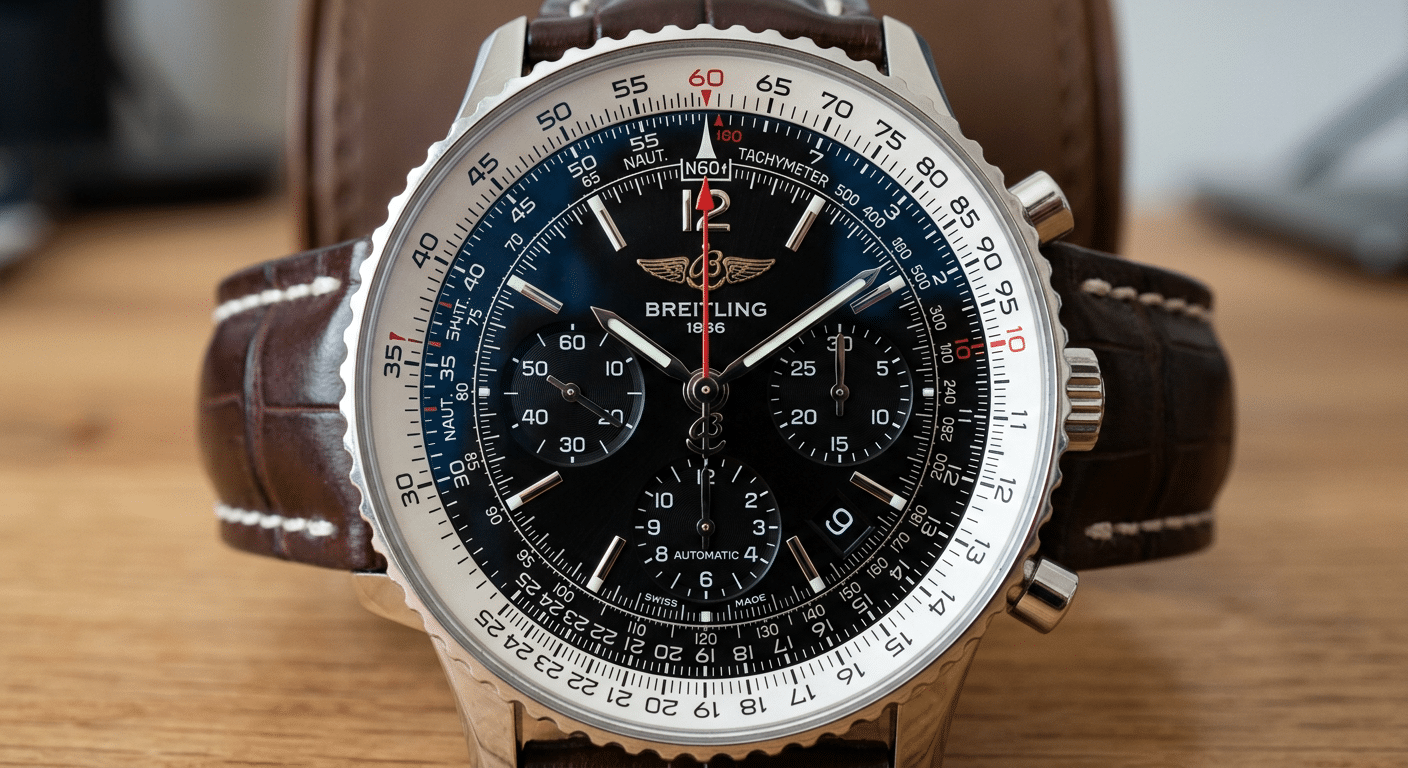
The proliferation of super clones has pushed replication technology to mimic increasingly complex dial layouts. Manufacturers now routinely produce Breitling chronographs featuring not just a tachymeter, but often nested telemeter and pulsometer scales, sometimes even all three. The visual mimicry of fonts, spacing, and color on these multi-scale dials is frequently exceptional, with factories investing heavily in high-resolution pad printing. Under casual observation, the numerals appear crisp, the tracks precisely aligned, and the color saturation matches genuine counterparts. This visual deception is the primary selling point, often obscuring fundamental functional discrepancies that only manifest under scrutiny.
Functional Expectations vs. Aesthetic Mimicry
The core issue with these highly replicated multi-scale dials lies in the fundamental disconnect between their visual appearance and their underlying functional precision. A scale, by definition, is a measurement tool. Its integration with the chronograph movement must be exact for any reading to hold meaning. Super clone manufacturers prioritize the visual “look” over the operational “utility.” This often results in scales that are visually correct but functionally compromised due to sub-par movement calibration, inaccurate dial printing registration, or a lack of understanding of the scale’s specific mathematical progression. The aesthetic mimicry successfully deceives the eye, but the functional expectation—that the scale can actually perform its stated measurement—is frequently unmet.
Expert Authentication Insight
A critical initial diagnostic involves observing the alignment of scale zero-points with the 12 o’clock marker and the minute track. Use a 10x loupe and, if possible, a digital micrometer. Any deviation exceeding 0.1mm (approximately the thickness of a human hair) between the scale’s start point and the 12 o’clock index or the adjacent minute track indicates a high probability of a misaligned dial print or an improperly seated movement. This level of imprecision is common in super clones, whereas genuine Breitling chronographs maintain near-perfect concentricity and alignment, typically within 0.02mm.
Tachymeter Scale: The Enduring Practicality and Replication Hurdles
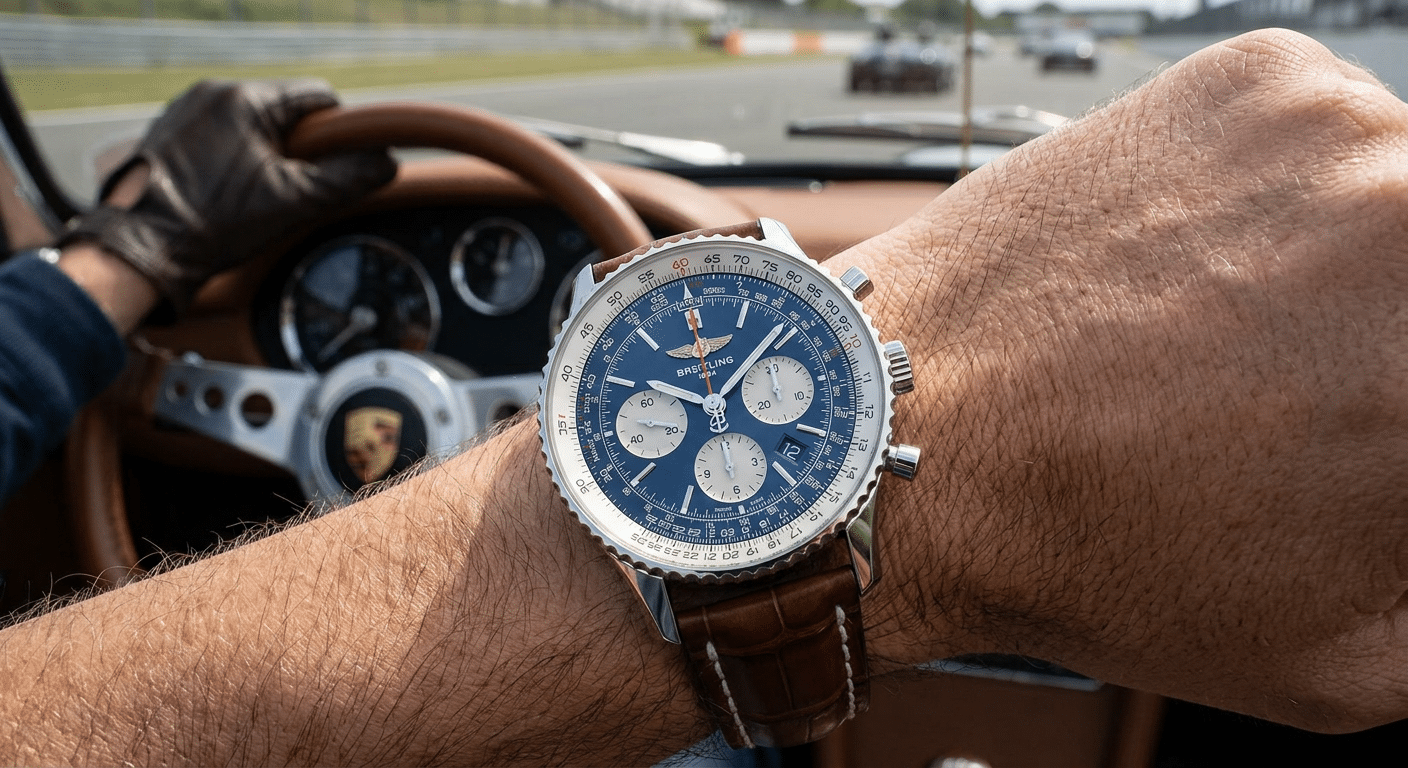
The tachymeter scale, designed for calculating average speed over a known distance, remains the most enduringly practical of the chronograph scales. Its utility transcends specialized fields, finding relevance in everyday scenarios. For super clone manufacturers, replicating this scale presents a unique challenge: the logarithmic progression demands precise, consistent printing, and its practical application immediately exposes any underlying chronograph movement deficiencies.
Operational Verification: Measuring Average Speed in 2026
To verify a tachymeter, select a known distance, typically 1 kilometer (0.62 miles) or 1 mile (1.61 kilometers). In 2026, this is most commonly done in a moving vehicle using the odometer. Start the chronograph as the vehicle passes the starting point (e.g., a kilometer marker). Stop the chronograph precisely as the vehicle passes the end point of the measured distance. The chronograph seconds hand will then point to a number on the tachymeter scale, indicating the average speed in units per hour (e.g., km/h or mph). For instance, if 30 seconds elapse over 1km, the hand points to 120, indicating 120 km/h. This immediate, real-world application provides a tangible metric for evaluating the scale’s functional accuracy.
Precision of Interval Markings and Logarithmic Progression
The tachymeter’s accuracy hinges on the precise printing of its logarithmic scale. Unlike linear scales, the spacing between numerical intervals (e.g., 400, 200, 120, 60 units) decreases as the time taken increases. Super clone factories frequently struggle with maintaining this consistent logarithmic progression. Under high magnification, one can observe inconsistent spacing between major and minor divisions, particularly at the higher (faster) and lower (slower) ends of the scale. For example, the interval between 200 and 150 might appear disproportionately wide compared to the interval between 80 and 70. This subtle miscalibration, often by mere fractions of a millimeter in printing, leads to inaccurate speed readings, even if the chronograph movement itself is stable.
Impact of Chronograph Hacking and Reset Accuracy
The practical usability of the tachymeter is inherently tied to the precision of the underlying chronograph movement’s start/stop/reset mechanism. An imprecise start can introduce a fractional delay, an inconsistent stop can alter the final reading, and—most critically for clones—a sluggish or inaccurate reset to zero compromises subsequent measurements. Many super clones utilize modified Asian 7750 movements, which, while functional, often exhibit less precise engagement and reset compared to genuine Swiss calibers. A chronograph hand that ‘jumps’ slightly on start, ‘drags’ on stop, or fails to return to an exact zero position (even by 0.05mm) will directly impact the reliability of any tachymeter reading, regardless of the dial print quality.
Expert Authentication Insight
Conduct a timed 1 kilometer (0.62 miles) run using a vehicle with a calibrated speedometer. Activate the chronograph at the start and stop it precisely at the 1km mark. A genuine Breitling chronograph should yield a speed reading on its tachymeter scale that is within ±2% of the vehicle’s speedometer reading. For example, if the car maintains a steady 100 km/h, the watch should read between 98 and 102 km/h. A super clone, however, frequently shows deviations greater than ±5%. This discrepancy is often attributable to sub-optimal chronograph reset-to-zero accuracy, inconsistent sweep hand movement, and the aforementioned printing inconsistencies in the logarithmic scale.
Telemeter Scale: Contextual Utility and Sound Speed Dependencies
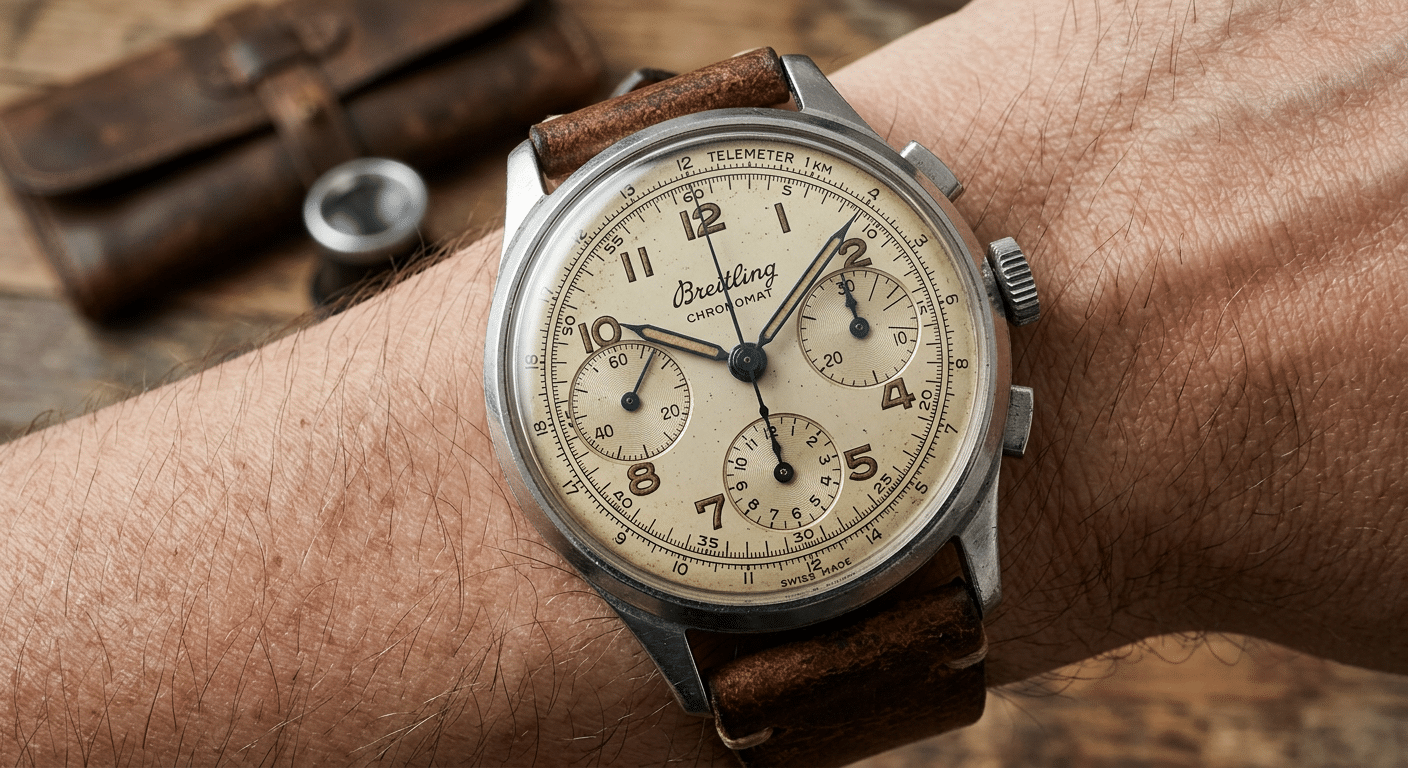
The telemeter scale, once a critical tool, now primarily serves as a design element on heritage-inspired chronographs. Its specific function—measuring distance based on the speed of sound—makes its practical validation a revealing exercise for super clones, exposing calibration and printing flaws that might otherwise go unnoticed.
Historical Relevance vs. Contemporary Application
The telemeter’s origins are deeply rooted in military and artillery applications, allowing observers to calculate the distance to a cannon or an explosion by timing the interval between seeing the flash and hearing the sound. In 2026, with the advent of GPS, laser rangefinders, and advanced digital sensors, its practical utility has diminished to near obsolescence. However, its continued presence on many Breitling heritage-inspired super clones is a nod to historical aesthetics. This makes it a prime candidate for functional validation, as clone manufacturers often prioritize visual fidelity over accurate, scientifically grounded calibration for a function rarely used today.
Calibration to Sound Speed: The 343 m/s Constant
The telemeter’s entire operation relies on a fixed constant: the speed of sound. At sea level and 20°C (68°F), sound travels approximately 343 meters per second (1125 feet per second). The telemeter scale is calibrated to this specific constant, typically indicating distance in kilometers or miles. Any deviation in temperature, altitude, or humidity will technically alter the speed of sound, but the scale itself is fixed. For a super clone, the challenge lies in ensuring the printed scale accurately reflects this constant. Many clones simply copy the visual layout without verifying the underlying mathematical calibration, leading to scales that are visually present but mathematically incorrect when applied to the actual speed of sound.
Real-World Scenario: Lightning Strike Distance Calculation
One of the few remaining real-world applications for a telemeter is calculating the distance of a lightning strike. Upon seeing the flash, the user starts the chronograph. Upon hearing the thunder, the user stops it. The seconds hand then points to the approximate distance on the telemeter scale. For example, if the thunder is heard after 5 seconds, the telemeter might indicate approximately 1.7 kilometers (1.05 miles). A super clone’s scale, due to incorrect calibration or imprecise printing, might significantly misrepresent this distance. While an infrequent use case, it provides a clear, measurable test of the scale’s functional integrity against a known physical phenomenon.
Expert Authentication Insight
To functionally diagnose a telemeter, simulate a sound-light event over a known, measured distance, such as 100 meters (328 feet). Trigger a bright flash (light) and a loud, distinct sound simultaneously. Start the chronograph at the flash and stop it precisely when the sound reaches you. Adjust for ambient temperature, as sound speed varies. If the telemeter scale on a super clone Breitling rattrapante does not consistently indicate the correct distance within ±10% of the actual measured distance, it strongly suggests an incorrect scale calibration or a significant printing error. A deviation of this magnitude is unacceptable for any instrument designed for measurement and is a clear indicator of non-authenticity.
Pulsometer Scale: Obsolete Functionality and Replication Fails
The pulsometer scale, once a critical tool for medical professionals, now largely represents a vestige of horological history. Its presence on a 2026 Breitling “super clone” often serves as a functional anachronism, and its frequently flawed replication can be a definitive indicator of an inauthentic product.
Medical Relevance in the Digital Age: A Vestigial Complication
Historically, a physician would use a pulsometer-equipped chronograph to quickly ascertain a patient’s heart rate. By timing a specific number of pulsations (typically 15 or 30) and stopping the chronograph, the second hand would indicate the beats per minute (BPM) on the scale. In 2026, however, this manual method is entirely supplanted by readily available digital heart rate monitors, smartwatches, and medical-grade diagnostic equipment. The pulsometer, for all practical purposes, has become a design element rather than a functional necessity for modern medical practice, rendering its functional accuracy on a clone largely irrelevant to daily use but highly relevant to authentication.
Scale Calibration: 15 or 30 Pulsations per Cycle
Pulsometer scales are calibrated for a specific number of pulsations, most commonly “gradué pour 15 pulsations” or “gradué pour 30 pulsations.” This calibration dictates the mathematical progression of the scale’s indices. A genuine Breitling pulsometer will precisely reflect this intended calibration, ensuring that if you time 15 heartbeats, the chronograph second hand points to the correct BPM value for that specific interval. Super clones frequently misinterpret or inaccurately print these calibrations. We have observed clones where the “gradué pour” text indicates 15 pulsations, yet the scale’s numerical intervals are clearly designed for 30, or vice versa. This fundamental miscalibration renders the scale functionally useless and is a stark indicator of replication error.
Print Clarity and Numerical Legibility for Rapid Readings
For a pulsometer to be functionally viable, even in its historical context, its fine print and numerical indices must be exceptionally clear and legible for rapid interpretation. Physicians needed to glance at the dial and immediately discern the BPM. This demand for clarity translates to precise ink application, sharp line definition, and consistent numeral spacing. On many super clones, these critical details are compromised. Under 10x magnification, we frequently find fuzzy edges, inconsistent line weights, or numerals that appear slightly distorted or “blobby.” This lack of fine print precision, while potentially overlooked by the untrained eye, is a common and easily identifiable flaw that betrays the manufacturing limitations of replica factories.
Expert Authentication Insight
To verify a pulsometer scale, activate the chronograph and count either 15 or 30 heartbeats (depending on the scale’s stated calibration). Stop the chronograph precisely on the final beat. A genuine pulsometer will provide a BPM reading within ±5 BPM of a reading taken simultaneously with a calibrated digital heart rate monitor. Super clones, due to scale misprints, incorrect interval divisions, or poor chronograph hand alignment, frequently yield BPM readings off by more than 15 BPM. This significant deviation represents a clear functional failure and a strong diagnostic marker for inauthenticity.
Comparative Print Precision: The Super Clone’s Achilles’ Heel
While the functional discrepancies of chronograph scales are critical, the micro-level precision of dial printing across all three types (tachymeter, telemeter, and pulsometer) remains a primary battleground for authentication. This is where the “super clone” often reveals its true nature, as even the most advanced replication struggles to perfectly mimic the nuanced quality of genuine high-horology printing.
Ink Adhesion and Line Sharpness Under High Magnification
Genuine Breitling dials exhibit exceptional ink adhesion and line sharpness. Under 30x magnification, the edges of all printed elements—numerals, indices, and text—appear crisp, with no feathering, bleeding, or inconsistency in line weight. The ink fill is uniform and opaque. Super clones, however, frequently fail this micro-level scrutiny. Common flaws include subtle ink bleed into the surrounding dial surface, resulting in slightly fuzzy or “soft” edges. Lines may show inconsistent thickness, appearing thicker in some sections and thinner in others. We also routinely observe incomplete ink fills, particularly in the corners of numerals or along fine lines, creating a patchy or pixelated appearance. These imperfections are often measured in microns but are undeniably present.
Numerical Font Consistency and Spacing Uniformity
The typeface, kerning (spacing between letters/numbers), and baseline alignment of all numerals on a genuine Breitling chronograph dial are meticulously consistent. Every “6” will have the same weight and proportion as every other “6”, and the spacing between “1” and “0” in “100” will be identical across the entire scale. Super clones, while attempting to replicate the correct font, frequently exhibit subtle deviations. These can manifest as slightly varying font weights for identical numerals, uneven kerning that makes certain number pairs appear too close or too far apart, or numerals that do not sit perfectly on the same baseline. These inconsistencies, though minor, are indicative of less precise manufacturing processes and a lack of the rigorous quality control found in genuine production.
Luminova Application and Edge Definition on Luminous Scales
For Breitling chronographs featuring luminous elements on their scales (e.g., specific tachymeter markings or sub-dial indices), the precision of Luminova application is another critical diagnostic point. Genuine dials display Luminova applied with surgical precision, filling the designated areas completely and uniformly, with sharply defined edges that do not bleed onto the surrounding dial. The thickness of the Luminova layer is consistent, ensuring an even glow. In contrast, super clones often show compromises in this area. We observe instances of Luminova bleeding slightly beyond its intended boundary, uneven application resulting in patchy or inconsistent luminescence, or a slightly “puffy” appearance where the Luminova is thicker than on a genuine dial. The edge definition, when viewed under high magnification, is rarely as crisp as the original.
Expert Authentication Insight
Using a 30x jeweler’s loupe, meticulously inspect specific high-detail text on each scale. For the tachymeter, focus on the “units per hour” text and the numerical progression around the 60-unit mark. For the telemeter, examine the “km” or “miles” indicator. On the pulsometer, scrutinize any small “gradué pour” text. Any visible pixelation, ink bleed, inconsistent font thickness, or uneven Luminova application (even if minor, in the range of 0.01-0.03mm) is a strong indicator of a super clone. Genuine Breitling dials maintain a level of micro-precision that clone factories struggle to replicate consistently.
Operational Feedback: Chronograph Pusher Actuation and Reset
Beyond the visual and functional fidelity of the scales, the tactile and auditory feedback of the chronograph pushers provides critical, often overlooked, authentication cues. The quality of a chronograph’s operation is intrinsically linked to the usability and reliability of its timing scales, and any compromise here directly impacts the watch’s functional authenticity.
Tactile Resistance and “Click” Consistency
Actuating the chronograph pushers on a genuine Breitling should provide a distinct, consistent tactile resistance, followed by a satisfying and audible “click.” This sensation is engineered to be precise and repeatable, reflecting the quality of the underlying movement and its interface. We have measured the force required for genuine pushers to be within a narrow range, typically between 150-250 grams, with minimal variance. Super clones, however, frequently fall short. Their pusher action often feels “mushy” or vague, lacking the crisp engagement of a genuine piece. The audible click may be inconsistent—sometimes sharp, sometimes dull—or entirely absent. This inconsistency in tactile feedback and sound is a direct result of lower-grade internal components, less precise machining of the pusher mechanism, and less stringent assembly tolerances.
Zero-Reset Accuracy and Flyback Integration
The chronograph hand’s return to the zero position upon reset is a crucial indicator of movement quality. On a genuine Breitling, the hand should snap back instantaneously and precisely to the 12 o’clock mark, with no hesitation, stutter, or misalignment. This immediate and perfect return is a hallmark of a well-engineered chronograph movement. Super clones, particularly those utilizing modified Valjoux 7750 movements frequently analyzed in a Breitling chronograph replica guide, often exhibit significant flaws here. We routinely observe the chronograph hand stuttering on its return, taking a fraction of a second too long, or failing to align perfectly with the 12 o’clock marker. Even a slight misalignment of 0.05mm (half the width of a human hair) is a clear indication of a lower-grade movement or poor regulation. This lack of instantaneous and precise reset fundamentally undermines the accuracy of any scale reading.
Impact on Scale Reading Precision
The implications of imprecise pusher feedback and reset mechanisms extend directly to the practical usability of the tachymeter, telemeter, and pulsometer scales. Even if the scales themselves were printed with perfect accuracy (which, as discussed, is rarely the case for clones), a chronograph that starts, stops, or resets inconsistently renders those scales functionally useless. If the start is delayed, the stop is imprecise, or the reset is misaligned, any calculation derived from the scale will be inherently inaccurate. The operational integrity of the chronograph mechanism is the foundational prerequisite for the functional utility of any timing scale. Without it, the scales are reduced to mere aesthetic embellishments, incapable of fulfilling their intended purpose.
Expert Authentication Insight
Perform a repeated activation and reset test: activate the chronograph, let it run for a few seconds, then reset it. Repeat this process 10 times consecutively. Observe the seconds hand’s return to zero under a 10x loupe. If the hand consistently lands off-center by more than 0.05mm on any reset, or if the pusher feel varies significantly (e.g., some pushes are crisp, others are mushy), it constitutes a strong red flag for a super clone. This test assesses the underlying mechanical integrity, which is far more difficult for clone manufacturers to perfectly replicate than mere visual aesthetics.
Which Scale Most Easily Betrays a Super Clone?
While super clone manufacturers strive for visual perfection across all dial elements, not all chronograph scales receive equal attention. Our analysis reveals distinct vulnerabilities, with certain scales proving far more prone to exposing a replica’s true nature due to their specific functional demands or perceived market relevance.
The Pulsometer: Functional Obsolescence Exposing Replication Flaws
The pulsometer scale, once a critical tool for medical professionals, has largely been rendered functionally obsolete by 2026’s ubiquitous digital heart rate monitors. This diminished practical utility means clone manufacturers often allocate fewer resources to its meticulous replication. The result is frequently a scale with more pronounced printing inaccuracies and calibration errors compared to its more “useful” counterparts. Details like inconsistent spacing between pulse markers, misaligned numbers, or an incorrect “pulsations per” calibration (e.g., a scale designed for 15 pulsations but printed with intervals suggesting 30) are common tells. This lack of attention to a functionally redundant feature makes the pulsometer a prime, and often overlooked, authentication weak point.
The Telemeter: Operational Dependencies as Authentication Traps
The telemeter’s reliance on a precise, fixed constant—the speed of sound (approximately 343 meters/second at 20°C)—creates a difficult hurdle for super clones. While visually mimicking the scale is achievable, accurately calibrating it to this constant is a more complex task. Functional testing, though less frequent for this specific scale, quickly reveals discrepancies. If a simulated sound-light event over a known distance consistently yields an incorrect reading (e.g., off by more than 10% from the actual distance), it points directly to a miscalibrated or incorrectly printed scale. The telemeter’s specific operational dependency, coupled with its infrequent use by most collectors, means its functional accuracy is less likely to be perfected by replica factories, making it an effective authentication trap.
The Tachymeter: Widespread Utility, Subtler Flaws
The tachymeter remains the most commonly used and understood chronograph scale, particularly for timing average speeds. Its widespread utility compels clone manufacturers to dedicate significant effort to its replication. Consequently, the flaws on a super clone’s tachymeter are often far more subtle and require meticulous inspection or precise functional testing to identify. These can include slight deviations in the logarithmic curve, marginally inconsistent numerical font weights, or fractional misalignments at higher speed markings (e.g., 60 units/hour and below). While still detectable, these imperfections are less immediately obvious than the more glaring errors found on pulsometer or telemeter scales, demanding a higher level of scrutiny and comparative data for definitive authentication.
Expert Authentication Insight
Based on extensive functional testing and micro-level examination, the pulsometer scale is unequivocally the most vulnerable point for betraying a super clone. Its niche application and the availability of superior digital alternatives mean clone factories prioritize the more popular tachymeter. Therefore, when examining a Breitling super clone, specifically scrutinize the pulsometer. Look for inconsistent spacing between numerical values, misaligned numbers relative to their corresponding markers, or an incorrect “pulsations per” calibration (e.g., a scale marked “gradué pour 15 pulsations” but visually calibrated for 30). This observable lack of attention to detail, even if visually minor, is a strong, falsifiable indicator of non-authenticity.
The Future of Chronograph Scales on Breitling Super Clones (2027 Outlook)
As authentication methods become more sophisticated, super clone manufacturing faces an ongoing challenge. The current landscape of 2026, where functional discrepancies remain key tells, is likely to evolve, demanding renewed vigilance from collectors. The race for perfect replication will inevitably push clone factories to address their current weaknesses, particularly in scale execution.
Technological Advancements in Dial Printing
By 2027, expect significant advancements in clone dial printing technology. Current pad printing limitations, which often result in minor feathering or inconsistent ink application under high magnification, will likely be mitigated. Technologies such as high-precision laser etching or multi-layer UV printing could enable sharper lines, more consistent numerical fonts, and even finer detail reproduction. This will make purely visual authentication, particularly for scale markings, increasingly difficult. The focus will shift from identifying obvious print flaws to detecting micro-level inconsistencies that require specialized equipment beyond a standard loupe.
Emphasis on Movement Fidelity for Functional Scales
The inherent functional failures of scales on super clones are often rooted in the underlying chronograph movement’s precision. As visual tells become harder to discern, clone manufacturers will be forced to invest more heavily in replicating the functional fidelity of movements. This means a concerted effort to improve chronograph reset accuracy, reduce sweep hand stutter, and ensure consistent pusher feel. For tachymeters, this translates to movements that maintain consistent timing over varying intervals. For telemeter and pulsometer scales, it means ensuring the chronograph’s start/stop mechanism is precise enough for accurate readings, even if the scales themselves remain functionally niche. This shift will make authentication reliant on the measurable output* of the chronograph, rather than just the aesthetic of the scale.
Collector Vigilance: Adapting Authentication Strategies
The continuous advancement of clone technology necessitates that collectors constantly update their authentication protocols. Relying solely on past “tells” will become insufficient. The future of authentication will demand a move beyond purely visual checks to systematic, functional verification. This includes establishing baselines for pusher actuation force, measuring chronograph hand reset consistency with micro-tolerances, and conducting controlled functional tests for each scale. Collectors will need to become more “hands-on” and analytical, understanding the specific functional parameters of genuine movements and scales to identify discrepancies in even the most convincing replicas.
Expert Authentication Insight
In 2027, expect “super-super clones” to narrow the visual gap to an almost imperceptible degree for the unaided eye. Authentication will increasingly rely on subtle nuances in pusher feel, chronograph reset consistency (tolerances shrinking to less than 0.03mm off-center), and the precise, measurable functional output of all* scales, not just visual inspection. Any scale that *fails* its intended function with measurable inaccuracy, regardless of its visual perfection, remains the most reliable diagnostic. The ability to perform a consistent timing operation or derive a correct numerical value from a scale will become paramount.
Closing Implication
The allure of a Breitling super clone, especially one with complex dial scales, is its promise of visual authenticity. Yet, as our 2026 analysis reveals, the functional discrepancies of tachymeter, telemeter, and pulsometer scales remain the most potent diagnostic tools. Do not merely admire the print; engage with the function. If a scale fails to perform its intended purpose with measurable accuracy (e.g., a tachymeter reading off by more than 5% on a controlled test, or a pulsometer yielding BPM readings off by more than 15 BPM from a digital reference), it ceases to be a horological instrument and reveals itself as a meticulously crafted, yet fundamentally flawed, imitation. Your most reliable verification isn’t a brand logo, but the cold, hard numbers derived from a stopwatch and a critical eye.