
The tell-tale twitch of a replica chronograph’s seconds hand isn’t a design quirk; it’s a diagnostic flag. For owners of Breitling replica chronographs, this erratic movement often signals a deeper mechanical or environmental issue, diminishing both the illusion of authenticity and the functional integrity of the timepiece. This guide cuts through speculation, integrating comprehensive chronograph hand alignment QC into a structured, evidence-based approach to identify, understand, and potentially resolve the frustrating phenomenon of a stuttering seconds hand. Our focus is to establish a systematic, user-centric approach to pinpoint the root cause of chronograph seconds hand stutter in Breitling replica movements, emphasizing observable symptoms and initial non-invasive checks before considering professional intervention.
Understanding the “Stutter” Phenomenon: Visual and Auditory Cues
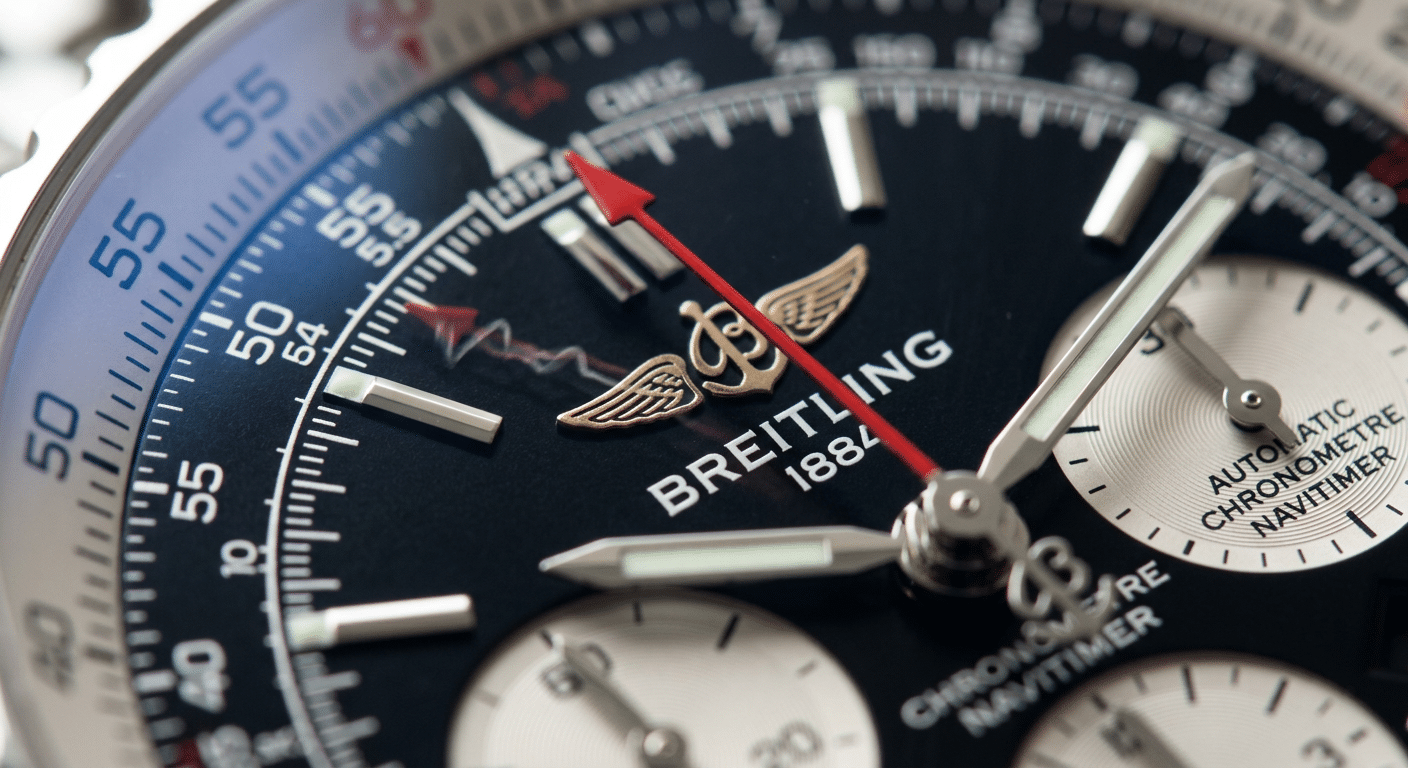
The “stutter” in a chronograph seconds hand manifests in several distinct patterns, each potentially hinting at a different underlying cause. Visually, this can range from an irregular beat where the hand advances unevenly across the minute track, to momentary halts where the hand visibly pauses for a fraction of a second before resuming its sweep. More concerning are instances of retrograde motion, where the hand briefly moves backward against its intended direction of travel, or excessive lateral play, where it appears to wobble side-to-side rather than maintaining a precise, linear path. These visual anomalies are often accompanied by subtle auditory changes; a normally smooth, almost silent sweep may develop an increased friction noise, a faint grinding, or an inconsistent ticking sound that betrays mechanical distress. Documenting these specific visual and auditory cues is the first critical step in differential diagnosis.
Initial External Checks: Environment and Crown Position
Before assuming internal mechanical failure, a series of basic external checks can quickly rule out simpler, user-rectifiable issues. First, confirm the chronograph is fully wound; an underpowered movement, especially one with a complex chronograph complication, may lack the consistent torque required for a smooth seconds hand sweep. Next, meticulously check for proper crown and pusher engagement. A partially pulled crown, or a chronograph pusher that is not fully disengaged, can introduce subtle friction points. Finally, assess the ambient environment: extreme temperature fluctuations (below 0°C or above 40°C) or high humidity can alter the viscosity of lubricants, leading to increased drag. In 2026, with many users in climate-controlled environments, such extremes are less common but still relevant for outdoor or specialized use cases.
Expert Authentication Insight
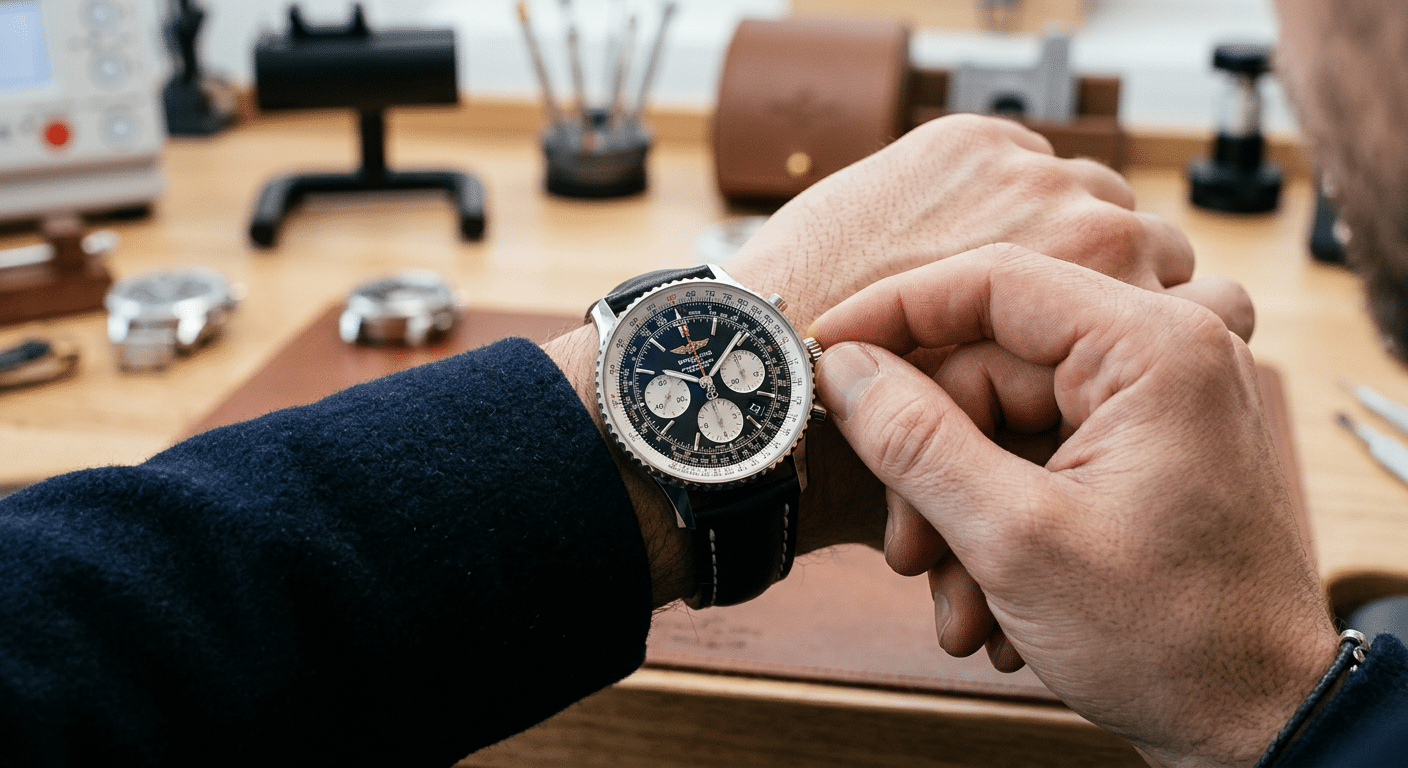
A crucial initial diagnostic involves a 10x loupe inspection of the seconds hand’s interaction with the dial indices during any stutter events. Focus on the precise moment the stutter occurs. Does the hand momentarily lose firm contact with the central pinion, exhibiting a slight upward or downward shift? Or does it display excessive lateral play, indicating potential instability of the central pinion or its mounting? Observe if the hand’s tip consistently clears the dial surface by approximately 0.15mm to 0.25mm. Any visible scuff marks on the dial under the hand, or a complete lack of consistent clearance, immediately points to a hand-to-dial friction issue, a common assembly error in replica production.
Insufficient Lubrication: The Friction Point Failures in Replica Chronographs
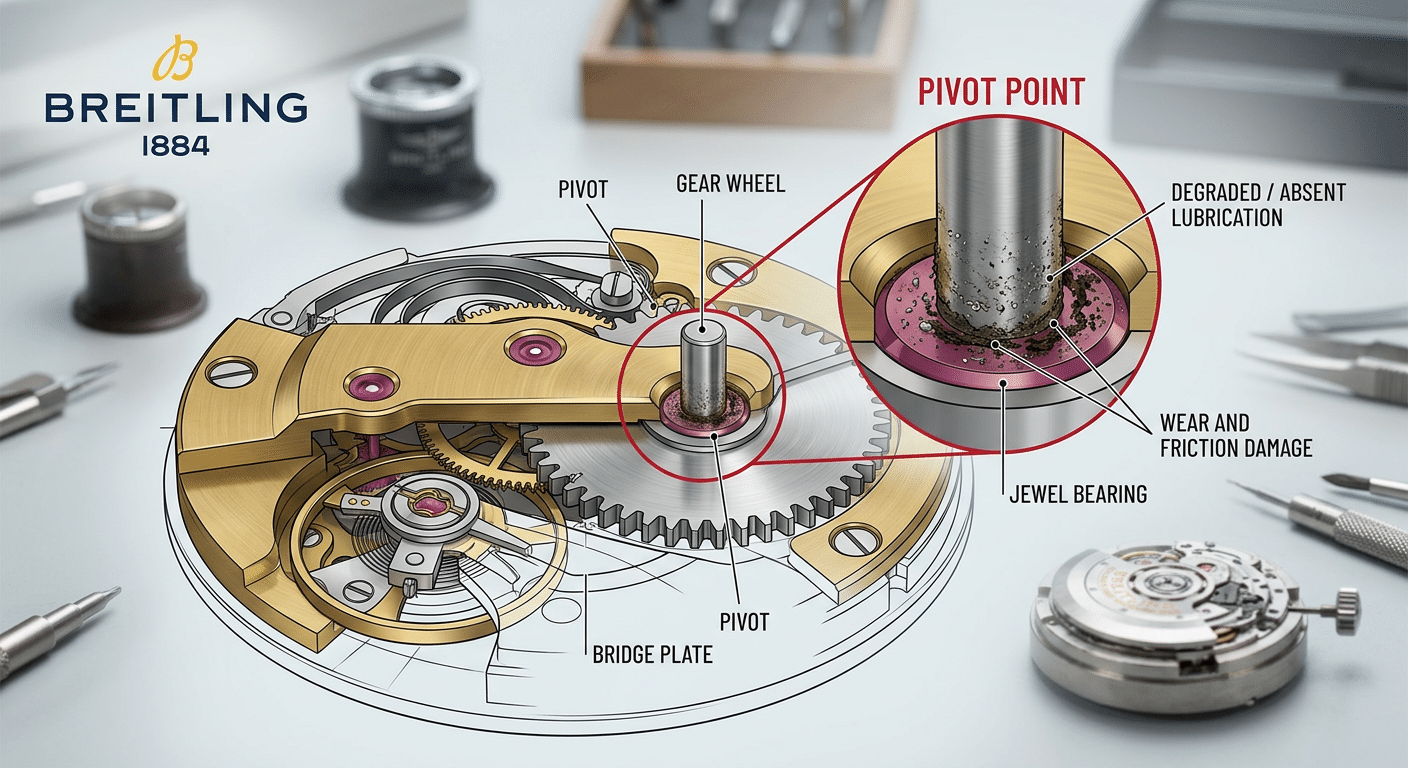
Insufficient or degraded lubrication is a pervasive issue in replica watch movements, often a direct consequence of cost-cutting measures during manufacturing. Unlike genuine movements that utilize precise quantities of high-grade synthetic oils at specific points, replicas frequently suffer from either a complete lack of lubrication in critical areas, or the application of low-quality, unstable oils that break down rapidly. This negligence creates localized friction points within the gear train and escapement, directly contributing to the erratic behavior of the chronograph seconds hand. Diagnosing this issue requires understanding its symptoms and identifying the most vulnerable components.
Symptoms of Dryness: Increased Drag and Erratic Motion
The primary symptom of insufficient lubrication is increased drag within the movement, which translates directly to the seconds hand’s performance. Visually, this manifests as an inconsistent sweep rate, where the hand appears to accelerate and decelerate subtly during its rotation, rather than maintaining a uniform pace. Audibly, the usually crisp and regular beat of the escapement may become muffled, uneven, or even develop a faint, high-pitched squeak—a tell-tale sign of metal-on-metal friction. When manually advancing the chronograph hand (if the movement allows), a distinct resistance or “grittiness” can be felt, particularly at specific points in the dial rotation. These tactile and auditory cues, combined with erratic motion, are strong indicators of elevated friction coefficients due to a lack of proper lubrication.
Critical Lubrication Points: Chronograph Mechanisms and Pivots
Within a replica chronograph movement, certain components are particularly susceptible to lubrication deficiencies due to their high-stress, intermittent, or finely articulated nature. The reset hammer, responsible for snapping the chronograph hands back to zero, requires precise lubrication at its pivot and contact surfaces; a dry hammer can cause a jerky reset or even a momentary stutter upon engagement. The column wheel or cam system, which orchestrates the start, stop, and reset functions, relies on minimal friction for smooth operation, making its pivots and engagement teeth critical lubrication points. The coupling clutch, which engages the chronograph mechanism with the base movement, is another high-stress area. Finally, the delicate pivots of the seconds pinion and its associated intermediate wheels are often overlooked, leading to localized high-friction zones that directly impede the smooth sweep of the chronograph seconds hand. These are common points where replica manufacturers compromise.
Expert Authentication Insight
To physically diagnose lubrication issues, gently rotate the crown while observing the chronograph seconds hand under 15x magnification (assuming a fully wound state for an automatic movement, or direct winding for a manual one). Pay close attention to the engagement of the chronograph mechanism. A “sticky” or uneven engagement, particularly during the initial sweep immediately after activation or at the precise moment of reset, strongly suggests inadequate lubrication at the coupling clutch or the pivots of the reset hammer. This manifests as a micro-stutter, often a brief hesitation or an overly forceful snap, rather than a fluid transition. If the stutter is more pronounced during the initial sweep, the coupling clutch is a prime suspect; if it’s during reset, the hammer’s action is likely compromised.
Gear Train Wear: Micro-Abrasions and Backlash in Replica Movements
The gear train is the heart of a watch’s power transmission, and its integrity is paramount for smooth, consistent timekeeping and chronograph function. In replica movements, premature wear within this system is a frequent cause of seconds hand stutter. This wear often stems from the use of inferior materials, inadequate hardening processes, or imprecise manufacturing tolerances that result in improper gear meshing. These factors combine to create excessive backlash—unwanted play between gear teeth—which disrupts the consistent transfer of power and manifests as an erratic chronograph seconds hand. Understanding the material compromises and how to visualize the resulting play is key to diagnosing this issue.
Material Compromises: Soft Pinions and Wheel Teeth
A significant distinction between genuine and replica movements lies in the metallurgical quality of their components. Replica manufacturers frequently utilize lower-grade, softer alloys for critical parts such as pinions and wheel teeth. These materials, often lacking proper heat treatment or surface hardening, are highly susceptible to accelerated wear. Over even a relatively short operational period (e.g., 6-12 months of regular use), the constant meshing of gears causes microscopic abrasions, leading to material loss and a measurable increase in the clearance between teeth. This increased play, or backlash, directly impacts the consistency of power transmission, causing the chronograph seconds hand to stutter as the gears “catch up” or momentarily lose firm engagement.
Diagnosing Backlash: Visualizing Gear Play
Diagnosing excessive backlash without disassembling the movement requires careful observation under magnification. With the case back removed (if possible) and the chronograph activated, observe the chronograph seconds wheel and its associated intermediate wheels. Gently apply minimal, alternating pressure to the chronograph reset pusher (without fully activating the reset sequence). Any perceptible “rocking” or subtle lateral movement (a “give” of more than 0.05mm) in the seconds wheel or its pinion before the reset mechanism engages indicates excessive clearance. This visual “play” confirms that the gears are not meshing tightly enough, allowing for inconsistent momentum transfer. This often occurs due to worn teeth, elongated pivot holes, or bent arbors, all contributing to the stuttering motion.
Expert Authentication Insight
For a direct physical diagnostic of gear train wear and backlash, with the movement stopped and the chronograph engaged (if possible without power), apply minimal, alternating pressure to the chronograph reset pusher. Do not fully depress it. Instead, apply just enough force to observe the initial mechanical response. Any perceptible “give” or lateral shift in the chronograph seconds wheel or its associated intermediate wheel before the actual reset sequence initiates indicates excessive backlash. A healthy gear train should exhibit virtually no play at this point. This lateral shift, often exceeding 0.08mm in worn replica movements, confirms that worn teeth or elongated pivots are allowing the wheel to move freely where it should be firmly engaged, directly contributing to stutter as power transmission becomes inconsistent.
Magnetic Interference: The Invisible Disruptor of Chronograph Precision
Unlike physical wear or obvious assembly faults, magnetic interference operates as an unseen force, capable of inducing erratic chronograph seconds hand movement without any visible damage to the replica Breitling movement. This phenomenon often perplexes owners, as the watch appears mechanically sound yet exhibits persistent stuttering that compromises the reading of Breitling super clone tachymeter scales during timing operations. Identifying magnetism as the root cause requires a systematic approach, as its effects can mimic other mechanical issues, making accurate diagnosis critical for effective remediation.
Common Sources of Magnetism: Daily Exposure Hazards
Modern daily life presents numerous opportunities for a mechanical watch movement to become magnetized. High-field permanent magnets are ubiquitous in consumer electronics and security systems. Smartphones, particularly those with integrated charging coils or powerful speakers, can generate localized fields exceeding 1,000 Gauss. Laptop closures, magnetic clasps on bags, induction cooktops, and even certain medical diagnostic equipment (e.g., MRI machines, though less common for casual exposure) are significant sources. Security scanners at airports, while often momentary, can also contribute to cumulative magnetization. Even seemingly innocuous items like refrigerator magnets or magnetic tool holders can, over time, induce enough residual magnetism in steel components to affect precision. A watch exposed to a continuous field of just 60 Gauss can exhibit noticeable rate instability and chronograph stutter.
Symptoms of Magnetization: Persistent Stutter and Rate Instability
When a replica chronograph movement becomes magnetized, the most prominent symptom is a persistent and often unpredictable stuttering of the seconds hand, particularly the chronograph seconds hand. This is often accompanied by a significant and consistent deviation in the watch’s timekeeping rate. The balance spring, traditionally made of a steel alloy, is highly susceptible; once magnetized, its coils can stick together or repel each other, altering the effective length and thus the oscillation period. This manifests as the watch running either consistently fast or slow, sometimes by several minutes per day, far exceeding the typical ±15-30 seconds deviation expected from a Shanghai 7750 or Seagull 2824 movement. Crucially, unlike issues caused by temperature fluctuations or lubrication degradation, the rate instability and stutter induced by magnetism are not typically position-dependent or temperature-sensitive. The erratic behavior remains largely constant until demagnetization.
Expert Authentication Insight
A simple, initial physical diagnostic for magnetism involves a standard magnetic compass. Place the replica Breitling chronograph on a flat, non-metallic surface and slowly bring a compass within 2-3 cm of the watch. Observe the compass needle. If the watch is significantly magnetized, the needle will deflect consistently by more than 15 degrees from its natural north-south alignment. For a more precise assessment, a dedicated electronic demagnetizer often includes a detection mode that indicates the presence and relative strength of magnetism. A positive result from either test, especially the compass deflection, confirms magnetism as a highly probable cause of the erratic seconds hand behavior and justifies proceeding with demagnetization.
Assembly Anomalies: The Human Factor in Replica Production Quality
The transition from individual components to a functional watch movement is a complex process, and in replica production, the “human factor” during assembly is a frequent source of chronograph seconds hand stutter. Unlike design flaws or material deficiencies, assembly anomalies stem from errors in execution—misalignment, incorrect tension, or improper clearances—that introduce friction or mechanical impedance where none should exist. These issues are particularly prevalent in complex chronograph mechanisms, where the precise interaction of numerous small parts is critical for smooth operation. The diagnostic challenge lies in identifying which specific assembly error is causing the observable stutter.
Misalignment and Friction: Pinions, Levers, and Springs
Errors during the assembly of a replica chronograph movement can introduce significant friction and impedance. Common culprits include chronograph clutch levers that are not perfectly aligned, causing undue pressure on the driving wheel or seconds pinion. Similarly, if the chronograph seconds pinion itself is improperly seated or has excessive end-shake due to a misaligned bridge or jewel, it can bind against the dial or other components. Bent reset hammers, often a result of careless handling, can create persistent drag on the heart cam, impeding a smooth return to zero or causing stutter during activation. Even subtle overtightening or undertightening of screws holding critical plates or bridges can distort the movement structure, leading to misaligned pivots and increased friction on rotating parts. These seemingly minor deviations can collectively introduce enough resistance to cause the chronograph seconds hand to stutter erratically or even halt momentarily.
Incorrect Hand Setting: Clearance and Drag Issues
One of the most common and easily diagnosable assembly-related causes of chronograph seconds hand stutter is incorrect hand setting. If the chronograph seconds hand is pressed too deep onto its arbor during assembly, its underside can make intermittent or constant contact with the dial surface. This direct friction creates significant drag, manifesting as visible stuttering, especially as the hand sweeps across the dial or encounters areas with slight manufacturing imperfections. Conversely, if the hand is set too high, it risks making contact with the crystal or, more commonly, with the minute or hour hands as they pass underneath. Such contact, even if brief, will cause the seconds hand to momentarily hesitate or jump. The lack of precise, consistent clearance—ideally around 0.1mm between the hands and the dial, and between successive hands—is a hallmark of hurried or imprecise replica assembly, directly impacting the smooth sweep of the chronograph seconds.
Expert Authentication Insight
To definitively diagnose incorrect hand setting as a cause of stutter, a 20x magnification inspection is essential. Carefully observe the chronograph seconds hand’s clearance relative to the dial and, critically, its interaction with the minute and hour hands as they cross paths. Look for any visible scuff marks or faint circular abrasions on the dial surface directly underneath the path of the seconds hand. These marks are conclusive evidence of direct physical contact and friction. Furthermore, visually assess the vertical spacing: a lack of consistent 0.1mm clearance between the seconds hand and the dial, or between the seconds hand and the other hands, confirms an assembly error. Any perceptible drag or momentary hesitation when the hands interact strongly indicates that incorrect hand setting is the primary driver of the stutter.
Intrinsic Movement Defects: The Unfixable Compromise in Replica Engineering
While many chronograph stutter issues in replica Breitling models can be traced to lubrication, wear, magnetism, or assembly errors, some cases point to more fundamental, unfixable compromises in the movement’s core engineering or component quality. These intrinsic defects represent the economic realities of replica production, where cost-cutting measures often extend beyond superficial finishing to the very foundation of the movement. Such flaws are difficult, if not impossible, to rectify economically, often rendering professional repair an unfeasible option given the watch’s original acquisition cost. Recognizing these limitations is crucial for replica owners to manage expectations and make informed decisions about their timepiece.
Substandard Base Movement Components: Unacceptable Tolerances
The base movements used in replica chronographs, such as the Shanghai 7750 or modified Seagull movements, are inherently produced to lower tolerances and with less stringent quality control than their genuine counterparts (e.g., ETA Valjoux 7750 or Breitling’s B01). This can manifest as fundamental weaknesses in critical components. Examples include poorly finished bridges that create uneven pressure on pivots, inconsistent jewel settings that allow excessive play or bind axles, or mainsprings manufactured with inconsistent power curves or insufficient torque for the chronograph complication. These “out-of-spec” components create systemic friction points or power delivery issues that are not isolated incidents but rather inherent to the movement’s construction. A mainspring that delivers insufficient or inconsistent power, for instance, can lead to the chronograph seconds hand stuttering under load, irrespective of lubrication or external factors. Replacing such core components with genuine quality parts is often cost-prohibitive and impractical for a replica.
Chronic Instability: Design Flaws vs. Manufacturing Defects
It is important to differentiate between an isolated manufacturing defect and a chronic design flaw. An isolated manufacturing defect might be a single faulty gear or a poorly finished screw, which, while problematic, could theoretically be replaced. However, chronic instability points to a more pervasive issue: a fundamental design flaw in the replica movement’s adaptation of the chronograph complication or an inherent material limitation. For example, some replica movements might struggle to adequately power the chronograph function due to an under-engineered mainspring or an inefficient winding system, leading to persistent stuttering whenever the chronograph is engaged. This isn’t a matter of a single component failing, but rather the entire system being marginally designed or built with materials incapable of sustaining the required operational loads. Such systemic weaknesses are often unresolvable through standard servicing or part replacement, as the underlying architecture or material choices are the source of the problem, leading to recurring stutter despite repeated interventions.
Expert Authentication Insight
To identify if a stutter is due to an intrinsic movement defect, observe its consistency across multiple chronograph activations and resets over a prolonged period, specifically a 24-hour period. Engage and disengage the chronograph at various points throughout the day, noting if the stutter’s character (e.g., location on the dial, intensity, frequency) remains identical. If the stutter persists with the same characteristics, regardless of the watch’s winding state (fully wound vs. low power reserve), ambient temperature fluctuations, or minor manual adjustments (such as gently tapping the watch), it strongly suggests an intrinsic, systemic defect. This unyielding consistency, despite varying operational parameters, indicates that the problem lies deep within the movement’s core design or the quality of its fundamental components, rather than being an external factor or an isolated, easily rectifiable assembly error. Such a diagnosis often points towards the economic unfeasibility of repair.
The Self-Diagnosis Flowchart: A Step-by-Step Guide for Replica Owners
Before entrusting a replica chronograph to a watchmaker, or considering its replacement, a systematic self-diagnosis can often isolate the most probable cause of a stuttering seconds hand. This flowchart, often featured in a comprehensive Breitling chronograph replica guide, provides a structured, non-invasive approach, leveraging observable symptoms to guide replica owners toward an informed decision.
Step 1: External Observation and Environmental Assessment
Begin by meticulously examining the watch’s external state and recent environmental exposures. First, confirm the watch is adequately powered. For an automatic replica, this means a minimum of 10-12 hours of active wear or 40-50 full crown turns if manually winding. An under-wound mainspring often results in insufficient torque to smoothly drive the chronograph complication, leading to stutter, particularly with movements like the A7750.
Next, test the chronograph pushers. Depress and release both the start/stop and reset pushers multiple times. They should operate with a crisp, consistent click and return smoothly to their neutral positions. Any stickiness, resistance, or lack of definitive tactile feedback can indicate issues with the pusher mechanism itself, potentially affecting the internal clutch or reset hammer engagement. Visually inspect the chronograph seconds hand under a 10x loupe for any physical obstructions. Look for subtle contact with the dial indices, the minute/hour hands, or the underside of the crystal. Minute scuff marks on the dial directly beneath the seconds hand are definitive proof of contact friction.
Finally, consider recent exposure to strong magnetic fields. Has the watch been near a smartphone speaker, induction charger, magnetic closure case, or an airport security scanner? Magnetism can cause steel components within the movement, especially the hairspring, to stick together, leading to erratic timekeeping and stutter. While a dedicated demagnetizer is ideal, an initial test with a simple compass can offer a preliminary indication of magnetization.
Step 2: Chronograph Activation and Reset Cycle Analysis
With the external checks complete, focus on the stutter’s behavior during the chronograph’s operational cycle. Activate the chronograph, let it run for 30-60 seconds, then stop and reset it. Repeat this sequence 5-10 times, meticulously noting when the stutter occurs. Does it happen immediately upon activation (suggesting issues with the coupling clutch or start lever)? Does it occur intermittently or consistently throughout the sweep (pointing towards lubrication, gear train wear, or magnetism)? Or does it manifest during the reset, where the hand hesitates or fails to return precisely to the 12 o’clock marker (indicating problems with the reset hammer or minute jumper)?
Observe the nature of the stutter: is it a brief, almost imperceptible twitch, a full momentary halt, or a slight retrograde movement? Consistent, repeatable stutter at the exact same point in the sweep or reset suggests a mechanical issue with a specific component. Intermittent stutter, especially if it varies with the watch’s power reserve or temperature, might lean towards lubrication deficiencies or environmental factors. Document these observations with specific times and conditions; this detailed log will be invaluable for further diagnosis or repair discussions.
Expert Authentication Insight
A crucial diagnostic step for isolating gravity-dependent issues is the “gravity test.” With the chronograph engaged and stuttering observed, position the watch for 30-60 seconds in each of the four cardinal orientations: dial up, dial down, crown up, and crown down. Note if the stutter significantly changes in frequency, intensity, or completely disappears in any specific position. A stutter that is position-dependent strongly indicates issues such as end shake (excessive vertical play) in the balance staff or chronograph pivots, a bent balance staff, or localized friction points that are exacerbated or relieved by gravity. For instance, if stutter disappears when the watch is crown up, it could point to a specific clearance issue on the crown side of the movement.
Professional Intervention vs. Replacement: Economic Realities of Replica Repair
Navigating the repair of a replica chronograph with a stuttering seconds hand presents a unique economic calculus. Unlike genuine timepieces with established service networks and guaranteed parts, replica ownership operates outside these conventional frameworks, demanding a pragmatic cost-benefit analysis.
Warranty Considerations: The “Open Case” Conundrum
The primary hurdle in replica repair is the immediate voiding of any implicit or explicit “seller’s warranty” once the case back is opened. Replica warranties, if offered at all, are typically brief—often 30 to 90 days from purchase—and contingent on the watch remaining sealed. Attempting self-repair, or even having an independent watchmaker open the case for diagnosis, will almost certainly nullify this limited protection. This places the owner in a difficult position: either accept the stutter, attempt a risky self-fix, or incur potentially significant costs for professional repair with no guarantee of success or ongoing support. The cost of a new, top-tier replica Breitling chronograph typically ranges from $700 to $1000 USD in 2026, making the decision to open the case a high-stakes gamble.
Cost-Benefit Analysis: Repair Thresholds for Replica Movements
The decision to repair or replace hinges on the estimated cost of repair versus the acquisition cost of a new replica. A basic service for a replica chronograph movement (e.g., A7750, A2824), involving disassembly, cleaning, and relubrication, typically ranges from $150 to $300 USD. If part replacement is necessary—such as a balance wheel, mainspring, or specific chronograph levers—costs can quickly escalate to $250-$500 USD, assuming parts are even available or can be sourced. Many independent watchmakers are reluctant to work on replica movements due to inconsistent quality, lack of genuine parts, and potential liability, often charging a premium for their services.
Consider the original cost of the replica. If a new BLS factory Superocean 42mm with an A2824 movement costs approximately $550 USD, and a professional repair quote for a stuttering seconds hand comes in at $350 USD, the repair represents nearly 64% of the replacement cost. For more complex issues or less common movements, repair costs can easily exceed 75-80% of a new replica’s price. At this threshold, the economic argument for replacement becomes compelling, especially given the inherent quality lottery of replica production. Upgrading to a “Swiss-spec” A2824 movement in a replica could add $150-$200 USD to the base price, potentially offering better long-term reliability but still without official warranty or service backing.
Expert Authentication Insight
Before any repair decision or contact with the seller, meticulously document the stuttering behavior with clear video evidence. This visual record should capture the watch’s full operational cycle (start, sweep, stop, reset) and the specific nature of the stutter. This serves as an irrefutable baseline for communication with the seller, particularly if a return or exchange is sought. If repair is pursued, this documentation empowers the owner to verify that the watchmaker has addressed the primary* issue, preventing ambiguous “repair for repair’s sake” charges. Without concrete evidence of the initial fault, assessing the efficacy of a repair, especially on a replica where quality control is inconsistent, becomes significantly more challenging.
Closing Implication:
The erratic behavior of a Breitling replica chronograph’s seconds hand is more than an aesthetic flaw; it’s a measurable indicator of underlying mechanical distress. By systematically applying the diagnostic framework outlined, owners can move beyond frustration to informed action, either pinpointing a resolvable issue or making a pragmatic decision regarding professional intervention. Ignoring these symptoms risks accelerated wear and potential catastrophic failure, ultimately diminishing the lifespan and perceived value of the replica timepiece.