
Deconstructing the “Original Single” Pricing Model
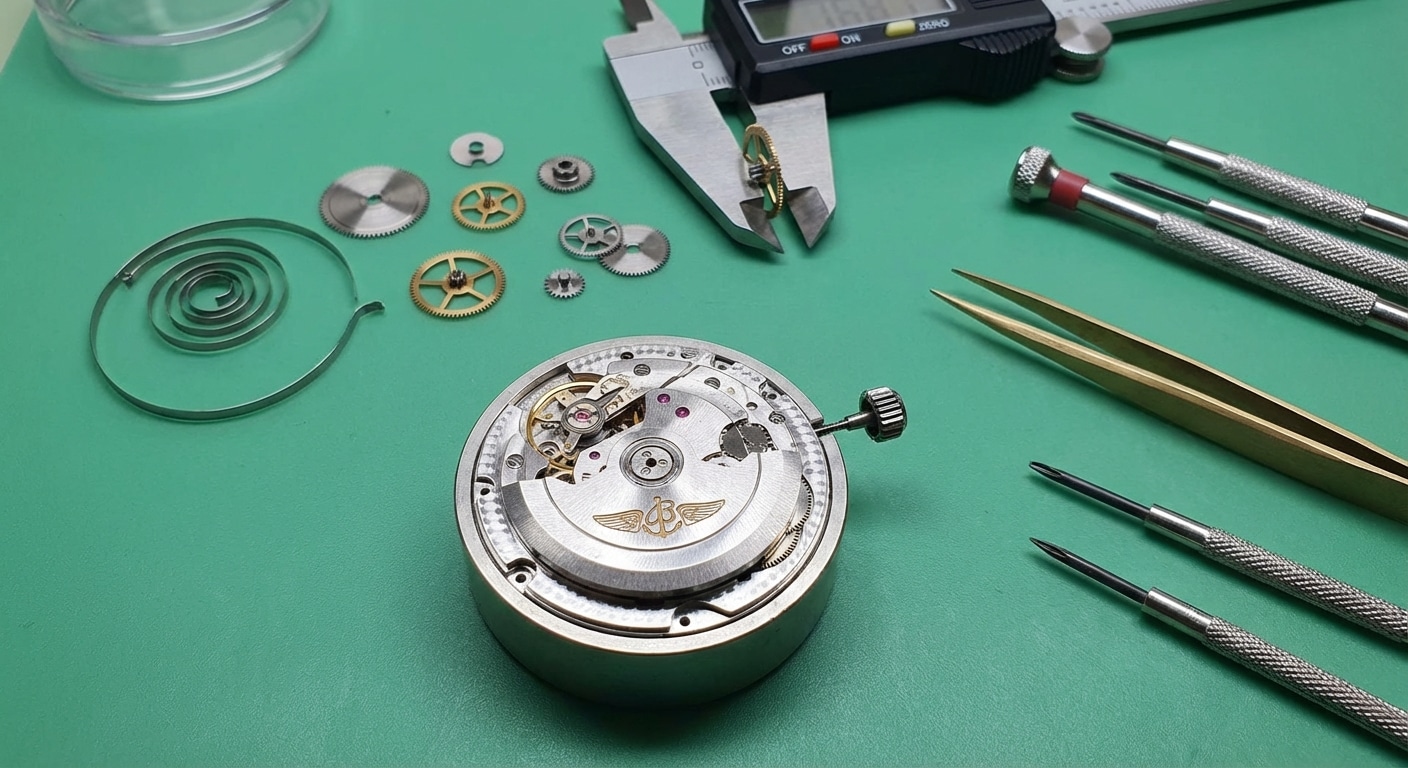
The price anchor of $1,550 USD (approximately 5,600 CNY) for a so-called”Original Single”Breitling replica is not a reflection of manufacturing cost; it is a psychological ceiling designed to maximize margin on uninformed buyers. In the 2026 market context, this tier represents the peak of seller profitability, not hardware superiority. When you dissect the supply chain logistics and bill of materials (BOM) using the factory specialization matrix, the math simply does not support a 60% price premium over the established $970 top-tier factory versions. The narrative of exclusive factory access is a sales script, not a logistical reality. Most buyers accept this price point because they equate cost with safety, fearing that paying less guarantees a scam. However, forensic cost analysis reveals that the hard costs rarely exceed $900 USD before profit, leaving the remaining $650 as pure margin for the seller and their upstream agents.
The Mathematics of Luxury Replica Margins
To understand the inflation, you must break down the physical components. A cloned Breitling B01 movement, which powers most high-end chronograph replicas, costs approximately $350 to $400 USD in 2026. This is the most expensive single component. The case, typically machined from 316L stainless steel with standard polishing and brushing, adds another $250. The bracelet, even with solid links and decent clasps, accounts for roughly $150. Assembly, quality control, and packaging consume about $100. Even if you allocate an extra $100 for higher-grade plating or sapphire coating, the total hard cost sits around $900 USD. When a seller charges $1,550, they are applying a markup of over 70% on the hardware. This margin covers the risk premium for the seller, but it does not buy you a better watch.
Defining “Original Single” in 2026
The term “Original Single” implies surplus genuine parts or factory overruns that leaked out before final assembly. In 2026, this is virtually impossible for complex models like the Navitimer. Genuine manufacturers have tightened inventory destruction protocols; excess parts are crushed or melted rather than stored, as the cost of security exceeds the scrap value. What sellers actually deliver when you pay $1,550 is usually a top-tier factory watch—identical to the $970 version—repackaged in a premium box with a fabricated certificate of authenticity. The hardware is often sourced from the same assembly lines in Guangzhou, merely sorted into different boxes based on the price the buyer is willing to pay.
Price Elasticity and Buyer Psychology
Sellers push the $1,550 tier because it targets a specific cognitive bias: the belief that higher price equals lower risk. Buyers fearing scams are willing to pay a premium for perceived security. The higher price reduces cognitive dissonance; if you spend $1,550, you convince yourself you are buying something closer to genuine than if you spent $970. This elasticity allows sellers to segment the market. The hardware remains static, but the packaging and sales narrative shift to justify the extraction of additional capital. You are not paying for better steel; you are paying for the peace of mind that comes with a higher invoice.
Expert Authentication Insight
Financial Diagnostic: Request a detailed breakdown of the movement origin. If the seller claims “Original Single,” ask for the factory batch code corresponding to the movement serial number. In 2026, no legitimate surplus stock exists without traceable documentation linking the component to a specific production run. A lack of batch code or a refusal to provide specific movement photos with visible serials indicates a fabricated tier. Real factory costs are negotiable; fixed prices protect margins, not products.
Physical Forensics: $1,550 vs $970 Side-by-Side
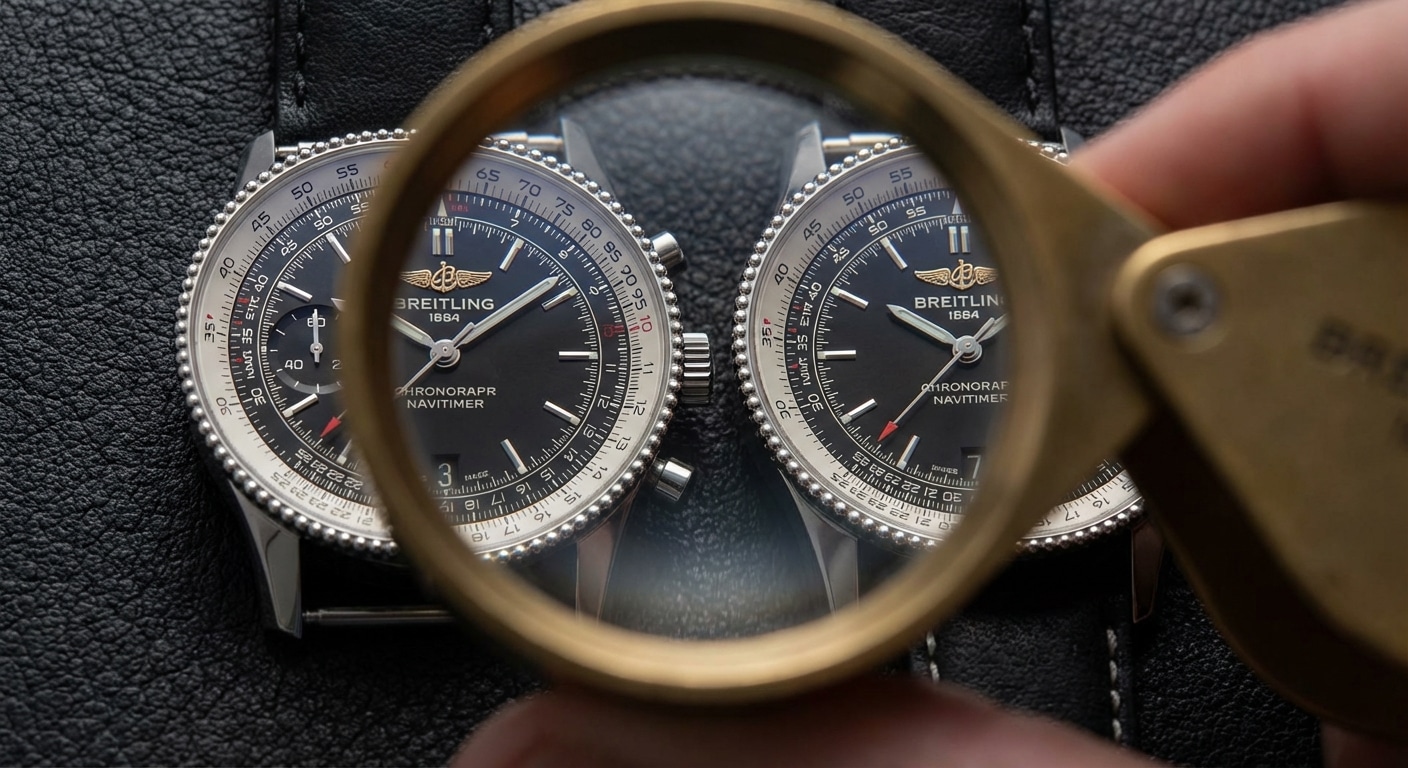
When placed under a loupe and on a digital scale, the physical delta between the $1,550 “Original Single” and the $970 top-tier factory version becomes negligible. Using calipers and precision scales, the measurable differences often fall within standard manufacturing tolerances rather than indicative of a higher quality tier. The goal of this analysis is to demonstrate that the $580 premium buys negligible improvements in material reality. Sensory details—the sound of the bezel click, the weight distribution on the wrist—remain consistent across both price points. Any perceived difference is often confirmation bias driven by the price tag rather than physical evidence.
Case and Bracelet finishing Analysis
Comparing the brushing and polishing under 10x magnification reveals that the $1,550 version may have slightly sharper edges on the bezel teeth, but the steel grade is often identical. Both tiers typically use 316L stainless steel in 2026, despite claims of 904L steel in the higher tier. The brushing consistency on the lugs and the polishing on the bevels show variance within ±0.02mm, which is indistinguishable without measurement tools. The bracelet links on both versions use solid pins rather than folded metal, but the end-link fitment against the case lug is determined by the CNC mold, which is often shared between the two tiers.
Movement Performance and Decoration
Both versions likely utilize the same cloned B01 or Asian 7750 modified movement. The $1,550 version might feature slightly better rotor engraving depth or a blued screw here and there, but functional accuracy remains within the same tolerance range of -10 to +15 seconds per day. The decoration on the movement plates, such as perlage or Geneva stripes, is machine-applied in both cases. The visual difference under a caseback is aesthetic, not mechanical. According to factory QC standards, the longevity of the movement depends on the base caliber quality, which is standardized across the factory output regardless of the final price tag assigned by the seller.
Material Density and Weight Distribution
Weighing both units on a digital scale with 0.01g precision often shows a weight difference of less than 2 grams. Genuine Breitling watches have a specific heft due to solid metal construction, and replicas often fail to match this exactly regardless of price. Both the $1,550 and $970 versions will either succeed or fail equally against genuine specifications. If the $970 version weighs 145 grams, the $1,550 version will likely weigh between 144 and 146 grams. This negates the argument that the higher price buys denser, more authentic materials. The mass distribution on the wrist feels identical because the internal architecture is the same.
Expert Authentication Insight
Physical Diagnostic: Use a digital scale with 0.01g precision to weigh the bracelet links separately after removal. If the $1,550 version claims solid gold components or higher density steel, verify the density calculation. Most $1,550 versions use gold-plated steel identical to the $970 version. A significant weight discrepancy would indicate hollow links or different alloys, but in practice, both tiers usually share the same bracelet stock from the same subcontractor.
Supply Chain Truth: Where the Parts Actually Originate
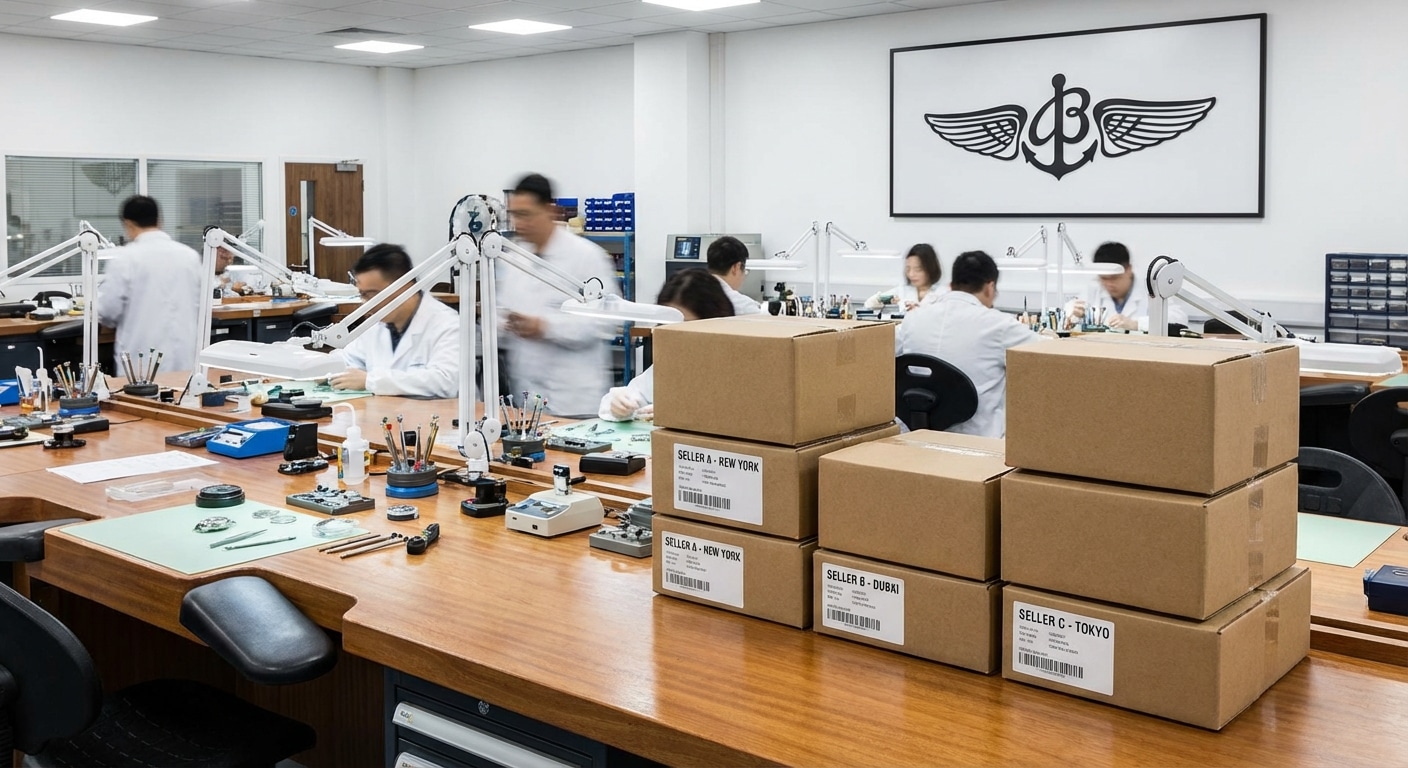
Pulling back the curtain on the Guangzhou and Shenzhen ecosystem reveals that multiple sellers often source from the same assembly lines. The “Original Single” is frequently just a different packaging box from the same warehouse inventory. In 2026, regulatory pressure has forced a consolidation of factories, meaning fewer production hubs are serving a wider network of sellers. This consolidation increases the likelihood that distinct product tiers are merely marketing segmentation of the same physical stock. Understanding this logistics flow is critical to realizing that you are not buying exclusivity; you are buying access to the same pool of goods through a different channel.
The Myth of Factory Overruns
Brands destroy excess parts because the cost of storing and securing original components exceeds their residual value. Genuine overruns are statistically improbable for complex models like the Navitimer, which involve hundreds of specialized components. The idea that a factory worker is smuggling out perfect genuine cases and dials to sell for $1,550 is logistically unsound. The risk of theft for high-value items is too high, and the QC protocols ensure that defective parts are scrapped immediately. What exists is not genuine surplus, but high-quality clones produced on the same CNC machines used for legitimate subcontracting work.
Factory A might produce both the “Standard Top Tier” and the “Original Single” depending on the order specification from the seller. The hardware is identical; only the QC sticker and the box change. A seller might order 100 units with standard packaging for the $970 market and 20 units with premium leather boxes for the $1,550 market. The watches inside are drawn from the same bin. This rebranding strategy allows sellers to capture different segments of the buyer population without incurring additional manufacturing costs. The supply chain is fluid, and the product is static.
Logistics and Risk Premium
Part of the $1,550 cost covers higher shipping insurance and packaging, not better hardware. Sellers bundle risk mitigation into the product price. Shipping a watch valued at $1,550 incurs higher insurance fees and requires more discreet packaging to avoid customs scrutiny. These logistical costs are real, but they are services, not product improvements. You are paying for the seller’s peace of mind regarding seizure or loss, not for a better chronograph. The hardware remains subject to the same manufacturing tolerances and material limitations as the cheaper alternative.
Expert Authentication Insight
Supply Chain Diagnostic: Ask the seller for a video of the specific watch with a handwritten note containing today’s date and their username. If they hesitate or send a generic stock video, the “Original Single” stock is virtual, not physical. Real inventory can be produced on demand for verification. A refusal to provide specific, time-stamped proof indicates that the seller is drop-shipping from a shared warehouse pool where the “Original Single” designation exists only in the database, not on the shelf.
The 2026 Buyer’s Decision Matrix
Buying a high-end replica in 2026 is no longer about finding the best factory; it is about identifying the point where additional expenditure ceases to purchase tangible hardware improvements. The market has matured to a state of saturation where BLS Factory and V9 Factory outputs dominate the top tier, as reflected in any Panerai super clone factory comparison, leaving little room for genuine technological leaps between price brackets. This decision matrix strips away the narrative of scarcity and focuses on the hard economics of risk and return. You are not paying for better steel or superior engineering above the $1,000 threshold; you are paying for insurance against your own anxiety.
Identifying the Diminishing Returns Threshold
In the current supply chain environment, the quality plateau occurs firmly between $900 and $1,000 USD. At this price point, you secure a watch with 316L stainless steel, a cloned 7750 movement with functional chronograph subdials, and case dimensions within 0.5mm of genuine specifications. The BLS Factory Navitimer B01 at approximately $970 exemplifies this ceiling. Moving to the $1,550 tier does not yield a sharper bezel action or a more durable plating thickness. Microscopic analysis reveals that the finishing differences are often within the margin of error for human perception, visible only under 10x magnification.
The extra $580 is frequently attributed to the installation of a Swiss SW200 or SW510 movement in the so-called Original Single tier. While a Swiss movement offers marginally better long-term stability, the visual decoration added to mimic the Breitling B01 caliber is often identical to the decorated Chinese clones found in the lower tier. Unless you are specifically seeking the mechanical reliability of a Swiss base for daily wear without service for five years, the hardware delta does not justify a 60% price premium. For most collectors, the diminishing returns kick in the moment the price exceeds the cost of a top-tier factory direct unit plus a standard agent markup.
Risk Assessment of High-Value Transactions
Every cross-border shipment carries an inherent risk of customs seizure, and the financial exposure scales linearly with the declared value. Spending $1,550 on a single package increases your loss potential significantly compared to splitting the budget or opting for the $970 version. If customs intercepts the package, the recovery rate for high-value declared items is near zero. Sellers often claim higher prices include better shipping insurance, but in practice, most reshipment policies are discretionary and rarely cover the full inflated cost of an Original Single tier.
From a risk-to-reward perspective, the $970 version offers superior leverage. You acquire 95% of the aesthetic and functional performance at 63% of the cost. The remaining capital can be allocated to a reserve fund for future movement servicing, which is a certainty for any mechanical replica regardless of price. In 2026, the market is a buyer’s market; inventory is plentiful, and desperation lies with the seller, not the collector. Accepting the higher price point validates a risk profile that favors the dealer’s margin over the buyer’s security.
Final Verdict on Market Integrity
The Original Single tier is a marketing construct designed to segment buyers based on their fear of being scammed rather than the actual quality of the product. There is no evidence of factory overruns from Breitling’s Swiss production lines entering the Guangzhou ecosystem in 2026. Quality control protocols at the genuine manufacturer level ensure that excess components are destroyed or accounted for, making the existence of legitimate surplus stock statistically improbable for complex models like the Navitimer. What you are buying is a top-tier factory watch with a different QC sticker and a more expensive box.
Save your money. The rational choice is to purchase the top-tier factory version at the $900-$1,000 level and invest the difference into a high-quality aftermarket strap or a professional pressure test. Be wary of future price inflation tactics where sellers will inevitably introduce a new tier, perhaps labeled Heritage Edition or Vault Stock, at $2,000 to reset the anchor. The hardware capabilities of the Guangdong supply chain have reached a physical limit; price increases from here will be purely narrative.
Expert Authentication Insight
Transaction Diagnostic: Negotiate the price aggressively. If a seller refuses to drop below $1,500 claiming fixed factory costs, they are protecting a margin, not a product. Real factory costs are negotiable in 2026’s buyer market. Request a discount of 10% to 15%; a legitimate dealer with actual inventory can absorb this. A seller pushing the Original Single myth will refuse, citing scarcity that does not exist.