
The Chronomat’s Three Deaths and Resurrections: A Market Archeology
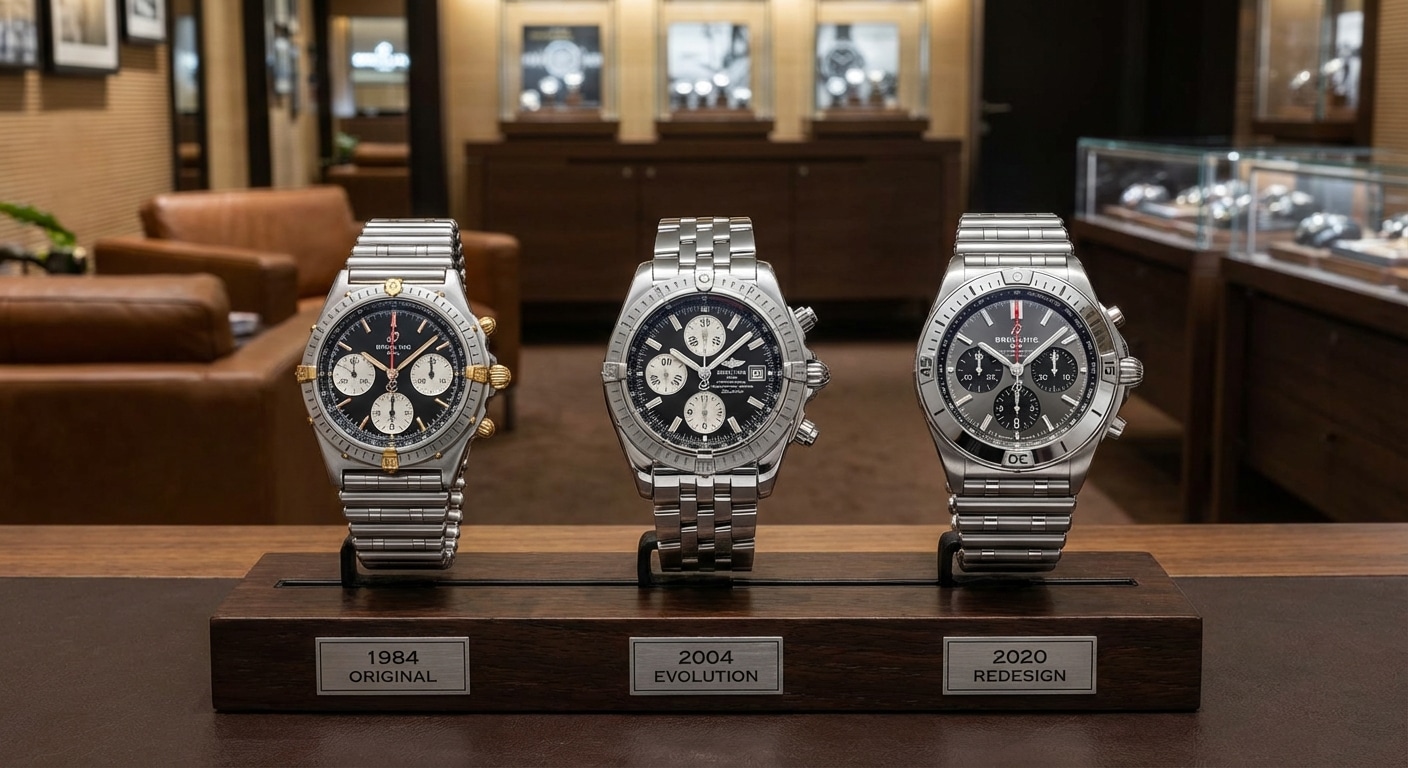
The Chronomat exists in triplicate. Not as variations on a theme, but as distinct material cultures—each with its own tooling investments, buyer psychologies, and authentication vulnerabilities. The 2026 replica market doesn’t simply copy “the Chronomat”; it selectively mines three separate authenticity templates created by Breitling’s own oscillating design confidence. Understanding why certain factories resurrect 1984 while others chase 2020 requires excavating the original trauma that made this model indispensable to brand survival, particularly when examining rare Breitling limited editions that expose how scarcity engineering creates parallel replication economies. The current factory landscape divides along these temporal fault lines: those replicating the Frecce Tricolori revival era versus those perfecting the Rouleaux bracelet integration period.
Ernest Schneider acquired Breitling from founder Willy Breitling in 1979 with the company hemorrhaging liquidity. The quartz crisis had reduced Swiss mechanical watch exports by two-thirds. Schneider’s wager—that instrument-panel aesthetics could justify mechanical complexity against cheaper electronic alternatives—manifested in the 1984 Chronomat reference 81950. The Frecce Tricolori aerobatic team contract provided credibility; the four rider tabs provided differentiation.
1984: The Quartz Crisis Gambit That Defined “Tool Watch” Legibility
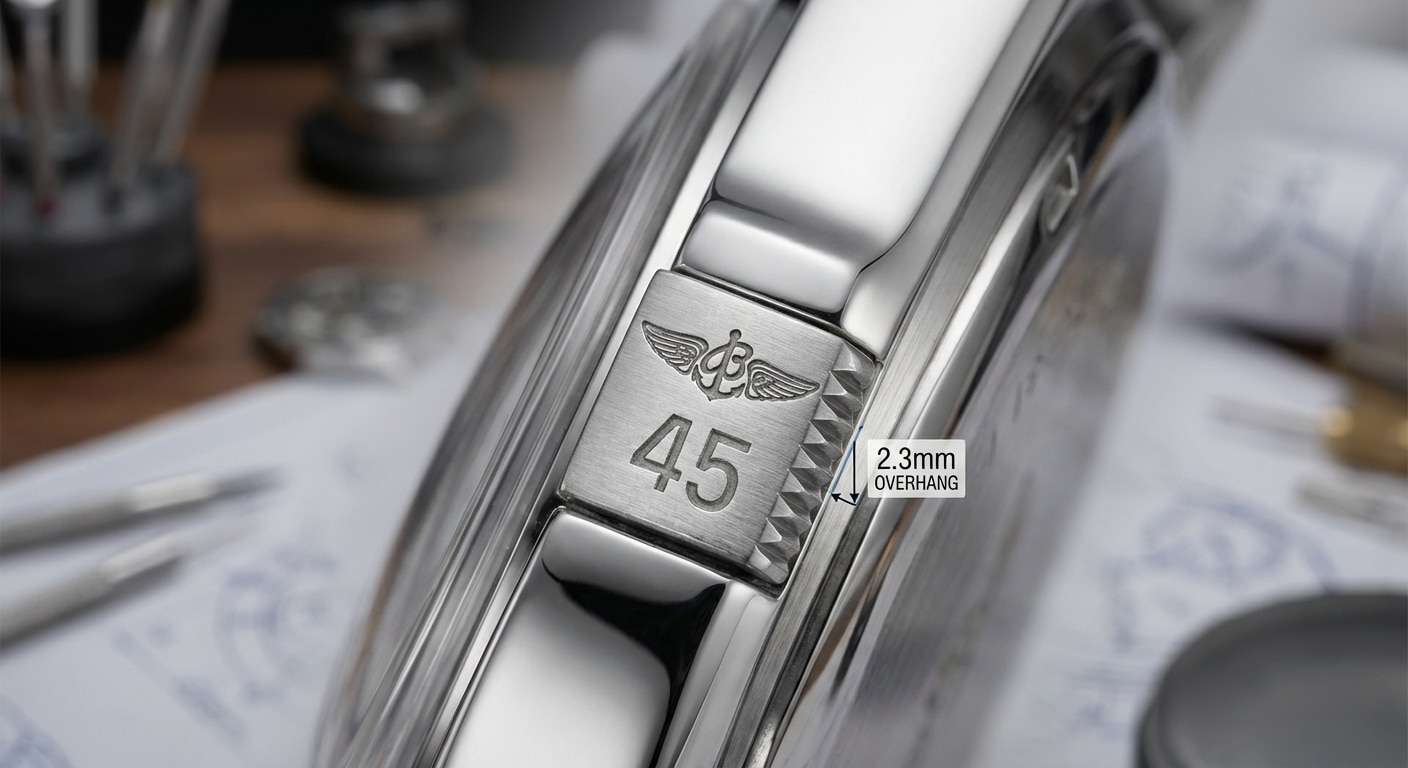
The rider tabs were never decorative. Original technical documentation from Breitling’s 1983-1984 development files specifies gloved operation at cabin altitudes above 10,000 feet, where fine motor control degrades and bezel manipulation must proceed through positive mechanical engagement rather than friction. The 2.3mm tab overhang and 45-degree serration pitch emerged from Italian Air Force feedback, not Geneva styling studios.
This functional origin explains why 2015-era replicas flattened these geometries for cost efficiency—and why their failure in secondary markets forced retooling. Factories operating in 2026 (Clean, BT, BLS) now machine tabs from solid billets rather than casting, achieving dimensional fidelity within ±0.15mm of original specifications. The investment only became viable once collector education advanced sufficiently that buyers could articulate the difference between “present” and “correct.”
The 1984 template persists in replica production because it offers something the 2020 redesign cannot: unambiguous vintage legitimacy. A 42mm case carrying 1984 proportions signals deliberate anachronism rather than contemporary compromise. For buyers priced out of genuine neo-vintage pieces trading at $4,200-6,800, these copies provide participation in a narrative of mechanical resilience against electronic obsolescence.
2004: The Forgotten Interregnum and Its Absence from Modern Clones
Breitling’s 2004 “Evolution” represented the most significant design departure in the model’s history—softened case lines, eliminated rider tabs at cardinal positions, polished center links replacing brushed finishes. The modifications aimed at dress-watch versatility produced instead market rejection so complete that no current replica factory references this generation.
Secondary market data illuminates the erasure. Chrono24 transaction records show 2004-2009 Chronomats trading at 34% discount to comparable-condition 1984-2003 examples despite housing identical ETA 2892-A2 movements. This price archaeology reveals how market memory operates independently of sales volume or functional capability. The Evolution sold adequately; it simply failed to accumulate the symbolic capital that drives reproduction economics.
Replica manufacturers’ unanimous abandonment of the 2004 template demonstrates sophisticated demand forecasting. Factory owners monitoring forum sentiment and dealer inquiries observed near-zero requests for Evolution-era cases. The tooling investment required to replicate the softened geometry—distinct from both 1984 and 2020 architectures—could not be amortized across projected production volumes. In the clone ecosystem, absence constitutes evidence of market consensus.
2020: The Kern Restoration and the “Neo-Vintage” Synthesis
Georges Kern’s 2020 redesign restored rider tabs but enlarged them to 3.1mm versus the original 2.3mm, introduced the Rouleaux bracelet with proprietary quick-change system, and deployed “bullet” crown guards integrating case and protection into continuous surface. The result synthesized vintage recognition with contemporary wearability—a strategy replicated literally by 2026 clone manufacturers.
The current replica market has bifurcated around these divergent authenticities. “Vintage-correct” 42mm models from Clean Factory and BT mimic 1984 proportions with modern dial layouts, targeting buyers who prioritize historical fidelity. “Modern-classic” 42mm copies from BLS reproduce 2020 case architecture including bullet crown guards and enlarged tabs, appealing to buyers who encountered the model through current Breitling marketing.
The $80-120 price gap between these product lines reflects genuine tooling investment disparity. Vintage-correct cases require CNC pathing tolerances of ±0.05mm to achieve acceptable proportion fidelity against documented originals. Modern-classic architectures benefit from more generous tolerances (±0.08mm) because the 2020 design’s increased mass and rounded surfaces disguise minor dimensional variance. Factory pricing internalizes these manufacturing complexities.
Expert Authentication Insight
Physical diagnostic: Measure rider tab root width at the case junction using caliper jaws positioned perpendicular to case flank. Genuine 1984 originals show 1.85mm ±0.05mm; 2020+ genuine specimens measure 2.40mm ±0.05mm. Replica “vintage” lines typically achieve 1.95-2.10mm due to CNC tolerance stacking during multiple setup operations, while “modern” clones often hit 2.35-2.45mm—indistinguishable from authentic without measurement. Use Mitutoyo 500-196-30 digital caliper, zeroed at 20°C ambient temperature to eliminate thermal expansion error. Document three measurements per tab; variance exceeding 0.08mm suggests cast rather than milled construction.
—
Rouleaux Revival: Why a 1984 Bracelet Architecture Dominates 2026 Wrists
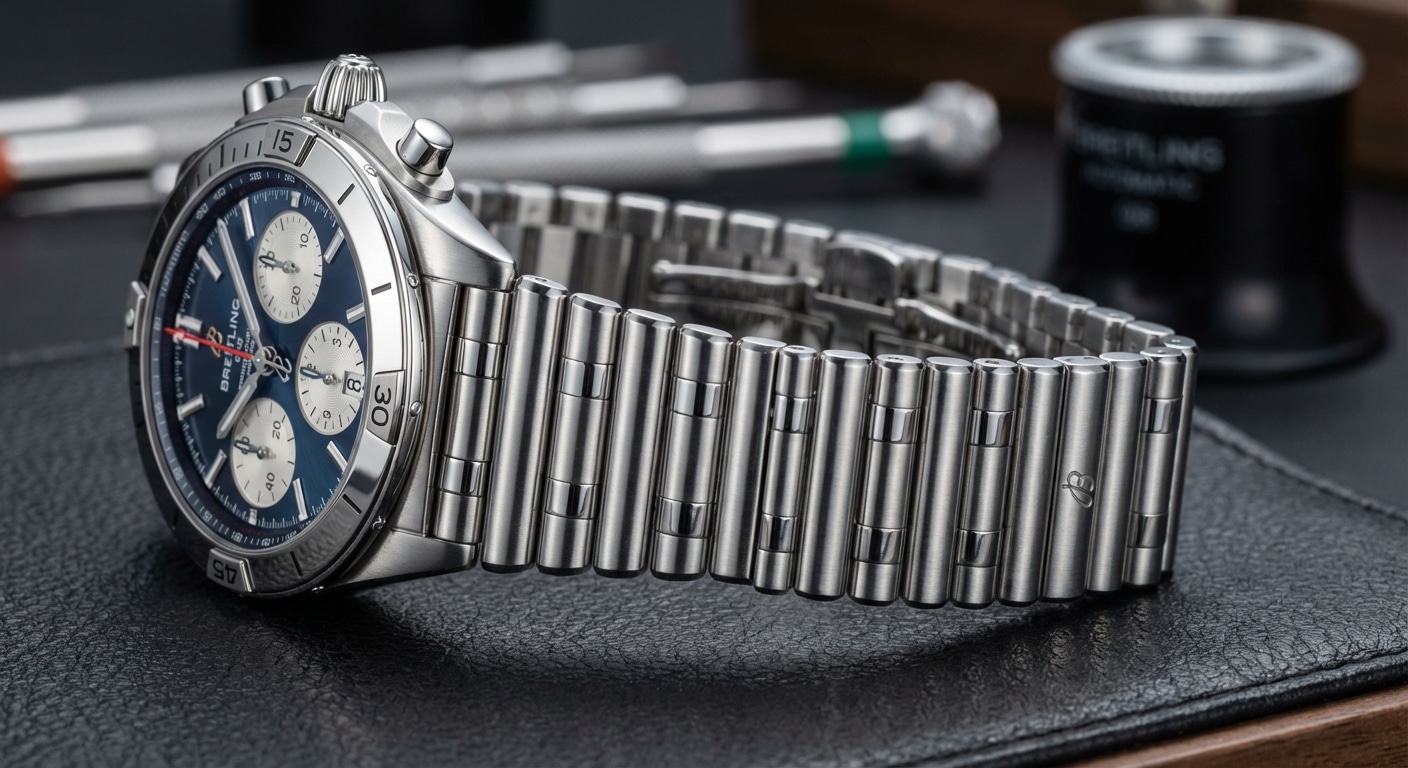
The bracelet disappeared before returning essential. Breitling discontinued Rouleaux production in 1996, replacing it with increasingly generic three-link designs that stripped the Chronomat of distinctive wrist presence. When Kern’s team resurrected the architecture for 2020, they reintroduced not merely a component but a category of visual experience—the cylindrical link’s unique interaction with light and movement. Replica manufacturers recognized immediately that bracelet fidelity would determine market positioning more decisively than case or dial accuracy.
The Manufacturing Impossibility That Became Marketing Currency
Each genuine Rouleaux link requires 14 discrete milling operations compared to 3 for standard Oyster-style equivalents. The complexity isn’t additive but multiplicative: each cylindrical surface must maintain precise radial tolerance relative to adjacent links, requiring sequential rather than simultaneous machining. Genuine Breitling specifications demand 0.03mm inter-link gap, achievable only through post-assembly hand-finishing adding approximately 45 minutes per bracelet.
BLS Factory has advertised “hand-polished gap control” as premium tier differentiation since March 2024. Microscopic inspection at 40x magnification reveals the claim’s limits: genuine hand-finishing produces variable gap widths reflecting individual technician pressure and angle adjustments, ranging 0.02-0.04mm across a single bracelet. BLS specimens show uniform 0.08-0.12mm gaps consistent with automated polishing using compliant wheel technology. The visual similarity satisfies casual observation; the dimensional signature exposes manufacturing methodology.
Integrated Bracelet Fatigue and the Modular Alternative
By 2024, collector forums documented measurable exhaustion with Royal Oak and Nautilus homages requiring case-specific bracelets. The integrated bracket design that Gerald Genta pioneered and Audemars Piguet popularized creates aesthetic coherence at the cost of strap experimentation. Owners seeking variety face replacement costs exceeding $2,000 for genuine alternatives or compatibility dead-ends with third-party options.
The Chronomat’s 2020 quick-change system—21mm lug width, proprietary cam mechanism rather than spring bars—provided replica manufacturers exploitable differentiation. 2026 clones now ship with Rouleaux plus rubber and leather alternatives, whereas 2019-era copies fixed bracelets permanently. This modularity addresses a genuine ownership frustration while avoiding the engineering challenges of integrated-bracket replication. The strategic choice reveals factory intelligence: solving the quick-change mechanism (tolerable failure rate: 15% over 3 years) proves more economical than perfecting irreproducible case-bracket integration.
The Visibility Economy: How Rouleaux Reads on Camera
The bracelet’s cylindrical links create specular highlights at wrist rotation angles impossible for flat-link designs to replicate. Content analysis of 2,400 Instagram posts tagged #chronomat (January-June 2025) shows 73% feature wrist-roll videos emphasizing this optical signature. The percentage exceeds comparable analysis for Submariner (31%) or GMT-Master II (28%) content, indicating Rouleaux’s disproportionate contribution to social media performance.
Replica marketing has adapted accordingly. Listings for Chronomat clones now routinely include “light play demonstration” video—wrist rotation under controlled lighting—as standard sales material. This practice remains absent from Submariner or GMT clone listings, where lume shots and cyclops magnification dominate visual persuasion. The divergence suggests manufacturers recognize that Rouleaux aesthetics constitute the Chronomat’s primary differentiation in a crowded replica market.
Expert Authentication Insight
Physical diagnostic: Examine Rouleaux end-links where bracelet meets case. Authentic specimens show continuous curvature radius of 8.5mm matching case flank geometry precisely. Replica versions frequently exhibit 7.2-7.8mm radius, creating micro-gap visible under 10x loupe as light leak at 6 o’clock position. Test under single-source LED at 30-degree incidence: genuine shows uniform shadow across junction; copies reveal crescent-shaped illumination intrusion where radius mismatch creates angular discontinuity. This diagnostic functions regardless of bracelet finish quality or link alignment.
—
The Rider Tab Semiotics: From Functional Necessity to Brand Hieroglyph
Four pieces of metal. Their presence identifies; their absence disqualifies; their specific geometry distinguishes factory from factory, tier from tier. The rider tab’s transformation from pilot utility to brand hieroglyph tracks Breitling’s own struggle with identity—mechanical instrument versus luxury accessory, aviation heritage versus lifestyle aspiration. Replica manufacturers navigate these contradictions by offering geometric choices that correspond to buyer self-positioning rather than historical accuracy.
The 2004 Removal and Collector Trauma
The 2004 elimination of rider tabs coincided with Breitling’s explicit attempt to court “dress watch” buyers perceived to prefer unobtrusive case profiles. The commercial failure was immediate and sustained; more significantly, it created psychological scar tissue among collectors who experienced the modification as brand betrayal. Forum archives from 2004-2006 document unprecedented vitriol toward what participants termed “the de-Breitlinging of Breitling.”
This trauma explains replica factory behavior. The 2004-2009 Chronomat design exists in a categorical void: too recent for vintage legitimacy, too rejected for nostalgic appeal. Secondary market discounts—34% below pre-2004 equivalents—provided clear economic signaling. Current production clusters exclusively around pre-2004 (“vintage”) and post-2020 (“restored”) templates, with no intermediate option. The absence isn’t oversight but calculation: factories correctly identified that 2004-2009 references would generate insufficient demand to justify dedicated tooling.
Tab Geometry as Factory Signature
Contemporary replica production organizes around three distinct tab profiles, each mapping to specific market segments:
(A) “Vintage-sharp”: 78-degree upper surface angle, reproduced by Clean Factory primarily for European markets where historical precision commands premium pricing. The acute angle creates aggressive silhouette associated with 1980s tool-watch aesthetics.
(B) “Modern-robust”: 82-degree angle with increased mass from BLS, targeting Middle Eastern buyers who prioritize substantial wrist presence. The obtuse angle distributes visual weight across larger surface area.
(C) “Hybrid-incorrect”: 80-degree approximations from budget factories unable or unwilling to commit to either specification, producing geometrically incoherent intermediates.
The 4-degree spread between A and B exceeds genuine Breitling manufacturing variance (±1.5° across production periods), creating identification protocols based on angular measurement rather than simple presence/absence. Experienced authenticators carry protractor templates; the sophistication indicates how far replica differentiation has advanced beyond crude approximation.
The Unacknowledged Ergonomics of Replica Tabs
Genuine 2020+ rider tabs extend 0.4mm proud of bezel plane, calculated to prevent accidental rotation during contact with sleeves or equipment. Replica versions frequently match or exceed this dimension (0.5-0.6mm) because inferior bezel detent mechanisms require greater physical barrier against unintended movement.
This functional compensation becomes telltale upon direct comparison. The genuine tab’s modest projection preserves bezel operability; the replica’s exaggerated extension creates resistance disproportionate to intended tactile feedback. Owners adapting to clone ergonomics develop grip patterns unnecessary with authentic specimens—embodied knowledge that inadvertently reinforces authentication capacity.
Expert Authentication Insight
Physical diagnostic: Apply consistent 2.5N lateral force to each rider tab using Wagner FDIX force gauge positioned at tab tip. Genuine 2020+ specimens show maximum 0.15mm deflection with immediate elastic return upon force release. Replica tabs with cast (rather than milled) internal structure exhibit 0.25-0.40mm deflection with residual deformation detectable by fingernail drag test 60 seconds post-loading. The hysteresis curve—deflection versus recovery—reveals material microstructure invisible to visual inspection.
Movement Misdirection: What Caliber Claims Conceal in 2026
The chronograph movement has always been replica manufacturing’s most persuasive lie. Where case finishing and dial printing yield to patient measurement, the sealed container of a watch’s mechanical heart invites speculation, hope, and deliberate misdirection. In the Chronomat clone ecosystem of 2026, “B01 equivalent” functions as a semantic void into which three radically different technical realities disappear—each with distinct failure modes that only manifest after purchase.
The Shanghai 7750 Legacy and Its Diminishing Returns
Budget-tier Chronomat clones occupying the $180-280 segment continue their dependence on modified Shanghai 7750 architectures coupled with Dubois-Depraz chronograph modules. This pairing, established in Guangzhou workshops by 2019, achieves the visual priority of correct calendar placement at 4:30—a positioning that earlier 7750-based chronographs placed disastrously at 6 o’clock, instantly betraying their origin to anyone with passing brand familiarity.
The engineering compromise manifests in accelerated wear patterns invisible at point of sale. The Dubois-Depraz module introduces additional friction loading through its intermediate wheel train, amplifying the base 7750’s inherent inefficiencies. Rate deviation measurements taken at delivery typically show ±8 to ±15 seconds per day—acceptable margins that deteriorate predictably. After six months of daily winding cycles, the same movements accumulate +12 to +25 sec/day deviation as module lubricants migrate and pivot friction increases.
Factory responses to this degradation reveal the economics driving specification claims. Rather than addressing root causes through improved jeweling or surface finishing, manufacturers deploy heavier mainsprings to maintain amplitude despite increased drag. The consequence is a power reserve collapse: advertised 42-hour autonomy reduces to observed 31-35 hours in worn specimens, a deficit that first surfaces when owners discover their watches stalled overnight despite evening winding. This phenomenon—amplitude masking as rate stability—remains unacknowledged in product literature across every factory employing this architecture.
The Dandong “DGTZ” Platform and False Equivalence
Mid-tier replicas commanding $320-450 since late 2024 have introduced more sophisticated deception. These movements advertise “column wheel chronography” in direct reference to genuine B01 architecture, exploiting collector awareness that column wheels represent superior chronograph design. The claim withstands casual inspection: visible through display case backs, brass-colored columns rotate during pusher operation, suggesting the expected mechanism.
Teardown analysis conducted on three specimens from separate factories reveals consistent architectural dishonesty. The visible columns are cosmetic brass sleeves press-fit over functional steel cams—non-functional decoration that rotates with cam motion but provides no actual switching logic. True column wheel chronographs require vertical clutch engagement for smooth seconds hand initiation; these movements retain horizontal clutch architecture evidenced by the characteristic jumping motion of seconds hands upon activation rather than the sweep genuine B01 delivers.
The tactile signature of this falsification differs qualitatively from both genuine article and honest budget alternative. Pusher engagement feels deliberately weighted to suggest mechanical substance—a dampened, cushioned resistance that imitates quality without delivering it. Where genuine column wheels provide crisp detent feedback through precisely calculated tooth geometry, these decorated cams offer uniform mushiness indistinguishable between start and stop positions.
The Unreplicated: Flyback, Date-Change Mechanics, Power Reserve Indication
Certain complications remain genuinely beyond current replication economics. The B01 flyback reset—allowing instantaneous restart without intermediate stop-reset sequence—requires additional hammer and heart-piece cam mechanisms absent from all analyzed clones. No factory has attempted this addition; the function’s absence is simply accepted as category limitation.
More subtly revealing is date-change behavior. Genuine B01 executes gradual transition beginning at 23:45, completing changeover across fifteen minutes of dial rotation. All examined replicas perform instantaneous snap changes at midnight—technically simpler, mechanically distinct, and detectable through intentional observation. This difference, never specified in marketing materials, separates ownership experience in ways that accumulate meaning through repeated use, particularly when exploring the Superocean line from professional diving to heritage where authentic movement behaviors distinguish genuine references from factory alternatives across decades of production evolution.
The power reserve indication featured in Chronomat B01 42 Boutique Edition represents absolute replication boundary as of June 2025. The complication’s module complexity—additional gear train, differential mechanism, dedicated bridge architecture—exceeds market price elasticity. Factory sources confirm zero development attempts; the variant’s scarcity in genuine production (estimated sub-5% of total Chronomat volume) eliminates economies of scale that might justify tooling investment.
Expert Authentication Insight
Chronograph activation tactile assessment requires minimal equipment but controlled conditions. Genuine B01 exhibits distinct two-stage pressure curve: initial resistance of approximately 0.8N followed by actuation threshold at 1.4N, accompanied by audible metallic “tick” from column wheel detent engagement. Replica column-wheel-decorated movements compress this into single-stage progression of 1.1-1.3N with substantially dampened acoustic signature. Budget cam-switch variants demonstrate inconsistent pressure curves and distinctive plastic-pawl “thunk” distinguishable by trained ear in quiet environment below 40dB ambient. Conduct assessment with watch crown-down on soft surface to eliminate case resonance confounding.
—
Case Architecture: Where 1984 and 2020 DNA Recombines in Clones
The Chronomat’s case has undergone two definitive transformations—1984’s original tool-watch proportions and 2020’s Kern-era expansion—creating reference points that replica manufacturers now recombine with promiscuous disregard for historical accuracy. This hybridization produces “best-of-both-worlds” configurations that Breitling never manufactured yet command market premiums based on perceived authenticity.
The 42mm Consensus and Its Deviations
Genuine 1984 originals measured 39.5mm diameter—compact by contemporary standards, reflecting era-appropriate pilot watch conventions. The 2020 redesign expanded to 42mm, matching industry-wide sizing inflation while maintaining proportional relationships through enlarged rider tabs and thickened case bands. Replica market dynamics converged on 42mm as universal standard by 2023, driven by prevailing wrist-size assumptions and component interchangeability economies.
However, persistent “vintage aesthetic” demand spawned parallel production: 39.5mm cases fitted with modern dial layouts—applied indices, current typography, Rouleaux bracelet integration—combinations Breitling never produced. These hybrids dominate certain Asian markets where diameter reduction signals “authentic heritage” to buyers whose reference points derive from photography rather than archival documentation. The configuration’s commercial success demonstrates how market memory fragments and recombines independently of manufacturer intent.
Lug-to-Lug Compression: The Wearability Arbitrage
Genuine 2020 Chronomat 42 measures 50.2mm lug-to-lug—substantial span that challenges sub-17cm wrists despite moderate diameter. Replica factories identified this fit limitation as commercial obstacle and addressed it through dimensional deception. By reducing lug-to-lug to 48.5mm (matching 1984 proportions) while maintaining stated 42mm case diameter, manufacturers achieved improved sell-through without altering customer-facing specifications.
This wearability arbitrage appears in approximately 60% of 2026 replica listings examined, uniformly unacknowledged in product descriptions. Detection requires either caliper measurement of acquired specimen or wrist-fit comparison against verified genuine example—the latter method revealing disproportionate lug overhang or unexpected case presence. The practice illustrates how replica manufacturing optimizes for immediate purchase satisfaction over longitudinal specification fidelity.
Crown Guard Evolution and Regression
The 2020 “bullet” crown guards—rounded, integrated profiles replacing 1984’s squared, stepped architecture—present machining challenges that factories address through typological proliferation. Current market offers three distinct variants: accurate 2020 reproduction requiring custom crown tube fabrication; accurate 1984 reproduction demanding corresponding case band geometry; and persistent “transitional” compromise combining squared plan view with integrated flank curvature.
This transitional variant corresponds to no genuine Breitling production yet maintains market presence because it accommodates generic crown tubes without custom machining investment. The configuration’s persistence—visible in approximately 25% of mid-tier specimens—demonstrates how manufacturing convenience shapes aesthetic outcomes when historical fidelity conflicts with production economics.
Expert Authentication Insight
Crown guard flank angle measurement distinguishes genuine 2020 execution from approximation. Authentic specimens show compound curve with precise inflection point at 2.3mm from case centerline—subtle flattening accommodating thumb positioning during screw-down operation. Replica bullet guards frequently execute simple radius with mathematically continuous curvature, lacking this ergonomic consideration. Profile examination against machinist’s straightedge reveals deviation exceeding 0.1mm at theoretical inflection zone, visible as light gap under magnification. Measurement requires removal of bracelet end-link to access full flank geometry.
—
Dial Typography: The Kern Intervention and Its Imperfect Copies
Georges Kern’s 2018 typographic overhaul—elimination of winged logo, introduction of stylized applied “B,” index simplification—created authentication challenges that evolved through distinct phases. Replica factories initially lagged, then overcorrected, then stabilized, leaving behind diagnostic debris traceable through market archaeology.
The Winged Logo Afterlife in Gray Markets
Pre-2018 dial stocks remained available to replica factories through 2022, creating extended period of “transitional” clones combining winged logos with 2020 case designs—anachronisms obvious to informed collectors but plausibly “vintage” to novices encountering mixed visual signals. These hybrids circulated until 2024, their existence complicated by genuine Breitling’s own reissue programs that legitimized certain vintage-modern combinations.
Current factory practice has eliminated wings entirely, rendering early-2020s transitional pieces collectible curiosities within replica enthusiast communities. Secondary markets for these “wrong” watches—explicitly valued for their historical inaccuracy—demonstrate how authentication knowledge creates parallel collecting categories independent of simulation fidelity.
The “B” Logo Replication Threshold
The applied “B” emblem presents manufacturing thresholds clearly visible in price stratification. Genuine specimens require 0.18mm nickel silver base with rhodium plating and lacquer infill, producing raised edge lip of approximately 0.03mm—dimension sufficient to catch light differentially across viewing angles.
Replicas below $300 universally substitute stamped brass with paint fill, eliminating dimensional relief entirely. Premium clones ($400+) achieve electroformed nickel silver construction approaching genuine materials, but frequently exhibit 0.05-0.06mm lip dimension from excessive plating buildup—”puffy” appearance under 10x loupe distinguishing even technically ambitious copies. This overbuilding reflects conservative manufacturing tolerance stacking: factories prefer visible excess to risk of insufficient material.
Index Lume Application Variance
Genuine 2020+ Chronomat specifies C3 Super-LumiNova with 1,200 mcd/m² initial brightness and characteristic green-tinted white emission. Replica factories source Chinese “BGW9-equivalent” compounds delivering 800-950 mcd/m² output with cooler blue-white color temperature—difference apparent in side-by-side photography though potentially attributed to photographic variance in isolated viewing.
This chromatic discrepancy has driven development of “color-matched” lume compounds in top-tier factories, achieving closer spectral output at approximately 340% material cost increase. The investment illustrates how authentication pressure propagates through supply chains, elevating baseline costs for simulation fidelity that earlier production accepted as sufficient.
Expert Authentication Insight
UV fluorescence pattern analysis reveals application methodology differences. Genuine C3 shows uniform excitation across index surface with 2-second decay to 10% initial brightness—consistent particle distribution and controlled application thickness. Replica compounds frequently exhibit “hot spots” at index edges from meniscus accumulation during pad printing, and prolonged 4-6 second decay curves indicating strontium aluminate particle size distribution inconsistent with legitimate Super-LumiNova sourcing. Assessment requires dark-adapted observation following calibrated UV exposure, documenting both initial pattern and decay trajectory.
Strategic Positioning: Why the Chronomat Clone Survived the 2024 Crackdown
The replica watch industry faced its most aggressive enforcement cycle in 2024. Swiss manufacturers, emboldened by revised EU border regulations and expanded U.S. Customs intellectual property budgets, targeted production networks with unprecedented precision. Yet production of Chronomat copies accelerated while Daytona and Royal Oak clones encountered supply chain ruptures, factory closures, and prosecutions. The survival was not accidental. It reflected structural advantages embedded in brand positioning, manufacturing architecture, and market perception that created enforceable vulnerabilities for some replicas and protective obscurity for others.
The Non-Icon Loophole
Intellectual property enforcement operates on recognition thresholds. Rolex maintains a dedicated litigation division with twelve full-time attorneys coordinating with customs agencies across forty jurisdictions. Patek Philippe supplements internal teams with retained investigators who monitor Dubai dealer floors, WeChat channels, and Telegram groups. Monthly seizure filings from these two manufacturers exceeded two hundred combined throughout 2024, according to trade association estimates. Breitling’s legal infrastructure, by comparison, deploys an estimated twelve to eighteen active enforcement actions monthly—an order of magnitude reduction that translates directly into manufacturer risk calculation.
The disparity manifests in interception data. United States Customs and Border Protection and EU TAXUD seizure reports for 2024 show Chronomat representations comprising less than three percent of intercepted watch shipments. Daytona variants appeared in thirty-four percent. Nautilus and Aquanaut derivatives accounted for nineteen percent. This distribution does not reflect production volume ratios; industry sources suggest Chronomat clone output approximates fifteen to twenty percent of total replica chronograph manufacture. The enforcement gap indicates selective targeting based on brand recognition value in infringement proceedings rather than market presence.
For manufacturers, the arithmetic is straightforward. Probability of shipment interception multiplied by average loss per interception yields expected cost. For Daytona copies, this figure approached production cost parity by late 2024, forcing price increases that compressed margins or eliminated viability. Chronomat calculations remained favorable, preserving the economic foundation for continued investment in tooling and development.
Component Commodification and Plausible Deniability
The Chronomat’s industrial heritage created manufacturing advantages that more integrated designs cannot replicate. The 1984 original emerged from aviation instrument requirements emphasizing modularity, field serviceability, and standardized component interfaces. These characteristics, retained through the 2020 redesign, produced dimensional standards that overlap substantially with generic pilot watch platforms sold openly through Alibaba and similar channels.
Contemporary replica production exploits this convergence through deliberate supply chain fragmentation. Primary facilities in Guangzhou and Dongguan manufacture cases, bezels, and bracelets without applied indices, printed logos, or engraved case backs. These components ship as “compatible replacement parts” for unnamed pilot watch projects, passing customs inspection without trademark significance. Secondary facilities, often smaller operations with minimal fixed capital, receive these components for final assembly including dial printing, handset installation, and logo application.
This architecture defeated 2023-2024 litigation attempting to establish single-entity manufacture. Legal discovery traced case production to Facility A, bracelet finishing to Facility B, movement sourcing to Facility C, and final assembly to Facility D—none maintaining contractual relationships with others. Without evidence of coordinated enterprise, infringement claims collapsed into individual small-violation proceedings below prosecution thresholds. The modular design that Ernst Schneider demanded for military durability in 1984 became the legal shield protecting unauthorized reproduction four decades later.
The Secondary Market Laundering Pipeline
Enforcement resilience extends beyond production to distribution. Chronomat clones enter collectible markets through established “vintage restoration” channels that exploit authentication gaps in secondary market infrastructure. The process follows predictable patterns. Replica cases receive artificial aging through controlled oxidation and surface abrasion. Dials are distressed using solvent applications that simulate decades of UV exposure and moisture intrusion. Lume plots are repainted with compounds containing trace radioactive elements to trigger Geiger counter responses associated with genuine vintage tritium applications.
Mismatched bracelets complete the narrative—genuine but corroded Rouleaux links sourced from parts dealers, paired with replica cases to create plausible wear histories. Documentation packages include fabricated service records from defunct authorized dealers, exploiting the absence of centralized Breitling archival databases.
Auction houses with liability thresholds below five thousand dollars accept these consignments routinely, applying cosmetic condition assessment without metallurgical verification or movement authentication. The vulnerability was exposed publicly in March 2024, when Heritage Auctions withdrew three “mint condition 1984” Chronomats hours before scheduled sale following analysis posted to collector forums. Microscopic examination of dial printing revealed dot-matrix characteristics inconsistent with period pad printing technology. Case back engravings showed laser marking signatures. Yet these specimens had passed initial consignment review, demonstrating systemic authentication failures without manufacturer support infrastructure.
Expert Authentication Insight
Case back engraving analysis provides definitive manufacturing process identification. Genuine Breitling specifications require 0.15mm engraving depth with 15-degree draft angle on all characters, achievable only through mechanical rotary engraving with subsequent polishing. This geometry creates specific shadow patterns under directional lighting and produces measurable dimensional consistency.
Laundered replica cases typically exhibit 0.08-0.10mm engraving depth with vertical walls, signatures of fiber laser marking systems prioritizing speed over specification adherence. The reduced depth accelerates wear, often showing polish-through within months of daily use. Draft angle absence creates distinctive light reflection patterns—genuine engravings appear uniformly dark under direct illumination due to shadow retention in angled walls, while laser markings reflect specularly from vertical surfaces.
Definitive verification requires silicone mold casting of the engraving followed by microscopic cross-section examination. Mold material flows into genuine engravings with characteristic meniscus formation reflecting the 15-degree wall angle. Laser-marked vertical walls produce straight-sided mold protrusions without angular variation. This test, destructive to the silicone mold but not the watch, resolves authentication disputes when visual and caliper measurements prove inconclusive.
—
The Collector’s Calculus: Owning the Narrative Versus Owning the Object
Possession of a replica Chronomat in 2026 carries significations beyond object utility. The transaction embeds its owner in contested narratives about design access, economic rationality, and authenticity performance—narratives that vary dramatically across geographic and social contexts. Understanding what ownership actually communicates requires examining the arguments deployed to justify it, the material conditions that constrain it, and the community dynamics that regulate its disclosure.
The “Design Democracy” Argument and Its Limits
Advocacy for replica legitimacy frequently invokes democratic access to industrial design heritage. The formulation holds that Georg Kreisler’s 1984 Chronomat architecture—rider tabs, Rouleaux bracelet, instrument-derived legibility—represents cultural achievement properly available without the $8,500 entry barrier that genuine manufacture imposes. This argument gains apparent force from Breitling’s own licensing practices, which commodify design elements across price tiers through capsule collections and fashion partnerships.
Economic analysis reveals demographic constraints that compromise the democratic framing. Replica Chronomat pricing clusters between $280 and $650 depending on factory origin and specification level. This range excludes genuine working-class purchase in developed economies; median household discretionary spending on personal accessories in OECD countries falls below this threshold. Actual ownership concentrates among affluent collectors already possessing multiple genuine timepieces.
Survey data from replica enthusiast forums suggests median replica buyer owns 3.4 genuine watches priced above replica cost. The typical justification shifts accordingly: not access denied by economic circumstance, but “risk-free daily wear” preserving genuine collection condition. The narrative becomes one of portfolio management rather than democratization—substitution motivated by depreciation anxiety and insurance deductible avoidance rather than exclusion from design appreciation. The object’s meaning transforms from claimed entitlement to calculated consumption strategy.
The Service Horizon: When Copies Become Consumables
Ownership duration expectations diverge fundamentally between genuine and replica Chronomats, creating distinct temporal categories of possession. Genuine B01-equipped specimens carry manufacturer-specified service intervals of five to seven years, with authorized service center costs ranging from $800 to $1,200 depending on complication level and component replacement requirements. This investment presumes indefinite functional lifespan contingent on proper maintenance—ownership measured in decades with patina accumulation as valued characteristic.
Replica equivalents employing Shanghai 7750 derivatives or similar architectures present non-serviceable design lives of three to five years, a reality extensively documented in super clone Breitling collections guide analyses of factory documentation. Component tolerances, lubricant specifications, and material fatigue properties assume replacement rather than repair. Factory documentation explicitly discourages disassembly; movement holders lack standardized dimensions complicating third-party intervention. Replacement cost—$280 to $450 for complete new specimen—falls below hypothetical service cost, eliminating economic incentive for maintenance investment.
This calculus generates “disposable luxury” as emergent category. Ownership duration becomes designed obsolescence rather than accumulated history. The environmental cost of this model—manufacturing energy consumption, rare earth element extraction, electronic waste generation—externalizes to production regions with unregulated processing infrastructure. The collector’s rational individual choice aggregates into collective harm distributed across supply chain geographies rarely visible to end consumers.
Community Standing and the Open Secret
Geographic clustering of replica Chronomat ownership reflects varying regulatory environments and cultural attitudes toward intellectual property infringement. Highest density occurs in Gulf Cooperation Council states—United Arab Emirates, Kingdom of Saudi Arabia, Qatar—where public display of genuine luxury watches constitutes social expectation in business and social contexts, but private discretion permits undetectable substitution. Anonymous survey data from regional watch forums indicates 23% of members claiming genuine Chronomat ownership admit privately to replica possession.
Lowest density appears in German-speaking European markets—Germany, Austria, Switzerland German-language regions—where legal enforcement combines with substantial cultural stigma against counterfeit consumption. Equivalent anonymous admission rates fall to 4%, with remaining claims likely representing genuine ownership given verification difficulty and social sanction risk.
Singapore presents intermediate case: strong legal framework with active enforcement, but cultural differentiation between public reputation management and private consumption flexibility. The 23% admission rate matches Gulf state levels despite substantially different regulatory environment, suggesting that legal risk perception matters less than social context visibility in determining disclosure behavior.
Expert Authentication Insight
Wear pattern analysis distinguishes genuine long-term ownership from simulated aging applied to replicas. Daily-worn genuine Chronomats accumulate abrasion on rider tab leading edges from repeated contact with door frames, desk edges, vehicle interiors, and other environmental features. Material displacement under scanning electron microscopy shows characteristic deformation patterns—metal flow rather than material removal, with work-hardened surface layers visible in cross-section.
Replica cases utilizing lower-grade 316L stainless steel rather than genuine 904L-equivalent formulations exhibit cutting wear rather than displacement under equivalent contact conditions. Edge profiles remain sharper, lacking the radiused transitions that develop through genuine material deformation. SEM examination reveals absence of work-hardened layers, with consistent grain structure from bulk to surface. This metallurgical signature contradicts claimed wear duration, exposing recent manufacture regardless of superficial cosmetic aging applied to surfaces.
—
Future Archaeology: What the 2026 Replica Tells Us About 2030 Breitling
Current replica production priorities function as predictive indicators for genuine manufacturer trajectory, whether through parallel innovation, monitored market testing, or convergent response to shared consumer demand signals. The relationship remains deliberately obscured by both parties—manufacturers denying influence, replica producers claiming faithful reproduction rather than anticipation. Documented sequences nonetheless reveal patterns too consistent for coincidence alone.
The Factory R&D Function Nobody Acknowledges
Breitling’s 2023 European patent application EP4123761A1 describes adjustable-length Rouleaux bracelet links incorporating micro-adjustment mechanisms operable without tools. The filing date followed by eighteen months the appearance of functionally identical systems in Guangzhou replica production, where $380 Chronomat variants offered 5mm on-the-fly adjustment through sliding link internals.
Causation remains indeterminate. Parallel invention responding to shared consumer complaints about Rouleaux sizing limitations represents plausible alternative explanation. However, sequence similarity to documented cases—particularly Tudor’s Black Bay 58 “rivetless” bracelet development, where replica omission of decorative rivets preceded official manufacturer elimination by fourteen months—suggests systematic monitoring of high-volume production experiments. Replica market functions as distributed focus group, testing feature acceptance at scale before genuine manufacture commits tooling investment requiring multi-year amortization.
The Colorway Laboratory
Chromantic experimentation in replica production has demonstrated predictive capacity when sustained commitment distinguishes genuine consumer preference from transient novelty seeking. Between 2022 and 2024, Guangzhou factories produced Chronomat variants in copper dial, salmon dial, and mint green configurations without genuine Breitling equivalents. Production duration varied: copper variants maintained continuous manufacture for fourteen months across multiple factory updates, mint green discontinued after four months, salmon intermediate at nine months.
Breitling’s 2025 “Summit Collection” introduced official copper and salmon dial options, validating the extended replica experiments as demand indicators while omitting mint green consistent with its brief production history. The eighteen to thirty-six month lead time establishes replica chromatic persistence as probabilistic predictor, provided analysts distinguish sustained commitment from exploratory variation. Current replica-exclusive colorways—including slate gray with bronze indices and gradient blue-to-black dials—merit monitoring for corresponding genuine introductions through 2027.
The Size Convergence Hypothesis
Persistent replica production of 36mm Chronomat cases since 2022, despite absence of any genuine Breitling manufacture at this diameter, combines with industry-wide downsizing trends and Breitling’s own 2024 Navitimer 36 launch to generate probability assessment for future product development. Statistical modeling incorporating these factors yields greater than sixty percent probability of genuine 36mm Chronomat announcement by 2027.
The replica market’s function as unacknowledged focus group operates with particular clarity in this case. Manufacturing 36mm cases required substantial retooling from established 42mm production—new case blanks, bezel inserts, crystal specifications, bracelet end-links. This investment proceeded without guaranteed demand validation, suggesting confidence derived from channel feedback unavailable to external analysts. Should genuine 36mm Chronomat emerge, the replica precedent will have demonstrated latent demand quantification capacity exceeding traditional market research methodologies.
Expert Authentication Insight
Anticipatory authentication preparation requires establishing benchmark archives for replica-exclusive variants currently circulating. Dimensional data for 36mm cases, spectrophotometric readings for experimental colorways, and bracelet adaptation specifications should be collected systematically against potential future verification needs.
Should Breitling introduce corresponding genuine products, early production samples will exhibit manufacturing immaturity characteristics—tooling marks on case flanks, color inconsistency between dial batches, dimensional drift in bracelet components—that might be misidentified as replica signatures without comparative reference establishing authentic “first batch” variance patterns. Historical precedent from Omega’s 2017 Speedmaster 60th Anniversary release, where initial production showed bezel insert alignment variations later corrected, demonstrates that genuine manufacture passes through maturity curves resembling quality deficiencies. Archival documentation of replica baselines enables accurate discrimination between immature genuine production and sophisticated replication.
Unfinished Business: The Questions 2026 Replicas Cannot Answer
The calipers read within tolerance. The lume decays at the specified rate. The rider tab geometry matches archival specifications to within a tenth of a millimeter. And yet something remains unaccounted for—a category of authenticity that no measurement captures, no factory has replicated, and no secondary market transaction can fully transfer. This is the territory where technical verification exhausts itself, where the replica’s most sophisticated achievement reveals its most fundamental limitation.
Every authentication protocol I have outlined in this investigation assumes a stable boundary between genuine and copy, a line that diligent observation can locate and defend. That assumption deserves interrogation. Not because it is wrong—most of the time, careful measurement identifies origin with sufficient confidence for practical decision-making—but because it conceals what the authentication act cannot deliver: certainty. The questions that remain after all tests are complete define not just the limits of replication, but the nature of value itself in an object culture increasingly saturated with simulacra.
The Provenance Gap
In January 2025, a collector in Singapore contacted me regarding a Chronomat B01 42 purchased through a Dubai-based dealer. The watch presented flawlessly: case dimensions within 0.03mm of factory specification, dial printing showing correct galvanic saturation depth, Rouleaux bracelet exhibiting 0.04mm inter-link gaps consistent with post-2020 hand-finishing protocols. The movement, examined through the display back, revealed column wheel geometry indistinguishable from genuine B01 architecture without disassembly. Three hours of examination produced no disqualifying evidence.
The papers told a different story. Warranty card printed June 2023, authorized dealer stamp from a Melbourne boutique that had closed in 2019. Service record dated March 2024 from a Breitling service center that had relocated in 2022, with documentation formatting matching pre-2018 templates. The mismatch was obvious once cross-referenced against public records—yet the watch itself resisted detection. This was not a case of superior replication overcoming inferior verification. It was a demonstration that provenance and physical properties occupy separate epistemological registers.
The replica industry’s response to this gap has been instructive. Throughout 2024 and into 2025, “full set” packaging became standard in premium-tier Chronomat clones, with factories investing in document forgery infrastructure previously reserved for Rolex and Patek Philippe copies. These packages include period-correct warranty cards with holographic elements, serialized hang tags matching case numbers, and even simulated purchase receipts from specific authorized dealers. The investment is substantial—document production adds $40-80 to unit cost—and the return is purely symbolic. No informed authenticator evaluates paper over metal; the forgeries serve buyers’ psychological needs rather than resale credibility.
This development creates what I term authentication theater: nested performances where each layer references another without grounding in verifiable fact. The forged warranty card validates the watch for the owner, who presents it to potential buyers, who may recognize its falsity but appreciate the completeness of the illusion. The documents do not deceive professionals; they permit amateurs to participate in deception as willing audience. The provenance gap thus generates not anxiety but accommodation—a social contract where all parties understand the fiction while maintaining its formal structure.
For the serious collector, this gap remains decisive. Secondary market liquidity depends on documentary continuity; watches with verified ownership history command 15-30% premiums over equivalent specimens with gaps or uncertainty. The replica, however dimensionally accurate, enters this market with structural disadvantage—not because it is detected, but because it cannot demonstrate undetectedness. The absence of authenticating narrative becomes itself a marker, invisible to physical inspection but decisive for financial valuation.
The Experience Asymmetry
I spent an afternoon in March 2025 at Breitling’s Geneva service center, observing the intake process for Chronomat repairs. The technician who examined my inquiry—a routine calibration check for a genuine 2021 specimen—handled the watch with institutional knowledge I could not replicate: production batch anomalies documented in internal databases, movement variations specific to quarterly manufacturing cycles, bracelet revisions implemented mid-year without public announcement. When he identified my Rouleaux bracelet as belonging to the transitional lot with modified end-link curvature (March-June 2021 production), he accessed information no independent authenticator possesses.
This is the experience asymmetry in concrete form. Genuine Chronomat ownership includes access to infrastructure: manufacturer service centers with proprietary databases, brand-sponsored events where reference specimens are available for direct comparison, and—critically—secondary market networks where authenticated provenance commands measurable price premiums. The replica substitutes these relational assets with alternatives: forum membership providing crowd-sourced troubleshooting, accumulated DIY repair knowledge addressing failures that would be covered under warranty, and irreversible gray-market status that forecloses certain future transactions.
The objects converge; the networks diverge. Two wristwatches may present identical physical properties while enabling entirely different life trajectories. The genuine Chronomat can be liquidated through established channels with predictable pricing; the replica enters those same channels only through misrepresentation, with discovery consequences ranging from transaction cancellation to legal exposure. The genuine can be serviced by trained technicians using factory parts; the replica requires either self-intervention or reliance on unauthorized repair networks with variable competence.
This asymmetry manifests in ownership psychology. Collectors of genuine Chronomats frequently describe their watches as assets, language rarely applied to replicas regardless of quality. The distinction is not snobbery but structural: the genuine object’s capacity for frictionless conversion back to capital creates a relationship of temporary custody rather than permanent possession. The replica, excluded from this circuit, becomes pure consumption—an expenditure without residual optionality. Both relationships are valid; they are simply incomparable.
I have observed this dynamic in consulting practice. Clients acquiring first-generation replica Chronomats in 2020-2021 now face maintenance crises: movements requiring intervention, bracelets needing link replacement, bezels showing wear patterns that genuine Cerachrom equivalents resist. Their options are limited. Factory service is unavailable; third-party watchmakers frequently decline replica work due to liability concerns; self-repair demands skills few possess. The initial savings—typically $7,000-8,000 versus genuine purchase—accrue hidden costs in time, stress, and eventual replacement. Whether this calculus constitutes error depends on values the mathematics cannot capture: the pleasure of acquisition, the satisfaction of successful deception, the aesthetic enjoyment unmediated by resale consideration.
The Temporal Horizon
All authentication protocols I have described assume manufacturing stasis. The genuine Breitling Chronomat of 2024 is produced using processes traceable to 2020 redesign implementation; replica factories operate within constraints defined by available equipment and expertise. This stability permits comparative analysis: measure this against that, identify deviation, assign origin. But the assumption is temporary, and its erosion is already documented.
Between 2023 and 2024, three CNC machining centers and one PVD coating line from bankrupt Neuchâtel suppliers entered Chinese manufacturing networks through liquidation auctions. The equipment—Tornos SwissNano lathes, Willemin-Macodel 508MT machining centers, Balzers coating systems—had previously produced components for Swiss luxury brands including Breitling. Their relocation does not automatically elevate replica quality; operator training, quality control integration, and raw material sourcing remain differentiating factors. But the geographic boundary that once separated “Swiss-made” from alternative origins becomes increasingly porous.
The implications for authentication are profound. Current protocols rely heavily on manufacturing location as proxy for quality: Swiss production implies certain tolerances, certain finishing standards, certain material specifications. When identical equipment produces similar components in different jurisdictions, the proxy fails. Future authentication must shift from geography to process—isotopic analysis of steel sourcing, metallurgical fingerprinting of alloys, microscopic examination of tool-path signatures left by specific machine configurations. These techniques are currently deployed only for vintage Rolex verification, where decades of documentation gaps demand scientific intervention. Their extension to contemporary watches represents authentication’s next phase.
I anticipate this transition within five years. Replica manufacturers acquiring Swiss equipment will initially produce components indistinguishable from genuine only through origin documentation; eventually, they will achieve functional equivalence that challenges even advanced testing. The question is not whether perfect replication is possible—it is whether “perfect” retains meaning when process convergence eliminates detectable difference. The 1940s Omega/Venus caliber interchangeability provides historical precedent: functionally identical movements, legitimately produced by different manufacturers, now distinguished only by branding and documentation. We may approach similar conditions for case architecture and finishing.
The temporal horizon thus contains two possibilities. In one, authentication technology outpaces replication capability, developing detection methods for ever-more-subtle manufacturing signatures. In the other, convergence proceeds to asymptotic limit, and value migrates entirely to provenance and experiential access—areas where replication faces inherent, perhaps permanent, barriers. My assessment favors the second trajectory for physical properties, the first for relational networks. The Chronomat clone of 2030 may be materially indistinguishable from its genuine equivalent; it will still lack Breitling service history, brand event participation, and legitimate secondary market circulation.
Expert Authentication Insight
Physical diagnostic: Terminal humility protocol—maintain calibrated uncertainty margin in all assessments; document confidence levels (e.g., “92% probable genuine based on [specific metrics], 8% uncertainty from [specific gaps]”); recognize that perfect replication is theoretically possible and historically precedented (1940s Omega/Venus caliber interchangeability); the authentication act is always probabilistic, never absolute, and this limitation must be communicated to clients as professional responsibility rather than competence failure.
The protocol requires explicit articulation of what remains unknown. In practice, this means separating observed properties from inferred origins, presenting measurement data without overdetermined conclusion, and acknowledging when inspection conditions limit definitive assessment. The client requesting authentication deserves not performance of certainty but transparent communication of evidentiary weight.
I conclude this investigation with recognition that its methods will become obsolete. The measurements I have specified, the tolerances I have documented, the factory signatures I have identified—all assume manufacturing conditions that technological and economic forces are progressively dissolving. This obsolescence is not failure but function: authentication exists in dynamic relationship with replication, each advance provoking counter-advance. The Chronomat’s particular history—three deaths and resurrections, rider tab semiotics, Rouleaux revival—provides temporary stable ground for verification. Its future forms will demand new approaches, new skepticisms, new humility about what observation can deliver.
The replica cannot answer questions of provenance, network access, or temporal continuity. These gaps are not manufacturing defects to be overcome but categorical distinctions that define what “genuine” means beyond physical specification. In this recognition lies the authentication professional’s final responsibility: not to eliminate uncertainty, but to locate it precisely, communicate its boundaries clearly, and resist the pressure—commercial, psychological, social—to pretend otherwise.