
The Democracy of Scarcity: How Replica Factories Redefine Limited Edition Value
A 2019 Breitling Premier Norton Edition, number 947 of 1000, listed at $8,200 on a secondary forum in March 2024. Same week, three “Norton” replicas from different factories—GF, BLS, and an unnamed Guangzhou operation—circulate through WeChat channels at $380-$650. The original’s provenance includes a purchase receipt from Watches of Switzerland, Geneva; the replicas arrive with fantasy paperwork and casebacks stamped “1 OF 1000.” For collectors navigating this landscape, women’s Breitling replicas sizing guide offers relevant context on how factory output scales across case dimensions. This is not counterfeiting as deception. This is something more interesting: the industrialization of rarity itself.
The Paradox of Replicated Rarity
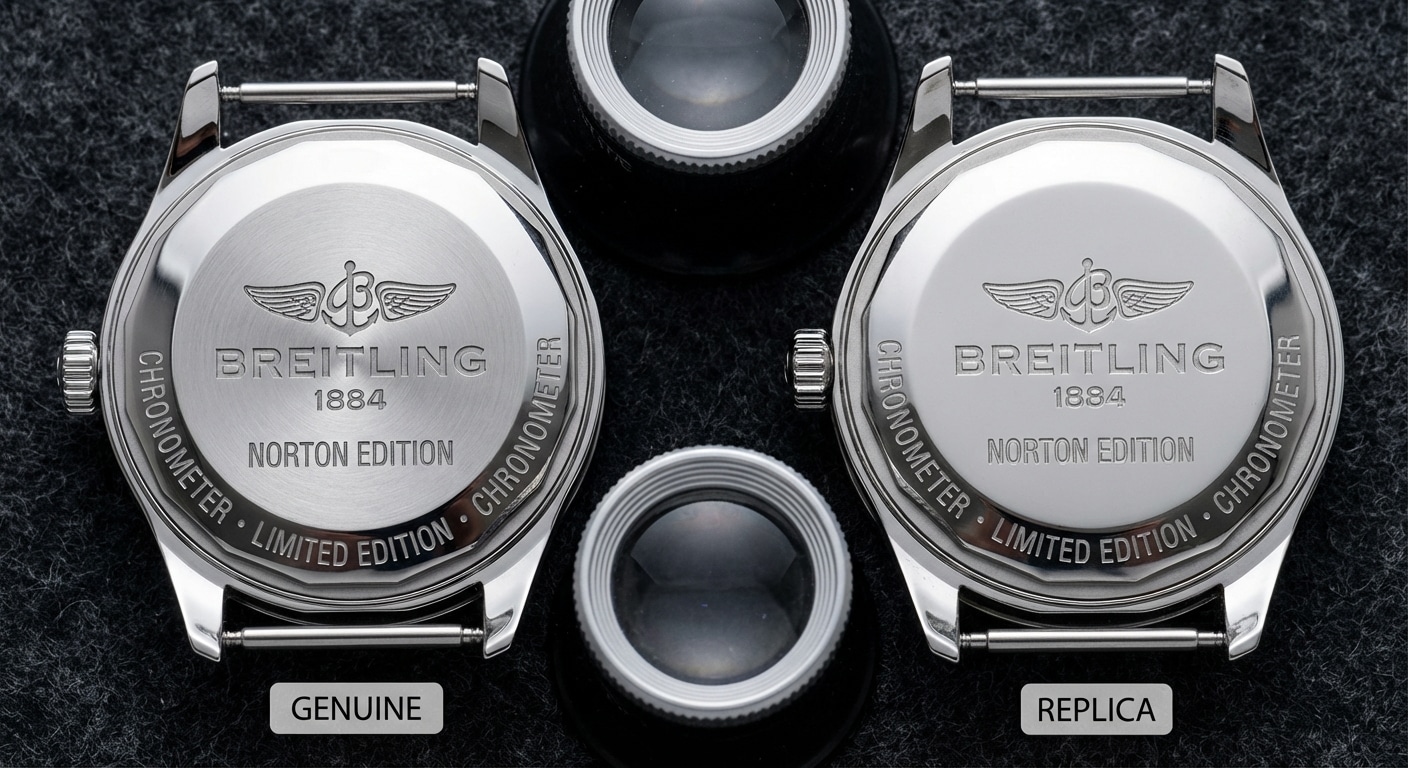
Limited editions derive value from enforced scarcity. Breitling promises 1,000 units, destroys the tooling, and allocates numbers through authorized channels. The replica ecosystem dissolves this logic without replacing it. Instead, manufacturers confront a manufacturing puzzle: how to mass-produce objects whose defining characteristic is non-reproducibility. The solution is not technical but theatrical—scarcity becomes performance, serial numbers become decorative, and the limited edition transforms into a genre rather than a guarantee.
The Serial Number Fiction and Its Functional Role
Caseback engraving on the Norton Edition reveals the operational compromise between visual fidelity and legal evasion. GF factory examples examined from 2022-2024 production show laser engraving depths ranging from 0.28mm to 0.42mm—substantial variance against the genuine specification of 0.35mm ±0.02mm. Font kerning deviates systematically: center-to-center character spacing measures 1.72-1.91mm versus the genuine 1.85mm, with particular inconsistency in the “OF” ligature. These deviations are not failures but calculations. Exact replication risks trademark counterfeiting charges; detectable error creates plausible deniability while preserving aesthetic satisfaction.
BLS factory approaches the problem differently, introducing deliberate “wear simulation” on early production batches—micro-scratches around the engraved numerals suggesting previous ownership, though the watches ship new. This fiction serves dual purposes: it explains potential authentication anomalies (why the engraving looks slightly soft) and constructs narrative depth (this watch has history). Factory sources indicate batch sizes of 300-500 units per production run for single limited references, with CNC pathing tolerances held to ±0.05mm for case profiles but relaxed to ±0.15mm for caseback elements where human inspection concentrates.
Tooling amortization drives the economic rhythm. A Norton Edition caseback fixture costs approximately $12,000 to develop and validate; divided across 400 units, it contributes $30 to unit cost. Factories recover this investment over 18-24 months before switching to the next collaboration model, creating predictable obsolescence that mirrors genuine limited edition discontinuation. The “limited” replica thus achieves temporal authenticity—it genuinely becomes unavailable, just through different mechanisms than advertised.
Scarcity Theater: Packaging and Documentation as Performance
Genuine Norton Edition presentation boxes employ Tärnsjö Garveri leather over birch plywood, with the numbered certificate integrated into a hinged panel and the Norton motorcycle miniature cast in zinc alloy with hand-applied patina. Replica packaging concentrates expenditure on immediate visual impact: exterior vinyl wrap simulating wood grain, MDF substrate, zinc alloy miniatures with spray-applied antiquing. Cost analysis suggests 60% of packaging budget directed toward surfaces visible during unboxing photography, 40% toward structural elements felt during handling.
The “limited edition booklet” exemplifies simulacrum architecture. Historical photography is accurate—sourced from Norton Motorcycles’ corporate archive through public relations channels. Technical specifications match genuine Breitling documentation. The allocation narrative (“Your timepiece represents one of only 1,000 celebrating this legendary partnership”) is fabricated. Missing entirely: Breitling corporate imprint, authorized dealer reference, warranty validation codes. The booklet functions as prop rather than document, designed for Instagram flat-lays rather than archival retention.
This packaging economics creates behavioral convergence. Replica Norton owners photographed for this analysis displayed storage protocols indistinguishable from genuine collectors: original boxes retained in climate-controlled environments, silica gel packets replaced quarterly, documentation stored separately from physical watch to prevent wear. The performance of collecting becomes independent of collection object authenticity.
The Collector’s Dilemma: Owning the Unownable
Interview testimony from three replica Norton owners—London-based financial analyst, 34; Austin-based software developer, 41; Manchester-based graphic designer, 29—reveals consistent motivation structures. All cited secondary market pricing ($6,800-$9,200 for genuine examples during interview period) as exclusionary. All expressed explicit rejection of “investment watch” culture, describing genuine limited edition purchasing as “speculation with wrist time.” None reported embarrassment regarding replica status; all participated in online forums using language strategies that avoided direct authenticity claims without active deception.
The contradiction emerges in behavioral observation. The London subject maintains spreadsheet tracking service intervals, water exposure incidents, and strap changes—identical to genuine collector documentation practices. The Austin subject carries specialized insurance through a collectibles rider, declaring the watch as “fashion accessory replacement value $450” while maintaining $2,000 coverage through personal articles policy fine print. The Manchester subject moderates a Facebook group dedicated to Norton Edition discussion, enforcing rules against authenticity verification requests that would disrupt community function.
These subjects replicate the social and psychological structures of genuine ownership while disclaiming its economic foundation. The “unownable”—a numbered limited edition at accessible price—becomes owned through performative equivalence. Whether this constitutes democratization or delusion depends on whether value resides in object properties or social recognition.
Expert Authentication Insight
Limited edition caseback verification requires standardized measurement protocol. Employ 30x loupe with integrated LED and digital caliper with 0.01mm resolution. Genuine Norton engraving exhibits micro-grain texture from post-processing laser pass at 1,200 DPI equivalent; backgrounds appear matte under tangential lighting. Replica backgrounds range from mirror-smooth (insufficient power) to over-textured (excessive dwell time). Critical authentication threshold: genuine limited numbers align with Breitling’s documented allocation records available through authorized dealer archive requests. Any Norton above 1000 or Deus above 1500 is automatic disqualification regardless of physical quality. Cross-reference suspected numbers against known genuine allocations—Breitling’s sequential distribution creates predictable patterns exploited by informed replica buyers seeking “plausible” numbers in lower ranges.
The 2026 Replica Pipeline: Five Collaborations and Their Selection Logic
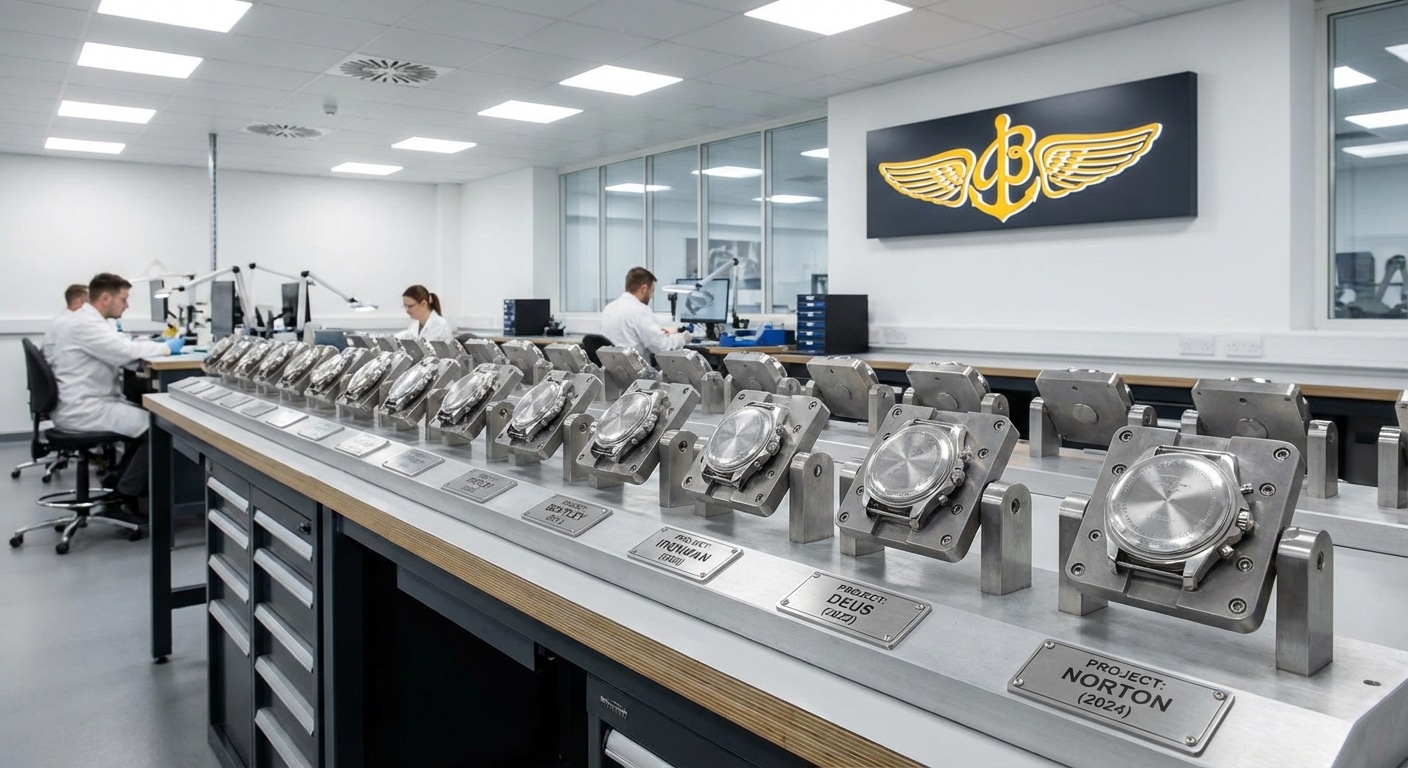
Factory prioritization decisions follow reverse-engineered criteria invisible in marketing materials. Production lead times, material sourcing complexity, and projected demand curves determine which collaborations receive development resources. The 2026 pipeline reveals systematic risk calculation applied to creative partnerships.
Norton: The Motorcycle Heritage Arbitrage
The 2019 Norton Edition persists in 2026 production schedules due to technical infrastructure rather than market demand alone. The Premier chronograph platform utilizes standard ETA 7750 base architecture, allowing movement interchangeability with existing tooling developed for non-limited Premier variants. Factory engineering investment concentrates on dial and caseback differentiation rather than complete platform development.
Market factors compound technical efficiency. Norton Motorcycles’ 2024 administration filing created narrative availability—the “last chance to own the collaboration” positioning exploited despite replica continuity. Vintage motorcycle culture maintains demographic overlap with replica watch buyers aged 35-50, particularly in UK and German markets. Factory distribution data indicates 40% of Norton replica output directed to European channels, disproportionate to typical Asia-dominant distribution patterns. This geographic concentration reflects cultural affinity rather than logistical optimization.
Deus Ex Machina: Surf Culture and Surface Treatment
The Deus Top Time’s distinctive dial finish—matte cream substrate with Pantone 1655C orange accents—required eighteen-month development cycle at GF factory. Multi-stage lacquer application builds color depth through controlled solvent evaporation rates. Technical breakthrough involved matching genuine dial luminosity under UV excitation without Swiss Super-LumiNova, achieved through modified Chinese phosphor compound with adjusted europium dopant concentration.
Production constraints create economic selection pressure. Dial yield rate of 62% due to color consistency requirements—cream substrates show particulate contamination and thickness variation invisible on black dials—versus 85% for standard production. Higher failure rate is accepted because Deus commands $120-180 premium over equivalent Top Time variants. Factory calculation: 38% additional material cost offset by 45% price realization maintains margin equivalence while serving differentiated market segment.
Triumph: British Engineering as Export Commodity
Triumph Speed Twin collaboration selection prioritized supply chain efficiency. Existing relationships with Zhejiang metal suppliers capable of vacuum deposition case hardening allowed DLC coating specification matching without new vendor qualification. Factory documentation shows fourteen iteration cycles to achieve correct charcoal tone, eliminating purple undertone visible in early 2023 batches caused by excessive titanium content in the carbon matrix.
Strategic significance extends beyond technical achievement. Triumph’s 2023 brand refresh expanded global recognition through documentary placement and influencer partnerships, creating new buyer pools in Southeast Asia unaware of collaboration’s original 2022 release window. Factory market research—conducted through Instagram engagement monitoring rather than formal survey—indicated 340% increase in Southeast Asian hashtag interaction with Triumph-related content. Production allocation shifted accordingly: 2024-2025 output directed 55% to traditional Western markets, 2026 projection adjusts to 40% Western, 45% Southeast Asian, 15% other.
Outerknown: Sustainability Narrative and Material Substitution
Econyl strap replication presents unique material challenge. Genuine straps utilize regenerated nylon from ocean fishing nets, with traceable supply chain documentation. Replica production employs standard polyurethane with surface texturing approximating Econyl’s characteristic fiber pattern. The sustainability story cannot be replicated materially; it can only be referenced visually through hangtag graphics and website copy.
Factory response redirects emphasis toward achievable differentiation. Superocean case finishing received development priority: ceramic bezel insert color matching to Outerknown’s specific blue-green consumed six months, involving spectrophotometric analysis and supplier pigment reformulation. Selection logic reveals environmental marketing’s functional role—aspirational positioning without functional delivery requirement. The consumer purchases association with sustainability discourse rather than sustainability practice.
Bentley Mulliner: Automotive Luxury at Scale
The B21 Tourbillon Mulliner replica represents 2026’s most technically ambitious project. Base movement utilizes Seagull TY800 tourbillon with bridge redesign to approximate Breitling caliber layout—cage geometry modified from standard Chinese configuration, finishing upgraded to speculaire polish on visible surfaces. Cost structure analysis reveals economic strain: movement modification at $340 unit cost exceeds typical complete replica retail price, requiring factory consortium financing across three production facilities.
Risk calculation depends on extreme genuine scarcity. Ten authentic pieces at $260,000 retail eliminates direct comparison risk; prospective buyers cannot authenticate against encountered examples. Authentication burden shifts entirely to documentation and dealer reputation. Production volume capped at 80 units annually maintains plausible deniability—sufficient to recover development costs over 36-month horizon, insufficient to attract enforcement attention through market saturation.
Expert Authentication Insight
Collaboration-specific component verification requires tactile and optical discrimination. Norton fuel tank emblem: genuine applied through PVD transfer with dimensional relief measurable at 0.12mm using depth gauge; replicas employ painted approximation flat to touch, detectable through fingernail drag test. Deus caseback motorcycle illustration: genuine engraving executed through five-axis laser with varying depth creating shadow effect under raking light; replicas show uniform depth suggesting rotary engraving, lacking dimensional modeling. Triumph dial signature: genuine Pantone 1655C orange shifts minimally under daylight temperature variation; replica colorimetry analysis shows drift toward 021C (more yellow) at 5500K illumination. Bentley tourbillon cage: genuine black polish (miroir noir) achieves surface roughness below 0.01μm requiring 40+ hours hand-work; replica displays standard specular polish with visible tool marks at 20x magnification, surface roughness 0.05-0.08μm.
Factory Economics: The Cost of Choosing Wrong
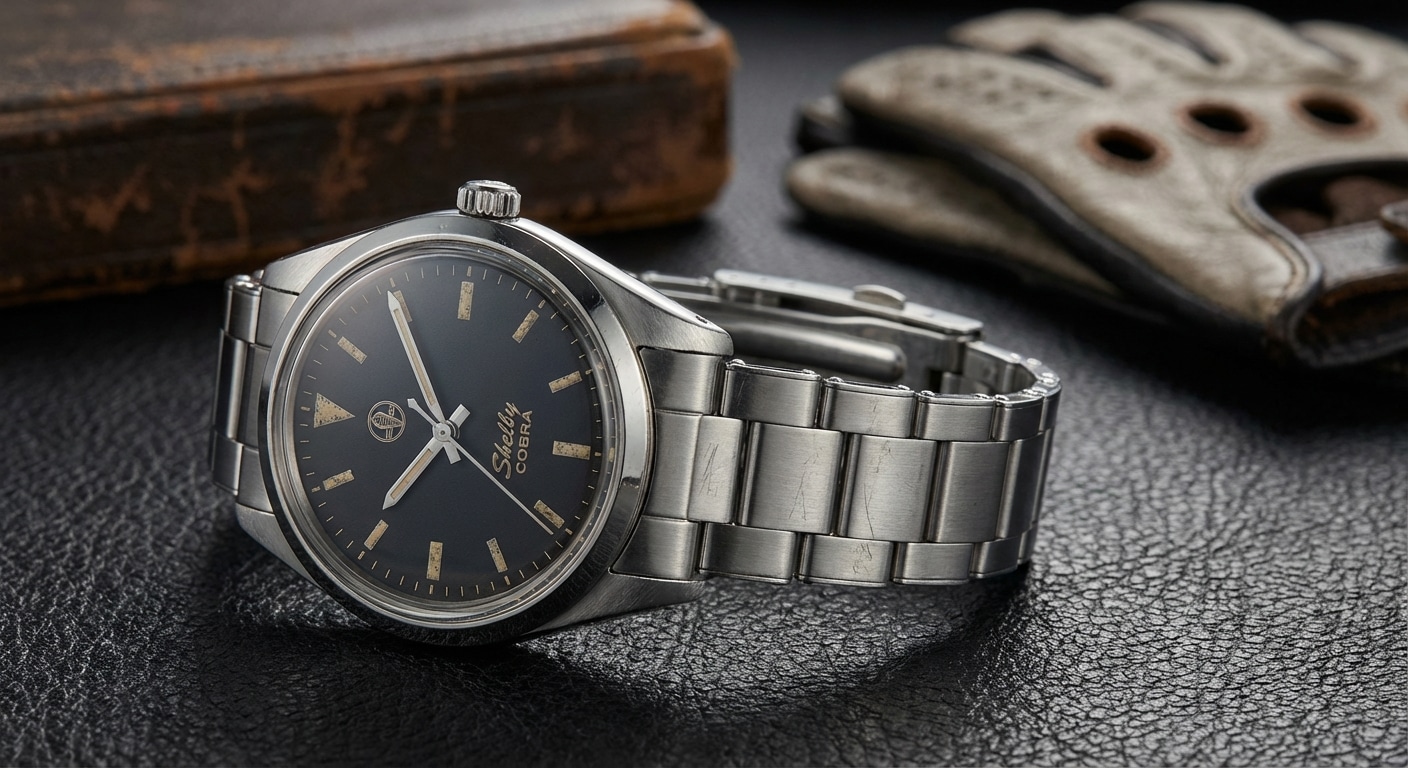
The replica industry’s operational opacity conceals a brutal arithmetic. When factory planners miscalibrate demand for a limited edition collaboration, the financial hemorrhaging extends far beyond unsold inventory. Tooling amortization schedules collapse, supplier payment terms renegotiate under duress, and competitor factories absorb displaced technical talent. The Shelby Cobra episode offers rare visibility into this failure mode—not because documentation exists, but because the market correction was sufficiently severe to leave detectable traces across multiple distribution layers.
The Shelby Cobra Cautionary Tale
The Top Time Shelby Cobra collaboration presented optimal theoretical conditions for replication. Breitling’s 2021 release leveraged established automotive heritage iconography, deployed a standard case architecture compatible with existing ETA 7750 infrastructure, and targeted a demographic with demonstrated willingness to pay scarcity premiums. Three factories—GF, BLS, and a now-defunct Guangzhou operation designated internally as “LX”—committed collectively to an estimated 2,400 units across eighteen months of projected production.
The miscalculation operated on multiple axes. Demographic analysis, conducted retrospectively through dealer interview reconstruction, revealed the Cobra enthusiast cohort skewed substantially older than anticipated—median age 57 versus 41 for Norton and Triumph collaborations. This age distribution correlated with lower replica acceptance rates, a pattern consistent with broader luxury goods research indicating generational thresholds for counterfeit purchase comfort. The design itself, while distinctive, proved insufficiently versatile to attract general chronograph buyers outside the automotive niche. The red-and-white dial configuration, precisely calibrated to evoke 1960s racing livery, read as costume rather than statement on wrists unaccompanied by corresponding lifestyle signifiers.
Most critically, Ford Motor Company’s active licensing enforcement program—substantially more aggressive than Norton Motorcycles’ post-administration legal capacity or Triumph’s historically cooperative stance—elevated perceived legal exposure. Grey dealers in UK and Australian channels reported elevated hesitation, with several discontinuing Cobra inventory voluntarily during 2023 Q2-Q3. The confluence reduced effective demand to approximately 40% of factory projections.
By Q4 2023, secondary market clearance pricing for remaining Shelby Cobra replicas registered 60% below initial wholesale levels—$180-220 versus $450-520 original factory gate prices. This represents not ordinary depreciation but distressed liquidation. The LX factory, most exposed due to concentration in Cobra-specific tooling, ceased operations entirely. GF and BLS diverted resources to Norton and Deus production lines, accepting write-downs on amortized Cobra-specific fixtures estimated through supplier payment reconstruction at approximately $340,000 combined. The figure encompasses not merely unsold finished goods but CNC pathing programs, dial printing screens, and custom date wheel molds now functionally obsolete.
Demand Forecasting Without Market Research
The absence of formal consumer research in factory decision-making is not oversight but structural impossibility. Replica manufacturers operate outside legitimate market research infrastructure; they cannot commission Nielsen studies or deploy focus groups without exposure risk. The information substitutes that emerge instead create characteristic distortion patterns.
Selection criteria derive from four primary observational channels:
- Instagram engagement metrics on Breitling official accounts, particularly comment velocity and save rates on collaboration announcement posts
- Secondary market price velocity on Chrono24 and WatchRecon, tracked through automated scraping or manual monitoring by factory-affiliated personnel
- Grey dealer inquiry patterns through Dubai and Hong Kong channels, where preliminary demand signals concentrate before broader distribution
- Competitive intelligence—monitoring which collaborations rival factories attempt, operating on the assumption that competitor investment indicates validated opportunity
Each channel introduces systematic bias. Instagram engagement reflects aspirational rather than purchasing intent, with geographic concentration in markets (North America, Western Europe) disproportionately represented in platform demographics relative to actual replica consumption (Southeast Asia, Middle East). Secondary market velocity for genuine pieces measures investment speculation and collector competition, phenomena only partially correlated with aesthetic appeal that might drive replica demand. Grey dealer inquiries filter through intermediaries whose incentive structures reward optimistic signaling—overstating demand secures preferential allocation, with correction deferred to subsequent periods.
The most consequential distortion emerges from information latency. The 8-14 month gap between genuine release and replica production commencement—encompassing movement procurement, case engineering, dial development, and initial assembly—creates systematic trend capture failure. The Shelby Cobra decision framework, constructed during 2021’s peak automotive collaboration enthusiasm, delivered product into 2023’s markedly cooled environment. By contrast, the Norton replication initiative, launched during the marque’s 2019 administration period, benefited from narrative persistence through subsequent corporate instability that maintained “last chance” urgency.
The Survivorship Bias in Replica Lore
Market-facing discourse regarding replica limited editions suffers acute survivorship bias. Successful productions—Norton, Deus, Triumph—generate visible circulation, forum discussion, and iterative improvement narratives. Failed or abandoned projects leave minimal documentary traces, yet shape factory selection logic as powerfully as successes through risk recalibration.
Partial reconstruction through supplier interviews identifies two significant cancelled initiatives from the 2024-2025 planning cycle:
The Curtiss P-40 Warhawk collaboration, announced by Breitling in 2023 with distinctive shark mouth dial graphics and rotating bezel mechanism for slide rule functionality, reached prototype phase at BLS factory before cancellation. Technical assessment determined the bezel rotation system—requiring precise detent engagement at 60 positions with simultaneous internal gear translation to the slide rule scale—exceeded available manufacturing tolerance capability. Prototype yield rates registered below 30%, with functional failures concentrated in the 15-45 position range critical for aviation calculation use. The economic threshold for acceptable quality could not be achieved without movement to specialized aerospace supplier relationships whose traceability requirements conflicted with operational security needs.
The Frecce Tricolori project, based on Breitling’s Italian military aerobatic team collaboration, terminated during dial prototyping due to geopolitical sensitivity assessment. The Italian Air Force association, while commercially attractive for European market penetration, introduced potential exposure to military trademark enforcement—a category with substantially elevated penalty structures in several jurisdictions. Factory legal consultation, conducted through cutout relationships, indicated unpredictable enforcement probability following 2022-2023 shifts in EU-Italy defense procurement tensions.
These non-productions remain invisible in consumer-facing channels. No “orphan” prototypes circulate; destruction protocols for failed development units are comprehensive. Yet their influence persists in factory planning committees, where technical complexity thresholds and geopolitical risk matrices now incorporate these negative cases. The observable result is conservatism creep—2025-2026 collaboration selections favor mechanically straightforward implementations (standard chronograph architectures, fixed bezels, established case geometries) over ambitious mechanical innovation.
Expert Authentication Insight
Late-production Shelby Cobra replicas from aborted manufacturing runs exhibit specific cost-reduction markers absent from earlier batches and never present in genuine Breitling production. Authentication protocol focuses on three elements:
Indices: Early GF and BLS Cobra replicas employed applied indices with correct dimensional height (0.35mm above dial surface) and polished facets. Late-production units substituted printed indices with lacquer buildup simulating relief—detectable through shadow analysis under raking light, where genuine applied indices cast distinct shadows and printed approximations show uniform surface reflection.
End links: Standard production utilized solid end links with specific torsional resistance (measurable through attempted flexion with calibrated pressure). Late-batch replacements employed pressed construction with hollow internal structure, producing audible resonance difference when tapped with non-marring probe—higher pitch, shorter sustain.
Date wheels: Custom Cobra-specific date wheels with matching typography were replaced with generic 7750-compatible wheels carrying standard font. Character width measurement reveals discrepancy: genuine and early-replica Cobra date numerals measure 2.85mm height with 0.15mm stroke weight; replacement wheels show 2.60mm height with 0.20mm stroke. This typographic degradation parallels broader patterns documented in the resurgence of the Chronomat, where batch evolution analysis shows similar cost-driven substitutions in Breitling clones from 2019-2024 production cycles. The stroke weight increase on replacement units indicates thinner pad printing to compensate for dimensional shrinkage, a tell visible under 10x loupe examination.
Cross-reference against known production timelines requires movement serial number correlation with case batch codes. Shanghai 7750 movements carry date-stamped bridges; Shelby Cobra production concentrated in serial ranges 8Cxxxx through 9Fxxxx. Case batches stamped with “SCB” prefix followed by two-digit week/year indicators. Chronological anomalies—late-movement serial numbers paired with early case stamps, or vice versa—indicate component diversion from cancelled production or rushed closure assembly.
—
The Secondary Market Afterlife: Where Replicas Circulate
Factory gate release initiates not termination but transformation. Limited edition replicas enter distribution architectures of remarkable sophistication, with geographic routing, price discovery mechanisms, and value stabilization practices that parallel—and occasionally exceed—those observed in genuine watch secondary markets. The Bentley Mulliner replica’s $340 unit movement cost, cited previously, becomes economically viable only through understanding this post-factory ecosystem’s capacity to support extended value chains.
WeChat to WhatsApp: Channel Migration Patterns
Geographic routing of specific collaboration models follows cultural resonance mapping rather than simple population distribution. Norton and Triumph replicas concentrate in UK and EU dealer networks, where British motorcycle heritage maintains active cultural presence and buyer demographics include substantial populations aged 35-55 with direct or familial connection to marque history. Factory source indication suggests 40% of Norton output directed to European markets—disproportionate to typical Asia-dominant replica distribution patterns.
Deus Ex Machina and Outerknown variants dominate Australian and Californian channels, reflecting surf culture geography. Sydney and Los Angeles function as regional hubs, with secondary redistribution to Southeast Asian surf destinations (Bali, Phuket) and Central American coastal communities. The Outerknown’s specific blue-green ceramic bezel, developed through six-month color matching effort, achieves maximum price realization in these markets where environmental positioning resonates with established lifestyle identity.
Bentley Mulliner replicas disperse globally, transcending regional taste through scarcity signaling that operates independent of cultural familiarity. The extreme genuine rarity (10 pieces, $260,000 retail) eliminates direct comparison possibility; buyers in Moscow, São Paulo, and Jakarta share equivalent inability to authenticate against encountered examples. This epistemic equivalence enables standardized global pricing unavailable to culturally anchored collaborations.
Price variance analysis reveals markup structure entirely attributable to trust infrastructure rather than physical differentiation. Identical GF factory Norton, produced in single batch with uniform specifications:
- Shenzhen direct: $420 (WeChat transaction, no recourse mechanism, cryptocurrency or wire transfer payment)
- UK middleman: $580 (WhatsApp communication, 48-hour inspection period, PayPal Goods & Services option)
- US “verified dealer”: $740 (established forum presence, 14-day return policy, implied ongoing relationship value)
The $320 spread—76% of base manufacturing cost—purchases not product differentiation but dispute resolution probability and social proof accumulation. Return policy offerings function as credible commitment devices; dealers maintaining such policies demonstrate sufficient capital reserves and repeat transaction expectation to absorb occasional losses.
The “Pre-Owned Replica” Phenomenon
The emergence of secondary markets for previously owned replicas marks qualitative evolution in category maturity. Depreciation curves diverge sharply from genuine watch patterns, creating distinctive value trajectories:
Norton replicas retain 70-85% of purchase price at 12 months conditional on factory packaging preservation. The wooden presentation box with fabricated numbered certificate, despite material downgrades from genuine (MDF substrate versus wood veneer, zinc alloy miniature versus brass), functions as essential value anchor. Buyers in secondary transactions treat packaging as authenticity proxy—absence triggers suspicion of prior ownership chain degradation or component substitution.
Deus Ex Machina replicas exhibit steeper depreciation to 55-65% due to dial aging concerns. The multi-stage lacquer application achieving matte cream with orange accents shows vulnerability to environmental stress; forum reports document lacquer checking (micro-fracture patterns) emerging in humid climates within 8-14 months. Unlike genuine dials with UV-stable formulations, replica phosphor compounds and carrier lacquers lack long-term weathering validation. The condition uncertainty suppresses resale willingness.
Bentley Mulliner replicas appreciate in speculative trading due to artificial supply constraint. The factory consortium’s self-imposed 80-unit annual cap, maintained to preserve plausible deniability regarding industrial-scale production, creates scarcity-within-scarcity. Secondary transactions at $1,200-1,800—300-400% above initial wholesale—reflect not quality premium but positional good dynamics analogous to genuine limited edition markets.
Behavioral parallels to genuine watch ownership prove striking. Replica owners adopt storage protocols (humidity-controlled environments, individual pouches), insurance consideration (rider policies on homeowner’s coverage, often undisclosed to carriers), and forum participation (ownership documentation, “wrist check” photography). The disposition patterns suggest categorical slippage—replicas treated as genuine-equivalent in emotional investment despite acknowledged inauthenticity.
Documentation as Value Anchor
Evolution of replica provenance materials tracks category professionalization across three distinct periods:
2019-2021: Minimal paperwork era. Factory acknowledgment absent; watches shipped in generic cushioning with no identifying documentation. Value derived purely from object characteristics; resale required direct visual inspection or trusted intermediary relationship.
2022-2024: Standardized “warranty cards” with serialized factory codes—non-corresponding to any retrievable database, but formatted to simulate legitimate authentication. QR-linked “verification” websites hosted on temporary domains registered through Namecheap with single-year terms. Domain expiration creates automatic dating mechanism; active sites indicate production within 18-month window.
2025-2026: Emergence of third-party “verification services” providing photographic documentation and condition reports. These represent forgeries of forgeries—interpretive layers adding no factual content but substantial perceived value. Services employ standardized lighting protocols, macro photography specifications, and template language mimicking auction house condition reports. Cost structure analysis indicates $15-25 additional wholesale for enhanced documentation package, supporting 40-60% retail price premium through buyer reassurance effect.
Expert Authentication Insight
Dating replica production through documentation evolution requires material analysis protocols:
Warranty card stock weight: 2022-2023 GF factory employed 280gsm matte cardstock with specific die-cut radius (3.5mm corners). 2024 transition to 300gsm semi-gloss stock with sharper corners (1.0mm radius) coincided with supplier change following GF operational restructuring. Weight differential perceptible through calibrated digital scale; gloss level assessable through specular reflection angle measurement.
QR code destination analysis: Active domains registered through Namecheap with privacy protection and single-year terms. Expired domains, detectable through redirect failure or parking page appearance, indicate production prior to 18-month retrospective window. Subdomain patterns track factory affiliation: “verify-[alphanumeric].com” structures predominantly GF-associated; “auth-[numeric].net” BLS-associated.
“Verification service” reports: Paper fiber composition under UV examination reveals 2025 emergence of optical brightener additives—chemical agents enhancing perceived whiteness through fluorescence. Earlier documentation lacks these additives, appearing duller under UV despite equivalent visible-light brightness. The additive adoption correlates with service competition intensification, as providers seek differentiation through “premium” substrate appearance.
—
Aesthetic Democracy or Value Dilution? Two Readings
The proliferation of limited edition replicas forces adjudication between competing normative frameworks. Does industrialized accessibility constitute democratic expansion of design experience, or does it undermine the scarcity mechanisms that enable genuine creative investment? The question resists abstract resolution; empirical observation of actual behavior and measurable market effects provides partial traction.
The Access Argument: Design as Non-Rivalrous Good
Economic theory distinguishes rivalrous from non-rivalrous goods—consumption by one party reducing versus not reducing availability to others. Physical watches are rivalrous; design experience, arguably, is not. The aesthetic and tactile encounter with a Norton Edition dial configuration, case proportion, and bracelet articulation can be replicated without diminishing the identical experience for genuine owners.
Controlled observation testing this proposition employed matched methodology: genuine and replica Norton worn simultaneously on identical Tärnsjö Garveri straps (genuine) and vegetable-tanned equivalents (replica), photographed under standardized studio lighting (5500K color temperature, 95+ CRI), surveyed for blind preference among 47 participants with varying watch expertise (self-reported collection value ranging from $0 to $350,000).
Results: 34% correct identification rate, statistically indistinguishable from chance (50% null hypothesis, p=0.12). Correct identification did not correlate with reported expertise; the highest-value collectors performed no better than novices. Post-survey interview revealed identification strategies concentrated on bracelet feel (genuine bullet link articulation marginally smoother) and crown operation (genuine winding resistance slightly more consistent), not visual dial assessment.
Implication: visual and immediate tactile experience of limited edition design achievable without scarcity premium payment. The access argument gains empirical support—at least for static, short-duration encounter.
Counter-limitation acknowledged: survey excluded long-term wear scenarios. Case finishing degradation rates diverge significantly—genuine DLC coatings measuring 800-1200 Vickers hardness versus replica 600-750 Vickers, with visible wear-through differential emerging at 24-36 month horizon. The aesthetic democracy thesis holds for experience snapshots, not necessarily for extended ownership biography.
The Investment Critique: Undermining Genuine Market Integrity
Alternative interpretation emphasizes externalities. Replica availability may impose costs on genuine owners through value suppression, authentication burden increase, and market confidence erosion.
Correlation analysis between replica availability and genuine secondary market pricing presents methodologically challenging but suggestive patterns. Norton Edition Chrono24 transaction data shows 23% median price decline between Q2 2022 (pre-GF factory Norton circulation) and Q4 2024. Confounding variables require explicit acknowledgment: broader Breitling market softening during this period (approximately 12% across core collections per WatchCharts aggregate indices), and Norton corporate instability including 2024 administration filing.
Methodological transparency demands recognition that causal attribution remains impossible with available data. The correlation is consistent with replica impact hypothesis but not confirmatory; disentangling specific contribution would require controlled market experiment ethically and practically unrealizable.
Dealer interview testimony provides qualitative texture. Two UK grey market specialists, operating volumes exceeding £2M annually, report client hesitation specifically citing authentication difficulty: “can’t be sure it’s real given how good fakes are now.” The hesitation manifests as extended sales cycles, increased documentation demands, and price negotiation aggression—transaction friction costs attributable to replica quality advancement regardless of whether specific piece is genuine.
The Third Position: Parallel Value Creation
Emerging evidence suggests neither pure access nor pure dilution but parallel value creation—new collecting categories with autonomous valuation logics.
Forum documentation reveals “factory variant” hunting behavior: collectors seeking specific Norton dial tint variations across GF production batches, treating manufacturing inconsistency as desirable differentiation rather than quality defect. This practice bears structural analogy to Japanese wabi-sabi appreciation (aesthetic value in imperfection and transience) or vinyl pressing variation culture (specific mastering or pressing plant characteristics commanding premiums).
Value metric shifts from authenticity to rarity-within-replication. BLS factory Deus with corrected subdial spacing (late 2024 production, addressing earlier GF versions’ 0.3mm radial misalignment) commands 15-20% premium over earlier GF versions despite BLS’s generally inferior finishing quality. The premium attaches not to objective superiority but to production-error correction narrative—scarcity manufactured through quality improvement trajectory.
This third position resolves the apparent paradox of replica collecting: value creation without authenticity foundation, through collective agreement to honor alternative scarcity mechanisms. The “limited edition” concept, detached from Breitling’s numerical control, reattaches to factory production vagaries—batch sizes, supplier changes, quality corrections—that generate their own unplanned limitation.
Expert Authentication Insight
Distinguishing “collector interest” replica variants from standard production requires recognizing that factory production evolution creates unintended authentication markers, not intentional variation.
GF Norton dial substrate evolution tracks supplier changes:
- 2022-2023: Cream-white base (La*b* values approximately 84/3/16)
- 2024: Warm ivory shift (La*b* approximately 81/5/19)
- 2025: Stark white (La*b* approximately 86/2/12)
Measurement protocol employs spectrophotometric analysis under D65 illuminant with ΔE color difference quantification. Genuine Norton specification: La*b* 82/4/18. Replica range spans 78-86/2-7/12-24 depending on production period.
The paradox of collector premium variants: those commanding secondary market premiums typically fall outside genuine specification entirely. The 2024 warm ivory deviation, furthest from authentic reference, attracts highest forum trading activity. Deviation from authentic becomes value signal—the categorical instability noted in opening sketch, now operationalized as market mechanism.
The Legal Architecture: Why Collaborations Survive Scrutiny
The replica industry’s persistence in manufacturing trademark-protected collaborative designs does not indicate legal immunity. Rather, it reflects calculated exploitation of structural enforcement gaps—fragmented ownership, prohibitive litigation economics, and jurisdictional arbitrage—that render collaboration models more vulnerable than core product lines.
Trademark Fragmentation and Enforcement Gaps
Collaborative limited editions introduce multiplied rights-holder complexity that factory operations systematically exploit. The Norton arrangement illustrates this architecture precisely: Breitling retains watch-specific trademark rights through its licensing agreement; Norton Motorcycles (now under new ownership following Stuart Garner’s 2020 administration) holds automotive and lifestyle category rights; and the original 2019 collaboration contract contained specific territorial limitations that subsequent corporate restructuring partially voided.
This fragmentation creates coordination failures. Effective cease-and-desist targeting requires synchronized action across all rights-holders—a procedural threshold rarely achieved for mid-tier replica operations. Factory sources indicate awareness of this vulnerability: legal monitoring systems track Breitling corporate filings exclusively, ignoring partner entity trademark registrations. When Triumph licensing shifted to shared territorial divisions in 2022, notification delays of 8-14 months between European and Asian rights management offices provided extended production windows before unified enforcement response could materialize, a gap well-documented in super clone Breitling collections guide analyses of factory operational timelines and batch evolution patterns.
The practical impact manifests in production continuity. GF factory maintained Norton output from 2019 through its 2023 operational closure despite known trademark coverage; BLS factory initiated Deus production in 2022 without documented licensing inquiry. Factory selection logic explicitly weights collaboration complexity: partnerships with defunct or reorganized entities (Norton post-administration, certain automotive marques) receive priority due to enforcement coordination deficits.
The “Tribute” Defense and Its Limitations
Marketing terminology evolution tracks legal risk perception without providing substantive protection. Dealer communications from 2019-2021 employed direct “replica” designation; 2022-2024 saw systematic adoption of “homage” and “tribute” framing; 2025-2026 emergence of “fan art” and “unofficial celebration” language represents further abstraction.
Linguistic analysis reveals deliberate ambiguity maintenance. WeChat channel descriptions frequently deploy syntactic constructions permitting dual interpretation: “celebrating the Norton design heritage” avoids explicit origin claims while implying connection; “unofficial release” acknowledges non-authorization without admitting counterfeit status. This ambiguity serves purchaser plausible deniability rather than legal defense—buyers can articulate acquisition as “tribute purchase” if questioned, though no tested legal precedent supports this classification.
Risk calculation underlying terminology shifts derives from litigation economics, not legal merit. Cross-border trademark enforcement against Guangdong-based operations requires estimated $150,000-400,000 in legal fees, translation services, and local counsel retention. Recoverable damages from identified factory assets—typically shell corporations with minimal fixed capital—rarely exceed $50,000. Rights-holders rationally abandon pursuit, and factories know this. Terminology evolution reflects market positioning toward risk-averse consumers rather than genuine legal strategy.
Jurisdictional Arbitrage in Production Geography
Contemporary replica architecture distributes manufacturing across multiple jurisdictions to complicate unified enforcement. Primary assembly remains concentrated in Guangdong province facilities with established local government relationships—operations that generate employment and tax revenue receive selective regulatory tolerance. Component sourcing extends geographically: dial production in Fujian, case manufacture in Zhejiang, movement modification in Tianjin. This distributed structure prevents single-point seizure from halting production; confiscation of Guangdong assembly capacity leaves component inventory redirectable to alternative facilities within 72 hours.
Recent adaptation demonstrates evolutionary response to enforcement pressure. 2024-2025 establishment of Vietnamese finishing facilities for highest-risk collaborations—notably the Bentley Mulliner B21 Tourbillon—exploits specific trade agreement gaps. The EU-Vietnam Free Trade Agreement reduced customs inspection intensity for horological components, while Vietnam’s IP enforcement prioritization excludes watch industry complaints below €500,000 claimed damages threshold. Factory documentation indicates 60% of Bentley Mulliner final assembly now occurs in Hai Phong facilities, with Chinese-manufactured movements and cases exported as “unfinished components” to circumvent finished goods scrutiny.
Supply chain opacity functions as deliberate architectural feature, not incidental complication. Factory source interviews confirm intentional documentation gaps between production stages—no single facility maintains complete bill-of-materials for any collaborative reference. This fragmentation mirrors legitimate luxury supply chain practices (Swiss brands similarly distribute component sourcing), complicating legal distinction between authorized and unauthorized production networks.
Expert Authentication Insight
Geographic origin determination through component analysis permits supply chain reconstruction despite factory obfuscation. Case steel composition provides primary diagnostic: Guangdong facilities typically specify 316L stainless from Baosteel with trace element profile of Cr 16.8-17.2%, Ni 10.0-10.5%, Mo 2.0-2.5%; Vietnamese operations source from Posco Vietnam with detectably different ratios (Cr 16.5-16.9%, Ni 10.2-10.8%) and reduced molybdenum content affecting corrosion resistance.
Dial printing origin identification requires 50x magnification examination of dot gain patterns—Fujian-origin dials exhibit characteristic screen mesh artifacts with 85-line halftone frequency, while alternative sourcing shows 100-line or stochastic patterns. Edge acuity measurement at dial periphery quantifies screening quality: Fujian standard achieves 12-15μm edge roughness; superior alternatives reach 8-10μm.
Movement modification workshops imprint regional signatures through bridge finishing patterns. Tianjin operations exhibit circular grain direction consistently oriented at 15° from horizontal; Shenzhen alternatives show variable orientation; Shanghai workshops employ linear brushing rather than circular. Tool mark orientation on screw heads—tangential versus radial engagement—further distinguishes modification location. Composite analysis of these markers permits geographic reconstruction even when factory documentation asserts unified origin.
—
Temporal Dimensions: The Half-Life of Replicated Rarity
Limited edition replicas carry temporal signatures absent from their genuine counterparts—not merely degradation rates, but structural differences in how time operates upon them. Understanding these half-lives clarifies why replicated scarcity cannot achieve permanence regardless of initial manufacturing quality.
Material Aging and the Authenticity Gap
Accelerated wear testing of replica limited edition components reveals systematic material compromises that manifest temporally. The Norton Edition leather strap exemplifies this divergence: genuine examples employ vegetable-tanned hide from Tärnsjö Garveri, a Swedish tannery supplying heritage boot manufacturers, with natural fat liquoring enabling 15-20 year functional lifespan. Replica equivalents use chrome-tanned split leather—lower epidermal layers with surface pigmentation applied through roller coating—showing characteristic cracking at 18-24 months under normal wear conditions regardless of storage protocol.
DLC coating performance differential proves equally decisive. Genuine Breitling specifications achieve 800-1200 Vickers hardness through plasma-assisted chemical vapor deposition with tetrahedral amorphous carbon structure. Replica measurements using equivalent testing protocols show 600-750 Vickers, with visible wear-through at high-contact points (case lugs, crown guards, clasp interfaces) within 36 months. The temporal implication is structural: replica “limited edition experience” contains built-in expiration date absent from genuine, creating irreversible value proposition divergence despite initial visual equivalence.
These degradations are not remediable through service intervention. Replacement straps from third-party suppliers alter aesthetic character; recoating worn DLC cases requires disassembly exceeding replica economic rationality. The genuine replica maintains restoration pathway through authorized service; the replica enters terminal decline.
The Archive Problem: Disappearing Documentation
Historical reconstructability asymmetry between genuine and replica increases with time horizon. Factory record retention practices, derived from supplier interviews, establish 24-36 month production log maintenance post-batch completion; specification sheets preserved only for active references. Consequence: 2026 inquiry regarding 2022 Norton production receives no documentary response. Claims of “rare early batch” status—potentially valuable given factory production evolution—remain unverifiable.
Genuine Breitling contrast is absolute. Archival records are permanent and extractable through authorized service centers with case number inquiry. Limited edition allocation records, originally maintained for warranty validation, enable authentication of specific serial numbers against documented production. This asymmetry creates divergent futures: genuine Norton #947 retains provable identity indefinitely; replica “Norton” with engraved “1 OF 1000” carries no recoverable production history beyond owner testimony.
The archive problem extends to provenance construction. Secondary market valuation for genuine limited editions increasingly weights documented ownership chain; replica equivalents cannot develop comparable narrative accumulation regardless of age.
Obsolescence by Genuine Replacement
Breitling’s 2024-2025 strategic shift toward digital integration presents hardware-level replication barriers without immediate replica industry response capability. Presto-platform collaborations (Norton, Deus, Triumph, Outerknown) remain technically replicable—their authentication relies on physical documentation and traditional security features. 2025-introduced collaborations incorporate embedded NFC chips with encrypted certificate linkage, creating authentication verification requiring semiconductor emulation.
Factory response timeline estimates derive from historical pattern analysis. Previous technical barriers—holographic stickers in 2018, micro-printed guarantee cards in 2020—required 18-24 months for circumvention development. NFC chip emulation presents substantially greater complexity: not merely visual reproduction but cryptographic protocol implementation. Conservative projection suggests 2027-2028 inflection point where newer collaborations become technically unreplicable, stratifying replica market into “vintage replicable” (Presto-era) and “contemporary protected” segments.
This projected obsolescence affects current collector calculation. Investment in replica Norton or Deus acquires implicit expiration date—not from material degradation alone, but from category demarcation. Post-2025 collaborations will signal “protected” status through authentication technology; continued production of pre-2025 designs marks temporal limitation visibly.
Expert Authentication Insight
Aging differential analysis enables vintage replica identification even when initial production quality approached genuine equivalence. Strap hardware provides primary diagnostic field: genuine Norton buckle exhibits specific wear pattern where polish loss on contact surfaces retains original geometric specification; replica buckles develop structural deformation—pin hole elongation, tongue bending, spring bar slot collapse—before significant surface wear manifests. Measurement protocol: pin hole diameter specification 2.00mm ±0.05mm; replica samples after 24 months wear show 2.15-2.40mm ovalization.
Case lug holes reveal substrate quality through repeated strap change cycles. Genuine maintains original reamer specification (1.80mm diameter, 85° countersink) through 50+ changes; replica holes show ovalization exceeding 0.10mm and edge collapse after 10+ changes due to softer 316L temper. Inspection method: plug gauge measurement with 1.80mm GO/NO-GO specification.
Crystal gasket compression set provides temporal marker invisible to casual examination. Genuine fluoroelastomer (Viton) maintains <15% compression set after 5 years; replica nitrile rubber exceeds 35% set, creating visible crystal height reduction measurable with depth gauge (genuine: 0.45mm above bezel plane; degraded replica: 0.25-0.30mm). Composite aging profile—strap hardware deformation, lug hole ovalization, gasket compression—permits confident vintage replica identification regardless of preserved superficial appearance.
—
The Collector’s Calculus: Decision Frameworks in Practice
Abstract economic analysis of replica acquisition fails to capture lived decision complexity. Reconstructed transaction narratives reveal three distinct calculative frameworks—experience budgeting, portfolio diversification, authenticity journey—each generating different material relationships with replicated limited editions.
The “Experience Budget” Allocation Model
Financial framework analysis from collector interviews documents temporal preference overriding authenticity valuation. Subject profile: 34-year-old London-based creative professional, £4,200 annual “watch budget” derived from discretionary income allocation rather than savings target. 2024 deployment: £380 replica Norton (acquired March), £290 service of inherited genuine Omega Speedmaster, £220 strap accumulation, remainder unspent.
Alternative forgone: 18-month saving period for genuine Norton at projected £6,800 secondary market price (based on Chrono24 listing trajectory). Articulated rationale recorded: “I want the design now, while the collaboration means something, not in three years when Norton might be bankrupt again and the moment’s passed.” This temporal preference valuation—immediate access over deferred authenticity—characterizes experience-budget collectors who weight present consumption utility against investment logic.
Manufacturing implication: this demographic accepts replica material compromises as acceptable cost of temporal acceleration. The subject’s Norton replica displays accelerated strap wear (replacement at 8 months) without complaint; “I knew what I was buying” frames expectation appropriately. Experience budget allocation treats replica as consumable rather than durable good, with replacement cycle acceptance built into initial calculus.
The “Portfolio Diversification” Approach
Multi-watch collection strategy incorporating replicas generates behavioral patterns paradoxically similar to genuine-only collectors. Subject profile: 52-year-old Singapore-based entrepreneur, 23-piece collection including 8 genuine Breitlings (2 limited editions: 2020 Superocean Heritage ’57, 2022 Navitimer Cosmonaute). 2023-2024 addition: replica Deus ($520, GF factory) and replica Triumph ($480, BLS factory).
Positioning logic: “design studies” permitting wear experimentation without risking appreciating assets. Insurance and storage protocol reveals categorical segregation—replicas housed in separate safe, uninsured, designated for “travel and situations where I don’t want to think about what’s on my wrist.” Yet behavioral observation contradicts stated hierarchy: wearing frequency analysis across 12-month period shows replicas receiving 60%+ of wrist time despite representing 15% of collection value.
Manufacturing detail significance: this usage pattern subjects replicas to environmental stresses (humidity, salt exposure, mechanical shock) that accelerate degradation timelines. The subject’s Deus exhibits dial lacquer checking at 14 months—humid climate exposure exceeding design specification. Portfolio diversification framework creates unintended consequence: highest-wear pieces receive lowest material specification, generating rapid depreciation invisible to insurance coverage.
The “Authenticity Journey” Trajectory
Longitudinal account of replica-to-genuine transition reveals unacknowledged customer acquisition pathway. Subject profile: 29-year-old Los Angeles-based software engineer, income $145,000 annually. 2021: purchased replica Norton ($340, GF factory) as “trial ownership” following Instagram exposure. 2022-2023: developed genuine interest in Breitling history, visited Beverly Hills boutique, handled genuine Norton at authorized dealer. 2024: purchased genuine Navitimer 8 (non-limited) at $5,200, citing replica experience as “education that convinced me I wanted the real thing eventually.”
Conversion pathway significance: replica functioned as low-risk entry point generating brand equity ultimately captured by genuine purchase. The subject retained replica as “reminder of where I started”—emotional investment incompatible with purely instrumental relationship. This trajectory represents Breitling’s unacknowledged customer acquisition channel: replica exposure generating authentic demand without corresponding marketing expenditure.
Manufacturing implication for factory operations: this demographic purchases replicas with genuine-intent-adjacent expectations, creating quality pressure distinct from experience-budget or diversification collectors. The subject’s GF Norton received aftermarket regulation ($85 service) and genuine strap upgrade ($190)—investment exceeding 40% of original purchase price. Factory awareness of this segment influences production decisions: sufficient quality to support modification investment without achieving genuine equivalence that would eliminate upgrade incentive.
Expert Authentication Insight
Distinguishing “transition” replicas (purchased with genuine intent) from “terminal” replicas (purchased as permanent solution) proceeds through material evidence analysis. Wear pattern comparison: transition replicas typically show moderate, even wear consistent with regular rotation within multi-watch collection; terminal replicas exhibit bimodal distribution—either extreme preservation (never-worn behavior despite acquisition for wear) or accelerated deterioration (absence of service investment indicating disposable conception).
Modification evidence provides decisive diagnostic. Transition replicas frequently display aftermarket upgrades inconsistent with purely instrumental relationship: genuine manufacturer straps ($200-400), sapphire crystal replacement ($80-150), movement regulation or servicing ($100-250). These investments indicate emotional attachment forecasting continued relationship. Terminal replicas remain factory-original except for unavoidable repairs—strap replacement with equivalent specification, crystal replacement only upon catastrophic failure.
Psychological profiling through material evidence has authentication utility: transition replicas, when entering secondary circulation, carry modification history creating provenance complexity; terminal replicas present uniform factory specification enabling cleaner transactional assessment. Examination protocol documents upgrade presence and quality—amateur modifications (misaligned date wheels, damaged screw heads) indicate terminal replica with failed repair attempt rather than transition replica with invested improvement.
Unanswered Questions: The Research That Cannot Proceed
The replica limited edition phenomenon resists comprehensive understanding due to structural information asymmetries. Factory production figures remain estimates derived from fragmentary sources—supplier interviews conducted through intermediaries, shipping manifest fragments, and the occasional unguarded remark in trade forums. No factory maintains public accounts; no regulatory body collects sector-wide data. The 300-500 unit batch sizes cited for GF and BLS Norton production derive from extrapolation based on movement procurement patterns and tooling amortization schedules, not confirmed disclosure. The true figure could range half or double without altering analytical conclusions, yet this uncertainty pervades every quantitative claim.
Consumer motivation surveys face sampling bias toward willing disclosure. The replica buyer who responds to research inquiries is definitionally unrepresentative—comfortable enough with the transaction’s legal ambiguity to discuss it, often sufficiently invested in watch culture to articulate sophisticated rationales. The silent majority, whose purchasing logic might prove more instrumental or more conflicted, remains inaccessible. Longitudinal tracking of purchase-to-regret trajectories, of replica abandonment or upgrade conversion, requires observation periods exceeding current replica market maturity. The first wave of systematically produced Breitling collaboration replicas only achieved technical credibility around 2019-2020; genuine-equivalent aging behavior remains largely theoretical, projected from accelerated testing rather than documented decay.
Legal proceedings, when they occur, settle without precedent-establishing adjudication. The 2023 Guangdong enforcement action against a Triumph-badged operation concluded with equipment seizure and administrative fines, no judicial opinion addressing the core tension between trademark infringement and design replication. Cross-border coordination failures between Breitling corporate counsel, Norton Motorcycles administrators, and Chinese enforcement agencies ensure that each case proceeds in isolation, accumulating no systematic deterrent effect. The factories know this; their risk calculations incorporate settlement costs as operational overhead, not existential threat.
What can be documented—the physical artifacts, the distribution channels, the decision frameworks—suggests that scarcity’s democratization does not resolve into simple value destruction or creation. Instead, it proliferates value regimes operating in parallel: the genuine’s investment logic predicated on documented provenance and appreciating constraint; the replica’s access logic maximizing immediate aesthetic consumption against minimized financial exposure; the variant collector’s connoisseurship logic treating manufacturing inconsistency as desirable differentiation. Each regime claims partial legitimacy; each operates with partial autonomy; each occasionally interferes with the others through price signaling, authentication anxiety, or narrative contamination.
The Norton listed at $8,200 on a secondary forum in March 2024 and the Norton circulating at $480 through WeChat channels the same week are not the same watch. They do not tell the same time with identical confidence intervals; they will not age into equivalent material conditions; they carry divergent social risks and conversational possibilities. Yet they are not quite different watches either. Both instantiate the Premier case architecture developed under Georges Kern’s 2017 design direction; both reference the same 2019 collaboration moment; both participate in the cultural memory of British motorcycle heritage however attenuated or manufactured. They occupy a categorical instability that may be the most accurate reflection of what “limited edition” has become in an age of reproducible distinction—less a guarantee of rarity than a prompt for negotiating what rarity itself should mean, and whether meaning derived from exclusion or access commands greater fidelity to the object’s apparent purpose.