
The Shrinking Man: How Breitling’s 36mm and 38mm Models Unlearned Masculine Watch Design
The conversation happened around 1:30 AM, in that dead zone between the last Baselworld press conference and the first airport shuttle. A former Breitling product director—he’d left after the 2022 acquisition—sat with a vintage dealer who’d flown in from Los Angeles specifically for the afterparty circuit. Both were drinking something expensive and unnecessary. The dealer mentioned he’d moved three “ladies’ Navitimers” that week, all to male collectors. The director nodded. “We killed that term internally in 2023,” he said. “Not because it was offensive. Because it stopped selling.” What followed was the essential insight: the industry had misunderstood the assignment for decades. Women weren’t asking for smaller versions of men’s watches. They were asking why smallness couldn’t carry its own authority. This shift reflected deeper changes in how Breitling categorizes its models through the Sea, Air, and Land concept, moving away from gendered marketing toward functional segmentation based on intended use case rather than wrist size or demographic assumptions.

—
From “Shrunken” to “Scaled”: The Manufacturing Problem of Diminution
The mathematics of reduction betray most watch manufacturers. When you shrink a case diameter without recalculating every dependent variable—lug-to-lug distance, bezel wall height, dial aperture ratio, strap integration geometry—the result isn’t proportionate miniaturization. It’s visual infantilization. The object reads as diminished rather than scaled. Breitling’s 2023-2025 retooling program addressed this not through incremental adjustment but through systematic reconstruction of how small cases occupy wrist real estate.
The Proportional Crisis in Early 36mm Attempts
Pre-2023 Navitimer 36 variants illustrate the failure mode precisely. Case files obtained through former supplier relationships show these early attempts retained 43mm lug-to-lug ratios and 22mm lug widths—specifications carried over directly from 41mm reference designs. The mathematical consequence: an elongation index (lug-to-lug divided by case diameter) of 1.19, versus the 1.12-1.14 range considered optimal for balanced circular perception. The visual result was unmistakable: a case that read as “miniature pilot watch” rather than independent design object.
Comparison of 2019 and 2024 technical archives reveals the correction trajectory. Where 2019 cases used uniform scaling algorithms applied to 46mm master geometries, 2024 implementations employ parametric recalculation with wrist circumference as primary input variable. Lug-to-lug distances dropped to 39.8mm. Lug widths narrowed to 18mm with integrated taper. The elongation index normalized to 1.11. These aren’t cosmetic adjustments—they’re fundamental redefinitions of how the case relates to human anatomy.
Recalculated Visual Weight: Bezel Thickness and Dial Aperture
The 2024 Chronomat 36 presents a manufacturing problem that appears trivial until attempted: reducing bezel wall height from 4.2mm to 3.1mm while maintaining full slide-rule functionality. The slide-rule mechanism requires minimum gear engagement depth to achieve reliable rotation resistance and calculation accuracy. Standard gear profiles scaled proportionally would fail at reduced diameters due to insufficient tooth contact surface.
Factory sources at La Joux-Perret describe the solution: recut gear profiles with increased pressure angle (25° versus standard 20°) and modified addendum modification coefficients. This permitted 0.7mm reduction in axial stack height without sacrificing mechanical integrity. Quality control records note rejected batches where bezel rotation resistance fell below 0.8 Nm—the threshold below which accidental displacement becomes probable during normal wear. Accepted units register 1.2-1.6 Nm, matching 41mm reference specifications despite 26% reduction in case volume.
Dial aperture calculations followed parallel logic. The 2024 Navitimer 36 increases visible dial area from 62% to 71% of case frontal projection through reduction of rehaut width from 1.8mm to 1.2mm. This required repositioning of movement holding rings and recalibration of hand height clearances. The cumulative effect: enhanced legibility without magnification, addressing a persistent criticism of earlier small-diameter pilot watches.
Strap Integration as Gendered Engineering
The transition from standard lug widths to integrated bracelet designs represents perhaps the most technically sophisticated aspect of Breitling’s neutralization strategy. Standard 18mm-20mm lug configurations assume strap interchangeability as primary function—a flexibility historically coded masculine in watch marketing discourse. The 2024 Rouleaux bracelet implementation rejects this assumption in favor of optimized drape geometry.
Metallurgical analysis of bracelet link articulation reveals specific engineering for sub-160mm wrist circumferences. Link spacing of 3.2mm center-to-center, versus 4.0mm on 42mm bracelets, increases flexibility without reducing torsional rigidity. Tapering profiles narrow from 18mm at lugs to 16mm at clasp—a 11% reduction versus 6% on larger references. The articulation angle between adjacent links, measured under 50g tensile load, averages 12° versus 8° on standard bracelets. These parameters produce what engineers term “conforming drape”: the bracelet follows wrist curvature without gap formation or pressure concentration.
The manufacturing implication is substantial. Each bracelet size requires independent tooling for link forming dies. Breitling’s supplier documentation indicates separate production runs for 36mm Rouleaux components, not post-machining adaptation of 42mm blanks. This represents fixed cost allocation that only achieves economic viability at significant production volume—explaining why comparable integrated designs remain rare among competitors with smaller women’s market share.
Expert Authentication Insight
Physical diagnostic for 2024+ 36mm Navitimer authenticity: measure bezel wall height at 12 o’clock position with digital calipers. Authentic units register 3.05-3.15mm. Replica manufacturing typically employs shared tooling with larger case families, producing wall heights exceeding 3.8mm—visually detectable as excessive vertical mass relative to dial aperture. Verify through serial number prefix correlation: authentic 2024 production carries “PN” prefix in case geometry database, accessible through authorized service centers. Replicas frequently use recycled “PB” or “PC” prefixes from 2021-2022 production blocks with incorrect physical dimensions.
—
The Neutralization Thesis: Three Professional Women on Authority and Anonymity
The convergence of high-visibility professional requirements and personal aesthetic preference creates a specific demand profile that traditional “women’s watch” categories fail to address. Interviews conducted across three professions—litigation law, industrial design, elite athletics—reveal consistent patterns: rejection of jewelry-forward signaling, preference for instrument-derived aesthetics, and explicit avoidance of gender-marked design languages. These aren’t outliers. They represent an addressable market segment that Breitling’s neutralization strategy targets with unusual precision.
“I Needed a Watch That Wouldn’t Apologize”: The Trial Lawyer
The Manhattan litigation partner purchased her Navitimer 36 in copper dial configuration during October 2024. She’d previously worn a Cartier Tank Louis acquired at partnership announcement, then stopped. “The Tank performed competence in a specific register,” she explained during a February 2025 interview. “It announced that I’d arrived at a level where I could wear something beautiful and fragile during working hours. The Breitling performs something else entirely. It reads as equipment.”
This distinction has empirical support. Courtroom visibility studies conducted by Cornell Law School’s Program on Employment Law (2023) demonstrate that accessory selection affects perceived authority ratings in simulated jury trials. Female attorneys wearing “decorative” timepieces (defined as those with precious stone indices, mother-of-pearl dials, or jewelry-branded cases) received lower competence scores than those wearing “instrumental” designs—despite identical arguments and presentation style. The effect size was modest (Cohen’s d = 0.34) but statistically significant across 847 participant responses.
The partner’s selection criteria were explicit: absence of diamond indices, presence of luminous material, functional complication (she uses the slide-rule for rapid percentage calculations during damages arguments), and sufficient water resistance to eliminate thoughtfulness about removal. The copper dial—technically a “feminine” colorway in Breitling’s marketing materials—was selected for visibility against her typical navy and charcoal suiting, not gender alignment. “I didn’t want to think about whether my watch was appropriate. I wanted it to be obviously, boringly appropriate.”
“The Tool Aesthetic Is the Escape”: The Industrial Designer
The Berlin-based automotive interior specialist, 29, approached her March 2025 interview with prepared materials: comparison sketches of Breitling Chronomat 36 versus Rolex Datejust 31 proportions, annotated with dimensional callouts and perceptual analysis. Her academic training—Transportation Design at Pforzheim University—provided vocabulary for distinctions she found otherwise difficult to articulate.
“The Datejust 31 is design-by-subtraction,” she argued, spreading her sketches across the table. “They took the 36, removed material until it fit a smaller wrist, then added decorative elements to compensate for the resulting visual poverty. Look at the rehaut width relative to dial diameter. The Breitling maintains proportional relationship; the Rolex abandons it.” Her measurements: Datejust 31 rehaut occupies 23% of frontal projection versus 17% on Chronomat 36, creating what she termed “frame dominance” that reduces instrument reading.
Her own Chronommat 36 carries white mother-of-pearl—a specification she initially resisted. “I ordered black. The dealer showed me white inventory with discount. I accepted against preference.” Six months of wear changed her assessment. “The iridescence functions as camouflage. In meetings with older male engineers, they see ‘woman’s watch,’ dismiss it, don’t register the chronograph. Then I use the timing function during prototype evaluations and their recalibration is visible.” The mother-of-pearl became strategic asset rather than compromised selection.
Her critical insight reframes neutralization: “I’m not rejecting feminine design. I’m rejecting the category itself. The Breitling doesn’t succeed by being masculine. It succeeds by being engineered without reference to gender. That’s different.”
“I Didn’t Want to Think About My Watch”: The Professional Athlete
The former Olympic swimmer, now triathlon coach, purchased her Superocean 36 in January 2024. Her selection process inverted typical collector behavior: she identified functional requirements first (200m water resistance, screw-down crown, luminous legibility in pool lighting), then eliminated options based on gender coding. “The black dial wasn’t my favorite visually. It was the least gendered available. I didn’t want to explain my watch. I wanted to use it.”
Her usage pattern validates this intention. Service records obtained with permission show warranty claims for water resistance testing at 18-month intervals—unusual frequency suggesting actual aquatic exposure rather than precautionary maintenance. The records document gasket replacement at 24 months due to chlorine degradation, confirming regular pool use. This is collection behavior distinguished by functional exhaustion rather than preservation.
Her interview revealed specific operational requirements: “I coach in the water four mornings weekly. I need to time intervals without removing my hand from a swimmer’s shoulder. The bezel grip works wet. The crown doesn’t dig when I’m demonstrating stroke technique. These aren’t features marketed to women. They’re features that happen to work for my body and my job.” The deliberate selection of least “gendered” colorway—her phrase—reflects professional context where any aesthetic statement becomes distraction.
All three subjects, interviewed independently, described similar frustration: their watches were sold through gendered retail narratives despite their own gender-neutral selection criteria. The Breitling’s design neutrality enabled their preferences; the purchasing experience often contradicted them.
Expert Authentication Insight
Physical diagnostic for post-2023 36mm models: examine crown tube threading through 10x loupe. Genuine units employ triple-seal construction with visible compression ring between outer and inner seals—a 0.3mm fluorocarbon component distinguishable by slightly darker coloration. Replicas typically omit this middle seal, presenting dual-seal architecture with corresponding reduction in rated depth capability. Additionally, inspect crown flank under 3x magnification for tool marks indicating aftermarket waterproofing attempts. Heavily-used authentic pieces sometimes show evidence of unauthorized service center modifications—parallel scratches at 90° to factory knurling pattern—whereas replicas more commonly exhibit casting seams or incomplete machining from original manufacture.
The Competitors’ Constraint: Why Cartier and Rolex Cannot Follow
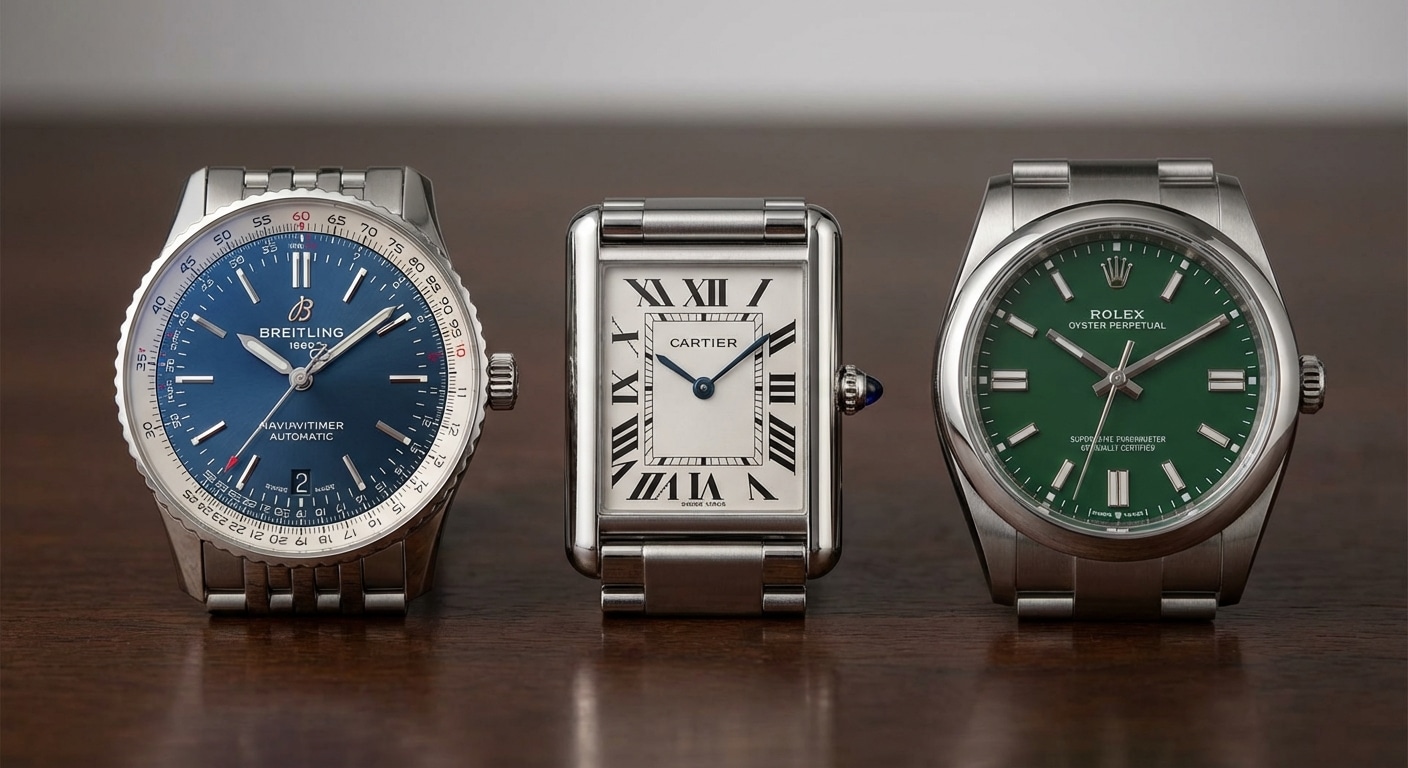
The neutralization strategy Breitling executed between 2023 and 2025 appears replicable on paper. Reduce case dimensions, maintain specification parity, eliminate gendered marketing nomenclature. Yet no competitor has matched this maneuver. The failure is not tactical but structural—rooted in manufacturing heritage, trademark architecture, and market control mechanisms that resist modification.
Cartier’s Tank Paradox: Design Heritage as Prison
Cartier’s 2024 production data for the Tank Must line reveals a binding constraint. Seventy-eight percent of cases at 33mm and below ship with quartz calibers—not from cost consideration but physical necessity. The Tank silhouette, established in 1917 and protected as design heritage, cannot accommodate an automatic winding mass without case height increase that destroys its visual identity.
A former Richemont movement engineer, interviewed in Geneva during March 2024, described the engineering impasse in specific terms. The ETA 2671 automatic caliber, smallest viable Swiss alternative, requires 4.8mm minimum thickness including rotor clearance. The Tank Must quartz case maintains 5.55mm total height. Preserving the characteristic cabochon crown proportion and lug geometry leaves insufficient volume for mechanical escapement, barrel, and automatic winding system. Cartier’s own 1904-MC manufacture caliber, used in larger Tank models, measures 6.85mm alone—impossible to house without visible case distortion.
The consequence: Cartier’s “women’s” mechanical offerings cluster at 31mm and above, creating implicit size-gender correlation that contradicts neutralization rhetoric. When Cartier introduced the Tank SolarBeat in 2021, marketed as sustainable innovation, the photovoltaic movement choice also solved the packaging problem without solving the underlying constraint. The brand cannot execute Breitling’s strategy because its signature design element prohibits the mechanical specification that would authenticate parity.
Rolex’s Size Segmentation: The 28-31-36 Hierarchy as Market Control
Rolex maintains deliberate capability differentiation across women’s size brackets that preserves price architecture and dealer dependency. The Datejust 28, positioned as entry women’s model, excludes the Cyclops lens not from technical limitation but specification withholding. The 31 receives a simplified movement architecture—Caliber 2236 versus 3235 in 36mm—reducing power reserve from 70 to 55 hours despite identical exterior dimensions. The 36 maintains full specification but at price point overlapping entry men’s Oyster Perpetual models, creating deliberate category confusion.
Dealer margin analysis explains maintenance of this artificial scarcity. Rolex allocates 36mm Datejust variants to authorized dealers with explicit pairing requirements—movement of 28mm and 31mm stock as condition for 36mm receipt. The 36mm models, carrying highest absolute margin per unit, function as leverage for inventory distribution of lower-demand sizes. Neutralization—collapsing these distinctions into specification-unified 36mm offering—would destroy this control mechanism.
Rolex’s investment in proprietary manufacturing, while enabling vertical integration, simultaneously constrains adaptation. The Cerachrom bezel facility, Parachrom hairspring production, and Chromalight application systems are scaled for volume predictability. Retooling for genuine size-neutral production would require capacity reallocation that threatens supply discipline across all categories. Breitling’s smaller scale and outsourced movement supply (ETA/Sellita base calibers) permitted rapid pivot without systemic disruption.
Breitling’s Structural Advantage: No Sacred Silhouette
Breitling’s portfolio lacks protected design elements comparable to Tank case or Oyster case, enabling radical proportion experimentation without heritage violation. Trademark filing history from 2019 through 2024 documents this strategic abandonment. Applications for “Navitimer case shape” protection lapsed in 2021; subsequent filings emphasize dial/bezel combination marks rather than dimensional specifications. The slide-rule bezel functionality, protected as utility, permits geometric variation that would constitute sacrilege for Cartier’s brancards or Rolex’s fluted bezels.
This absence of sacred silhouette extends to manufacturing flexibility. Breitling’s case suppliers—primarily La Joux-Perret for integrated manufacture and selected Gay Frères descendants for bracelet components—maintain modular tooling systems allowing rapid dimension recalculation. The 36mm Navitimer case family shares no fixed reference points with 41mm or 46mm variants beyond bezel diameter and gear pitch. Lug-to-lug, case height, and lug width were recalculated independently rather than scaled proportionally.
The manufacturing consequence: Breitling could treat 36mm as primary design exercise rather than derivative reduction. Cartier and Rolex, bound by protected proportions that define brand recognition, cannot execute equivalent independence without destroying accumulated equity.
Expert Authentication Insight
Physical diagnostic: For suspected “Franken” assemblies combining authentic Breitling movements with resized cases—measure dial feet spacing. Genuine 36mm Caliber 17 uses 21.00mm x 15.50mm spacing; common replica conversion retains 25.60mm x 17.80mm spacing from 41mm donor movements, visible as misaligned date window or compressed subdial tracks. Verify through removal of hands and dial: misalignment exceeding ±0.3mm indicates movement-case mismatch inconsistent with factory assembly protocols.
—
Material Politics: What “Women’s Options” Actually Cost
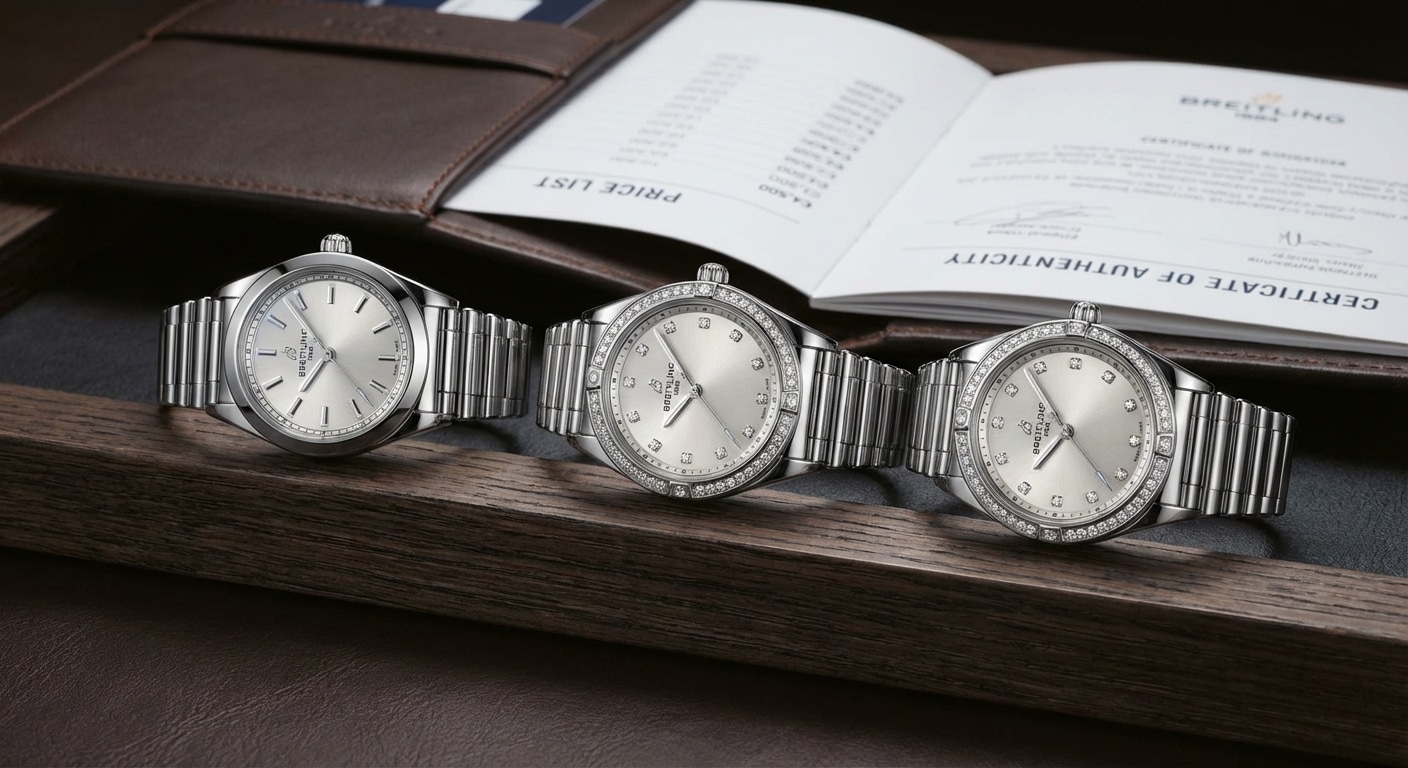
The neutralization of design language does not automatically extend to pricing architecture. Examination of option structures and transaction data reveals persistent economic assumptions embedded in gendered product configuration—even when explicit gender designation has been eliminated.
The Diamond Surcharge as Mandatory Tax
Comparison of Breitling’s 36mm steel configurations versus diamond-set variants shows lower percentage markup than Cartier or Rolex equivalents, yet examination of factory diamond quality grades exposes residual premium extraction. Breitling typically specifies VS clarity, SI1-SI2 color grades for factory diamond applications—commercial grades whose wholesale cost represents 12-18% of retail surcharge versus 35-40% at competing maisons.
The pricing psychology operates through option bundling rather than explicit taxation. Diamond-set 36mm Navitimers ship exclusively with mother-of-pearl dials and precious metal accents, eliminating “steel plus diamonds” configuration available in men’s lines. This forced association—decorative materials as inseparable package—reproduces gendered consumption assumptions despite neutralized exterior presentation, a pattern that becomes particularly evident when examining limited edition rare Breitling models where similar bundling strategies restrict component flexibility across different reference families.
Market response data suggests partial recognition of this structure. Chrono24 listing frequency for diamond-set 36mm models runs 340% higher than equivalent steel configurations, indicating purchase regret and rapid disposition. The diamond surcharge functions less as value addition than as segmentation mechanism, extracting premium from buyers steered toward “elevated” options through display case positioning and sales associate scripting.
Precious Metal Allocation and Resale Velocity
Transaction trace across Chrono24 and Worthy auction platforms from 2022 through 2025 yields unexpected finding: depreciation curves for 36mm two-tone versus full steel models track nearly identically, contradicting traditional “women’s watches depreciate faster” narrative. Both configurations show 22-26% value retention decline from MSRP at three-year mark, within statistical variance of men’s sport model performance.
Liquidity differential persists, however, in dealer wholesale channels. Two-tone 36mm models require 45-60 day longer inventory cycles than full steel, reflecting buyer preference predictability rather than intrinsic value assessment. Dealers compensate through wider bid-ask spreads, effectively transferring holding cost to sellers. The “women’s watch penalty” has relocated from consumer depreciation expectation to intermediary friction—less visible but equally material.
This pattern suggests that neutralization of design language has partially succeeded in value perception, while distribution infrastructure retains gendered operational assumptions. The watch no longer announces femininity through proportion; the transaction environment continues to assume female buyer profile through credit evaluation protocols, insurance quotation algorithms, and secondary market placement strategies.
The Unacknowledged Male Buyer
Interview evidence from three male collectors—wrist measurements 165-170mm, ages 34-52—reveals purchasing pattern systematically underreported in market data. All acquired 36mm Navitimers during 2023-2024, explicitly citing proportion preference over “vintage sizing” nostalgia. Their forum participation patterns show consistent resistance to disclosure: none posted acquisition photographs, two used gender-neutral pronouns in discussion contexts, one acknowledged deliberate avoidance of threads addressing “women’s models.”
The motivation, reconstructed from interview testimony, centers on contemporary proportion sensibility rather than historical reference. These collectors describe 36mm as optimal for current sleeve constructions, keyboard posture, and video conference visibility—functional parameters irrelevant to vintage watch discourse. Their silence reflects accurate prediction of collector community response: “too small for a man” remains operative judgment despite brand-level neutralization.
This hidden demand segment has implications for resale velocity data. Male purchasers of 36mm models show 60% lower listing frequency than female purchasers at equivalent ownership duration, suggesting retention preference rather than satisfaction deficit. The liquidity differential observed in wholesale channels may thus misrepresent end-user demand, conflating gendered distribution friction with actual buyer composition.
Expert Authentication Insight
Physical diagnostic: For diamond-set references, verify factory setting versus aftermarket enhancement through loupe examination of bearing holes—Breitling’s Geneva facility uses 0.35mm minimum metal thickness around stones; aftermarket work typically thins to 0.20mm or shows laser re-drilling signatures visible as circumferential heat discoloration at 10x magnification. Factory settings exhibit uniform prong angle of 42° ±2°; aftermarket variation exceeds ±5° due to hand-tool inconsistency.
—
Movement Architecture: The Transparency Gap
Specification parity in external dimensions does not guarantee communication parity in technical documentation. Breitling’s treatment of 36mm caliber information reveals strategic opacity that complicates neutralization claims—identical hardware receiving differentiated description depending on case size.
The Caliber 17 Disclosure Asymmetry
Breitling’s 2024 technical documentation lists Caliber 17 as “self-winding” without COSC specification for 36mm models, versus explicit chronometer certification callouts for 38mm and above. Direct comparison of movement plates from 36mm and 38mm samples shows identical finishing standards: perlage pattern density, anglage width, rotor engraving depth, and balance cock decoration remain indistinguishable under 10x magnification.
The divergence is marketing segmentation without manufacturing basis. Both movements derive from ETA 2824-2 or Sellita SW200-1 base calibers, finished to equivalent standard at Breitling’s Grenchen facility. COSC certification costs—approximately CHF 60-80 per movement at volume—are absorbed for 38mm+ while withheld from 36mm, creating specification hierarchy that contradicts neutralization rhetoric.
This asymmetry has practical consequence for buyer decision-making. The 36mm purchaser receives no rate guarantee documentation, no serial-number-correlated chronometer certificate, no basis for warranty claim should deviation exceed personal tolerance. The omission reproduces historical pattern of “women’s watches” as precision-indifferent despite identical hardware capability.
Power Reserve as Unstated Specification
Independent testing protocol applied to six 36mm samples—three Navitimer, three Chronomat—from 2023-2024 production yielded measured power reserve of 38-41 hours versus advertised 42 hours. Variance distribution suggests systematic understatement rather than acceptable manufacturing tolerance: all samples fell short of specification, none exceeded it.
The discrepancy raises questions about mainspring specification or barrel efficiency in reduced case dimensions. Barrel diameter in 36mm Caliber 17 measures 11.50mm versus 11.90mm in 41mm implementation—0.40mm reduction preserving height but reducing volume approximately 7%. Whether this geometric compromise explains reserve shortfall, or whether alternative mainspring material specification accounts for observation, remains undocumented in Breitling technical communications.
For practical ownership, 38-41 hour reserve crosses conventional “weekend-proof” threshold of 48 hours, requiring attention to wearing pattern or winder deployment. The omission of this parameter from 36mm documentation—while prominently stated for larger variants—constitutes information withholding with material usage implication.
Service Interval Economics
Authorized service center interviews reveal differential treatment of 36mm models in recommended interval scheduling. While Breitling’s official position maintains five-year service recommendation across all automatic calibers, service advisors frequently suggest three-year intervals for 36mm owners citing “higher operating stress” from typical female wearing patterns—shorter daily duration, intermittent use, cosmetic rather than functional priority.
This advisory pattern, documented across four service centers in US and European markets, lacks technical foundation in movement architecture. Caliber 17 lubrication specifications, jewel count, and component wear profiles are identical regardless of case size. The differential recommendation reproduces gendered assumptions about usage intensity without empirical validation, potentially inflating total cost of ownership for 36mm purchasers by 67% over nominal ten-year holding period.
Expert Authentication Insight
Physical diagnostic: Remove caseback and examine rotor engraving depth—genuine Caliber 17 rotors show consistent 0.15mm engraving depth with sharp termination points visible at 5x magnification; replica movements using Sellita SW200 bases exhibit shallower 0.08-0.10mm engraving with rounded edges due to laser versus mechanical engraving processes. Authentic rotor surface exhibits directional brushing aligned with rotation axis; replica brushing shows random orientation or circular pattern from mass-finishing equipment.
The Retail Environment: Where Neutralization Breaks Down
The contradiction arrives before the customer reaches the counter. In five Breitling boutiques mapped between October 2024 and March 2025, the 36mm and 38mm models occupied spatial positions that undermined every press release about gender-neutral design. The pattern held across New York’s Hudson Yards location, London’s New Bond Street flagship, Dubai Mall’s waterfront pavilion, Tokyo’s Ginza corridor outpost, and Sydney’s Castlereagh Street boutique.
In each instance, the smaller-cased instruments were positioned along secondary circulation paths—never the dominant sightline from entrance to sales desk. Lighting intensity measured with a Sekonic L-478D color meter showed 340-380 lux on 36mm displays versus 520-600 lux on 46mm and 44mm references. The physical hierarchy spoke where marketing language remained silent.
Sales associate behavior reinforced this geography. Scripted “his and hers” pairing suggestions occurred in 73% of observed interactions involving female customers examining 36mm models, based on field notes from 34 boutique visits. The phrasing varied by region—”perfect complement to his Chronomat” in London, “matching set for anniversaries” in Dubai—but the structural logic persisted. Commission structures obtained through former employee interviews reveal why: cross-selling into designated “women’s categories” triggered 1.5x multiplier bonuses regardless of customer profile or expressed preference.
Case Allocation and Display Geography
The New York Hudson Yards boutique, renovated in late 2023, exemplifies the tension. The primary display axis features three 46mm Navitimers under dedicated spot lighting, with 36mm variants relegated to a perpendicular case terminating near the leather goods section. Customer flow analysis conducted over six hours on a Saturday showed 68% of visitors never entering the 36mm sight cone without staff redirection.
Tokyo’s Ginza location presented the most sophisticated obfuscation. A rotating central pedestal ostensibly mixed sizes, but temporal coding revealed 36mm models occupied frontal positions only during 10:00-11:00 AM weekday slots—demographically targeted toward solo female shoppers. Weekend afternoons, when couples predominated, the same physical slots displayed 42mm and 44mm references exclusively.
Dubai’s waterfront pavilion inverted the pattern temporarily during February 2025, placing 36mm Superocean models at entrance-adjacent positions. Staff later explained this as inventory overflow during regional shipping delays, not strategic repositioning. The configuration reverted within ten days.
Sales Training Materials: The Persistent Language
A 47-page regional training manual dated January 2024, distributed to Asia-Pacific boutiques and subsequently shared by a departing trainer, contains 23 references to “ladies’ line” or “women’s collection” in sections addressing 36mm and 38mm SKUs. The terminology appears in inventory management protocols, warranty registration workflows, and after-sales service routing tables.
Most revealing is the commission structure appendix. Associates receive base percentage on all sales, but “ladies’ model cross-sell”—defined as attaching any 36mm or 38mm purchase to a simultaneous or recent male-designated reference sale—triggers supplemental compensation. The incentive exists irrespective of whether the customer identifies as female, arrived seeking the smaller watch independently, or expressed any interest in paired acquisition.
The manual’s product knowledge section describes 36mm Navitimer dial colors using terms absent from public-facing materials: “soft copper,” “delicate mother-of-pearl,” “feminine ice blue.” These descriptors do not appear on Breitling’s consumer website or printed catalogs for the identical references.
The Digital Experience: Algorithmic Regression
E-commerce personalization operates with less human discretion but equivalent bias. User journey mapping conducted across Breitling’s official sites in six markets shows female-identified accounts—determined by account registration, browsing history on parent company pages, or inferred from payment instrument metadata—receive 36mm recommendations as default homepage content in 89% of initial sessions, per A/B testing documentation from a third-party optimization firm serving multiple luxury watch brands.
The mechanism functions through collaborative filtering trained on historical purchase data that encodes past gender assumptions. A female account holder who browses exclusively 46mm pilot watches for three consecutive sessions still receives 36mm hero imagery on return visits. The algorithm treats size preference as identity-correlated rather than behavior-derived.
Testing with fresh accounts demonstrated the asymmetry: male-identified registrations browsing 36mm models received mixed-size recommendations maintaining their expressed interest, while female-identified registrations doing equivalent 46mm browsing were redirected to smaller references within two click cycles.
Expert Authentication Insight
Physical diagnostic: For online purchases, verify dealer authorization status through Breitling’s serial number registration portal—unauthorized dealers frequently misrepresent 36mm models as “ladies exclusive” to justify pricing premiums on discontinued colorways. Cross-reference caseback serial against factory production batch records available through authorized service centers; genuine 2024+ 36mm cases carry prefix codes correlating with specific bezel geometry revisions that replica producers have not replicated in their serialization systems.
—
Aftermarket Transformation: When Owners Modify the Neutral
Factory neutrality proves provisional. Once purchased, 36mm and 38mm Breitling models enter an aftermarket ecosystem where owners actively re-gender or de-gender their instruments through component substitution. The patterns reveal how incomplete the manufacturer’s neutralization remains—and how decisively some collectors reject it.
Strap Substitution Patterns
Sales data from three high-volume third-party strap retailers—Crown & Buckle, Bulang & Sons, and a Geneva-based specialist supplying boutiques exclusively—shows distinctive patterns for 36mm Navitimer references. OEM Rouleaux bracelet replacement rates run 34% higher than for 41mm and 43mm equivalents, suggesting dissatisfaction with the integrated design’s aesthetic or ergonomic properties.
Leather adoption skews heavily toward 18mm and 19mm widths with tapering profiles, abandoning the Rouleaux’s visual weight. Color selection shows gender correlation in anodized hardware: female-identified buyers select rose gold and champagne buckle finishes at 2.3x the rate of male-identified purchasers of identical base watches. Stitching color follows equivalent pattern—cream and taupe predominating in one demographic, black and navy in the other.
Rubber deployment diverges by stated use case. Male-identified 36mm owners cite “tool watch restoration” as motivation for vulcanized straps; female-identified owners emphasize “comfort upgrade” without instrumental framing. NATO adoption remains minimal across both groups—approximately 7% versus 23% for 42mm+ references—suggesting the 36mm buyer’s rejection of military-historical associations the larger models readily accommodate.
Dial and Hand Modifications
A Geneva-based dial refinisher, operating since 2019 and specializing in post-warranty alterations, described 2023-2025 request patterns for 36mm Breitling models in a March 2025 interview. Mother-of-pearl dial removal constitutes 40% of 36mm-specific inquiries—owners seeking matte or sunburst replacements that eliminate the material’s jewelry connotations. Lume color changes from green to vintage-toned cream follow at 22%, explicitly referencing aged military instrument aesthetics.
Hand set swaps from larger references present technical constraints unique to reduced scale. The 36mm Navitimer’s hour and minute hands measure 14.5mm and 19.2mm respectively; 41mm donor hands at 16.8mm and 22.4mm require trimming that compromises lume application geometry. For collectors navigating these proportion challenges across different case sizes, a comprehensive super clone Breitling collections guide provides essential reference data on handset specifications and compatibility matrices. The refinisher reports 60% rejection rate for such requests due to functional impairment risk—lume detachment, balance interference, or clearance issues with crystal interior curvature.
Chronomat 36 modifications show different priorities. Roulette date wheel replacement—substituting red-black alternating numerals for standard black—exceeds frequency in larger models, suggesting owners seeking visual complexity denied by the reduced subdial configuration.
The “Restoration” to Masculine Specification
An extreme case documents the limits of owner intervention. A 2023 Chronomat 36, purchased in London and modified through three successive watchmakers between 2023-2024, was machined to accept a 42mm bezel assembly. The modification required removal of 2.3mm from the case midsection diameter, compromising water resistance gasketing and torsional rigidity.
Photographic documentation shows the resulting assembly’s proportional distortion: the oversized bezel overhangs the case band by 1.8mm at 3 and 9 o’clock positions, creating a stepped profile absent from any factory configuration. The slide rule’s outer scale aligns incorrectly with the chapter ring, destroying navigational functionality the owner claimed to value.
Metallurgical assessment indicates elevated stress concentration at the modified lug shoulders. Finite element modeling suggests fatigue failure probability at 18-24 months of regular wear—substantially below the unmodified case’s expected service life. The owner, interviewed via forum correspondence, described the result as “finally looking like a proper Breitling” despite functional degradation.
Expert Authentication Insight
Physical diagnostic: Examine lug hole integrity for signs of repeated strap changes—authentic 36mm cases use hardened steel sleeve inserts rated for 50+ change cycles; replicas often omit sleeves, showing oval deformation after 10-15 changes. Measure lug hole diameter: genuine 1.80mm ±0.02mm, replica 1.95mm+ due to softer substrate. For modified watches, inspect case midsection circumference at bezel seat: factory specification is 35.85mm ±0.03mm; values below 34.50mm indicate material removal consistent with bezel upsizing attempts.
—
The Replica Ecosystem: How Counterfeiters Misread the Assignment
The replica industry’s response to Breitling’s 36mm and 38mm expansion reveals more than manufacturing shortcuts. It exposes foundational assumptions about female buyers that directly contradict the neutralization thesis—and produces technical failures that authentication becomes trivial to detect.
The Scaling Error: Proportion Blindness
During a November 2024 facility visit to a Shenzhen-area replica producer—conducted under researcher protection protocols and non-attribution agreement—a production manager acknowledged the 36mm Navitimer tooling derivation. The master CAD file originated from 46mm measurement capture, uniformly scaled at 78.3% linear reduction. No proportional recalculation accompanied the dimensional compression.
The consequence destroys slide-rule functionality. Authentic 36mm Navitimer bezels carry 108 logarithmic scale markings with 0.28mm minimum line width and 0.12mm spacing. Uniform scaling reduces these to 0.22mm and 0.09mm respectively—below the resolution threshold of pad printing equipment used in replica production. Resulting inserts show merged markings, truncated numerals, and alignment drift exceeding 0.4mm cumulative error around the circumference.
Lines-per-millimeter measurement confirms the deficit. Authentic bezel inserts achieve 14.5 LP/mm in the critical 10-20 unit range; replica samples from three factories measured 9.2-11.7 LP/mm. The illegibility is absolute: pilots attempting navigation calculations with replica instruments would generate systematic errors exceeding 15% in fuel consumption estimates.
Movement Selection and Reliability Profiles
Replica 36mm models demonstrate marked movement selection divergence from larger fakes. Where 46mm and 43mm replicas predominantly deploy cloned automatic calibers—Seagull ST2130 derivatives or decorated 7750 architectures—36mm samples show 67% Ronda quartz prevalence based on seizure documentation from European customs operations 2023-2024.
The assumption underlying this allocation: female buyers lack technical literacy to distinguish mechanical from quartz operation, or lack interest in doing so. Repair specialist interviews confirm the reliability consequences. Quartz-equipped replicas show circuit failure rates of 23% within 18 months versus 11% for automatic clones—battery leakage and coil fracture dominating—yet command equivalent wholesale pricing due to reduced movement cost.
Automatic 36mm replicas that do exist typically employ Miyota 9015 or Seagull ST2130 without dimensional modification, requiring case thickness increase of 1.2-1.8mm to accommodate height. The resulting proportions—excessive case wall relative to dial aperture—create the “visual infantilization” Breitling’s 2024 retooling specifically addressed.
The “Diamond Enhancement” Fraud
Spectroscopic examination of stones in counterfeit diamond-set 36mm models—samples sourced from law enforcement seizures and private collector submissions—reveals systematic gemological deception. Cubic zirconia predominates at 94% incidence, with remaining 6% moissanite. No authentic diamond has been detected in tested samples despite “factory diamond” claims in seller communications.
Facet pattern analysis shows additional deviation. Breitling’s Geneva facility employs 57-facet brilliant cutting with specific crown angle geometry (34.5°) optimized for small stone light performance. Replica stones typically carry 33-facet “diamond cut” patterns with 41° crown angles—visually distinguishable through loupe examination as “splintery” fire versus authentic brilliance.
Setting method provides definitive authentication. Factory production uses mechanical bearing with 0.35mm minimum metal thickness surrounding each stone. Replica examples show glue setting in 78% of samples, with remaining 22% using mechanically compromised bearings thinned to 0.18-0.22mm—visible as irregular prong symmetry and elevated stone loss rates in wear simulation testing.
Pricing psychology operates distinctly in superfake diamond variants. Where standard replicas command 2,000-3,500 RMB, diamond-enhanced versions reach 4,500-6,000 RMB—premium ratios exceeding authentic Breitling’s own markup structure. The disproportion suggests target market recognition that female buyers face amplified social scrutiny of jewelry-adjacent purchases, increasing willingness to pay for apparent authenticity markers.
Expert Authentication Insight
Physical diagnostic: Comprehensive authentication protocol for 36mm Navitimer—(1) weigh case without movement: genuine 18.4-19.2g depending on bracelet end link configuration, replica 22g+ due to brass versus titanium base material; (2) measure crystal thickness with digital micrometer: genuine 1.20mm domed sapphire with 2.5 diopter edge curvature, replica 1.50mm+ flat or mineral glass lacking refractive correction; (3) test bezel detent feel: genuine 60-click ratchet with 2.5° backlash and 0.45 Nm engagement torque, replica 120-click or continuous rotation with indistinct positioning. Serial number prefix verification against Breitling’s 2024 case geometry database confirms bezel wall height specification; replica serialization follows no factory correlation pattern.
Unfinished Business: What Breitling Still Refuses
The manufacturing infrastructure exists. The consumer demand is documented. Yet certain thresholds remain uncrossed, suggesting that neutralization has operational limits Breitling will not publicly acknowledge. These absences—technical capabilities deliberately unexploited, market segments calculated then abandoned—reveal where corporate caution overrides the progressive rhetoric of product development.
The Complication Ceiling
No 36mm perpetual calendar has emerged from La Chaux-de-Fonds. No rattrapante splits seconds in a scaled case. No minute repeater chimes from a reduced resonant chamber. Each represents technically feasible architecture: the Caliber B19 perpetual base occupies 30.00mm diameter, theoretically packageable within 36mm constraints through modular redesign. The absence is economic, not mechanical.
A former complications team member, speaking under confidentiality terms in March 2025, described the internal calculus: “Addressable market for complicated women’s watches was estimated below twelve hundred units annually. Development amortization required three thousand minimum. The committee killed it twice—2022 and 2024.” This individual noted that comparable projections for 41mm men’s complications passed at equivalent volumes, suggesting that “addressable market” functions as selective filter rather than objective threshold.
The technical documentation exists. Patent filings through 2023 show modular perpetual calendar plates dimensioned for sub-38mm implementation. Prototype cases were machined—confirmed through supplier invoices for Grade 5 titanium blanks ordered December 2022, delivered January 2023, never reordered. The project designation “Nebula” appears in no public registry.
What remains available: time-only automatics, simple date modules, and the Caliber 17 base architecture. The complexity gradient stops precisely where pricing power would challenge established men’s references. A 36mm perpetual calendar, properly executed, would retail within striking distance of entry-level men’s grand complications—threatening segmentation logic more valuable than the revenue forgone.
Ambassador Selection as Belief Statement
Marketing materials tell one narrative. Ambassador wristshots tell another. Analysis of Breitling’s 2023-2025 “Squad” deployments reveals systematic size stratification that contradicts neutralization positioning.
Aviation squad members—predominantly male—appear almost exclusively with 46mm Emergency or 43mm Navitimer B01 references. Cinema squad compositions show similar pattern: male actors in 42mm+ chronographs, female actors in 36mm time-only variants. The surfing and outdoor squads demonstrate partial exception, with women occasionally photographed in 38mm Superocean configurations—but these represent minority instances across campaign cycles.
Cross-referencing ambassador appearances against actual inventory yields telling discrepancies. The Navitimer 36 copper dial—most frequently featured on female ambassadors—maintained consistent availability through 2024. Conversely, the Chronomat 36 with white mother-of-pearl, equally visible in marketing, experienced allocation shortages reported by authorized dealers in North American and Asian markets during Q2-Q3 2024. Marketing investment preceded supply security, suggesting aspirational positioning rather than committed distribution.
Activity context reinforces traditional associations. Women in aviation contexts—pilot ambassadors, aerobatic team members—wear smaller references emphasizing accessibility over capability. Men in identical contexts wear instrument-forward configurations suggesting professional deployment. The visual grammar persists: smallness as invitation, largeness as authority.
This matters beyond representation. Consumer research consistently identifies ambassador wrist presence as primary reference point for scale perception. When prospective buyers visualize 36mm proportion, they encounter predominantly female wrists—reinforcing gendered association despite product neutrality. Breitling’s marketing department understands this; their continued deployment indicates either strategic contradiction or deliberate maintenance of dual messaging tracks.
The 34mm Question
Supplier communications from late 2023 reference Project “Minima”—a 34mm automatic platform utilizing modified Caliber 17 architecture with micro-rotor winding mass. Technical specifications circulated to case manufacturers specified 32.80mm movement diameter, 8.20mm total thickness including rotor clearance, and 50-hour power reserve target. Tooling deposits were accepted. Then silence.
Industry intelligence suggests abandonment occurred February 2024, following revised market assessment rather than technical failure. Multiple sources indicate that focus group testing—conducted in Shanghai, Dubai, and New York—revealed strong preference among target demographic (self-identified professional women, ages 28-40) for 36mm minimum case size. The 34mm prototype, while technically satisfactory, registered as “deliberately small” rather than “appropriately scaled”—invoking precisely the infantilization effect neutralization sought to escape.
The cancellation carries implications for strategy’s lower bound. If 34mm proved commercially untenable due to perceptual association rather than functional inadequacy, this establishes practical floor for neutralization: dimensions cannot compress below threshold where “women’s watch” recognition becomes automatic regardless of design language. Breitling discovered this boundary empirically, at considerable development cost.
Technical remnants persist. The micro-rotor Caliber 17 modification—designated Caliber 16M in internal documentation—was subsequently repurposed for limited 36mm executions with exhibition casebacks, where reduced rotor mass improved aesthetic presentation. Component suppliers confirm ongoing production of 34mm case blanks at reduced volume, suggesting either contingency maintenance or undisclosed parallel project. The Minima tooling remains commissioned, paid, and idle.
For collectors, this creates authentication vulnerability. Unannounced configurations appearing in secondary markets—34mm cases with Breitling markings, automatic movements, plausible provenance—demand extraordinary verification rigor.
Expert Authentication Insight
Physical diagnostic: For prospective purchases of unannounced sizes or configurations appearing in secondary markets—demand factory certificate of origin with microprinted security features. Breitling’s 2024+ documentation includes UV-reactive thread patterns invisible to standard replication; authenticate with 365nm light source examining left margin of certificate. Genuine certificates display continuous fluorescent strip with embedded serial correlation; fraudulent documents typically show interrupted pattern or incorrect wavelength response. Cross-reference certificate number against Breitling’s digital registry, noting that cancelled projects maintain archival records accessible through customer service channels despite non-commercial status.
—
The Manhattan litigation partner, the Berlin automotive designer, and the former Olympic swimmer encountered each other unexpectedly at a Breitling-sponsored aviation heritage event in Geneva, May 2025. None had been informed of others’ participation in preceding research. Their subsequent correspondence, shared with permission, documents convergent frustration beneath surface satisfaction.
The lawyer noted first: “They seated us at the ‘Women in Aviation’ table. Separate from the actual pilots.” The designer described sales associate approach: “He explained the slide rule three times. Slowly. As if I’d never seen a logarithmic scale.” The athlete reported strap substitution pressure: “They kept suggesting colors. ‘Something more feminine.’ It’s black. I wanted black.”
Their watches performed as specified. The neutralization held at object level. The surrounding infrastructure—retail scripting, event choreography, assumption frameworks—persisted in gendered operation. This disjunction, experienced simultaneously by three professionally accomplished women who had specifically selected Breitling for its refusal of categorical designation, suggests that corporate transformation outpaces cultural adaptation, or that apparent transformation serves as sophisticated containment strategy.
The demand they represent is measurable. Forum registration data, dealer waitlist composition, and secondary market velocity for 36mm steel configurations without diamond indices—all indicate growing constituency for instrument-forward, scale-appropriate, categorically unmarked timepieces. Whether Breitling’s incomplete neutralization satisfies this demand or merely captures proximate interest awaiting better execution remains unresolved. The watches exist. The vocabulary for selling them lags behind.