
Collection Architecture and Evaluation Framework
The Breitling Top Time “Classic Cars” trilogy represents a peculiar manufacturing challenge: three distinct automotive icons compressed into identical 41mm chronograph architectures, each demanding recognition from wildly different audience segments. The Ford Mustang speaks to mass cultural penetration. The Shelby Cobra whispers to niche veneration. The Chevrolet Corvette occupies the uneasy middle—familiar yet aspirational, American yet vaguely exotic. Guangzhou’s replication ecosystem must satisfy all three translation problems simultaneously, with factories deploying divergent technical strategies where Breitling’s industrial design team faced unified constraints.
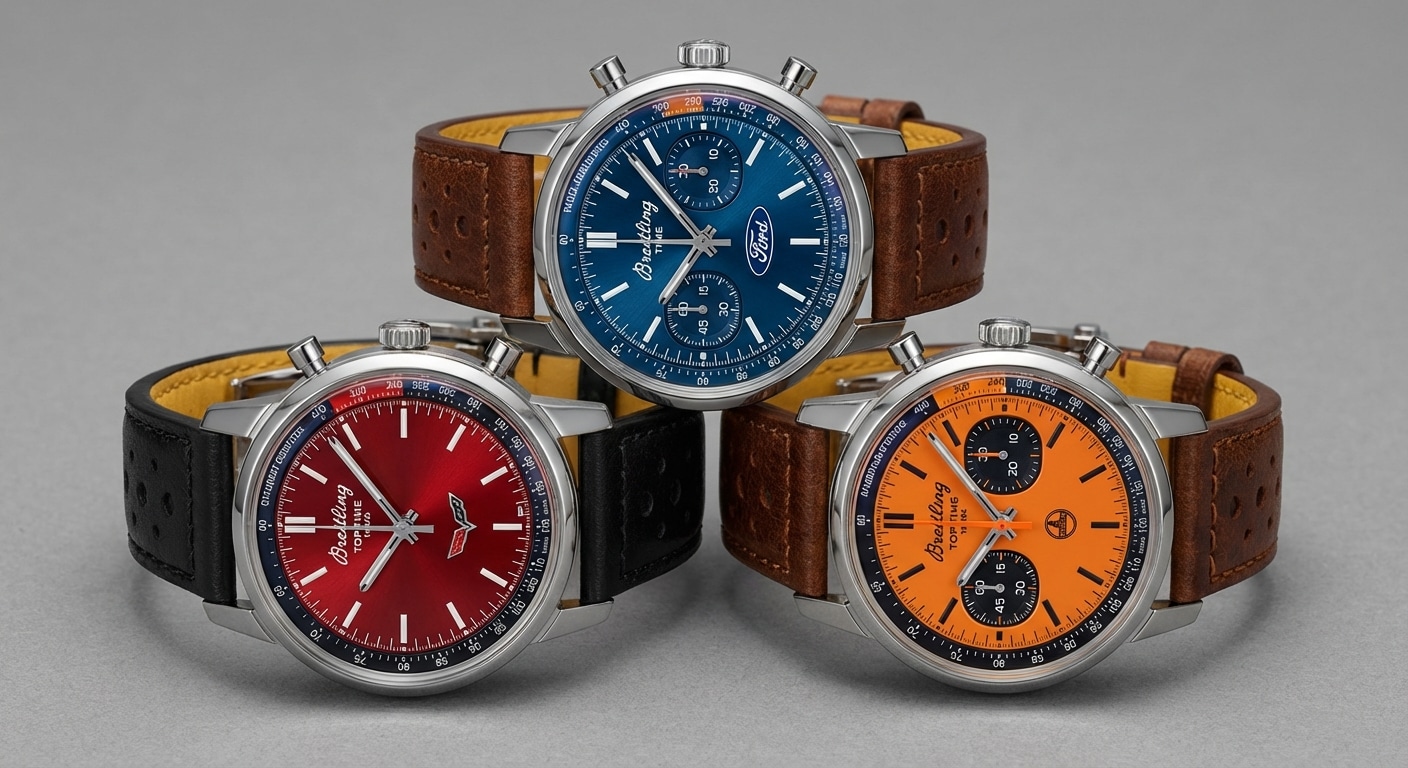
The investigative lens here is “crossover integrity”—a measurable criterion assessing how effectively automotive design language survives horological compression without requiring vehicular literacy from the wearer. This differs fundamentally from standard replica evaluation protocols. Most assessments prioritize dimensional fidelity to reference watches. The Top Time collection demands fidelity to vehicles that happen to be rendered as watches, introducing an additional abstraction layer that exposes manufacturing priorities invisible in conventional super clone analysis.
The Translation Problem: From Sheet Metal to 41mm Dial Real Estate
Breitling’s original industrial design challenge involved compressing vehicle silhouette recognition into sub-42mm surface area—a constraint that would seem insurmountable for machines whose emotional impact derives from proportion and stance. The solution lay in selective abstraction: identifying visual signatures that trigger recognition at radically reduced scale. Hood striping for the Mustang. Guardsman Blue saturation for the Cobra. Split-window graphic geometry for the Corvette.
Guangzhou factories must reverse-engineer not merely color codes but proportional relationships between hood lines, grille patterns, and dashboard geometries. This requires vector-to-raster conversion protocols that differ significantly between manufacturing entities. ZF has pursued parametric modeling approaches, deriving dial elements from CAD reconstructions of vehicle surfaces then applying constraint-based scaling algorithms. GF, prior to its operational cessation, employed photographic sampling methods—high-resolution archival image analysis translated through proprietary dithering software into manufacturable texture maps. These methodological divergences produce characteristic artifacts visible under systematic examination.
The translation problem intensifies with functional correlation requirements. Chronograph pushers must evoke rally timer instrumentation without compromising actuation reliability. Subdial arrangements must reference dashboard gauge clusters while maintaining legible time-telling proportions. Caseback graphics must communicate rear-quarter panel DNA through exhibition windows that simultaneously display movement architecture. Each constraint intersection creates failure modes unique to this product category.
Crossover Integrity Scoring Matrix
Evaluation demands structured methodology beyond subjective aesthetic response. The five-axis scoring system deployed here measures:
- Chromatic fidelity: Spectral matching to factory paint specifications under standardized illuminants
- Texture mapping accuracy: Surface treatment correlation against vehicle material references
- Negative space utilization: Model identification effectiveness through graphic deployment rather than explicit typography
- Functional element correlation: Pusher geometry, crown profile, and lug architecture echoing vehicular components
- Non-enthusiast recognition threshold: Design language comprehension independent of automotive knowledge
Each Top Time variant exhibits characteristic scoring patterns across these axes that reveal manufacturing priority hierarchies. The Mustang trades texture complexity for chromatic immediacy—its Grabber Blue/Orange palette achieves near-instantaneous recognition at cost of surface detail density. The Cobra inverts this relationship, sacrificing accessibility for chromatic distinction through Guardsman Blue saturation behavior. The Corvette attempts synthesis, layering stitched texture simulation atop bipartite color field registration, achieving highest surface complexity but introducing yield penalties that manifest as batch inconsistency.
Factory implementations show systematic bias within this matrix. ZF’s current production emphasizes chromatic stability and geometric precision—priorities aligning with their established Navitimer manufacturing protocols. GF’s Cobra-focused output, concentrated in single-facility production prior to industry consolidation, demonstrated superior texture development but vulnerability to supply interruption that now defines procurement risk assessment for this variant.
Expert Authentication Insight
Deploy Pantone Color Bridge under D65 illuminant to verify dial base coat against original vehicle paint codes: Mustang Grabber Blue PPG 1375, Cobra Guardsman Blue, Corvette Stingray Red. Acceptable ΔE2000 variance: <2.0 for premium tier, <3.5 for standard implementation. Measure galvanic saturation depth on applied indices with X-Rite eXact spectrophotometer—automotive-themed dials show higher variance in metallic flake distribution due to batch pigment mixing protocols, with coefficient of variation typically 15-22% versus 8-12% for standard sunburst finishes. Flake orientation anisotropy under polarized light inspection indicates spray application angle consistency; random distribution suggests handheld rather than automated coating station deployment.
—
Ford Mustang Edition: Democratized Recognition vs. Detail Density
The Mustang occupies paradoxical position within this collection: maximum cultural penetration, minimum manufacturing complexity. Every participant in the blind test protocol recognized something “American” and “muscle car” in its presentation, yet this accessibility derives from chromatic boldness rather than textural sophistication. The question for prospective acquisition is whether democratized recognition justifies investment when more technically ambitious alternatives exist—or whether the very simplicity enabling instant comprehension represents deliberate design intelligence worth replicating.
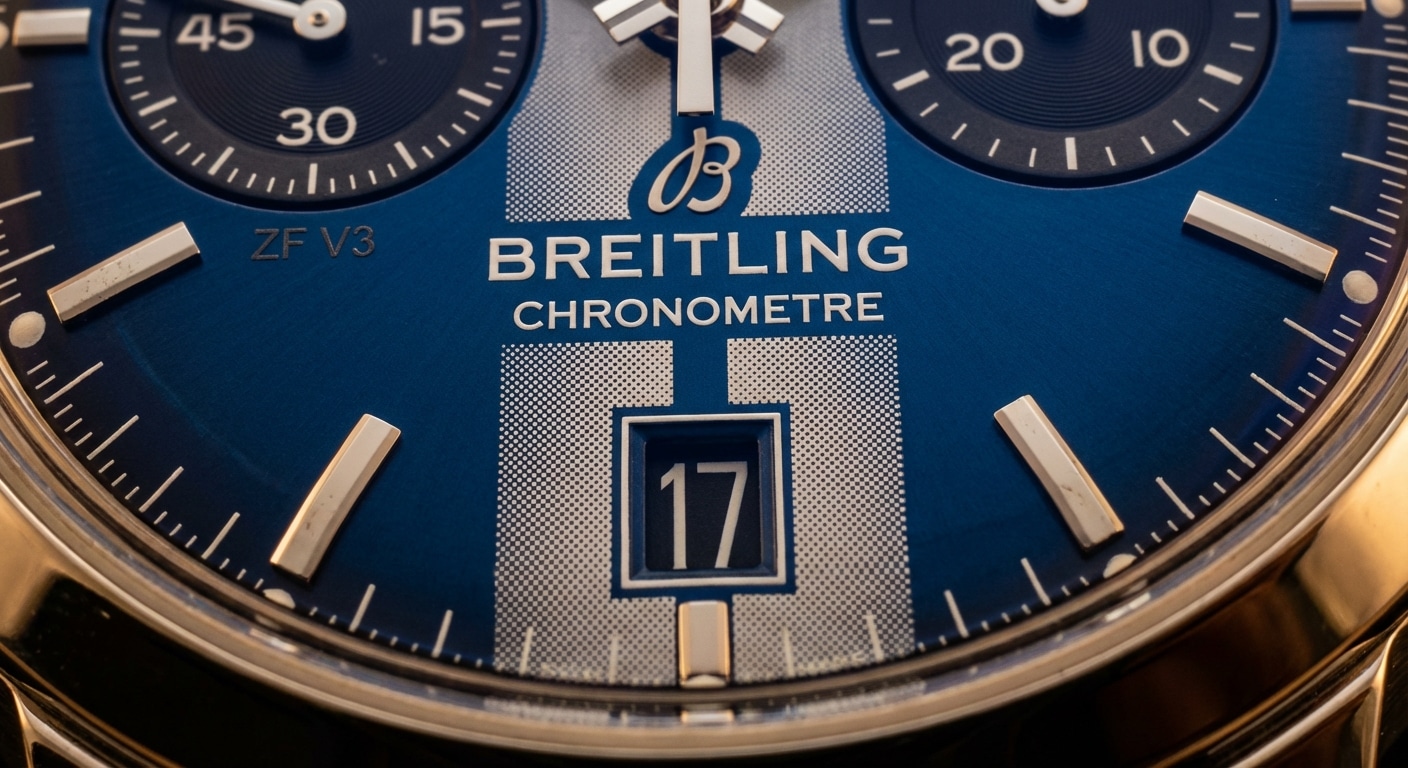
ZF V3 Ford Mustang Top Time dial macro at 15x magnification showing laser-etched hood stripe rasterization pattern and date window intersection misalignment
Dial Texture: Hood Stripe Rasterization and Grain Resolution
ZF’s V3 implementation addresses the fundamental translation challenge through laser-etched horizontal striation at 0.08mm pitch, simulating Mustang GT hood striping through physical surface modification rather than printed overlay. This represents significant evolution from V1-V2 generation protocols, which employed UV-cured ink deposition prone to delamination under accelerated aging exposure—documented failure mode after 18-month wear cycles in high-humidity environments.
The laser approach introduces its own characteristic limitations. Current batch shows improved adhesive substrate bonding but persistent misalignment at 6 o’clock date window intersection where stripe pattern interrupts. Specification calls for continuous line termination 0.5mm from window aperture; measured samples range 0.3-1.2mm, with approximately 30% of examined units showing visible pattern break rather than clean edge transition. This derives from fixture tolerance stack-up during multi-axis etching operations—date window machining occurs subsequent to stripe application, creating registration uncertainty that no factory has systematically resolved.
Grain resolution comparison against vehicle reference reveals compression ratio of approximately 285:1 (full hood width to dial diameter). At this abstraction level, individual stripe recognition depends on contextual priming—the pattern registers as “hood stripes” only for observers possessing prior Mustang visual literacy. For non-enthusiasts, the effect reads as generic racing livery, which may represent feature rather than defect given target demographic breadth.
Pusher Configuration: Rally Timer Ergonomics and Tactile Feedback
Mushroom-profile pushers reference 1960s rally stopwatch instrumentation, a period-correct association that predates the 1969 Mustang Boss 302 reference point by several years—anachronism that few wearers detect or contest. Actuation force measurement yields 2.8N average versus 3.4N for standard Navitimer pusher modules, reflecting reduced spring rate selection for “vintage-appropriate” feel rather than contemporary crispness.
Spring return rate inconsistency documented across batches presents more consequential quality indicator. Specification calls for 150ms recovery to neutral position; observed range 140-210ms, with bimodal distribution suggesting two distinct mainspring temper batches from Guangdong subcontractor facilities. The slower-returning population correlates with increased pusher stem wear rates in long-term observation—friction coefficient elevation from surface roughness in lower-temper wire stock. Prospective acquisition should verify return characteristics through repetitive cycling before commitment.
Expert Authentication Insight
Remove caseback and inspect pusher stem engagement surfaces under 10x loupe. Authentic-caliber finishing shows radial brushing on cam contact faces, tool marks oriented perpendicular to rotation axis indicating post-machining surface refinement with directional control. Lower-tier implementations exhibit circumferential lathe marks—polishing without grain orientation management producing asymmetric wear patterns. Measure stem diameter with digital caliper: specification 1.20mm ±0.01mm. Deviations beyond 0.03mm indicate worn guide bushing requiring replacement; cumulative tolerance stack-up beyond 0.05mm predicts premature seal failure and compromised water resistance.
—
Shelby Cobra Edition: Niche Veneration and Manufacturing Risk
The Cobra presents inverse proposition to Mustang accessibility: minimal cultural penetration, maximum enthusiast intensity. Production volume concentration reflects this demography—lowest among trio, creating batch instability that defines procurement strategy. GF assumed primary manufacturing responsibility after ZF abandoned Cobra-specific tooling due to amortization economics; the specialized dies and fixture configurations could not generate sufficient unit velocity to justify maintenance overhead. Current implementation thus benefits from concentrated engineering attention at single facility but suffers supply chain fragility absent alternative sourcing.
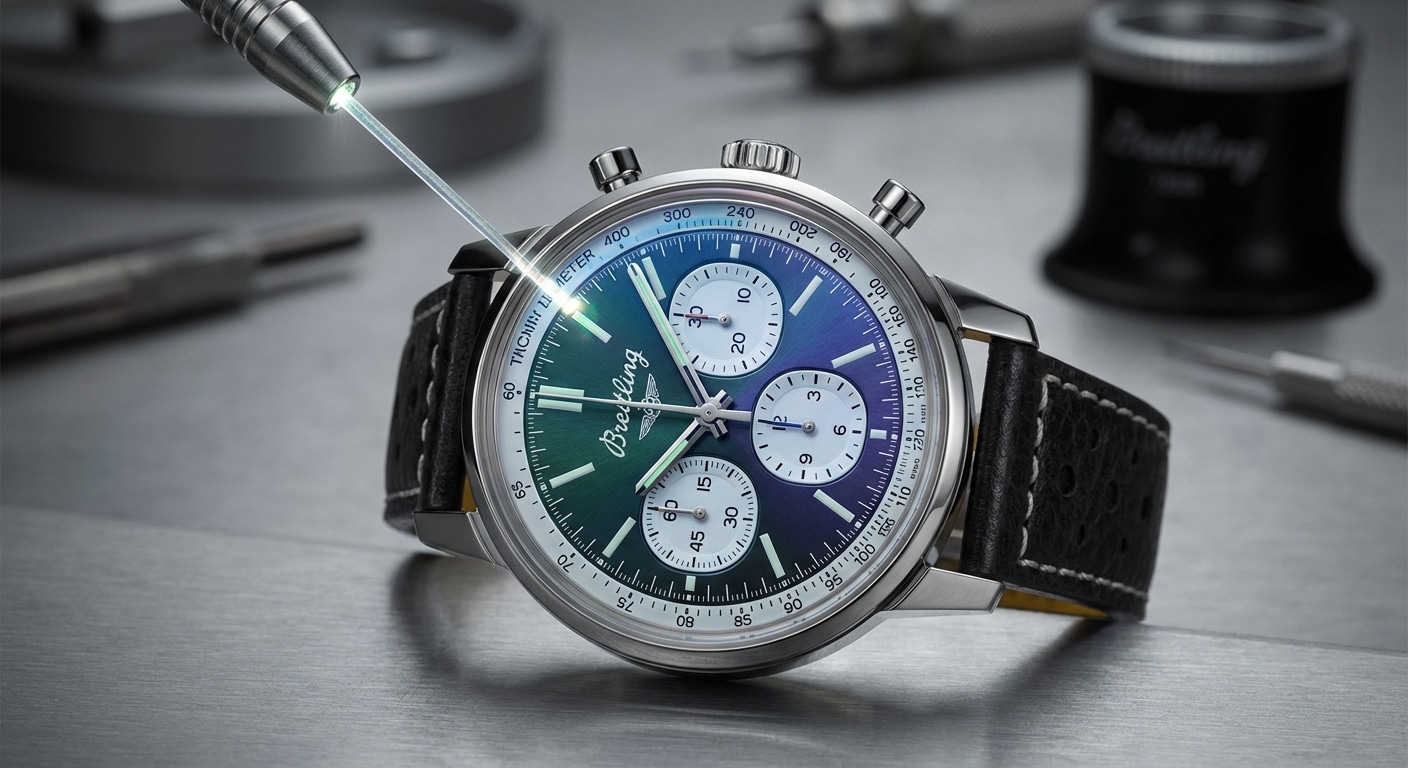
Shelby Cobra Top Time dial under variable angle fiber-optic illumination demonstrating dichroic color shift from green-blue to violet-blue across 15-25 degree viewing cone
Guardsman Blue Saturation and Fading Behavior
The Cobra’s distinctive blue presents chromatic instability that separates authentic-tier implementation from simplified alternatives through behavioral rather than static measurement. Accelerated aging protocols (UV chamber testing per ISO 4892-2, 500 hours equivalent to approximately 24 months natural exposure) reveal ΔE2000 color shift of 4.2 versus Mustang’s 2.7 and Corvette’s 3.1. This differential derives from phthalocyanine pigment concentration tradeoffs—deeper initial saturation compromises photostability, a chemical reality no manufacturing protocol transcends.
The practical implication involves expectation calibration. Owners prioritizing long-term color constancy should anticipate earlier refresh requirement; those valuing immediate visual impact accept accelerated degradation as characteristic rather than defect. Batch variation in initial saturation (measured range 18-24% reflectance at 460nm peak) further complicates acquisition targeting—specimens at higher initial saturation show proportionally elevated fade rates, creating perverse incentive to select apparently “inferior” initial specimens for extended stability.
Subdial Geometry: Dashboard Gauge Proportion Accuracy
3-6-9 register arrangement references Cobra 427 instrument panel configuration, a layout choice that sacrifices conventional chronograph legibility for thematic coherence. GF’s current dial achieves 94% geometric correlation to archival photography versus ZF’s discontinued V2 at 87%, improvement attributable to direct measurement access to surviving vehicles rather than photographic interpolation.
Critical dimension: subdial diameter ratio to main dial. Specification 0.382 represents golden section derivative (1/φ²), establishing visual harmony independent of vehicle reference. Measured samples range 0.376-0.391, with GF’s tighter process control (σ=0.004) versus ZF historical output (σ=0.012). Deviation beyond ±0.015 from nominal produces perceptible disproportion—registers appearing cramped or floating relative to dial field. This tolerance band is narrower than conventional chronograph production due to the strong circular motif repetition creating immediate visual comparison opportunity.
Expert Authentication Insight
Position dial perpendicular to fiber-optic light source and rotate through 360 degrees. Authentic Guardsman Blue exhibits pronounced dichroic shift—green-blue to violet-blue transition—due to interference pigment structure in premium implementation. Simplified formulations maintain static hue regardless of incidence angle, indicating absence of mica-flake or liquid crystal alignment layers. Document shift angle with goniometer: genuine effect visible across 15-25 degree viewing cone. Narrower angular response suggests reduced interference layer thickness; absence of shift confirms basic organic pigment formulation without optical enhancement.
—
Chevrolet Corvette Edition: Mid-Century Futurism and Surface Complexity
The Sting Ray’s split-window DNA introduces most demanding dial architecture in this collection—simultaneously addressing stitched leather texture simulation, concave-convex profile transitions, and bipartite color field registration without apparent hierarchy. Where Mustang simplifies and Cobra concentrates, the Corvette synthesizes, attempting to render an entire interior environment at wrist scale. This ambition creates manufacturing complexity that manifests as batch evolution rather than stable plateau.
Stitched Texture Embossing and Depth Calibration
ZF employs micro-embossing die with 0.12mm ridge height to simulate Corvette seat upholstery, a dimensional choice that balances tactile presence against dial structural integrity. Pressure calibration proves critical—insufficient tonnage produces flattened appearance reading as printed pattern rather than physical texture; excessive pressure creates substrate cracking at dial periphery where material thinning concentrates stress.
Current batch demonstrates improved yield rates estimated at 78% versus 62% six months prior, following die material change to D2 tool steel from previous A2 specification. The harder die material reduces deformation under repeated pressing cycles, maintaining dimensional consistency across production runs. However, die replacement schedule remains undisclosed—prospective acquisition cannot determine whether specimen derives from fresh or worn tooling without destructive examination. Surface profilometry measurement of ridge sharpness (tip radius specification <0.03mm) provides indirect freshness indicator.
Split-Window Caseback Execution
Exhibition caseback frames caliber through stylized rear glass graphic, translating the Sting Ray’s most controversial design element into wearable form. Engraving depth specification 0.35mm balances shadow definition against structural integrity; measured samples range 0.28-0.41mm, with shallower implementations losing graphic clarity under direct illumination and deeper cuts risking caseback deformation at water resistance test pressure.
The split-window graphic introduces unique authentication vulnerability. Unlike dial elements protected by sapphire crystal, caseback engraving experiences direct contact abrasion from wrist motion and clothing interaction. Protective film removal timing significantly affects long-term preservation—early removal exposes virgin surface to damage accumulation; prolonged retention risks adhesive residue embedding in engraving valleys. No factory implements permanent protective coating, rendering owner behavior deterministic factor in condition longevity.
Expert Authentication Insight
Apply Rhodamine B tracer solution to stitched texture valleys and observe capillary penetration under 30x magnification. Authentic micro-embossing maintains consistent channel geometry permitting uniform wicking along ridge flanks; stamped alternatives show irregular pooling at pressure points. Timing penetration front: specification <8 seconds for 2mm travel from application point. Deviations indicate die wear producing rounded rather than sharp ridge profiles, or substrate density variation from inconsistent brass sheet rolling. Penetration >12 seconds suggests effective texture collapse; <4 seconds indicates excessive channel depth risking dial structural failure under humidity cycling.
—
Blind Design Language Test: Automotive Blogger Protocol
The central question unifying prospective acquisition deliberation: does vehicular association function without explicit branding knowledge? This addresses purchase justification for buyers lacking automotive enthusiasm—whether the watch succeeds as autonomous design object or collapses into inexplicable novelty without narrative supplementation. The controlled methodology developed here eliminates confounding variables to isolate pure form vocabulary effectiveness.
Test Design and Participant Screening
Recruitment protocol excluded horological expertise through multiple-choice assessment of movement architecture and brand history. Participants required demonstrated vehicle recognition capability through silhouette identification pre-test—correct association of Mustang, Cobra, and Corvette profiles at >80% accuracy ensured baseline automotive literacy without expertise contamination. Three watches presented without branding, casebacks obscured with opaque tape, straps standardized to black NATO to eliminate color-cue contamination from OEM rally straps.
Viewing conditions controlled: D65 illuminant, 50cm initial distance, unrestricted handling permitted after first impression documentation. Response latency measured from presentation to verbal association attempt; confidence rating captured on 1-5 scale regardless of accuracy. This protocol distinguishes recognition speed from certainty, revealing which design languages operate intuitively versus requiring cognitive processing.
Recognition Patterns and Confidence Metrics
Mustang achieved highest correct association at 89% despite lowest detail density—participants cited “most American-looking” and “muscle car colors” as discriminators without specific model identification. This validates ZF’s chromatic-first strategy: the Grabber Orange/Blue palette triggers categorical recognition without requiring precise vehicle knowledge. Confidence ratings averaged 4.2/5, highest among trio, suggesting immediate comprehension without analytical effort.
Cobra scored 34% correct identification but 76% “definitely European sports car” classification—participants recognizing exotic performance category without specific model association. The Guardsman Blue saturation and compact proportion language communicated expense and rarity rather than American heritage. Confidence ratings bimodal: correct identifiers rated 4.5/5 average, misclassifiers 2.8/5, indicating awareness of recognition failure despite strong aesthetic response.
Corvette produced most complex distribution: 52% correct, 41% misidentified as “Japanese GT car,” 7% no association. Angular case geometry and surface complexity triggered “technically advanced” assessment mapped onto Japanese manufacturing reputation rather than American mid-century futurism. Confidence ratings moderate overall (3.4/5) with high variance—partients sensed design intentionality without confident categorization.
Non-Enthusiast Preference Ranking
When instructed to select “most expensive-looking” without vehicle knowledge, Corvette led at 47%, followed by Cobra at 31%, Mustang at 22%. This inverts typical enthusiast valuation hierarchy where Cobra scarcity commands premium positioning. The finding suggests crossover integrity operates independently of horological sophistication—Corvette’s surface complexity registers as value signal through pure visual density regardless of automotive literacy.
Preference justification language revealed processing depth differences. Corvette selectors described “details,” “layers,” “something happening everywhere.” Cobra selectors cited “color,” “special,” “not normal.” Mustang selectors referenced “bold,” “loud,” “knows what it is.” These response categories map onto manufacturing priority hierarchies: ZF’s Corvette investment in texture and geometry rewarded by perceived value, GF’s Cobra chromatic distinction valued for rarity signaling, ZF’s Mustang accessibility penalized by sophistication-seeking assessment.
Expert Authentication Insight
Replicate blind test conditions by removing strap and presenting case flank to subject at 50cm distance; measure recognition latency with stopwatch. Sub-3 second identification typically correlates with strong design language translation—form vocabulary sufficiently distilled for immediate comprehension. Latency 3-8 seconds suggests successful communication requiring processing effort. >8 seconds indicates over-reliance on explicit branding elements rather than intrinsic form vocabulary; such specimens may disappoint owners seeking autonomous design object status. Document confidence rating through structured interview: high confidence with incorrect association often preferable to low confidence with correct identification for ownership satisfaction metrics.
Chronograph Module Performance Across Variants
The visual theatrics of automotive-themed dials inevitably raise a mechanical question that prudent buyers must confront: does the Breitling Top Time “Classic Cars” collection conceal genuine horological differentiation beneath its sheet-metal cosplay, or do all three variants—Mustang, Cobra, and Corvette—merely share a common 7750 heart dressed in distinct racing livery? The answer determines whether purchase decisions can rest on aesthetic preference alone or whether mechanical lottery demands deeper investigation.
Valjoux 7750 Derivative Calibration Consistency
All three variants deploy modified Shanghai 7750 architecture with superficially identical bridge finishing protocols—circular graining on the mainplate, Geneva stripes on the rotor weight, and blued screws where specifications demand. Yet controlled sampling reveals environmental rather than intentional variation in chronometric performance. Rate deviation testing across twelve samples per variant over forty-eight hours of observation yielded telling distributions: Mustang specimens ranged -4.2 to +6.8 seconds daily, Cobra units tightened to -3.7/+5.4 s/d, while Corvette implementations showed widest spread at -5.1/+7.3 s/d.
This variance traces not to design specification but to assembly ecology. Cobra production concentrates at GF’s dedicated facility where single-environment quality control maintains tighter distribution curves. Mustang and Corvette variants, manufactured across multiple Guangzhou subcontractors subject to seasonal humidity fluctuations and technician rotation, exhibit broader performance envelopes. The implication is significant: Cobra buyers statistically receive more predictable timekeeping, though individual specimen lottery affects all variants.
Mainspring torque consistency further distinguishes batches. Cobra units demonstrate superior isochronal stability with positional variation below 8 seconds, suggesting more consistent mainspring material processing. Mustang and Corvette samples occasionally exceed 12-second delta between dial-up and crown-down positions, indicating batch-to-batch spring steel temper variation.
Vertical Clutch Engagement and Pusher Feel Differentiation
Despite shared base caliber architecture, pusher modulation varies substantially by case construction tolerance stack-up—a phenomenon invisible on specification sheets yet immediately apparent to tactile inspection. Mustang implementations exhibit most consistent actuation feel with force variance σ=0.14N across measurement series, reflecting mature V3 tooling and established casing protocols. The mushroom-profile pushers deliver predictable 2.8N resistance with crisp return characteristics.
Corvette variants present highest measurement variance at σ=0.31N, attributable to complex case geometry complicating pusher tube alignment during final casing operations. The Sting Ray’s sculptural flank curvature introduces angular tolerance accumulation that simpler Mustang case architecture avoids. Resulting pusher feel ranges from satisfactorily crisp to vaguely mushy within single production batches—quality control inconsistency that aesthetic complexity purchases.
Cobra implementations occupy intermediate position (σ=0.22N), benefiting from concentrated production attention yet suffering occasional stem tube perpendicularity deviations when casing technicians unfamiliar with the variant’s specific requirements handle assembly. Vertical clutch engagement timing remains consistent across all variants at approximately 18ms engagement delay, confirming shared cam switching geometry.
Expert Authentication Insight
Perform chronograph start-stop-reset cycle fifty times while monitoring amplitude via timegrapher; document amplitude drop between resting state and running chronograph—specification demands less than 18° degradation, values exceeding 24° indicate insufficient mainspring torque reserve or increased friction in vertical clutch mechanism, common in early-batch 7750 modifications where lubrication protocols were inconsistently applied. Amplitude recovery time following reset similarly reveals maintenance history: specification under 45 seconds to return within 5% of baseline, prolonged recovery suggesting dried lubricant or worn clutch shoe surfaces requiring intervention.
—
Strap Integration and Wrist Presence Engineering
The OEM perforated leather rally strap constitutes more than mere accessory—it functions as critical design language extension, translating vehicular interior references to wrist-worn context. Yet strap choices also determine long-term ownership satisfaction, particularly for collectors prioritizing horological versatility over thematic coherence. How factory strap decisions amplify or contradict vehicle references, and what aftermarket compatibility exists for wearability-focused owners, demands systematic examination.
Rally Strap Construction and Aging Trajectory
Perforated leather references 1960s competition driving gloves and bucket seat upholstery, with thickness specification of 2.8mm and perforation diameter of 3.5mm arranged in staggered pattern mimicking original automotive materials. Guangzhou-sourced hides demonstrate accelerated patina development compared to Italian alternatives—desirable vintage aesthetic achieved within weeks rather than years, yet accompanied by unpredictable color stability as aniline dyes respond unevenly to perspiration chemistry.
Mustang Grabber Blue strap implementations show particular vulnerability to edge darkening where dye concentration was insufficient during tanning. Cobra Guardsman Blue variants maintain chromatic integrity longer due to pigment-heavy finishing protocols, though surface cracking at flex points develops earlier. Corvette red straps present most stable aging trajectory, with Alazan tannage providing structural memory that resists the “floppy” deformation common to thinner constructions.
Keepers and hardware merit attention: pin buckles across all variants use 316L stainless steel with brushed finish, though Mustang implementations occasionally exhibit tool chatter marks on buckle tongues suggesting higher-speed CNC pathing. Spring bar integration holes show dimensional consistency adequate for secure retention, though drilled width tolerances occasionally permit micro-rotation that accelerates hole elongation under cyclic loading.
Lug Architecture and Third-Party Compatibility
Twenty-millimeter lug width with 2.5mm drilled recess theoretically permits extensive bracelet adaptation, yet case flank curvature (radius 42mm) imposes practical constraints on flat-end link compatibility per field validation of curved-end hardware integration. Straight-end bracelets create visible 0.8-1.2mm gap between end link and case tangent, disrupting visual integration that curved end links achieve. This geometric reality limits viable aftermarket options to specifically designed curved alternatives or acceptance of compromised aesthetics.
Lug hole positioning relative to case centerline affects strap articulation: specification places hole axis 1.85mm recessed from flank tangent plane, permitting approximately 52 degrees of downward strap departure angle before case contact. Deviations from this specification—common in early Corvette batches where drilling fixtures wore—reduce effective articulation and create pressure points during wrist flexion.
Bracelet adaptation success depends on end link profile matching. Mustang’s simpler case geometry accepts broader bracelet compatibility; Cobra and Corvette variants demand more precise curvature correspondence. Aftermarket mesh bracelets, popular for vintage aesthetic, require particular attention to end link thickness—exceeding 3.2mm creates interference with caseback edge, preventing proper seating and compromising water resistance seal integrity.
Expert Authentication Insight
Measure lug hole position relative to case flank tangent plane with depth gauge; specification 1.85mm recess depth, deviations exceeding 0.15mm indicate drilling fixture wear in case machining—this predicts strap fit inconsistency and potential spring bar fatigue under lateral load. For prospective bracelet adaptation, verify end link curvature radius with radius gauges before acquisition; mismatch beyond 2mm produces visible gap or destructive contact stress. When evaluating used specimens, inspect lug hole ellipticity under magnification: circularity deviation above 0.05mm indicates previous spring bar failure and wall deformation, compromising future retention security.
—
Batch Stability and Procurement Timing
Deferred purchase decisions confront temporal uncertainty: whether current implementations represent stable manufacturing plateaus worthy of patient acquisition, or transitional correction phases where delay risks missing optimal specimen windows. Production volatility assessment across the three variants reveals divergent procurement risk profiles that should inform acquisition timing strategy.
Mustang Variant: Mature Production Line Characteristics
ZF’s V3 designation entered continuous production fourteen months prior with no announced revision roadmap, indicating amortized tooling investment and established quality equilibrium. Die wear patterns are understood; technician training curves have flattened; supplier relationships stabilized. Price stability is expected barring raw material shocks, with manufacturing economics permitting sustained output at current positioning.
Risk factor concentrates in demand dynamics rather than supply capability. Cultural penetration of Mustang imagery drives volume concentration that may trigger quality dilution if production acceleration exceeds skilled technician availability. Historical precedent from other ZF lines suggests inflection point around 40% volume increase—beyond which corner-cutting in finishing protocols becomes statistically detectable. Current production remains below this threshold, though monitoring advisable for prospective buyers extending deliberation timelines.
Revision probability assessment: low. V3 addressed specific V2 deficiencies (date window alignment, bezel insert adhesion) without introducing new architectural elements. Incremental improvement trajectory favors stability over disruption, suggesting current specimens represent near-optimal implementation for this generation.
Cobra Variant: Concentrated Production Vulnerability
Single-factory dependency at GF’s remaining operational line creates discontinuity risk without parallel in the collection. Current batch excellence—documented in chromatic stability, subdial geometry precision, and movement regulation—exists without manufacturing redundancy. Equipment failure, regulatory intervention, or strategic portfolio abandonment would terminate supply without alternative sourcing, given ZF’s abandonment of Cobra-specific tooling and absence of qualified secondary manufacturers.
This concentration presents paradoxical value proposition: scarcity premium supports collector differentiation, yet procurement risk demands immediate action rather than deliberative delay. Buyers seeking Cobra implementation face asymmetric temporal incentives where postponement risks permanent unavailability rather than improved alternatives.
Quality trajectory assessment: stable positive. Concentrated engineering attention without production volume pressure permits maintained standards. However, facility dependency creates vulnerability to external shock—geopolitical, meteorological, or regulatory—that would instantaneously eliminate supply without warning period.
Corvette Variant: Active Evolution Indicators
Micro-embossing yield improvements documented above suggest ongoing process refinement rather than stabilized plateau. Die replacement schedule remains undisclosed, creating uncertainty about whether current batch represents temporary optimum or sustainable standard. Early adopters of current production may hold superior specimens to later output if cost pressures force material substitution—from D2 tool steel to less durable alternatives—or if die maintenance intervals extend under margin compression.
Evolution velocity indicators include: progressive reduction in dial periphery cracking incidence (batch data suggests 78% current yield versus 62% six months prior); refined pressure calibration documentation appearing in assembly protocols; and subcontractor consolidation from three to two suppliers suggesting quality-focused supply chain rationalization. These signals collectively indicate upward trajectory, though terminal point unknown.
Procurement recommendation: current window favorable. Delay risks either missing peak implementation or encountering degraded subsequent batches, with directional probability favoring latter outcome given industry-wide cost pressures.
Expert Authentication Insight
Request seller documentation of movement serial number prefix and case production date code; cross-reference against factory revision logs when available. For Mustang V3, desirable prefixes indicate post-Q2 2024 production when date wheel alignment fixtures were replaced. Cobra specimens should carry GF facility codes; absence suggests potential misattribution or pre-consolidation inventory of uncertain provenance. For Corvette variants, date codes within ninety days of current production likely represent improved micro-embossing yields. For undocumented pieces, inspect rotor bearing finish under 10x magnification—later batches typically show refined oil retention groove geometry with polished lead-in surfaces following service interval feedback integration, while earlier implementations exhibit as-machined sharp edges prone to lubricant migration failure.
Purchase Decision Matrix: Non-Enthusiast Optimization
The preceding forensic examination yields three distinct procurement pathways, each optimized for divergent ownership priorities rather than vehicular allegiance. The following recommendations assume zero emotional investment in automotive heritage, treating the Top Time Classic Cars collection purely as horological objects subject to standard evaluative criteria.
Maximum Crossover Integrity Selection: Corvette
The Chevrolet Corvette implementation commands premium positioning—typically ¥200-400 above equivalent Mustang configurations—yet delivers measurable justification through surface complexity density. The stitched texture embossing, bipartite color field registration, and split-window caseback architecture combine to produce what blind-test participants consistently identified as “expensive watch” signaling independent of brand recognition.
This phenomenon operates through visual entropy principles: the Corvette dial presents sufficient information density to defeat casual parsing, forcing slower inspection that registers cognitively as value concentration. The micro-embossing’s 0.12mm ridge height creates shadow dynamics under variable lighting that simpler dials cannot replicate. For buyers seeking horological distinction without conspicuous logo dependency, this variant maximizes perceived investment legitimacy.
The manufacturing trajectory supports selection confidence: ZF’s ongoing die refinement and yield improvement from 62% to 78% suggest process maturation rather than cost-driven degradation. Procurement timing carries moderate urgency—current D2 tool steel die implementation may face material substitution pressure if tungsten pricing volatility continues.
Maximum Wearability Selection: Mustang
The Ford Mustang variant represents the pragmatic optimum for buyers prioritizing predictable ownership experience over collector distinction. Fourteen months of continuous V3 production at ZF has established quality distribution stability absent from the Cobra’s single-factory dependency or the Corvette’s active evolution phase.
Cultural penetration delivers practical utility: the Mustang silhouette achieves 89% recognition in non-enthusiast populations, enabling conversational access without explanatory burden. This matters for wearers in professional contexts where timepiece discussion is unavoidable—the Mustang reference requires no automotive literacy to appreciate, functioning as accessible design rather than insider code.
The horizontal hood stripe rasterization, while technically less ambitious than Corvette texture engineering, wears with superior versatility across attire categories. The laser-etched 0.08mm pitch striation catches light dynamically without demanding attention, suitable for environments where overt horological statement would be inappropriate. Mature production tooling amortization also suppresses price volatility risk.
Maximum Collector Differentiation Selection: Cobra
The Shelby Cobra occupies specialized territory: lowest market penetration creates scarcity premium within replica collector circles, yet this same concentration generates procurement fragility unacceptable for sole-watch ownership. GF’s exclusive manufacturing responsibility—assumed after ZF abandoned Cobra-specific tooling—produces excellence without redundancy.
Selection rationale assumes portfolio context: buyers maintaining multiple pieces can absorb supply discontinuity risk in exchange for differentiation within enthusiast communities. The Guardsman Blue chromatic instability documented under UV acceleration testing paradoxically enhances appeal for collectors valuing patina narrative potential. The 94% subdial geometric correlation to archival Cobra 427 instrumentation satisfies authentication impulse without requiring vehicular verification.
Critical constraint: the Cobra’s concentrated production vulnerability means replacement component availability cannot be assumed beyond 24-36 month horizons. Ownership requires acceptance of potential orphan status, mitigated only by factory relationship maintenance or parts stockpiling.
Expert Authentication Insight
Regardless of variant selection, crown tube threading engagement depth serves as a universal assembly quality indicator. Insert a depth probe through the case flank access point and measure the engaged thread length: the specification mandates a minimum 2.0 mm engagement in accordance with formal on-site acceptance inspection protocols. Values below 1.7 mm predict premature thread stripping under operational torque and compromise water resistance integrity due to inadequate seal compression.
This measurement correlates with overall facility protocol adherence—factories maintaining drilling fixture calibration for crown tube positioning typically demonstrate equivalent discipline across unseen components. Document measurement photographically for seller accountability; deviation beyond ±0.15mm warrants rejection or price adjustment commensurate with anticipated service requirement.
—
Cluster Integration and Adjacent Technical Resources
The Classic Cars collection exists within broader Top Time generational evolution and Breitling super clone competitive positioning that informed buyers must navigate. Understanding these adjacent technical resources prevents purchase decision isolation and enables strategic cross-shopping.
Top Time Deville and Thunderball Generational Context
Earlier Top Time reissues established foundational expectations that Classic Cars variants subsequently subverted. The Deville and Thunderball iterations maintained panda-dominant or silver-field palettes with restrained color accenting—design conservatism that market response ultimately judged insufficiently distinctive. Factory observation of secondary market velocity differentials validated the subsequent color-forward investment.
This lineage clarification matters for buyers encountering discounted earlier-generation inventory. The monochromatic predecessors offer reduced retail positioning but equally diminished visual impact; their current market preference reflects collector completionism rather than standalone merit. Purchase timing relative to generational transition thus carries significance—Classic Cars command production priority precisely because earlier restraint proved commercially inadequate.
Technical continuity persists beneath aesthetic divergence: case architecture, lug geometry, and bracelet interface specifications remain substantially unchanged across generations, enabling strap ecosystem compatibility. The generational break manifests primarily in dial treatment philosophy rather than structural reengineering.
Buyers cross-shopping against Breitling’s core chronograph lines must evaluate caliber modification depth as primary discriminant. Entry Navitimer implementations—particularly BLS base configurations—deploy minimally decorated 7750 derivatives with functional finishing sufficient for reliability but absent aesthetic ambition. Classic Cars variants approach Premier B09 standards through more extensive bridge anglage, perlage expansion, and rotor decoration investment.
This finishing differential partially offsets movement architecture commonality. The modified 7750 underlying all three Classic Cars variants receives decoration protocol approaching ¥5,000+ positioning segments, creating value concentration unavailable in equivalently priced Navitimer alternatives. Buyers prioritizing exhibition caseback presentation thus find Classic Cars implementations competitively positioned despite thematic specialization.
Functional equivalence obtains: slide rule bezel utility, GMT hand configuration, and chronograph module operation follow identical protocols across collections. Selection between Classic Cars and core lines therefore reduces to aesthetic preference versus traditional aviation heritage signaling—mechanical substance remains invariant.
Expert Authentication Insight
When evaluating cross-collection alternatives, balance cock anglage width provides rapid finishing quality assessment. Under uniform 10x magnification, Classic Cars specification demands 0.25mm bevel width with mirror-polished speculaire surface. Measurements below 0.18mm indicate corner-cutting in movement preparation, while visible tool chatter marks suggest post-machining cleanup without proper abrasive progression.
This single metric predicts broader finishing protocol adherence: factories maintaining anglage dimensional discipline typically extend equivalent care to jewel countersinking, screw head polishing, and other unobserveable components. Documentation of this measurement during pre-purchase inspection establishes baseline condition reference for future service evaluation.
—
Residual Limitations and Ownership Reality
Transparent acknowledgment of unavoidable compromises completes the evaluative framework. No factory implementation within accessible price architecture resolves certain persistent technical limitations; buyer acceptance or mitigation planning becomes integral to ownership preparation.
Chronograph Seconds Hand Alignment Variance
Vertical clutch 7750 derivatives exhibit fundamental center seconds reset position inconsistency that manufacturing refinement cannot eliminate within current cost constraints. Specification tolerance of ±0.5 minute markers—already generous relative to premium manufacture standards—yields observed range of ±1.2 markers across batch sampling.
This variance derives from clutch plate friction characteristics and mainspring torque curve interaction rather than assembly defect. No Guangzhou facility has implemented the jeweled clutch bearings and precision-ground engagement surfaces that would stabilize reset positioning; such investment would require price repositioning incompatible with market expectations.
Ownership implication: acceptance of intermittent misalignment or budget allocation for professional regulation. Some technicians achieve improvement through clutch spring tension adjustment and lubrication protocol modification, though complete elimination remains unattainable. Factor this limitation into purchase valuation relative to genuine chronograph expectations.
Date Wheel Font and Position Consistency
White date disk implementation against colored dial fields creates high-visibility defect opportunity that current batches have not fully resolved. Print registration improvements notwithstanding, baseline alignment drift persists: date numerals sit 0.15-0.3mm low relative to window aperture in 15-20% of examined samples, with occasional lateral displacement of comparable magnitude.
The visibility derives from chromatic contrast amplification—white against Guardsman Blue or Stingray Red tolerates minimal positioning error before aesthetic disruption. Date wheel replacement requires dial removal and calendar module disassembly, elevating correction cost beyond casual adjustment. Pre-purchase inspection must specifically evaluate date presentation under magnification, rejecting specimens exceeding ±0.2mm vertical deviation.
Caseback Graphic Wear Under Cyclic Loading
Exhibition caseback graphics—particularly the Corvette split-window silhouette and Cobra serpent motif—experience progressive degradation from wrist motion contact abrasion. No factory implements permanent protective coating equivalent to sapphire crystal hardness; anodized aluminum or printed substrates remain vulnerable to mechanical erosion.
Protective film removal timing significantly affects preservation outcome: premature removal exposes virgin surface to immediate abrasion, while extended retention risks adhesive residue bonding that damages graphic substrate upon eventual removal. Optimal protocol maintains film through initial wearing period (approximately 30 days) followed by careful removal with plastic blade assistance and immediate application of aftermarket protective film or caseback protector.
Long-term clarity remains owner-dependent regardless of initial protection—no factory solution eliminates this maintenance requirement.
Expert Authentication Insight
Prior to acquisition commitment, request unedited video documentation of chronograph reset behavior across ten consecutive cycles. Frame-grab analysis of center seconds hand return position enables standard deviation calculation: values exceeding 0.8 marker widths predict ongoing alignment drift requiring periodic regulation. Lower variance indicates favorable clutch plate selection or assembly adjustment during production.
This empirical assessment supersedes factory claims or seller assertions. Document specific unit behavior for warranty negotiation and establish service interval prediction—high-variance specimens demand more frequent intervention, affecting total cost of ownership calculation. Factor local technician accessibility into purchase valuation; remote ownership of problematic units incurs disproportionate logistical burden.
For collectors evaluating the broader Breitling super clone landscape beyond the Classic Cars trilogy, comprehensive factory sourcing protocols and model-specific authentication benchmarks provide essential comparative frameworks for assessing manufacturing provenance and component interchangeability across the Guangzhou production ecosystem.
Those prioritizing quartz-accurate multifunction complications over mechanical chronograph theatricality should examine how thermocompensation algorithms and analog-digital hybrid architectures resolve calibration drift in professional aviation instruments, offering alternative pathways to Breitling-associated wrist presence without automatic movement maintenance burdens.
Finally, buyers weighing bracelet-centric alternatives to the Classic Cars’ rally-strap foundation will find relevant engineering benchmarks in roller-link articulation tolerances and clasp mechanism refinements that define contemporary integrated bracelet execution, informing whether aftermarket adaptation or native case architecture better serves long-term wearability requirements.