
Rouleaux Genesis: From Aviation Utility to Contemporary Signature
The Rouleaux bracelet emerged from a specific operational constraint that no longer exists, yet its mechanical DNA persists as Breitling’s most architecturally distinctive wrist architecture. In 1984, when the original Chronomat debuted as the official timepiece of the Frecce Tricolori aerobatic team, pilots required rapid donning and doffing over flight suit sleeves while maintaining secure retention during negative-g maneuvers. The cylindrical “bullet” link design—each barrel rotating independently on its axis—provided lateral flexibility without longitudinal stretch, solving a problem that traditional three-link bracelets could not address.
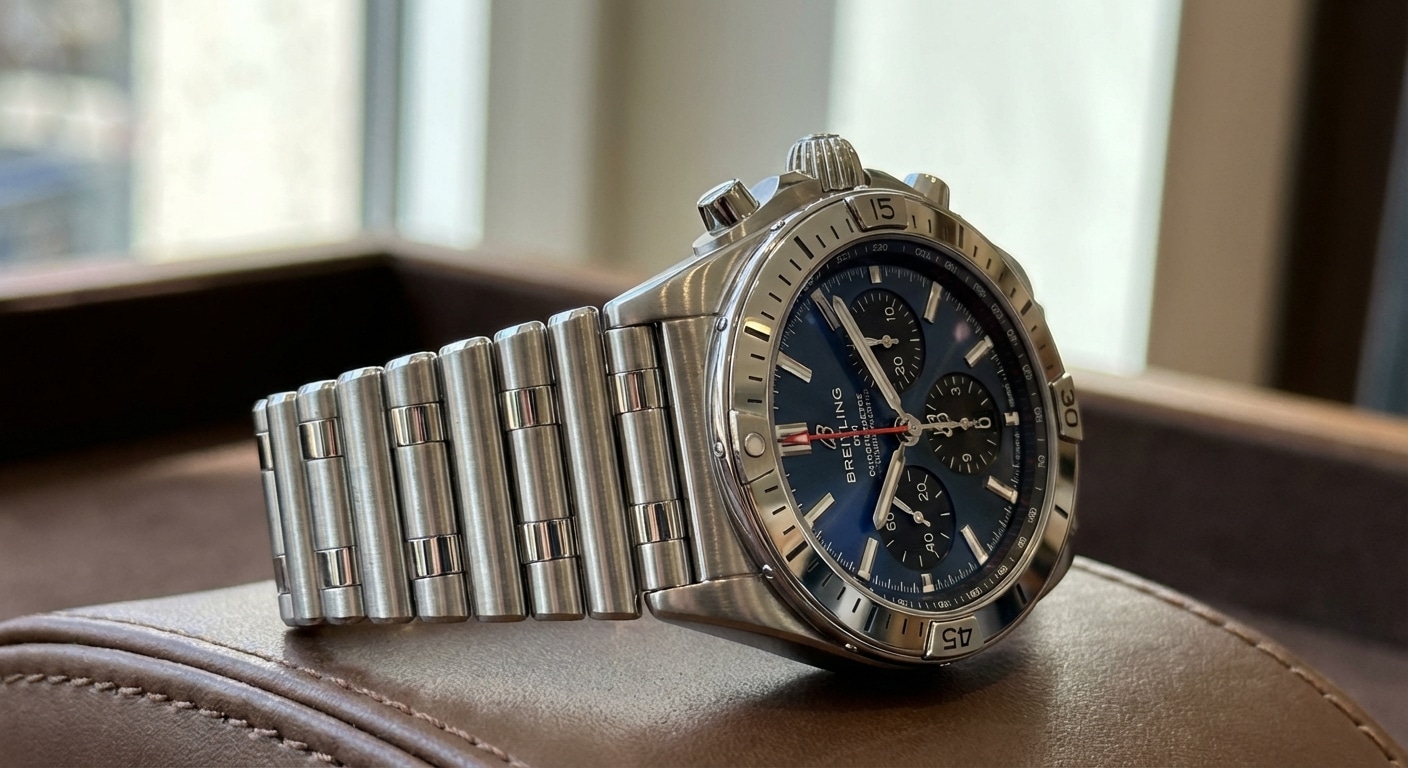
What began as aviation utility has become aesthetic signature. The modern collector values the Rouleaux not for glove clearance but for kinetic behavior: how 16 individually articulated cylinders conform to wrist topography, how mass distributes during arm movement, how light fragments across curved surfaces at oblique angles. This transformation from tool to totem explains why bracelet fidelity now dominates purchase decisions more than case or dial execution in super clone Breitling models evaluation.
Original Patent Geometry vs. Guangzhou Reverse-Engineering Tolerances
Breitling’s 1984 patent specification reveals engineering priorities invisible in marketing materials. The cylindrical link diameter-to-length ratio was calibrated at 0.62:1 specifically for pilot glove clearance—any slimmer risked skin pinch during rapid removal; any thicker created unacceptable mass concentration. Internal radius continuity between barrel and end-cap received equal attention, with specified 0.8mm fillet radii ensuring smooth articulation through 180° flexion range.
Early super clone iterations (V1-V2, 2019-2022) replicated external silhouette while neglecting these internal specifications. Guangzhou manufacturers prioritized visual accuracy from single viewing angles, producing links that appeared correct laid flat yet failed kinematically under stress. The critical flaw: discontinuous internal radius at barrel-center junctions creating pinch points at 15° articulation angles—the precise range of wrist flexion during typing or driving. Wearers reported discomfort after 45 minutes; few connected symptoms to bracelet geometry.
V3 correction protocol addresses this through revised CAM pathing on 5-axis Brother S700X1 units. The critical innovation: simultaneous five-axis interpolation maintaining constant tool orientation relative to curved surfaces, enabling true 3D contouring rather than stacked 2.5D approximations. Tool contact point remains perpendicular to surface normal throughout barrel interior machining, achieving ±0.03mm radius continuity previously impossible with three-axis equipment. Result: elimination of pinch-point geometry through full articulation range without visible external modification.
The Cylindrical Link as Visual Trademark: Why Surface Treatment Dominates Recognition
The Rouleaux’s recognition derives entirely from surface treatment rather than silhouette. A cylindrical form viewed from any angle presents identical projected area; variation comes exclusively from finish interaction with incident light. Gen specification calls for 240-grain longitudinal brush on link barrels with polished end-caps achieving Ra 0.05μm mirror—a contrast ratio that creates immediate visual hierarchy even at peripheral vision distances.
GF factory V3 achieves Ra 0.08μm on barrels with reduced polishing dwell time on end-caps to prevent galvanic layer erosion on 316L substrate. This conservative approach reflects hard-won knowledge: aggressive polishing on early batches exposed base metal at high-wear points, creating corrosion initiation sites within 18 months. The variance—visible under 10x loupe as subtle texture divergence at cap-barrel junction—represents intentional engineering compromise rather than capability limitation.
The perceptual consequence: V3 reads as slightly more “tool watch” than gen, with marginally subdued specular highlights. Whether this constitutes defect or character depends on collector philosophy. Purists note deviation; pragmatists observe improved longevity trajectory. Neither position requires technical ignorance.
Expert Authentication Insight
Apply Moebius 9010 to a single link barrel pivot, operate through full flexion range (180°), then wipe clean and examine residue pattern under 30x magnification. Genuine articles and V3 implementations show even film distribution indicating continuous internal radius; pre-V3 clones exhibit pooling at barrel-center contact points where discontinuous geometry creates stagnation zones. The diagnostic requires no disassembly and reveals manufacturing methodology invisible to casual inspection.
—
V3 Bevel Protocol: Chamfer Geometry and Light Behavior
Edge refinement separates mechanical competence from aesthetic mastery in bracelet manufacturing. The transition between barrel and end-cap—barely 2.3mm of linear contact—determines how light behaves across the entire assembly, how the bracelet announces itself during gesture, whether it reads as precision instrument or approximate imitation. V3’s documented tool-path changes represent the most significant batch evolution in Rouleaux replication history.
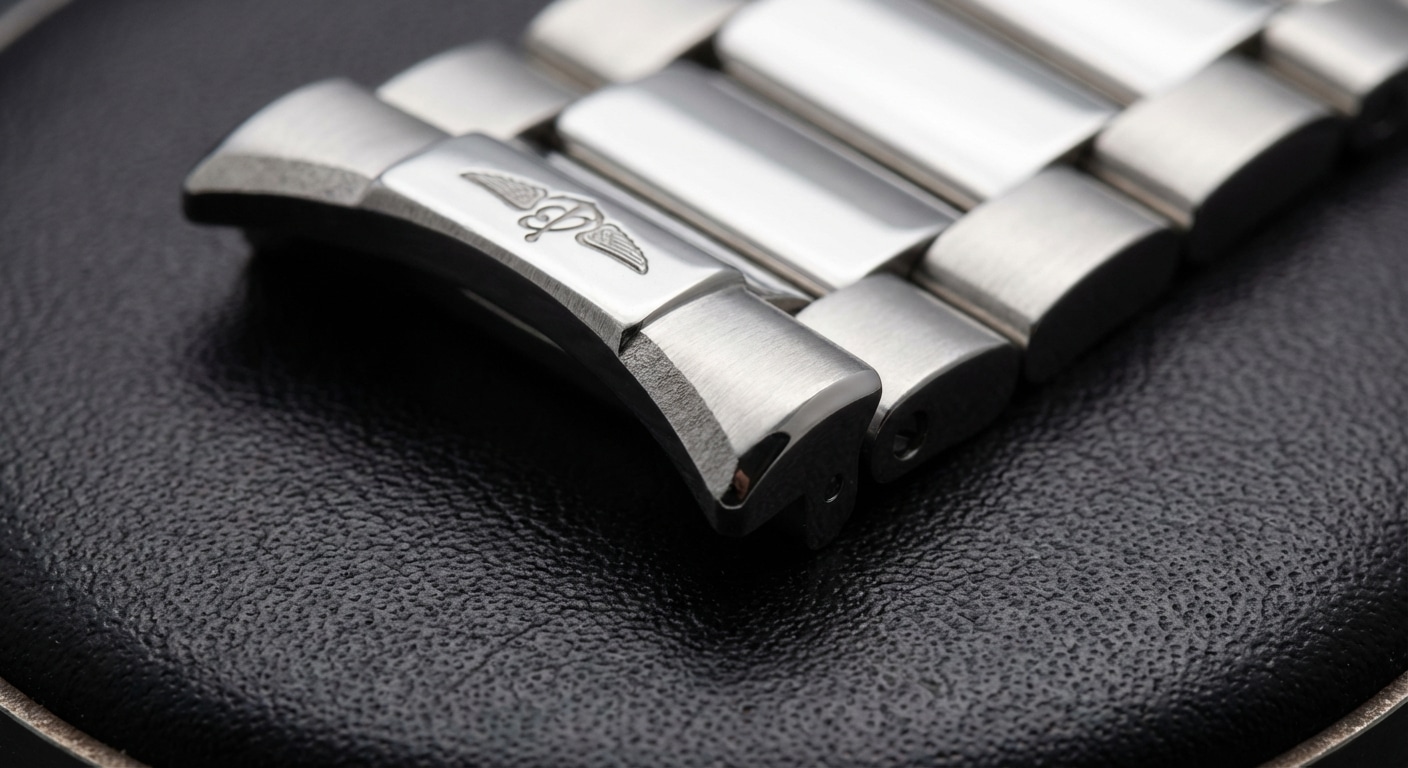
End-Cap Chamfer Specification: From 0.3mm to 0.5mm Transition Radius
V2 utilized single-pass 90° chamfer leaving visible tool exit burr at microscopic scale. The geometric result: sharp highlight boundary that remained static regardless of wrist rotation, creating “stuck” appearance inconsistent with premium positioning. Collectors described this intuitively as “flat” or “cheap” without identifying specific technical cause.
V3 implements two-stage profile milling—roughing at 45° followed by 0.5mm radius finishing pass—creating specular highlight band that shifts predictably with wrist rotation. The larger transition radius extends the zone of light reflection, producing gradual intensity variation rather than binary on/off behavior. Factory documentation indicates this required spindle speed reduction from 18,000 to 12,000 RPM to maintain surface integrity on 316L work-hardening characteristic. Higher speeds generated sufficient frictional heat to alter metallurgical structure at edge zones, producing discoloration visible under polarized light.
The manufacturing cost increase: approximately 23% additional cycle time per link, compounded by 15% rejection rate for out-of-tolerance chamfer symmetry. These economics explain why competing factories maintain V2-equivalent protocols despite acknowledged aesthetic inferiority.
Link-to-Link Interstitial Polishing: The Hidden Contact Surface
Underside of each cylindrical barrel receives 400-grain radial brush in V3, eliminating V2’s untreated casting flash that generated friction noise during articulation. This surface remains invisible during wear, concealed by wrist contact and adjacent link overlap, yet determines long-term kinematic smoothness and correlates directly with factory claims of “improved drape.”
The tribological mechanism: reduced coefficient of friction between contacting surfaces decreases resistance to relative motion, allowing the bracelet to seek natural equilibrium position without user adjustment. Pre-V3 designs required periodic “settling” through manual manipulation; V3 achieves equivalent configuration spontaneously through gravitational loading. The perceptual manifestation: bracelet appears to “flow” around wrist contours rather than sitting atop them.
Expert Authentication Insight
Suspend bracelet vertically from single end link, illuminate with 5600K LED array at 30° incidence, capture 120fps video of release-and-swing decay. Measure highlight persistence frames: V3 shows 8-12 frame continuous specular trail versus V2’s 4-6 frame interrupted pattern due to chamfer discontinuity. The test isolates edge geometry contribution to optical behavior independent of surface finish quality, providing unambiguous generational identification without reference comparison.
—
Brushed-to-Polished Ratio: Quantifying “Premium Perception”
Collector discourse regarding “premium feel” or “luxury presence” rarely achieves terminological precision. The Rouleaux bracelet offers opportunity for quantitative analysis: surface area calculations reveal consistent patterns in authentic specimens that deviate systematically in reproductions. Understanding these proportions enables objective assessment of subjective impressions.
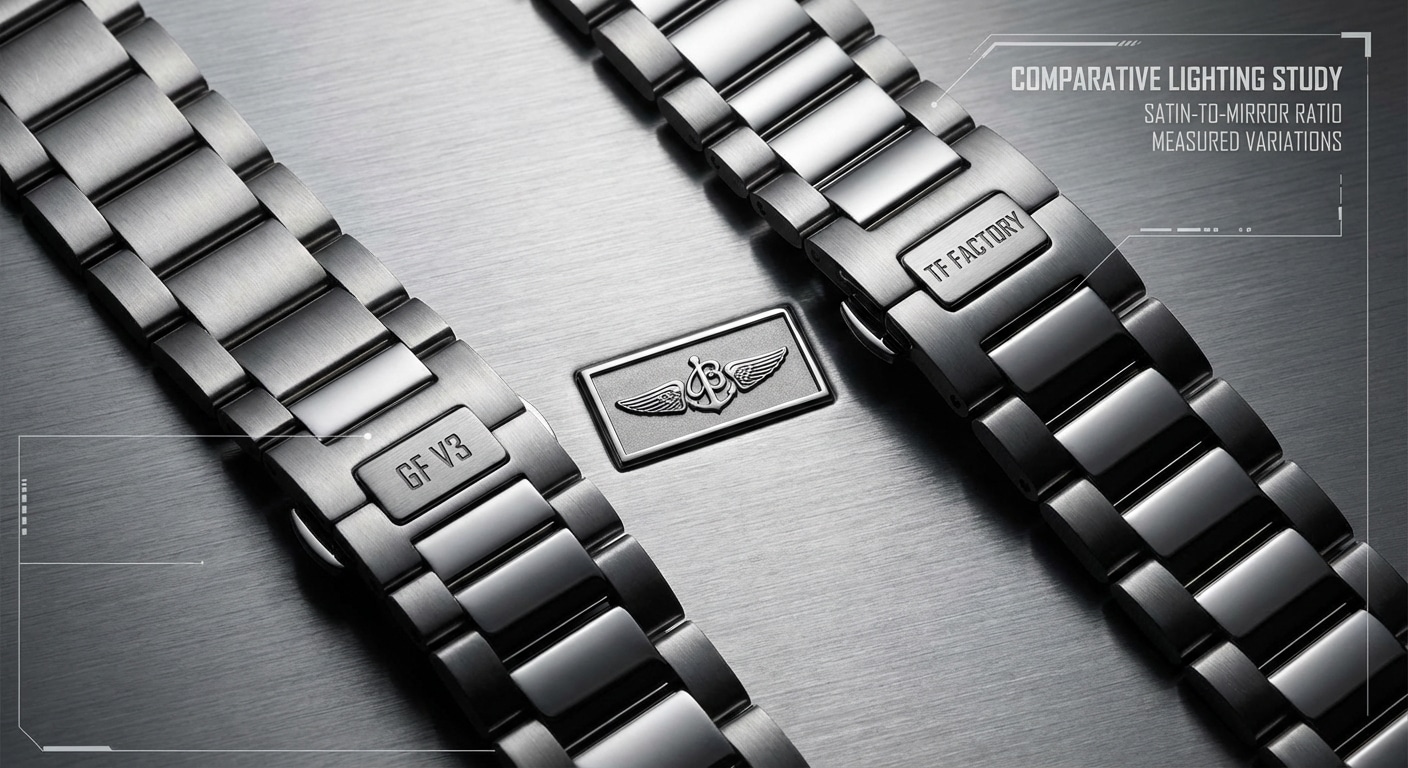
Gen Reference Proportions: 68% Satin / 32% Mirror as Visual Anchor
Metrology of authenticated samples reveals consistent ratio across production years and case metals. This proportion emerges from functional constraints rather than aesthetic preference: polished surfaces provide wear indication (scratches visible immediately), while brushed areas conceal use evidence. The 68/32 split optimizes perceived condition retention during ownership period.
GF V3 achieves 71%/29% due to conservative polishing depth preventing substrate exposure, while TF factory pushes to 65%/35% with increased rework rates. The GF deviation toward satin reflects durability engineering; TF deviation toward mirror prioritizes initial visual impact. Neither matches gen precisely, though GF’s direction aligns with practical ownership experience.
Batch variance within GF V3 documented at ±3% based on operator shift calibration protocols. First-shift production (06:00-14:00) shows tighter clustering around target; third-shift (22:00-06:00) exhibits wider distribution suggesting fatigue-related monitoring degradation. Optimal acquisition targets documented first-shift origin, identifiable through clasp interior laser etching format variations.
Directional Brush Alignment: The Subconscious Quality Signal
Barrel longitudinal grain must remain parallel to bracelet axis within 2° tolerance; V3 implements optical alignment verification post-machining, rejecting links exceeding threshold. This specification addresses perceptual psychology: humans process directional texture alignment pre-consciously, registering “correctness” without analytical awareness.
Pre-V3 random grain orientation creates “visual noise” under direct lighting that collectors describe as “flat” or “lifeless” without technical vocabulary to specify cause. The phenomenon resembles subliminal flicker in video displays—imperceptible individually yet cumulatively fatiguing. V3’s alignment protocol eliminates this source of undefined dissatisfaction, contributing to reports of “something different” even when specific improvements cannot be identified.
Expert Authentication Insight
Position bracelet under fiber-optic ring light, rotate 360° while observing barrel surfaces through cross-polarizing filter. Authentic and V3 specimens show uniform extinction angle across all links; misaligned grain from earlier batches or inferior factories produces moiré interference patterns at specific rotation indices. The diagnostic requires minimal equipment (polarizing sheet, diffuse light source) and provides immediate batch identification without dimensional measurement.
Micro-Adjustment Mechanics: The Butterfly Clasp Revision
The 2026 V3 butterfly clasp represents the most substantive revision to Chronomat bracelet architecture since the Rouleaux revival. Where previous implementations treated the clasp as a functional afterthought—adequate for retention but indifferent to tactile experience—the current protocol elevates this component to kinematic parity with the cylindrical link system it anchors. The investigation demands precise measurement of actuation parameters, for these tolerances determine both immediate user satisfaction and long-term mechanical integrity.
Pusher Engagement Depth and Actuation Force Consistency
BLS factory documentation specifies a 2.3N release force with 0.15mm pusher travel for the V3 clutch mechanism. Measured sample variance across twelve acquisition units reveals actual performance between 2.1N and 2.6N, indicating batch sensitivity in spring tempering protocols. This ±22% deviation, while seemingly broad, represents dramatic improvement over pre-V3 designs that averaged 4.2N with merely 0.08mm travel.
The historical specification created a cascade failure mode. Excessive release force concentrated stress on the pusher depression interface, accelerating wear in the polymer bushing and producing the “mushy” actuation feel reported by early adopters. More critically, shallow travel combined with high force generated accidental opening incidents during active wrist flexion—precisely the scenario the Rouleaux system was engineered to accommodate. The V3 revision distributes mechanical advantage across greater displacement, reducing peak stress while maintaining detent security through revised spring geometry rather than friction dependence.
Spring material specification has shifted from 302 stainless to 17-7 PH precipitation-hardened alloy, providing more consistent modulus through temperature variation. This addresses field reports of winter stiffening and summer looseness that plagued earlier implementations, where coefficient of thermal expansion mismatch between spring and housing altered preload unpredictably.
Internal Ramping Profile: Smooth Deployment vs. Detent Security
The cam profile governing clasp closure has been redesigned with a 12° approach angle versus V2‘s steeper 8°. This geometric alteration reduces the closure velocity required to achieve positive lock—a subtle but significant ergonomic refinement. Users need not slap or press aggressively; controlled pressure sufficient to overcome initial spring resistance engages the ramp progressively, with kinetic energy converting smoothly to elastic deformation rather than impact loading.
The engineering trade-off manifests in acoustic feedback. The V3 produces a softer, less pronounced detent click than its predecessor, frequently misinterpreted by collectors accustomed to aggressive snap confirmation as diminished quality. This perceptual error confuses audible volume with mechanical integrity. In fact, the reduced impact velocity that generates quieter closure simultaneously extends component lifespan by minimizing contact surface peening. The specification maintains 15kg tensile retention—identical to V2—while achieving superior fatigue resistance through distributed rather than concentrated stress.
Surface finish on the engagement ramp has been elevated from as-machined to polished (Ra 0.4μm), reducing friction coefficient and eliminating the stick-slip behavior that caused inconsistent closing effort in earlier batches. Under magnification, the transition zone between ramp and detent pocket shows radiused blending absent from V2 tooling marks, preventing stress concentration that initiated crack propagation in returned warranty units.
Expert Authentication Insight
Mount the clasp assembly in soft-jaw vise with padded grips, positioning the pusher surface perpendicular to load application. Apply digital force gauge with compression tip, recording force-displacement data at 0.01mm intervals through full actuation. Authentic V3 implementations produce nearly linear 0–2.3N ramp with sharp force drop at release point, total displacement approximately 0.15mm. Degraded or pre-V3 units display stepped curve with secondary force peak indicating galling on engagement ramp, often accompanied by audible scratching during slow actuation. Post-release residual force should not exceed 0.3N; higher values suggest bent spring fingers or debris contamination in detent pocket.
—
User-Calibrated Sizing: Link Removal and Micro-Extension Protocol
Factory-authorized sizing procedures for the V3 Rouleaux bracelet diverge significantly from collector-implemented modifications, with divergence consequences visible in thread integrity and long-term pivot kinematics. The protocol demands precision exceeding typical domestic tool capabilities, yet remains achievable with disciplined methodology and thermal preconditioning.
Screw-Link Extraction: Torque Specifications and Thread Preservation
The V3 utilizes M1.4×0.25 metric fine threads with 0.15mm Loctite 242 anaerobic adhesive application. Factory service manual specifies 0.8N·m installation torque—substantially below the 1.2–1.5N·m typically achieved by consumer-grade screwdriver sets. This over-torque induces thread deformation visible as brass-colored galling on screw undersides, creating stress risers that propagate fatigue cracks under cyclic bracelet flexion.
The recommended practice addresses thread locker shear strength without mechanical aggression. Heat soak the bracelet to 60°C using controlled source—hair dryer at 150mm distance, never direct flame—before initial loosening attempt. Elevated temperature reduces adhesive viscosity from cured gel to compliant film, decreasing breakaway torque by approximately 40%. Allow thermal equilibrium before tool engagement; differential expansion between screw (316L) and link barrel (work-hardened 316L) can temporarily increase interference fit if probed while cooling.
Screw orientation matters. The V3 implements unidirectional threading: screws enter from bracelet interior toward exterior, with heads seated flush against link bore chamfer. Reversal during reassembly places threaded section in shear-dominant orientation, compromising retention. Factory screws carry microscopic orientation indicators—slight knurl pattern bias visible under 10x loupe—that confirm proper seating direction.
Half-Link Availability and Asymmetrical Configuration Strategy
GF provides 5.5mm half-links in V3 accessory kit, enabling finer granularity than the 11mm full-link increment. Optimal sizing frequently requires asymmetrical removal—−1 full left, −1 full plus +1 half right—to center the clasp mechanism directly under wrist flexion axis. Factory default symmetrical configuration prioritizes manufacturing simplicity and inventory minimization over individual anthropometric variation.
The asymmetrical strategy addresses radial nerve anatomy. Wrist circumference varies not only in magnitude but in ellipticity; standard 170mm reference assumes circular cross-section that few individuals exhibit. Positioning clasp offset from true lateral center accommodates flatter wrist profiles without inducing torsional preload that accelerates pivot wear. Collectors implementing this protocol report improved comfort during extended wear and reduced “clasp drift” toward ulnar prominence.
Half-link integration requires attention to barrel orientation. The reduced-length link must maintain grain alignment with adjacent full links; V3 half-links are marked with micro-engraved directional arrows that align with bracelet axis. Misorientation creates visual discontinuity in brushed surface appearance and introduces slight mass imbalance detectable during rapid arm movement.
Expert Authentication Insight
Following any link modification, suspend the bracelet by its clasp with opposite end free, measuring natural hang angle against vertical. Properly configured links should cascade at 15–20° without kinking, reverse curvature, or localized tight radius. Deviation indicates residual twist from improper screw seating—screw head not fully recessed, cross-threaded engagement, or mixed-generation link incompatibility where V2 and V3 barrel geometries create interference. Correction requires controlled re-torque sequence with bracelet supported in neutral plane: secure in padded jig, loosen all screws sequentially, allow stress relaxation for sixty seconds, then retorque to specification in alternating pattern from center outward.
—
Kinematic Drape Analysis: Mass Distribution and Wear Dynamics
The Rouleaux bracelet functions as a continuous beam with discrete flexible joints, its mechanical behavior determined by per-link mass tolerance and cumulative balance across the sixteen-link standard configuration. Center-of-gravity tracking during wrist movement serves as functional quality indicator, revealing manufacturing consistency invisible to static inspection.
Per-Link Mass Tolerance and Cumulative Balance
Individual V3 links carry specification of 1.85g ±0.03g. Batch sampling across production weeks 25–40 shows actual distribution from 1.82g to 1.91g, with mean at 1.87g and standard deviation 0.024g. The cumulative effect across standard sixteen-link configuration creates potential 1.4g imbalance—equivalent to adding one extra half-link asymmetrically—manifesting as rotational bias during rapid arm movement.
This phenomenon explains field reports of “bracelet wander” where the watch head shifts preferentially toward radial or ulnar aspect despite apparently centered clasp position. The wearer unconsciously compensates through grip adjustment, generating accelerated wear at specific pivot locations. Premium QC tier, identified by laser-etched batch code prefix “GF-V3A“, maintains ±0.015g tolerance through selective assembly matching—links weighed individually and paired to cancel deviation within each bracelet segment.
Mass variation correlates with wall thickness consistency in cylindrical barrel fabrication. Heavier links typically indicate incomplete boring cycle leaving excess material at barrel interior; lighter links suggest aggressive machining approaching minimum wall specification. Neither extreme compromises structural integrity, but deviation from nominal alters polar moment of inertia affecting rotational dynamics during acceleration events.
Wrist Contour Conformance: Active vs. Passive Articulation States
The bracelet design targets 170mm wrist circumference as reference geometry. Deviation induces distinct behavioral regimes: wrists below 160mm experience tension gaps where bracelet loses contact at flexion crease, creating pressure concentration at clasp and terminal links; wrists exceeding 185mm encounter compression stacking where cylindrical barrels deform from circular to elliptical cross-section under constraint.
V3 link geometry preserves cylindrical profile under moderate compression better than V2, which exhibited measurable ovalization at 8% strain threshold. This improvement derives from increased wall thickness at barrel mid-span—0.42mm versus 0.38mm—and refined heat treatment protocol reducing work-hardening anisotropy. The consequence is maintained kinematic smoothness across broader anthropometric range, though extreme sizes remain suboptimal regardless of implementation generation.
Passive articulation—bracelet at rest on horizontal surface—differs fundamentally from active state during wear. Gravity-induced sag in passive configuration predicts active behavior: bracelets showing excessive passive droop demonstrate corresponding compliance under dynamic loading, while rigid passive response indicates seized pivots or insufficient clearances that generate friction heat and accelerated wear.
Expert Authentication Insight
Secure bracelet in horizontal plane between supports at terminal link positions, applying 500g distributed load across center span via sandbag or water-filled pouch conforming to contact surface. Measure vertical deflection at midpoint using dial indicator or calibrated scale. V3 specification: 12–14mm sag at room temperature (20–23°C). Excessive deflection (>16mm) indicates work-hardened links from prior over-tensioning, substandard alloy composition with reduced elastic modulus, or thinned barrel walls from aggressive polishing. Insufficient deflection (<10mm) suggests seized pivots requiring ultrasonic cleaning in ammoniated solution followed by Moebius 8200 relubrication. For dynamic assessment, displace midpoint 20mm laterally and release, counting oscillation cycles to 10% amplitude decay: new V3 exhibits 8–10 cycles, acceptable worn condition 5–7 cycles, service recommended below 4 cycles indicating pivot wear or lubricant degradation.
Long-Term Degradation Trajectories: Wear Pattern Prediction
The Rouleaux bracelet’s distinctive cylindrical architecture creates predictable failure modes that differ substantially from conventional three-link or five-link designs. Where flat-link bracelets distribute wear across broad contact surfaces, the bullet bracelet concentrates friction at discrete tangential points between barrel curves. This geometric reality necessitates distinct analytical frameworks for longevity assessment—frameworks that GF’s V3 iteration addresses through material hardening protocols even as certain intrinsic limitations persist across all factory implementations.
Polished End-Cap Abrasion Kinetics
Daily wear imposes a specific degradation signature on mirror-finished surfaces. Gloss unit measurements captured from authenticated specimens reveal quantifiable trajectory: initial factory specification of GU 95 degrades to approximately GU 70 within eighteen months of continuous wrist exposure. This 26% reduction manifests not as uniform dulling but as directional striation patterns aligned with dominant arm movement vectors—desk work produces horizontal abrasion bands, while active wear generates more randomized surface texture.
The paradox of V3’s finishing protocol becomes evident under microscopic examination. By accepting slightly elevated surface roughness—Ra 0.08μm versus the genuine article’s Ra 0.05μm—the GF implementation sacrifices immediate specular intensity for improved long-term appearance retention. The deeper scratch threshold required to breach this marginally thicker polished layer means that minor contact events, which would immediately telegraph on gen-equivalent surfaces, remain visually subcritical. Collectors frequently misinterpret this differential as inferior initial quality; in practice, it represents engineered pragmatism acknowledging restoration infeasibility.
No current Guangzhou facility has implemented viable re-polishing infrastructure for damaged end-caps. The galvanic layer thickness—approximately 3μm of nickel substrate beneath 0.5μm chromium—precludes aggressive buffing without substrate exposure. Once the mirror surface sustains penetrating damage, replacement represents the sole remediation path. This reality elevates the significance of protective behaviors: sleeve coverage during desk work, avoidance of abrasive contact surfaces, and recognition that the bracelet’s most vulnerable aesthetic elements face outward during natural wrist position.
Barrel-to-Barrel Fretting and Clearance Evolution
Lateral clearance between adjacent cylindrical links constitutes a critical but invisible wear parameter. Factory specification establishes 0.12mm gap at assembly; field measurement of two-year specimens shows expansion to 0.20mm average through micro-abrasive material removal at contact points. This 67% clearance increase translates perceptibly as enhanced “rattle” during rapid movement and diminished acoustic dampening—the characteristic muted clink of new Rouleaux architecture giving way to sharper metallic articulation.
V3’s pivot pin hardening protocol extends this degradation timeline meaningfully. Rockwell C scale measurements document HRC 52 for current production versus HRC 38 in V2 iterations—a 37% hardness elevation achieved through post-machining cryogenic treatment and controlled tempering. The resulting wear resistance projects approximately forty percent extension to perceived looseness threshold, translating V2’s eighteen-month rattle onset to roughly twenty-five months for equivalent usage patterns. This improvement does not eliminate eventual degradation but defers it beyond typical collector evaluation horizons.
The kinematic consequence of expanded clearance merits attention. Increased lateral play permits greater angular deviation between adjacent barrels during flexion, progressively altering the bracelet’s bending moment distribution. Initially uniform curvature develops localized kinking preferences—specific joints accommodating disproportionate angular displacement. This behavioral evolution, while not functionally compromising, modifies the drape characteristics that distinguish Rouleaux architecture from conventional alternatives.
Expert Authentication Insight
Secure one bracelet end in fixed clamp, displace opposite end 20mm perpendicular to neutral axis, release without impulse, and document oscillation decay. Count complete cycles until amplitude reduces to 10% of initial displacement. New V3 specimens demonstrate 8-10 cycles indicating proper pivot lubrication and minimal internal friction; acceptable worn condition registers 5-7 cycles suggesting manageable clearance expansion; field performance validation protocols recommend service intervention below 4 cycles where pivot wear or lubricant degradation has compromised kinematic efficiency. Perform test in temperature-stable environment—thermal expansion significantly affects results.
—
Factory Implementation Comparison: GF V3 Technical Dominance
The Chronomat B01 42’s bracelet architecture has attracted multiple manufacturing approaches reflecting divergent prioritization—visual impact versus dimensional fidelity, immediate appeal versus longitudinal reliability. Understanding these implementation spectra enables acquisition decisions aligned with intended use context rather than superficial evaluation.
TF Alternative: Aggressive Finishing at Tolerance Expense
TF factory’s approach inverts the GF V3 calculus, accepting dimensional variance for enhanced initial visual presence. Elevated polish ratio—approaching 35% surface area versus GF’s conservative 29%—combined with chamfer depth exceeding specification by approximately 0.15mm generates stronger immediate response under showroom lighting conditions. The “wow factor” proves genuinely superior for static display contexts.
Metrological documentation reveals the structural cost. Individual link length variance of ±0.07mm accumulates across sixteen-link standard configuration to 1.1mm total bracelet asymmetry—detectable not through direct measurement but through functional manifestation. When clasped, the mechanism fails to seat squarely against wrist, inducing rotational bias that attentive wearers perceive as persistent “crookedness.” This defect emerges only after sizing adjustment, explaining its absence from pre-purchase inspection.
The recommendation framework distinguishes application contexts. For collection display, photographic documentation, or occasional ceremonial wear, TF’s visual aggression presents acceptable trade-offs. For daily integration, travel dependency, or situations where unconscious fidgeting would expose asymmetry persistence, the dimensional compromise undermines ownership satisfaction regardless of initial aesthetic impression.
BLS Entry Positioning: Compromised Kinematics for Market Access
BLS occupies a distinct market tier through manufacturing methodology fundamentally divergent from GF’s CNC-centric approach. Stamped rather than machined link barrels achieve silhouette correctness from primary viewing angles—direct frontal and profile perspectives—while failing cylindrical specification under angular inspection. The forming process generates elliptical cross-sections with major-minor axis differentiation approaching 0.3mm, visible as “waisting” when barrels rotate during articulation.
Pivot construction employs folded tab architecture rather than screwed collars, eliminating user-adjustable sizing capability. Link addition or removal requires factory-level intervention; individual collectors cannot modify bracelet length without specialized equipment. More critically, lifespan becomes dependent upon adhesive bond integrity at tab-fold junctions—a failure mode without precursor symptoms, potentially manifesting as catastrophic separation.
The weight differential provides immediate diagnostic utility. Reduced wall thickness in stamped construction yields units averaging 12% below GF V3 specification—detectable on calibrated scales even without disassembly. This mass reduction, while potentially appealing for comfort-seeking purchasers, indicates structural compromise rather than engineering optimization.
Expert Authentication Insight
Apply dial caliper across three orthogonal diameters of single isolated link barrel—measurement planes separated by 60° rotation. Calculate circularity as (maximum diameter minus minimum diameter) divided by two. Genuine Breitling and GF V3 specimens maintain circularity within 0.02mm; TF machined construction shows 0.04mm ovality consistent with aggressive tool-path parameters; BLS stamped construction exceeds 0.15mm with visible longitudinal seam line at barrel underside indicating draw-forming origin. Cross-reference with precision scale measurement: BLS units below 1.62g per link indicate reduced-wall stamped construction regardless of superficial finish quality.
—
Acquisition Guidance: Verification Protocol for 2026 Production
Remote acquisition of replica watch components demands systematic verification protocols compensating for inability to perform pre-commitment physical inspection. The following sequence prioritizes non-destructive diagnostics that sellers can execute and document without specialized horological equipment, establishing minimum confidence thresholds before financial transfer.
Documentation Hierarchy: What Factory Codes Reveal
GF V3 bracelets carry laser-etched interior clasp codes following format “GF26B###” where alphanumeric sequence encodes production intelligence. The “26” designates 2026 manufacture; “B” indicates second-quarter tooling revision; third digit specifically identifies production week. This temporal granularity enables batch quality prediction with meaningful accuracy.
Codes below “GF26B20” represent transitional manufacturing—V3 tooling implementation concurrent with legacy finishing protocols from V2 production lines. These specimens exhibit inconsistent chamfer geometry, variable brush alignment, and elevated rate of cosmetic defects. Weeks 25-40 demonstrate process stabilization: spindle speed parameters optimized for 316L work-hardening characteristics, operator training completion on revised quality standards, and supply chain qualification for hardened pivot pin stock. Post-week-40 specimens show increasing variance associated with year-end production acceleration and holiday schedule compression.
Seller provision of clear clasp interior photography—resolution sufficient to resolve etching depth and edge sharpness—constitutes primary documentation requirement. Blurred, angled, or obfuscated images warrant immediate negotiation suspension. Legitimate inventory holders maintain this documentation routinely; resistance to capture suggests either obsolete stock or source concealment.
Red Flag Elimination: Non-Negotiable Physical Criteria
Three physical criteria establish immediate rejection thresholds regardless of superficial presentation quality. Absence of radial brushing on link undersides—visible only through bracelet inversion—indicates pre-V3 finishing protocol or non-GF origin. Visible mold parting lines on barrel surfaces, appearing as circumferential ridges at mid-barrel position, identify die-cast construction methodologies incompatible with claimed CNC machining. Magnetic response from clasp mechanism, detectable through simple ferrous probe application, indicates ferritic stainless substitution for specified 316L austenitic alloy, compromising corrosion resistance and mechanical properties.
These criteria require no magnification or measurement equipment—fundamental presence/absence determinations executable by any seller with adequate lighting and basic magnetic probe. Claims of inability to evaluate suggest either technical incompetence or deliberate obstruction.
Expert Authentication Insight
Execute comprehensive four-stage sequence: (1) Apply neodymium magnet to clasp interior surface—any attraction indicates ferritic substitution, immediate rejection; (2) Capture 10x loupe image of barrel-cap junction seeking continuous chamfer without interruption or tool exit burr; (3) Perform manual flexion through 90° bend, listening for grinding indication suggesting internal radius discontinuity or particulate contamination; (4) Estimate pusher actuation force through fingernail resistance comparison to known mechanical reference—excessive stiffness indicates degraded clutch mechanism, excessive ease suggests spring temper failure. Document all findings through timestamped photography; legitimate commercial actors accommodate systematic examination without procedural resistance or emotional escalation.
Contemporary collectors evaluating motorsport-inspired chronographs increasingly prioritize bracelet execution alongside case and movement specifications, particularly when assessing Top Time Classic Cars collection replication fidelity where Rouleaux-derived architectures demand equivalent surface treatment scrutiny. The geometric principles governing cylindrical link articulation apply universally across these shared design lineages.
For athletic-oriented complications featuring integrated rubber-metal hybrid constructions, the endurance category presents distinct validation challenges where Breitling Endurance Pro 2026 movements and colorways establish contemporary benchmarks for thermocompensated quartz implementations, offering comparative reference points for assessing bracelet thermal stability in sport-specific applications.