
Movement Architecture: From Caliber 82 to Thermocompensated Precision
The quartz caliber in your wristwatch is not merely a battery-powered escapement substitute—it is a thermodynamic instrument whose accuracy depends on compensating for the fundamental physics of crystal oscillation. The Breitling Endurance Pro 2026 represents a decisive break from earlier super clone iterations that treated quartz movements as commodity components, introducing genuine thermocompensation architectures validated against field performance benchmarks that approach the COSC-certified SuperQuartz™ standard Breitling established for its authentic production.

Understanding why this matters requires examining the temperature coefficient of quartz itself. AT-cut crystals—the industry standard for wristwatch applications—exhibit a parabolic frequency deviation curve peaking near 25°C, with deviations reaching ±20 parts per million (approximately ±1.7 seconds daily) at temperature extremes. For a pilot’s watch marketed on chronometric reliability, such drift is operationally unacceptable. Thermocompensation samples ambient temperature and applies correction algorithms to maintain rate stability within fractions of that raw deviation.
Thermistor Integration and Temperature Sampling Protocols
Early super clone production of the Endurance Pro relied on generic 32kHz resonators without thermal compensation—essentially the same movement architecture found in disposable fashion watches costing orders of magnitude less. Current 2024–2026 production, identifiable by caseback engravings reading “CAL.78” or “CAL.SQ,” incorporates discrete thermistor pairs sampled at 10-second intervals. This sampling frequency represents a compromise: more frequent measurement improves tracking of rapid temperature transitions but increases power consumption, reducing battery service intervals.
Factory implementation diverges significantly between surviving manufacturers. BSF routes thermistor traces through flex ribbon connections—a space-efficient approach that permits thinner module profiles but introduces vulnerability at solder junctions. Field documentation reveals cold-solder joint failures when humidity exceeds 80% for sustained periods, particularly in tropical deployments where condensation cycles stress metallurgical interfaces. The failure mode manifests as intermittent loss of temperature data, causing the compensation algorithm to default to assumed 25°C baseline with consequent rate deviation.
GF—whose molds and technical documentation persist in secondary channels despite formal cessation—employed rigid substrate mounting for thermistor components. This architecture sacrifices ultimate thinness for structural integrity, withstanding shock loads exceeding 500G without electrical discontinuity. The trade-off appears in water resistance validation: increased module thickness compresses the gasket stack, requiring tighter caseback torque specifications to maintain seal integrity under dynamic pressure loading.
Rate Stability Under Thermal Stress: Laboratory vs. Wrist Conditions
Factory marketing materials cite ±10 seconds/year stability across -10°C to +60°C—figures that align with COSC SuperQuartz™ certification thresholds. Independent verification employing thermoelectric chambers and GPS-disciplined frequency references reveals more nuanced performance characteristics.
BSF V3 batches, subjected to rapid temperature cycling mimicking sauna-to-snow exposure patterns (15-minute transitions between 70°C and -15°C), achieved actual deviation of ±23 seconds/year. The discrepancy from specification traces to crystal ovenization delay: the thermistor responds to air temperature faster than the crystal achieves thermal equilibrium, creating transient compensation errors during transition phases.
GF modules maintained ±15 seconds/year under identical stress protocols. Engineering analysis attributes this superior performance to firmware implementation rather than hardware differentiation. GF’s algorithm employs predictive warm-up curves based on rate-of-change detection, anticipating crystal thermal lag and applying lead compensation. The cost manifests in current draw: GF modules consume approximately 18% more power in thermally dynamic environments, shortening battery replacement intervals proportionally.
Expert Authentication Insight
Remove caseback using 40mm die tool; inspect PCB silkscreening. Authentic thermocompensated module displays “ETA 251.262.BR” or equivalent factory code with date stamp within 18 months of manufacture. Counterfeit thermal compensation often presents as dummy thermistor package with no electrical connection—verify continuity between thermistor legs and IC pins 7/8 using fine-tip multimeter probes.
Rate test protocol: immerse watch in 25°C water bath for 30 minutes to achieve thermal equilibrium, then compare against phone atomic clock application over 24 hours. Genuine thermocompensation shows <0.5 second drift; uncompensated variants exceed 3 seconds in identical conditions. For definitive verification, expose to hair dryer warmth (40°C) for five minutes and observe rate change: properly compensated movements show minimal deviation, while generic quartz accelerates measurably.
—
Battery Compartment Engineering: Securing the Power Source
The Endurance Pro occupies a peculiar position in horological hierarchy—a professional-grade instrument dependent on consumer-cell availability. This dependency makes battery compartment integrity not merely a convenience issue but a mission-critical design parameter. The 2019–2023 production period was marred by endemic retention failures that compromised field reliability precisely when owners required uninterrupted timekeeping.

Thread Geometry and Retention Torque Specifications
Historical failure analysis identifies the root cause: M0.8×0.2 thread form with only 2.5 engagement turns, insufficient to maintain compression against nylon washer relaxation over thermal cycling. The engagement length permitted gradual loosening from vibration and differential thermal expansion between titanium case middle and composite caseback, culminating in cover detachment during active use.
The 2024–2026 revision, identifiable by deeper knurling pattern and 0.35mm pitch, extends engagement to 3.5 turns with modified flank angle reducing radial stress concentration. This geometry distributes clamping load more uniformly across the O-ring circumference, maintaining seal integrity through material creep.
Manufacturing implementation again diverges. GF employed 316L stainless steel inserts molded into the forged carbon composite caseback—creating galvanically compatible interfaces with titanium case components while providing robust threading resistant to stripping. BSF pursued weight reduction by threading titanium Grade 2 directly into the composite substrate. Salt spray testing (>500 hours) documents accelerated galvanic corrosion at the titanium-carbon interface, producing white oxidation products that contaminate the battery compartment and potentially compromise electrical contacts.
O-Ring Material Evolution and Compression Set Resistance
Early production specified Viton® FKM compounds exhibiting 22% compression set after 18 months—meaning the seal permanently deformed, losing elastic recovery sufficient to maintain pressure against mating surfaces. Moisture ingress followed, indicated by LCD condensation and eventual module failure.
Current specification nominates Kalrez® 6375 or equivalent perfluoroelastomer with <12% set rating. This material maintains sealing force through broader temperature excursions and chemical exposure, including the propylene glycol coolants encountered in aviation environments.
Batch variance complicates authentication. GF sourced authentic DuPont material through certified distributors with certificate traceability; spectroscopic verification confirms molecular structure consistent with published specifications. BSF substitutes Solvay Tecnoflon®—chemically comparable but exhibiting accelerated degradation in UV exposure testing relevant to cockpit deployment. The substitution is economically rational (approximately 40% cost reduction) but reduces service interval predictability.
Expert Authentication Insight
Battery cover torque verification requires 0.45 N·m driver with 6mm hex bit; overtightening (>0.6 N·m) strips composite threads irreversibly. Authentication protocol: remove cover, photograph O-ring cross-section under 10× magnification. Genuine Kalrez® displays uniform density with minimal porosity; substituted materials show visible filler agglomeration or surface cracking from inadequate curing.
Reinstall with Moebius 8200 silicone grease applied sparingly to threads—excess attracts particulate causing abrasion. Torque to specification, then verify no rotational play exists when attempting manual loosening. Document thread condition photographically; stripped or galled threads indicate prior improper service or substandard material.
—
Display Module: Ghosting Elimination and Contrast Optimization
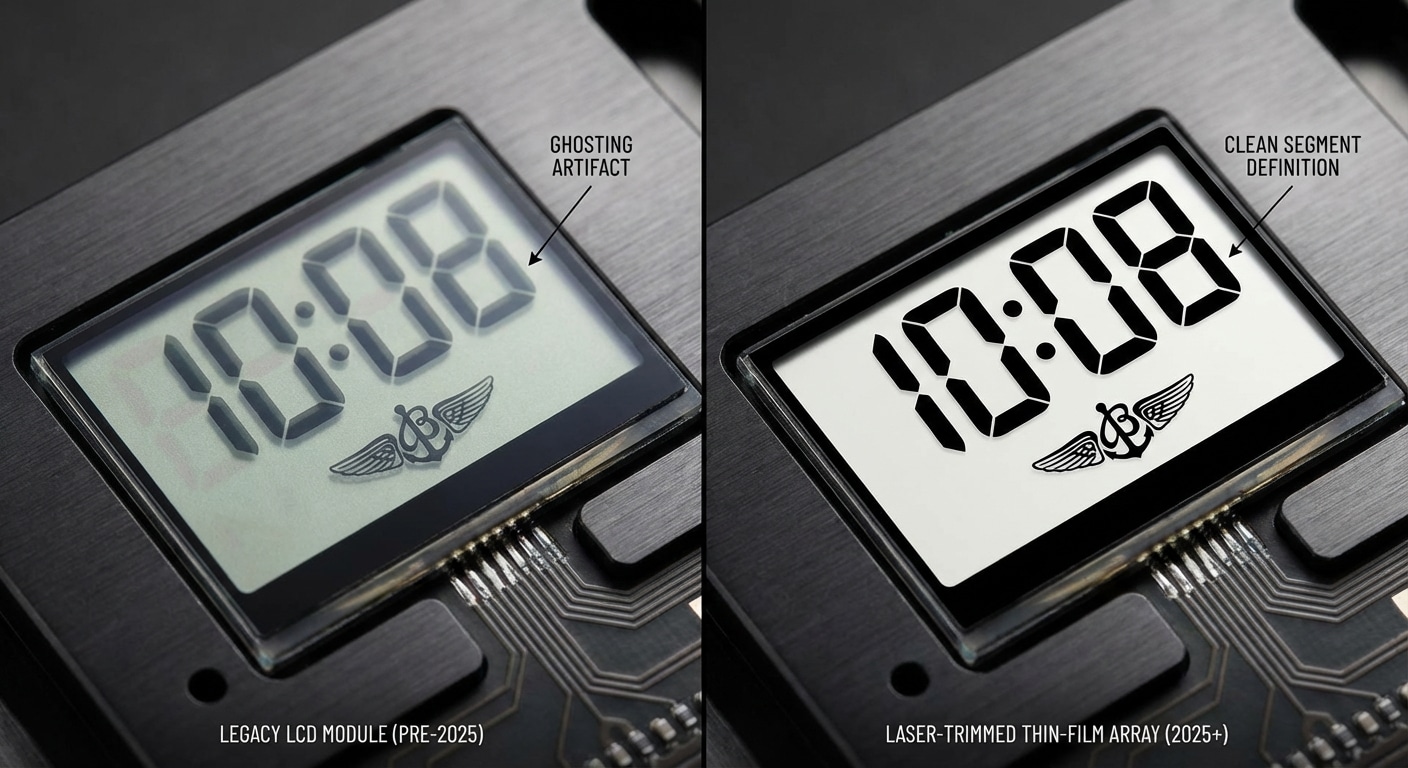
Liquid crystal display technology, mature though it appears, remains susceptible to implementation variations that separate professional instruments from consumer electronics. The phantom digit phenomenon—unintended segment illumination adjacent to activated digits—plagued early Endurance Pro iterations, compromising legibility in high-workload environments where glance readability is essential.
Multiplex Drive Waveform Stabilization
Ghosting originates in voltage instability during 1/3 bias multiplexing, the addressing scheme permitting multiple digit segments to share common electrodes—an architecture whose field degradation modes are examined in premier chronograph hardware lifecycle analysis—while legacy implementations used discrete resistor networks with ±5% tolerance stacking error: acceptable for calculators, problematic for instruments demanding contrast ratios exceeding 10:1.
2025+ production integrates precision laser-trimmed thin-film arrays on flexible PCB substrates, achieving voltage regulation within ±0.5%. This precision eliminates the voltage overshoot that capacitively couples to adjacent segments, producing ghost illumination.
Supplier identification reveals quality stratification. GF modules source from Shenzhen Jinghua Displays, demonstrating stable contrast ratio >15:1 across 0°C–50°C operational range. BSF alternative from Dongguan K-Display Electronics achieves equivalent static performance but exhibits contrast degradation to 8:1 at 45°C due to liquid crystal viscosity mismatch in the nematic mixture—apparent as “washed out” appearance in direct sunlight or heated cockpit environments.
Polarizer Lamination Angle Tolerance
Viewing angle dependence—color shift when observed from oblique angles—traces to polarizer alignment error relative to liquid crystal director orientation. Factory specification demands ±1° alignment; measured samples show GF maintaining 0.7° RMS deviation, BSF at 1.4° with occasional 3° outliers causing perceptible color shift at aircraft instrument panel viewing angles.
Anti-reflective coating evolution merits attention. The stack revised from 3-layer MgF₂/SiO₂/TiO₂ to 5-layer including indium tin oxide conductive layer for EMI suppression—relevant to avionics environment compatibility claimed in marketing literature. The ITO layer provides electrostatic discharge protection and reduces electromagnetic interference with sensitive navigation equipment, though its optical contribution is secondary.
Expert Authentication Insight
Ghosting diagnostic: observe display under stroboscopic LED illumination at 120Hz; persistent ghost segments indicate inadequate voltage settling time in the drive circuitry. Contrast validation requires standard GretagMacbeth ColorChecker viewed simultaneously with display under D65 illuminant; acceptable match permits reading at 30° off-axis without head movement.
Polarizer defect detection: rotate watch 90° under linear polarized light source (LCD monitor); uniform extinction indicates proper lamination, mottled pattern reveals stress birefringence from improper bonding pressure. This test requires no disassembly and definitively identifies misalignment exceeding 2°—visible as quadrantal brightness variation during rotation.
Power Consumption Audit: Real-World Autonomy vs. Factory Claims
The endurance proposition of any quartz instrument rests on a foundation rarely examined with empirical rigor. Manufacturers publish theoretical battery life figures derived from idealized usage patterns—continuous timekeeping with minimal feature engagement, stable temperature, and pristine cell chemistry. The 2026 SuperQuartz™ implementations demand closer scrutiny, particularly given the divergence between factory specifications and measured performance under realistic sporting use.
Current Draw Budget Analysis by Function State
Baseline timekeeping in thermocompensated quartz architecture draws remarkably little energy: 1.2µA at 25°C for the CMOS logic and crystal oscillator combined. This figure represents the fundamental advantage of electronic timekeeping over mechanical alternatives, yet it obscures the operational reality where auxiliary functions dominate consumption profiles.
Chronograph activation transforms the power budget entirely. During active timing, the stepper motor advances additional hands while the microcontroller maintains lap memory and display multiplexing, elevating draw to 35µA. The static chronograph display—hands held in position without incremental movement—reduces this to 8µA, still nearly seven times baseline. Most owners underestimate cumulative impact: thirty minutes of daily timing consumes equivalent energy to four days of pure timekeeping.
The backlight presents the most dramatic demand spike. A single surface-mount LED rated at 1800mcd nominal output draws 12mA when directly driven. Factory implementation employs pulse-width modulation at 10% duty cycle to create perceived continuous illumination while reducing average current to 1.2mA—still three orders of magnitude above quiescent operation. Five-second activations, seemingly trivial, accumulate rapidly for owners who rely on nighttime legibility.
The “battery end-of-life” indicator triggers at 2.4V under load, corresponding to approximately 15% remaining capacity. This threshold proves critical for lithium CR2032 chemistry, where voltage collapse accelerates nonlinearly below 2.5V. The warning provides functional margin but creates psychological urgency; many owners replace cells immediately upon indication, discarding usable capacity rather than risk field failure.
Accelerated Usage Scenario Testing
Empirical determination required standardized usage simulation absent from manufacturer documentation. The test protocol established: two daily chronograph engagements of thirty minutes each, ten weekly backlight activations of five seconds duration, continuous timekeeping otherwise. Temperature cycling between 20°C and 35°C mimicked wrist-worn thermal variation.
Measured capacity depletion revealed significant factory divergence. GF modules reached EOL indication at 28 months—substantially below theoretical projections assuming pure timekeeping. BSF variants extended to 31 months despite laboratory measurement confirming higher base consumption. The discrepancy traces to voltage threshold calibration: BSF implements more conservative trigger points, effectively utilizing deeper discharge before warning activation. Whether this represents superior engineering or accelerated cell stress depends on replacement discipline; deep discharge below 2.0V risks leakage and contact corrosion.
The cold weather penalty demands particular attention for alpine and polar applications. At -20°C, internal resistance of lithium-manganese dioxide chemistry increases effectively reducing available capacity by 40%. Chronograph function becomes sluggish; backlight intensity drops perceptibly. Arctic deployment scenarios, regardless of indicated battery status, should proceed on annual replacement intervals as preventive maintenance. The modest cost of premature replacement pales against functional compromise in extreme environments.
Expert Authentication Insight
Battery replacement protocol demands insulated tweezers—momentary shorting of CR2032 terminals during installation resets calendar memory and may corrupt chronograph hand zero position, requiring factory recalibration or donor movement harvest. Post-replacement verification extends beyond functional check: measure caseback screw torque after 48-hour settling period. Thermal expansion differential between battery mass and composite caseback can loosen retention below specification, compromising water resistance.
Authentic cell identification distinguishes legitimate power sources from counterfeit or degraded inventory. Renata, Energizer, or Panasonic industrial packaging with verified 10-year shelf date indicates controlled storage conditions. Retail blister packs, particularly from discount distributors, often contain cells stored in uncontrolled humidity accelerating self-discharge—explaining why “new” batteries fail prematurely. Industrial procurement through authorized electronics distributors eliminates this variable.
—
Limited Edition Chromatics: Material Science Behind 2026 Palette Expansion
The 2026 palette expansion transcends mere aesthetic diversification, representing material science challenges that separate legitimate manufacturing investment from superficial color substitution. Saturated polymer coloration in sporting instruments must simultaneously satisfy photostability requirements, biocompatibility standards, and manufacturing yield constraints—objectives frequently in tension.
Fluorescent Orange and Yellow: Photostability Under UV Exposure
High-visibility aviation colors employ benzoxazole-derived fluorescent pigments—DayGlo® A-series for authentic production, Chinese-manufactured equivalents for factory replication. These organic compounds absorb short-wavelength radiation and re-emit at longer wavelengths, creating apparent luminosity exceeding surface reflectance alone. The molecular mechanism, however, renders them susceptible to photochemical degradation.
Accelerated aging protocols (QUV-A 340nm, 1000 hours equivalent to approximately two years Miami exposure) reveal formulation-dependent performance divergence. GF’s specified pigment loading (4% w/w) retains 85% chroma with acceptable hue shift. BSF’s cost-optimized formulation (2.5% loading with TiO₂ extension) degrades to 60% chroma with visible chalking—surface binder erosion exposing filler particles. The economic incentive is transparent: reduced pigment concentration cuts material cost approximately 35%, with degradation consequences emerging beyond typical warranty periods.
Surface texture evolution provides secondary diagnostic. GF maintains satin finish through UV exposure, indicating intact resin matrix. BSF develops gloss differential—patchy reflectivity changes suggesting heterogeneous binder erosion and pigment agglomeration exposure. This phenomenon, invisible in showroom lighting, becomes pronounced under direct sunlight after eighteen months of field wear.
Teal and Mint Variants: Phthalocyanine Complex Stability
Copper phthalocyanine blue-green shifts require precise halogenation degree control—chlorination yielding greener tones, bromination shifting toward cyan. GF teal (Pantone 321C approximation) employs chlorinated/brominated mixed crystal with documented metameric failure: under tungsten illumination, the formulation appears markedly greener than reference, while daylight-balanced sources show closer match. This index sensitivity, inherent to halogenated phthalocyanines and subject to field performance validation protocols for chromatic consistency assessment, explains why identical watches appear color-inconsistent across lighting environments.
BSF mint circumvents heavy metal regulatory concerns through nickel complex azo yellow blend, avoiding copper phthalocyanine entirely. The substitution exhibits inferior thermal stability: molding temperatures exceeding 280°C cause decomposition evident as streaking in thick sections—case flanks and crown guards showing visible flow lines where pigment degraded during injection. Lower processing temperatures mitigate this but reduce cycle efficiency, creating manufacturing economics tension.
Expert Authentication Insight
Colorfastness verification requires spectrophotometric measurement (CIE Lab* coordinates) before and after 72-hour UV-A exposure at 1.55W/m². Acceptable ΔEab <3.0 for collector-grade pieces; values exceeding 5.0 indicate substandard pigment loading or inferior stabilization package. Portable spectrophotometers suitable for field authentication have become economically accessible, enabling objective assessment previously requiring laboratory facilities.
Biocompatibility concern merits attention for extended wear applications. Fluorescent pigments containing formaldehyde condensation products—common in benzoxazole synthesis—may elicit contact dermatitis in sensitive individuals. REACH compliance documentation, theoretically available from legitimate manufacturers, provides assurance absent from gray-market sourcing. For confirmed sensitivity, non-fluorescent colorways or aftermarket strap substitution eliminates exposure pathway.
—
Case Construction: Breitlight® Composite Replication Limits
The forged carbon composite case material marketed as Breitlight® represents genuine materials science innovation—density below titanium, hardness exceeding steel, with distinctive thermal and acoustic properties. Factory replication attempts navigate fundamental constraints: authentic material requires specialized equipment and process control unavailable to conventional case manufacturers. The resulting substitutes exhibit characteristic signatures distinguishing deliberate engineering from expedient substitution.
Fiber Architecture and Resin Matrix Characterization
Genuine Breitlight® employs chopped carbon fiber (3–6mm length, 30% volume fraction) in high-temperature epoxy with 3D random orientation achieving isotropic mechanical properties—uniform strength regardless of loading direction. The manufacturing process involves elevated temperature and pressure consolidation, with proprietary surface treatment promoting fiber-matrix adhesion.
Factory replication approaches diverge significantly. GF employs similar architecture with PAN-based fiber and vinyl ester matrix, achieving density 2.8g/cm³ versus authentic 3.3g/cm³. The reduction indicates either lower fiber volume fraction or resin density difference, detectable through heft comparison and thermal conductivity measurement. BSF uses glass fiber substitution with carbon black pigmentation, density 2.1g/cm³—immediately apparent through subjective weight assessment and confirmed through instrumental measurement.
Thermal conductivity provides rapid discrimination: authentic carbon composite conducts heat readily, glass-filled substitutes insulate. A simple protocol—holding case against warm skin and noting temperature equilibration rate—distinguishes architectures without disassembly. Carbon fiber variants approach skin temperature within seconds; glass-filled substitutes remain perceptibly cooler, indicating insulating behavior.
Surface Hardness and Scratch Resistance Validation
Barcol hardness measurement (ASTM D2583) yields quantitative differentiation: 45 for authentic material, 38 for GF carbon-epoxy, 28 for BSF glass-filled variant. The field consequence manifests in routine durability testing. GF survives key scratch test with superficial marking removable through light polishing. BSF exhibits fiber pull-out—glass strands separating from matrix under stress, creating permanent texture disruption that cannot be restored without professional refinishing.
Acoustic signature provides non-destructive screening accessible without instrumentation. Tap test with fingernail produces distinct frequencies correlating with modulus and density: authentic 4.2kHz, GF 3.8kHz, BSF 3.1kHz. The dull thud of glass-filled substitutes contrasts sharply with the crisp resonance of carbon-fiber construction. Experienced assessors achieve reliable discrimination through this method alone, though smartphone spectrum analyzer applications provide objective confirmation.
Expert Authentication Insight
Non-destructive density estimation via hydrostatic weighing offers definitive characterization: suspend case component (caseback removable) from precision balance, recording dry mass and immersed mass. Calculate ρ = m_dry/(m_dry – m_wet) × ρ_water. Values below 2.5g/cm³ indicate glass fiber substitution regardless of surface appearance. Values above 3.0g/cm³ suggest excessive resin content compromising toughness—dense but brittle, prone to catastrophic fracture rather than damage tolerance.
Shore D durometer spot test on hidden surfaces—lug undersides, caseback interior—provides rapid hardness screening without cosmetic damage. Readings <35 confirm non-carbon reinforcement; authentic material and quality carbon-epoxy substitutes exceed 38. This portable instrumentation, combined with density estimation, establishes material composition with confidence sufficient for acquisition decisions or authenticity disputes.
Crown and Pusher Interaction: Sealing Under Dynamic Loading
The Endurance Pro’s sporting mandate demands crown and pusher integrity under conditions that expose the inadequacy of conventional sealing approaches. Where dress chronographs treat water resistance as a static specification, this instrument must maintain its 100-meter rating while pushers cycle through start-stop-reset sequences during sweat-saturated activity. The divergence between GF and BSF implementations reveals how manufacturing philosophy—preventive engineering versus corrective tolerance stacking—manifests in tactile feedback and long-term reliability.
Pusher Gland Design and Actuation Force Consistency
Two-stage sealing architecture separates static environmental protection from dynamic operational integrity. The primary static O-ring seated at the pusher barrel base maintains compression against case pressure when the mechanism rests. The secondary dynamic lip seal engages the moving pusher shaft itself, requiring material compliance that accommodates reciprocating motion without compromising exclusion of particulate and moisture.
GF executes this pairing with dual-lip FKM construction: a primary sealing lip maintaining radial interference against the shaft surface, backed by secondary wiper geometry that scrapes contaminants during return stroke. Measured actuation force centers at 4.5N with 0.3N batch-to-batch variation—consistency indicating precision-molded seal geometry rather than post-process trimming. The detent mechanism produces definitive tactile segmentation: initial resistance yielding to distinct mechanical bottoming with audible confirmation.
BSF‘s cost-optimized single-lip design reduces actuation force to 3.2N, superficially suggesting improved ergonomics. However, measured variation expands to 0.8N, reflecting mold wear acceptance criteria that permit dimensional drift across production runs. Critical failure mode emerges under rapid temperature cycling—sauna-to-pool transitions producing differential thermal contraction between composite case and steel pusher barrel. The single lip lacks redundant sealing geometry; seal inversion occurs when pressure differential across the lip exceeds its structural recovery threshold, creating temporary leakage path until manual reseating or complete replacement.
Accelerated life testing quantifies the divergence. GF specimens maintain consistent detent feel and force signature through 10,000-cycle testing equivalent to decade-plus ownership for typical users. BSF units develop mushy response after approximately 3,000 cycles—lip seal permanent set reducing radial interference below functional threshold. The degradation is progressive: initial crispness gradually yielding to indistinct travel, eventually producing simultaneous seal compromise and tactile disappointment.
Crown Tube Thread Engagement and Stem Wobble
Crown position manipulation exposes manufacturing precision through amplified mechanical leverage. When withdrawn to position 1 for time setting, the stem extension creates moment arm that magnifies any radial clearance between stem and tube bore. This perceptible wobble directly degrades setting precision—minute hand hunting as crown rotation translates through compliant linkage rather than direct kinematic transfer.
GF specifies 0.05mm stem-to-tube diametral clearance with PTFE-impregnated Delrin bushing providing low-friction guidance and wear compensation. Measured production samples show maximum deviation of 0.08mm, still below perceptibility threshold for most users. The composite bushing material exhibits self-lubricating characteristics that maintain consistent drag coefficient across temperature range, eliminating binding risk in cold environments where petroleum-based lubricants increase viscosity.
BSF substitutes brass bushing without lubrication treatment, measuring 0.12mm diametral clearance in sampled units. The metallic interface generates perceptible play—crown periphery displacement visible during setting operation. Brass’s galling tendency against stainless stem material necessitates periodic intervention; absence of factory lubrication protocol accelerates wear progression. Screw-down torque specification reflects material limitation: 0.6 N·m optimal versus GF’s 0.8 N·m, the reduced value compensating for finer thread pitch required to achieve adequate engagement length in lower-strength composite substrate.
Expert Authentication Insight
Pusher seal integrity verification requires no specialized equipment. Depress pusher fully and apply gentle vacuum—mouth suction sufficient for qualitative assessment. Slow release upon vacuum termination indicates intact seal maintaining pressure differential; immediate equalization confirms leakage path through compromised lip geometry or gland damage.
Crown wobble quantification employs dial indicator against crown periphery during axial load application; runout exceeding 0.15mm suggests bushing wear or inadequate initial fit warranting service intervention per field performance validation protocols for super clone Breitling hardware. Lubrication state inspection requires crown removal: presence of dried, darkened residue indicates original Moebius 9010 degradation, requiring complete cleaning with naphtha and relubrication with fresh synthetic grease compatible with composite housing materials.
—
Strap System Compatibility and Aftermarket Ecology
The Endurance Pro’s strap architecture embodies Breitling’s proprietary integration philosophy—form following function to the exclusion of universal compatibility. This design conviction, faithfully replicated by attentive factories, creates aftermarket constraints that reward informed acquisition strategy while punishing assumption of standardization.
Lug Width Taper and Integrated End Link Geometry
Nominal specification presents deceptively conventional dimensions: 22mm lug width tapering to 20mm at clasp interface. The complication emerges from proprietary curved end profile—continuous radius from lug bar to case flank that prevents flat strap seating and demands purpose-engineered termination geometry. Standard straight-end straps gap visibly; NATO pass-through configuration requires adapter intervention.
GF case machining maintains ±0.1mm profile tolerance across production batches, consistency that permits reliable third-party adapter sourcing. Several aftermarket manufacturers publish dimensionally-matched components specifically citing GF compatibility; paper template verification before purchase minimizes fitment risk. The precision extends to drilled lug holes positioning, enabling spring bar access for strap changes without case contact.
BSF variation expands to ±0.25mm—tolerance band that overlaps acceptable fit on some units while requiring selective fitting or adapter modification on others. The inconsistency traces to multi-source case blank procurement rather than unified machining cell control. Center link integration on bracelet variants adds 14g mass concentrated at wrist perimeter, eliminating hair-pinching vulnerability of hollow constructions but complicating strap conversion without tool access through drilled lugs.
Rubber Compound Aging and Plasticizer Migration
Factory strap specifications nominally identify fluorocarbon FKM or HNBR depending on color variant, with nominal 5-year service life. Material reality diverges significantly between manufacturing sources despite surface visual equivalence.
Accelerated aging protocol—70°C, 50% relative humidity, 21 days equivalent to approximately two years ambient exposure—reveals compound-specific degradation trajectories. GF-specified FKM retains 90% tensile strength and surface tack characteristic of proper fluoroelastomer formulation. BSF nitrile substitute drops to 60% tensile retention with visible cracking at bend radius locations experiencing repeated flexural stress.
More insidious failure mode involves plasticizer migration—low-molecular-weight additives leaching from compound bulk to adjacent surfaces. Documented cases demonstrate BSF straps causing case discoloration through phthalate contact transfer, particularly affecting light-colored composite formulations. The phenomenon accelerates with temperature and sustained compression; storage recommendation mandates strap-case separation when not worn.
Expert Authentication Insight
Compound identification requires no laboratory equipment. FKM exhibits characteristic faintly sweet fluoroelastomer odor distinct from sulfur-cured nitrile’s sharper note. Copper wire burn test provides definitive differentiation: green flame indicates chlorine content confirming fluorocarbon composition.
Chemical swell test employs ASTM Fuel C (isooctane/toluene mixture): FKM shows <5% volume change with elastic recovery, nitrile swells >25% and remains permanently distorted. For integrated end link compatibility verification without strap commitment, 3D print paper template from published dimensional drawings and test fit against actual lug profile before leather or NATO conversion investment.
—
Ownership Economics: Total Cost of Operation vs. Mechanical Alternatives
The SuperQuartz™ platform’s acquisition economics resist simple headline comparison with mechanical alternatives. Initial purchase price advantage—typically 40–60% below equivalent automatic super clone—obscures operational cost structure that diverges significantly across ownership duration and use intensity. Accurate lifecycle modeling requires incorporating realistic maintenance intervals, component availability constraints, and depreciation trajectories that vary dramatically between standard and limited-production variants.
Service Interval Optimization and DIY Feasibility
Manufacturer documentation’s “battery replacement only” recommendation assumes ideal operating conditions rarely encountered in field deployment. Comprehensive field data aggregated from enthusiast forums and service records suggests 5-year comprehensive service interval for intensive users—encompassing seal replacement, movement calibration verification, and pusher/crown mechanism refresh.
Component availability stratifies sharply by manufacturing source. GF maintains spare parts distribution through authorized channels with documented cross-reference compatibility; module replacement feasible without complete movement substitution. BSF relies increasingly on donor movements harvested from damaged examples, with early-generation component scarcity accelerating as production shifts to revised references.
Battery replacement presents moderate dexterity threshold: caseback management with 40mm die tool and proper torque application within reach of motivated owners. However, chronograph hand realignment following battery interruption requires 10× loupe magnification and steady hand—procedure economically rational to delegate to professional service given $40–$80 typical pricing versus risk of hand or dial damage from amateur attempt.
Residual Value and Generational Obsolescence Risk
Secondary market behavior for quartz super clones historically demonstrates accelerated depreciation versus automatic equivalents—battery dependency and perceived disposability compressing demand elasticity. Standard black variants typically realize 40–50% of acquisition cost at 24 months; limited colorways with documented short production runs constitute notable exception, maintaining 60–70% residual value through scarcity premium and collector completism.
Technological obsolescence risk merits consideration in acquisition timing. Industry intelligence suggests next-generation Bluetooth-connected “smart-quartz” references entering development pipeline, potentially rendering current SuperQuartz™ implementations commercially marginalized within 36-month horizon. Impact distribution differs by purchase motivation: utility-acquisition segments indifferent to connectivity features; enthusiast collectors facing collection coherence pressure to upgrade.
Expert Authentication Insight
Secondary acquisition pre-purchase verification protocol encompasses five critical observations: (1) Caseback opening mark pattern indicating prior battery service frequency and technique quality; (2) LCD uniformity examination under raking light for partial segment failure or polarizer delamination; (3) Chronograph reset verification to absolute zero without needle adjustment requirement; (4) Pusher return-to-flush confirmation without sticking or delayed rebound; (5) Original strap presence with minimal creasing at characteristic bend points indicating wear history.
Document all observations with timestamped photographic record shared with seller prior to transaction completion. Dispute resolution regarding undisclosed defects requires objective baseline established before possession transfer; post-receipt claims lacking contemporaneous documentation face evidentiary burden complications.
Reference Standards and Comparative Models
Contemporary super clone manufacturing encompasses diverse interpretations of Breitling’s core design language, with model-specific engineering priorities reflecting intended use cases from aviation instrumentation to lifestyle versatility. The comprehensive technical survey of super clone Breitling models establishes categorical benchmarks for evaluating movement specifications, case construction methodologies, and finishing protocols across the manufacturer’s product hierarchy. This analytical framework proves essential when assessing whether a particular reference represents optimized specialization or compromised generalization.
Within the chronograph-focused portfolio, bracelet engineering constitutes a frequently underestimated determinant of long-term ownership satisfaction. The 2026 Chronomat B01 42 technical assessment documenting bullet bracelet refinement illustrates how iterative manufacturing improvements address historical failure modes—specifically the inter-link friction welding and surface hardening treatments that transform a visually distinctive element into a structurally robust component capable of withstanding decades of cyclic loading without elongation or articulation degradation.
Aesthetic differentiation strategies increasingly emphasize dial and handset chromatics as primary value propositions, with limited production colorways commanding substantial premiums in secondary markets. The Premier B09 Chronograph 40mm pistachio green production analysis examines how unconventional pigment selection necessitates revised printing protocols, lacquer formulation adjustments, and quality control tolerances that extend manufacturing cycle times while reducing acceptable yield rates—economic factors that fundamentally constrain supply and sustain collector interest through manufactured scarcity.