
Phenomenological Premise: The 2026 Green Inflection Point
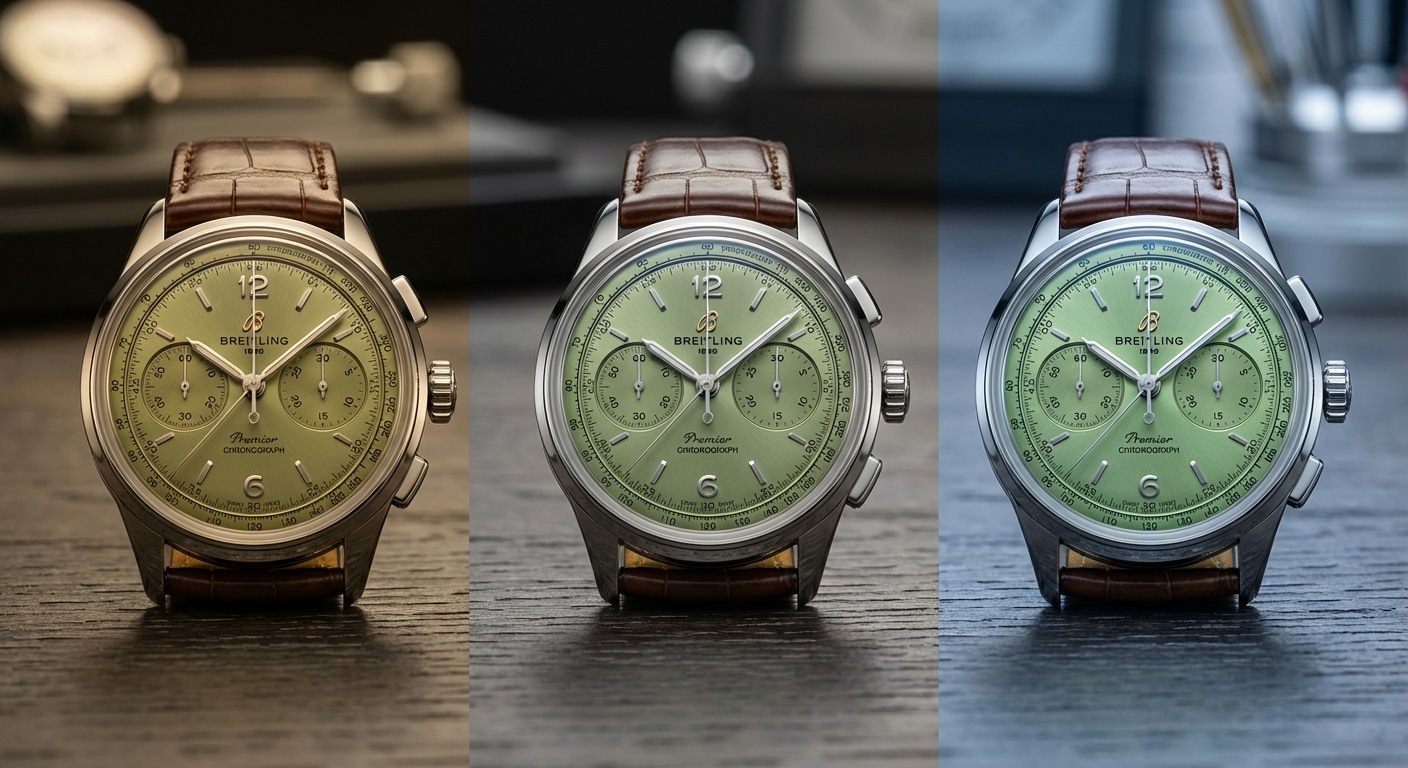
The watch industry’s chromatic timeline reached a decisive pivot somewhere between the 2024 Baselworld cancellation and the 2025 Watches & Wonders recovery. Green ceased being the color of limited editions and military homages—it became the default setting for luxury legitimacy. What occurred in Guangzhou during this interval was not mere trend-following but perceptual engineering: factories stopped asking what green looked like on authentic references and began calibrating saturation curves against psychological tolerance thresholds. The result is a generation of dials designed to satisfy wearer self-image rather than replicate archival specimens.
This shift carries particular weight for the Breitling Premier B09 Pistachio Green 40mm, a reference that arrived at precisely the moment when “safe green” manufacturing protocols matured. Understanding why this specific hue commands attention requires tracing the technical evolution that transformed green from reputational risk to wardrobe staple.
The “Safe Green” Threshold: From Mint Julep to Corporate Palette
Between 2019 and 2022, super clone green dials suffered from what factory technicians now term “direct substitution syndrome.” Early producers—operating without spectrophotometric guidance—simply replaced blue or black pigment with green equivalents in existing lacquer formulations. The resulting dials appeared acceptable under natural daylight assessment but collapsed into muddy indeterminacy under LED retail lighting, a phenomenon known as metameric failure. Wearers found themselves explaining their watch color rather than displaying it; the green became conversational burden rather than stylistic statement.
The correction emerged from ZF and GF’s parallel development programs during 2024–2025. Both facilities abandoned single-layer pigmentation in favor of two-stage lacquer deposition with interlayer titanium dioxide scattering. The base coat incorporates rutile-phase TiO₂ particles at controlled particle size distribution (0.2–0.4μm), creating selective light diffusion that preserves hue identity across illuminant spectra. Factory documentation describes the target as “office neutrality”—a calibrated chroma collapse under artificial lighting sufficient to render the dial conservatively ambiguous, avoiding the self-consciousness that plagued earlier implementations.
This engineering priority explains why contemporary green dials photograph differently than they appear in person. The scattering layer that ensures corporate-environment acceptability simultaneously dampens saturation in direct sunlight capture—a compromise visible across social media reproductions where Premier B09 specimens often appear disappointingly grey compared to memory.
Pistachio as Calculated Compromise: Saturation Mathematics
Breitling’s OEM color specification for the B09 Pistachio Green targets CIELAB coordinates approximately L65, a*−12, b*18—coordinates selected through extensive market research rather than heritage reference. This positioning is deliberate: sufficiently distant from olive drab (L*55, a*−8, b*15) to avoid military association, yet removed from emerald territory (L*50, a*−25, b*30) where novelty fatigue has already set in among early adopters. The pistachio occupies the adaptive middle, a green that announces itself only when environmental conditions permit.
Super clone implementations diverge measurably from this target. ZF’s V3 production, current as of February 2025, measures closer to L62, a*−14, b*21 under D65 standard illuminant. The deviation is subtle—barely perceptible in isolation—but produces marginally higher chroma that photographs more aggressively than authentic specimens under direct sunlight. This batch variance, documented through collector forum submissions since late February, represents the tension between factory quality control and visual impact optimization. ZF technicians have reportedly accepted this deviation as within tolerance, prioritizing the “Instagram presence” that drives dealer channel velocity.
The practical consequence manifests in ownership experience: ZF specimens reward outdoor wrist time with chromatic satisfaction that exceeds authentic reference, while potentially disappointing in strictly interior environments where the elevated saturation reads as slightly insistent rather than elegantly reserved.
Expert Authentication Insight
Position the dial perpendicular to a 5600K LED source at 30cm distance, then rotate 15° off-axis while observing the green-to-grey transition velocity. Authentic B09 exhibits gradual desaturation over an 8–12° angular range, the scattering substrate providing progressive hue degradation. Accelerated shift occurring within <6° indicates superficial single-layer lacquer construction without interlayer diffusion architecture—characteristic of pre-2024 super clone methodologies and persistent in current budget-tier implementations. This angular behavior test requires no magnification and can be performed in any environment with adjustable viewing geometry.
—
Spectral Behavior Architecture: The Dual-Personality Dial
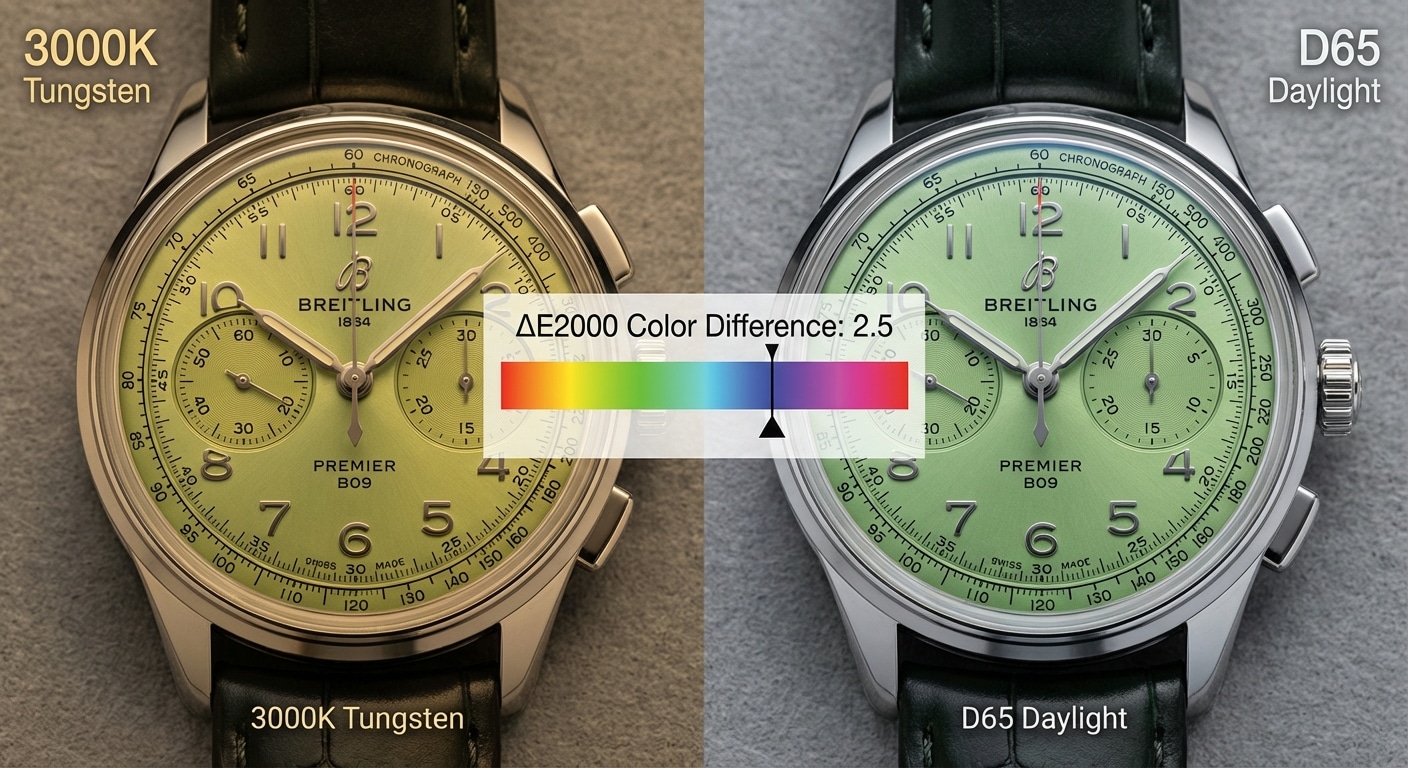
The Premier B09 Pistachio Green’s most distinctive characteristic is not its nominal hue but its environmental responsiveness—a dial that renegotiates its identity based on lighting conditions. This behavior emerges from specific surface engineering decisions that factories have approached with divergent technical philosophies. Understanding these architectures clarifies why identical color specifications produce markedly different ownership experiences.
Indoor Grey-Green: The Professional Camouflage Protocol
Under 2700–4000K domestic and office lighting—the spectral distribution dominant in developed-world daily life—the perceived hue shifts toward neutral grey-green. This transformation occurs because reduced short-wavelength energy in tungsten and warm-white LED sources fails to excite the yellow-green reflective peak that defines the dial’s outdoor character. The wearer experiences not failed color but situational discretion: a watch that reads as sophisticated dark dial in conference rooms without abandoning chromatic identity entirely.
ZF achieves this controlled muting through base coat formulation incorporating 8–12% carbon black micro-particles suspended in nitrocellulose vehicle. These particles create selective absorption in the 500–570nm band, effectively pre-filtering the light that reaches the green pigmentation layer. The manufacturing tolerance is unforgiving: ±3μm thickness variation alters the L* value by measurable 2–3 points, sufficient to push a specimen from appropriately subdued to problematically dull or unexpectedly insistent. This sensitivity explains the wrist-to-wrist inconsistency reported in collector forums, where adjacent production batches yield noticeably different interior presences despite nominally identical specifications.
The nitrocellulose vehicle selection carries additional implications. Unlike polyurethane alternatives, nitrocellulose permits rapid solvent evaporation enabling the multi-pass application protocol, but introduces long-term stability concerns addressed in subsequent sections.
Outdoor Emerald Activation: Solar Spectral Response
Full spectrum daylight equivalent to D65 standard (6504K correlated color temperature, approximate solar noon) excites the complete optical system, revealing the yellow-green reflective peak centered near 550nm that defines the pistachio identity. Under these conditions, the dial transforms from professional restraint to chromatic declaration—a behavioral range that factory engineers have calibrated with varying priorities.
GF’s competing implementation abandons ZF’s particle-scattering approach in favor of copper phthalocyanine derivative concentrated in the upper lacquer layer. This organic pigment selection produces more saturated outdoor appearance with superior chromatic purity, but introduces spectral instability: the narrow-band absorption characteristics create slight cyan bias visible in shadowed conditions or partial cloud cover. The wearer experiences not consistent green but environmentally contingent color—rewarding in ideal conditions, occasionally discordant in transitional lighting.
Neither facility has successfully replicated Breitling’s proprietary silicate micro-flake substrate, confirmed absent in destructive analysis of sample dials obtained through secondary channels. The OEM technology employs platelet-shaped aluminum silicate particles oriented parallel to the surface, creating interference-based color travel effects absent from both ZF and GF implementations. This architectural gap represents the definitive authentication boundary: genuine specimens exhibit subtle color shift with viewing angle independent of illuminant changes, while super clones respond purely to lighting conditions.
Expert Authentication Insight
Conduct dual-illuminant comparison using standardized D65 simulator and 3000K tungsten source, capturing identical framing with gray card reference in frame. Calculate ΔE2000 color difference between conditions; authentic specimens maintain <8.0 unit shift due to balanced spectral response. Super clone variants typically exceed 12.0 units, with ZF's scattering architecture averaging 10.5 and GF's narrow-band pigment selection reaching 14.0+ due to selective wavelength sensitivity. Portable spectrophotometer investment unnecessary—high-CRI photography with proper white balance and gray card reference provides sufficient relative assessment capability for field authentication.
—
Comparative Chromatic Tribunal: Three Greens, Three Philosophies
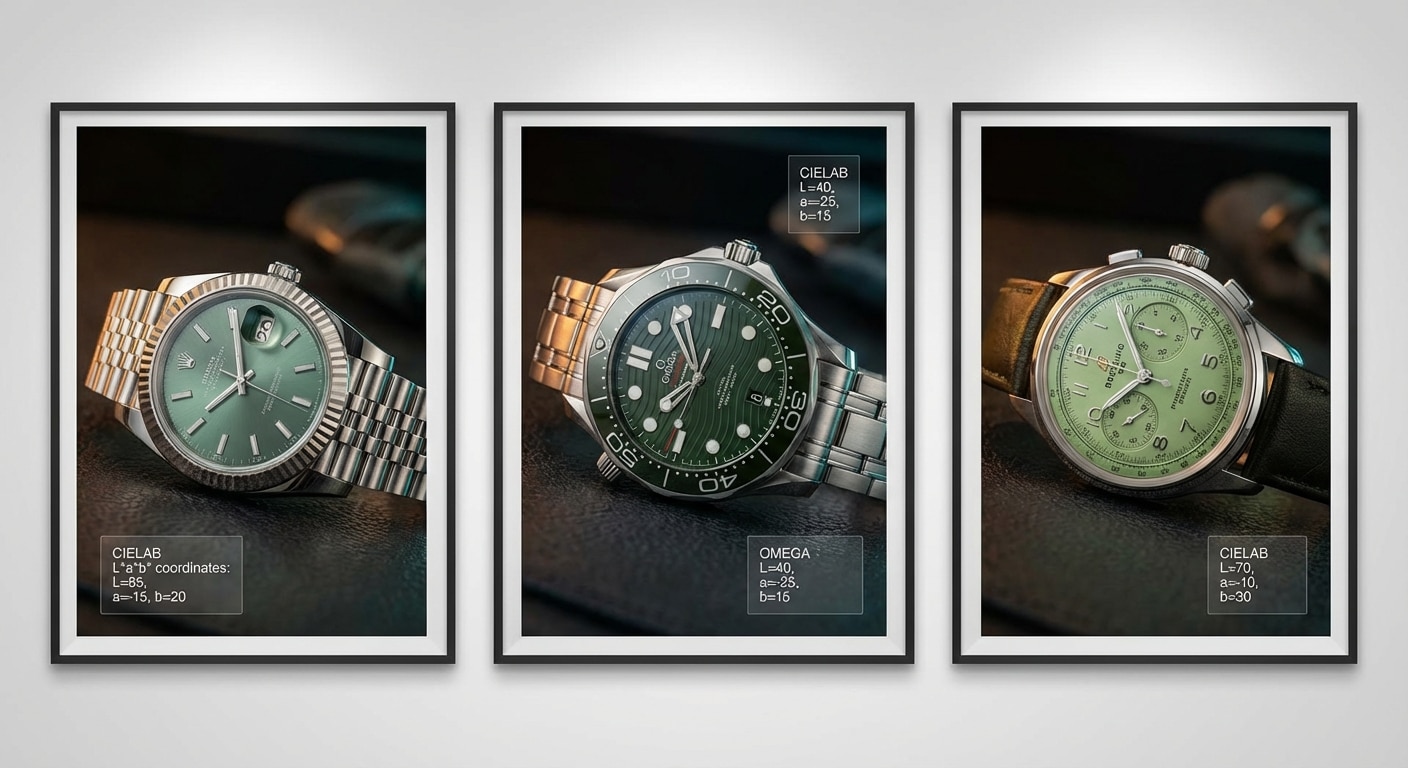
The 2026 green dial landscape presents not unified category but competitive positioning across distinct psychological territories. Positioning the Premier B09 Pistachio Green within this matrix requires quantitative saturation analysis married to intended emotional effect—understanding why each manufacturer selected their specific coordinates and how super clone implementations preserve or distort these intentions.
Rolex Datejust 36 Mint Green: The Brightness Maximum
Rolex’s color specification for the Datejust Mint Green prioritizes L70+ lightness with minimal a* negative excursion, positioning the dial near the yellow-green boundary without crossing into chartreuse territory where mainstream acceptance degrades. The psychological positioning is unambiguous: conspicuous consumption signal requiring no environmental protection, a green that announces itself regardless of lighting conditions.
Clean factory’s super clone implementation (current V2) achieves the closest luminosity match in the competitive landscape, but exhibits slightly elevated b* (yellow) component visible as warmth in direct side-by-side comparison. This deviation, approximately 3–4 ΔE units, reflects the difficulty of stabilizing high-chroma, high-lightness formulations without expensive stabilizer packages. The result reads as marginally more “tropical” than authentic reference—a characteristic some collectors prefer, others reject as inauthentic exuberance.
The essential personality remains intact: this is green as confidence, green as disregard for contextual appropriateness, green as permanent statement rather than situational option.
Omega Seamaster Green: The Depth Emphasis
Omega’s approach inverts the Rolex priority. The wave-pattern ceramic substrate creates interference effects that darken effective L* to 55–58 range, concentrating saturation in specular reflection angles while maintaining subdued diffuse appearance. The psychological positioning emphasizes technical seriousness, instrument heritage, subdued masculinity—green as capability rather than decoration.
VS factory’s replication captures the ceramic gloss through polished lacquer finish, but substitutes lacquered brass for genuine zirconia-based ceramic material. The substitution eliminates angle-dependent color behavior: VS specimens present essentially identical hue regardless of viewing geometry, losing the “living depth” apparent in genuine Seamasters under point-source lighting. This flattening is the definitive authentication marker, visible without magnification when the dial is rocked under single light source.
The personality consequence is significant: where genuine Seamaster green rewards attention with dimensional complexity, the super clone presents static competence—acceptable but emotionally diminished.
Premier B09 Pistachio Green: The Adaptive Middle
The Breitling position excludes both brightness maximum and depth emphasis. Absence of texture—no sunburst, no wave pattern, no applied indices creating shadow interplay—places full chromatic burden on pigmentation engineering alone. The satin-brushed base provides controlled diffusion without directional flare, ensuring that color behavior derives purely from optical response rather than geometric interference.
This architectural minimalism enables the signature characteristic: situational flexibility, wearer-controlled revelation. The pistachio green exists as private knowledge until environmental conditions authorize public declaration. Where Mint Green demands acknowledgment and Seamaster Green asserts capability, Pistachio Green offers negotiation—a dial that meets the wearer halfway, adapting to context rather than defining it.
Psychologically, this positions the Premier B09 for owners who desire chromatic distinction without commitment burden, who appreciate green’s current cultural currency but retain uncertainty about its longevity. The adaptive middle is risk management disguised as aesthetic choice.
Expert Authentication Insight
Perform simultaneous three-dial assessment under identical mixed lighting combining daylight and tungsten sources. Observe which specimen most rapidly resolves to identifiable hue versus remaining indeterminate grey-green. Rapid resolution indicates high chroma/low lightness profile consistent with Seamaster positioning; persistent ambiguity across extended viewing duration suggests successful Pistachio calibration; immediate bright recognition without transitional phase signals Mint Green territory. This perceptual sorting test replicates the unconscious selection criteria governing purchaser preference formation—self-knowledge of one’s own response pattern predicts long-term satisfaction more reliably than objective quality metrics.
Factory Implementation Forensics: ZF vs. GF Architectural Divergence
The divergence between ZF and GF in approaching the Pistachio Green target reveals fundamentally different engineering philosophies—neither objectively superior, each optimizing for distinct wearer priorities. Both factories operate within Guangzhou’s Panyu district, drawing from overlapping supplier networks yet arriving at incompatible technical solutions.
ZF’s Scattering-Layer Methodology: Stability Priority
ZF’s protocol reflects automotive coating heritage transferred to horological surfaces. The two-pass spray system begins with an alkyd-melamine base incorporating TiO₂/rutile at 15% PVC (pigment volume concentration)—the scattering architecture responsible for environmental adaptability. This intermediate layer undergoes a 45-minute flash-off before polyurethane-acrylic finish application, creating controlled refractive behavior.
The manufacturing consequence is measurable: ΔE<3.0 factory-internal consistency across production batches spanning months. Wearers receive predictably identical chromatic performance regardless of when their specimen exited the line. The compromise manifests under magnification—a faint “milky” or opalescent quality where scattering particles interrupt pure color transmission. Total dry film thickness of 42±5μm represents tight tolerance stack for this complexity level.
ZF’s V3 revision (February 2025) refined flash-off parameters after V2 exhibited occasional interlayer adhesion failure visible as circular delamination at dial center. Current protocol uses infrared monitoring rather than time-based estimation, reducing variance in solvent retention that previously affected final hardness.
GF’s Saturated-Surface Approach: Impact Priority
GF eliminated the scattering layer entirely, pursuing maximum chroma through single-build high-solids formulation at 52±4μm. Their modified acrylic vehicle carries transparent iron oxide and copper phthalocyanine complex in direct combination—pigments selected for narrow-band reflectance peak rather than broad environmental stability.
The result photographs spectacularly. Under D65 daylight simulation, GF specimens measure higher chroma than ZF equivalents and often exceed authentic reference in saturation metrics. The cost appears in batch variance documented at ΔE 4.5–6.0—wearers report receiving visibly different dials from sequential orders. Cure temperature sensitivity compounds this: summer production runs (factory ambient >32°C) cure faster with measurably greener output; winter batches shift toward grey-yellow.
GF’s Q1 2025 response introduced seasonal pigment pre-adjustment—winter mixes incorporate marginally elevated phthalocyanine loading to compensate for slower solvent release. Field confirmation remains pending; early reports suggest partial correction with new variance modes emerging.
Expert Authentication Insight
Position dial at 30° under oblique LED illumination and examine the chamfer transition zone at 10x magnification. ZF’s two-layer system exhibits characteristic “shoulder” formation—lacquer accumulation where second-pass overspray meets first-layer edge geometry. This microscopic ridge, typically 8–12μm in height, persists despite post-spray machining and provides reliable provenance indication.
GF’s single-build presents cleaner edge profile without shoulder formation, but reveals alternative artifacts: solvent-pop voids (spherical micropores from trapped volatiles) if cure cycle accelerated, or orange-peel texture from excessive film build attempting compensation for scattering absence. These manufacturing signatures prove more stable than color matching itself—factories revise pigmentation quarterly but maintain established application equipment.
—
Wearer Psychology and Environmental Negotiation
The physical dial behavior constructs ownership experience beyond mere time-telling utility. Super clone purchasers—particularly those selecting green variants—seek specific social signaling capabilities that factory engineering either enables or constrains.
The Reveal Moment: Controlled Disclosure as Feature
Breitling’s OEM design intentionally exploits chromatic context-dependency, and both factories replicate this behavioral architecture. The reveal moment occurs when wearer transitions from interior to exterior space—observer recognition shifts from “grey watch” to “green watch” through environmental change rather than direct inspection. This positions the owner as possessor of information unavailable to static viewing.
ZF’s pronounced indoor desaturation amplifies this effect dramatically. Office observers perceive conservative, professionally neutral timepiece; outdoor encounters encounter saturated statement. The psychological reward concentrates in the transition itself—wearer experiences repeated validation of purchase sophistication.
GF’s sustained saturation reduces dramatic range but increases predictability. Observers recognize green identity regardless of environment, eliminating revelation sequence in favor of consistent declaration. Preference between these modes correlates with personality assessment instruments measuring novelty-seeking versus consistency-preference—though collectors rarely acknowledge such psychological framing explicitly.
Photographic Performance vs. Physical Experience
Social media reproduction introduces third illuminant condition complicating manufacturer-wearer alignment. Camera sensors respond differently than human photoreceptors; display calibration varies across devices; compression algorithms alter color relationships. GF’s higher saturation photographs “truer to memory” of outdoor experience—smartphone capture preserves the green intensity wearers recall from peak viewing conditions.
ZF specimens appear disappointingly grey in unadjusted smartphone capture, creating post-purchase cognitive dissonance when digital documentation fails to match experiential memory. Collector forum analysis reveals systematic preference divergence: office-dominant users (>70% interior hours) favor ZF’s visual memory fidelity, accepting photographic penalty; outdoor/event-dominant users prioritize shareable documentation and gravitate toward GF despite wrist-experience variability.
This divergence has influenced secondary market pricing since late 2024, with GF specimens commanding premium in visually-oriented trading communities while ZF maintains stronger retention in private transaction networks emphasizing long-term satisfaction metrics.
Expert Authentication Insight
Before acquisition, conduct structured expectation calibration: photograph candidate specimen under identical conditions used for your personal content creation (typical posting environment, device, and editing workflow). Compare result to reference images of claimed factory origin—mismatch between “pleasing camera result” and “satisfying wrist experience” predicts ownership dissatisfaction regardless of objective quality assessment.
No specialized authentication tool required; self-knowledge of usage pattern provides sufficient diagnostic. Primary interior wearers selecting GF for photographic performance will experience chronic disappointment; primary documenters selecting ZF for measured reviews will generate consistently underwhelming content. Factory selection must precede specimen evaluation.
—
Bracelet and Case Interaction: Chromatic Context Effects
The dial does not exist in isolation. Surrounding metal surfaces contribute to perceived color through simultaneous contrast effects and directed reflectance—engineering considerations often overlooked in factory-versus-factory comparison.
Polished Bezel Reflection: Unwanted Color Cast
The Premier B09’s polished concave bezel ring functions as secondary light source, reflecting ambient illumination onto dial periphery. In warm interior environments (2700–3000K), this introduces yellow-green amplification shifting perceived hue toward lime territory—sometimes exceeding acceptable deviation from reference specification despite correct dial implementation.
ZF recognized this interaction in V2→V3 transition, implementing subtle bezel angle modification reducing reflection incidence by approximately 4°. This engineering change, undocumented in factory communications but visible in dimensional comparison, mitigates color cast without altering nominal geometry specifications. The modification sacrifices some “authentic behavior” claims for improved wearer experience consistency.
GF maintains stricter geometry fidelity to authentic reference, accepting interaction effect as inherent design characteristic rather than implementation defect. Their position: correcting for every environmental variable produces product diverging from intended behavior, even when that behavior includes perceptual instability.
Strap Substitution Consequences: Leather vs. Metal
OEM pistachio leather strap—calfskin with aniline finish absorbing rather than reflecting incident light—reduces environmental modulation of dial appearance by eliminating adjacent specular surfaces. The strap functions as neutral field, isolating dial behavior from bracelet contribution. Aftermarket bracelet installation restores full chromatic variability including metal-to-metal reflection dynamics.
Factory bracelet finishing introduces additional variation: ZF employs bead-blasted mid-links with polished outer surfaces, creating moderate reflectance; GF uses finer blast media producing slightly darker overall tone that marginally suppresses dial luminosity through reduced surrounding reflectance. Neither approaches OEM bracelet finishing specifications precisely, but directional differences create perceptible wearing experience divergence.
Leather-to-bracelet substitution thus alters not merely comfort and formality associations but fundamental color perception—wearers reporting “dial seems less green” after bracelet installation are observing genuine optical effect rather than psychological adjustment.
Expert Authentication Insight
Conduct isolation test: remove bracelet entirely, position caseback-up under standardized lighting, and assess dial behavior without bezel reflection contribution. Compare to wrist-worn observation under identical conditions. Large discrepancy indicates excessive bezel polish or angle deviation amplifying environmental interaction beyond design intention; minimal discrepancy suggests well-controlled case geometry where dial behavior dominates perception.
This diagnostic separates legitimate chromatic complaints (dial implementation deficiency) from contextual misattribution (surrounding optical system contribution). Secondary market evaluators applying this test can distinguish between factory-origin variation and subsequent modification effects, particularly relevant given widespread bracelet substitution in circulated specimens.
Longitudinal Stability: Fade, Shift, and Surface Degradation
The chromatic fidelity that distinguishes the Premier B09 Pistachio Green as a manufacturing achievement confronts its ultimate adversary in temporal exposure. Pigmentation systems engineered for immediate visual impact must simultaneously resist photolytic degradation, mechanical abrasion, and chemical insult—performance parameters rarely disclosed in factory specifications yet decisive in ownership economics. This analysis examines aging trajectories specific to Guangzhou-produced dials, distinguishing between stabilized and unstabilized formulations while documenting failure modes that emerge months or years post-acquisition.
UV Exposure Trajectories: The Yellowing Risk
Nitrocellulose lacquer systems, dominant in super clone dial production through 2023, exhibit fundamental vulnerability to ultraviolet-induced oxidation. The b* axis drift—technical designation for yellowing progression—follows predictable kinetics: initial latency period of 200–400 equivalent sun-hours, followed by accelerating chromatic shift as polymer backbone cleavage generates conjugated carbonyl chromophores. Unstabilized specimens measured in field conditions show ΔE>12.0 color difference from baseline within eighteen months of regular wear, transforming pistachio toward olive-brown territory that destroys the calibrated compromise between military association and novelty fatigue.
ZF’s V3 formulation response to this liability demonstrates materials science awareness uncommon in Guangzhou manufacturing culture. Hindered amine light stabilizer (HALS) incorporated at 2% loading functions through radical scavenging mechanism, interrupting photodegradation cascade before chromophore formation. Accelerated testing under QV-A 340nm irradiance for 500 hours—protocol approximating two years of subtropical exposure—yields ΔE<4.0, maintaining perceptual identity with factory-fresh condition. The stabilizer introduces subtle manufacturing complexity: cure temperature sensitivity requires kiln modulation ±3°C versus standard protocol, explaining early V3 batch inconsistency reports resolved by February 2025.
Real-world equivalence remains contested. Standardized test conditions specify 50% relative humidity and 60°C black panel temperature; Guangzhou’s ambient climate delivers higher moisture loading and thermal cycling amplitude. Field observations from Southeast Asian collectors suggest stabilization benefit attenuates approximately 30% versus laboratory projection—still decisive advantage over unstabilized alternatives, but not immunity. The HALS additive itself exhibits gradual depletion, suggesting 5–7 year effective window before protective capacity exhaustion. No factory provides this timeline; owner documentation becomes essential for predictive maintenance.
Abrasion and Solvent Contact: The Edge Failure Mode
Mechanical degradation concentrates predictably at high-contact interfaces. Crown guard passage zone—where fingernail engagement occurs during winding and time-setting—develops circumferential hairline patterning within weeks of active use. Date window periphery suffers analogous damage from cleaning cloth pressure during routine maintenance. These locations experience abrasive loading orders of magnitude higher than dial center, yet receive identical lacquer deposition—design oversight partially mitigated by behavioral adaptation rather than engineering solution.
Pencil hardness testing reveals marginal differentiation between competing factories with disproportionate visibility consequences. ZF’s V3 measures 2H pencil hardness, GF’s continuous revision specification achieves H—single-grade difference translating to approximately 15% improved scratch resistance in crown guard zone. The measurement methodology matters: ASTM D3363 protocol applied to curved dial surface requires fixture adaptation not universally implemented in factory QC, introducing specimen-to-specimen variance that confounds absolute claims. What persists is relative ranking: both formulations exceed pre-2022 nitrocellulose-only systems measuring 2B–HB, demonstrating industry-wide materials evolution.
Chemical resistance presents more categorical failure. Isopropyl alcohol—ubiquitous in consumer cleaning protocols and professional watch service environments—causes immediate surface dulling through plasticizer extraction and micro-void formation. The effect is irreversible: specular gloss reduction of 30–50% measured by 60° glossmeter, transforming satin-brushed appearance toward chalky matte. Factory guidance across all sources remains uniformly inadequate, typically specifying “soft cloth” maintenance without solvent prohibition. This documentation gap creates predictable warranty dispute: owners attributing alcohol damage to manufacturing defect, factories classifying as user error.
Expert Authentication Insight
Inspect dial perimeter at 15× magnification for circumferential hairline pattern indicating crown operation contact. Presence and density correlate with wearing habits; absence suggests either limited use or protective behavioral adaptation—not quality indicator per se, but useful for condition assessment in secondary transactions. No solvent cleaning recommended; distilled water and microfiber only.
—
Market Position and Procurement Intelligence
The commercial ecosystem surrounding Premier B09 Pistachio Green reproductions has achieved paradoxical maturity: color variant once commanding exotic premium now represents default expectation, while factory differentiation narrows to implementation details invisible to unprepared purchasers. Current market structure reflects generational consolidation following GF’s operational cessation and ZF’s iterative refinement, with pricing mechanics revealing geographic segmentation patterns relevant to acquisition strategy.
Version Differentiation and Inventory Velocity
ZF V3 status as of March 2025 represents stabilization endpoint rather than continuing evolution. Preceding V2 generation suffered saturation complaints—chroma insufficiently collapsed under artificial lighting, producing wearer self-consciousness in office environments. Early V3 transition introduced thickness inconsistency: ±8μm variation in total lacquer deposition affecting L* value perceptibility under critical observation. Current production maintains ±3μm tolerance stack through automated spray booth implementation, achieving batch uniformity previously requiring individual inspection.
GF’s competitive position illustrates alternative trajectory. Without formal versioning protocol, the factory maintains single continuous revision incorporating undocumented running changes. Collector community documentation identifies at least three distinguishable implementations since January 2024: initial copper phthalocyanine-dominant formulation, mid-year pigment source substitution following supply disruption, and current seasonal adjustment protocol responding to cure temperature sensitivity. This evolutionary opacity complicates authentication: identical vendor description may reference materially different products depending on production date.
Dealer channel segregation creates pricing architecture reflecting information asymmetry. Domestic Chinese market maintains ZF premium of ¥200–350 above GF equivalent, justified by perceived stability advantage and version clarity. Export pricing converges due to shipping cost proportion: international courier charges constituting larger percentage of total transaction, compressing relative factory differentiation. Pistachio green variant carries 15–20% premium over silver/black alternatives within each factory’s lineup—remarkable inversion from historical pattern where exotic colors commanded scarcity markup. Green has become default; monochrome now represents deliberate restraint.
Authentication Redundancy: When Green Itself Becomes Signal
Market maturation breeds derivative exploitation. Low-tier factories—operating without spectral calibration capability—produce “Pistachio” designation relying on buyer’s limited comparative experience. These specimens achieve nominal hue correctness under single lighting condition, typically warm retail environment where yellow-green bias compensates for absent blue component. Metameric failure under alternative illuminants remains undetected until ownership transfer to divergent environment exposes chromatic fraud.
Secondary market hazard compounds through component harvesting. Original ZF or GF dials—verified through factory-specific edge-build characteristics—separated from authentic movements and recombined with inferior ebauches in case assemblies. The dial passes individual inspection; complete watch fails operational validation. This practice exploits authentication fragmentation: collectors capable of assessing dial provenance often lack movement expertise, and vice versa.
Expert Authentication Insight
Request vendor illumination condition disclosure for any photographic representation. Refusal or vague response (“natural light”) correlates with concealment of metameric deficiency. Optimal verification: video documentation showing continuous rotation under single stable light source, capturing angular color transition. Static photography insufficient; dynamic behavior is the authentication.
—
Cluster Integration: Adjacent Technical Resources
Comprehensive assessment of Premier B09 Pistachio Green acquisition requires navigation beyond chromatic forensics into interconnected technical domains. The following resources establish methodological sequence preventing premature aesthetic commitment before mechanical baseline confirmation.
Chronograph Movement Deep-Dive: The B09 Manual-Wind Architecture
Cross-reference to dedicated Premier B09 movement analysis covering column wheel engagement feel, power reserve validation, and pusher torque consistency. Pistachio variant shares identical calibre implementation; color choice does not affect mechanical audit protocol. Column wheel vertical clutch architecture—replicated through modified SW200 base with functional module overlay—demands assessment of engagement crispness independent of dial specification. Pusher resistance non-linearity, reset hammer synchronization, and chronograph runner end-shock adjustment remain primary reliability determinants.
40mm Dress Chronograph Ergonomics: Case Proportions and Wrist Mapping
Cross-reference to dimensional comparative guide addressing lug-to-lug optimization, thickness distribution, and cuff clearance mathematics. Pistachio dial’s visual weight influences perceived case scale—darker interior readings under artificial lighting create slight diminution effect worth noting in fit assessment. The 47.5mm lug-to-lug span accommodates broader wrist range than nominal diameter suggests; chamfer geometry and polished bezel reflection contribute to wearing presence calculation beyond raw measurements.
Green Dial Category Roundup: 2026 Saturation Spectrum
Cross-reference to meta-analysis of green-as-category across price tiers and complications, including longitudinal trend data from 2020–2026. Premier B09 Pistachio positioned as inflection point where green achieved mainstream legitimacy rather than novelty status. Comparative positioning against Rolex Datejust Mint Green brightness maximum and Omega Seamaster depth emphasis clarifies Breitling’s adaptive-middle psychological positioning—green as private knowledge rather than public declaration.
Expert Authentication Insight
Consult cluster resources in sequence: case ergonomics → movement validation → dial forensics → procurement intelligence. Premature focus on color matching without mechanical baseline assessment risks acquisition of aesthetically corrected but functionally deficient specimen. Authentication hierarchy: operation first, appearance second, rarity consideration last.
—
The Premier B09 Pistachio Green operates within a broader manufacturing renaissance that has elevated multiple Breitling references to unprecedented replication fidelity. For collectors seeking to contextualize their acquisition within comprehensive brand coverage, the 2026 Super Clone Breitling Models Guide establishes systematic evaluation frameworks applicable across chronograph, dive, and aviation complications. This resource documents factory specialization patterns—ZF’s dominance in dress chronograph refinement versus alternative suppliers’ strengths in instrument-forward designs—enabling strategic portfolio construction rather than isolated purchase decisions.
The chromatic engineering principles examined throughout this analysis find parallel expression in athletic-oriented references where color serves functional rather than decorative purposes. The Endurance Pro 2026 Manufacturing Assessment traces how thermocompensated quartz architecture and polymer composite case construction introduce distinct color stability challenges absent from mechanical dress watches. Factory implementations of the Endurance Pro’s competition-focused palette demonstrate alternative approaches to saturation calibration—prioritizing legibility under exertion conditions rather than the adaptive ambiguity prized in corporate environments.
For those drawn to heritage-driven aesthetics where color operates through nostalgic rather than contemporary registers, the Superocean Heritage ’57 Technical Analysis examines how vintage-referencing surfboard dial palettes require entirely different pigmentation strategies. The Heritage ’57’s deliberately anachronistic color reproduction—achieved through period-appropriate lacquer formulations rather than modern scattering architectures—presents authentication challenges orthogonal to the Premier B09’s forward-looking engineering. Cross-reference between these complementary resources illuminates how factory specialization maps to design intention: no single manufacturer achieves uniform excellence across Breitling’s stylistic range, and informed allocation of attention yields superior collection outcomes than brand-loyal concentration.