
Executive Summary
The Vacheron Constantin Patrimony series, specifically the 81180 and 85180, represents the pinnacle of minimalist horology, presenting a significant challenge for clone manufacturers due to its ultra-thin profile. While KZ厂 and MKS厂 have made strides in replicating the 6.8mm and 9mm case geometries, the factory-shipped straps remain the primary “replica tax” paid by collectors. This technical audit explores the engineering requirements for achieving a “Super Clone” standard through precise strap calibration and hardware interfacing.
Case Architecture and Dimensional Accuracy
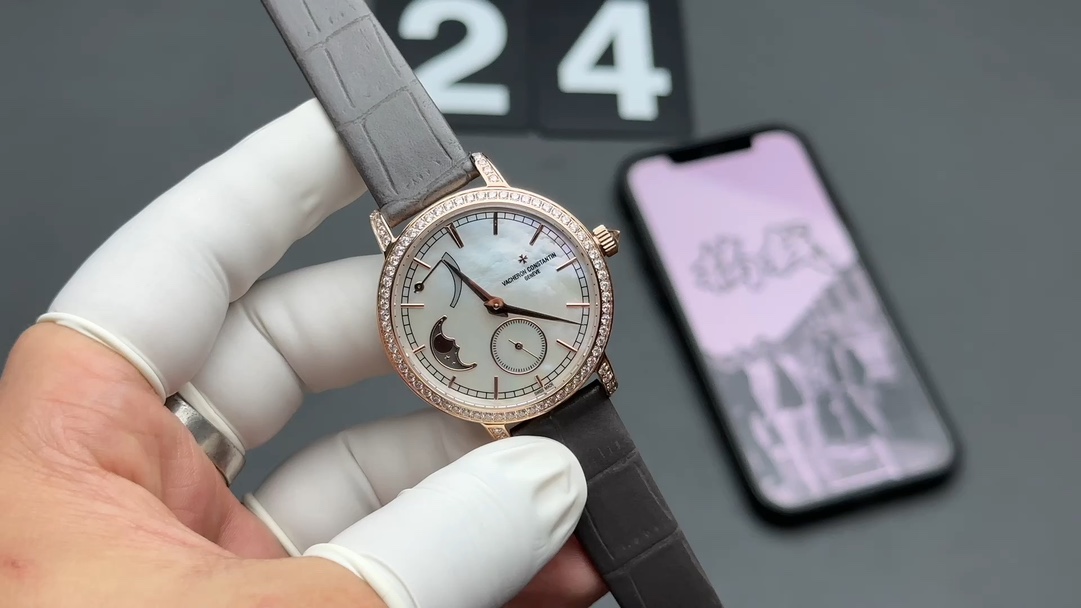
KZ 81180 Ultra-Thin Engineering
The engineering constraint here is the extreme vertical limitation of the 81180 case, which measures a mere 6.8mm in thickness. KZ addresses this by utilizing a heavily modified Miyota 9015 movement, stripped of its secondary bridges to fit within the slim 316L steel or gold-plated housing. What this means in practice is that any aftermarket strap must respect the narrow lug-to-case gap to avoid friction against the polished case flank. From an assembly standpoint, the 40mm diameter requires a perfect balance between the ultra-thin profile and the structural integrity of the spring bar holes.
Expert Authentication Insight
Measure the total case height with a digital caliper; a true Super Clone version from KZ should not exceed 7.0mm. If the measurement approaches 8.0mm, the movement is likely an unmodified low-grade caliber rather than the high-tier slimline variant.
![[IMAGE: Macro profile view comparing the case thickness of a KZ 81180 against a genuine Patrimony, highlighting the 6.8mm measurement.]](https://www.cleanvsfactory.com/wp-content/uploads/2026/02/image-13-1024x559.jpeg)
MKS 85180 Profile Discrepancy
A direct comparison between MKS厂 and the genuine 85180 reveals a deviation in the mid-case thickness, with the replica often reaching 9mm to accommodate the date complication and the oscillating weight of the Miyota 9015. The mechanical implication is that the MKS厂 version presents a slightly more “top-heavy” feel compared to the weightless experience of the genuine 2450 Q6 caliber. This deviation traces back to the use of a standard-height automatic movement rather than the ultra-thin architecture found in the 81180 manual-wind models. Consequently, the strap must be engineered with “Thin Padding” (max 2.5mm) to visually compensate for the increased case height.
Expert Authentication Insight
Inspect the date wheel alignment within the aperture; the MKS version often sits 0.2mm deeper into the dial than the genuine article due to the thickness of the movement spacers. Use a 10x loupe to check for shadows cast by the dial edge onto the date disk.
Strap Material Standards and “Replica Tax”
Dermal Texture and CITES Compliance
The diagnostic-first approach to identifying factory-shipped straps involves an immediate inspection of the leather’s natural pore structure under magnification. Most MKS厂 releases utilize embossed calf leather which, unlike genuine CITES Alligator, lacks the multidimensional depth and varied scale geometry of exotic skins. What this means in practice is that the strap will exhibit a “plastic” sheen that fails to reflect light with the same matte-gradient complexity as high-grade skins. The mechanical implication of using embossed calf is a lack of flexibility, often leading to edge paint delamination after only 10–15 flex cycles.
Expert Authentication Insight
Perform the “Pinch Test” by folding the strap 180 degrees—a method for verifying material authenticity discussed in the Vacheron Constantin Patrimony Reference 81180 & 85180-11 super clone technical comparison. If white “stress lines” or micro-cracks appear within the scales, the material is revealed to be plastic-coated calf rather than genuine alligator hide, which would maintain its surface integrity under such pressure.
Lining Longevity and Moisture Resistance
The engineering constraint here is the high acidity of human sweat, which rapidly degrades the porous leather linings used by most budget factories. To achieve a “Super Clone” wearability standard, the internal architecture of the strap must be upgraded to Zermatt leather or a specialized rubberized lining. This is a direct result of the factory lining’s tendency to absorb oils, leading to rapid rot and odor within months of regular use. From an assembly standpoint, a high-density lining also provides the necessary “stiffness-to-thinness” ratio required to support the 40mm case without the strap stretching over time.
Expert Authentication Insight
Apply a single drop of water to the inner lining of the strap—a diagnostic test frequently used to verify the material quality discussed in the Vacheron Constantin Traditionnelle Tourbillon Ref 6000V-11 super clone technical comparison. If the liquid is absorbed instantly, the lining is untreated porous leather; conversely, a high-grade Zermatt lining will cause the water to bead on the surface for several seconds, indicating superior moisture resistance.
Dimensional Standards and Taper Physics
Lug Spacing and Torque Management
A diagnostic-first analysis of the 81180 lug geometry reveals a standard 20mm width, whereas the smaller 36mm versions utilize 18mm spacing. The tolerance issue compounds when a “forced” fit is attempted with a 19mm or 21mm strap, which introduces lateral torque onto the spring bars. This is a direct result of the short, curved nature of the Patrimony lugs, which provide very little “leeway” for oversized leather ends. What this means in practice is that an ill-fitting strap will eventually cause lug-hole ovalization, permanently damaging the case’s structural integrity.
Expert Authentication Insight
Insert a 20mm strap and check for lateral movement; if there is a gap exceeding 0.1mm between the leather and the lug wall, the strap’s shoulder is undersized, which will lead to an audible “clicking” sound during wrist movement.
The Patrimony Taper Ratio
Leading factories like 8F厂 and ZF厂 often neglect the specific “Patrimony Taper,” which is essential for maintaining the watch’s vintage proportions. A standard 20mm lug strap must taper to 16mm at the buckle for the classic aesthetic, or 18mm for a modern profile, to avoid “overpowering” the slim case. The engineering constraint here is that a non-tapered (20/20) strap increases the visual mass of the watch, ruining the “Ultra-Thin” geometry designed by Vacheron Constantin. From an assembly standpoint, the 2mm minimum taper ensures that the buckle remains proportional to the dial’s diameter.
Expert Authentication Insight
Measure the strap width at both the lug and the buckle using a caliper; if the difference is less than 2mm, the strap is a “sport” profile and will not sit correctly with the elegant 81180 case architecture.
Hardware Interface and Security
Maltese Cross Ardillon Mechanics
The engineering constraint here is the precision of the Maltese Cross pin buckle, which serves as the primary security point for the watch. In many MKS厂 replicas, the “tongue” of the buckle is machined too wide for the strap holes, which leads to premature leather tearing. This deviation traces back to the use of generic Ardillon hardware rather than a dedicated 1:1 mold of the Vacheron design. What this means in practice is that the buckle will not sit flush against the leather, creating a bulky protrusion that catches on shirt cuffs.
Expert Authentication Insight
Test the buckle tongue for lateral play; it should move freely in its vertical arc but exhibit zero side-to-side wiggle. If the tongue wiggles more than 0.5mm, the tolerances are too loose for a high-grade build.
Spring Bar Gauge and Lug Clearance
The diagnostic-first approach to the hardware interface requires an inspection of the spring bar diameter, typically 1.5mm in these references. Upgrading to a 1.8mm “Heavy Duty” bar is often impossible due to the narrow drill holes in the 316L lugs of the KZ厂 or 8F厂 cases. The mechanical implication is that the strap must utilize curved spring bars to maintain a 0.5mm clearance from the case edge, preventing the leather from “sanding” the high-polish finish between the lugs. From an assembly standpoint, the seating of the spring bar must be checked for “full engagement” to prevent the watch from detaching under tension.
Expert Authentication Insight
Use a wooden toothpick to apply firm pressure to the strap near the lug; if a “pop” or “click” is heard without the strap releasing, the spring bar tip is not fully seated in the lug hole.
Installation Physics and Maintenance
Lug Protection and Seating Protocols
A diagnostic-first protocol for strap replacement must begin with the protection of the high-polish lug surfaces, which are prone to “micro-scratches” from steel tools. This is a direct result of the 5N Rose Gold plating or polished steel having a lower Vickers hardness than the spring bar tool itself. What this means in practice is that the inner and outer lug surfaces must be masked with Kapton tape before any torque is applied to the bars. Once the new strap is installed, a final friction check is required: rotate the leather up and down to ensure it moves smoothly without “binding” against the case.
Expert Authentication Insight
After installation, tug the strap firmly at a 45-degree angle away from the case—a stability check highlighted in the VC Patrimony & Traditionnelle dress watch replica guide. A correctly seated 1.5mm spring bar will show no movement, whereas an undersized pin will “wander” within the lug hole, indicating an improper fit that could compromise the security of the attachment.