
The Vacheron Constantin Traditionnelle 82172 represents the pinnacle of conservative Genevan horology, making its replication a high-stakes exercise in geometric precision rather than sport-watch ruggedness. This guide analyzes how the Guangzhou ecosystem handles the 82172’s specific design constraints, focusing on the critical trade-offs between case thickness and movement stability for the informed collector.
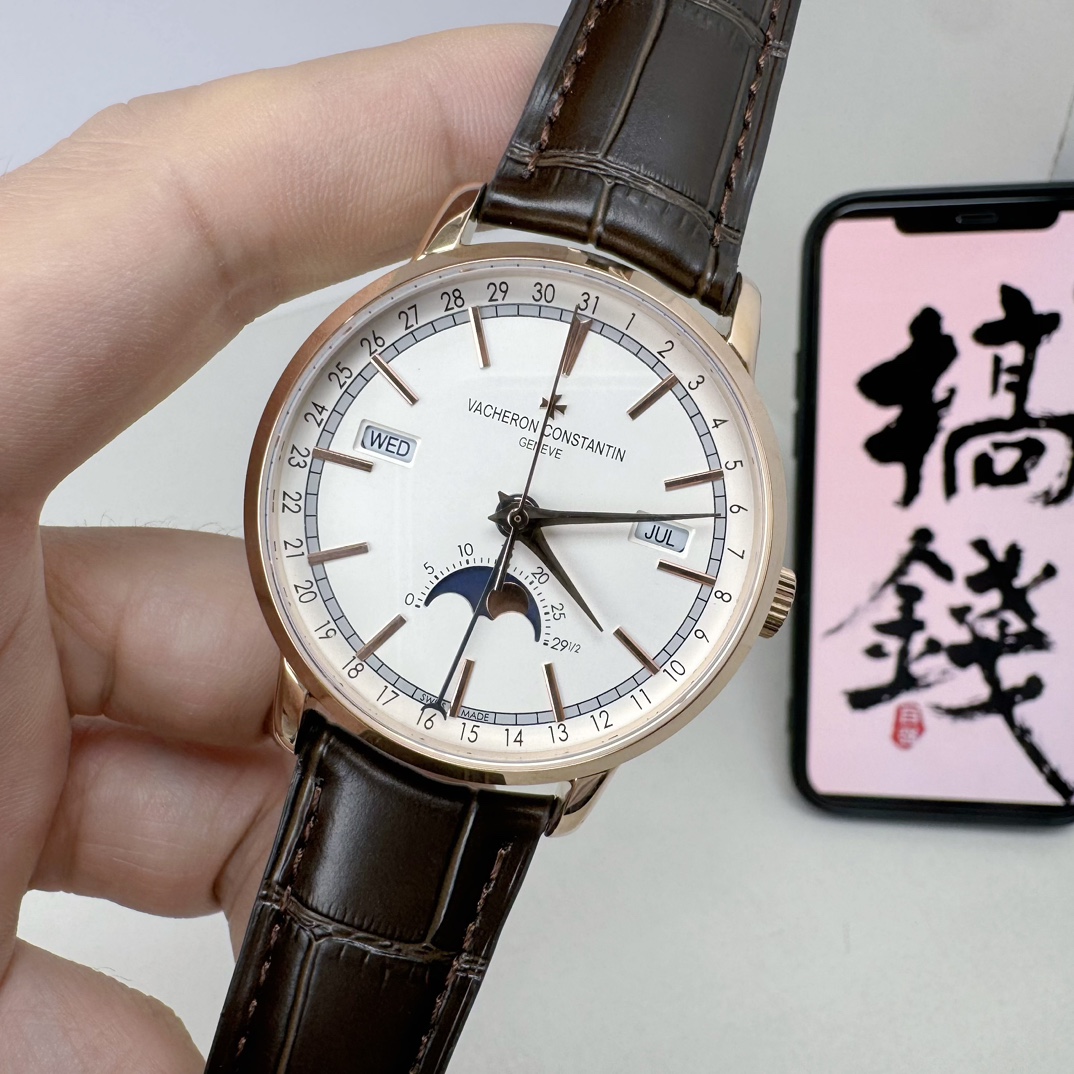
Traditionnelle vs. Patrimony: The Geometric Logic of Replica Selection
Linear Discipline vs. Curvilinear Minimalism
The Traditionnelle 82172 utilizes a “stepped” case architecture that demands high-precision CNC programming to maintain the sharp transitions between the bezel, mid-case, and caseback. Unlike the rounded profiles of the Patrimony series, the Traditionnelle requires 316L stainless steel blanks to be machined with strict angular tolerances to avoid “soft” edges that betray the watch’s origin. Replicas often struggle with the lug transitions, where the stepped design must remain perfectly parallel to the horizontal axis of the case. Mechanical equivalence in this sector is measured by the crispness of these steps under magnification. The optical deviation in lower-tier versions is usually visible where the lug meets the case body, showing a merged or rounded fillet instead of a clean, stepped junction.
The Railway Minute Track Execution
The “Chemin de Fer” (railway) dial printing on the 82172 is the primary failure point in mid-tier manufacturing due to the high contrast between the ink and the velvet-finish dial. The outer track requires a perfectly centered pad-printing process to ensure the minute markers align with the applied gold-tone indices without any perceptible parallax error. Industrial-grade replicas utilize multi-layered silk-screening to achieve the necessary ink density, preventing the “faded” look often found in entry-level batches. Precision in the sub-seconds dial at 6 o’clock is equally critical, as any eccentricity in the printing will be magnified by the circular graining of the sub-dial. Achieving the correct ink height is essential for maintaining the three-dimensional presence of the dial markings.
Judgment Tip: Inspect the case side profile under a macro lens; the Traditionnelle replica must show a distinct, sharp “step” on the lugs—if the transition is soft or rounded, the case finishing discipline is insufficient.
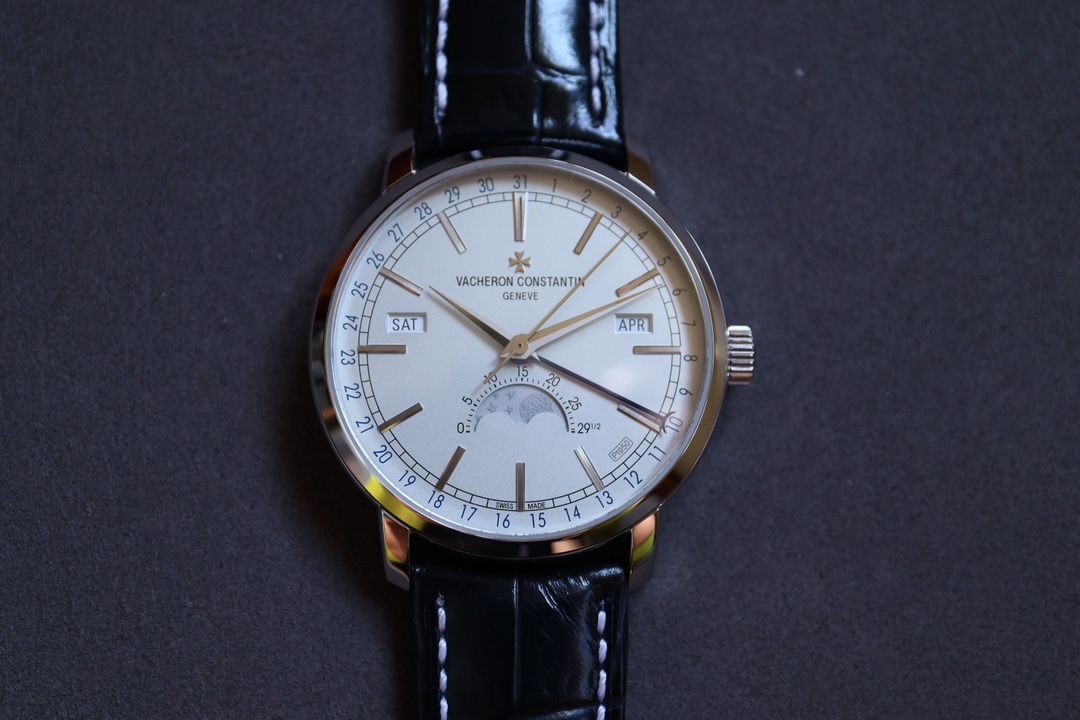
Reference 82172 Dimensional Accuracy: Case Profile and Lug Curvature
The 38mm x 7.77mm Challenge
The genuine 82172 features a profile height of precisely 7.77mm, a benchmark that is rarely achieved by manufacturers using standardized automatic movements. Most high-fidelity replicas utilizing a modified Miyota 9015 reach a thickness of 8.5mm to 9.0mm, an optical deviation caused by the height of the movement plates and the clearance required for the hand stack. This 0.73mm to 1.23mm discrepancy significantly impacts the watch’s ability to slide under a formal shirt cuff. To mitigate this, some factories shave the internal movement spacers, but this often compromises the structural integrity of the crown tube alignment. Collectors must prioritize the thinnest possible execution to maintain the “disappearing” quality of a true dress watch.
Lug-to-Wrist Interaction
The straight, stepped lugs of the 82172 dictate a specific wearability profile that can lead to “lug overhang” if the lug length is not precisely calculated. Genuine lugs are engineered to follow a subtle downward pitch, ensuring the 38mm case sits flush against the wrist bone despite the straight aesthetic. Replicas that fail to replicate this downward angle create a gap between the strap and the wrist, destroying the watch’s formal silhouette. The geometric fidelity of the lug-to-case junction also affects how the spring bars are positioned, which in turn influences the drape of the leather strap. High-quality cases ensure the lug holes are drilled at the exact depth to prevent the strap from rubbing against the case edge.
Judgment Tip: Use a digital caliper to measure the total height; any version exceeding 8.5mm will lose the “disappearing” quality of a true dress watch under a French cuff, a critical dimension noted in the Vacheron Constantin Traditionnelle 82172 replica buying guide.
The Dial Architecture: Assessing the Railway Track and Dauphine Hands
Dauphine Hand Polishing and Faceting
The 82172 utilizes bi-faceted Dauphine hands where one side is mirror-polished and the other side is frosted or bead-blasted to catch light at different angles. This dual-finish requirement is a significant hurdle for replica suppliers, as it requires two distinct finishing passes on a very small surface area. Cheap components often substitute this for a uniform polish, which lacks the legibility and “sparkle” of the genuine hand stack. The hand-setting process must also be executed with high cleanliness to avoid dust particles on the velvet-textured dial. Any misalignment in the faceting ridge will cause uneven light reflection, making the hands appear bent or distorted.
Index Alignment and the Maltese Cross
Applied gold-tone indices on the 82172 must be perfectly perpendicular to the dial surface and aligned with the railway track to within a 0.05mm tolerance. The 12 o’clock Maltese cross is a separate component that requires precise mounting; if it is tilted by even a fraction of a degree, the visual balance of the entire dial is ruined. Factories like ZF use advanced adhesive jigs to ensure the cross is centered between the two primary indices at the noon position. The finish on the cross itself should show sharp internal corners, a detail often lost when using cast rather than CNC-milled parts. High-tier versions ensure the indices have a consistent height and facet angle across the entire dial.
Judgment Tip: View the hands at a 45-degree angle; a high-quality replica will show a sharp, clean ridge down the center of the Dauphine hands, whereas budget versions look flat or stamped.
Movement Execution and the Thickness Bottleneck
The Miyota 9015 Manual-Wind Modification
To emulate the Vacheron Constantin Caliber 4400 AS, factories frequently utilize the Japanese Miyota 9015 as a base, operating at 28,800 vph. The modification involves removing the automatic winding rotor and the bridge assembly to reduce the total height and simulate a manual-wind movement, a technical execution detailed in the Vacheron Constantin Patrimony 85180 replica factory comparison. While this modification captures the spirit of a manual caliber, it requires the winding click-spring to be re-tensioned for appropriate tactile resistance and demands that the plates remain properly secured to avoid “arbour friction” after the rotor’s removal.
Bridge Decoration and “Jewel” Placement
The aesthetic accuracy of the movement plates is assessed by the quality of the “Côtes de Genève” and “perlage” visible through the sapphire caseback. Replicas often use decorative “deco plates” on top of the 9015 to mimic the architecture of the 4400 AS, including faux sink-holes and non-functional jewels. The “tell” in these modifications is often the depth of the engraving and the color of the rubies, which may appear too pink or translucent compared to genuine synthetic pigeon-blood rubies. High-fidelity versions focus on the alignment of the bridge screws, ensuring they are polished and flush with the plates. Movement modification logic dictates that the thinner the deco plate, the closer the watch can get to the genuine thickness benchmark.
Judgment Tip: Wind the watch fully; the movement should have a distinct, clicking resistance. If the winding feels “mushy” or infinitely spinning, the click-spring mechanism is poorly assembled.
Factory Landscape: MKS vs. ZF in the Battle for 82172 Supremacy
MKS Factory – The Value Entry
The MKS factory iteration is recognized for its robust reliability and its use of standard 316L steel for the case and buckle. While it offers excellent mechanical equivalence for its price point, it often sits on the thicker end of the spectrum, typically measuring around 9.0mm. The dial printing is generally accurate, though the ink deposits may be slightly thicker than the genuine “serigraphed” appearance. MKS focuses on the stability of the modified 9015, ensuring the watch functions as a daily wearer for the budget-conscious collector. It remains a popular choice for those who prioritize movement longevity over absolute dimensional perfection.
ZF Factory – The High-Fidelity Execution
ZF factory represents the high-fidelity tier, pushing the limits of case thinning and dial texture accuracy. Their 82172 execution often features a more refined Maltese cross with sharper internal angles and a dial finish that better captures the “Nid d’abeille” or velvet effect. ZF typically achieves a thinner profile than MKS, often hovering around the 8.5mm mark, making it the preferred choice for enthusiasts. The hands on the ZF version undergo a more rigorous polishing process, resulting in better light play across the Dauphine facets. Their procurement of higher-grade sapphire crystals with superior AR coating also reduces optical deviation.
Judgment Tip: When evaluating the dial, compare the printing of the “Vacheron Constantin” text; MKS often features slightly thicker ink deposits, whereas ZF achieves the “serigraphed” thinness characteristic of the genuine article, a distinction highlighted in the VC Patrimony Traditionnelle dress watch replica guide.
Procurement Logic: Pricing and Maintenance for Formal Replicas
The 350−550 Price Equilibrium
The 82172 typically occupies a price bracket between 350∗∗���∗∗350∗∗and∗∗550, which is lower than the Overseas series due to the lack of a complex integrated bracelet. The value in this segment is driven by the quality of the case finishing and the precision of the dial components. At this price, collectors should expect a movement with a beat error of less than 0.3ms and a stable rate across various positions. The lack of a date complication simplifies the movement, reducing the potential for mechanical failure. Paying a premium for the ZF version is generally justified by the superior dimensional accuracy and dial-side finishing.
Long-term Reliability of Modified Manual Movements
Maintenance for the modified 9015 should occur every 3 to 5 years, focusing on the lubrication of the crown wheel and the mainspring barrel. Because the rotor has been removed, the crown stem and winding gears take the full load of the daily winding ritual, increasing the risk of “re-tensioning” failures or stem snapping. It is vital to avoid over-winding the movement; once resistance is felt, the user should stop immediately to prevent damaging the click-spring. The slimness of the case means the movement is closer to the caseback, making it more sensitive to impact-related shocks. Proper care ensures the 82172 remains a reliable formal companion for years.
Judgment Tip:
Always request “Timegrapher” photos from the seller; for a formal dress watch, a beat error of 0.0ms – 0.2ms is the standard for a movement that won’t require immediate servicing.**