
The rapid depletion of Richard Mille replica batches often appears as manufactured urgency, but the reality stems from strict physical constraints. Tonneau cases demand intensive 5-axis CNC work and manual finishing, which naturally caps production runs, while rigorous quality control routinely discards dozens of units over misaligned materials or threading flaws. When factories also shift between discrete material lots, inventory turnover becomes a matter of manufacturing logistics rather than artificial scarcity. Understanding this dynamic changes how buyers should approach version updates and limited stock. This article breaks down why early releases carry higher mechanical risk, how minor tooling adjustments are frequently inflated into major upgrades, and what documentation actually matters before committing. Rather than chasing the newest batch number, you will learn how to evaluate verified consistency, request precise macro photos, assess China-made super clone service, and decide whether a stabilized older run or a freshly adjusted model aligns with your risk tolerance. The goal is to treat each purchase as a verified manufacturing agreement, not a race against disappearing inventory.
| Buying Factor | Typical Risk | Verification Requirement |
|---|---|---|
| Batch Timing | Early runs carry higher mechanical risk as they often function as untested field trials. | Wait for macro documentation or choose a stabilized older run with resolved tolerances. |
| Version Number | Often reflects minor tooling tweaks that are marketed as major mechanical upgrades. | Ignore version codes; request written confirmation of specific movement or dial changes. |
| Material Consistency | Forged carbon and titanium arrive in discrete lots with inherent visual and structural variations. | Confirm the exact material lot code and compare it against factory reference specifications. |
| Inventory Scarcity | Driven by wholesale pre-orders and high QC rejection rates, not artificial supply limits. | Avoid sellers pushing urgency without providing unit-specific documentation and photos. |
| Quality Assurance | 30–50% of units are scrapped for alignment, carbon grain, or case threading flaws. | Require four clear photos: dial alignment, side profile, clasp finish, and movement view. |
Quick Questions Before You Read
Q: Does a newer batch number mean better quality?
Not necessarily. Early runs often function as field tests and may introduce new mechanical or cosmetic flaws while fixing older ones. Stabilized older batches frequently offer more predictable tolerances and consistent finishing.
Q: Should I buy immediately if a batch is selling out fast?
Inventory speed usually reflects wholesale pre-orders and high factory rejection rates, not artificial scarcity. Rushing without written specifications and unit-specific photos increases the risk of receiving mismatched materials or untested movements.
Q: What documentation actually matters before payment?
Focus on verified mechanical updates and material lot codes rather than version numbers. Require written confirmation of changes alongside four clear photos: dial alignment, side profile, clasp finish, and movement view to confirm the exact build you will receive.
Market Context and Reference Clarity: The term Richard Mille is used throughout this article solely as a reference point for identifying design architecture and comparison topics. Replica watches and super clones discussed here are replica-market products and are not genuine watches produced, authorized, or endorsed by the original luxury brand. Factory labels, version codes, and batch identifiers function as buyer-facing market references rather than official brand affiliations or quality certifications. Understanding this boundary ensures that comparison discussions remain focused on replica-market realities, manufacturing logistics, and practical verification steps without implying official partnership, genuine product equivalence, or commercial interchangeability.
The Reality of Small-Run Production for Tonneau Replica Cases
The rapid disappearance of Richard Mille super clone listings is rarely a calculated marketing tactic. It is the direct mathematical outcome of RM tonneau case production. Unlike round sports watches that share standardized case molds and automated machining paths across multiple references, a tonneau architecture demands dedicated tooling, asymmetric routing, and slower machining cycles. Factories typically schedule small production runs of 50 to 200 units per batch because dedicating CNC machines to a single barrel-shaped geometry is prohibitively expensive and disrupts broader production scheduling. When a public listing appears and clears within days, you are observing replica batch sizing constraints, not artificial scarcity.
Official Design Constraints and Reverse-Engineering Limits
Official Richard Mille specifications emphasize extreme case geometry, proprietary composite materials, and multi-axis machining that pushes conventional watchmaking limits. The brand’s public documentation highlights tonneau profiles that require precise curvature mapping across bezel, mid-case, and case-back components. When replica manufacturers attempt to reproduce these designs, they work without original CAD files or factory-authorized tooling. Every dimension must be reverse-engineered through manual measurement and trial machining, which inherently introduces tolerance drift. This explains why a replica batch may exhibit consistent visual accuracy for fifty units, then show slight lug curvature shifts or bezel thickness variations in the next fifty. The physical limitation is not a lack of machining capability, but the reality of reproducing proprietary tolerances through iterative measurement. Buyers who understand this reverse-engineering constraint are better positioned to evaluate batch photos objectively, focusing on proportional continuity rather than expecting mathematical equivalence across different production windows.
Why Tonneau Geometry Defies Standard Mass Production
Round watch cases benefit from rotational symmetry. CNC machines can clamp the blank and rotate it while cutting bezels, polishing case sides, and threading case backs using automated paths. Tonneau architecture breaks this efficiency entirely. The lug-to-lug curvature requires continuous multi-axis routing to maintain smooth transitions from the bezel into the strap lugs. Every angle along the side profile must be calculated to avoid flat spots or uneven chamfers that ruin the visual depth of the original design. Factories cannot use standard rotary jigs. Instead, they rely on custom fixtures and 5-axis CNC setups that slow down feed rates and increase tool wear.
Polishing and finishing introduce additional bottlenecks. A round case can move through tumbling machines and automated buffing wheels with predictable results. A tonneau case requires manual sanding and hand-polishing along compound curves. Machining limits force factories to prioritize precision over volume, capping manufacturing yield per production window. This is why a 150-unit run can exhaust dealer inventory in less than a week. The constraint is physical, not psychological.
What to Check Before You Decide
Do not treat a vanished listing as proof of exceptional demand. Instead, verify that the remaining stock meets basic geometric standards. Request side-profile photos that clearly show the lug curve continuity. Flattened or overly sharp transitions indicate rushed machining or poorly calibrated CNC offsets. Examine the case-back threading alignment through macro shots; misaligned threads on a tonneau profile usually mean the case was forced or milled without proper rotational referencing. Finally, ask the seller directly how many units were scheduled for that specific run. If they cannot explain the limited batch explanation or refuse to acknowledge the production window, they are either selling leftover stock from multiple inconsistent runs or obscuring how small run replica watches actually move through the supply chain.
How High Rejection Rates Drive Batch Turnover
Publicly listed inventory never represents a full production run. It represents only the units that survive strict internal QC thresholds. In high-complexity RM-style builds, factories frequently scrap 30% to 50% of machined cases and assembled dials before anything reaches a dealer network. A replica watch rejection rate this high does not indicate superior craftsmanship; it reflects the physical difficulty of aligning multi-layer skeleton dials, carbon inserts, and precision bezel screws within tight tolerances.
When a new batch drops, factories run initial QC sweeps targeting structural and visual alignment standards. Minor deviations in carbon weave orientation, rehaut spacing, or bezel insert fit trigger immediate batch shrinkage. Units that fail these internal cutoffs are pulled from the assembly line and either destroyed, parted out, or quietly sold through secondary channels at steep discounts. The sudden disappearance of stock is a direct result of why stock drops rapidly after initial dealer allocation, driven by internal quality control rather than overwhelming consumer purchases. Batch QC standards remain fluid and shift depending on factory workload, material consistency, and assembly line pressure. Stringency is a variable, not a permanent guarantee.
Which Flaws Trigger Scrapping Versus Minor Adjustments
Factories distinguish between correctable assembly errors and structural failures that compromise the entire build. Misaligned hands, uneven lume application that does not cross hour markers, or slight rotor friction can often be resolved on the line by resetting the dial stack, applying targeted cleaning, or adjusting the movement seating. These units typically proceed to dealer networks after minor adjustments.
Critical flaws force immediate scrapping. Case seam gaps that expose internal threading, misaligned rehaut text that drifts off the dial edge, or carbon patterns that run perpendicular to the intended grain direction cannot be fixed without remilling the case or discarding the dial. A factory cannot sand down a misaligned bezel insert or reprint a skeleton dial that was drilled off-center. Production loss occurs when a batch encounters widespread tolerance drift, forcing the factory to halt distribution and restart machining. Understanding this separation explains why two seemingly identical releases may carry different reputation scores. One batch passed stringent visual cutoffs; the other survived with acceptable adjustments but lower overall consistency.
Quality Control Disclosure: For replica and super clone watches, buyer confidence depends on visible quality-control details such as case finishing, dial printing, bezel alignment, bracelet fit, clasp engraving, datewheel position, and movement configuration. These details should be checked model by model rather than assumed from a factory name alone, as production tolerances can shift between individual runs even when the same assembly line is used.
Why Factory Reputation Does Not Guarantee RM Model Success
In the broader replica market, certain factory names carry weight because they consistently deliver strong execution on round sports watches. Richard Mille tonneau replicas do not follow the same hierarchy. A factory that maintains tight tolerances on a Submariner or Daytona does not automatically translate that precision to a barrel-shaped case with complex carbon inserts and high-clearance skeleton dials. The machining requirements, material sourcing, and assembly tolerances for RM-style watches operate on a completely different axis. At cleanvsfactory.com, this distinction is treated as a baseline reality: the factory label helps narrow the initial search, but it does not predict batch stability for high-complexity tonneau models.
Buyers often mistake a well-known factory tag as proof of mechanical reliability, but for RM replicas, the movement route and material batch matter far more than the brand stamped on the movement plate. Some factories prioritize visual accuracy in carbon weave and dial printing, accepting slightly higher rotor noise or tighter crown threading. Others may reverse-engineer the base caliber to improve daily winding feel but compromise on bezel insert depth. Neither approach is inherently wrong, but they create different ownership profiles. When a batch disappears quickly, it is often because a specific factory successfully matched a stable movement supplier with a consistent carbon lot, not because their overall reputation guarantees a flawless watch. Evaluating an RM replica requires separating the factory’s general track record from the specific version’s documented strengths and known compromises.
Factory names in the replica watch market are useful buyer-facing references, but they should not be treated as official luxury-brand affiliations or automatic guarantees of quality across every model. In super clone watch comparisons, the safer judgment is usually version-specific. A factory may be strong on one model and weaker on another because case shape, dial printing, bracelet construction, bezel action, and movement layout are not equally difficult across every reference. When evaluating a rapidly vanishing RM batch, buyers should separate the market label from the actual execution of that specific production run. Tracking which factory handles the tonneau architecture, who supplies the composite material, and how the movement module is integrated provides a much clearer picture than relying on a single factory tag. CleanVSFactory’s editorial approach is to make replica watch decisions more traceable by connecting factory claims to visible details, movement behavior, version differences, and RM super clone quality control standards that assess lume consistency, bezel feel, and movement timing before shipment.
Component Shortages and Material Variations in Carbon and Titanium
Material sourcing dictates production scheduling far more than buyer demand. Forged carbon composites and aerospace-grade titanium are purchased in discrete production lots, each carrying distinct resin densities, fiber orientations, and curing characteristics. Factories do not stockpile years’ worth of raw material. They machine until a lot runs out or fails density and scratch-resistance testing, then pause production while sourcing replacement stock. This supplier dependency creates natural gaps in titanium replica availability and forces unexpected production halts.
When a new material lot arrives, it rarely matches the previous batch exactly. Subtle shifts in resin color, carbon weave tightness, or titanium brushing grain become immediately visible on the wrist. Factories treat these material shifts as hard version breakpoints, retiring the old batch and relabeling the next run as an updated iteration. Buyers frequently misinterpret this as a deliberate upgrade cycle. In reality, it is a necessary response to why carbon batches change without warning. The factory adapts to available inventory, and the visible stock shifts accordingly. Expecting exact material consistency across consecutive purchases ignores the fundamental limitations of material supply replica watches operate under. Forged carbon variation is an inherent characteristic of the supply chain, not a manufacturing defect, provided the fiber orientation remains structurally sound and visually coherent.
A replica watch should be evaluated with realistic ownership expectations. Even a strong super clone can have limits in water resistance, long-term movement stability, servicing convenience, and close inspection compared with a genuine reference. Visual accuracy should be judged through specific details rather than broad claims. Case thickness, lug shape, dial texture, bezel tone, hand length, date magnification, and bracelet construction can affect how convincing a watch feels in real use. When a batch disappears quickly, it is tempting to assume every detail has been perfected. However, buyers should recognize that replica-market terminology often differs significantly from official brand terminology. Phrases like “updated carbon structure” or “refined bezel tension” usually indicate internal factory adjustments to compensate for supply chain shifts, not a guarantee of genuine equivalence. Focusing on traceable execution details rather than promotional batch names helps buyers set accurate expectations for daily wear and long-term maintenance.
Version Details to Confirm
Before committing to a newly listed RM replica, request specific documentation regarding the material lot. Ask the seller to confirm whether the carbon composite or titanium brushing matches the original promotional photos or if the unit comes from a subsequent production window. Request macro images of the case side, bezel edge, and strap lug transition to verify weave direction and finishing grain. If the seller cannot clarify whether you are looking at an original material batch or a replacement lot, you risk purchasing a unit with altered weight characteristics, surface hardness, or visual depth. Clear version confirmation protects against receiving mismatched stock that deviates from your initial expectations.
Realistic Usage and Durability Boundaries: Replica tonneau cases and composite materials do not inherit the rigorous pressure-testing protocols or official waterproof certifications applied to genuine luxury watches. Even when a replica features screw-down crowns and visible gaskets, water resistance should not be assumed unless the specific unit has undergone independent pressure testing and the seller provides transparent documentation of the results. Daily wear should account for the fact that replica case seals, crown threading tolerances, and carbon-to-titanium bonding interfaces may shift over time due to temperature changes, strap tension, or routine handling. Treating a super clone with the same environmental expectations as an authentic sports watch can lead to premature moisture ingress or accelerated finish wear. For long-term ownership, maintaining a cautious approach around water exposure, avoiding sudden temperature shifts, and confirming seller policies regarding post-delivery condition expectations will help preserve both the visual integrity and functional reliability of the piece.
Interpreting QC Photos and Seller Listings for Tonneau Cases
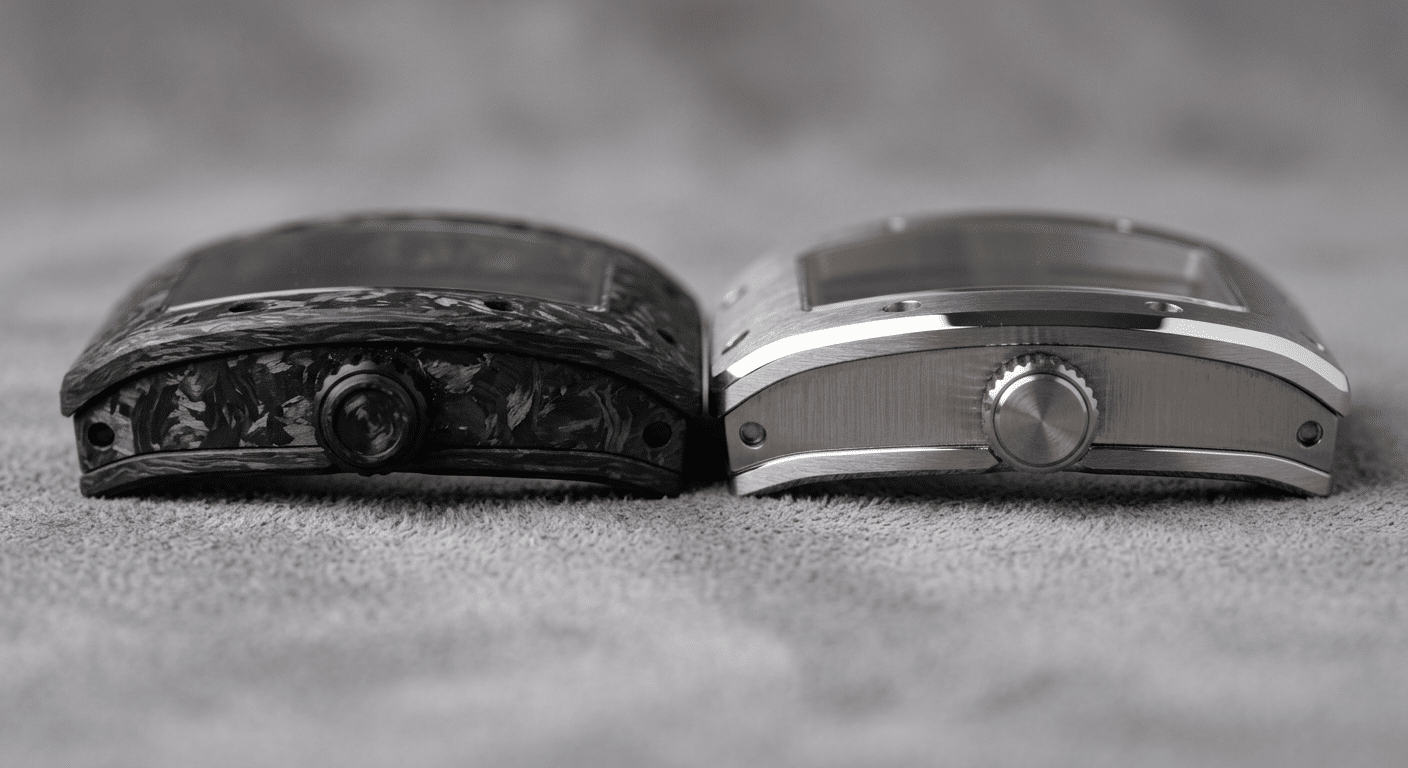
Seller-provided QC images are a necessary step in replica purchasing, but they should be treated as directional signals rather than final proof of daily reliability. Richard Mille replicas are particularly prone to photographic distortion. Controlled studio lighting, shallow depth of field, and carefully chosen angles can mask case thickness variations, carbon resin pooling, or slight rehaut misalignment that becomes obvious under normal indoor lighting. A dial that appears perfectly aligned in a macro shot may reveal uneven hand clearance or visible printing halos when viewed at wrist height. For buyers, the goal is not to find a flawless photograph, but to verify whether the watch holds its proportions in unoptimized conditions.
When reviewing QC images, focus on structural continuity rather than cosmetic perfection. Check whether the lug curvature flows smoothly into the bracelet or rubber strap without abrupt flat spots. Look at the bezel screw alignment in natural light, not under direct flash, to assess true thread seating and finish depth. Pay attention to the case-back window: a clean rotor view is useful, but it should not distract you from checking whether the crystal sits flush with the bezel or if there are visible gasket gaps that affect dust resistance. At cleanvsfactory.com, listings are cross-referenced against unfiltered owner photos precisely because factory-approved shots rarely show how a watch behaves after three weeks of wrist movement. Visual accuracy matters for presentation, but daily reliability depends on how tolerances hold up under temperature changes, strap tension, and normal winding cycles. A batch that photographs perfectly but exhibits inconsistent timekeeping or premature strap wear is rarely worth the initial price premium.
Movement Route Transitions and Why They Trigger Version Shifts
A movement route update in a Richard Mille super clone rarely happens as a simple drop-in swap. Factories typically stabilize a specific clone caliber for a production cycle, then encounter real-world friction that forces a halt: rotor noise complaints, inconsistent supplier availability for specific module components, or feedback that the dial spacing feels visually shallow under certain lighting. When a replica version change occurs, it is usually because the old architecture has hit a practical ceiling. The factory pauses production, sources an updated module or adjusts the gear train layout, and restarts the line under a new version number.
This lifecycle creates the sudden availability gaps buyers frequently notice. The transition does not allow for a gradual phase-out. Once the new clone caliber transition begins, the factory must reconfigure case milling jigs, adjust hand stack tolerances, and recalibrate dial feet positioning. The old batch is retired because its dimensional envelope no longer matches the incoming components. If you are wondering whether you should wait for a movement upgrade or buy the current stable route, the answer depends on your tolerance for early production variables. A new movement batch often introduces untested rotor bearing tension, revised crown winding feel, or subtle changes to power reserve consistency. The first fifty to one hundred units out of a revised production line typically function as a field test.
Version retirement is a mathematical certainty in high-complexity replicas, not a marketing tactic. Factories cannot inventory mismatched case shells alongside updated movements without risking assembly failures or warranty spikes. When a listing disappears overnight, it frequently means the movement layout shift has officially crossed over from internal testing to active assembly, draining the remaining old-spec inventory from dealer channels. Buyers who chase the newest movement route without checking dealer feedback on early units are essentially volunteering to document the factory’s quality control curve.
Movement Architecture Realities and Long-Term Serviceability
Movement descriptions in the replica market should be read as configuration references, not as official brand-caliber claims unless there is clear, verifiable evidence. Buyers should distinguish between movement layout, decoration, reliability, and actual serviceability. Before making a decision, buyers should review real QC photos where available, including dial printing, hand alignment, bezel position, datewheel centering, bracelet fit, clasp engraving, case thickness, and overall finishing. Factory labels and stock photos alone are not enough for a reliable judgment.
Replica movement configurations in tonneau watches are rarely standardized across factories or production cycles. Instead of relying on single-source calibers, many assemblers source base movement platforms from independent suppliers and modify gear trains, rotor thickness, or dial spacing to approximate the visual profile of complex skeleton layouts. This modular approach allows factories to respond to supply disruptions or adjust stack height, but it creates significant variability in serviceability. Unlike authorized movements with established parts networks and documented service procedures, replica architectures depend on the availability of matching replacement components and independent watchmakers willing to work on modified calibers. Buyers should not assume that a movement will remain serviceable indefinitely or that parts will be interchangeable between batches. Long-term reliability depends on the specific gear layout, rotor bearing quality, and dial clearance stability. When evaluating a batch, prioritize clear documentation of the movement architecture and verify whether the seller can confirm part sourcing for potential future maintenance, rather than relying on generic caliber labels or decorative finishing.
Understanding Movement Terminology and Service Limits: Movement names commonly referenced in the replica market describe layout, decorative finishing, clone architecture, or seller terminology rather than an original brand-manufactured caliber. These configurations are engineered for visual approximation and functional operation within replica case constraints, but they do not share genuine parts compatibility, official service documentation, or brand-level quality control. Over time, clone movements may require adjustment, lubrication, or component replacement that falls outside official brand service channels. Buyers should plan for independent horological maintenance rather than expecting boutique-level support. Additionally, replica calibers should never be represented as genuine movements for inspection, authentication, or resale purposes. The purpose of tracking movement routes is to understand operational characteristics, identify potential maintenance needs, and set realistic expectations for daily accuracy and long-term ownership.
How Movement Upgrades Alter Case and Dial Proportions
The most misunderstood aspect of a replica movement transition is how quickly it disrupts the physical architecture of the watch. A custom module update or a thinner rotor configuration changes the vertical stack between the movement plate and the underside of the crystal. Even a zero-point-three millimeter difference in module thickness forces a complete dial reprint or requires case back milling to restore proper clearance. If the factory attempts to force a thicker movement into an existing case, the hands will sit too high, creating parallax errors that make the watch look visually cheap at normal viewing distances.
This dimensional mismatch is why a movement transition always triggers a hard version reset rather than a mid-batch swap. Dial printing must be realigned to match new subdial centers or updated calendar windows. The bezel flange may need slight reshaping to maintain proper crystal seating pressure. Factories track these changes through internal batch codes, but from the outside, the result is identical: the old version vanishes from dealer stock because its case and dial components are physically incompatible with the new caliber. Treat any newly announced movement route as a proportional recalibration. Until independent reviewers confirm that hand clearance, dial alignment, and case thickness have stabilized, assume the version change prioritizes mechanical function over immediate visual perfection.
Dealer Pre-Order Cycles and Inventory Drain
Public listings for a Richard Mille super clone often appear only after the wholesale allocation pipeline is already full. Factories operate on a dealer pre-order cycle that reserves the initial portion of every production run for established channels before the batch ever reaches retail-facing websites. When you see a new RM replica appear online and vanish within hours, you are rarely witnessing artificial stock suppression. You are watching the final trickle of a replica inventory drain that was committed weeks earlier through bulk wholesale reservations.
Dealer allocation logic follows predictable communication timelines. A factory confirms a production window, trusted dealers submit volume requests based on historical sales data, and the first completed units are routed directly to those pre-order lists. By the time the batch is photographed for public retail pages, only units with minor cosmetic variances or last-minute production overages remain visible. The rapid disappearance of public listings is a structural feature of how China replica watches move through the market, not a signal that a specific version is inherently superior. Buyers who misinterpret this timing often rush into purchases or pay unnecessary expedited fees for inventory that simply followed standard wholesale distribution.
To navigate this cycle effectively, shift your focus from chasing website stock indicators to monitoring dealer communication channels. Established sellers announce allocation windows privately before updating public catalogs. If you want a specific version, requesting placement on a wholesale reservation list during the production phase is the only reliable way to secure it. Paying a premium to bypass a “sold out” status on a public listing rarely guarantees better quality; it only guarantees you are buying the leftover units from a batch that was already filtered through primary dealers.
Trademark, Import, and Disclosure Realities for Replica Transactions
The replica watch market operates within a complex legal and regulatory framework that buyers must acknowledge before purchasing. Imitation timepieces that reference established brand designs, logos, or collection names exist in a space where trademark enforcement, customs inspection protocols, and import regulations vary significantly by jurisdiction. Reputable marketplaces and transparent sellers typically include clear disclosure statements clarifying that replica products are not authorized, endorsed, or affiliated with the original trademark owners. Buyers should understand that international shipping can trigger customs reviews, and that resale or public display may raise additional legal questions depending on local consumer protection and intellectual property guidelines. Treating replica purchases with appropriate disclosure awareness does not diminish the mechanical or aesthetic discussion; it establishes a responsible buying framework. Sellers who provide transparent transaction terms, accurate product descriptions, and clear ownership documentation demonstrate higher operational integrity. Buyers who recognize these legal boundaries can make informed decisions without unrealistic expectations regarding authorization, warranty coverage, or official service channels.
What This Means for Daily Wear
Allocation timing has zero correlation to wearing quality or long-term reliability. A watch that sells out during the pre-order phase does not possess tighter case tolerances or better movement regulation than one listed publicly a week later. Both originate from the same assembly line and undergo the same final QC inspection. Buyers should evaluate the actual specifications of the version, Richard Mille China super clone—case thickness, movement route, carbon or titanium finish, and dial execution—rather than treating early availability as a reliability signal. The watch on your wrist functions exactly the same whether it was reserved during the factory allocation window or purchased after the public listing appeared.
Understanding Price Variance and Beginner Risk with Complex Replicas
Price differences between Richard Mille batches are often misread as direct quality indicators. In practice, a higher price point usually reflects a combination of movement supplier costs, limited material availability, dealer margin adjustments, and the financial cushion required to cover high rejection rates. It does not automatically guarantee tighter tolerances, better timekeeping, or longer ownership lifespan. Some factories price older stabilized runs higher simply because replacement parts for those specific movement routes are easier to source. Conversely, a newer batch may launch at a lower price to clear inventory while testing revised tooling, which can create temporary value for buyers willing to accept minor cosmetic variances.
This pricing reality is especially important for first-time buyers. Richard Mille replicas are among the most unforgiving designs in the replica market. The exposed skeleton architecture, thin carbon layers, and complex tonneau case sealing leave little room for machining compromise. A slight deviation in dial foot height or a marginally thicker gasket can alter the visual balance or compromise moisture resistance in ways that simpler round watches easily conceal. If your primary goal is daily wear without constant inspection or maintenance anxiety, starting with a less complex reference may offer a more predictable ownership curve. When a dealer emphasizes the “latest generation” or “limited pricing window,” it is worth asking whether the movement route has enough long-term support, and whether the specific flaws you might encounter would actually impact your intended use. Chasing the most expensive or newest RM batch rarely resolves the fundamental tradeoff between visual impact and mechanical consistency. Buyers who prioritize verified movement behavior, stable carbon lots, and clear return documentation often find that a slightly older, well-documented run delivers better long-term value than a freshly announced version.
Factory-Initiated Version Replacements Versus Market Hype
Factories track their production through internal version numbers, but the market frequently translates those identifiers into exaggerated marketing claims. A factory version replacement usually begins with a quiet tooling adjustment, a revised clasp micro-fit, or a slight tightening of bezel tension tolerances. These incremental updates are necessary for assembly consistency, but dealers often rebrand them as revolutionary generational leaps. Understanding the difference between batch naming logic and genuine mechanical or structural upgrades is essential to avoiding inflated pricing on routine improvements.
When a seller claims a new batch corrects long-standing flaws, verify whether the change addresses a functional wear issue or merely alters cosmetic presentation. Factories rarely announce comprehensive specification changes because their version tracking prioritizes production clarity over consumer transparency. If a dealer cannot provide explicit documentation detailing which jigs, modules, or finishing processes were modified, assume the update is a minor calibration rather than a structural overhaul. Market hype control starts with the buyer refusing to treat version numbers as quality guarantees. A higher version count does not automatically mean closer genuine proportions; it often just means the factory adjusted a single variable to resolve a supplier bottleneck.
Identifying Meaningful Updates Versus Cosmetic Tweaks
To separate genuine improvements from promotional renaming, cross-reference seller claims against physical evidence rather than listing descriptions. Meaningful updates alter wearing experience or mechanical stability: revised rotor bearings that reduce noise under normal wrist movement, updated date-change gearing that prevents calendar misalignment, or case milling adjustments that lower overall thickness by half a millimeter or more. These changes directly impact how the watch behaves outside a display box.
Cosmetic tweaks, by contrast, only affect initial visual impression. Repositioned text under magnification, slightly adjusted screw finishing, or rebranded strap keepers do not justify version premiums. If a dealer advertises a major replica version change but the side profile photos, dial printing depth, and movement bridge finishing remain identical to previous iterations, the update is likely cosmetic. Always request macro images of the exact area claimed to be improved before payment. Sellers who genuinely manage meaningful updates will provide clear change documentation and updated reference photos without hesitation. Those relying on batch marketing will pivot to vague language about “better overall execution” when pressed for specifics. Evaluate the watch’s physical adjustments, not its catalog title.
Evaluating Old Versus New RM Replica Batches Without Bias
In the replica watch market, the assumption that a newly released batch automatically supersedes the previous one is a frequent source of buyer regret. When you compare old vs new replica batches, the primary question should never be about generation numbers or listing dates. It should be about stabilized manufacturing. A practical version evaluation framework must weigh proven wearability against the inherent risks of early production windows.
Older RM replica batches hold a distinct advantage: they have survived real-world scrutiny. Factories typically release a run, monitor dealer feedback, and silently adjust tolerances before the next production cycle. By the time a batch reaches its third or fourth iteration, the most obvious case seam gaps, dial spacing inconsistencies, and rotor friction points have usually been resolved. This is the core of discontinued version value. You are paying for settled replica version stability, not theoretical improvements.
Conversely, a current batch assessment often reveals a different reality. To fix a thickness profile or improve carbon weave alignment, a factory might swap suppliers for a movement baseplate, alter the bezel insert resin, or modify the crown threading. These adjustments solve one problem but frequently introduce another. Early buyers of updated RM-style builds often report unexpected changes: heavier wrist presence, altered rotor noise, or slightly off-center date wheels that were previously acceptable. When deciding whether you should buy a discontinued batch, the answer depends on your tolerance for beta testing. If the older run already delivers strong external accuracy and reliable timekeeping, it remains the safer choice.
A structured batch tradeoff analysis shifts focus from marketing language to physical verification. A meaningful upgrade alters how the watch wears, seals, or runs. A cosmetic rebranding only changes the font on the paperwork or tightens a screw that was already secure. To determine how to judge batch quality without hype, request macro images of the exact version code you are offered. Cross-reference those images with long-term owner logs rather than initial unboxing videos. The goal is to confirm whether the factory has resolved a known mechanical flaw or simply repackaged the same tolerances under a new listing name. Buyer decision logic built on verified data, rather than inventory urgency, prevents paying a premium for unproven adjustments.
Red Flags Before Buying
Do not proceed with a purchase if the seller presents a newly released batch as a revolutionary upgrade but cannot provide a clear change log. Missing QC documentation is the first warning. If the listing shows generic stock photos instead of unit-specific angles, the factory has likely not stabilized production yet. Rushed listing timelines paired with premium pricing indicate inventory pressure rather than quality improvement. Finally, any refusal to confirm the exact movement route, material lot, or version number in writing should end the conversation. Sellers who hide these details are usually clearing out leftover stock from a paused production line, not delivering a refined new generation.
What to Verify Before Committing to a Disappearing Batch
Inventory pressure is the most dangerous variable in replica watch purchasing. When a Richard Mille super clone listing shows limited units and a countdown timer, the natural impulse is to bypass standard checks. That is exactly how buyers receive outdated stock, mismatched movements, or heavily discounted material lots. Proper replica batch verification requires a strict pre-purchase QC check that treats urgency as a reason to slow down, not speed up.
Before confirming payment, you must establish a paper trail. Every version transition relies on specific factory codes, movement supplier identifiers, and material lot references. A simple verbal assurance from a dealer holds no value once a watch ships. Written confirmation of version codes, movement route, and material lot creates accountability. It prevents a seller from swapping a higher-tier clone for an older decorated base movement, or replacing a premium carbon lot with a visibly inconsistent substitute. This documentation is your only leverage if the delivered watch does not match the advertised build.
Understanding what to ask before buying disappearing batch comes down to treating the transaction as a manufacturing agreement, not a retail purchase. You are funding a specific production specification. If the seller hesitates to document the exact build parameters, they either lack control over their supply chain or are preparing to ship leftover inventory from a cancelled run. Replica QC verification steps should be completed and documented before funds are released. A reputable seller will provide batch details on request without hesitation. If they cannot, the batch has likely already shifted in ways the dealer does not want to explain.
Essential Documentation and Photo Requests for Version Confirmation
When you confirm version before payment, the minimum verification package must include four specific photographic angles paired with written specifications. First, request a straight-on dial photo under direct, neutral light. This reveals printing sharpness, rehaut spacing, and any uneven carbon fiber weave alignment that macro listings often obscure. Second, demand a side-profile shot with the watch resting flat on a neutral surface. Tonneau cases are highly sensitive to machining variations; this angle confirms whether the case thickness, bezel overhang, and lug transition match the advertised generation. Third, photograph the clasp interior and strap mounting points. Early RM replica batches frequently show rushed finishing on hidden screws, mismatched engraving depth, or improper strap width integration that affects daily wear. Finally, ask for a clear view of the movement back through the case window. The rotor shape, bridge finishing, and visible balance wheel confirm whether you are receiving the exact movement route listed.
Cross-referencing these photos with the seller’s written claims eliminates guesswork. If the movement back does not match the promised clone caliber, the batch has been mislabeled. If the side profile exceeds the listed thickness by even one millimeter, you are receiving an older tooling run disguised as an update. Dealer documentation that aligns with physical proof protects against version mismatch and drastically reduces the friction of returns or exchanges. Batch tracking relies on these details. Without them, you are simply hoping the correct watch arrives. Proper purchase validation means refusing to complete the transaction until the exact unit you will receive has been verified against the factory specification sheet.
Verification Note: When possible, buyers should review real watch photos, dial details, clasp finishing, caseback structure, date alignment, and movement information before making a decision. Stock images and factory labels alone are not enough for a reliable judgment. A careful comparison of unit-specific documentation against the actual specifications offered by the seller can help reduce uncertainty and clarify whether a specific batch aligns with your ownership expectations.
Compliance-Aware Buying Framework and Educational Purpose
The detailed analysis of batch turnover, factory references, movement configurations, and QC verification in this article is intended strictly for educational purposes and comparison guidance. Replica market information should never be used to misrepresent a super clone as a genuine luxury watch, to bypass authentication screening, or to facilitate resale under false pretenses. The safest application of factory tracking, version comparison, and material lot verification is to avoid overpaying for unproven batches and to align ownership expectations with realistic replica-market boundaries. QC photos can reduce purchasing uncertainty, but they do not replace independent inspection or guarantee long-term performance. Buyers should treat all movement claims, durability assumptions, and water-resistance expectations with appropriate caution, recognizing that replica watches operate outside official brand service networks, genuine parts supply chains, and certified testing protocols. By focusing on traceable details, transparent seller communication, and documented version changes, collectors can navigate the replica market responsibly while maintaining clear distinctions between market references and authentic luxury products.
Disclosure: This article is for general educational and comparison purposes only. Replica watches are not genuine products from the original luxury brands, and brand names are used only to identify reference designs or comparison topics. Factory names, movement descriptions, prices, availability, QC details, seller policies, and version information can change, so readers should verify important details with the seller before making a purchase decision. Replica watches should not be represented, resold, or used as genuine watches.