
Most disappointments in vacheron constantin replica watches do not begin on the dial. They surface through behavior first: uneven crown torque, subtle hand interference, drifting alignment, or a center axis that never quite feels settled. The mistake many buyers make is assuming that polished cases and clean printing indicate structural health, when in practice VC replicas reveal their weaknesses through operational coherence long before cosmetics collapse.

This happens because Vacheron Constantin designs around restraint. Wide dial spacing, exposed central geometry, and thin typography remove visual noise that might otherwise hide tolerance errors. When a system like this loses alignment by fractions of a millimeter, there is nowhere for that error to disappear. You feel it in the crown, you see it in the hands, and you notice it in the way the dial elements stop agreeing with one another.
Over repeated ownership cycles, one pattern stays consistent: surface finish ages slowly, but alignment behavior degrades quickly when assembly discipline is weak. A watch can look convincing on day one and still announce its problems within weeks through crown feel inconsistency or creeping hand stack tolerance. That is why VC replicas must be judged as mechanical systems, not photographed objects.
Why Vacheron layouts expose tolerance earlier than most brands
Vacheron layouts amplify small manufacturing errors because they rely on negative space as a design tool. Large fields of open dial, narrow markers, and minimal text leave every axis fully exposed. There is no dense texture to mask offset printing, no busy subdials to distract from a drifting minute track, and no heavy bezel geometry to pull attention away from the center.
This creates extreme geometric sensitivity. When the center axis sits even slightly off, the hands no longer track cleanly over the markers, and the imbalance becomes perceptible in normal viewing, not just under magnification. Thin typography compounds the issue, because any baseline deviation in the logo or minute indices immediately reads as instability rather than character.
That is why vacheron constantin super clone pieces stratify so sharply even when parts appear similar on paper. Two watches can share the same visible components, yet feel entirely different on the wrist once alignment behavior enters the equation. One holds visual silence under motion; the other accumulates micro-errors that turn every adjustment into friction.
Practical judgment tip: the “empty dial test”
Start by treating the dial as a measurement surface, not a decoration. Look straight down at twelve o’clock and confirm verticality, then let your eye follow the minute track around the perimeter to detect drift or compression. Finally, check whether the logo baseline remains level relative to the case, rather than subtly leaning with the dial.
This works because VC dials offer very little camouflage. When center axis accuracy slips, the imbalance propagates outward and becomes visible across multiple reference points at once. If two of these three signals disagree, you are not looking at a cosmetic imperfection; you are seeing structural misalignment.
Use this test as a fast gate before deeper inspection. It does not tell you everything, but it reliably filters out watches whose dial geometry already contradicts itself, saving you from investing time in a system that has failed its most basic alignment behavior.
Can You Swim With a VC Super Clone?
The short answer is no, not in any way that assumes safety by default. With any china super clone vacheron, water resistance is not a designed system outcome but a byproduct of how carefully multiple interfaces happened to be seated on a given day. Case gaskets, crown tubes, and caseback threads are assembled by hand, and each of those steps introduces variance that cannot be averaged out by a stamped rating on the dial or case.
This is where Vacheron Constantin replicas differ from sport-focused designs. VC layouts prioritize thin profiles and clean geometry, which leaves less tolerance for inconsistent gasket compression and crown tube depth. Even when two watches look identical, one may tolerate splashes while the other draws moisture from a humid room. In real use, the safest assumption is hand-washing only unless the specific watch has been independently pressure-tested after assembly.
The practical implication is behavioral, not cosmetic. If crown feel already lacks continuity, or if setting the time reveals micro-binding, the sealing surfaces almost always share the same lack of discipline. Water resistance in this segment is inconsistent because the system itself is inconsistent, not because any single component is inherently poor.
Why “rated water resistance” means little in Guangzhou production
In Guangzhou replica watch production, printed depth ratings function more like aspirations than guarantees. Gaskets are manually seated, crown tubes vary slightly in insertion depth, and casebacks are tightened by feel rather than calibrated torque. Each of these steps introduces small deviations that compound, and once compounded, they redefine what “sealed” actually means for that individual watch.
This is why buyers eventually learn to ignore the numbers engraved on the case. Two watches from the same batch can exit assembly with meaningfully different gasket compression, simply because one technician applied more pressure than another, or because a spacer stack sat a fraction higher on one unit. Without strict system assembly discipline, there is no mechanism to enforce uniform outcomes across production.
Over time, this reality reshapes expectations. Experienced owners stop treating specifications as promises and start reading behavior instead. If the crown engages unevenly or the caseback feels inconsistently seated, those signals carry more predictive value than any printed depth rating.
Practical judgment tip: crown resistance check
Before trusting a watch anywhere near water, wind it slowly and pay attention to resistance across the full rotation. The motion should feel continuous and evenly damped, without dead spots, scraping sensations, or sudden changes in load. Those irregularities almost always indicate misalignment along the stem and tube, which in turn suggests uneven gasket compression at the crown interface.
This simple check matters because crown feel consistency correlates strongly with overall sealing integrity. When resistance fluctuates, it usually means the stem is not traveling concentrically, and that same offset tends to appear at the caseback and crystal seats. You are not diagnosing lubrication here; you are observing geometry. If the crown already feels unstable, assume the sealing surfaces share that instability.
How Long Do VC Replicas Last in Real Use?
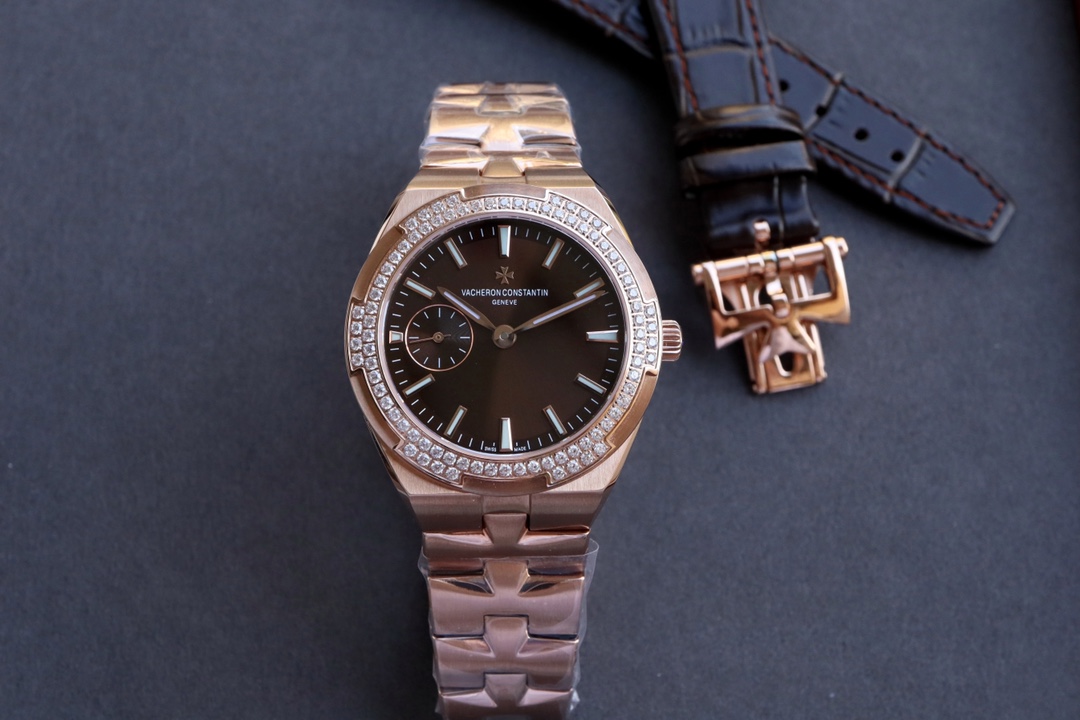
Service life in VC replicas is governed less by advertised components and more by how cleanly tolerances were stacked during assembly. Hand clearance stability, calendar engagement consistency, and axis seating accuracy determine whether a watch ages quietly or begins accumulating friction within months. Parts quality matters, but process control matters more.
In daily wear, failures usually begin as small behavioral changes. The second hand starts to wobble during setting, the minute hand develops intermittent drag, or the calendar hesitates near its change window. These are not isolated defects; they are early expressions of tolerance stacking that was already present at birth.
When assembly discipline is high, these watches can run for years with only routine care. When it is not, no amount of nominally “good” parts will prevent accelerated wear, because misalignment forces components to compensate for geometry that never agreed in the first place.
Assembly quality matters more than component origin
A common misconception is that durability comes primarily from where parts are sourced. In practice, longevity tracks much more closely with axis seating order, spacer calibration, and the pressure applied when modules are stacked. These steps determine whether loads distribute evenly or concentrate at a few stressed interfaces.
If the center axis is seated a touch high, the hand stack compensates. If spacers are a fraction off, calendar components begin to ride against each other instead of floating freely. None of this shows up in marketing descriptions, but all of it defines whether the system settles into equilibrium or slowly grinds itself out of tolerance.
Owners who have cycled through multiple pieces tend to converge on the same conclusion: consistent system assembly discipline produces quiet watches, regardless of component pedigree. Inconsistent assembly produces noisy ones, even when the visible parts look impressive.
Practical judgment tip: hand clearance observation
Set the time slowly and watch how the hands behave as they pass one another. The second hand should maintain a stable height, the hour and minute hands should never brush or hesitate, and there should be no visible wobble as load reverses during setting. These are small motions, but they reveal whether vertical tolerances were respected.
Subtle interference at this stage predicts accelerated wear later. When hands already compete for space, friction migrates into the motion works and calendar drive, shortening service life across the entire system. Treat this as an early warning signal: clean hand stack tolerance today usually means a quieter watch tomorrow, while even minor contact foreshadows compounding problems.
In real ownership cycles, VC replicas reward careful observation far more than optimistic assumptions, and the reader remains the final authority on whether a given watch earns long-term trust.
Does Upgrading the Movement Actually Improve a VC Replica?
In most cases, replacing the movement does not improve a VC replica in any meaningful way. It feels logical to assume that a “better” core will stabilize everything around it, but real-world outcomes rarely follow that path. What actually governs system behavior is how the movement interfaces with the dial, hands, stem, and calendar geometry that were already fixed by the original assembly.
On watches styled after Vacheron Constantin, those interfaces operate inside very narrow margins. Dial feet alignment, center axis height, and calendar coupling were all established around the original stack. Swapping the movement leaves those geometric relationships untouched, so any offset present before the change simply migrates into the new configuration. In practice, upgrades tend to reshuffle stress rather than remove it, often introducing fresh misalignment at the stem or hand stack while failing to resolve the underlying structural imbalance.
Over repeated ownership cycles, this pattern stays consistent — when a watch already exhibits unstable setting feel, drifting alignment, or hesitant calendar engagement, a movement swap almost never restores coherence, it usually converts visible problems into subtler ones, trading obvious symptoms for harder-to-diagnose internal friction, which aligns with the failure-acceleration mechanisms tied to surface choices and tolerance cascades explored in the why color and material choices fail faster on Vacheron Constantin replicas analysis.
Why most “upgrades” fail to change real-world outcomes
Component replacement does not correct geometry. Center axis offset persists because it lives in the case and dial relationship, not inside the movement itself. Dial seating tolerances remain what they were, and stem alignment continues to follow the same tube path, even when the internal engine changes.
This is why alignment behavior dominates performance. If the dial plane is already tilted by fractions of a degree, the hands will continue to travel unevenly. If the stem enters the movement at a slight angle, crown action will still feel inconsistent. None of that disappears with a new movement, because those errors originate upstream in case machining and assembly order.
What changes after an “upgrade” is usually distribution of load. A different movement architecture may shift where resistance accumulates, but it does not realign the system. Owners often interpret this temporary change in feel as improvement, only to discover weeks later that the same drift and interference have simply reappeared in a different form.
Practical judgment tip: setting feel before modification
Before considering any modification, set the time slowly and pay attention to how the system responds. The crown should turn with uniform resistance, without backlash when reversing direction, and without hesitation as the hands cross each other. Crown return should feel predictable rather than springy or delayed.
If this behavior already fails, an upgrade will not address the root cause. Irregular setting feel usually indicates axis misalignment or uneven dial seating, and those conditions remain after movement replacement. Treat this as a diagnostic gate: when coherence is missing at the interface level, changing internals only masks the problem temporarily.
Why VC Replicas Stratify More Sharply Than Other Brands
VC replicas separate into usable and unusable categories faster than most designs because their geometry leaves almost no margin for error. Open dials expose every axis, thin typography amplifies baseline drift, and minimal visual structure removes opportunities to hide misalignment. Even small deviations become visible and tactile within normal handling.
This creates a low tolerance stacking margin. Each assembly step consumes part of that margin, and once it is gone, the system has no buffer left. Two watches may share similar parts, yet one settles into quiet operation while the other accumulates micro-friction from day one. The difference lies in how cleanly those tolerances were stacked, not in how impressive the components appear.
As a result, vacheron constantin super clone pieces tend to reveal manufacturing truth early. Geometry either agrees with itself, or it does not. There is very little middle ground, and that is why buyers encounter such extreme variance across outwardly similar examples.
Guangzhou production realities and tolerance economics
In Guangzhou replica watch production, throughput pressure shapes outcomes more than intent. Fixtures vary slightly from bench to bench, alignment stages rely on manual judgment, and quality control windows compress when volume rises. Each of these factors introduces small inconsistencies that accumulate across the assembly chain.
This does not stem from negligence but from economics: manual alignment takes time, and time competes directly with output, so when that balance tilts toward speed, tolerance control becomes probabilistic rather than enforced — a dynamic reflected in the long-term service behavior and maintenance trajectories laid out in the long-term behavior and maintenance implications for Vacheron Constantin super-clone watches, where some watches exit with well-centered dials and clean axis seating while others leave with barely perceptible offsets that later define their entire service life.
Understanding this context helps recalibrate expectations. Variance arises from process discipline, not from bad faith, and that variance is exactly what buyers feel when two similar-looking watches behave completely differently on the wrist.
Practical judgment tip: three-signal acceptance rule
Before committing to any piece, look for agreement across three behaviors: dial centering, crown resistance, and hand clearance. The dial should sit square in the case, the crown should wind with continuous resistance, and the hands should pass without wobble or contact. These signals are independent, yet they converge on the same underlying geometry.
When all three align, the system usually settles into stable operation. When even one fails, the odds of long-term coherence drop sharply. This compact framework does not guarantee perfection, but it filters out watches whose alignment behavior already contradicts itself.
Closing Judgment: VC Replicas Reward Process Discipline, Not Optimism
VC replicas ultimately favor watches built with quiet geometry over those chosen on appearance alone — a distinction underscored throughout the field evaluation of dimensional fidelity and structural discipline in the Vacheron Constantin replica structural and alignment performance review — and the reader remains the final authority on whether a given piece demonstrates that discipline in real use.