
This guide analyzes the engineering trade-offs and aesthetic divergence between the two pillars of Vacheron Constantin’s dress watch catalog. We evaluate how Guangzhou factories navigate the minimalist challenges of the Patrimony versus the ornamental complexities of the Traditionnelle to help buyers identify the superior Super Clone for their specific requirements.
Lineage and Replication Complexity
Minimalist Symmetry vs. Ornamental Masking
The 1950s minimalist architecture of the Patrimony series dictates a manufacturing tolerance where any deviation in dial symmetry becomes a critical failure point. Because the design lacks decorative elements, the alignment of the “pearl” minute markers and the central axis of the hands must be executed with absolute geometric fidelity. Specifically, the sparse opaline surface offers no concealment for flaws in indices placement or printing errors, unlike busier sports models. Consequently, factories must prioritize the exact centering of the Malte Cross logo to avoid an immediate visual tell of mechanical deviation. Therefore, the replication of this series remains a high-stakes endeavor where the lack of ornamental distraction exposes even sub-micron assembly inconsistencies to a trained auditor.
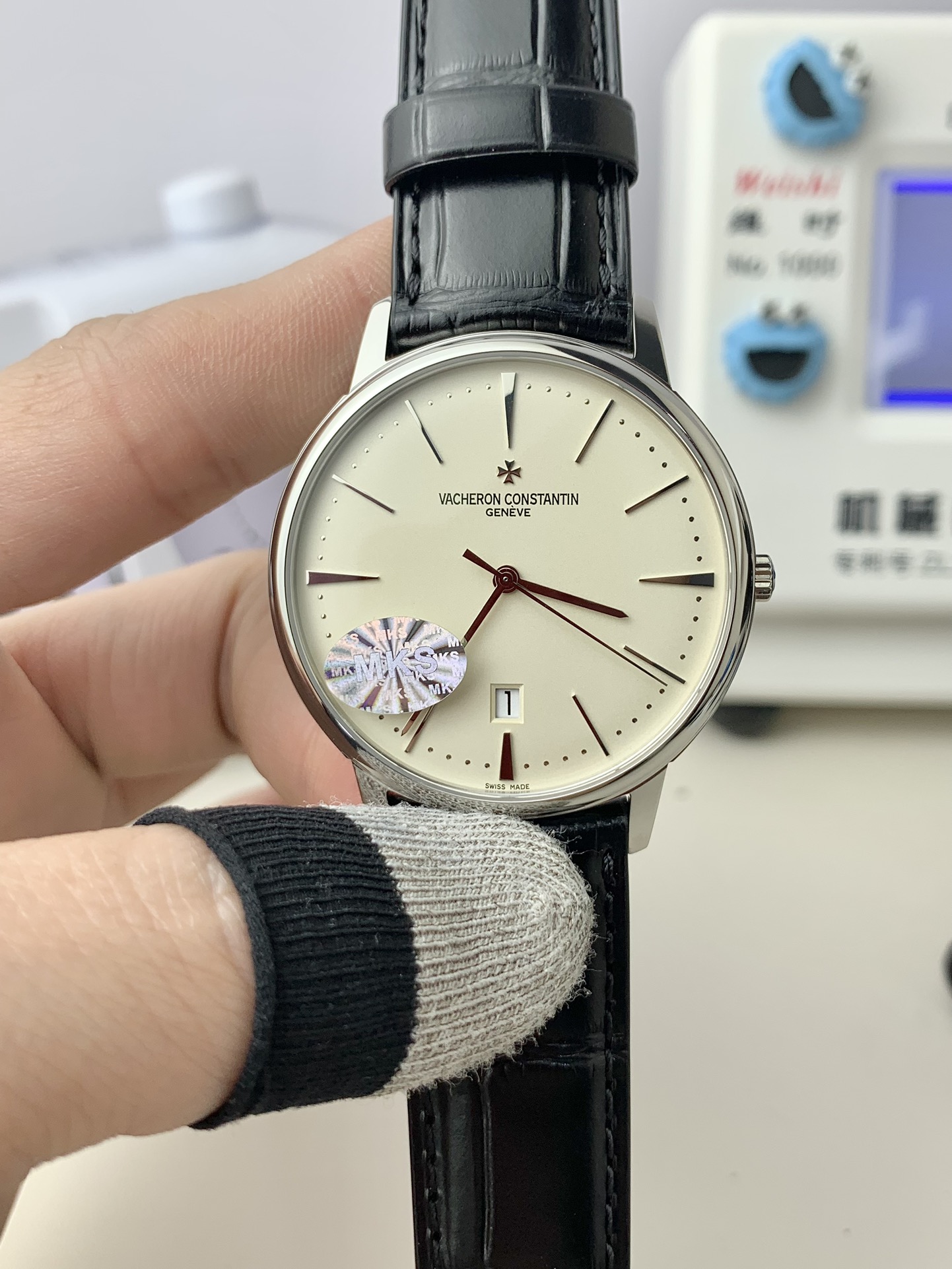
In contrast, the Traditionnelle series draws from the Cabinotiers tradition, utilizing a multi-tiered case and railroad minute tracks that introduce significant visual noise. This structural complexity allows manufacturers to effectively mask minor variances in dial depth or hand-stack height that would be glaring in a simpler layout. Specifically, the stepped bezel and fluted case back create a three-dimensional silhouette that distracts the eye from slight deviations in the 9.5mm or 10.2mm case thickness measurements. Moreover, achieving the ultra-thin profile required for these dress watches presents a far higher engineering barrier than the more robust 11mm Overseas series. Consequently, the transition from a standard 3.9mm Miyota 9015 movement to a modified ultra-thin configuration often results in stability trade-offs that factories must navigate through specialized housing.
Judgment Tip: Inspect the “phantom space” between the crystal and the dial; a high-quality Patrimony replica must maintain a vacuum-like closeness to achieve the genuine’s “thin” visual effect.
Geometry and Dial Finishing: Minimalism vs. Ornamentation
Topographic Execution of the Patrimony Dial
The Patrimony dial necessitates a precise convex curvature that terminates at the minute track, a feature often flattened in lower-tier replications. Specifically, the 40mm opaline surface must demonstrate a gradual drop-off to accommodate the hands without creating parallax error. To achieve this, factories like ZF and MKS manually curve the tips of the minute hands to mirror the dial’s topography. Consequently, this adjustment ensures that the hands do not collide with the sapphire crystal while maintaining a low-profile hand-stack height. Moreover, the refraction of light across this curved plane is the primary indicator of a high-fidelity die-pressing process.
Judgment Tip: Tilt the watch at a 45-degree angle and observe the minute hand tip; it must follow the exact downward slope of the dial edge, a key metric in the Patrimony Moonphase 4010U hand-to-dial clearance inspection, without touching the crystal.
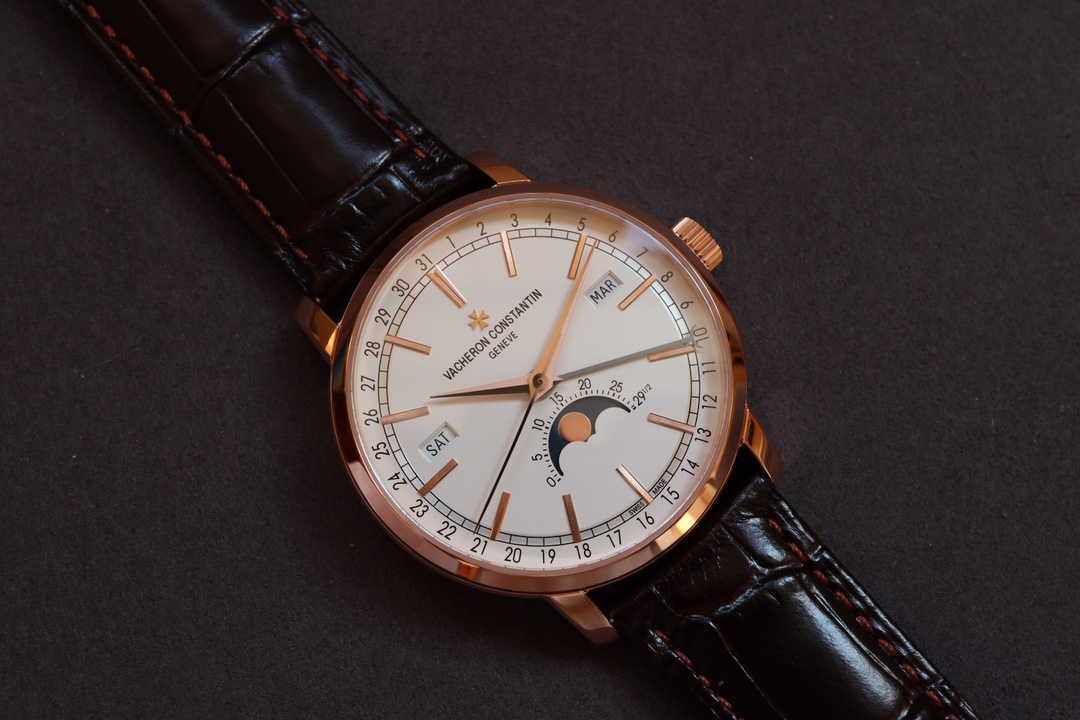
Ornamental Precision in the Traditionnelle Layout
The Traditionnelle 82172 features a stepped dial periphery and an auxiliary sub-seconds register at the 6 o’clock position that requires strict mechanical equivalence. Specifically, the dauphine hands must be finished with a sharp longitudinal crease to ensure optimal light reflection on the polished facets. In contrast to the Patrimony’s applied pearl markers, the Traditionnelle relies on a crisp railroad track that requires high-resolution pad printing to prevent ink bleed. Therefore, the depth of the sub-seconds recess is a critical diagnostic for assessing the modification of the base movement’s gear train. Furthermore, the applied indices must be analyzed for adhesive residue, as high-end clones use friction-fit pins rather than surface-level epoxy.
Judgment Tip: Use a 10x loupe to check the “Malte Cross” logo; on high-end Traditionnelle clones, the cross should be a separate, polished component with sharp interior angles, not a flat stamping.
Case Architecture and the Engineering of Thinness
Volumetric Fidelity and Movement Housing
Replicating the Patrimony 81180 requires a radical reduction in case thickness to achieve the benchmark 6.8mm profile. KZ factory attempts this by utilizing a modified Miyota 9015 movement where the automatic winding assembly is removed to minimize vertical height. Consequently, the case must maintain a monoblock illusion with a nearly invisible seam between the bezel and the mid-case. Specifically, the reduction in internal clearance forces the arbour friction and pivot points to operate within extremely tight tolerances. Therefore, any deviation from the genuine 40mm diameter-to-thickness ratio results in a loss of the series’ signature elegance.
Judgment Tip: Drag a fingernail across the seam between the bezel and the case body; a high-fidelity monoblock replication will feel like a single, continuous piece of 316L steel.
Crown Integration and Structural Masking
The Traditionnelle’s architecture utilizes a stepped bezel and a fluted case back to disguise the inherent bulk of replica movements. Specifically, this complex case-side geometry breaks up the vertical plane, allowing a 10mm thickness to appear visually comparable to the genuine’s thinner dimensions. Moreover, the crown engagement must be audited for its near-flush fit against the case tube to ensure the crown does not protrude excessively. Mid-tier factories often fail this integration, resulting in an elongated tube height that disrupts the watch’s circular symmetry. Consequently, the interaction between the crown and the fluted case back serves as a primary indicator of structural engineering fidelity.
Judgment Tip: Measure the case thickness with digital calipers; a Super Clone Patrimony exceeding 9mm loses the “dress watch” silhouette, whereas a Traditionnelle can “absorb” 10mm due to its stepped bezel design.
Movement Aesthetics and Case Back Fidelity
The Deco-Plate Challenge of Calibre 1400/4400
The primary obstacle in Traditionnelle replication is the visual emulation of the Poinçon de Genève (Geneva Seal) finishing on the manual-wind Calibre 1400 or 4400. Guangzhou factories typically employ decorative plates (deco-plates) over a base movement—often a Seagull or modified Miyota—to mimic the bridge architecture and rubies. Specifically, the depth of the “Côtes de Genève” and the angle of the “anglage” (bevelling) serve as the most immediate tells under magnification. While high-end clones achieve a convincing layout, they often lack the functional depth of the genuine’s escapement positioning. Consequently, the visual “stillness” of the movement in an open-back 82172 requires a higher level of scrutiny than its solid-back counterparts.
Judgment Tip: Observe the “perlage” and “Côtes de Genève” under direct light; genuine finishing reflects light in a rainbow spectrum, while lower-tier clones exhibit grey, dull machining marks.
Case Back Security and Rotor Dynamics
The Patrimony 81180 remains a superior “NWBIG” (Not Worth Buying Gen) candidate largely due to its solid screw-down case back, which eliminates the movement as a visual point of failure. In contrast, automatic versions like the Patrimony 85180 utilize a modified Miyota 9015 that, according to VC Patrimony and Traditionnelle movement and acoustic evaluation, introduces the notorious “Miyota rattle” during high-speed axial oscillation. Specifically, the unidirectional winding rotor generates a distinct vibration and acoustic signature that differs from the near-silent, ceramic-bearing rotors of genuine Vacheron movements. Therefore, the choice between a manual-wind Traditionnelle and an automatic Patrimony often hinges on whether the user prioritizes visual accuracy through the sapphire glass or tactile/auditory discretion on the wrist.
Judgment Tip: Perform a “snap-rotation” of the watch near your ear; if the rotor continues to spin freely with a high-pitched metallic whir, it confirms a standard Miyota base rather than a dampened high-tier modification.
Factory Hierarchy: Who Rules Which Series?
Specialized Engineering: KZ vs. MKS
The market for the Patrimony is currently bifurcated between the technical minimalism of KZ Factory and the price-to-performance ratio of MKS. KZ Factory has achieved a breakthrough with the 81180 by heavily modifying the movement to reach a case thickness that approximates the genuine’s 6.8mm profile, making it the definitive choice for purists. Conversely, MKS dominates the 85180 (automatic) category, offering a robust, reliable build that sacrifices absolute thinness for mechanical stability. Specifically, MKS focuses on dial texture and “pearl” marker alignment, providing a high-fidelity aesthetic at a lower entry cost. Consequently, the decision between these factories should be based on whether “thinness” or “dial-side perfection” is the primary priority.
Judgment Tip: If the seller cannot name the factory for a “Super Clone” 81180, check the strap; KZ usually ships with a higher-grade calfskin that mimics alligator better than the plastic-feeling straps of budget versions.
Complexity and Complications: The 8F Dominance
For the Traditionnelle series, especially those featuring moonphase or tourbillon complications, 8F Factory remains the dominant manufacturer. They have successfully replicated the multi-tiered dial complexity of the Traditionnelle Moonphase, ensuring that the lunar disc’s texture and the power reserve indicator remain visually coherent. Specifically, 8F utilizes customized modules that allow these complications to function, even if the sub-dial spacing differs slightly from the genuine Calibre 2460. Moreover, their execution of the fluted case back and stepped bezel provides the necessary structural “masking” to hide the increased thickness of these complicated movements. Therefore, for any Traditionnelle beyond the base time-only model, 8F provides the most consistent engineering output.
Judgment Tip: On 8F Traditionnelle moonphase models, check the moon’s texture; it should have a matte, cratered appearance rather than a shiny, flat-printed finish.
The Selection Framework: Scenario-Based Decision Making
Wardrobe Integration and Aesthetic Longevity
The Patrimony’s Bauhaus-inspired simplicity makes it the quintessential “Black Tie” companion, designed to disappear under a tuxedo cuff. Its lack of texture and minimal dial furniture ensure it remains timeless, though its expansive polished surfaces are prone to showing hairline scratches. In contrast, the Traditionnelle’s railroad tracks and dauphine hands offer a more “Executive Daily” aesthetic that pairs naturally with business-casual attire. Specifically, the “visual noise” of the Traditionnelle’s design provides a level of architectural depth that remains engaging even in well-lit office environments. Consequently, the Traditionnelle is often the more versatile choice for those who do not strictly adhere to formal dress codes.
Judgment Tip: For daily wear, prioritize the Traditionnelle; its busier design hides the micro-scratches that inevitably appear on the expansive, polished surfaces of the Patrimony case.
Material Selection: Steel vs. Plated Gold
When selecting a Super Clone, the longevity of the finish is as critical as the movement’s accuracy. White Gold (replicated in 316L Stainless Steel) offers the highest durability, as it lacks a surface coating that can wear down over years of friction against shirt cuffs. If choosing a Rose Gold (RG) variant, ensure the factory uses a high-micron PVD or IPG plating to prevent the “fading” effect commonly seen on budget replicas. Specifically, the Traditionnelle’s stepped case provides more edges where plating might first show wear, whereas the Patrimony’s smooth curves distribute friction more evenly. Therefore, for long-term ownership exceeding three years, the “White Gold” (Steel) Patrimony 81180 remains the most resilient choice in the catalog.
Judgment Tip: Inspect the inner lugs of a Rose Gold clone; if the plating is thin or missing in the corners where the spring bar meets the case, it indicates a low-quality PVD process that, according to the VC Traditionnelle 82172 plating and finishing quality guide, will likely fail on external surfaces.