
Case Geometry and Vertical Profile Architecture
Vertical Height Adjustments in Super Clone Cases
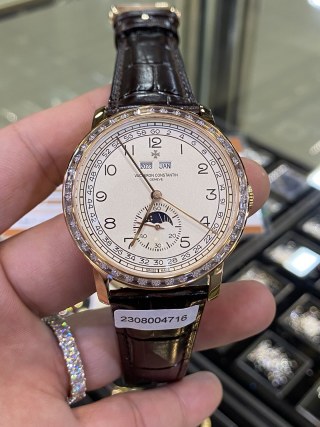
The genuine Ref. 4010U maintains a slender 9.7mm profile, a feat achieved by the integrated caliber 2460 R31L. In the realm of mechanical equivalence, factories typically utilize the Miyota 9015 as a base, which measures 3.9mm before adding the retrograde and moonphase modules. This modular stacking necessitates a case expansion, often resulting in a total thickness ranging from 10.8mm to 11.5mm. To mitigate this optical deviation, engineers employ a stepped caseback design to hide the extra 1.1mm to 1.8mm within the wrist’s shadow. The mid-case must be precisely machined from 316L stainless steel to ensure the proportions of the bezel and lugs remain consistent with the original silhouette.
Lug Curvature and Strap Integration
Proper geometric fidelity requires a steep downward lug angle to compensate for the increased case thickness and ensure ergonomic wrist contact. High-end fabricators use five-axis CNC machinery to replicate the subtle taper of the 40mm case, focusing on the seamless transition to the alligator-grain leather strap. The spring bar holes are drilled at a specific depth to prevent the strap from rubbing against the case wall, a common failure in lower-tier iterations. Precision in the lug-to-lug distance, ideally capped at 48mm, is vital for maintaining the dress watch aesthetic of the Patrimony line. This ensures the watch does not “hover” over the wrist despite the added mechanical bulk of the calendar module.
Judgment Tip: Use digital calipers to measure the total thickness from the center of the sapphire crystal to the caseback; any measurement exceeding 10.5mm confirms a modular Miyota or Seagull base rather than a true integrated movement.
Moonphase Disk Materiality and Optical Accuracy
Materiality of the Moon and Star Decals
While the genuine moonphase features an 18K gold disk, technical replicas utilize PVD-gold plating over a brass or steel substrate to achieve a similar chromatic profile. The vacuum-deposition process ensures a uniform color temperature, though it lacks the deep, soft luster of solid precious metal under varying light angles. High-fidelity disks must display sharp, well-defined “moon” edges without the bleeding often seen in cheap pad-printing techniques. The “stars” surrounding the lunar bodies are applied via miniature transfers, requiring a high-resolution plate to avoid pixelation under a 10x loupe. This technical compromise is the primary “tell” for experts who analyze the reflectivity of the lunar surface.
Aperture Edge Finishing and Depth
The “cloud” border of the moonphase aperture at 6 o’clock requires meticulous sink-hole polishing to avoid raw metal burrs. In the manufacturing process, the dial is stamped from a thin brass plate and then galvanized to achieve the signature “opaline” silver finish. The depth between the dial surface and the moonphase disk must be kept within a 0.2mm tolerance to ensure visual depth without creating a shadow gap. Poorly executed apertures often show inconsistent paint application at the edges or visible debris from the CNC cutting process. Ensuring a clean radius on the aperture’s curves is essential for passing the initial optical inspection of the complication.
Judgment Tip: Inspect the “stars” under 10x magnification; high-quality VC moonphase replicas use crisp, individual transfers rather than a blurred, singular plate print, a critical quality marker detailed in the VC Traditionnelle 82172 replica and dial finishing guide.
Retrograde Dynamics and Hand Stack Engineering
Hand Stack Sequence and Clearance
The integration of a retrograde date hand necessitates a complex four-tier hand stack involving the hour, minute, and calendar indicators. Engineers must maintain a vertical clearance of at least 0.15mm between each hand to prevent friction-induced “stuttering” or total mechanical seizure. The arbour friction must be perfectly calibrated, as the retrograde hand covers a wide 180-degree arc on the upper half of the dial. Any deviation in the pinion height results in the hands sitting at an angle, which can be detected by viewing the dial from a sharp horizontal perspective. Proper re-tensioning of the hand-setting assembly is required to ensure that the date hand aligns perfectly with the printed date track.
The Snap-Back Mechanism Reliability
The 180-degree “snap-back” from the 31st to the 1st is governed by a specialized cam and spring-loaded lever system. In these modified modules, the spring tension must be high enough to facilitate a crisp, instantaneous jump without bouncing past the “1” marker. If the tension is insufficient, the hand will “drag” or stop midway, indicating a failure in the mechanical logic of the module. This component is the most frequent point of failure in high-complication replicas due to the high kinetic energy involved in the return stroke. Longevity is dependent on the hardness of the steel used for the retrograde cam, which must resist wear over thousands of cycles.
Judgment Tip: Manually advance the date from the 31st to the 1st using the crown; if the hand fails to return instantly to the “1” position or stops halfway, the spring tension in the retrograde module is insufficient.
Movement Architecture and Caliber 2460 R31L Implementation
Base Engine Selection: Miyota 9015 vs. Seagull Variants
The 3.9mm height of the Miyota 9015 provides the necessary overhead for the retrograde date and moonphase modules without exceeding the 12mm total thickness threshold. While Seagull ST2130 variants offer a robust 28,800vph beat rate, their thicker architecture would push the case height beyond acceptable dress watch parameters. The 9015’s slim profile allows for the addition of decorative plates that mimic the aesthetic of the genuine caliber 2460 R31L. Consequently, the Guangzhou ecosystem standardizes on this Japanese base to achieve the required mechanical equivalence in high-end clones. This selection ensures that the movement remains reliable while supporting the high torque requirements of the retrograde hand.
Decorative Bridge Work and Rotor Weighting
The skeletonized Maltese Cross rotor is a critical focal point, often machined from tungsten to provide the mass required for efficient bi-directional winding. Decorative bridge plates are laser-engraved with Côtes de Genève patterns and perlage in the sink-holes to distract from the underlying Miyota architecture. However, the geometric fidelity of the “2460 R31L” engraving often reveals slight optical deviations in font weight compared to the genuine movement. Technical flaws often persist in the depth of the rubies’ pivot points, which are frequently non-functional aesthetic caps rather than true friction-reducing bearings. Despite these deviations, the visual impact through the sapphire caseback remains convincing to the unaided eye.
Judgment Tip: Hold the watch close to your ear and perform a quick wrist flick to listen for the signature “Miyota rattle” caused by the high-speed uni-directional rotor.
Dial Geometry and Marker Alignment Sensitivity
Applied Index Centering and Adhesion
The alignment of the applied batons at the 3, 9, and 12 positions is critical for maintaining the dial’s symmetrical balance. Each index is secured via two tiny pins through the dial plate, requiring precise CNC drilling to prevent crooked adhesion. Particular attention must be paid to the 6 o’clock marker, which must be perfectly centered on the vertical axis of the moonphase window. Any deviation here creates a “tilted” appearance that is immediately visible under magnification. In high-tier clones, these indices are polished to a mirror finish, ensuring they catch light with the same intensity as white gold.
The “Pearl” Minute Track Execution
The “Pearl” minute track consists of rounded, spherical markers that simulate the 18K gold beads found on the original dial. In superior clones, these pearls are individually drilled and press-fitted, whereas lower-tier versions rely on raised metallic paint which lacks the proper three-dimensional relief. The spacing between these markers must remain consistent around the entire perimeter to avoid crowding near the retrograde arc. Proper execution requires a clean-room assembly environment to prevent dust or microscopic debris from adhering to the galvanised opaline surface. The subtle reflection of these pearls is a primary indicator of the factory’s commitment to optical accuracy.
Judgment Tip: Use a 10x loupe to inspect the 12 o’clock Maltese Cross for horizontal symmetry and to ensure the four arms are perfectly aligned with the center of the 12 o’clock index.
Operational Protocol: Adjusting the Complications
Identifying the Quick-Set Pushers
The Ref. 4010U case features recessed pushers located on the case flanks to facilitate quick-set adjustments for the moonphase and date. These actuators interact with internal levers that override the gear train’s standard advancement logic. A high-quality assembly provides a tactile, spring-loaded feedback that confirms the internal pawl has successfully engaged the wheel tooth. Technicians must ensure the pusher pins are the correct length to prevent “mushy” engagement or accidental double-jumping of the complication. Understanding the tactile resistance of these pushers is essential for identifying a well-calibrated movement module.
Avoiding the “Danger Zone” Calendar Jam
The “Danger Zone” between 9 PM and 3 AM represents the period where the movement’s date-change finger is engaged with the calendar wheel. Attempting to use the quick-set pushers during this window can lead to sheared teeth or the permanent misalignment of the retrograde hand’s spring tension. In the modified Miyota architecture, the retrograde module is particularly sensitive to these forced adjustments due to the delicate nature of the return spring, a mechanical vulnerability detailed in the Vacheron Constantin Traditionnelle 82172 replica movement and maintenance guide. Owners must manually advance the time past midnight before making any corrections to the moonphase or date to protect the movement’s longevity, as failure to observe this protocol often results in a “stuck” date hand that requires a full movement teardown.
Judgment Tip: Use a wooden toothpick to depress the recessed pushers at 2 and 4 o’clock, feeling for a sharp “click” that indicates positive mechanical engagement of the complication module.
Value Judgment: Complication Utility and Dimensions
Longevity of Complicated Modules in Replicas
Complicated retrograde modules in the replica market carry a higher risk of mechanical failure than standard three-hand movements due to the complexity of the “snap-back” spring. While the base Miyota 9015 is highly reliable, the custom-built calendar plate is often difficult to repair or source parts for if the main spring loses its re-tensioning capacity. Users should expect a higher maintenance overhead, as the added arbour friction can impact the power reserve over several years. Statistical data from repair centers suggests that the retrograde hand’s alignment is the most common point of technical drift in these specific models. Regular servicing every 2-3 years is recommended to maintain the integrity of the complication.
The Wearability Factor and Wrist Presence
The transition from a 9.7mm genuine profile to an 11mm replica height significantly alters the watch’s wrist presence from a discreet dress piece to a more substantial “conversation” watch. The added verticality is most noticeable when wearing French-cuffed shirts, where the extra 1.3mm may catch on the sleeve. However, the mechanical theater provided by the 180-degree retrograde jump and the luminous moonphase disk offers a visual complexity rarely seen in simple dress watches. This “thickness tax” is the price for functional mechanical equivalence in an environment where true ultra-thin integrated calibers are not commercially viable. For many collectors, the functional retrograde hand outweighs the deviation in case thickness.
Judgment Tip: Measure the watch’s total height with a digital caliper; if the measurement is above 11.5mm, the case architecture is likely an older, non-optimized version of the 4010U clone, a critical dimension check discussed in the VC Patrimony Traditionnelle dress watch replica guide.