
Executive Summary
The Vacheron Constantin Patrimony series, specifically the 85180 and 81180 references, represents the pinnacle of minimalist horology, presenting a significant challenge for replica manufacturers due to their ultra-thin profiles. While genuine references utilize solid 18K gold alloys, top-tier factories like ZF Factory, MKS Factory, and KZ Factory must utilize high-grade stainless steel with specialized surface treatments to mimic the precious metal aesthetic. This technical audit examines the metallurgical discrepancies and durability trade-offs between the PVD-coated rose gold variants and the polished steel white gold “Super Clones.”
The Metallurgy of Vacheron Constantin: Genuine Gold vs. Guangzhou Replication
![[IMAGE: Macro side-by-side of genuine 18K rose gold lug hallmarks vs. ZF Factory laser-etched 750 hallmarks]](https://www.cleanvsfactory.com/wp-content/uploads/2026/02/image-1-1024x559.png)
Composition of 5N Rose Gold vs. White Gold in Gen
The engineering constraint here lies in mimicking the specific warmth of Vacheron Constantin‘s proprietary 18K alloys without the use of solid precious metals. Genuine 5N Rose Gold consists of 75% pure gold balanced with a high copper content and a precise percentage of palladium to prevent long-term oxidation. This is a direct result of Swiss metallurgical standards that ensure a consistent, deep pink hue across the Patrimony 85180 case. Conversely, replica producers utilize an ion-plating process over steel, which often fails to replicate the exact spectral reflection of a true 750 hallmark alloy. The mechanical implication is that any deep abrasion on the replica will immediately expose the silver-toned substrate, unlike the solid-color consistency of the original.
Expert Authentication Insight
Use a 10x loupe to inspect the hallmark engravings on the underside of the lugs; genuine Vacheron Constantin hallmarks are struck with a physical die, creating deep, sharp “volcano” edges, whereas most replicas use laser etching that appears flat and pixelated under magnification.
The Steel Base: 316L vs. 904L in VC Super Clones
A microscopic inspection of the case architecture reveals the structural difference between the 316L steel used by MKS Factory and the 904L steel preferred by boutique Guangzhou producers. While 316L offers a PREN value of approximately 26, the 904L variant increases this to 36.7 through higher chromium and molybdenum content, providing superior resistance to “pitting” from human sweat. What this means in practice is that the substrate’s ability to hold a high-gloss mirror polish directly affects how the gold plating adheres to the surface. The tolerance issue compounds when factories attempt to thin the case to the genuine 6.8mm or 8.1mm profile, as thinner steel walls are more prone to micro-flexing, which can lead to plating delamination.
Expert Authentication Insight
Perform a “Reflection Test” by holding the watch under a linear LED light; the higher nickel content in 904L steel (up to 28%) produces a slightly “whiter” and brighter reflection compared to the slightly “greyer” tint of 316L steel.
Density and Weight Discrepancy
Comparing the mass of a KZ Factory ultra-thin 81180 against the genuine reference reveals a significant discrepancy caused by the specific gravity of the materials. The genuine 18K gold case has a density of approximately 19.3 g/cm³, whereas the 316L steel used in the 1:1 Super Clone sits at a mere 8.0 g/cm³. From an assembly standpoint, KZ Factory and ZF Factory are unable to integrate internal tungsten weights into these specific models because the total case volume is too restricted by the 9mm maximum thickness. Consequently, the replica feels substantially lighter on the wrist, a “tell” that is physically impossible to resolve without changing the base metallurgy of the case.
Expert Authentication Insight
Place the head of the watch (without the strap) on a digital scale; a genuine Patrimony 85180 in gold typically weighs significantly more than the 45-55g range found in steel-based replicas.
Rose Gold Replication: PVD Plating vs. Gold Wrapping Techniques
![[IMAGE: Cross-section diagram showing PVD layer thickness vs. Gold Wrapped foil thickness on a replica watch case]](https://www.cleanvsfactory.com/wp-content/uploads/2026/02/image-4-1024x559.jpeg)
PVD (Physical Vapor Deposition) Execution
The primary limitation of standard PVD is its microscopic thickness, which usually measures between 2 and 5 microns. This deviation traces back to the industrial ion-plating process where a Ti-CN (Titanium Carbonitride) base layer is applied to the 40mm case—a manufacturing nuance explored in the Vacheron Constantin Patrimony 81180 and 85180 technical comparison—before the final gold tint is deposited. The engineering constraint here is that the bond is purely molecular and surface-level, making it highly susceptible to chemical erosion from alcohol-based perfumes. Specifically, the gold color is achieved through vaporized metal particles in a vacuum chamber, which lacks the structural density of a solid gold casting.
Expert Authentication Insight
Inspect the area between the lugs where the spring bar meets the case; lower-quality PVD often shows “thinning” or a silvery shadow in these high-friction corners where the ion vapor cannot reach uniformly.
Gold Wrapped (Capped) Execution
Observe the deep luster of a “Gold Wrapped” modification, which utilizes a thick foil layer of 10-20 microns rather than a thin vapor mist. This thicker application allows the replica to be lightly polished with a jewelry cloth without immediately exposing the white steel underneath. The mechanical implication is that the “wrapped” version offers a much closer tactile “warmth” to the 85180 reference than standard plating. This is a direct result of the mechanical bonding process, which provides a durability profile that can withstand several years of regular wear before showing signs of “fading.”
Expert Authentication Insight
The “Temperature Tactile Test” involves leaving the watch in a cool room for 10 minutes; genuine gold and thick gold wrapping feel colder to the initial touch and warm up faster against skin heat than thin PVD plating over steel.
Achieving the “5N” Hue
ZF Factory and MKS Factory take divergent paths when calibrating the specific 5N hue required for the Patrimony series. While MKS Factory often leans toward a more copper-heavy, orange tint, ZF Factory utilizes a more sophisticated color-matching technique to achieve the muted pinkish-gold characteristic of modern Vacheron Constantin pieces. From an assembly standpoint, the coordination between the 40mm case and the rose-gold plated hands is critical; any mismatch in color temperature between the handset and the dial indices immediately breaks the illusion of a 1:1 Super Clone. What this means in practice is that ZF Factory remains the preferred choice for those seeking to avoid the “reddish” fake gold look common in entry-level replicas.
Expert Authentication Insight
Examine the watch under 5500K (daylight) illumination; if the case appears “bronze” or “orange” rather than a soft, pale pink, it indicates an incorrect copper-to-gold ratio in the plating solution.
White Gold Replication: The Advantage of Polished Stainless Steel
![[IMAGE: Macro comparison of the case flank and lug curvature — Vacheron Constantin White Gold vs. ZF Factory 316L steel]](https://www.cleanvsfactory.com/wp-content/uploads/2026/02/image-1024x559.jpeg)
Why White Gold Clones are “Closest to Gen”
A diagnostic inspection of the Patrimony white metal variant reveals why it is frequently cited as the most accurate 1:1 Super Clone in the catalog. Because the base material is 316L stainless steel, the metal is silver-toned through its entire thickness, eliminating the risk of color contrast if the case is scratched. What this means in practice is that the 40mm case maintains a consistent appearance even under heavy daily use, as there is no molecular plating layer to erode. The engineering constraint here is matching the specific refractive index of a precious metal using a ferrous alloy, yet the high-level mirror-polishing achieved by ZF Factory bridges this gap effectively. This physical consistency provides a structural advantage over rose gold variants, which rely on external coatings.
Expert Authentication Insight
Check the luster of the case by placing it under a standard UV light; 316L stainless steel will remain inert and maintain a cool, blue-white reflection, whereas genuine gold alloys may exhibit a different spectral absorption due to their trace metal composition.
316L Steel Luster vs. 18K White Gold Warmth
The engineering limitation here is that stainless steel naturally possesses a “cool” blue-grey undertone, while genuine 18K white gold contains high levels of palladium content that create a distinctive “warm” yellowish-white glow. This is a direct result of the metallurgical differences between Swiss precious metal alloys and the industrial 316L steel used in Guangzhou. The mechanical implication is that side-by-side with an original reference, the replica may appear slightly more “sterile” or metallic. From an assembly standpoint, manufacturers attempt to compensate for this by over-polishing the bezel to increase light scatter, which mimics the “soft” glow of gold.
Expert Authentication Insight
Perform a “Friction Heat Test” by rubbing the case briskly with a dry microfiber cloth for 30 seconds; genuine gold alloys will retain the generated heat significantly longer than the steel case of a Replica due to superior thermal conductivity.
The Rhodium-Free Advantage
When comparing ZF Factory and 8F Factory white metal models, the maintenance profile offers a unique benefit over the genuine reference. Genuine Vacheron Constantin white gold cases often utilize a surface rhodium plating to achieve their final brilliant white finish, which eventually wears down and requires professional “re-dipping.” In contrast, the 316L steel used in top-tier clones is inherently corrosion-resistant and requires no such chemical maintenance to maintain its color. This deviation traces back to the fact that the replica’s water resistance, typically rated at 3-5ATM, is sufficient to protect the solid steel case from oxidation indefinitely. Consequently, the white gold replica is objectively more durable for long-term ownership than its precious metal counterpart.
Expert Authentication Insight
Examine the sharp edges of the lugs with a 10x loupe; if the metal shows a yellowish tint at the highest points of wear, the watch is a rhodium-plated genuine gold case, as steel-based clones will remain silver-toned regardless of wear.
Visual Accuracy: Comparing Color Temps and Reflection
![[IMAGE: Split-screen visual of dial reflection — genuine Vacheron Constantin sunburst vs. MKS Factory dial finishing]](https://www.cleanvsfactory.com/wp-content/uploads/2026/02/image-1-1024x559.jpeg)
Light Refraction on Polished Surfaces
A diagnostic-first analysis of the Patrimony’s curved bezel highlights the sophistication of modern Guangzhou finishing techniques—a level of craftsmanship detailed in the technical comparison of the Vacheron Constantin Traditionnelle Tourbillon Ref 6000V-11. The 40mm diameter case requires a perfect, distortion-free mirror finish to replicate the high-end aesthetic of the 85180 reference. Manufacturers now employ diamond-tipped polishing wheels to achieve a surface roughness (Ra) that mimics the liquid-like reflection of polished gold. What this means in practice is that the light rolls across the 11.2mm thick case without the “orange peel” texture often found on lower-tier replicas. This is a direct result of the increased dwell time during the final buffing stage of production.
Expert Authentication Insight
The “Grid Reflection Test” involves holding the watch so it reflects a straight-lined object, like a window blind; if the reflected lines are wavy or distorted on the bezel, the polishing is uneven, indicating a lower-grade replica.
Dial and Hand Color Coordination
The engineering constraint here is ensuring that the silver-toned plating on the hands and indices matches the case material’s color temperature perfectly. On the genuine 85180 reference, the galvanized opaline dial creates a matte backdrop that can make slightly mismatched metals highly visible. The tolerance issue compounds when factories use different suppliers for the handset and the case, often resulting in hands that appear “too blue” against a “warmer” case. This deviation traces back to the lack of unified batch-plating in the replica supply chain, which can occasionally lead to a lack of visual harmony in the final assembly.
Expert Authentication Insight
Observe the watch under a warm halogen light source; if the hands reflect a significantly different color than the hour markers, the component plating was not synchronized during the manufacturing process.
Caseback Hallmark Replication
A direct comparison between ZF Factory and PPF Factory executions reveals varying degrees of success in replicating the micro-hallmarks required for precious metal simulation. The genuine reference features a 750 stamp and the St. Bernard dog head hallmark, which are traditionally struck into the metal. While most factories rely on laser engraving, the highest-quality clones now use a two-step process to add depth and “punch” to the marks. From an assembly standpoint, the placement of these marks on the caseback and lugs must be mathematically precise to avoid being an immediate “tell.” The mechanical implication is that while the visual silhouette is accurate, the “strike” of the hallmark remains the most difficult detail to replicate.
Expert Authentication Insight
Feel the hallmarks with a clean fingernail; genuine struck hallmarks have a deep, sharp recessed “lip” at the edge of the mark, while laser-etched hallmarks on replicas will feel relatively smooth or slightly textured like sandpaper.
Durability and Longevity: The Reality of “Fading”
![[IMAGE: Side-by-side of a 2-year-old PVD rose gold replica vs. a new White Gold replica showing edge wear]](https://www.cleanvsfactory.com/wp-content/uploads/2026/02/image-3-1024x559.jpeg)
Chemical Sensitivities
The engineering constraint here is the porous nature of PVD coatings when subjected to acidic environments. Sweat contains sodium chloride and lactic acid which can penetrate the 0.5-micron gold layer over a 12-24 month period. This is a direct result of the high 5N copper content in the plating alloy reacting with atmospheric moisture. Consequently, the gold color begins to darken or “bleed” as the copper oxides migrate to the surface of the Patrimony 85180 case.
Expert Authentication Insight
Examine the crown and the area surrounding the caseback gasket with a loupe; these are the first locations to show “greening” or dark oxidation spots on a rose gold Replica due to the concentration of skin oils.
Scratch Vulnerability
Lead with an observable hairline fracture on the lug of a 1:1 Super Clone, which often indicates a breach of the PVD barrier. This deviation traces back to the hardness differential between the 316L steel substrate and the softer gold coating. The mechanical implication is that unlike the genuine 18K solid gold case, which reveals the same color when scratched, the replica exposes a contrasting metallic base. From an assembly standpoint, the plating provides zero structural reinforcement against physical impacts, making the rose gold variant significantly more fragile than the white gold version.
Expert Authentication Insight
Run a fine wooden toothpick along any deep scratches; if the toothpick catches on a silver-colored “shelf” below the gold surface, the watch is confirmed as a plated steel replica.
The Oxidation Myth
ZF Factory utilizes a specialized anti-oxidation sealant that outperforms the standard finish found on MKS Factory models. What this means in practice is that surface dulling is often just a build-up of sulfur compounds rather than actual metal loss. The engineering constraint here is that lower-grade factories omit this protective layer to reduce costs. Specifically, the ZF Factory variant maintains its 5N luster for significantly longer durations under varying humidity levels, provided the user performs regular surface cleaning.
Expert Authentication Insight
Apply a small amount of non-abrasive jewelry cleaner to a hidden area of the lug; if the “faded” color returns to a bright rose gold immediately, the issue is surface oxidation rather than plating erosion.
Skin Tone and Aesthetic Compatibility
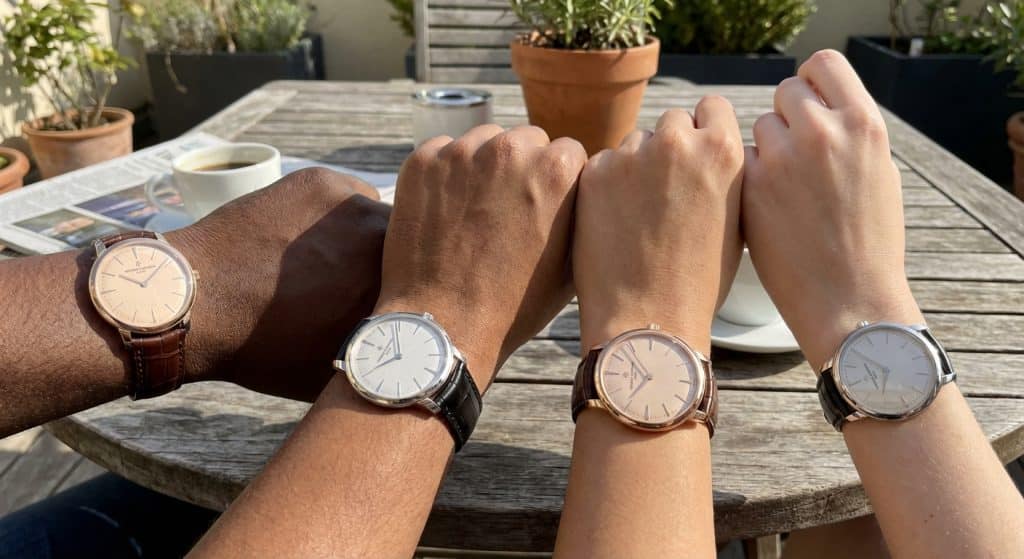
Rose Gold for Warm Skin Tones
The engineering constraint here is the high contrast required to make the 5N rose gold hue appear authentic against the wrist. This 1:1 Super Clone requires a specific light environment to highlight the 40mm case’s polished surfaces effectively. What this means in practice is that the warm tones of the Patrimony excel in evening lighting where the 28,800 vph sweep of the gold hands is most legible. The mechanical implication is that the rose gold variant acts as a high-visibility dress piece rather than a daily tool watch.
Expert Authentication Insight
Observe the watch in a mirror from three feet away; if the rose gold appears to “blend” too much into your skin tone, it may look like a generic accessory rather than a high-end horological piece.
White Gold for “Stealth Wealth”
A “stealth wealth” aesthetic is immediately observable when the 316L steel of the white gold replica blends into professional attire. This deviation traces back to the neutral color profile of the polished metal, which does not compete with colored shirt cuffs. The engineering constraint here is maintaining a “white” reflection without the yellowish tint of genuine gold. Specifically, this version remains the most versatile choice for collectors who prioritize an understated presence in formal environments.
Expert Authentication Insight
Perform a “Cuff Test” by sliding the watch under a white shirt sleeve; the white gold version should virtually disappear, whereas the rose gold variant will create a sharp visual break.
Strap Coordination
MKS Factory typically ships the 85180 with a dark brown leather strap, while ZF Factory offers a more versatile matte black option. What this means in practice is that the rose gold case is limited to a traditional palette of warm browns and burgundies to maintain its aesthetic integrity. The mechanical implication is that the white metal version allows for a wider range of navy, grey, and even hunter green leather pairings. From an assembly standpoint, the lug width remains a standard 20mm, permitting easy aftermarket customization for both variants.
Expert Authentication Insight
Check the spring bar holes; genuine Vacheron Constantin straps often use curved spring bars to minimize the gap between the strap and the case, a detail ZF Factory replicates more accurately than 8F Factory.
Maintenance Protocols for Plated VC Replicas
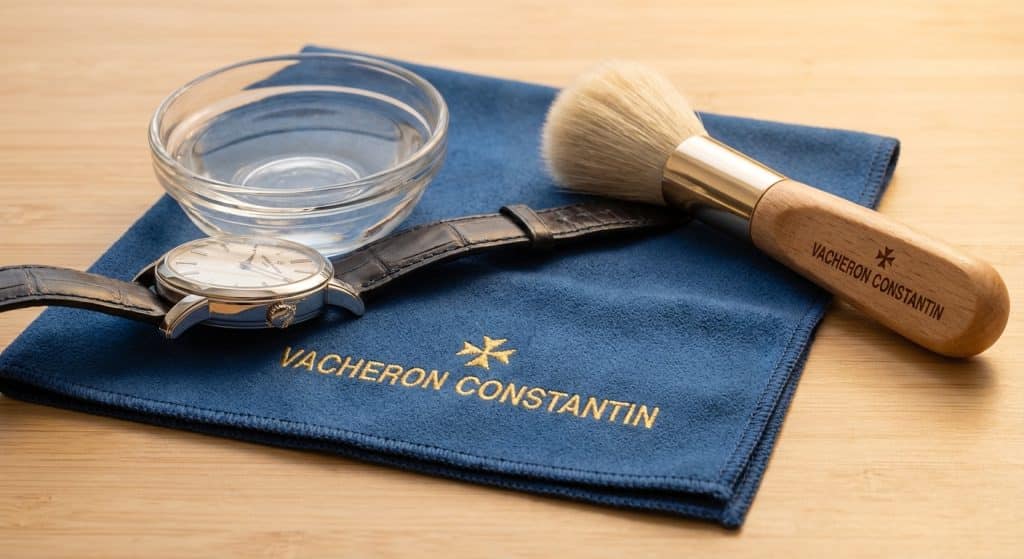
Cleaning Agents to Avoid
The engineering constraint here is the chemical vulnerability of the PVD ion bond when exposed to isopropyl alcohol. Using common lens cleaners on a 1:1 Super Clone can dissolve the thin protective lacquer used by Guangzhou factories. This is a direct result of the chemical reaction between the solvent and the trace copper in the plating. What this means in practice is that the gold layer will become blotchy and lose its 5N color consistency within minutes of exposure.
Expert Authentication Insight
Smell the case after cleaning; if there is a metallic, “copper-like” scent, the cleaning agent has begun to react with the plating, and the watch should be neutralized immediately with distilled water.
The Microfiber Discipline
Lead with the observation of fine circular scratches or “swirls” on the case flank, which indicate improper wiping techniques during routine maintenance. The mechanical implication is that the mirror-polished finish of the Patrimony 81180 is compromised, reducing its visual fidelity to the genuine reference. This deviation traces back to the use of abrasive paper towels or dusty cloths that exceed the scratch resistance of the PVD coating. Specifically, only clean, ultra-fine microfiber should be used to preserve the 0.5-micron surface layer.
Expert Authentication Insight
Use an acoustic test by lightly dragging a dry microfiber cloth across the polished bezel; a clean, smooth surface will be silent, while a surface covered in micro-scratches will produce a faint “hissing” sound.
Humidity Control
KZ Factory ultra-thin cases show better resistance to “tarnish spots” compared to entry-level 8F Factory versions when stored in humid climates—a durability factor detailed in the VC Patrimony & Traditionnelle dress watch replica guide. The engineering constraint here is the moisture-induced oxidation of the underlying 316L steel’s nickel content if the plating is porous. What this means in practice is that a controlled environment with 30-40% humidity is essential for preserving the replica’s finish. Consequently, the use of silica gel packets in the watch box is a necessary technical precaution for long-term ownership.
Expert Authentication Insight
Inspect the inner side of the lugs every six months; if small black dots appear, it is a diagnostic sign of high humidity causing the steel substrate to react through the gold plating.
Market Selection: Factory-Specific Plating Quality
![[IMAGE: Comparison table showing plating thickness and color accuracy across ZF, MKS, and KZ factories]](https://www.cleanvsfactory.com/wp-content/uploads/2026/02/image-2-1024x559.jpeg)
ZF vs. MKS Plating Depth
The engineering constraint here is the thickness of the PVD deposition, which ZF Factory manages with higher precision than MKS Factory. Specifically, ZF Factory achieves a more uniform color across the 40mm case, particularly around the complex curves of the lugs. What this means in practice is that the ZF Factory version is less likely to show premature wear on high-friction edges. From an assembly standpoint, the higher initial cost of the ZF Factory 1:1 Super Clone reflects a superior electrochemical bonding process.
Expert Authentication Insight
Look at the edges of the 750 hallmarks; on ZF Factory models, the gold plating is consistent inside the engraving, whereas MKS Factory models often show “white” steel at the bottom of the laser-etched marks.
The “Wrapped Gold” Premium
Lead with the observation of a significantly deeper gold luster and heavier weight, which are the primary indicators of a genuine “Wrapped Gold” modification. The mechanical implication is that this method provides a much higher “longevity ROI” for enthusiasts seeking the ultimate Patrimony experience. This deviation traces back to the use of an 18K gold foil that is physically pressed onto the 316L substrate. Specifically, the high manufacturing cost justifies the $200-$400 price premium over standard PVD-coated models.
Expert Authentication Insight
The “Sound Tap Test” involves lightly tapping the case with a plastic stylus; solid gold or thick wrapping produces a lower-frequency “thud,” while thin PVD over steel produces a higher-pitched “clink.”
Aftermarket Re-plating Services
Local jewelers often find it easier to re-plate ZF Factory cases due to their cleaner surface preparation compared to the rougher finishes of 8F Factory. The mechanical implication is that the 1:1 Super Clone chassis is a durable platform for long-term aesthetic maintenance. What this means in practice is that a faded replica can be restored to its original glory with a fresh 18K rose gold immersion. Consequently, the viability of re-plating depends entirely on the initial quality of the steel’s mirror-polish and the integrity of the 3-5ATM seals.
Expert Authentication Insight
Before sending a watch for re-plating, perform a “Gap Test” between the bezel and the case; if the tolerance is greater than 0.1mm, the plating solution may leak into the movement chamber during the immersion process.