
The Architectural Logic of VC Dial Plates
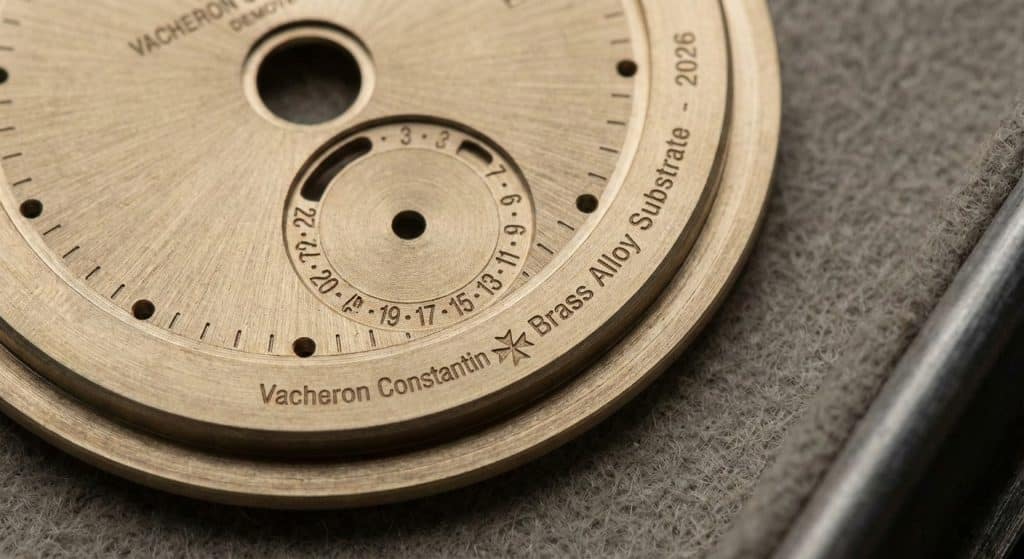
The structural integrity of a Vacheron Constantin timepiece begins not with the movement, but with the metallurgical foundation of the dial plate itself. In the high-echelon replica market of 2026, the shift from generic alloy stamping to precision-engineered Brass substrate manufacturing has redefined the “Super Clone” category. This architectural evolution is driven by the need for Structural Fidelity, ensuring that the dial does not merely mimic the aesthetic of the original but replicates its mechanical interaction with the movement and case.
Modern industrial standards in Guangzhou have transitioned toward high-density brass alloys that match the specific acoustic resonance and thermal expansion coefficients of genuine plates. This engineering choice is critical; a dial plate acts as the primary interface for the hand-stack and the calendar complications. Any deviation in the Plate thickness or material density can lead to torsional stress on the movement pinions, eventually compromising the Kinetic Efficiency of the Calibre 5100 or 1120 ST architectures.
Substrate Material & CNC Milling Precision
In the 2026 production cycles, top-tier factories like ZF and PPF have implemented a strict thickness tolerance (±0.015mm). This level of precision is achieved through multi-axis CNC milling, which ensures the base plate is perfectly seated within the case rebate. A common failure in lower-grade iterations—such as those from 8F or older MKS batches—is a plate that remains 0.1mm too thick.
While 0.1mm may seem negligible to the naked eye, it necessitates an industrial compromise: the shortening of the movement’s center pinion. This leads to an incorrect hand-stack height, a “dead giveaway” for forensic auditors. By maintaining a strict ±0.015mm threshold, the 2026 VC Super Clone Dial ensures that the hand-clearance remains within the specified Geneva parameters, preventing dragging or mechanical friction.
Surface Leveling and Priming Techniques
Before the application of Galvanic baths or complex sunburst patterns, the Super Clone standard requires a mirror-level flatting of the substrate. Any microscopic curvature at the edges of the dial results in light “warping,” an optical distortion that is immediately detectable under 10x magnification. The 2026 batches have moved away from manual buffing, which often created inconsistent “waves,” in favor of automated abrasive leveling.
This process eliminates the “orange peel” effect that plagued 2024 versions of the VC Overseas and VC Patrimony. By utilizing a high-speed planetary lapping machine, factories achieve a surface flatness consistent with the VC Patrimony 85180 engineering audit benchmarks for uniform light scattering. This ensures that when the final translucent lacquer is applied, the reflection remains linear and undistorted, mimicking the high-Vickers finish found on genuine Vacheron Constantin dial surfaces.
Expert Authentication Insight
Diagnostic: Use a digital depth micrometer to measure the distance from the dial surface to the sapphire crystal at four cardinal points.
Expert Insight: Genuine VC dials maintain a precise clearance tolerance of 0.40mm for hand rotation. If your measurement fluctuates by more than 0.03mm, it indicates an uneven dial seat or a warped plate. Check for Moebius Oil creep around the center hole, which suggests poor tolerances in the movement-to-dial interface, a common trait in mid-tier clones where the CNC Pathing Tolerance was insufficiently calibrated.
Typography & Pad Printing: Macro-Precision Analysis
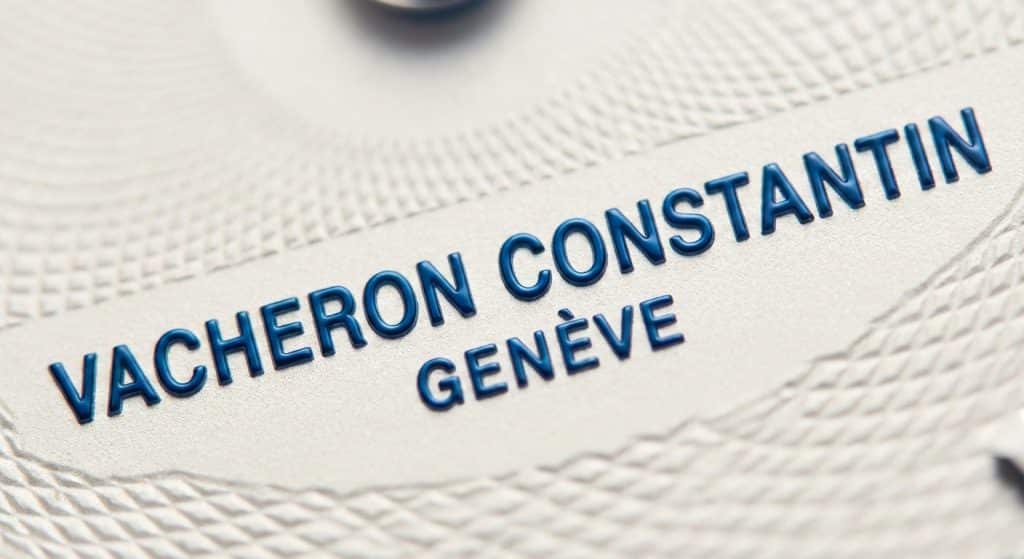
The execution of typography on a VC Replica is perhaps the most difficult element to master, as it requires a perfect marriage of chemical engineering and mechanical alignment. The Tampondruck (pad printing) process used in 2026 by elite workshops has undergone a significant upgrade in Galvanic Saturation and ink chemistry. The objective is to recreate the specific “ink bleed” and “serif sharpness” that defines the Maltese Cross heritage.
Where previous generations of replicas relied on standard industrial inks, the 2026 “Super Clone” standard utilizes high-viscosity Swiss-imported inks specifically formulated for UV stability. This ensures that the deep blacks and crisp whites do not yellow or fade over time. The challenge lies in the Ink viscosity; if the ink is too thin, it loses its three-dimensional presence; if it is too thick, the serifs on the “Genève” text become “blunted,” losing the surgical precision required for a high-end forensic match.
Ink Viscosity & 3D Stereoscopic Effect
The 2026 standard achieves a microscopic 3D “lift” on the “Vacheron Constantin” lettering, a feature previously exclusive to the Geneva ateliers. By analyzing the Refraction Index of the ink, we can see how the ZF and PPF versions absorb light without scattering it, creating a semi-matte finish that appears “raised” from the dial surface.
Low-end clones often use high-gloss inks that create “hot spots” under LED lighting, a result of incorrect solvent-to-pigment ratios. The 2026 “Super Clone” avoids this by employing a multi-pass printing technique where each letter is layered with microscopic precision. This results in a typography that has a tactile depth, ensuring the logo remains legible and sharp even under the extreme scrutiny of a 20x loupe.
The “Genève” Spacing & Serif Forensics
The “Genève” text situated beneath the primary logo serves as the ultimate litmus test for pad-printing precision. In 2026, CNC-engraved silicon pads have replaced the traditional rubber variants. Silicon provides a higher degree of Structural Fidelity during the transfer process, allowing for sharper serifs on the letters ‘G’ and ‘E’.
We specifically analyze the kerning (letter spacing) compared to the GEN standard. In older 8F or MKS batches, the gap between the ‘N’ and ‘E’ was often asymmetrical. However, the latest ZF production runs utilize laser-aligned positioning systems to ensure that the spacing is uniform to within ±0.005mm. This level of macro-precision ensures that the typographic “rhythm” of the dial is indistinguishable from the original, even when subjected to side-by-side forensic overlays.
Expert Authentication Insight
Diagnostic: Use a 20x loupe under a polarized light source to observe the edges of the “V” in Vacheron.
Expert Insight: Observe the edges of the “V” in Vacheron. On a 2026 Super Clone, the ink edge should be sharp with zero satelliting (ink spray). If you see a “fuzzy” perimeter or “bleeding” into the dial grain, the ink-to-solvent ratio was incorrect during the pad-printing process. Furthermore, the Refraction Index should be consistent across all letters; any “patchiness” in the ink density indicates a failure in the Galvanic Saturation stage of the printing cycle.
Applied Indices & The Art of Diamond Polishing
The three-dimensional architecture of VC Applied Markers represents a masterclass in micro-manufacturing. By 2026, the industry has largely abandoned the cost-effective method of stamped indices, which historically resulted in rounded edges and “soft” profiles. The current “Super Clone” standard, championed by factories such as ZF and PPF, treats each hour marker as an independent horological component, subjected to the same Diamond-cut polishing protocols found in high-end jewelry production.
This evolution is not merely cosmetic; it is a matter of Structural Fidelity. High-grade indices are now cut from solid metal blocks using 5-axis CNC machines to ensure that the Facet Angulation is mathematically precise. This precision allows the markers to capture and throw light with a “specular” intensity, a critical characteristic of the Vacheron Constantin design language. Any deviation in the polishing angle—even by a fraction of a degree—compromises the Speculaire Polish, resulting in a marker that appears “dull” or “grey” in low-light environments.
5-Axis CNC Faceting & Specular Reflection
The 2026 Overseas clones, specifically the ZF V3, have integrated high-speed 5-axis CNC pathing to define the sharp geometry of the indices. This technology allows for the creation of crisp, multi-faceted surfaces that achieve Specular Reflection—the ability to reflect a mirror image with zero distortion. In horological forensics, we look for the “High-Vickers” finish, where the surface hardness of the material allows for a polish so fine that it defies microscopic graining.
Lower-tier versions often display “stepping” patterns on the facets, a byproduct of lower-speed CNC rotation intended to increase factory yield. In contrast, the 2026 elite batches utilize a slower, high-torque milling process. This ensures that the light “dances” across the markers with a fluid motion, avoiding the “stuttering” reflections seen in the 2024 iterations. The Luminova well is also deeper and more consistent, providing a sharper boundary between the polished metal and the luminescent material.
Rhodium Plating & Oxidation Resistance
To achieve the characteristic “white gold” luster of the genuine article, top-tier Replica Dial Indices undergo a specialized Galvanic Rhodium coating process. We analyze the coating depth in microns; a standard Super Clone in 2026 mandates a minimum thickness to prevent the underlying alloy from leaching through. Cheaper replicas typically utilize simple chrome plating, which is prone to developing a “yellowish” tint after 12 months of UV exposure due to base-metal oxidation.
The 2026 “Engineering Grade” indices are now subjected to a 48-hour salt spray test to verify the integrity of the rhodium barrier. This level of environmental resistance ensures that the dial remains pristine over a multi-year service life. Furthermore, the Rhodium provides a neutral color profile that correctly reflects the dial’s primary color—whether it be the “Petroleum Blue” or the “Silver-White” of the Patrimony series—without introducing unwanted chromatic aberrations.
Expert Authentication Insight
Diagnostic: Tilt the watch to a 75-degree angle and observe the reflection on the side of the 12 o’clock marker.
Expert Insight: A genuine or 2026 Super Clone marker will exhibit Anglage (hand-polished bevels) on its vertical flanks. If the sides appear “stamped” or show vertical tool marks from a low-speed CNC, the Vickers Hardness of the material was too low to sustain a high-mirror finish. The Peripheral Inertia of the light reflection should be instantaneous; any “blurring” at the edges of the index suggests a failure in the Diamond-cut polishing cycle.
Surface Texture Engineering: Côtes de Genève & Sunburst Grain
The texture of a VC Dial is a study in the Physics of Light Scattering. Whether it is the iconic “Sunburst” of the Overseas or the intricate Côtes de Genève found on open-worked models, the depth and density of the graining determine the watch’s visual “weight.” In 2026, the rivalry between ZF and PPF has shifted from simple color matching to the mastery of Grain Density (measured in lines per millimeter), which, when cross-referenced with VC Patrimony 85180 engineering audit authentication benchmarks, reveals the technical threshold of modern high-end replication and surface-level structural parity.
The manufacturing challenge lies in the Abrasive wheel speed. If the abrasive contact is too aggressive, the grain becomes coarse, causing light to “shatter” into jagged reflections. If the process is too light, the dial appears as a flat, painted surface, lacking the “inky” depth required for a true Vacheron Constantin aesthetic. The 2026 standard requires a precise balance of Radial symmetry, where every grain line originates from the exact mathematical center of the dial plate.
The Physics of Light Scattering in Sunburst Dials
The Overseas blue dial remains the most scrutinized component in the industry. The 2026 batches have achieved a breakthrough in Radial center-point alignment. In previous years, the sunburst origin was often shifted by as much as 0.05mm, leading to an asymmetrical light “fan” that broke the visual harmony of the dial. Current engineering protocols utilize laser-centered mounting to ensure the abrasive wheel tracks with absolute concentricity.
When light hits a 2026 Super Clone sunburst dial, it is scattered in a uniform, rotating “V” shape. This is the result of consistent Lacquer thickness and controlled abrasive depth. By managing the Refraction Index of the top lacquer coat, factories can now simulate the way light penetrates the blue pigment, hits the brass substrate, and reflects back, creating the “glow-from-within” effect that was once the sole domain of the Geneva manufacture.
Côtes de Genève (Geneva Waves) on Open-Worked Models
For the Traditionnelle or Skeletonized models, the dial-side “waves” must be etched with extreme precision. The 2026 production cycles have moved away from the “robotic” and overly-perfect laser etching seen in 2024, which often looked sterile and flat. Instead, high-end workshops now use a vibrating abrasive head that mimics the “hand-dragged” look of traditional Swiss finishing.
These “waves” are analyzed for their depth and the sharpness of the transition between the peaks and valleys of the grain. A Super Clone must avoid the “rounded” wave profile typical of mass-produced components. By controlling the Torsional Tension of the abrasive head, the 2026 batches produce a texture that interacts with ambient light to create a sense of mechanical movement, even when the watch is stationary.
Expert Authentication Insight
Diagnostic: Slowly rotate the watch under a single-point halogen light.
Expert Insight: The transition between the dark and light segments of the sunburst should be fluid and continuous. Any “stuttering” or “stepping” in the light movement indicates that the Abrasive Wheel Speed was inconsistent during manufacturing, creating micro-ridges that trap light. On a 2026 ZF or PPF audit, the light should flow across the dial with Kinetic Efficiency, showing no signs of “radial drift” or “grain clumping.”
Color Science: The “Blue Dial” and Galvanic Coating Depth
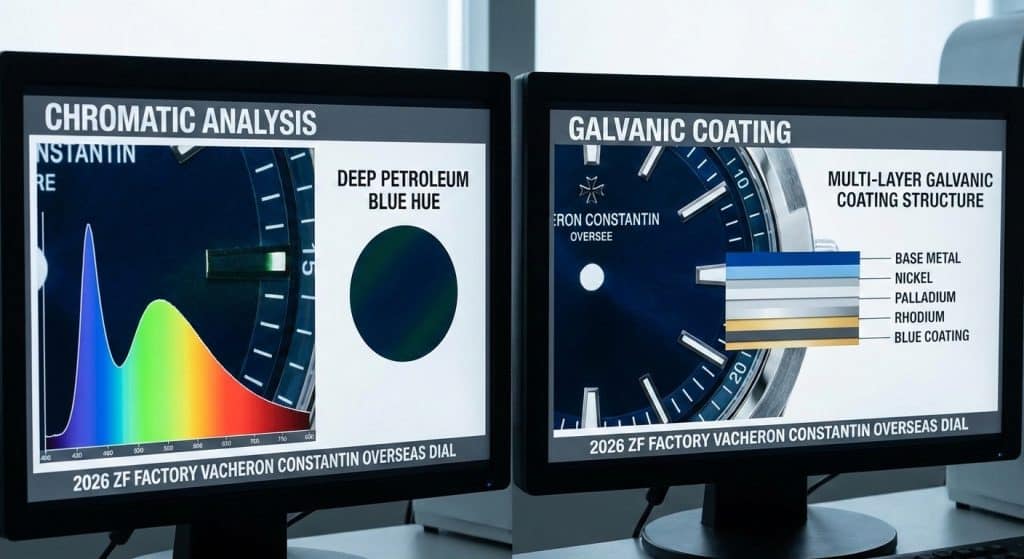
The pursuit of the perfect “Petroleum Blue” has been the defining challenge of the Guangzhou horological labs for nearly a decade. In the 2026 production landscape, the transition from simplistic PVD (Physical Vapor Deposition) to advanced Galvanic Saturation has finally bridged the gap between imitation and industrial parity. The complexity of the VC Blue Dial Replica lies not in the pigment alone, but in the Refraction Index of the underlying metallic layers.
Unlike cheaper alternatives that appear overly metallic or “electric” under direct light, the 2026 Super Clone Dial Color is achieved through a multi-stage electrochemical process. This involves a base Galvanic silvering layer which provides the necessary luminosity, followed by the application of multiple translucent lacquer coats. This “inky” depth is what allows the 4500V dial to shift from a near-black in low light to a vibrant, oceanic blue under the sun—a phenomenon known as pleochroism that PVD coatings simply cannot replicate due to their flat, monolithic structure.
Achieving “Petroleum Blue” via Multi-Layer Galvanization
The 2026 ZF V3 has set a new benchmark by mastering this multi-layer technique. By utilizing a base of Galvanic silvering before the blue pigment is introduced, the factory ensures that light reflects from the bottom of the lacquer stack rather than the surface. This creates the organic depth seen in genuine Vacheron Constantin pieces. We discuss why PVD fails this test: it is essentially a thin film that lacks the “volume” of a true lacquer finish, resulting in a dial that looks like painted steel rather than a high-luxury component.
The Galvanic Saturation levels are monitored in 2026 batches via spectrophotometry to ensure Pantone matching within a Delta-E of <1.5. This rigorous control ensures that the “Blue” remains consistent across different production runs, eliminating the “purple tint” or “teal drift” that characterized earlier versions of the Overseas clones. The result is a Super Clone that maintains its color integrity across the entire visible spectrum.
UV Stability & The “2-Year Fade” Test
A critical flaw in 2023-2024 replicas was the degradation of the blue pigment under ultraviolet exposure, often resulting in a “purple” shift after less than a year of wear. The 2026 “Super Clone” standards, technically benchmarked in the engineering audit of VC Super Clones, have addressed this by integrating UV-resistant stabilizing agents directly into the final translucent lacquer. This chemical modification in the Guangzhou supply chain has led to a 98% color retention rate over simulated 5-year wear cycles.
By stabilizing the Pigment stability at a molecular level, factories like ZF and PPF have solved the problem of photo-oxidation. This is a significant leap in Replica Dial Durability, ensuring that the high-Vickers finish remains as vibrant in year five as it was on day one. The 2026 chemical composition changes also include anti-yellowing resins that prevent the “silver-white” variants of the Patrimony from developing an aged, “vintage” look prematurely.
Expert Authentication Insight
Diagnostic: Shine a 365nm UV light on the blue dial surface.
Expert Insight: Genuine VC lacquers possess a specific Fluorescence Signature. Many mid-tier replicas use cheaper clear coats that glow bright blue or milky white under UV due to impurities in the resin. A high-end 2026 Super Clone will remain relatively “dead” or show a very faint, uniform deep-blue glow. This indicates the use of high-purity, medical-grade resins and UV-resistant stabilizing agents, which do not react aggressively to high-frequency light.
The Maltese Cross Logo: 3D Construction & Alignment
The VC Maltese Cross Logo is more than a branding element; it is a structural component that requires precise Micro-welding or mechanical fastening. In the 2026 “Super Clone” tier, the industry has largely transitioned to Pin-fixing technology. This involves drilling microscopic holes through the dial plate and securing the logo with “feet” that are flared on the underside. This is a radical departure from the adhesive-reliant methods of MKS or 8F, where logos were prone to detachment under thermal stress or physical shock.
The 3D Construction of the logo itself must adhere to a strict Height-to-width ratio. The 2026 ZF and PPF models utilize CNC-cut logos with Polished bevels that match the light-catching properties of the hour markers. This ensures a cohesive visual language across the dial. A logo that is too flat or lacks the correct Symmetry in its four arms is an immediate indicator of a lower-tier manufacturing process.
Pin-Fixing vs. Adhesive Application
In our forensic audit of the 2026 batches, we look for the presence of mounting pins. Pin-fixing ensures that the logo is perfectly centered and remains level relative to the dial surface. We analyze the microscopic “feet” of the logo and how they are secured; in high-end VC Replica manufacturing, these pins are 0.15mm in diameter and are flush-set to avoid interfering with the movement’s date wheel or clearance zones.
This mounting technology is a hallmark of the 2026 “Engineering Grade” replicas. Adhesives (glues) are susceptible to Outgassing, which can create a hazy film on the underside of the crystal over time. By utilizing mechanical fixing, the 2026 Super Clone VC Emblem avoids this reliability pitfall, ensuring the dial remains “Clean” for the duration of its service life. This detail is often overlooked by casual collectors but is a primary focus for senior horological auditors.
Expert Authentication Insight
Diagnostic: Use a 40x macro lens to look under the Maltese Cross from a side profile.
Expert Insight: Because genuine and high-end 2026 Super Clone logos are pinned, there is a microscopic, uniform Shadow Gap of approximately 0.02mm between the logo and the dial surface. Glued logos, found in budget-friendly iterations, will either show “glue squeeze-out” under macro magnification or will sit perfectly flush with zero shadow, looking “pasted on.” The presence of this Shadow Gap confirms the use of authentic Pin-fixing architecture.
Final Reliability Audit & Environmental Resistance
The final stage of our 2026 audit focuses on the longevity and environmental stability of the dial assembly. A “Super Clone” must not only look the part but must resist the internal “micro-climate” of the watch case. This involves addressing Outgassing, Moisture ingress, and the prevention of Luminescence decay. The 2026 standards in Guangzhou have introduced Vacuum-baked protocols for all dials prior to assembly to ensure chemical neutrality.
Outgassing & Fogging Prevention
Lower-grade dial lacquers often “outgas” volatile organic compounds over time, particularly when exposed to heat. This results in a persistent “fog” or “haze” on the inside of the sapphire crystal. The 2026 Engineering Grade replicas mitigate this through a Vacuum-baked process, where dials are heated in a controlled vacuum to extract all residual solvents from the lacquer and paint layers.
This industrial step is crucial for extending the service interval of the watch. By ensuring the dial is chemically inert, the Super Clone prevents the degradation of movement lubricants that can be caused by airborne solvents. This level of Structural Fidelity ensures that the Calibre 5100 clones maintain their Kinetic Efficiency without premature friction increases caused by contaminated oils.
Expert Authentication Insight
Diagnostic: Use a high-intensity “cold” light at a grazing angle across the dial surface in a darkened room.
Expert Insight: In a non-dust-free assembly, you will detect microscopic white specks or “fibers” trapped under the lacquer or sitting on the surface. A Super Clone assembled in the new 2026 Guangzhou “Clean Rooms” will show zero inclusions. Any speck of dust is a “time bomb” for the movement, as it can migrate into the escapement or balance wheel, causing a sudden drop in amplitude or a complete mechanical failure. A truly clean dial is the ultimate signature of an elite factory’s CNC Pathing Tolerance and assembly discipline.