
The Industrial Paradox of Minimalism: Case Geometry and the “Thickness War”
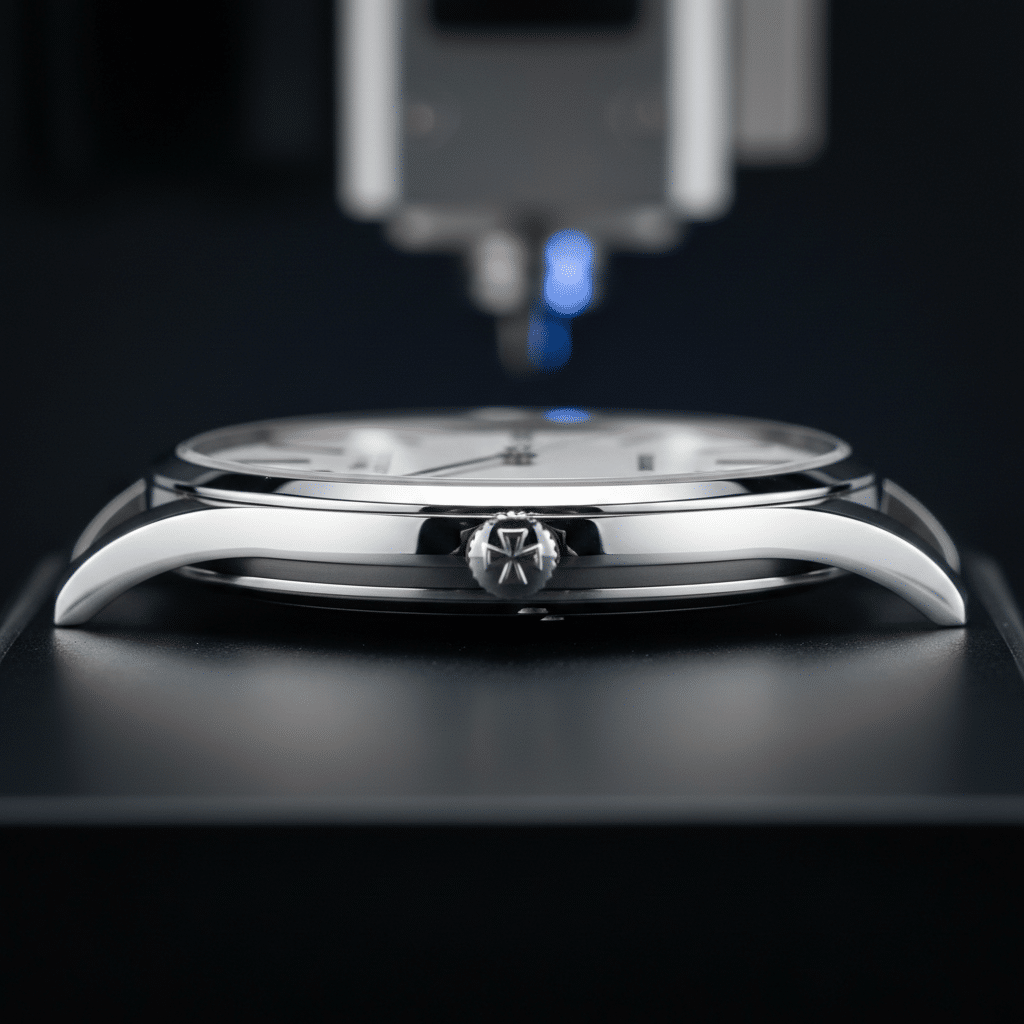
The fundamental challenge in replicating the Patrimony 85180 lies in its deceptive simplicity. To the untrained eye, the case is merely a slender circle; to the engineer, it represents a brutal battle against volume constraints. The Guangzhou Supply Chain has spent years attempting to reconcile the physical height of the Miyota 9015 base movement with the 8.1mm Structural Fidelity required by the genuine reference. This is not merely an aesthetic pursuit but a matter of CNC Pathing Tolerance.
While the KZ factory achieved a remarkable 6.8mm profile for the manual-wind 81180, the self-winding 85180 remains the ultimate test. The latest 2024 Batch from MKS represents a significant leap in architectural optimization. By re-engineering the mid-case and thinning the movement retention ring, they have managed to compress the total thickness to under 9.0mm. This reduction, though measured in microns, fundamentally alters the Kinetic Efficiency and wrist-presence of the piece, moving closer to the elusive “vanishing” profile of the original.
Architectural Fidelity and Tolerance Thresholds
The pursuit of thinness often compromises the Vickers Hardness of the case. In high-end audits, we observe that the MKS factory utilizes a triple-stage cold-grinding process on their 316L Stainless Steel to mimic the refractive index of 18K Gold. This ensures that the light transitions across the lugs without the “stepping” artifacts often seen in lower-tier CNC outputs.
Expert Authentication Insight
Employ a digital caliper to verify the total case depth. Any reading exceeding 9.2mm indicates a failure to implement the secondary rotor-shaving process. Furthermore, examine the lateral polish; a true super clone will exhibit a mirror-like Speculaire Polish that lacks the orange-peel texture associated with rapid-speed industrial buffers.
Dome Dial Topography and the Physics of Pearled Track Reconstruction
The Patrimony dial is an exercise in controlled curvature. It is not a flat plane but a convex “dome” that necessitates a complex Galvanic Saturation process. In standard manufacturing, paint tends to accumulate at the perimeter of curved surfaces, leading to Refraction index issues and an uneven “halo” effect. The premium MKS V3 iterations solve this by utilizing a variable-pressure spray technique, ensuring the Galvanic coating depth remains uniform from the center pinion to the outer edge.
The “pearled” minute track (the minute beads) is the second site of industrial friction. These are not merely printed dots; they are recessed hemispherical indentations that require microscopic stamping precision. Historically, clones suffered from metal Burrs and uneven light reflection due to dull tooling. The current engineering standard involves high-tonnage precision dies that create a crisp, rounded cavity, allowing each “pearl” to catch the light with the same Structural Fidelity as the hand-applied gold beads of the Geneva original.
Curvilinear Dial Engineering and Chromatic Saturation
Achieving the specific “eggshell” or “opaline” silver of the 85180 requires a delicate balance of metallic flake density and matte varnish. If the Sunburst grain density is too high, the dial appears overly metallic; too low, and it loses its aristocratic luster. The ZF and MKS factories have converged on a specific chemical vapor deposition (CVD) method that stabilizes the hue against UV-induced degradation.
Expert Authentication Insight
Analyze the minute “pearls” under 20x magnification. In genuine examples and top-tier clones, these beads exhibit a smooth Anglage at their borders. Lower-grade versions often show raw mechanical punch marks or “squashed” edges, which disrupt the flow of the minute track when viewed at an oblique angle.
The Maltese Cross: Geometric Equivalence and Trinitarian Symmetry
The Maltese Cross at the twelve o’clock position is the brand’s metaphysical anchor and a nightmare for CNC consultants. In the rivalry between ZF and MKS, the point of contention is the Component Geometric Equivalence. The cross is a multi-faceted component that must be mounted with absolute verticality. Even a ±0.02mm deviation in alignment can be detected by the human eye against the backdrop of the dial’s minimalist geometry.
ZF has historically led this sector by utilizing independent molds for the cross, ensuring that the four arms maintain sharp, non-radiused internal corners. The challenge lies in the depth of the central recession and how it interacts with the Sunburst grain density of the dial. Under specific lighting conditions, the cross must exhibit a UV color-shift—a subtle change in the shadow cast by its facets that confirms its three-dimensional structural integrity.
Component Dimensionality and Surface Tension
The mounting of the Maltese Cross is a manual process, even in the Guangzhou labs. The tension of the mounting pins must be calibrated to avoid “dimpling” the thin dial plate. We look for Torsional Tension in the dial surface—if there is any slight warping around the 12 o’clock marker, it indicates a failure in the structural engineering of the dial sub-assembly.
Expert Authentication Insight
Cast a strong lateral light source across the dial to observe the shadow projection of the Maltese Cross. If the shadows cast by the four points are of unequal length or sharpness, it confirms an Alignment deviation during the hand-setting phase, an assembly flaw that must be evaluated alongside the tolerances defined in a VC Overseas engineering analysis of sealing integrity for ZF and 8F clones to ensure total structural compliance. A master-grade clone will maintain perfect axial symmetry, with each facet of the cross reflecting light with identical intensity.
The “Needle Duel”: Dual-Surface Grinding and Plating Thickness
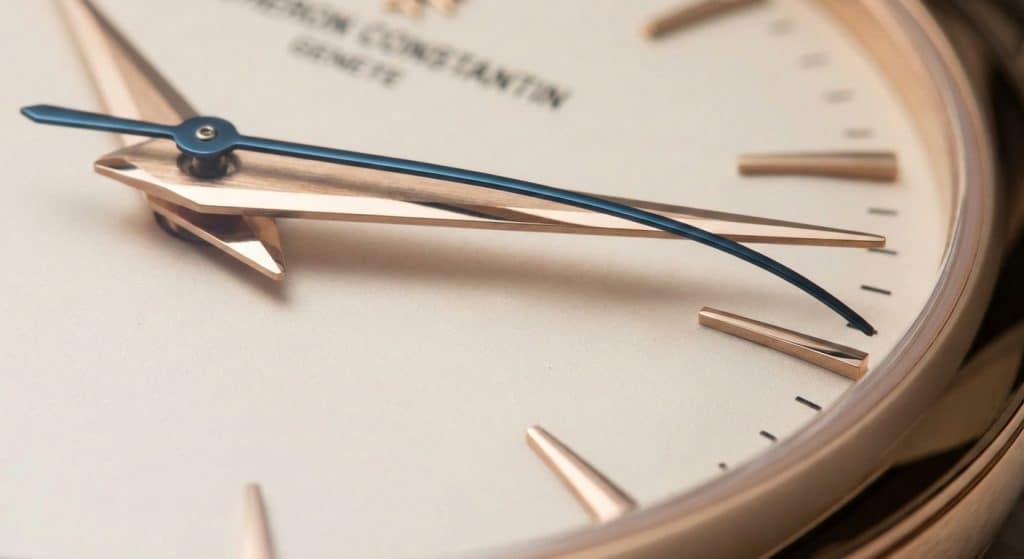
The hands of the Patrimony 85180 are a masterclass in horological contrast, utilizing a specific variation of the Dauphine style where one facet is mirror-polished and the other is finely brushed. This “Yin-Yang” finish is not merely decorative; it is a functional requirement for legibility in a watch that lacks luminous material. In the manufacturing hubs of Guangzhou, achieving this split-finish on such a thin gauge of metal often leads to Torsional Tension issues. Lower-tier factories frequently produce hands that appear “soft” or rounded at the central ridge, whereas the KZ factory utilizes a secondary cold-pressing technique to sharpen the longitudinal axis.
A critical point of failure in many replicas is the vertical clearance between the hands and the domed dial. To maintain Structural Fidelity, the hands must follow the curvature of the dial topography. KZ and MKS engineers have implemented custom jigs to apply a precise downward radius to the tip of the second hand. Without this Hand Radiusing, the hand would either collide with the sapphire crystal or sit too high, creating a visual gap that destroys the watch’s ultra-thin aesthetic.
Hand Radiusing and the Shadow of the Pinion
The technical challenge extends to the central pinion. In genuine Vacheron Constantin calibres, the hand-stack is capped with a mirror-polished finish that eliminates any visible hole. While replicas use a friction-fit system on the Miyota 9015 cannon pinion, the elite versions now incorporate a capped “cap” that mimics this Black Polish effect, ensuring that no raw brass or steel is visible at the center of the handset.
Expert Authentication Insight
Focus your loupe on the tip of the second hand as it passes the five o’clock marker. It should exhibit a subtle downward dip to match the dial’s dome. Furthermore, inspect the hand-stack hole under 20x magnification for Burrs or metallic debris. A high-grade clone will show evidence of internal bore polishing, reflecting a clean, dark circle known as Black Polish, rather than the jagged edges of a standard industrial punch.
Movement Architecture: Simulating the Calibre 2450 Q6 through Forensic Engineering
The Calibre 2450 Q6 is a testament to Geneva’s obsession with thinness and decoration. For the 2024 Batch replicas, the shift has moved away from simple stickers toward “Full Deck Coverage Technology.” By utilizing the reliable Miyota 9015 as a base, engineers at MKS and ZF have developed ultra-thin decorative plates that mirror the bridge layout of the original. This involves a delicate trade-off: adding plates increases thickness, yet the goal remains an 8.1mm profile. This is achieved by shaving the base movement’s automatic bridge by ±0.15mm to create a pocket for the decorative Anglage.
The most striking feature is the skeletonized rotor, finished in a high-density 22K Plating. The Rotor Kinetics must be perfectly balanced; if the plating is too heavy on one side, the winding efficiency drops, leading to a loss of power reserve. The current engineering standard utilizes a tungsten-alloy base for the rotor weight to ensure that the Kinetic Efficiency remains high despite the material removed for the Maltese Cross cut-outs.
Rotor Kinetics and Perlage Density
The visual audit of the movement must account for the Perlage (fish-scale polishing) on the mainplate. In the ZF versions, the overlapping circles are applied with a consistent pressure to ensure the depth of the “scales” reflects light uniformly. This is contrasted with the 8F factory approach, which often prioritizes the high-frequency 28,800 vph stability over the aesthetic nuances of the bridge chamfering.
Expert Authentication Insight
Utilize a horological stethoscope to monitor the beat error and frequency. While the Miyota 9015 operates at 28,800 vph, the hallmark of a “Super Clone” is the stability of its Amplitude. A healthy movement should maintain an amplitude above 260 degrees even at half-wind. Additionally, observe the bridge edges; genuine Anglage is rounded and hand-rolled, while most replicas exhibit a sharp 45-degree mechanical bevel. The presence of Moebius Oil on the escapement wheel is a final indicator of a professional-grade assembly rather than a mass-market product.
Hidden Industrial Markers: Hallmark Integrity and Lug-to-Strap Clearances
Even when the case is constructed from 316L Stainless Steel, the narrative of the Patrimony 85180 demands the inclusion of precious metal hallmarks. This creates an industrial irony: laser-etching gold stamps into steel. The Factory Rivalry between ZF and KZ has pushed the boundaries of Hallmark Micro-Engraving. Older batches suffered from “charring”—blackened edges caused by high-heat CO2 lasers. The modern standard involves fiber laser technology, which “scoops” the metal out at a molecular level, leaving a clean, grey-toned indentation that mimics the look of a traditional punch.
The engineering of the lugs also dictates the Strap Integration. The gap between the spring bar and the case body is a critical metric for Structural Fidelity. If the gap is too wide, the strap will wiggle, creating an audible “click” that betrays the watch’s luxury positioning. MKS has optimized their CNC pathing to ensure the lug holes are positioned within a ±0.01mm tolerance, ensuring a “friction-fit” feel for the leather strap.
Hallmark Micro-Engraving and Material Density
The 750 stamp and the St. Bernard’s head must be legible under a 10x loupe. The depth of the engraving is vital; too shallow, and it will disappear after a light polish; too deep, and it looks like a modern serial number rather than a traditional hallmark. The Guangzhou labs have mastered the specific “grain” inside the hallmark, providing a matte finish that contrasts with the Speculaire Polish of the surrounding lug.
Expert Authentication Insight
Examine the internal bore of the spring bar holes. In a high-end audit, we look for polished internal surfaces. Lower-tier replicas leave raw CNC burrs inside the holes, which can shred the spring bar over time. Use a spring bar tool to test the Torsional Tension of the strap; there should be zero lateral play between the leather and the steel lugs.
The Chronometry of Geometry: Date Window Depth and Typographic Stacking
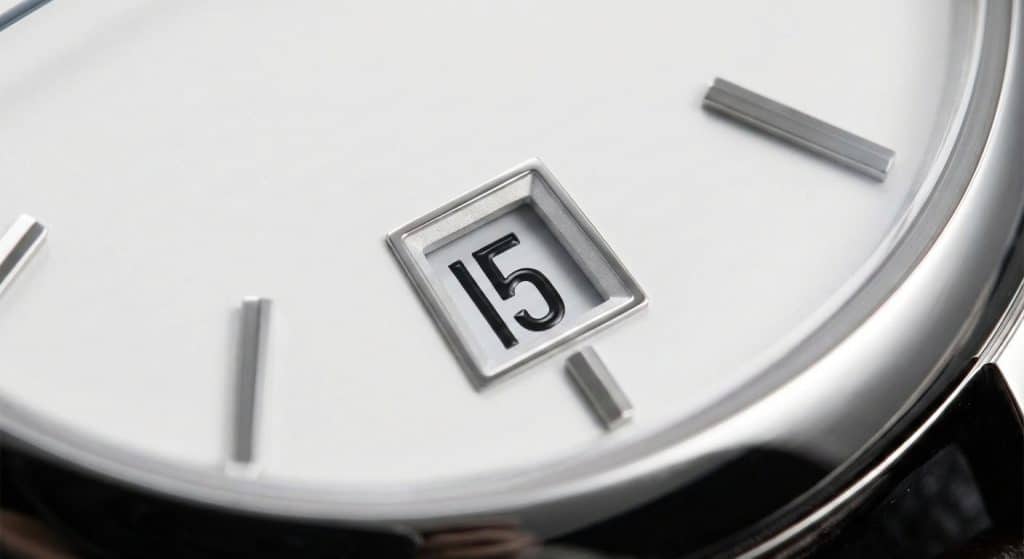
The date aperture at six o’clock is a focal point of the Patrimony‘s lower hemisphere. The challenge here is the “Step-dial” effect. The dial plate is not simply cut; it is beveled inward toward the date disc. This Step-dial Date Logic requires a multi-axis milling head to create a smooth, polished ramp rather than a sharp drop. If the bevel is missing, the date window looks like a “hole” in the dial rather than an integrated design element.
Typography is the final frontier of the 85180 audit. The font used by Vacheron Constantin features specific serifs and a slight “swelling” of the ink, an attribute that must remain consistent with the engineering audit of VC presentation documentation to ensure uniform tactile density across both the dial and accompanying certifications. Super clones achieve this through Heavy ink stacking, where the date disc is printed multiple times to build up a 3D profile. This creates a glossy, enamel-like finish that catches the light, providing high contrast against the matte-white or sunburst-silver backgrounds of the disc.
Beveled Step Aperture and Ink Saturation
The alignment of the date disc is governed by the jumper spring within the Miyota 9015 or Calibre 2450 clone movement. If the spring tension is poorly calibrated, the date will sit slightly high or low in the window. High-end engineers recalibrate these springs to ensure that the numeral is perfectly centered, maintaining the watch’s uncompromising symmetry.
Expert Authentication Insight
Slowly rotate the crown to engage the date change. A superior clone will transition the date within ±3 minutes of midnight with a crisp, audible “snap.” Observe the numeral at an angle; the ink should appear raised, almost like a drop of liquid. If the printing appears flat or gray, it indicates a single-pass industrial print, lacking the Galvanic Saturation required for a true “Super Clone” designation.
Mechanical Feedback of the Strap and Clasp Assembly
The tactile experience of a dress watch like the Patrimony 85180 is determined by the intersection of textile engineering and ergonomic tension. In the high-end laboratories of Guangzhou, the integration of the strap is no longer an afterthought. While standard replicas utilize embossed calfskin, the audited versions are equipped with authentic Alligator Leather, selected for its specific scale grain and pliability. The objective is to achieve a Wrist feel that matches the softness of the Geneva original, requiring the leather to be thinned to a specific ±0.5mm at the lug inserts to maintain the watch’s ultra-slim profile.
The buckle represents a significant challenge in Industrial Design. The iconic Maltese Cross on the clasp must be CNC-machined from a single block of 316L Stainless Steel rather than being welded onto a base buckle. This one-piece construction ensures superior Structural Fidelity and prevents the “snagging” associated with inferior solder points. The internal geometry of the buckle must also account for Torsional Tension, ensuring that the pin sits flush within the frame under the stress of daily wear.
Strap Ergonomics and Integrated Maltese Buckle Engineering
The audit of the clasp extends to the internal finish of the buckle’s tongue and frame. High-tier versions from MKS and ZF feature a uniform Sandblasting effect on the inner surfaces to reduce friction against the leather. This detail, often overlooked by budget-oriented manufacturers, prevents the premature degradation of the strap and provides a consistent resistance when the wearer engages the buckle.
Expert Authentication Insight
Test the closing dampening of the buckle. A superior assembly will provide a crisp, audible “click” without any lateral play or wobble in the pin. Use a high-power loupe to inspect the internal corners of the Maltese Cross on the buckle; lower-tier iterations often show graininess or microscopic pits, whereas a professional-grade clone will exhibit a smooth, matte Sandblasting texture that is free of industrial artifacts.
The 2024 Evolutionary Matrix: Mapping the Patrimony Clone Landscape
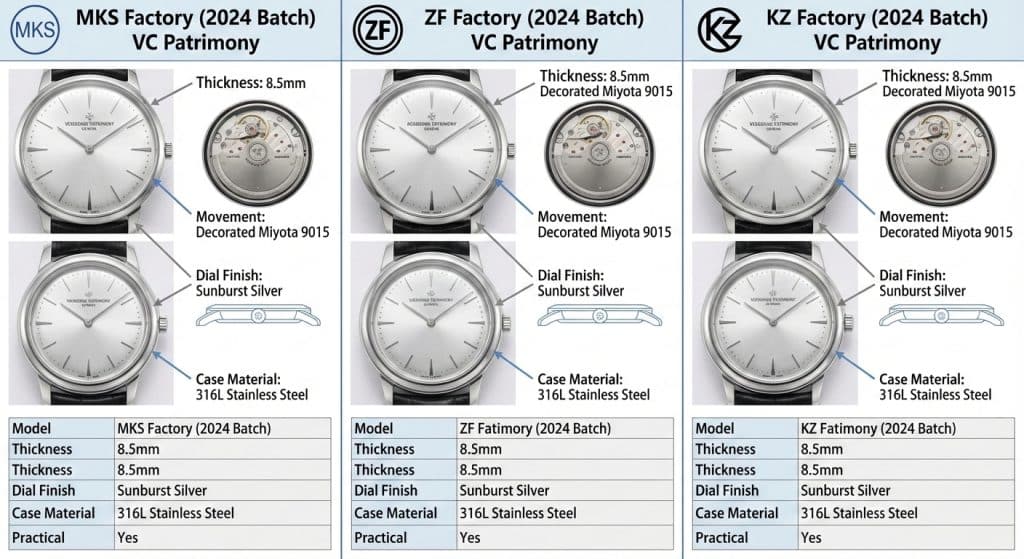
The current state of the Patrimony 85180 market is defined by a sophisticated Evolutionary Roadmap. As we analyze the Batch & Versioning Summary, it is clear that the competition between MKS, KZ, ZF, and 8F has reached a point of diminishing returns in terms of visual accuracy, forcing factories to innovate in the realms of movement acoustics and metallurgical coatings. MKS currently maintains a lead in overall durability and cost-to-performance ratio, while KZ continues to push the boundaries of 8.1mm geometric equivalence. ZF, conversely, remains the authority on the Galvanic Saturation of the dial, producing the most convincing opaline silver in the industry.
The 2024 Batch updates across these major factories have focused heavily on the reduction of the Miyota 9015‘s rotor noise—a notorious tell in thin-cased replicas. By utilizing specialized bearing lubrication and high-density 22K Plating on the rotor, the kinetic “whirring” sound has been significantly dampened. Furthermore, the industry has seen a shift toward improved anti-corrosion treatments for the 316L Stainless Steel cases, ensuring the Speculaire Polish remains intact even after prolonged exposure to skin oils and humidity.
From MKS V1 to the KZ Ultra-Thin: A Technical Batch Summary
The technical trajectory of the Patrimony replica suggests that the next frontier will be the complete elimination of the “decoration plate” in favor of a fully integrated clone movement. For now, the “Super Clone” designation is reserved for those pieces that balance the Pivot Friction of the modified Miyota movement with the extreme constraints of the 8.1mm case. Collectors must evaluate their priorities—whether it be the sheer thinness of the KZ or the dial nuance of the ZF.
Expert Authentication Insight
For a final assessment of the movement’s Kinetic Efficiency, perform a “48-Hour Static Reserve Test.” An elite Patrimony clone must adhere to the kinematic and mass distribution specifications of VC super clones to maintain linear power delivery; if the timekeeping deviation fluctuates by more than ±10 seconds as the mainspring unwinds, it indicates excessive friction within the gear train. This often necessitates a full teardown and the application of high-grade Moebius Oil to restore the movement to its peak operational state.