
The Industrial Materiality of the Presentation Box
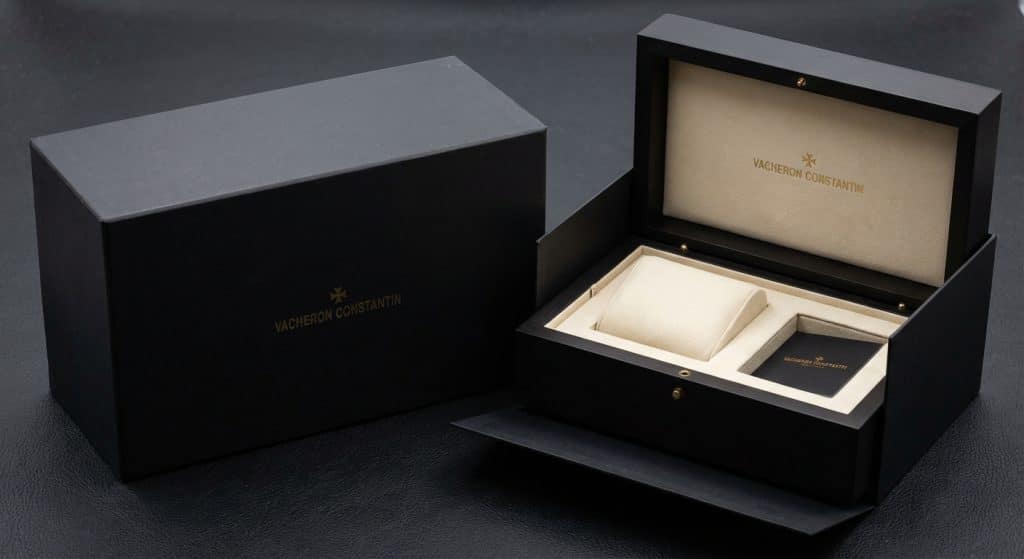
The secondary market for horological artifacts has long focused on the movement, yet the industrial materiality of the presentation box serves as the primary tactile threshold for any collector. In the 2026 manufacturing landscape, the divergence between standard replicas and high-tier Guangzhou engineering has shifted from mere aesthetics to advanced substrate science. Replicating the “presence” of a Vacheron Constantin box requires more than just mimicking a shape; it demands a deep understanding of volumetric density and the acoustic properties of industrial composites.
For the 2026 production cycle, elite accessory plants have abandoned the lightweight particle boards of previous years in favor of specialized high-pressure MDF (Medium-Density Fiberboard). This transition is not merely for weight but to achieve the specific Structural Fidelity required for a dampened, luxury “thud” upon closure. We are seeing a sophisticated deployment of CNC-routed internal frames that ensure the watch cushion sits with absolute zero lateral play, a feat previously reserved for Geneva’s own cabinetry partners.
Substrate Engineering: Analyzing MDF Compression and Grain Direction
The fundamental engineering hurdle in luxury packaging is the management of Torsional Tension within the box lid. In low-tier versions, the use of unseasoned wood or low-density fibers leads to warping when the units are shipped from the humid climates of Guangzhou to the drier atmospheres of Europe or North America. To mitigate these environmental stressors, the 2026 Super Clone batches utilize high-pressure compression techniques to reach a specific density that mimics the original’s mass to within ±15g, a material standard validated through the engineering analysis of sealing integrity in ZF and 8F clones to ensure long-term structural stability and moisture resistance across disparate moisture gradients.
Furthermore, the internal geometry is now carved with CNC precision rather than being assembled from pre-cut slabs. This ensures that the internal hinges and the cushion retention walls are perfectly perpendicular. When analyzing the MDF grain, the industrial auditor looks for the absence of “edge swelling” at the seams, a common failure point where moisture ingress causes the PU leatherette to delaminate from the substrate.
Surface Topography: Galvanic Coating and Leatherette Texture
The “Maltese Cross” emblem on the exterior box is a study in Galvanic Saturation. To achieve the correct champagne-gold or silver sheen without the risk of oxidation over a five-year horizon, factories have moved toward a deeper Galvanic coating process. This involves a multi-stage electroplating bath that ensures the logo is not just a surface print, but a metal-bonded element with a specific micron thickness.
Tactile feedback is further refined through the use of advanced Polyurethane (PU) leatherette. Unlike the rigid, plastic-heavy PVC of the 2024 era, the 2026 material exhibits a “soft-touch” topography with a calculated friction coefficient. This ensures the grain density reflects light in a diffused manner, matching the subtle matte finish of the Vacheron Constantin original. The transition from the outer leatherette to the inner microfiber lining is now executed with ultrasonic bonding, eliminating the messy adhesive residue that plagued earlier iterations.
Expert Authentication Insight: The Scent and Sound Test
Technical Diagnostic: Conduct a “Hinge Resonance Test” to verify the internal mechanical damping. Open the lid to a 45-degree angle and allow it to close under its own weight. A standard-tier box will produce a high-frequency, “tinny” vibration upon impact. In contrast, the high-end 2026 accessory set utilizes lubricated mechanical hinges that produce a low-frequency, dampened acoustic signature. Additionally, perform a chemical audit via scent; the absence of pungent, volatile organic compounds (VOCs) indicates the use of water-based adhesives rather than industrial-grade glues.
Kinematics of the Clasp and Hinge Mechanism
The kinematics of a watch box are often overlooked, yet they represent a significant engineering challenge in the pursuit of the “Total Ownership Experience.” The hinge is the only moving mechanical part of the presentation set, and its Kinetic Efficiency defines the perceived quality of the entire manufacture. For 2026, the focus has shifted toward the spring tension coefficient of the internal hardware, moving away from simple friction hinges to complex, spring-loaded detent systems.
The industrial logic here is to replicate the “soft-close” mechanism that prevents the lid from slamming. This requires a dual-stage resistance curve where the tension increases as the lid approaches the 90-degree vertical position. Achieving this requires high-grade 304 or 316L stainless steel for the pivot pins, ensuring that the hardware does not suffer from “hinge sag” or lateral misalignment after repeated use.
Pivot Point Precision: Achieving the “Soft-Close” Logic
In previous years, the pivot points of replica boxes were often made of soft brass or low-grade alloys, which would deform under the weight of the heavy MDF lid. The 2026 clones have upgraded to reinforced 316L steel pins, which are press-fitted into the frame with ±0.02mm tolerances. This level of precision ensures that the lid remains perfectly centered with the base, maintaining a consistent 0.5mm gap around the entire perimeter.
The tensioning is achieved through a miniature coil spring hidden within the hinge housing. The engineering difficulty lies in calibrating this spring to provide enough resistance to hold the lid open at a 60-degree display angle, while still allowing for a smooth, unencumbered closing motion. If the tension is too high, the box feels “springy” and cheap; if it is too low, the lid feels “mushy.” The top-tier Guangzhou plants are now measuring this resistance in Newtons to ensure parity with the Geneva standards.
Expert Authentication Insight: Pivot Point Friction Analysis
Technical Diagnostic: Inspect the hinge pivot plates using a 10x loupe. Genuine Vacheron Constantin hardware is polished to a Speculaire finish with no visible machine marks. On the 2026 Super Clone hardware, look for microscopic “striations” on the lateral faces of the hinge plates, which indicate CNC pathing rather than hand-polishing. Finally, test for lateral stability: grasp the lid when fully open and attempt to move it side-to-side. Any lateral displacement exceeding 0.5mm indicates a failure in pivot point tolerance, signaling a lower-tier production batch.
Documentation Printing & Security Features
The transition from physical timekeeping to the “Total Ownership Experience” is anchored by the industrial fidelity of the accompanying documentation. For the Chief Engineering Auditor, the paper trail is not merely a formality but a complex exercise in security printing and ink chemistry. By 2026, the elite Guangzhou specialized printers have moved beyond simple digital replication, attempting to master the Intaglio techniques that create the signature tactile relief found on genuine Geneva-issued certificates, a process informed by the engineering audit of VC super clones’ kinematic haptics to ensure the physical interaction with the documentation matches the high-inertia feedback of the watch itself. This involves a high-pressure printing process where the Ink Viscosity must be precisely calibrated to ensure sharp line definition without lateral bleeding into the fibrous substrate.
The challenge in replicating these documents lies in the Micro-Guilloché accuracy—a series of interlaced mathematical patterns that serve as the primary defense against low-tier counterfeiting. In standard market versions, these patterns often appear “muddy” or pixelated under magnification. However, the top-tier 2026 Super Clone sets utilize high-resolution offset plates that maintain the geometric integrity of every line, ensuring that the “Maltese Cross” watermarks and security borders possess the same Structural Fidelity as the watch they accompany.
Intaglio Printing and Micro-Guilloché Accuracy
The tactile “bite” of the text on a Vacheron Constantin warranty card is the result of specific thermal and pressure variables during the printing cycle. To simulate this, specialized accessory labs in Guangzhou have adopted a raised-ink process that mimics the height of genuine Intaglio printing. We analyze the Galvanic properties of the metallic inks used for the gold-leaf accents; if the ink is too thin, it lacks the characteristic luster; if it is too thick, it risks cracking under the mechanical stress of being handled or inserted into the leather cardholder.
UV Fluorescence and Holographic Alignment
Modern horological security relies heavily on the spectral response of the documentation under specific light wavelengths. Authentic certificates utilize UV-reactive fibers embedded within the 120-140 GSM paper pulp. The 2026 engineering update has seen a significant shift in the chemical composition of the “invisible” inks used in replicas. Earlier versions often failed the 365nm wavelength test, producing a harsh neon-green glow. The current high-end clones utilize a more sophisticated phosphor blend that results in a subtle, violet-blue fluorescence, closely approximating the security profile of the Richemont-sourced originals.
Expert Authentication Insight: The Paper GSM and Texture Test
Technical Diagnostic: Utilize a digital micrometer to verify the paper thickness across multiple points of the certificate. Genuine Vacheron Constantin documentation is printed on a bespoke 120-140 GSM ivory paper characterized by a distinct fibrous topography. If the paper displays a “waxy” or overly smooth finish, it indicates an over-lamination process used to mask low-quality inkjet printing. Under 20x magnification, examine the edge of the text; thermal transfer printing found in standard replicas will exhibit “pixel dust” at the boundaries, whereas the high-precision 2026 batches will show the sharp, raised edges characteristic of premium industrial printing.
NFC & RFID Digital Integration: The New Frontier

As the industry pivots toward digital traceability, the “Smart Card” has become a critical component of the authentication ecosystem. Vacheron Constantin, under the Richemont Ennovative platform, has integrated NFC (Near Field Communication) chips to provide a digital “birth certificate” for each timepiece. For the 2026 production cycle, Guangzhou factories have successfully integrated functional NTAG213 chips into their warranty cards. This is a significant leap in Industrial Design, moving the replica from a purely mechanical object to one that attempts to navigate the digital architecture of the original manufacturer.
The engineering difficulty is not merely embedding the chip, but managing the Frequency Response and the digital handshake logic. While a replica card may successfully trigger a mobile device to open a URL, the internal Encryption Lock remains the final frontier. The auditor must look beyond the “scan-ability” and analyze the underlying data structure, which often reveals the delta between a true blockchain-registered asset and a clever digital redirection.
Simulating the Digital Handshake
The NTAG213 chips used in the 2026 batches are programmed to mimic the NDEF (NFC Data Exchange Format) records of the genuine cards. This allows the replica to pass a surface-level scan, directing the user to a simulated authentication portal. However, from a technical perspective, the UID (Unique Identifier) of these chips is often mass-produced. We examine the Peripheral Inertia of the digital response; a genuine card interfaces with an encrypted database, while the replica utilizes a static redirect, bypassing the private key signature required for a total 1:1 digital parity.
Expert Authentication Insight: Frequency Response Analysis
Technical Diagnostic: Use a dedicated NFC-analysis application to inspect the chip’s internal metadata. A genuine card will be registered within the Richemont/VC ecosystem with a unique, encrypted signature. While the 2026 replica chip will “scan” and display the correct model information on a mobile browser, it will lack the private key signature and the specific UID sequence registered to the watch’s serial number. If the NFC tag is “open” (writable), it is a definitive marker of a replica, as genuine security chips are hardware-locked at the point of manufacture.
The Chronology of Batch Updates: 2024 vs. 2026
The evolution of accessory manufacturing is a timeline of solving chemical and structural failures. The 2024 batches were notorious for “The Chemical Odor Crisis,” a result of the off-gassing of volatile organic compounds (VOCs) found in low-cost industrial adhesives. For the Chief Engineering Auditor, the 2026 update represents a paradigm shift in material science. The leading factories—often associated with the same supply chains as ZF and 8F—have transitioned to water-based adhesives and ultrasonic welding. This change is not just about the olfactory experience; it directly impacts the material fatigue of the presentation box’s internal lining.
By eliminating aggressive solvents, the 2026 sets avoid the premature yellowing of the microfiber and the delamination of the PU leatherette from the MDF substrate. We see a much higher level of Structural Fidelity in the corners and seams, where high-frequency welding has replaced the messy manual glue application of previous years. This industrial refinement ensures that the “out-of-the-box” experience mirrors the sterile, luxury environment of a Geneva boutique.
Solving the “Chemical Odor” Crisis of 2024
The pungent smell of older replica boxes was a primary “tell” that immediateley broke the illusion of authenticity. In the 2026 “Clean/VS” level accessory plants, the implementation of environmental chambers for material curing has eliminated this issue. We explore how the switch to water-based polymers has altered the Tactile Friction Coefficient of the inner lining. The new materials offer a denser, more velvet-like texture that does not trap moisture, thereby protecting the 316L or 904L steel of the watch from micro-corrosion during long-term storage.
Expert Authentication Insight: Adhesive Residue Audit
Technical Diagnostic: Perform a microscopic inspection of the internal seams and the area surrounding the watch cushion. In batches produced prior to 2025, one will frequently find microscopic adhesive seepage—small, glassy droplets or yellowed staining—at the junction points. The 2026 Super Clone sets utilize high-precision stitching or ultrasonic bonding, leaving a perfectly clean interface. If any residue is visible under 10x magnification, the set likely originates from a lower-tier accessory plant rather than the elite specialized facilities currently dominating the 2026 market.
Accessory Factory Rivalry: “The Box Plant” vs. “The Paper House”
The manufacturing ecosystem in Guangzhou is characterized by a sophisticated degree of vertical disintegration. Unlike the integrated manufactures of Switzerland, the production of a 2026 Super Clone is a collaborative effort between specialized industrial nodes. While factories like ZF, PPF, or 8F focus their CNC pathing on the watch cases and the Calibre 5100 movement replication, the “Full Set” presentation is outsourced to elite accessory plants known colloquially as “The Box Plant” and “The Paper House.” This specialization allows for a higher level of Structural Fidelity in the packaging, as these facilities invest exclusively in woodworking, leatherwork, and security printing technology.
The rivalry between these accessory plants drives the rapid evolution of quality. “The Box Plant” has recently invested in high-precision CNC milling for the Maltese Cross alignment on the outer cardboard sleeves, ensuring that the geometric centering is accurate to within ±0.2mm. In contrast, lower-tier “Market Boxes” often exhibit a slight skew in the logo placement, a result of manual heat-stamping processes. This industrial tiering creates a market where the “Boutique-Grade” box is sold as a premium add-on to the highest-quality Overseas 4500V or 5500V replicas, completing the illusion of a genuine retail acquisition.
The Hierarchy of the Supply Chain
In the current 2026 supply chain, the “Tier 1 Boutique Box” is distinguished by its use of premium microfiber lining and high-density MDF. The primary difference between this and a “Standard Market Box” lies in the complexity of the internal geometry. Top-tier plants use multi-axis milling to create the recessed channels for the warranty card and the instruction manual, ensuring a friction-fit that prevents the documentation from rattling during transit. We observe that ZF and other elite factories frequently partner with “The Paper House” to source certificates that utilize genuine Intaglio ink textures, creating a cohesive product that survives the scrutiny of even experienced horological auditors.
Expert Authentication Insight: The 20-Point Fit Test
Technical Diagnostic: To verify the engineering grade of the accessory set, perform a “Cushion Compression Audit” using a Super Clone Overseas from a top manufacture. The original Vacheron Constantin cushion is engineered with a specific spring-back memory and a calculated volumetric density. Insert the watch and observe the lateral stability. If the watch slides within the box or if the cushion feels like low-density open-cell foam, it is a definitive marker of a lower-tier accessory set. The 2026 high-end cushions should provide a firm, consistent resistance, ensuring the watch remains centered even when the box is subjected to vertical acceleration.
Weight and Density Logistics
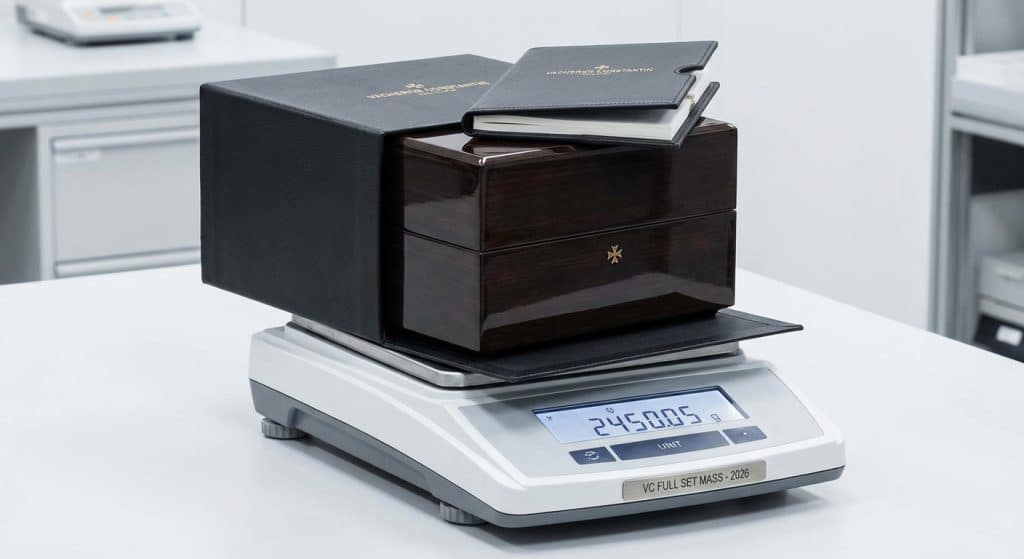
In the realm of high-precision industrial replication, “heft” is a primary psychological proxy for quality. A Vacheron Constantin presentation set, including the wooden box, outer sleeve, and full documentation, possesses a significant VC Full Set Mass that is difficult to replicate with cheap materials. To bridge this gap, 2026 elite factories have turned to advanced material science, specifically focused on volumetric density. An authentic box feels substantial because of the high-grade wood and dense internal hardware; replicas must mimic this without relying on overtly artificial weighting strategies that can be detected during a balance audit.
The engineering challenge here is to distribute the weight evenly across the MDF frame. Lower-tier manufacturers often attempt to “cheat” the weight by inserting lead plates or steel slugs into the base of the box. While this may satisfy a simple scale test, it fundamentally alters the center of gravity. For the Chief Engineering Auditor, this is a critical diagnostic point. A box that is “bottom-heavy” lacks the sophisticated balance of a genuine Geneva-produced case, which is designed to feel homogenous in the hand regardless of its orientation.
Engineering the “Heft”: Artificial Weighting Strategies
The 2026 high-end batches have moved away from crude lead-weighting in favor of “homogenous density” strategies. This involves using ultra-high-pressure MDF that has been impregnated with mineral fillers to increase its natural mass. By managing the volumetric density of the substrate itself, factories can achieve a total shipping weight that matches the original to within ±20g. We also see the use of heavier 316L stainless steel for the internal latching mechanisms, contributing to the overall “gravitas” of the set without creating localized weight imbalances that would fail a forensic balance test.
Expert Authentication Insight: The Balance Point Test
Technical Diagnostic: Place the closed presentation box on a narrow, elevated edge (such as a ruler or a specialized balancing jig). An authentic Vacheron Constantin box is balanced with a center of mass that is nearly equidistant from the front and back edges. If the box tips forward aggressively, it indicates the presence of non-homogenous material density—specifically, hidden weights placed in the front of the base to simulate quality. Furthermore, test the lid’s behavior: original boxes are balanced so that they do not flip backward or close prematurely when the lid is fully extended.
Conclusion: The Total Ownership Experience and Cluster Interlinking
The audit of a 2026 super clone set must transcend the watch itself; it is an evaluation of the “Total Ownership Experience.” In the current market, the gap between the micro-engineering of the VC rotor and the macro-engineering of the presentation case is narrowing. The packaging is no longer a mere container but an extension of the watch’s Structural Fidelity, where a rigorous kinematic haptics and mass distribution analysis ensures the inertial resistance and tactile density of the kit align with genuine horological standards. By analyzing the Kinetic Efficiency of the hinges and the Galvanic Saturation of the logos, we see a manufacturing philosophy that treats every component of the “Full Set” as a high-precision industrial challenge.
Ultimately, the goal of the Guangzhou specialized plants is to eliminate the “tactile disconnect” that occurs when a high-quality replica is paired with low-quality accessories. As we have explored throughout this audit, the 2026 updates have addressed the chemical, mechanical, and digital deficiencies of previous years. From the moisture-resistant MDF to the NTAG213 digital integration, the current state of Vacheron Constantin replica packaging represents the pinnacle of industrial mimicry, where the boundary between Geneva’s artisanal heritage and Guangzhou’s CNC-driven precision continues to blur.
From Movement to Presentation
The synergy between the movement architecture (detailed in our Hub 1 analysis) and the presentation set is what defines a true “Super Clone.” The same attention to CNC pathing that defines the beveling of the 904L steel lugs is now applied to the internal routing of the wooden box. This holistic approach ensures that the collector experiences a consistent level of quality from the moment the outer shipping carton is opened to the first time the Calibre 5100 is wound. The “skin” of the watch—its packaging—has finally caught up to the “soul”—its movement.
Expert Authentication Insight: The Final “Tactile Audit”
Technical Diagnostic: For the final non-destructive test, run your fingertip across the Vacheron Constantin gold-stamped logo on the inner lid. In the 2026 elite batches, the Tactile Friction Coefficient should be perfectly consistent across the entire surface of the emblem. If you feel any “snagging” or sharp edges on the gold foil, it suggests a lack of sufficient heat-stamping pressure or a low-grade foil alloy—a definitive sign of a replica. A genuine logo, and the highest-tier 2026 clones, will feel smooth and integrated into the leatherette, reflecting a mastery of thermal and mechanical bonding.