
The Gravity of 44mm: Why Grams Matter More Than Millimeters
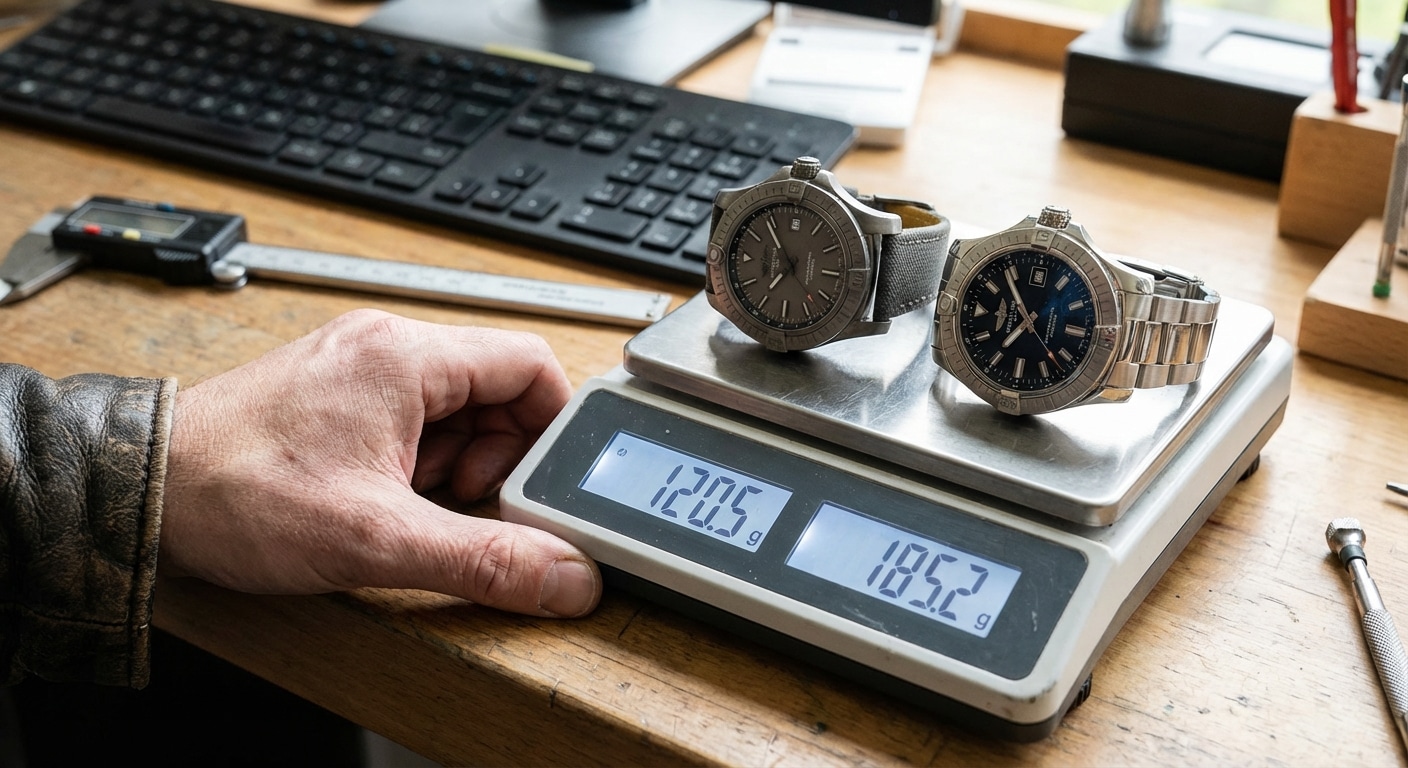
When evaluating a Breitling clone weight comparison, the conversation usually stops at the spec sheet. A dealer tells you a stainless steel model weighs 200 grams, you nod, and the transaction proceeds. But human wrists are not static display stands; they are dynamic, asymmetrical joints. The physical reality of strapping a high-mass replica watch case to your arm goes far beyond a simple numerical value, often dictating the limits of your versatile Breitling styling across different wardrobe choices. If you want to understand large watch wrist fatigue, you have to stop looking at millimeters and start feeling the gravitational pull of dense metals over an extended period. The choice between titanium vs steel replica watches dictates whether your timepiece functions as an instrument or an anchor.
The Coin Analogy: Visualizing Wrist Burden
Human anatomy simply did not evolve to carry asymmetrical, static loads on the distal end of the forearm. To truly grasp this ergonomic burden, we must bypass abstract gram measurements and look at everyday objects. A 44mm stainless steel Breitling clone on a full Pro III bracelet weighs roughly the equivalent of thirty-five U.S. quarters stacked and strapped to your wrist. Its titanium counterpart drops that payload to roughly twenty quarters. That fifteen-quarter difference is not a subtle nuance. It dictates whether the watch head stays centered over the flat of your wrist or violently swings outward during a brisk walk. This constant pendulum motion forces your forearm muscles into a state of perpetual micro-correction, accelerating wear fatigue before you even reach your lunch break.
Center of Gravity and Lug Overhang Dynamics
A heavier steel case naturally sits higher on the wrist, shifting the center of gravity away from the stabilizing wrist bone. When you wear a 15mm thick stainless steel clone, it acts as a lever. As the watch shifts, it pulls the rigid bracelet links tight against the skin, creating severe pinch points along the ulna. Titanium fundamentally alters this dynamic. By significantly lowering the overall mass, titanium mitigates the pendulum effect. The lighter case anchors securely to the wrist, maintaining its proportional balance even when your arm naturally swells by 3 to 5 millimeters in the afternoon heat.
Expert Authentication Insight
You can quickly diagnose the material integrity of a replica by weighing the watch head independent of the bracelet. A genuine titanium Breitling clone utilizing Grade 2 or Grade 5 titanium will display a specific gravity drastically lower than steel. If you receive a supposedly “titanium” replica watch head that weighs within 10% of its known steel counterpart, you are holding sandblasted 316L steel masquerading as a premium metal. This is a notorious cost-cutting tactic in lower-tier replica production, designed to fool the eye rather than the scale.
The 18-Hour Wear Cycle: A Comparative Fatigue Study
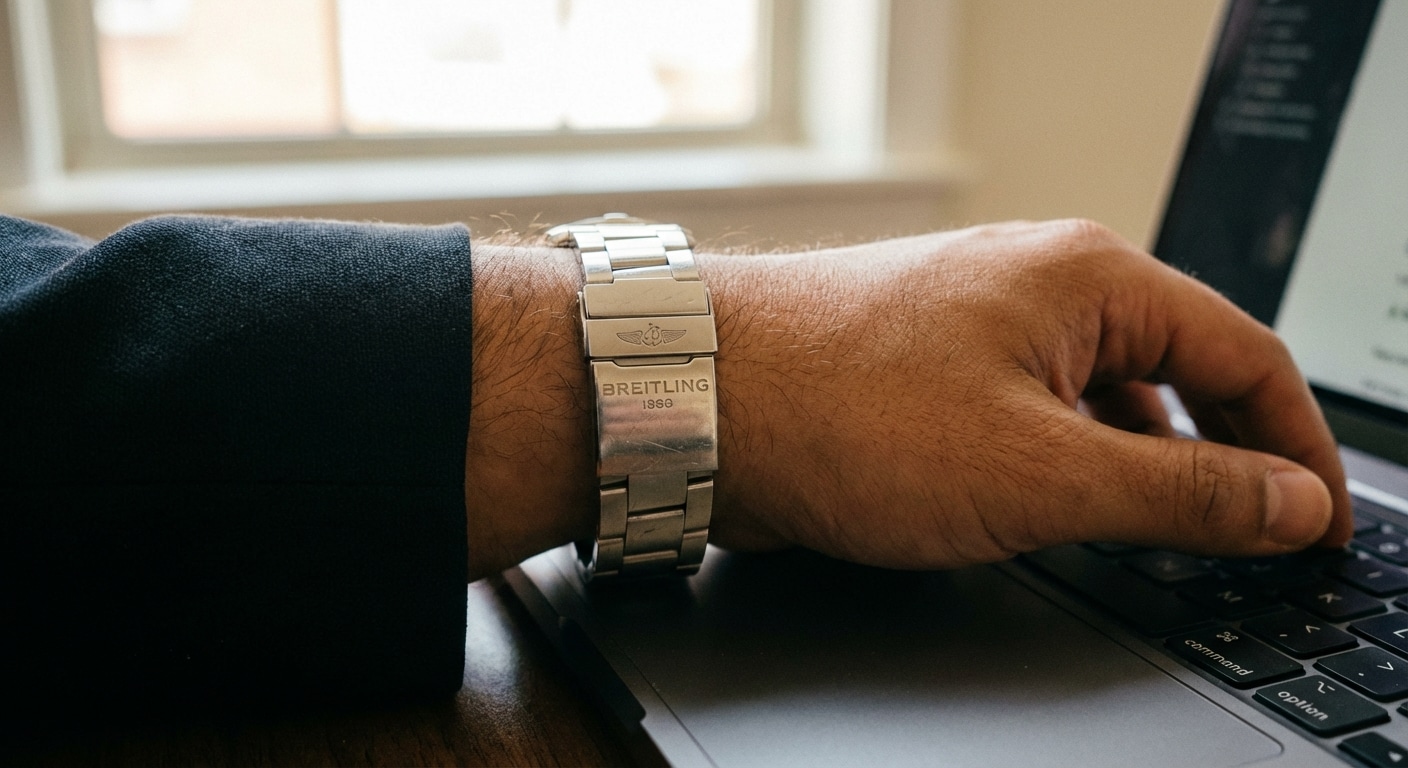
Static reviews fail because they evaluate all-day watch comfort based on a five-minute try-on. To understand heavy watch wrist pain, we must subject these materials to a modern, 18-hour daily routine. The true test of a Breitling clone in daily wear is not how it looks in a mirror at 8:00 AM, but how desperately you want to take it off by midnight.
Hours 1-8: Desk Diving and Keyboard Friction
During eight hours of remote work and continuous typing, the sheer mass of a steel Avenger clone becomes highly disruptive. The heavy milled clasp creates a harsh, localized pressure point against a laptop palm rest. Furthermore, the 200-gram weight, exacerbated by its distinct Breitling lug-to-lug profile, causes the watch to constantly drag downward toward the keyboard, requiring the wearer to repeatedly hike it back up the forearm. Titanium clones, conversely, glide effortlessly over the ulna bone. They also maintain thermal neutrality. While a steel case absorbs the ambient chill of office air conditioning and the exhaust heat from a laptop—adding a layer of thermal discomfort—titanium adapts to your body temperature and disappears on the wrist.
Hours 9-10: The Gym Test and Sweat Adhesion
When the workday ends and heart rates rise, the physical properties of steel become a liability. As wrists expand during a workout, a heavy steel bracelet quickly turns into a tourniquet. Sweat breaks down the microscopic friction barrier between the metal and your skin, causing a heavy steel watch to slide aggressively during kettlebell swings or treadmill runs. This violent shifting inevitably leads to the crown digging painfully into the back of your hand. Titanium’s lower thermal conductivity and lighter mass allow it to remain relatively stable under kinetic stress, preventing this dreaded “crown bite” entirely.
Hours 11-18: Evening Swell and Sleep Disruption
By 10:00 PM, a standard 17cm wrist has naturally swelled to its maximum daily circumference. Unclasping a 44mm steel Breitling clone at this hour often reveals deep, red indentations across the skin—a glaring physiological sign of restricted capillary blood flow. Attempting to wear a steel clone of this density to sleep is physically disruptive, frequently causing wearers to wake up with localized numbness in the hand. Titanium models, while sharing the same imposing visual footprint, reduce this compression penalty by over 30%, making them ergonomically tolerable for overnight wear.
Expert Authentication Insight
Thermal conductivity testing is a foolproof, tool-free method to verify the material of your clone. True titanium replica bracelets will warm to your skin temperature almost instantly and retain that heat, feeling noticeably warm to the touch the moment you take the watch off. Stainless steel clones, possessing different thermal properties, will feel distinctly cold when first put on and will lose your body heat rapidly once removed.
Case Geometry vs. Material Density: The Breitling Equation
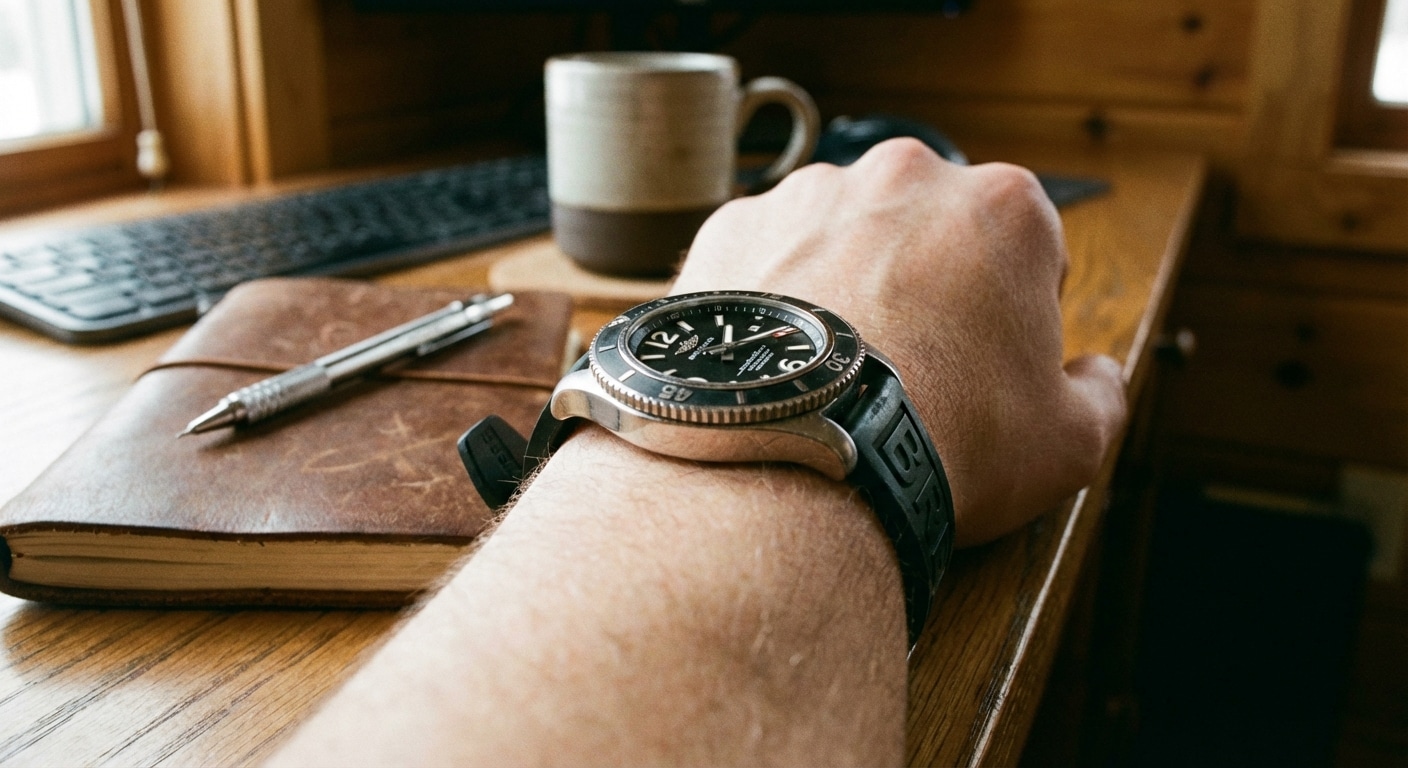
Breitling’s specific design language is notoriously unapologetic. The brand favors slab-sided, vertical case walls that inherently exacerbate weight issues in the replica market. When analyzing Breitling Superocean thickness or Avenger clone dimensions, it becomes clear that the replica watch bracelet drape is heavily compromised by the geometry of the watch head itself.
The Avenger and Superocean Thickness Penalty
A 15.5mm thick Avenger clone machined from solid steel applies an immense amount of torque to the wrist bone. The vertical walls of these cases amplify the perception of weight, acting as a fulcrum every time you rotate your wrist. A 42mm steel watch with a curved profile might be manageable, but at 44mm wide and over 15mm thick, the geometric penalty of Breitling’s tool-watch aesthetic increases exponentially. Titanium acts as the great equalizer here, neutralizing the dense, top-heavy nature of these slab-sided designs and allowing the watch to sit flush rather than fighting your anatomy.
Bracelet Articulation and Weight Distribution
The Pro III style bracelets equipped on these clones handle structural loads very differently depending on their base metal. Stainless steel links possess high articulation resistance simply due to their own mass. When evaluating the fitment against a standard Breitling replica size wearing guide, wrists under 18cm experience a rigid “hula hoop” effect, where the bracelet bulges awkwardly at the sides rather than hugging the skin. Titanium links are significantly lighter, allowing them to drape more naturally. This superior articulation contours to asymmetrical wrist shapes, distributing the lighter payload evenly across the entire lug junction and clasp.
Expert Authentication Insight
Inspect the clasp micro-adjustment mechanism under dynamic load. Heavy steel clones frequently utilize poorly machined clasp springs that simply cannot handle the 200-gram kinetic force of the watch swinging on a moving wrist, leading to frustrating accidental deployments. High-quality titanium clones, engineered for accurate material tolerances, utilize reinforced tension bars designed specifically for the stress profiles of lighter metals. You can test this by applying firm, lateral twisting pressure to the closed clasp to check for spring failure.
The Verdict: When to Choose Steel and When Titanium is Mandatory
The 44mm Threshold: Why Steel Fails on Average Wrists
Let us establish a hard, anatomical boundary. If your wrist measures under 18cm (roughly 7 inches), strapping a stainless steel Breitling clone larger than 44mm to your arm is a predictable ergonomic failure. The geometry and mass simply do not work in your favor. When you combine a lug-to-lug distance that frequently exceeds 53mm with the sheer, unforgiving density of 316L steel, you guarantee accelerated wrist fatigue. By mid-afternoon, that heft translates into deep, red skin indentations and an inescapable sense of buyer’s remorse. For wrists in this average median, stainless steel should be strictly quarantined to cases measuring 42mm or smaller. Anything larger requires a drastic material intervention.
Long-Term Wearability and the Secondary Market
There is a highly revealing metric hidden in the secondary replica market: the sheer volume of massive, heavily worn steel clones listed for sale. Buyers are routinely seduced by the catalog aesthetics, wear the watch for a single grueling week, and promptly offload it because it physically hurts to wear. Conversely, titanium clones of the exact same 44mm and larger models are practically ghosts on the resale forums. The lighter material fundamentally alters the watch’s utility, transforming a cumbersome weekend novelty piece into a viable, comfortable daily wearer. When you opt for titanium, you are drastically increasing the utility value of the purchase by paying for the ability to actually keep the watch on your wrist past lunch.
Expert Authentication Insight
You can verify the material integrity of your purchase without a laboratory scale by observing its scratch behavior and oxidation profile over the first month of wear. True titanium clones will naturally develop a distinct, dark grey oxide layer. More importantly, they pick up superficial “snail trail” scuffs on the clasp and bracelet that can frequently be erased with a simple blue ink eraser. 316L steel clones, on the other hand, will sustain bright, deep gouges that cannot be organically faded or rubbed out. Verifying this surface behavior confirms you paid for genuine titanium rather than a heavy, sandblasted steel counterfeit masquerading as a lightweight upgrade.
Do not let the showroom appeal of high-polished steel blind you to the physical reality of wearing a quarter-pound of metal on an articulating joint. Before purchasing any Breitling clone over 44mm, wrap a tape measure around your wrist at 4:00 PM—when natural swelling puts it at its absolute largest—and honestly assess your daily routine. If you spend your day typing on a laptop, training at the gym, or simply intend to wear the watch for more than six hours continuously, titanium is not an optional luxury. It is a strict anatomical requirement. Ignoring this baseline ergonomic rule guarantees your new watch will spend its life sitting in a valet tray instead of living on your wrist.