
The QuarantaQuattro’s Perceived Position: Marketing vs. Ergonomic Reality
Forget the “Goldilocks zone” marketing. Many watch enthusiasts, drawn to the 44mm Submersible as the “just right” option, often overlook the subtle yet significant ergonomic trade-offs that can turn an aspirational dive watch into an everyday wrist struggle. Similar to insights from a comprehensive Panerai GMT guide, we’ll cut through the hype to reveal why 44mm isn’t always the sweet spot, but sometimes an awkward compromise, comparing it directly with 42mm and 47mm models.
The Allure of the “Middle Ground”: Initial Appeal of PAM1229 and PAM1288
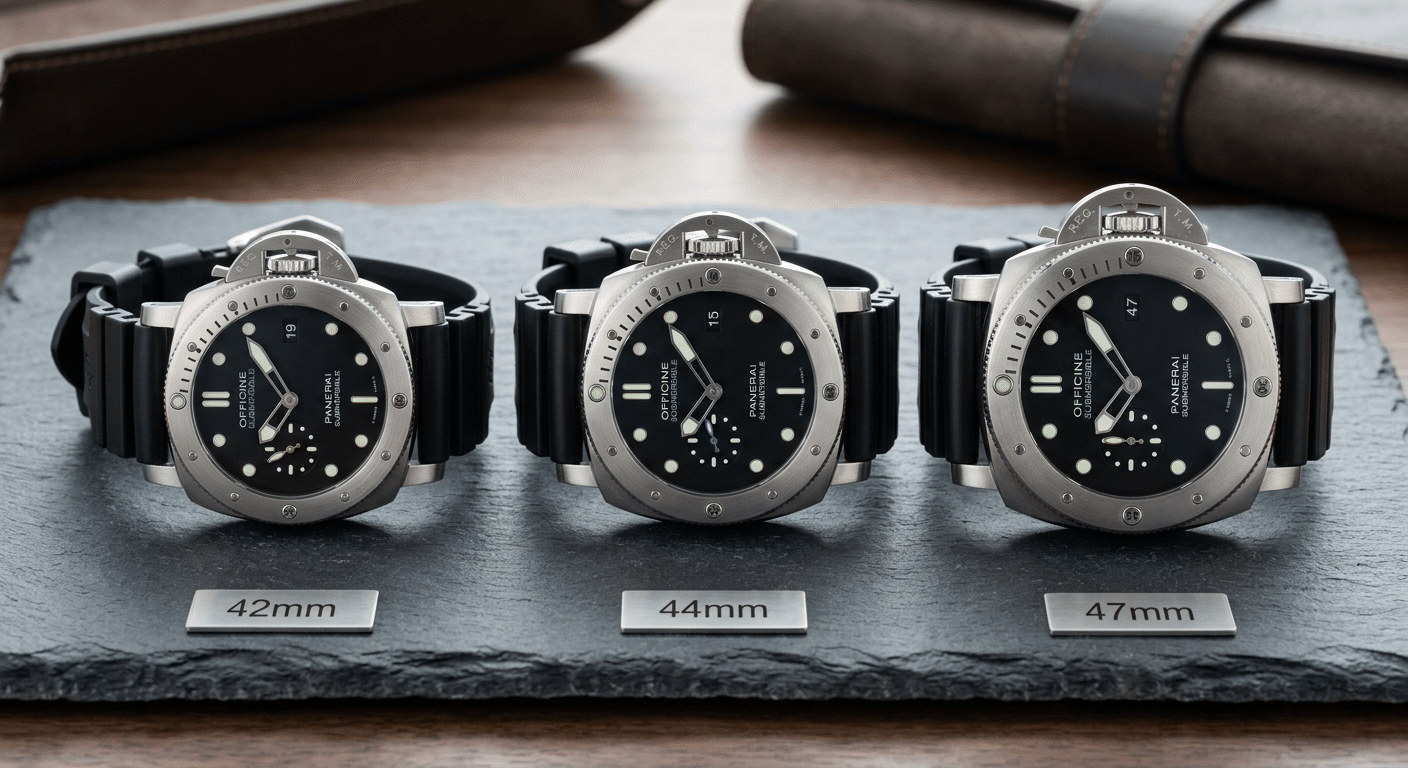
Panerai strategically positions its 44mm Submersible models, such as the PAM1229 and PAM1288, as the ideal compromise—a versatile option that bridges the gap between the more compact 42mm and the overtly commanding 47mm variants. This marketing narrative taps into a potent buyer psychology: the desire for balance, for a watch that isn’t “too big” nor “too small.” For many, the 44mm diameter feels like a safe, universal choice, promising Panerai’s distinctive wrist presence without the perceived impracticality of its larger siblings. The initial appeal is strong, suggesting a watch that can flex from a casual weekend to a more dressed-up occasion with ease. However, this perception of versatility often rests on diameter alone, overlooking the complex interplay of other physical dimensions that truly dictate wearability.
Why 44mm Isn’t Just a Number: Lug-to-Lug and Case Shape Dynamics
In the world of Panerai, case diameter serves as a headline, but it’s the underlying geometry—specifically the lug-to-lug measurement and the unique cushion case shape—that dictates the watch’s actual footprint on the wrist. The 44mm Submersible, despite its seemingly moderate diameter, carries a substantial lug-to-lug dimension, often exceeding 53mm. This length, combined with Panerai’s characteristic straight, robust lugs, means the watch can wear significantly larger than its diameter suggests. Unlike watches with highly curved or integrated lugs that conform to the wrist, the Submersible’s design often creates a flatter, broader profile that may extend beyond the natural curve of many wrists. This fundamental design choice, while integral to the brand’s aesthetic, means that simply choosing “44mm” doesn’t guarantee a comfortable or proportional fit; it’s a specific set of physical dimensions that must be considered.
The False Promise of Universal Fit: When Expectations Meet Wrist Anatomy
The notion that a 44mm watch offers a “universal fit” is a marketing simplification that often collides with the anatomical realities of individual wrists. Generic sizing advice, which frequently focuses solely on wrist circumference, fails to account for crucial factors like wrist contour (flat versus round), bone structure, and the width of the flat surface across the top of the wrist. A wrist with a 7-inch circumference, for example, might be very round with a narrow flat top, making a 53mm lug-to-lug watch overhang significantly. Conversely, a 6.5-inch wrist that is exceptionally flat could potentially accommodate the same watch with less issue. The 44mm Submersible, with its distinctive case and lug profile, demands a more nuanced assessment than simple circumference-based recommendations, revealing that expectations of universal comfort can quickly turn into daily ergonomic struggles.
Expert Authentication Insight
Physical diagnostic: The “Lug-Overhang” Visual Test – This is a simple, direct visual check that provides an objective assessment of fit. With the watch securely fastened on your wrist, take a photograph directly from above, ensuring your wrist is flat and relaxed. Observe whether the lugs of the watch extend visibly beyond the flat plane of your wrist. If the lugs “float” in the air or clearly protrude past the sides of your wrist, it indicates a poor fit and that the watch is too large for your specific wrist anatomy. This test bypasses subjective feeling and offers concrete visual evidence of proportionality, or lack thereof.
Deconstructing Wearability: Beyond Case Diameter for Panerai Submersible
The Critical Role of Lug-to-Lug Measurement: Panerai Submersible Dimensions Compared
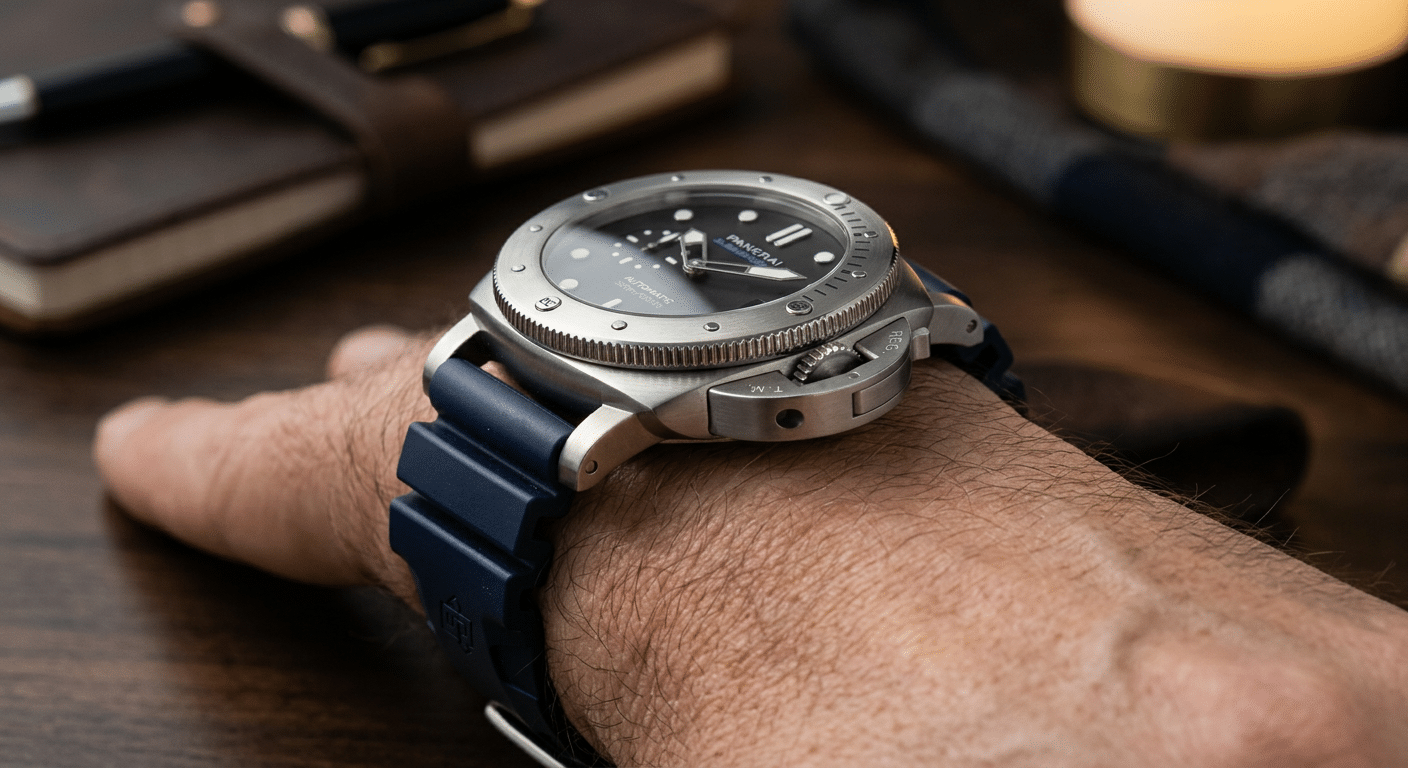
For large dive watches like the Panerai Submersible, the lug-to-lug measurement is arguably more critical than the case diameter in determining true wearability. While the diameter might catch the eye, it’s the distance between the outermost points of the lugs that dictates how much of your wrist’s flat surface the watch will occupy. For context, the 42mm Submersible models typically feature a lug-to-lug measurement of approximately 51mm. The 44mm QuarantaQuattro, encompassing models like PAM1229 and PAM1288, stretches to about 53-54mm lug-to-lug. The formidable 47mm Submersibles push this even further, often reaching 57-58mm. A watch with a lug-to-lug measurement significantly wider than the flat top surface of your wrist will inevitably result in uncomfortable overhang, preventing the watch from sitting flush. This often translates to the watch feeling top-heavy, prone to rotating, and visually disproportionate, making lug-to-lug a primary determinant of fit for Panerai’s robust cases.
Case Thickness and Profile: How it Affects Sleeve Fit and Balance on the Wrist
Beyond its diameter and lug-to-lug, the Submersible’s inherent case thickness and profile profoundly impact its daily wearability. These are not thin watches by any standard. A 42mm Submersible typically measures around 14.5mm thick, while the 44mm models often exceed 15.5mm, and the 47mm variants can approach 17mm. Panerai’s slab-sided case design, characterized by relatively straight, vertical case walls, tends to visually magnify this thickness. This substantial height directly affects sleeve compatibility, making it challenging to slide the watch comfortably under a shirt cuff or jacket sleeve—a common frustration for office wear. Furthermore, a thick, heavy watch can feel top-heavy and unbalanced on the wrist, particularly during active movement, requiring tighter strap adjustments that can compromise comfort. The Submersible’s robust profile, while contributing to its tool-watch aesthetic, demands a practical assessment of its everyday integration.
Crown Guard Ergonomics: A Panerai Signature and Potential Friction Point
The iconic crown guard is arguably Panerai’s most recognizable design element, a signature feature that reinforces its tool-watch heritage. However, this distinctive lever-locking mechanism, while visually strong and functionally robust, can present a significant ergonomic challenge. On the 44mm Submersible models, the crown guard protrudes substantially from the right side of the case, extending both laterally and vertically. For many wearers, particularly those with wrists that flex frequently or have prominent wrist bones, this projection can dig uncomfortably into the back of the hand. This friction point can lead to irritation, discomfort, or simply an awareness of the watch’s presence that detracts from long-term wearability. Its presence is a design non-negotiable for Panerai, but its practical impact on user comfort is a variable that must be personally evaluated.
Expert Authentication Insight
Physical diagnostic: The “Wrist Articulation” Clearance Check – This test is vital for identifying potential impingement points. With the watch on your wrist, perform a full range of motion. Flex your wrist upwards, downwards, and side-to-side, paying close attention to any contact or pressure from the crown guard or the edges of the watch case against the back of your hand or wrist bones. The goal is to ensure uninhibited movement. If the crown guard consistently digs in or restricts natural wrist articulation, it’s a strong indicator that the watch will be a source of chronic discomfort during daily activities, regardless of its visual appeal.
The 42mm Submersible: Compact Powerhouse and its Wearability Strengths
Proportionality and Understated Presence for Smaller Wrists
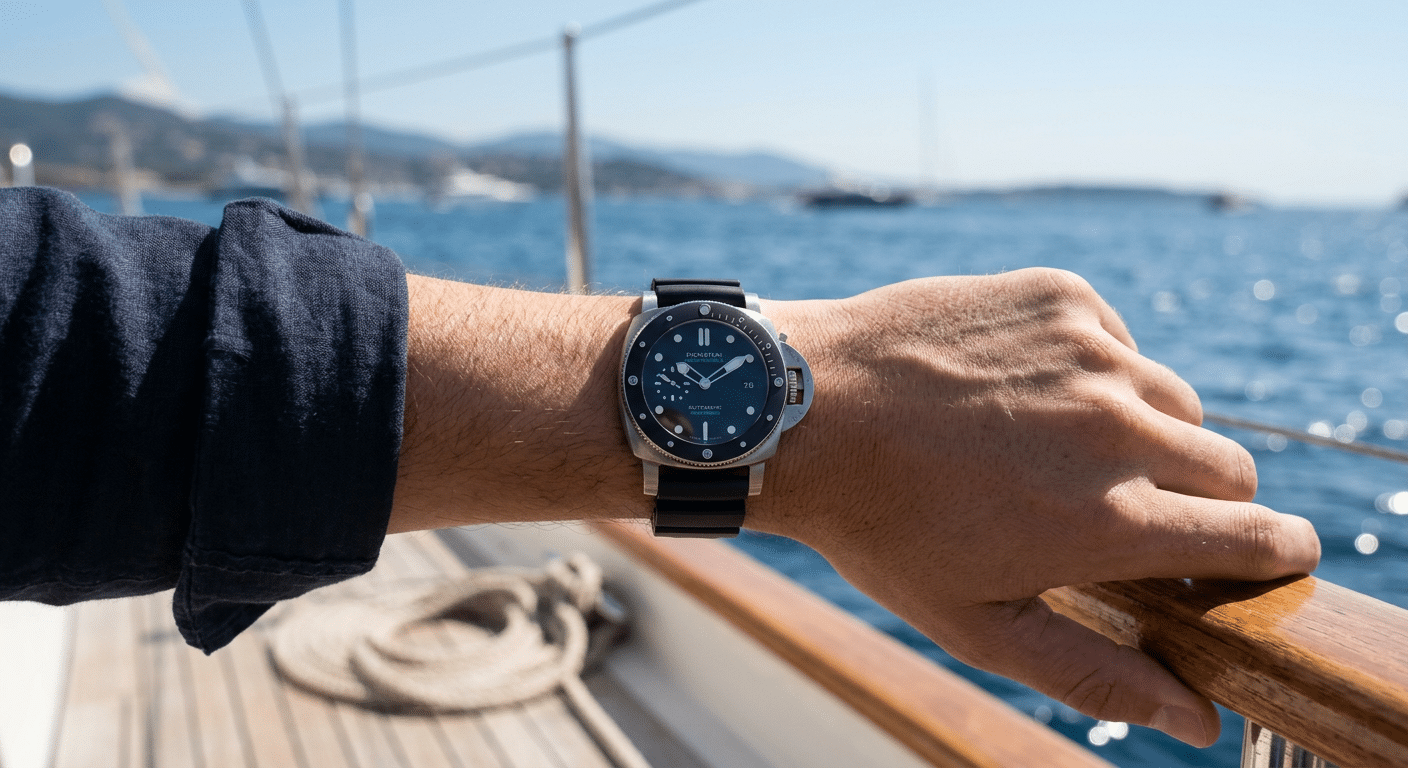
The 42mm Submersible models, such as the PAM973 or PAM683, represent Panerai’s most concerted effort to broaden its appeal to a wider range of wrist sizes without entirely sacrificing its distinctive DNA. While still a substantial watch by industry standards, the 42mm case offers a significantly more balanced visual and physical presence for wrists typically under 7 inches. Its reduced diameter and corresponding shorter lug-to-lug measurement (around 51mm) allow the watch to sit more harmoniously on the wrist, reducing the likelihood of unsightly overhang. It retains the robust, tool-watch aesthetic of its larger siblings—the prominent bezel, the legible dial, the signature crown guard—but in a package that feels less overwhelming. For those who appreciate the Panerai look but find the 44mm or 47mm models simply too large, the 42mm offers a compelling blend of brand identity and practical proportionality.
Practical Benefits: Sleeve Compatibility and Reduced Overall Weight
Beyond mere aesthetics, the 42mm Submersible offers tangible practical benefits for daily wear. Its reduced thickness, typically around 14.5mm, combined with its more manageable footprint, significantly improves sleeve compatibility compared to the 44mm and 47mm versions. This makes it a more viable option for wear with dress shirts and jacket sleeves, a common challenge for many larger sports watches. Furthermore, the overall reduction in mass contributes to a lighter watch on the wrist. A steel 42mm Submersible might weigh approximately 130-140g with a strap, compared to the 160-170g of its 44mm steel counterpart. This lighter weight reduces wrist fatigue over extended periods of wear, enhancing comfort for all-day use. These practical advantages position the 42mm as a more versatile and less demanding daily companion.
Perceived Compromises: “Too Small” for Traditional Paneristi?
Despite its clear ergonomic advantages, the 42mm Submersible often faces a particular critique from a segment of traditional Paneristi who view it as a dilution of the brand’s oversized “DNA.” Panerai built its reputation on large, bold, often 44mm or 47mm watches, designed for commanding wrist presence. For some purists, a 42mm Panerai, regardless of its design integrity, simply doesn’t embody the historical essence of the brand. This perception, while rooted in brand heritage, can unfortunately lead buyers to opt for larger sizes that are ultimately less comfortable or practical for their wrists, chasing an idealized notion of what a Panerai “should” be. However, when contrasted with its undeniable practical wearability benefits, this “too small” critique often reveals itself as a preference for tradition over real-world comfort.
Expert Authentication Insight
Physical diagnostic: The “Cuff Clearance” Test – This is a direct measure of a watch’s real-world versatility. To perform this, wear the 42mm Submersible with a standard dress shirt and, if applicable, a jacket. Attempt to comfortably slide the watch under the cuff of both garments. Observe any resistance, bunching of fabric, or snagging, especially around the crown guard. A watch that consistently catches or prevents the cuff from falling naturally over it will prove to be a source of daily frustration. For a watch intended to be a versatile daily wearer, smooth cuff clearance is a critical, non-negotiable metric that the 42mm Submersible often passes where its larger siblings struggle.
The 47mm Submersible: Unapologetic Presence and its Unique Ergonomics
While the 44mm Submersible attempts to capture a wider audience, the 47mm variant (exemplified by models like the titanium PAM1305 or the steel PAM682) remains the purest expression of Panerai’s oversized tool watch heritage. This section analyzes its distinct wearability profile, acknowledging its strengths as an iconic statement and its inherent ergonomic challenges.
The Iconic Statement: Unrivaled Wrist Presence and Panerai Heritage
The 47mm Submersible is not merely a watch; it is a declaration. Panerai built its legacy on robust, oversized instruments designed for Italian Navy frogmen, and the 47mm dimension directly channels this historical DNA. For many enthusiasts, this size represents the “true” Panerai experience, offering an unrivaled wrist presence that smaller variants simply cannot replicate. The sheer physical footprint, combined with the distinctive cushion case and prominent crown guard, ensures that a 47mm Submersible captures attention and embodies the brand’s bold, uncompromising aesthetic. Its appeal lies in its unapologetic scale, drawing in collectors who prioritize a commanding visual impact over discreet wearability.
Understanding the “Big Watch” Ergonomics: When Size Works (and When it Doesn’t)
Accommodating a 47mm Submersible comfortably is not a matter of wrist circumference alone. With a typical lug-to-lug measurement often exceeding 56mm (e.g., PAM1305 measures approximately 56.5mm), the critical factor is the flat surface width of the wearer’s wrist, a point extensively covered in any thorough Luminor Due review. For the lugs to sit properly without significant overhang, a wrist generally needs a flat top surface of at least 56-60mm. Flatter, wider wrists tend to integrate the watch head more harmoniously, allowing the strap to articulate naturally downwards. Conversely, on rounder or narrower wrists, the long, relatively straight lugs of the 47mm Submersible can extend noticeably beyond the wrist’s edge, creating an unstable, top-heavy feel and an awkward visual gap between the strap and the skin.
The Real-World Challenges: Desk Diving, Daily Wear, and Doorways
The very characteristics that give the 47mm Submersible its iconic presence also contribute to its practical drawbacks in daily life. Its substantial case thickness, often 15-16mm or more, makes it notoriously difficult to fit comfortably under most shirt cuffs, severely limiting its versatility for formal or even business-casual attire. Moreover, the sheer mass (a steel PAM682 on a strap can easily weigh over 160g) combined with its expansive diameter increases the risk of accidental impacts with doorways, desk edges, and other common obstacles. This “desk diving” phenomenon becomes less an aesthetic concern and more a functional reality, often leading to dings and scratches that detract from the watch’s intended tool aesthetic. For many, the 47mm becomes a weekend-only watch, reserved for specific occasions where its bulk is an asset, not a hindrance.
Expert Authentication Insight
Physical diagnostic: The “Forearm Integration” Visual Test
To truly assess if a 47mm Submersible works for your anatomy, observe how it integrates with your entire forearm, not just the immediate wrist area. A well-fitting large watch should appear as a natural, albeit substantial, extension of your limb. If the watch head appears disconnected, like a separate appendage or a “dinner plate” floating on your wrist, it suggests a poor ergonomic match. This visual harmony, or lack thereof, is often a more reliable indicator of long-term comfort than mere lug overhang.
QuarantaQuattro (44mm) Under the Microscope: PAM1229 & PAM1288 Specifics
The 44mm Submersible, or “QuarantaQuattro,” is positioned as the accessible sweet spot. Yet, a closer examination of models like the all-steel PAM1229 and the ceramic-bezel PAM1288 reveals unique wear characteristics that challenge the notion of universal comfort. This section dissects the material and design nuances that define the 44mm experience.
Case Construction and Weight Distribution: Steel (PAM1229) vs. Ceramic Bezel (PAM1288)
The choice between the PAM1229 and PAM1288, while seemingly subtle, can influence perceived comfort. The PAM1229, featuring a full stainless steel construction including its bezel, possesses a uniform density and a higher overall mass. This contributes to a solid, planted feel on the wrist, which some find reassuringly robust. In contrast, the PAM1288 incorporates a ceramic bezel, a material significantly lighter than steel. While the total weight difference might not be drastic, the shift in mass distribution can alter the watch’s balance. The ceramic bezel also offers superior scratch resistance, a practical wearability benefit for those prone to “desk diving” marks, potentially making the PAM1288 feel more resilient in daily use despite its similar dimensions. The PAM1229, while equally robust, will show bezel wear more readily.
Strap Integration and Comfort: Factory vs. Aftermarket Options for 44mm Submersible
Panerai’s signature quick-change strap system, often found on Submersible models, is a user-friendly feature. Factory-supplied straps, typically rubber for dive use and fabric for casual wear, are designed for seamless integration and optimal comfort given the watch’s weight. However, the fundamental lug geometry and fixed lug hole placement dictate the strap’s initial angle as it departs the case. If this angle is too straight for a wearer’s wrist curvature, even the softest strap material cannot fully compensate. This can lead to a visible gap between the strap and the wrist, or cause the watch head to sit less securely. While aftermarket straps offer a vast array of materials and aesthetic choices, they cannot fundamentally alter the watch’s intrinsic lug-to-lug dimension or the angle at which the strap begins its descent, making careful selection crucial for comfort.
The “Visual Bulk” Effect: How 44mm Appears on Different Wrist Circumferences
Despite its “middle ground” 44mm diameter, the Submersible QuarantaQuattro is not a svelte watch. Its case thickness, typically around 13-14mm, combined with the pronounced, non-tapering crown guard, creates substantial visual bulk. On wrists below approximately 6.75-7 inches, this can result in the watch appearing disproportionately large, with the case sides extending noticeably beyond the natural profile of the wrist. Even if the lugs technically fit without overhang, the sheer mass and width of the case can overwhelm a smaller wrist, making the watch feel and look top-heavy. This “visual mass” is a critical, often overlooked, aspect of wearability that can be as impactful on daily comfort as precise lug-to-lug measurements.
Expert Authentication Insight
Physical diagnostic: The “Strap Angle” Gap Measurement
To accurately assess the fit of a 44mm Submersible, put the watch on your wrist and observe the angle at which the strap departs the lugs. A significant gap (more than 2-3 millimeters) between the strap and your wrist, particularly when viewed from the side, indicates that the watch’s lugs are too long or too straight for your wrist’s natural curvature. This not only creates an awkward visual but also prevents the watch head from sitting flush and stable, leading to rotation and discomfort throughout the day.
Wrist-Fit Logic: A Practical Decision Framework for Submersible Sizing
Choosing the right Submersible size transcends marketing hype and aesthetic preference; it demands a practical, evidence-based approach centered on wrist anatomy. This section provides a structured framework to navigate the sizing decision, moving beyond generalized advice to actionable measurements and visual cues.
Measuring Your Wrist: Circumference vs. Flat Surface Width for Panerai Fit
Many watch buyers rely solely on wrist circumference, but for a watch with Panerai’s distinct case and lug geometry, this is insufficient. While a 7-inch wrist might seem ample, its shape—round vs. flat—is paramount. The critical measurement for Panerai’s often long and straight lugs is the flat surface width* across the top of your wrist. This dimension dictates the maximum lug-to-lug measurement a watch can accommodate without unsightly and uncomfortable overhang. Use a pair of calipers or a ruler to measure the distance across the top of your wrist, from one side to the other, where the watch head will actually sit. This figure will be your primary guide for comparing against the Submersible’s lug-to-lug dimensions.
The “Lug-to-Lug Rule of Thumb” Refined for Panerai’s Submersible Fit Guide
For Panerai Submersibles, the traditional “lug-to-lug should not exceed wrist circumference” rule is too broad. A more precise guideline, based on the critical flat surface width, is necessary:
- 42mm Submersible (e.g., PAM973): Typically features a lug-to-lug of approximately 51mm. This size generally requires a flat wrist width of at least 50mm, and ideally no more than 55mm, for optimal fit without overhang.
- 44mm Submersible (e.g., PAM1229, PAM1288): Measures approximately 53-54mm lug-to-lug. For these models, a flat wrist width between 53mm and 58mm is typically required to ensure the lugs sit within the confines of the wrist.
- 47mm Submersible (e.g., PAM1305, PAM682): Boasts a substantial lug-to-lug of around 56-57mm. This size demands a flat wrist width of 56mm or greater to avoid prominent lug overhang and ensure a stable fit.
The explicit judgment here is that for Panerai, the watch’s lug-to-lug dimension should ideally be less than or equal to* your flat wrist width for genuine comfort and visual balance, rather than merely fitting the overall circumference.
Visual Balance: How the Watch Sits on Your Wrist (44mm Submersible Wearability)
Beyond numerical measurements, assessing the visual balance of a Panerai on your wrist is crucial. This involves more than just checking for lug overhang. Consider how the case sides align with the edges of your wrist: does the watch appear to “spill over” or does it integrate cohesively? Evaluate the proportion of the dial to your wrist’s surface area. The iconic crown guard, while a Panerai signature, should not dig into the back of your hand during normal wrist articulation. A well-balanced 44mm Submersible should feel substantial but not overwhelming, and its bulk should not detract from the overall aesthetic harmony. This subjective visual assessment often solidifies or negates the objective measurements.
Expert Authentication Insight
Physical diagnostic: The “Mirror Test” (3-Angle Self-Assessment)
To gain a holistic and objective perspective on fit, perform the “Mirror Test.” Stand in front of a full-length mirror and observe the watch from three critical angles:
- Eye-Level (from a distance): Observe your entire arm. Does the watch appear proportional to your build, or does it look conspicuously wide or tall? This angle reveals overall visual harmony.
- From Above (looking down at your wrist): This is the classic lug overhang check. Do the lugs extend noticeably beyond the flat surface of your wrist? This direct view is crucial for identifying an unstable fit.
- From the Side: Assess the watch’s thickness profile and how it sits on your wrist’s curve. Is there a significant gap between the case back and your wrist, indicating the watch is floating? Does the crown guard make contact with the back of your hand when your wrist flexes? This angle highlights comfort and practical interaction.
These three perspectives collectively provide a comprehensive assessment that a single glance or measurement cannot capture, offering the ultimate authentication of a proper fit.
Real-World Scenarios: When 44mm Shines, and When it Struggles for Comfort
Understanding a watch’s true wearability extends beyond static measurements; it involves observing how it integrates with daily activities. For the 44mm Submersible QuarantaQuattro, its “middle ground” sizing can be either a practical advantage or a persistent ergonomic challenge, depending on the wearer’s lifestyle and context.
Office Wear vs. Casual Dress: The QuarantaQuattro’s Versatility and Limitations
The 44mm Submersible, exemplified by models like the PAM1229 and PAM1288, often presents a paradox in professional settings. On the one hand, its robust, tool-watch aesthetic, softened slightly from the 47mm behemoth, can project a confident, adventurous image, especially in business casual environments. For a detailed replica Panerai models guide, understanding the diameter itself is manageable for many wrists, allowing it to convey presence without overwhelming. However, the inherent thickness and the prominent crown guard system remain significant hurdles for formal wear.
Unlike a 42mm Luminor Due, which is explicitly designed for a sleeker profile, the 44mm Submersible struggles to disappear under a standard shirt cuff. Its case height, typically around 14.5mm, combined with the often-protruding crown guard, means it frequently snags on sleeves or pushes them up. This isn’t merely an aesthetic concern; constant friction can lead to premature wear on shirt cuffs and an awkward, unbalanced feel throughout the day. While it might transition seamlessly from a t-shirt to a polo, its “versatility” often stops short of traditional business attire, forcing a wardrobe compromise or a choice to simply not wear it with certain outfits.
Active Lifestyles and Sport Use: Durability, Comfort, and Submersible Performance
For active pursuits, the 44mm Submersible tends to hit its stride. Its substantial build, robust case, and 300m water resistance are genuinely functional attributes for diving, swimming, or other outdoor activities. The weight, while noticeable, contributes to a sense of durability without becoming unwieldy for most wrist sizes during movement. The rubber strap options, common on Submersibles, are designed for secure fit and comfort during exertion, resisting moisture and providing adequate ventilation.
However, even in its element, specific ergonomic quirks persist. For high-impact sports or activities requiring fine motor skills, the watch’s bulk can be a minor hindrance. The crown guard, while offering protection, can occasionally dig into the back of the hand during extreme wrist flexion, such as when gripping a rock climbing hold or performing certain gym exercises. Accidental impacts, often referred to as “desk diving scars,” are more likely to become “doorway dings” with a watch of this size, even if the case is built to withstand them. The 44mm is a capable tool watch, but its physical footprint means constant awareness of its presence is required during dynamic activities.
The “One Watch” Dilemma: Can 44mm Be the Daily Driver for Every Occasion?
The aspiration for a “one watch collection” is common among enthusiasts, and the 44mm Submersible is often positioned as a strong contender due to its blend of presence, ruggedness, and perceived versatility. Its robust construction certainly qualifies it for daily wear, capable of shrugging off the bumps and scrapes of everyday life. The legibility of its dial and hands, coupled with strong lume, makes it practical in various lighting conditions.
Yet, the cumulative effect of its ergonomic demands can undermine its candidacy as a true daily driver for every* occasion. The persistent struggle with sleeve clearance, the occasional impingement from the crown guard, and the sheer visual and physical bulk can lead to “watch fatigue.” A watch that feels uncomfortable or constantly catches on things, even subtly, is less likely to be worn consistently. For many, the 44mm Submersible excels as a weekend warrior or a dedicated sports watch, but its specific design language and wear characteristics often necessitate a more discreet or comfortable alternative for formal events or prolonged desk-bound tasks, challenging its “one watch” potential.
Expert Authentication Insight
Physical diagnostic: The “Sleeve & Keyboard” Test – Wear the watch for a full hour at a desk, typing and moving naturally, to assess how it interacts with clothing and workstation ergonomics. Pay close attention to whether the crown guard presses into your hand, if the case edge leaves marks on your wrist, or how frequently it snags on your shirt cuff. A truly comfortable watch should largely disappear on the wrist during these common activities.
The “Compromise” Re-evaluated: Making an Informed Submersible Choice
The journey to finding the ideal Panerai Submersible size is less about universal truths and more about individual wrist anatomy, lifestyle, and priorities. The 44mm QuarantaQuattro, while marketed as a sweet spot, is in reality a conditional fit, a unique set of trade-offs that demand careful consideration.
Prioritizing Comfort vs. Aesthetic Preference: Panerai Submersible Sizing Decision
For many, the visual impact of a Panerai—its bold proportions and distinctive design—is the primary draw. The 44mm diameter offers a significant wrist presence without the outright dominance of the 47mm. However, aesthetic preference, while powerful, should not completely override the practical realities of comfort. A watch that looks stunning but constantly digs into your wrist, snags on clothing, or feels unbalanced will ultimately spend more time in its box than on your arm. This leads to buyer’s remorse, regardless of how much you initially admired its looks.
The decision requires a conscious effort to weigh both factors equally. Ask yourself: “Does the aesthetic pleasure I derive from this size outweigh any potential discomfort I might experience throughout a full day of wear?” For some, the answer will be a resounding yes, accepting minor ergonomic quirks for the desired look. For others, the persistent physical friction will quickly overshadow the visual appeal. Recognizing that the 44mm Submersible does* present specific ergonomic challenges, rather than assuming it’s universally comfortable, is the first step toward an informed decision.
The Value of “Try Before You Buy”: Dealer Visits and Community Insights
Relying solely on published dimensions or online pictures for a watch as architecturally distinct as the Panerai Submersible is a recipe for potential disappointment. The most critical step in evaluating the 44mm, 42mm, or 47mm Submersible is to physically try on all three sizes at an authorized dealer. This allows for a direct comparison of how each model’s lug-to-lug, case thickness, and crown guard integrate with your specific wrist shape and size.
Beyond dealer visits, leverage the vast resources of online watch communities. Forums and social media platforms are replete with “wrist shots” from owners with varying wrist circumferences. Specifically seek out examples of the PAM1229 and PAM1288 on wrists similar to your own, and pay attention to comments regarding their daily wear experience. These real-world perspectives, often highlighting both the joys and frustrations of ownership, provide invaluable context that glossy marketing materials simply cannot.
Beyond the Numbers: The Intangible Feel of a Panerai on Your Wrist
While measurements like diameter, lug-to-lug, and thickness provide a crucial analytical framework, the ultimate decision often transcends pure data. There’s an intangible “feel” to a watch—how it balances, how its weight distributes, the tactile feedback of its components, and its overall presence—that cannot be quantified. A watch might technically fit your wrist based on all measurements, yet simply not “feel right.”
This emotional and sensory connection is particularly potent with Panerai, a brand known for its distinctive and often polarizing designs. The 44mm Submersible might align with your desired aesthetic and even pass initial fit tests, but only extended wear will reveal if it truly integrates into your personal space and habits without becoming a constant reminder of its presence. Trusting this gut feeling, this subjective sense of integration, is as important as any objective measurement in making a choice you’ll be happy with long-term.
Expert Authentication Insight
Physical diagnostic: The “Long-Term Wear” Self-Interview – After wearing the watch for a minimum of 4-6 hours, ask yourself: Is anything digging in? Is it constantly rotating or sliding to one side? Do I feel an unconscious urge to take it off or adjust it? Your honest answers to these questions are the ultimate authentication of true comfort and fit, far more telling than a five-minute try-on in a store.
Before you commit to the 44mm Submersible as your “sweet spot,” conduct these final, critical checks. Does it clear your cuff? Does it stay centered on your wrist through a full range of motion? And most importantly, does it feel right after an hour, not just a minute? Your wrist, not marketing, should make the final call.