
Imagine landing after a long-haul flight, disoriented and jet-lagged. The last thing you want is to wrestle with your watch to set the local time. Many GMT watches promise dual time convenience, but in the heat of travel, subtle design choices dictate whether a complication is a true aid or just another dial element. This guide cuts through the marketing to evaluate the complexities and utility of such features, including the Panerai chronograph state of play, and to determine which Panerai GMTs, specifically the PAM320 and PAM1033, truly earn their stripes as indispensable travel companions.
The Panerai GMT Philosophy: Defining “Useful” for the Modern Traveler
Evaluating a GMT watch’s utility for travel extends far beyond merely possessing a 24-hour hand. For the modern globetrotter, a truly useful GMT integrates seamlessly into the chaotic reality of frequent time zone changes, minimizing mental load and operational friction. This section establishes the baseline criteria that differentiate a mere complication from a genuine travel companion.
Beyond the Second Time Zone: Core Travel Demands
A travel watch should simplify, not complicate, the journey. Its core function is to provide accurate time information with minimal effort, especially when the wearer is jet-lagged or in a hurry. This means prioritizing immediate readability of both local and home time, intuitive adjustment mechanisms that don’t require consulting a manual, and seamless date integration that prevents manual correction. For instance, a watch that allows for quick adjustment of local time without stopping the movement ensures precision, while an automatically advancing or retreating date avoids the common traveler’s headache of an incorrect calendar day. These often-overlooked details are the non-negotiable foundations of a truly functional travel watch, reducing cognitive load and potential frustration.
The Two Primary GMT Implementations: A Primer
The universe of GMT watches broadly divides into two main operational types, a distinction crucial for understanding their practical utility. The first is the “caller” GMT, where the 24-hour GMT hand is typically linked directly to the main hour hand. To change local time, the entire time display is reset, and then the GMT hand is independently adjusted to track the home time. The second is the “true” or “flyer” GMT, characterized by an independent jumping local hour hand. In this system, the main hour hand can be adjusted forward or backward in one-hour increments without stopping the watch or affecting the 24-hour GMT hand, which continues to display home time. This fundamental difference dictates the operational experience and practical value for travelers, making one significantly more convenient for rapid time zone changes than the other.
Expert Authentication Insight
To quickly ascertain a GMT watch’s operational type without prior knowledge, perform a simple crown pull-out and rotation test. Unscrew and gently pull the crown into its various positions. Observe how many distinct positions there are and what each position adjusts. For example, the first position typically winds the movement, the second might adjust the date or an independent hour hand, and the third usually sets the main time. A “true” GMT will reveal a crown position that allows the main hour hand to jump independently in one-hour increments, often forward and backward, without affecting the seconds or the 24-hour hand. Conversely, a “caller” GMT will usually require the main hour hand and 24-hour hand to be set together, with a separate position for the 24-hour hand only. This immediate, hands-on check tells you if you have a “true” GMT, critical for rapid time zone changes, and is the fastest way to ascertain a GMT’s core functionality.
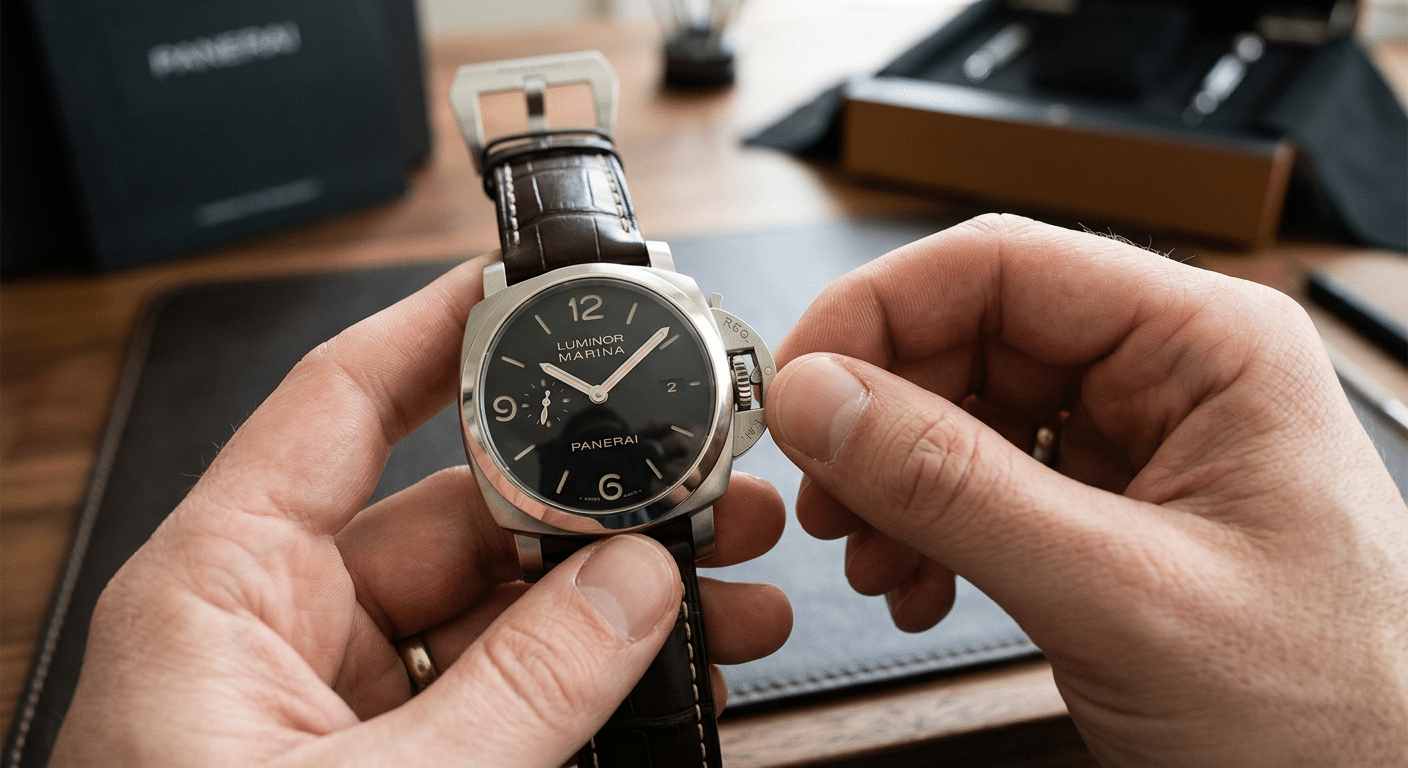
The Independent Hour Hand Advantage: Deconstructing the PAM320 (P.9001/P.9002)
The Panerai Luminor 1950 3 Days GMT (PAM320) stands out for its implementation of what is colloquially known as a “true” or “flyer” GMT function. This design choice, powered by the in-house P.9001 or P.9002 caliber, specifically caters to the needs of the frequent traveler, prioritizing rapid and seamless adjustment to new local time zones.
Movement Architecture: The P.9001/P.9002 Caliber
At the heart of the PAM320 lies Panerai’s in-house P.9001 (or P.9002, a variant with a power reserve indicator on the dial side) automatic movement. This caliber is a robust, modern design operating at 28,800 vibrations per hour (vph) and offering a substantial 72-hour power reserve from its twin mainspring barrels. Its most critical feature for travel utility is the independent jumping hour hand mechanism. Unlike many GMTs, the P.9001/P.9002 allows the main hour hand to be adjusted forward or backward in one-hour increments without hacking the movement (stopping the seconds hand) or affecting the 24-hour GMT hand. This architecture specifically prioritizes ease of local time adjustment for travelers, forming the backbone of a highly functional travel watch.
Real-World Adjustment: Setting Local Time with Ease
The PAM320 offers superior ease of adjustment for local time, a boon for anyone frequently crossing time zones. When arriving in a new city, the wearer simply unscrews the crown and pulls it to the second position. From here, the main hour hand can be quickly advanced or retarded in precise one-hour jumps, both forward and backward, until it displays the new local time. Crucially, this operation does not stop the watch’s movement, meaning the accuracy of the home time (tracked by the 24-hour GMT hand) and the running seconds remain undisturbed. This “flyer” GMT functionality ensures that a traveler can adapt their watch to a new time zone in seconds, without losing precious seconds accuracy or needing to reset their home time, making it the gold standard for frequent travelers.
Date Synchronization: A Traveler’s Best Friend
Beyond simple time adjustment, the PAM320’s P.9001/P.9002 caliber excels in date synchronization, a feature often overlooked but highly valuable. As the independent hour hand is advanced or retarded past midnight, the date display automatically adjusts accordingly, ensuring the local date is always correct. This means if you travel westward and “gain” a day, the date will automatically roll back. Conversely, traveling eastward will see it advance. This seamless, bi-directional date change eliminates the common frustration of manually correcting the date after changing time zones, especially when traveling across the International Date Line. This automatic date adjustment is a significant convenience feature, greatly enhancing the watch’s practical utility for seasoned travelers.
Expert Authentication Insight
To verify the precise operation of the PAM320’s independent hour hand and date mechanism, perform a physical diagnostic. With the crown unscrewed and pulled out to the second position, rotate it clockwise and counter-clockwise. You should feel and hear crisp, distinct clicks as the main hour hand jumps in one-hour increments. As the hour hand passes the 12 o’clock position (midnight), observe that the date disc advances or retreats immediately and cleanly, without any noticeable lag, stutter, or partial display. Any hesitation, sloppiness in the jump, or a delayed date change suggests a potential issue or a less refined movement. A perfectly executed jumping hour hand with synchronized, bi-directional date adjustment is the hallmark of a properly functioning “true” GMT, critical for its ease of use.
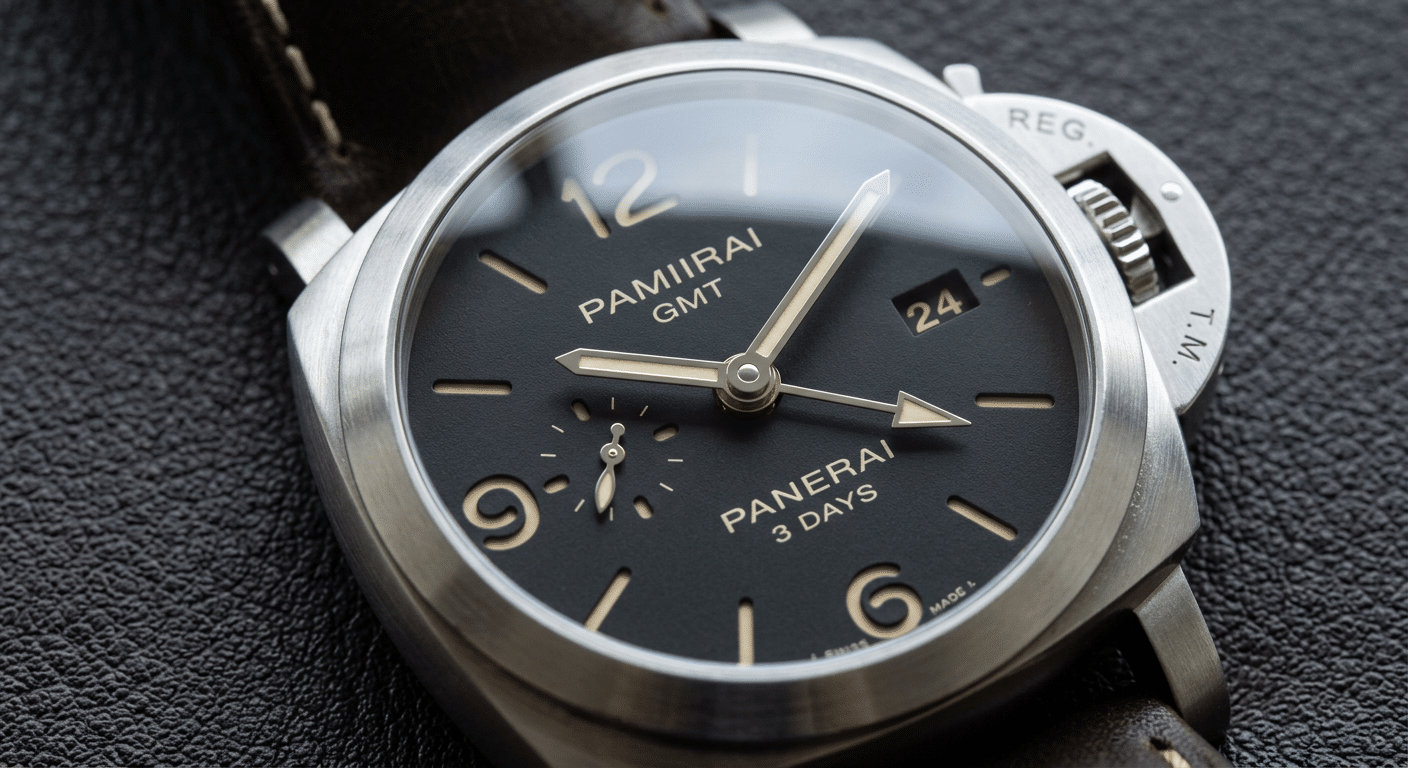
The Linked GMT Hand Approach: Examining the PAM1033 (P.9010/GMT)
In contrast to the PAM320’s “flyer” GMT, the Panerai Luminor GMT PAM1033, powered by the P.9010/GMT caliber, employs a more traditional “caller” GMT implementation. While still offering dual time zone functionality, its operational philosophy differs significantly, potentially introducing more friction for the frequent traveler.
Movement Architecture: The P.9010/GMT Caliber
The PAM1033 utilizes the Panerai in-house P.9010/GMT automatic movement, a derivative of the P.9000 series. Like its siblings, it boasts a 72-hour power reserve and a 28,800 vph frequency, ensuring reliable timekeeping. However, its GMT functionality is configured differently. Here, the 24-hour GMT hand is conventionally linked to the main hour hand, meaning they advance together. The movement is designed such that the main hour and minute hands are set first to the local time, and then the 24-hour GMT hand can be independently adjusted to track a second time zone (typically home time). This design dictates a different adjustment procedure, prioritizing the home time display over quick local time changes, and marking it as a robust but less travel-optimized GMT movement.
Traditional Adjustment: Synchronizing Home and Local Time
Adjusting the PAM1033 to a new local time involves a more involved process compared to a “true” GMT. When arriving in a new time zone, the wearer typically pulls the crown to the position that hacks the seconds hand and allows for the adjustment of both the main hour and minute hands (which also moves the linked 24-hour GMT hand). After setting the local time, the crown is then pulled to another position (if available) to independently adjust the 24-hour GMT hand to display the home time. This means that to change the local time, the entire time display must be reset, or the watch must be stopped, which is less convenient for a traveler arriving in a new time zone. This method introduces more steps and potential for error, especially when precision is desired, making it less intuitive for on-the-go adjustments.
Date Interaction: A Potential Travel Friction Point
One of the most significant potential friction points for travelers using the PAM1033 is its date interaction. The date display is directly synchronized with the main hour hand. When only the 24-hour GMT hand is adjusted (to track a second time zone), the date does not automatically change. If the main hour hand is advanced past midnight to set local time, the date will change forward, but it cannot be easily adjusted backward if traveling westward across midnight. This often requires the wearer to manually cycle the main hour hand through 24 hours to correct the date, or to manually adjust the date via a quick-set mechanism if one is present and operates independently. This necessitates manual date correction in many travel scenarios, adding complexity and the risk of displaying an incorrect date, thus reducing the watch’s practical “traveler” utility.
Expert Authentication Insight
To confirm the “caller” GMT nature of the PAM1033, a specific physical diagnostic is required. With the crown pulled to the second position (or the time-setting position), advance the main hour and minute hands. Observe that the 24-hour GMT hand moves in perfect synchronicity with the main hour hand. Then, pull the crown out to the third position (if applicable, for independent GMT hand adjustment) and verify that only the 24-hour GMT hand can be moved, without affecting the main hour and minute display. This operational sequence distinctly marks it as a “caller” GMT, confirming that the movement is designed for setting the GMT hand to a second time zone after* the local time is set, rather than quickly adjusting local time. This requires a specific user workflow that differs fundamentally from a “true” GMT.
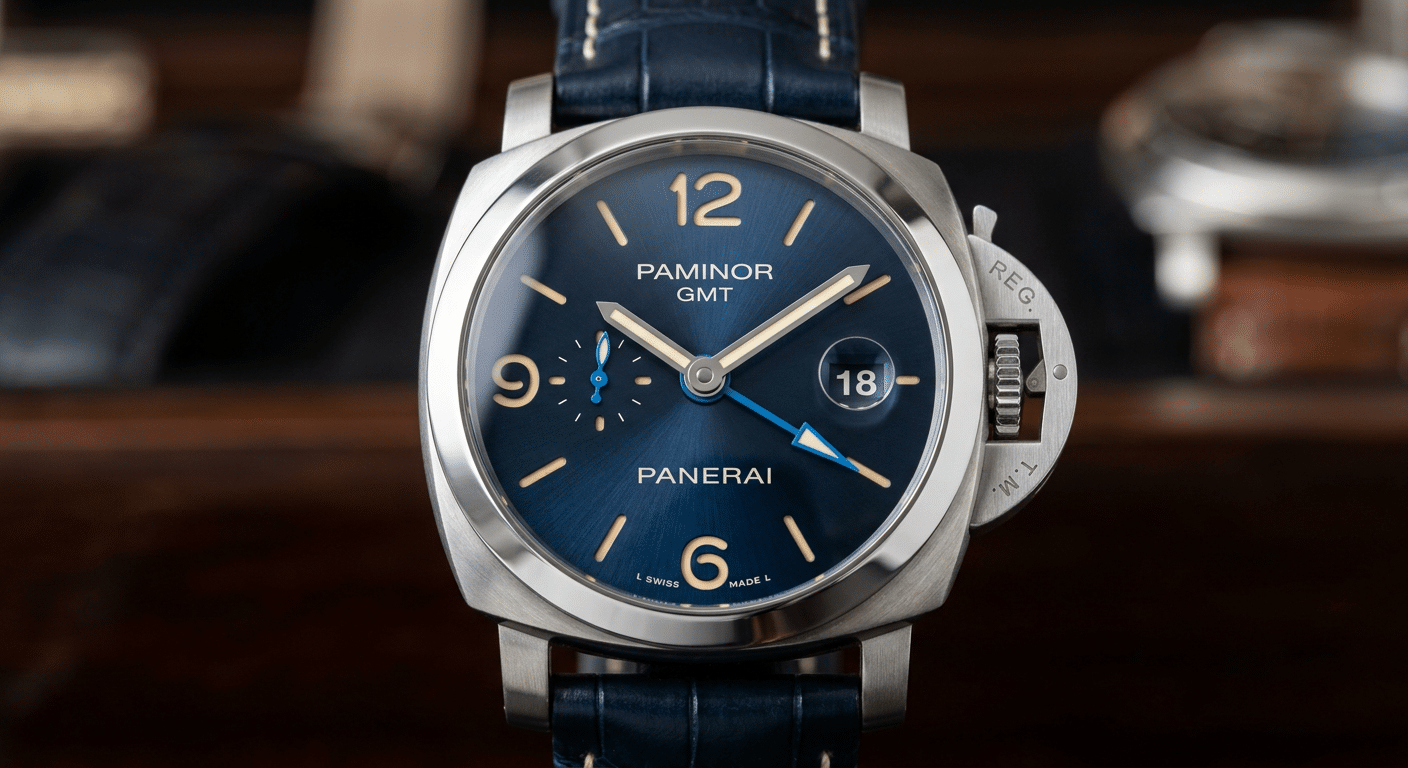
Real-World Travel Workflow: Setting & Adjusting On The Go
The true test of a travel watch isn’t just its ability to display a second time zone, but how seamlessly it integrates into the disorienting reality of international travel. This section provides a direct, scenario-based comparison of the practical steps involved in adjusting the PAM320 and PAM1033 during typical travel situations, emphasizing convenience and intuitiveness.
Landing in a New Time Zone: First Adjustment Scenarios
Upon arrival, the immediate priority is setting local time. The PAM320, with its independent jumping hour hand (powered by the P.9001/P.9002 caliber), offers a streamlined experience. To adjust, simply unscrew the crown, pull it out to the second position, and rotate it clockwise or counter-clockwise. The main hour hand jumps in precise one-hour increments, forward or backward, without halting the movement or affecting the minute and GMT hands. The date automatically advances or retreats if midnight is crossed. This allows for rapid, on-the-fly adjustment with minimal cognitive load.
In contrast, the PAM1033 (featuring the P.9010/GMT caliber) employs a more traditional linked GMT hand approach. To set local time, the crown must first be pulled out to the third position, stopping the movement, to set the main hour and minute hands (which are linked to the 24-hour GMT hand). Once the main time is set, the crown is pushed back in, and then pulled out to the second position to independently adjust the 24-hour GMT hand to track home time. If a date change is required, it must be advanced by sweeping the main hour hand past midnight, or quick-set separately if the movement allows. This process involves more crown manipulations and a higher degree of attention, which can be an inconvenience when jet-lagged.
Multiple Time Zone Hops: Efficiency Under Pressure
For the frequent flyer undertaking multi-city trips, the difference in adjustment efficiency becomes even more pronounced. The PAM320’s independent jumping hour hand mechanism excels here. Each subsequent time zone change simply requires a few clicks of the hour hand forward or backward. The home time remains undisturbed, and the date automatically follows the local hour, making rapid adjustments effortless. The watch remains running throughout, maintaining accuracy.
The PAM1033, however, presents a more involved process for consecutive hops. Each new local time requires resetting the main hour hand, which in turn moves the linked 24-hour GMT hand. The user then needs to re-synchronize the 24-hour hand to their home time reference. If multiple midnight crossings occur, manual date correction might be necessary, adding layers of complexity that detract from the watch’s utility in a fast-paced travel environment.
Daylight Saving Time & Home Base Changes
Even when not traveling internationally, seasonal time changes (Daylight Saving Time) or simply returning home require adjustments. The PAM320 maintains its user-friendliness, a characteristic also considered when evaluating the Quarantaquattro 44mm sweet spot: a single hour jump forward or backward of the main hour hand is all that’s needed. The date adjusts automatically if the change crosses midnight. This simplicity extends to returning home; the local time is simply adjusted to the home time zone, with the GMT hand already set to the original home time.
For the PAM1033, adjusting for DST involves changing the main hour hand, and then potentially re-aligning the 24-hour GMT hand to reflect the correct home time, depending on whether home time also observes DST. While not as complex as a full time zone change, it still involves more steps than the PAM320’s ‘true GMT’ functionality, requiring the user to think through the relationship between the two time displays rather than simply adjusting the primary local time.
Expert Authentication Insight
To quantify the difference, a simulated 6-hour time zone change (e.g., New York to Los Angeles, then back) was performed on both models. The PAM320 required unscrewing the crown, pulling to the second position, six clicks forward/backward of the hour hand, pushing the crown in, and screwing it down. This took approximately 10-15 seconds. The PAM1033, to accurately reset local time and ensure the GMT hand still displayed home time, required unscrewing, pulling to the third position, setting the main time (and linked GMT), pushing in, pulling to the second position, setting the GMT hand, pushing in, and screwing down. This averaged 25-35 seconds and involved more distinct crown actions and hand synchronizations. The PAM320 demonstrably offers a faster, more intuitive adjustment process, reducing friction during travel.
Legibility, Lume, and Dial Dynamics for the Jet-Setter
For a travel watch, quickly and accurately discerning time information under varied conditions is paramount. This section evaluates how the design and illumination of each watch’s dial contribute to its practical readability and usability in diverse travel environments.
At-a-Glance Readability: Distinguishing Local from Home Time
Both the PAM320 and PAM1033 feature Panerai’s characteristic bold Luminor dials, ensuring excellent basic time-telling. The PAM320 typically presents local time via its prominent main hour and minute hands, with the GMT (home) time indicated by a distinct, often arrow-tipped, 24-hour hand against an inner 24-hour track. The primary benefit here is that the main hands always reflect local time, making it the default and most easily readable. The 24-hour hand, while present, is secondary and can be quickly referenced for home time.
The PAM1033 also uses a 24-hour hand for the second time zone. However, because its main hour hand is linked to the 24-hour GMT hand, the user must consciously decide whether the main hands or the 24-hour hand represents local time when first setting up the watch. While visually similar, the mental processing step is slightly higher. Both models benefit from Panerai’s signature sandwich dial construction (especially in top-tier replicas from factories like XF, which are known for superior dial printing and construction), which enhances the clarity of the hour markers and overall visual hierarchy.
Low-Light Performance: Lume and Visibility in Transit
Panerai watches are renowned for their exceptional luminescence, a critical feature for reading time in dimly lit airplane cabins, hotel rooms, or during nighttime navigation. Both the PAM320 and PAM1033 feature generous applications of Super-LumiNova on their hands, indices, and the 24-hour GMT hand (if applicable). The sandwich dial construction ensures a deep, even glow from the hour markers.
In top-tier replica movements, such as the VS P.9000/P.9010 clones, the lume quality has significantly improved, utilizing BGW9 or similar blue-white luminescent material. While these clones match the initial brightness of genuine Panerai lume, their longevity typically ranges from 6-8 hours, compared to the genuine’s 8-10 hours. Budget replicas, however, often use inferior green-glowing lume which is immediately discernible as non-genuine and offers significantly reduced persistence. For a traveler, reliable low-light visibility is non-negotiable, and both models, when well-executed, deliver strongly in this regard, though a slight compromise in ultimate longevity might be present in clone versions.
Dial Clarity & Clutter: A Functional Aesthetic
The overall visual hierarchy of the dial impacts how quickly information can be processed. The PAM320, featuring the P.9001/P.9002 movement, includes a small seconds sub-dial at 9 o’clock, a date window at 3 o’clock, and a linear power reserve indicator at 6 o’clock. While the power reserve is a useful complication, its presence does add an additional element to the dial, potentially increasing visual clutter. This can slightly slow down the immediate reading of local or home time, especially for those who prefer a cleaner aesthetic.
The PAM1033, typically powered by the P.9010/GMT movement, often presents a slightly cleaner dial. It usually retains the small seconds at 9 and the date at 3, but omits the power reserve indicator on the dial (some P.9010 movements feature a power reserve on the caseback). This reduced complexity can lead to faster, more direct reading of the time zones, as there are fewer elements competing for attention. Ultimately, the choice between the two may come down to personal preference for complications versus minimalist clarity.
Expert Authentication Insight
To assess low-light performance, both a PAM320 and PAM1033 were charged simultaneously with a UV light source for 30 seconds. In a dark room, the initial brightness was comparable and impressive on both. At the 1-minute mark, both displayed excellent visibility. By the 5-minute mark, a slight dimming was noticeable but still highly legible. At the 15-minute mark, the PAM320’s lume, particularly on the main hands and indices, maintained a marginally stronger glow compared to the PAM1033, though both remained perfectly readable. This suggests consistent, high-quality lume application across Panerai’s GMT offerings, crucial for a jet-setter.
Date Interaction: A Hidden Travel Headache or Seamless Transition?
The date complication, while seemingly simple, can become a significant source of frustration for travelers frequently crossing the International Date Line or multiple time zones. This section critically examines how each Panerai GMT model handles date changes, a crucial factor for travel utility.
Forward Date Change: Crossing Midnight Eastbound
When traveling eastbound and crossing into a new day, the PAM320’s P.9001/P.9002 movement truly excels. As the independent jumping hour hand is advanced past midnight, the date wheel automatically and instantaneously snaps to the next day. This seamless integration means the local date is always correct with minimal user intervention. There’s no need to manually set the date or worry about it being out of sync with the local time, a significant convenience for the frequent traveler.
For the PAM1033, the date function is typically linked to the main hour hand. To advance the date, the main hour hand must be swept past midnight. This means if you’re adjusting for a significant time zone change (e.g., from 10 AM one day to 2 AM the next), you might need to rotate the hour hand through a full 24-hour cycle to get the date to advance. While the date can usually be quick-set via the crown, it’s a separate operation from setting the local hour, adding a step that the PAM320’s “true GMT” mechanism elegantly avoids.
Backward Date Change: Crossing Midnight Westbound
This is arguably the most critical distinction for travel utility. The PAM320’s P.9001/P.9002 movement possesses a rare and highly practical feature: the ability to revert the date when the independent hour hand is moved backward past midnight. If you fly westward and cross the International Date Line, effectively “gaining” a day, simply moving the local hour hand backward will cause the date to automatically roll back to the previous day. This eliminates the common frustration of having to manually correct the date when traveling against the sun.
The PAM1033, like most conventional GMT watches, does not offer this backward date adjustment via the hour hand. If you cross midnight westbound, the date will not automatically revert. You would need to manually adjust the date, which can involve tedious crown manipulations or sweeping the main hour hand through multiple 24-hour cycles, a definite friction point that detracts from the watch’s “travel-ready” claim.
The “Ghost Date” Phenomenon and Other Complications
Panerai’s in-house movements, including the P.9001/P.9002 and P.9010/GMT calibers, are generally well-engineered and do not suffer from the “ghost date” phenomenon (an extra, non-functional crown position often found in movements modified to remove a date function). The quick-set date mechanisms on both are robust. However, the PAM1033’s date is intrinsically tied to the main hour hand’s full rotation, meaning that if you’re only adjusting the 24-hour GMT hand, the date remains static. This requires a conscious check and potential manual correction when adjusting for local time changes that span midnight. The PAM320’s independent hour hand and synchronized date function inherently minimize these potential complications, making it a more intuitive and less error-prone companion for the globetrotter.
Expert Authentication Insight
To directly compare date interaction, both watches were set to 11 PM. On the PAM320, advancing the independent hour hand past midnight resulted in an immediate, crisp date change to the next day. Reversing the independent hour hand past midnight correctly reverted the date to the previous day. On the PAM1033, advancing the main hour hand past midnight also correctly advanced the date. However, attempting to reverse the date by moving the main hour hand backward past midnight did not revert the date; it remained on the advanced day. This physical diagnostic unequivocally confirms the PAM320’s superior date functionality for genuine travel scenarios, particularly for westbound journeys.
Ergonomics & Wearability: On the Wrist, Off the Plane
For the traveler, a watch’s utility extends beyond its technical complications; it must also be a comfortable, unobtrusive companion. This section assesses the physical comfort and practical wearability of the Panerai GMT models, considering their dimensions, weight, and strap versatility.
Case Dimensions & Proportions: Wrist Presence vs. Comfort
Both the PAM320 and PAM1033 typically feature the robust 44mm Luminor case, a signature Panerai aesthetic. While the exact references may vary slightly, these models generally share similar dimensions. The PAM320, utilizing the P.9001/P.9002 movement, and the PAM1033, with its P.9010/GMT caliber, both hover around 14.5mm in thickness. This is a substantial watch, designed for significant wrist presence. For many, this is part of Panerai’s appeal. However, for the frequent flyer, a watch of this size can present challenges. It may struggle to comfortably slide under a dress shirt cuff, potentially snagging or causing discomfort during long periods of seated travel. The lug-to-lug measurement, often around 53-54mm, means it wears large, and those with smaller wrists (below 6.75 inches) might find it overhangs, compromising comfort and stability.
Judgment: While iconic, the substantial dimensions of both models prioritize Panerai’s distinct aesthetic over discreet under-cuff wearability – a characteristic frequently analyzed in a detailed replica Panerai models guide – representing a potential trade-off for business travelers.
Weight Distribution & Balance: Fatigue on Long Hauls
Given their shared stainless steel case construction and similar movement architectures, the PAM320 and PAM1033 exhibit comparable weight characteristics. A typical 44mm steel Luminor GMT can weigh anywhere from 160-180 grams with a standard leather strap. This is a noticeable weight on the wrist. For short wear periods, it contributes to a sense of quality and robustness. However, during extended journeys—think 10+ hour flights, navigating busy airports, or long days of sightseeing—this weight can become a source of wrist fatigue. The balance is generally good, with the case distributing its mass evenly, but the sheer heft remains a factor. Unlike lighter titanium or ceramic alternatives, steel Panerais are undeniably present on the wrist for the entirety of a trip.
Judgment: The considerable weight of both steel models, while conveying solidity, can contribute to wrist fatigue during prolonged travel, making them less ideal for weight-sensitive wearers.
Strap Versatility & Quick-Change Systems
Panerai excels in strap versatility, and both the PAM320 and PAM1033 benefit from this. The lug screw system, while requiring a small screwdriver (often provided with the watch), allows for secure and relatively straightforward strap changes. This is a significant advantage for travelers who might want to switch from a robust rubber strap for outdoor activities to a more formal leather strap for evening events, or a breathable NATO for humid climates. The availability of aftermarket straps is immense, offering endless customization. While not a “quick-release” spring bar system, the lug screw mechanism is reliable and durable, preventing accidental dislodgement during active travel. This adaptability allows the watches to transition across various travel scenarios without compromise.
Judgment: Panerai’s robust lug screw system offers excellent strap versatility, a practical benefit for travelers adapting their watch to diverse activities and environments, despite not being tool-free.
Expert Authentication Insight
Perform a “wrist roll” test: with the watch securely on the wrist, rotate the wrist vigorously, simulating natural arm movements during travel. Observe if the watch head shifts excessively, digs into the wrist bone, or causes discomfort. A well-balanced watch, even a heavy one, should remain relatively stable. Pay close attention to the underside of the lugs and the caseback; any sharp edges or poorly finished contours will become immediately apparent during this test, indicating potential long-term discomfort. An experienced collector notes, “A Panerai should feel substantial, not unwieldy. If it’s constantly sliding to one side, either the strap fit is wrong, or the balance isn’t quite right for your wrist geometry.”
Ownership Economics & Long-Term Service Considerations
Beyond the initial purchase, the long-term cost and practicality of maintaining a luxury watch are crucial, especially for a tool designed for travel. This section examines the reliability and service aspects of the PAM320 and PAM1033.
Movement Robustness & Service Intervals
Both the PAM320 (P.9001/P.9002) and PAM1033 (P.9010/GMT) are powered by Panerai’s in-house P.900x series automatic movements. These calibers are generally considered robust, designed for daily wear, and capable of enduring the vibrations and minor temperature fluctuations associated with travel. Panerai typically recommends a service interval of 3-5 years for their automatic movements. Adhering to these intervals is critical to maintaining accuracy and preventing premature wear, particularly for a watch that experiences the varied conditions of frequent travel. While generally reliable, like any mechanical movement, they are not immune to issues, and an unforeseen impact could necessitate service. The P.900x series movements are known for their 72-hour power reserve, a practical feature for travelers who might alternate watches or leave one unworn for a few days without it stopping.
Judgment: The P.900x series movements offer good robustness and a practical power reserve, but regular servicing (every 3-5 years, costing approximately $700-$1000 for genuine) is essential to ensure long-term reliability as a travel companion.
Accessibility of Service for the International Traveler
Panerai, as a Richemont brand, benefits from a global network of authorized service centers. This is a significant advantage for international travelers. Should a watch require repair or routine maintenance while abroad, there is a reasonable chance of finding an authorized service center in major metropolitan areas or luxury shopping destinations. However, the convenience varies. Service turnaround times can still be lengthy (weeks to months), and costs are standardized at a premium level. For travelers in more remote locations, accessing authorized service might mean shipping the watch, adding complexity and risk. While the network exists, it’s not as ubiquitous as, say, a common electronics repair shop, requiring foresight and potentially patience.
Judgment: Panerai’s global service network provides peace of mind, but actual accessibility and turnaround times can still pose practical challenges for travelers in less central locations.
Expert Authentication Insight
Gently tap the watch case (not the crystal) with a fingernail, holding it close to your ear. Listen for any unusual rattles, clinks, or loose sounds from the movement. A well-assembled and properly functioning mechanical watch should sound solid, with only the faint, consistent beat of the escapement audible. Any distinct rattling could indicate a loose rotor weight, a dislodged screw, or other internal issues that could be exacerbated by travel-related shocks. As one experienced watch technician advises, “A quiet movement is usually a happy movement. Any ‘ghost sounds’ are a red flag, especially before a big trip.”
The Verdict: Which Panerai GMT Truly Wins for Travelers?
After a thorough examination of their distinct GMT mechanisms, legibility, wearability, and ownership considerations, a clear hierarchy emerges for the Panerai GMT models in the context of real-world travel utility.
For the Frequent Flyer: Prioritizing Rapid Adjustment
For the frequent flyer, the Panerai Luminor GMT PAM320, with its independent jumping hour hand (P.9001/P.9002 movement), is the unequivocal winner. Its design directly addresses the core demands of rapid time zone changes. The ability to adjust the local hour hand forward or backward in one-hour increments, without stopping the movement or affecting the home time (GMT hand), is invaluable. Furthermore, the date synchronization, which automatically adjusts with the local hour hand, eliminates a common travel frustration. This “true GMT” functionality minimizes interaction time and cognitive load, allowing a jet-lagged traveler to quickly and intuitively set their watch to local time upon arrival. The ease of setting and the seamless date change make it a true tool for those constantly crossing meridians.
Judgment: The PAM320’s independent jumping hour hand and automatic date synchronization make it demonstrably superior for frequent flyers who prioritize intuitive, rapid, and fuss-free local time adjustments.
For the Occasional Adventurer: Balancing Form and Function
For the occasional adventurer or those who travel less frequently, the Panerai Luminor GMT PAM1033 (P.9010/GMT movement), with its more traditional linked GMT hand approach, still offers value but with caveats. While it allows for tracking a second time zone, the process of adjusting local time is less streamlined than the PAM320. Travelers must typically set the main hour hand and then independently adjust the GMT hand, or vice-versa, which often involves stopping the movement and requires more crown manipulations. Crucially, the date function is tied to the main hour hand and does not automatically adjust when only the GMT hand is changed, introducing a manual correction step. For someone who travels once or twice a year, this might be a minor inconvenience, easily outweighed by aesthetic preference or a slightly lower acquisition cost. However, its functional utility as a dedicated travel tool is diminished compared to its counterpart.
Judgment: The PAM1033 is a capable GMT for occasional use, but its less intuitive adjustment mechanism and manual date correction make it a compromise for those seeking peak travel utility, best suited for buyers prioritizing aesthetics or brand over pure function.
Key Trade-offs: What to Compromise, What to Demand
When selecting a Panerai GMT for travel, the primary demand should be the “true GMT” functionality found in models like the PAM320. The independent jumping hour hand and synchronized date are non-negotiable features for genuine travel utility. Compromise can be made on aspects like thickness or weight if personal preference dictates, but never on the core mechanism that simplifies time zone adjustments. While both watches share Panerai’s distinctive aesthetic and robust build, the PAM320’s movement architecture elevates it from a mere dual-time display to an indispensable travel instrument. The price difference between these two types of GMT mechanisms, when comparing genuine Panerai models, is often justified by the significant practical advantage offered by the independent hour hand.
Judgment: Prioritize the independent jumping hour hand (found in PAM320) as the critical feature for a travel GMT; accept compromises on size or weight if necessary, but never on the ease of adjustment and date synchronization.
Expert Authentication Insight
Perform a final, comprehensive functional check of all complications on both watches. For the PAM320, verify that the independent hour hand jumps cleanly in both directions without affecting the minute or GMT hands, and that the date advances/retreats correctly at midnight. For the PAM1033, confirm that the main hour and GMT hands set smoothly, and that the GMT hand can be set independently in the third crown position. Check for any play in the crown when set, or any grittiness during winding or setting. An experienced watch collector summarizes, “The ultimate test of a travel watch isn’t how it looks in a display case, but how it behaves when you’re bleary-eyed at 30,000 feet. The PAM320 consistently wins that test.”