
The Aesthetic Allure vs. Wrist-Top Reality: Panerai Chronograph Dimensions
The immediate visual impact of a Panerai chronograph is undeniable, often triggering an impulse purchase based on its distinctive aesthetic. However, moving beyond the glamor shots to the reality of wrist-top wear reveals a complex interplay of dimensions that dictate practical comfort and daily usability. This section dissects how Panerai’s characteristic design translates into the physical experience, providing a Luminor Destro guide particularly for models like the PAM356 and PAM1218.
Case Diameter and Lug-to-Lug Proportions
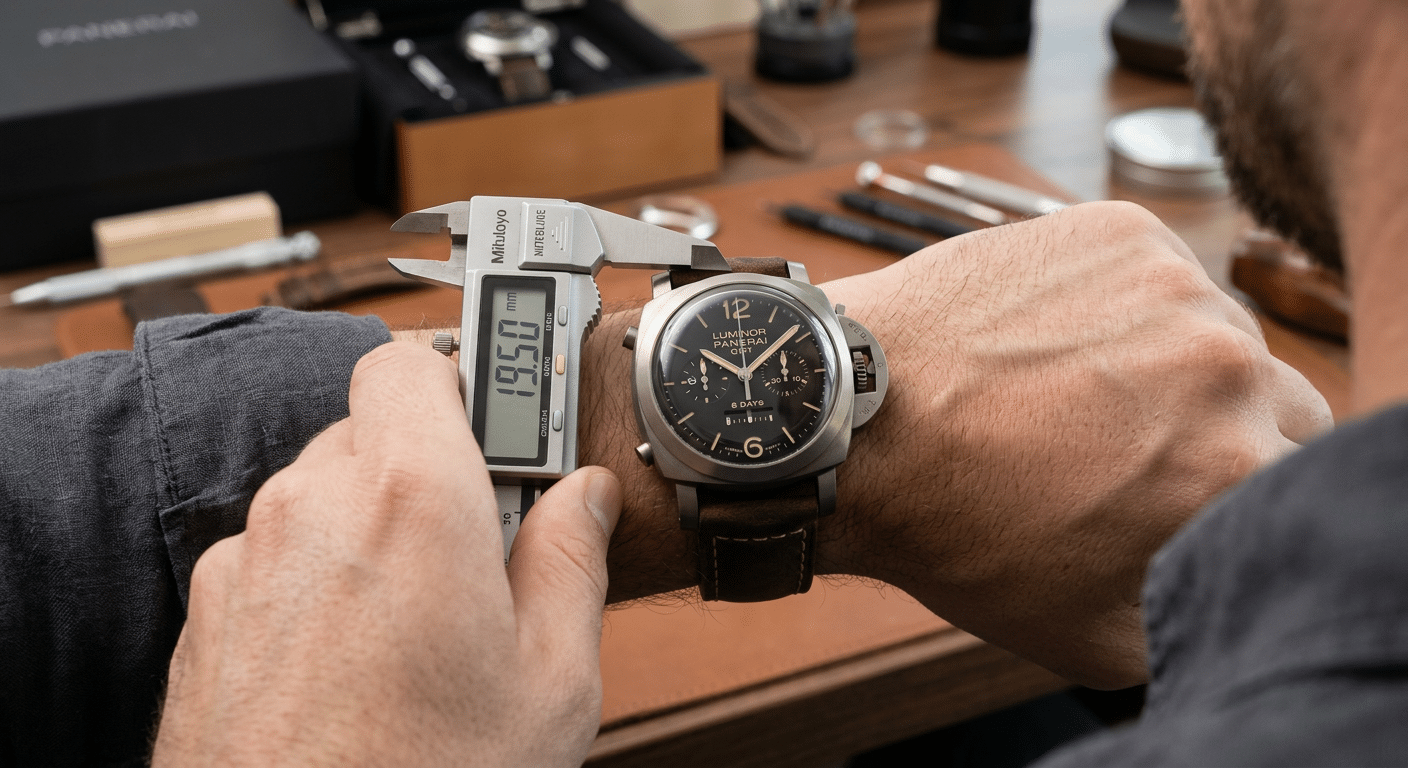
Panerai’s cushion-shaped cases, while visually striking, often wear larger than their nominal diameter suggests. For example, both the PAM356 (Luminor) and PAM1218 (Luminor Due) feature 44mm cases. However, the effective footprint on the wrist extends significantly due to the brand’s signature long, straight lugs. On wrists below 7 inches, these lugs can extend beyond the natural curve of the wrist bone, leading to noticeable overhang and a less integrated feel. The broader contact area across the top of the wrist, inherent to the cushion design, further amplifies its presence, making it a dominant feature rather than a subtle accessory. This design choice, while central to Panerai’s identity, requires a wearer to genuinely appreciate a substantial wrist presence.
The Vertical Challenge: Case Thickness and Profile
Chronograph movements, by their nature, add significant vertical bulk. Panerai chronographs are no exception, and this thickness is arguably their most critical wearability factor. The PAM356, housing a modified Valjoux 7750, often measures over 17mm in thickness. This substantial height directly impacts sleeve clearance, making it a challenge to wear comfortably with dress shirts or tighter cuffs. Even the more refined PAM1218, with its in-house P.9200 movement, registers around 15.9mm. While marginally slimmer, it remains a tall watch. This vertical profile not only affects how the watch fits under clothing but also influences its balance on the wrist. A top-heavy watch, especially when paired with a stiff strap, can shift and rotate, requiring frequent adjustment and detracting from ergonomic comfort.
Weight Distribution and Ergonomic Balance
The material choice significantly influences the overall weight and, consequently, the ergonomic balance. The PAM356, constructed from steel, contributes to its considerable heft, often exceeding 160 grams without a strap. This weight, combined with the aforementioned thickness, can make the watch feel unbalanced if not properly secured. While some Panerai chronographs utilize lighter materials like titanium, the models under discussion are predominantly steel. The integration of the strap system plays a crucial role here; Panerai’s robust strap attachment points, often featuring quick-change mechanisms, ensure a secure connection. However, a strap that is too narrow, too thin, or improperly fitted will struggle to counteract the watch’s inherent top-heaviness, leading to perceived instability and reduced comfort over extended wear.
Expert Authentication Insight
To objectively assess the true wearability, physically verify the exact case thickness and lug-to-lug distance using digital calipers. Compare these measurements against factory specifications for the specific reference number. For instance, a PAM356 might be officially listed at 44mm, but its lug-to-lug measurement, often exceeding 53mm, is the critical dimension for wrist fit. Pay close attention to variations in the caseback profile—a sapphire display caseback typically adds a millimeter or two compared to a solid steel caseback, further contributing to overall height and potentially affecting how the watch sits flush on the wrist.
The Engine Room: Movement Complexity and Chronograph Mechanics
Beneath the distinctive Panerai dial lies a mechanical heart whose complexity and architecture fundamentally define the watch’s operational feel, performance characteristics, and long-term service demands. Understanding the specific movements within models like the PAM356 and PAM1218 is crucial for appreciating their inherent trade-offs.
PAM356: The Valjoux 7750 Heartbeat (OP XII)
The Panerai PAM356 utilizes the Calibre OP XII, which is a heavily modified Valjoux 7750. The Valjoux 7750 is a cam-actuated chronograph, meaning its start, stop, and reset functions are controlled by a series of levers and cams rather than a more intricate column wheel. This robust, workhorse movement is known for its reliability and ease of service. Its design incorporates an oscillating pinion for engaging the chronograph, a system that, while effective, can sometimes result in a less crisp or “mushy” pusher feel compared to column-wheel designs. A characteristic trait of the 7750 is its unidirectional winding rotor, which can produce a noticeable “wobble” or vibration on the wrist as it spins freely in the non-winding direction. While not a defect, this tactile feedback is a distinct aspect of ownership that some find endearing and others find distracting.
PAM1218: The In-House Flyback Marvel (P.9200)
In contrast, the PAM1218 features Panerai’s in-house P.9200 automatic flyback chronograph movement. This caliber represents a significant leap in sophistication, employing a column-wheel mechanism for its chronograph functions. Column-wheel chronographs are generally lauded for their smoother, more precise pusher action and greater mechanical elegance. The P.9200 also incorporates a vertical clutch, which minimizes wear on the movement when the chronograph is engaged and prevents the “jump” often seen in horizontal clutch designs when the chronograph starts. The “flyback” function is a key advantage: it allows the chronograph to be reset and immediately restarted with a single push of a button, rather than requiring a stop-reset-start sequence. This feature is particularly useful for timing consecutive events, such as laps in a race, without interruption.
Tactile Feedback: Pusher Action and Reset Precision
The operational feel of a chronograph’s pushers is a significant aspect of its user experience. The cam-actuated mechanism of the PAM356’s OP XII (Valjoux 7750) typically results in a longer, more deliberate push with a less distinct “click” when engaging the chronograph. The reset can also feel less immediate due to the inherent design. Conversely, the column-wheel and vertical clutch architecture of the PAM1218’s P.9200 generally delivers a crisper, shorter push with a more satisfying tactile and audible “click” on actuation. The reset is often instantaneous, with the chronograph hands snapping back to zero with remarkable precision. This difference in tactile feedback is not merely aesthetic; it speaks to the mechanical philosophy and componentry within each movement, directly influencing the user’s interaction with the complication. For those interested in other functionalities, a Panerai GMT guide can provide insights into models useful for travel, highlighting how different complications cater to specific user needs.
Expert Authentication Insight
To truly understand the movement’s functionality and health, conduct a timed test of the chronograph. Observe the instantaneity of the start, stop, and reset actions. For the PAM1218, test the flyback function specifically. Note the crispness of the pusher engagement—is there a clean click, or does it feel spongy? Crucially, verify the precise return of all chronograph hands to the zero alignment. Any hesitation, stuttering, or misalignment beyond factory tolerance (typically within a fraction of a second or a hair’s breadth of perfect alignment) could indicate wear, adjustment issues, or a more significant mechanical fault requiring immediate attention.
Legibility Under Pressure: Reading the Panerai Chrono
For a chronograph, legibility is not merely a design preference; it is a fundamental requirement for its intended function. A watch designed to measure elapsed time must present that information clearly and quickly, often under dynamic or challenging conditions. This section evaluates how Panerai chronographs, specifically the PAM356 and PAM1218, perform in practical legibility across various lighting and use cases, a critical factor often overshadowed by their bold aesthetic.
Sub-Dial Placement and Scale Readability
Panerai chronographs typically feature a bi-compax layout, often with a running seconds sub-dial at 9 o’clock and a 30-minute counter at 3 o’clock. While this configuration offers a clean, symmetrical aesthetic, the readability of these sub-dials can vary. The PAM356, for instance, uses a black dial with contrasting white sub-dials, which aids visibility. However, the scales themselves, particularly the minute track on the 30-minute counter, can be condensed. The PAM1218, with its often contrasting sub-dials and clear indices, generally maintains good separation. The challenge arises when sub-dial hands are thin or lack sufficient contrast against their respective backgrounds, making quick, precise readings of elapsed time difficult, especially for intermediate chronograph measurements that require reading between minute markers.
Luminescence and Low-Light Performance
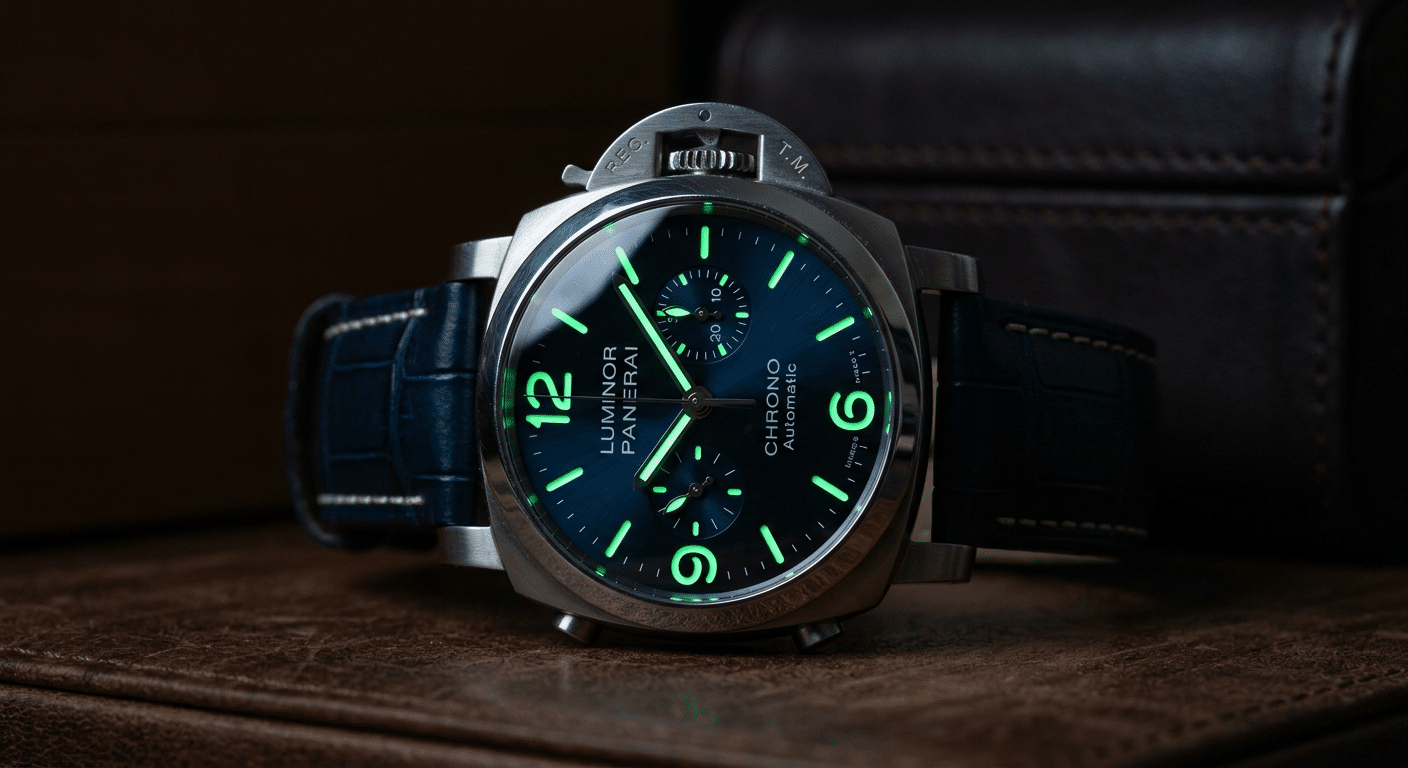
Panerai is renowned for its exceptional luminescence, a direct legacy of its military heritage. Both the PAM356 and PAM1218 typically employ high-grade Super-LumiNova on their main hands and hour markers, providing excellent low-light and nighttime visibility for the primary time display. However, the application of luminous material to the chronograph hands and sub-dial markers is critical for the complication’s legibility in darkness. While the main hour and minute hands glow brightly, the efficacy of the luminous treatment on the chronograph seconds hand and the small sub-dial hands is equally important. In some instances, while the main time is brilliantly clear, the chronograph functions can be less discernible, limiting the watch’s utility in truly dark environments or during extended night-time operations.
Anti-Reflective Coating and Crystal Clarity
The sapphire crystal, a standard feature on both the PAM356 and PAM1218, plays a significant role in overall dial clarity. Panerai typically applies an anti-reflective (AR) coating to the interior surface of the crystal only. This interior-only application is a practical choice, as it significantly reduces glare for the wearer while protecting the delicate coating from scratches and daily wear on the exterior. When effective, this treatment ensures that the dial, including all chronograph indications, remains highly visible from various angles without distracting reflections. However, a poorly applied or absent AR coating can lead to substantial glare, effectively obscuring portions of the dial and compromising the primary function of a chronograph to provide instantaneous readings. The slight blue tint often observed at certain angles on crystals with interior AR is a normal characteristic and not a flaw, indicating the presence of the coating.
Expert Authentication Insight
To assess true legibility, perform a comprehensive test in varying light conditions. Start in bright, direct sunlight, then move to indirect indoor lighting, a dimly lit room, and finally, complete darkness after sufficient charging of the lume. In each scenario, quickly glance at the main time and then attempt to read specific chronograph elapsed times from the sub-dials. Observe if any part of the display becomes obscured by glare or if the luminous material on chronograph hands provides sufficient contrast and longevity. Pay particular attention to how the anti-reflective coating performs; there should be minimal glare-induced obstruction of the dial from typical viewing angles. Any significant difficulty in discerning chronograph hands or sub-dial markers under these conditions indicates a practical limitation that outweighs aesthetic appeal.
The Long Game: Service Intervals and Ownership Costs
The decision to acquire a Panerai chronograph extends far beyond the initial purchase price. These are complex mechanical instruments, and like any high-performance machine, they demand specific, often costly, long-term maintenance. Understanding the financial and logistical demands of servicing is crucial for any prospective owner, turning what might seem like a simple aesthetic choice into a significant ownership commitment.
Recommended Service Intervals and Procedures
Panerai, like most high-end watch manufacturers, recommends a full service for its mechanical movements every 3 to 5 years. For chronographs, this isn’t merely a check-up; it’s an extensive overhaul. A complete service involves the full disassembly of the movement, where every component is inspected for wear, cleaned in specialized solutions, and then meticulously reassembled. This process includes the careful lubrication of dozens of intricate parts, particularly within the chronograph mechanism itself. Gaskets are replaced, the case and bracelet are cleaned, and the movement undergoes comprehensive regulation to ensure it meets factory accuracy standards. The complexity of a chronograph movement, with its additional levers, springs, and wheels, means this procedure is inherently more time-consuming and labor-intensive than servicing a basic time-only caliber.
Cost of Routine Maintenance and Overhaul
The financial outlay for servicing a Panerai chronograph can be substantial. For a model like the PAM356, which utilizes a modified Valjoux 7750 (Panerai Calibre OP XII), a standard full service can range from approximately $850 to $1,300 USD. This cost is higher than a typical time-only movement service due to the additional complexity of the chronograph module. For in-house movements, such as the P.9200 in the PAM1218, a common example found in a replica Panerai models guide, service costs are generally elevated, often starting around $1,200 and potentially reaching $1,800 or more for a full overhaul, especially if specific component replacements are needed. These figures can fluctuate based on the specific service center, the watch’s condition, and any additional repairs required beyond routine maintenance. It’s not uncommon for a full chronograph overhaul to approach 10-15% of the watch’s original retail price over its lifetime.
Availability of Parts and Specialized Repair
Servicing a Panerai chronograph almost invariably requires sending the watch to an authorized Panerai service center or a highly specialized independent watchmaker with access to genuine parts and the brand’s proprietary tools. While Valjoux 7750 parts for the PAM356 are relatively common in the broader watchmaking world, Panerai’s specific modifications (e.g., specific finishing, unique module components) often necessitate brand-specific parts. For the in-house P.9200 movement in the PAM1218, parts availability is strictly controlled by Panerai, making unauthorized repairs challenging and potentially compromising the watch’s integrity and value. This reliance on authorized channels means longer turnaround times, typically ranging from 6 to 12 weeks, and sometimes longer if rare components need to be manufactured or sourced.
Expert Authentication Insight
When considering a pre-owned Panerai chronograph, always request a detailed service history. This should include records from either Panerai authorized service centers or reputable independent watchmakers. Cross-reference the movement serial numbers and service dates against the watch’s expected maintenance schedule. Any significant gaps or a lack of verifiable service records should be a red flag. Furthermore, during a physical diagnostic, an expert will carefully inspect the movement (if visible through a display caseback) for any signs of non-factory repairs, such as mismatched screws, tool marks, or component substitutions that deviate from original specifications, which can indicate unauthorized work and potential long-term reliability issues.
Risk vs. Reward: Evaluating the Panerai Chronograph Trade-Off
The Panerai chronograph is a watch of compelling contradictions. It offers a distinct aesthetic and mechanical sophistication that captivates many, but it also demands practical compromises. The ultimate “worth it” factor hinges on a prospective owner’s willingness to embrace these trade-offs, making it a highly personal equation.
The “Worth It” Equation for PAM356
The PAM356, with its robust tool-watch aesthetic and the proven reliability of its modified Valjoux 7750 movement (OP XII), offers a compelling proposition for those who appreciate classic chronograph mechanics. The 7750 is a workhorse, known for its durability and relatively straightforward service, making it a reliable choice. However, its cam-actuated chronograph mechanism often results in a less crisp, sometimes “mushy” pusher feel compared to column-wheel chronographs. More significantly, the PAM356’s substantial thickness—often exceeding 17mm—is a critical ergonomic factor. While its reliability and a lower initial cost (compared to in-house models) are undeniable upsides, the wearer must be comfortable with its dominant wrist presence and the tactile specifics of its operation. For many, the iconic Panerai design, paired with a dependable movement, outweighs the bulk and the specific pusher feel.
The “Worth It” Equation for PAM1218
The PAM1218, featuring the in-house P.9200 automatic flyback chronograph movement, represents a step up in mechanical refinement. The P.9200’s column-wheel and vertical clutch architecture typically deliver a smoother, crisper pusher action and more precise chronograph engagement. The flyback function, allowing instant reset and restart with a single press, adds a layer of operational sophistication. While still substantial, the PAM1218’s case thickness (around 15.9mm) is often slightly less imposing than its 7750-based counterparts, potentially offering improved wearability. The trade-off here is a higher initial purchase price and, as discussed, more specialized and potentially costlier long-term service due to its in-house nature. For the enthusiast who prioritizes mechanical pedigree, operational finesse, and the prestige of an in-house caliber, the PAM1218’s additional costs and service considerations may be justified.
Target User Profile: Who is this Watch For?
A Panerai chronograph is not for the faint of wrist or faint of heart, financially speaking. It is ideally suited for individuals with larger wrist sizes (typically 7 inches or more) who can comfortably carry its significant dimensions without excessive lug overhang. The ideal owner appreciates bold, distinctive design and prioritizes strong wrist presence over discreet wearability. They are typically not seeking a “one-watch collection” but rather a statement piece that complements a diverse rotation. Furthermore, this owner understands and accepts the long-term financial commitment associated with specialized mechanical watch service, viewing it as an investment in the longevity and performance of a cherished instrument. They value mechanical complexity and the tactile engagement of a well-engineered chronograph, even if it comes with practical compromises in thickness or pusher feel. This isn’t a watch for someone who wants to forget it’s on their wrist; it’s for someone who wants to feel it, use it, and appreciate its engineering.
Expert Authentication Insight
To truly evaluate the “worth it” factor, a side-by-side comparison on your own wrist is indispensable. During a physical diagnostic, carefully assess the subjective “feel” of both the PAM356 and PAM1218 (or similar representative models). Pay close attention to objective fit for your wrist circumference: does the case sit flat, or do the lugs noticeably overhang your wrist bones? How does the case height interact with your shirt cuffs? Actuate the chronograph pushers multiple times on both models, noting the difference in resistance, click, and reset precision. An expert will also analyze the specific lug integration and strap choice, as these significantly impact how the watch balances and wears on different wrist shapes, providing valuable context beyond mere case dimensions.
Ultimately, the Panerai chronograph presents a clear decision framework for any prospective buyer. First, “Can you live with the thickness?” These are not subtle watches; their dimensions are a defining characteristic. Second, “Do you appreciate the specific tactile feedback of the pushers?” Whether it’s the robust cam-actuated feel or the refined column-wheel action, the operational experience is central to ownership. Finally, and perhaps most critically, “Are you prepared for the long-term service commitment?” The costs and logistics of maintaining these complex mechanical instruments are non-negotiable. Before making a purchase, physically evaluate these models. Try them on, wear them for an extended period if possible, and engage with the chronograph functions. Additionally, for any pre-owned piece, a thorough service history check is paramount to avoid unexpected and costly surprises down the line. The Panerai chronograph is a commitment, and it demands an informed, eyes-open decision.