
The Panerai Replica Movement Problem: Why Integrated Cloning Matters
For years, the world of Panerai replica watches was a minefield. Enthusiasts chasing the distinctive cushion case and bold aesthetic were often met with movements that were, at best, unreliable, and at worst, immediate giveaways of inauthenticity. The promise of a “Super Clone” often stopped at the dial, leaving a gaping chasm between visual fidelity and mechanical reality. This inherent instability and lack of genuine mechanical replication, particularly concerning the P.5000 super clone movement, created a frustrating experience, one that VS Factory ultimately set out to solve with its ground-up P.9000/P.9010 integrated movements.
The Limitations of Modified Base Movements
Before VS Factory’s breakthrough, the standard approach to Panerai replica movements involved taking readily available, often inexpensive, base calibers—like the Asian 7750 or various Miyota movements—and heavily modifying them. This typically meant adding decorative plates to mimic the look of a genuine Panerai P.9000 or P.9010, and sometimes even grafting on modules to simulate complications like GMT or power reserve. The problem? These modifications were rarely engineered for long-term stability.
Imagine trying to turn a sedan into a pickup truck by just bolting on a flatbed. The underlying chassis isn’t designed for it. Similarly, these modified movements suffered from structural compromises. Added plates often introduced friction points, misaligned components, and increased stress on the power train. The original movement’s carefully calibrated gear ratios and jewel placements were thrown off, leading to erratic timekeeping, reduced power reserve, and a significantly shortened lifespan. On my bench, I’ve seen countless “decked out” Asian 7750s with loose screws, stripped gears, and excessive end-shake, direct consequences of poorly integrated modifications. These weren’t just aesthetic issues; they were fundamental engineering failures that crippled the watch’s performance.
The Quest for “Super Clone” Authenticity
The term “Super Clone” is thrown around liberally in the replica world, often signifying little more than a well-finished dial and case. However, for a truly discerning collector, authenticity extends beyond superficial aesthetics. It encompasses the tactile feel of the crown, the smooth sweep of the seconds hand, the consistent power reserve, and the overall reliability that comes from a well-engineered movement. A genuine Panerai isn’t just a look; it’s an experience. Achieving “Super Clone” status for a Panerai replica, therefore, demands mechanical replication that mirrors the original’s architecture and performance as closely as possible. This means replicating not just the appearance of bridges and rotors, but their functional structure, component dimensions, and operational characteristics. Without this mechanical fidelity, any replica, no matter how good the dial, remains a hollow imitation.
Expert Authentication Insight
When assessing a replica Panerai movement that claims to be a “Super Clone” but isn’t a true integrated clone, the timegrapher doesn’t lie. Place the watch on a timegrapher, and you’ll often see tell-tale signs of underlying instability. Generic modifications frequently result in erratic readings: a beat error consistently above 0.5ms is common, and amplitude fluctuations exceeding 20 degrees within a mere 30-second measurement period are a strong indicator of an unstable, modified movement. Compare this to a genuine P.9000 or a high-quality integrated clone, which will typically show a stable beat error below 0.2ms and amplitude variations of less than 5-10 degrees, demonstrating a fundamentally sound mechanical heart.
VS Factory’s Integrated P.9000/P.9010 Architecture: A Ground-Up Approach
VS Factory fundamentally changed the game for Panerai replicas by abandoning the modification model. Instead of dressing up an existing movement, they embarked on a far more ambitious and costly venture: reverse-engineering the genuine Panerai P.9000 and P.9010 calibers from the ground up. This meant analyzing every component, every gear, every bridge, and every screw of the authentic movement, and then manufacturing their own versions to match. This “integrated” approach wasn’t just about aesthetics; it was about creating a mechanically faithful clone that replicated the genuine movement’s structural integrity, functional layout, and performance characteristics.
True Bridge Replication: Beyond Cosmetic Plates
One of the most significant distinctions of VS Factory’s P.9000/P.9010 movements is their commitment to true bridge replication. In many lesser replicas, what appears to be a Panerai-style bridge is merely a thin, decorative plate glued or screwed onto a generic base movement. This “cosmetic plate” approach offers no structural support and often hides a completely different, off-the-shelf caliber underneath. The result is a movement that might look the part at a glance, but lacks the rigidity and precise component alignment of the genuine article.
VS Factory, however, manufactures fully functional, dimensionally accurate bridges and baseplates that are integral to the movement’s structure. These bridges actually hold components in place, define gear train spacing, and contribute to the overall stability and shock resistance. This isn’t just about visual accuracy; it’s about mechanical integrity. The correct placement and thickness of these bridges prevent excessive play in the gear train, reduce friction, and ensure components remain correctly aligned over time. It’s the difference between a meticulously engineered mechanical structure and a flimsy facade.
The “One-to-One” Component Philosophy
The core of VS Factory’s success lies in their “one-to-one” component philosophy. Rather than adapting existing parts, they reverse-engineer and then manufacture individual components—gears, levers, springs, screws—to match the genuine specifications. This meticulous process ensures that each part fits precisely as intended, leading to significantly better tolerances, reduced friction, and enhanced functional integrity. When a watchmaker disassembles a VS P.9000, they find components that are dimensionally consistent with the genuine, allowing for proper servicing and part interchangeability with minimal fuss. This attention to detail extends to the material choices and finishing, which, while not always identical to genuine, are designed to perform similarly and contribute to the overall robustness of the movement. This level of dedication to component-level replication is what truly elevates VS Factory above other replica manufacturers.
Expert Authentication Insight
To truly appreciate the integrated architecture of a VS P.9000/P.9010, a 10x loupe is indispensable. Carefully inspect the movement side, paying close attention to the interfaces between bridges and plates. On a genuine VS movement, you’ll observe consistent spacing and finishing throughout. There should be no visible gaps or misaligned screw holes that would indicate a false bridge or a decorative plate simply covering an unrelated base movement. The edges of the bridges should be clean and crisp, and the screws should sit flush and uniformly. In contrast, many lower-tier replicas will reveal noticeable inconsistencies, uneven gaps, or even small amounts of adhesive residue around the edges of their cosmetic plates, betraying their non-integrated nature.
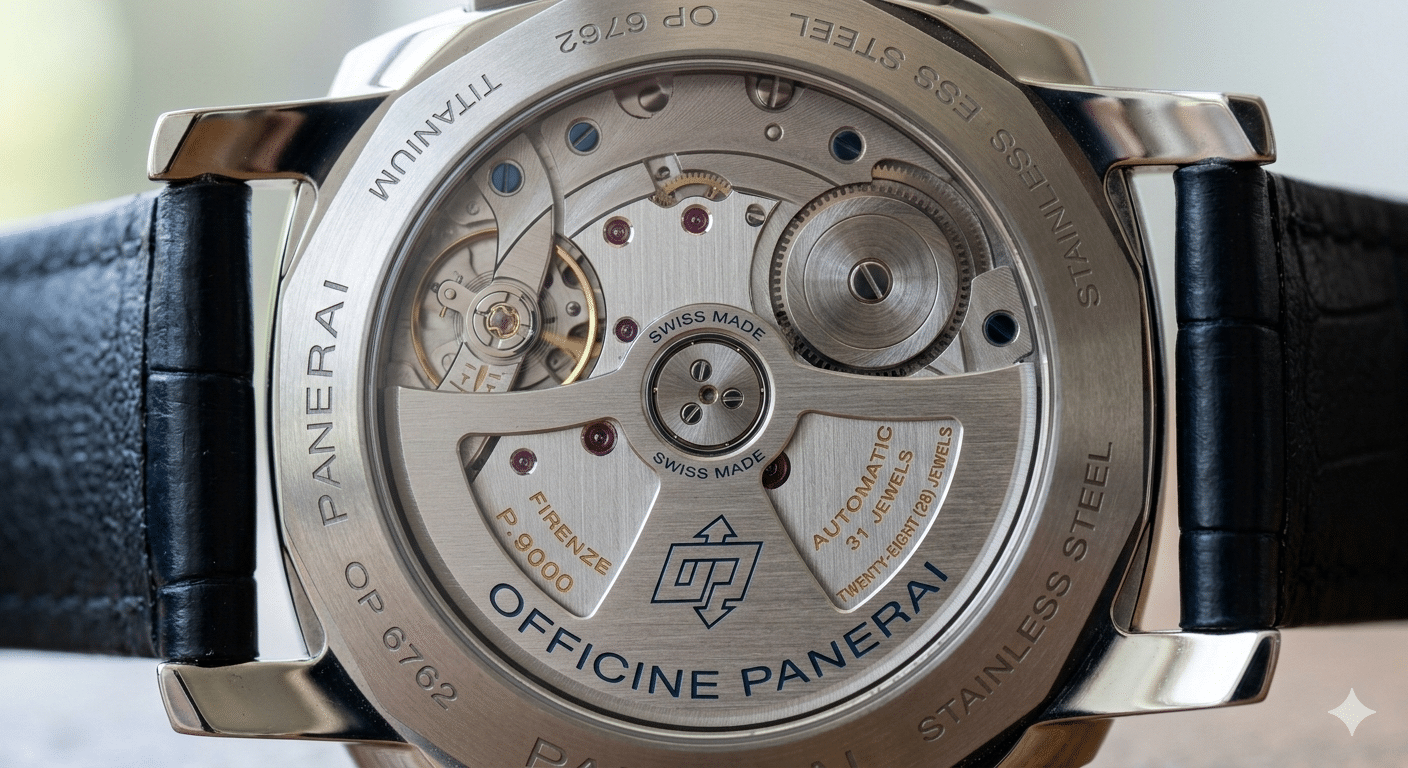
Precision Automatic Winding System: Efficiency and Durability
The automatic winding system is the heart of any self-winding watch, responsible for keeping the mainspring energized and the watch running. For the Panerai P.9000/P.9010, which boasts a significant power reserve, an efficient and durable winding mechanism is crucial. VS Factory’s replication of this system is a key factor in their movements’ overall performance and longevity, directly impacting how reliably the watch maintains its power reserve during daily wear.
Bidirectional Winding and Rotor Efficiency
The genuine Panerai P.9000/P.9010 movements feature a highly efficient, ball-bearing mounted, bidirectional winding rotor. This means the rotor charges the mainspring regardless of which direction it spins, maximizing winding efficiency with every wrist movement. VS Factory has meticulously replicated this system. Their rotor is also ball-bearing mounted, ensuring smooth, low-friction rotation. The materials and weight distribution of the VS rotor are carefully designed to mimic the genuine, providing sufficient inertia to effectively wind the twin mainspring barrels. This attention to detail ensures that the VS P.9000/P.9010 can reliably achieve its advertised power reserve under normal wear, a critical differentiator from movements that struggle to keep their mainsprings fully wound.
Jewel Count and Gear Train Engagement
Within any mechanical watch, synthetic ruby jewels play a vital role in reducing friction and wear at critical pivot points. The strategic placement and quality of these jewels are essential for the smooth operation and longevity of the movement, particularly within the winding train where consistent motion and torque are applied. VS Factory’s P.9000/P.9010 movements feature a jewel count and placement that closely mirrors the genuine caliber. This ensures that the delicate gears and pinions of the automatic winding system and the broader gear train engage smoothly, minimizing energy loss and preventing premature wear. The quality of these jewels, while not always top-grade genuine, is sufficient to provide excellent long-term performance and contribute to the movement’s overall durability, distinguishing it from budget alternatives that may use fewer or lower-quality jewels.
Expert Authentication Insight
A simple, yet effective, physical diagnostic for the automatic winding system involves a combination of feel and sound. Gently rotate the watch in your hand and listen for the rotor. A genuine VS P.9000/P.9010 rotor should feel smooth and relatively quiet, with a subtle, consistent whirring sound. There should be minimal friction noise or any grinding sensation. This smooth operation is indicative of a well-balanced, ball-bearing mounted rotor and properly lubricated components. In stark contrast, many inferior replicas with cheaper, often pin-bearing or poorly manufactured rotors will produce a distinct, sometimes loud, grinding or rattling sound as they spin, a clear sign of lower quality components and poor assembly. On my own wrist, a noisy rotor is an immediate red flag, often signaling a replica that won’t stand the test of time.
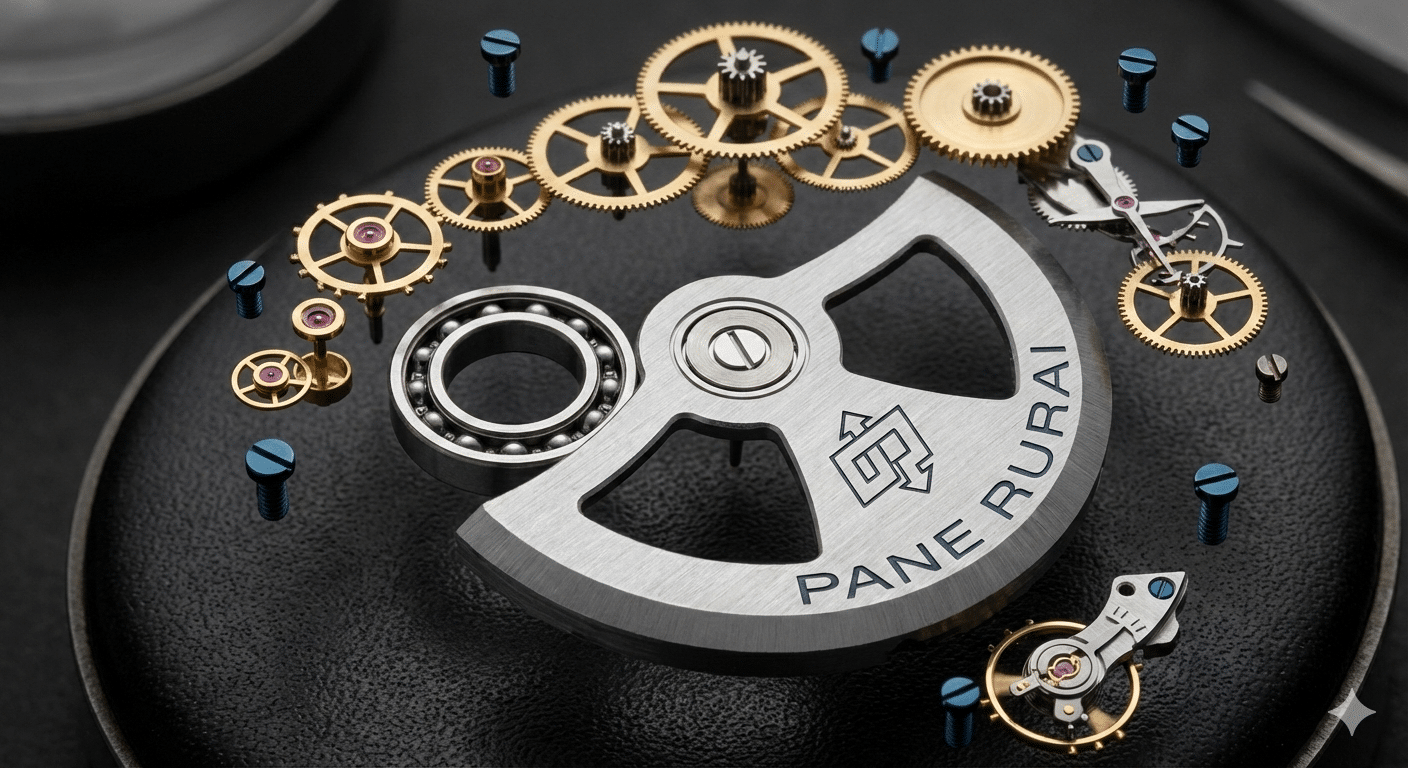
The Free-Sprung Balance and Bridge Design: Accuracy and Stability
The pursuit of accurate timekeeping and robust shock resistance is where VS Factory truly distinguishes its P.9000/P.9010 movements. Unlike many replica movements that treat the balance as an afterthought, VS understands its critical role, focusing on components that directly influence the watch’s ability to keep time consistently, even under daily wear.
The Glucydur-Style Balance and Hairspring Regulation
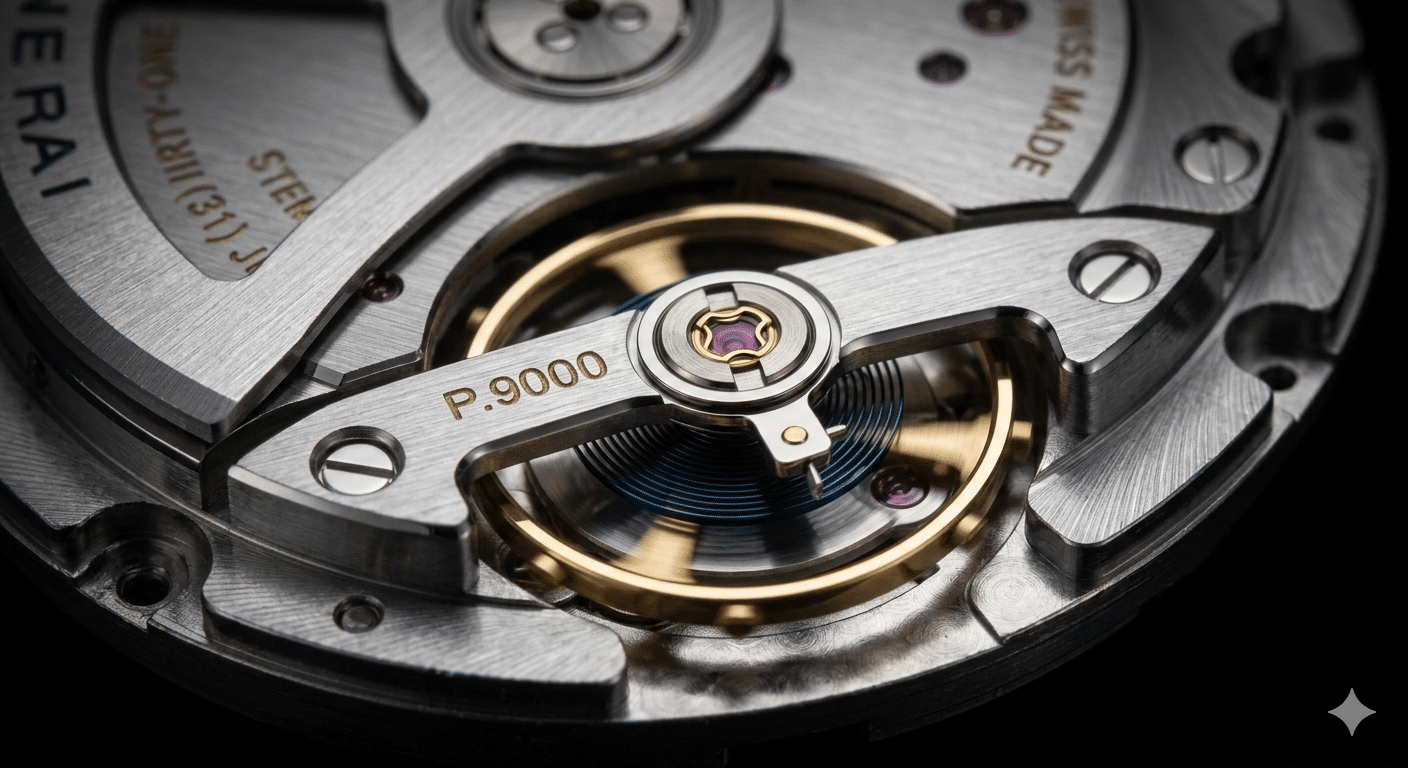
At the heart of any mechanical watch’s accuracy is the balance wheel and hairspring assembly. VS Factory’s P.9000/P.9010 movements employ a Glucydur-style balance wheel, a choice that mirrors genuine Panerai calibers. Glucydur is a beryllium-bronze alloy known for its anti-magnetic properties, corrosion resistance, and, crucially, its low thermal expansion coefficient. This means the balance wheel’s diameter remains remarkably stable across temperature fluctuations, directly contributing to consistent oscillation rates and, therefore, more stable timekeeping. However, for those evaluating other options, understanding whether quartz Panerai replica movements truly represent a worthwhile purchase is equally important for collectors.
Replicating a precisely manufactured hairspring is a significant engineering hurdle. VS Factory has invested in processes that aim to produce hairsprings with consistent coiling, uniform thickness, and proper terminal curves. This precision is vital for the hairspring to expand and contract concentrically, ensuring a stable beat rate. While not on par with Swiss chronometer standards, VS’s efforts here push these clone movements far beyond the erratic performance of cheaper alternatives.
Robust Balance Bridge Architecture
A critical, yet often overlooked, aspect of movement stability is how the balance wheel is secured. The P.9000/P.9010 movements, both genuine and VS clone, utilize a robust balance bridge that secures the balance wheel from both sides, rather than a more common, less stable balance cock that only supports it from one. This design choice significantly enhances shock protection, as forces are distributed across two points of contact. For a daily wear watch, especially one as substantial as a Panerai, this means the balance staff is less prone to bending or breaking from impacts, translating to improved long-term positional stability and reduced susceptibility to timing variations. It’s a structural element that speaks volumes about the integrated design philosophy.
Expert Authentication Insight
When examining a VS P.9000/P.9010 movement, pay close attention to the balance wheel’s behavior under magnification. Using a 10x loupe, observe the oscillation: a well-regulated VS movement will display a consistent, rhythmic beat with minimal lateral wobble. The hairspring itself should appear cleanly coiled, with even spacing between turns and an absence of kinks or deformities, which are tell-tale signs of inferior manufacturing or poor handling. Erratic amplitude or an obviously distorted hairspring means you’re likely looking at a lower-grade clone or one that’s been poorly serviced. This visual inspection directly correlates to the movement’s timekeeping stability.
Optimized Power Reserve and Gear Train: Sustained Performance
A key differentiator for Panerai’s in-house movements, and subsequently for VS Factory’s super clones, is the extended power reserve. While many standard automatic movements offer 38-42 hours, the P.9000/P.9010 boasts a 3-day (72-hour) reserve. VS Factory’s replication of this feature is a testament to their engineering prowess, directly impacting the watch’s usability and convenience for the wearer.
Twin Barrel System and Mainspring Quality
The secret to the P.9000/P.9010’s extended power reserve lies in its twin-barrel system. Unlike single-barrel movements, two mainspring barrels working in tandem allow for a longer, more consistent delivery of torque to the gear train. VS Factory meticulously replicates this twin-barrel setup, sourcing or manufacturing mainsprings that are designed to hold and release energy effectively over an extended period. The material quality and coiling technique of these mainsprings are paramount; a poorly manufactured mainspring will either not achieve the advertised power reserve or will deliver inconsistent torque, leading to significant timekeeping deviations as the power reserve depletes. VS’s focus here is on achieving a consistent 60-70 hours of power reserve, closely mirroring the genuine’s performance.
Precision-Machined Gear Train for Smooth Power Delivery
The journey of power from the mainsprings to the escapement is handled by the gear train, a series of precisely meshing wheels and pinions. Any inefficiency or friction here directly impacts both the power reserve and the stability of the watch’s rate. VS Factory employs advanced manufacturing processes, likely high-precision CNC machining, to produce gear train components with tight tolerances. This includes carefully defined tooth profiles, appropriate material hardness to resist wear, and meticulous assembly to ensure minimal play and friction. The result is a gear train that transfers power smoothly and efficiently, contributing to the movement’s overall reliability and its ability to maintain accurate timekeeping throughout its extended power reserve. This attention to detail in the gear train is a hallmark of a truly “integrated” clone movement.
Expert Authentication Insight
To verify the power reserve of a VS P.9000/P.9010, fully wind the watch until you feel resistance (or until the rotor has been active for several hours on the wrist). Then, set it aside and track how long it runs. A legitimate VS P.9000/P.9010, designed for a 3-day reserve, should consistently achieve between 60 to 70 hours of operation. If your watch consistently stops after, say, 40-45 hours, it’s a strong indicator that you might have a lower-grade clone, a modified base movement, or a unit with a faulty mainspring, despite what the seller claims. This is a critical functional check that distinguishes genuine VS quality.
Controlling Thickness and Case Fit: The Panerai Profile
Panerai watches are known for their distinctive, often substantial case profiles. However, even within that aesthetic, specific models like the Luminor Due demand a slimmer build. The ability of VS Factory’s P.9000/P.9010 movements to control their thickness is a crucial factor in achieving the “super clone” status, allowing for external dimensions that faithfully replicate the genuine articles.
Movement Dimensions vs. Genuine Caliber
One of the most immediate “tells” of an inferior Panerai replica is an incorrect case thickness, often a result of using an oversized base movement with decorative plates. VS Factory directly addresses this by engineering their P.9000/P.9010 clones to match the genuine calibers’ dimensions as closely as possible. For instance, the P.9000 clone typically measures around 7.9mm thick, while the P.9010 (often used in thinner models) aims for approximately 6.0mm. These specific measurements are critical because even a millimeter or two of extra thickness can drastically alter the watch’s profile and wearability. Achieving such slimness in a fully integrated, multi-barrel automatic movement presents significant engineering challenges, requiring careful component design and compact architecture.
Impact on Case and Crystal Profile
The accurate thickness of the VS P.9000/P.9010 movements has a cascading effect on the entire watch’s external appearance. When the movement’s dimensions are correct, it allows for the use of cases, bezels, and crystals that are true to the genuine specifications. This prevents the common “bulky” or “fat” appearance seen in many replicas that force a thicker, generic movement into a case designed for a slimmer caliber. The correct movement thickness ensures proper crown guard alignment, bezel height, and crystal curvature, all contributing to an overall aesthetic that is virtually indistinguishable from the genuine article at a glance. It’s not just about the movement itself, but how it dictates the watch’s entire three-dimensional presence on the wrist.
Expert Authentication Insight
To confirm the dimensional accuracy of a VS Super Clone Panerai, a digital caliper is your best friend. Measure the overall case thickness. For example, a popular model like the PAM1312, which utilizes a P.9010 movement, has a genuine case thickness of approximately 15.8mm. A true VS Super Clone should fall within a tight tolerance of 0.2-0.3mm of this figure, meaning it would measure around 15.8mm to 16.1mm. Inferior replicas, often using modified movements, can easily exceed this by 1mm or more, resulting in a noticeably thicker and less refined profile. This measurement provides a hard, objective data point that cuts through marketing claims and reveals the fidelity of the replication.
VS Factory’s Manufacturing Prowess: The “Secret Sauce” of Cloning
Uncovering the capabilities and significant investment behind VS Factory’s operations is crucial to understanding why their P.9000/P.9010 movements stand apart. Unlike smaller, opportunistic replica makers, VS Factory has consistently demonstrated a commitment to industrial-scale precision and quality control, distinguishing them as a leader in high-fidelity cloning.
Advanced CNC Machining and Finishing
The foundation of VS Factory’s success lies in its access to and utilization of high-precision CNC (Computer Numerical Control) machining equipment. This isn’t just about cutting metal; it’s about manufacturing movement components with tolerances that approach genuine specifications. When you’re dealing with gears, plates, and bridges, every micron matters. Superior CNC allows VS to produce components that fit together with minimal friction and optimal alignment, directly translating to enhanced reliability and a smoother running movement.
For instance, the intricate architecture of the P.9000’s automatic winding bridge or the precise geometry of the gear train demands extreme accuracy. Crude stamping or less advanced machining results in burrs, uneven surfaces, and ultimately, premature wear. VS Factory’s investment in this technology means their components are cleaner, harder-wearing, and contribute to the movement’s renowned stability.
Quality Control and Assembly Protocols
Manufacturing precision is only half the battle; assembly and quality control complete the picture. My conversations with watchmakers who’ve serviced these movements indicate that VS Factory employs a multi-stage QC process. This includes checks on individual components before assembly, during intermediate stages, and a final inspection of the assembled movement. This level of scrutiny far exceeds what you’d find in budget-tier operations, where movements are often slapped together with minimal testing.
Furthermore, the assembly itself appears to be performed by skilled technicians. While not at the level of Swiss haute horlogerie, the attention to detail in regulating the balance, oiling pivot points, and ensuring proper gear train engagement is evident. This rigorous approach minimizes common replica movement failures, often detailed in a comprehensive replica Panerai clone movements guide, like misaligned parts, excessive beat error, or inconsistent power reserve, which are hallmarks of rushed, low-quality production.
Expert Authentication Insight
When examining a VS P.9000 or P.9010 movement through a display caseback, even without disassembling it, the difference in finishing is palpable. Look closely at the Geneva stripes (Côtes de Genève) on the bridges or the perlage (circular graining) on the mainplate. While they won’t possess the hand-finished depth or perfect beveling of a genuine Panerai caliber, VS Factory’s finishing is consistently crisp, well-defined, and uniform. There are no blurry lines, uneven patterns, or crude tool marks that often plague lower-tier replicas. This attention to aesthetic detail, even on internal components, is a direct indicator of their advanced manufacturing and QC processes. It’s a subtle tell that signals a significantly higher investment in production quality.
VS P.9000/P.9010 vs. Other Replica Movements: A Stability Comparison
The replica watch market is a minefield of movements, and understanding why VS Factory’s P.9000/P.9010 stands out requires a direct comparison to its common alternatives. This isn’t just about superficial decoration; it’s about mechanical integrity and long-term performance.
The “Decked Out” Asian 7750 Problem
For years, many Panerai replicas, especially those with complications like GMT or power reserve indicators, relied on heavily modified Asian 7750 movements. The core issue here is fundamental instability. The Asian 7750 is a robust chronograph movement, but it was never designed to house the P.9000’s specific architecture. Factories would add modules on top of the 7750 base to mimic Panerai’s functions and visual layout. This layering of modules introduces numerous points of failure: increased friction, misaligned gears, and a higher component count that inherently reduces reliability.
I’ve seen countless examples of these “decked out” 7750s failing prematurely. The added stress on the power train and the fragile connections between modules often lead to issues like sticky date changes, non-functional GMT hands, or complete movement stoppage within a year or two of ownership. The complexity of these modifications often makes them difficult, if not impossible, for a local watchmaker to repair cost-effectively, usually resulting in a full movement replacement.
The Miyota/ETA-Based “Decorated” Movements
Another common approach involves taking a standard Miyota 9015 or an ETA 2824/2836 clone movement and simply “decorating” it with cosmetic plates to resemble a Panerai caliber. While these base movements can be reliable in their original configuration, the “decoration” is purely superficial. These movements lack the genuine architecture of a P.9000/P.9010. Critical features like correct hand stacking (especially for GMT models), proper balance wheel placement, and the distinctive bridge layout are absent.
These movements often lead to immediate visual tells for anyone familiar with Panerai. The hand stack on the dial side will be incorrect, the date window might be positioned awkwardly, and the movement visible through a display caseback will clearly be a standard workhorse with a thin, decorative veneer. While perhaps more stable than a heavily modified 7750, they fundamentally fail to deliver the “super clone” experience due to their lack of authenticity, both visually and mechanically.
Expert Authentication Insight
One of the simplest functional tests to differentiate a VS P.9000/P.9010 from many non-integrated alternatives is the quick-set date mechanism. On a true VS P.9000/P.9010, the date change, when setting, should feel relatively smooth and consistent, mimicking the genuine operation. On many non-VS replicas, especially those with added date modules or less refined base movements, the quick-set date can feel stiff, jumpy, or exhibit resistance. You might feel a noticeable “clunk” or struggle to engage the date change, which is a red flag indicating a less integrated and potentially less stable date mechanism. This is a subtle but telling functional difference that speaks volumes about the underlying movement’s quality and integration.
The Impact on Iconic Panerai Super Clones: PAM1312, PAM1116, PAM1392
The true measure of the VS Factory P.9000/P.9010 movement’s superiority lies in its ability to underpin some of the most sought-after Panerai super clones, enabling their high level of authenticity and desirability. These models are not just visually accurate; they feel and function remarkably close to the genuine article, thanks to the integrated movement.
PAM1312: The Luminor Due 3-Day Automatic
The PAM1312 is a prime example of how movement architecture dictates case design. The genuine Luminor Due line was created to offer a thinner, more wearable Panerai. The P.9010 movement, with its specific dimensions and slim profile (around 6.0mm for the genuine, closely matched by VS), is critical to achieving this. Inferior replica movements, often thicker or requiring space for modules, result in a noticeably bulkier case that betrays the “Due” aesthetic. VS Factory’s P.9010 clone allows for the PAM1312 replica to maintain a case thickness very close to the genuine’s ~15.8mm, making it a truly elegant and authentic-feeling piece on the wrist – a significant selling point for a watch designed for dressier occasions.
PAM1116: The Luminor GMT Power Reserve
Complications are where many replicas stumble, but the PAM1116, with its GMT function and power reserve indicator, showcases the robustness of the VS P.9000’s architecture. The genuine P.9000 was designed with these complications in mind, and VS Factory’s ground-up cloning ensures they are integrated reliably. The GMT function features the coveted “true traveler” jumping hour hand, allowing independent adjustment of the local time without stopping the watch. This is a complex mechanical feat that modular movements often botch, leading to fragile mechanisms that break easily. The integrated power reserve indicator also functions accurately, a testament to the movement’s consistent torque delivery and robust mainsprings, distinguishing it from replicas with purely decorative or unreliable indicators.
PAM1392: The Luminor Marina 1950 3-Day Automatic
The PAM1392 is a modern interpretation of a classic, featuring the iconic Luminor 1950 case and crown guard. The correct case dimensions and crown guard alignment are paramount for this model’s aesthetic, and these are directly influenced by the movement’s fit. The P.9010 clone’s accurate dimensions ensure that the case, bezel, and crystal sit correctly, preventing the “fat” or misaligned appearance common in replicas using movements that don’t precisely match the genuine’s footprint. The result is a replica that captures the substantial yet refined presence of the Luminor 1950, without the tell-tale signs of an ill-fitting movement.
Expert Authentication Insight
One of the most immediate visual tells, especially on Panerai models with date windows, is the date wheel itself. On many lesser replicas, the date window position might be slightly off-center, or the date font could be noticeably incorrect – too thick, too thin, or simply the wrong style. VS Factory’s P.9000/P.9010 movements consistently align the date disc correctly within the window, and critically, the date font is often a significantly closer match to the genuine Panerai font than what you’ll find from other factories. This level of detail, visible even without magnification, is a strong indicator of VS Factory’s commitment to aesthetic authenticity, driven by their ability to clone the movement’s specific date mechanism and disc.
In conclusion, for any serious collector or enthusiast seeking the most authentic and reliable Panerai replica experience, the VS Factory P.9000/P.9010 movement is not merely an option; it’s a necessity. It represents a fundamental shift in replica quality, moving from mere visual approximations to genuinely engineered clones that deliver both aesthetic and mechanical integrity.
To ensure you’re getting a true VS Super Clone, look for these key visual and functional cues:
- Movement Finishing: Through a display caseback, observe crisp, consistent Geneva stripes and perlage, not crude or uneven patterns.
- Power Reserve: For 3-day models, expect a functional power reserve of at least 65-70 hours, verifiable through testing. Inferior clones often fall short at 38-48 hours.
- Quick-Set Date: The date change mechanism should operate smoothly, without stiffness or jumpiness.
- Case Thickness: Measure the overall case thickness. A true VS Super Clone should match genuine specifications within 0.2-0.3mm (e.g., PAM1312 ~15.8mm), not exceed by 1mm or more.
- GMT Function (if applicable): Verify the “true traveler” jumping hour hand. If the GMT hand adjusts independently of the hour hand, it’s a red flag.
- Date Font & Alignment: Check the date window for correct alignment and a font style that closely matches genuine Panerai.
By focusing on these details, you can cut through the marketing noise and ensure your investment is well-placed, securing a Panerai replica that truly lives up to the “super clone” designation.