
Beyond the Surface: A 2026 Visual Guide to Genuine vs. Non-Genuine Watch Finishing
In 2026, the narrative that high-quality non-genuine watches are “virtually indistinguishable” from their authentic counterparts has become a pervasive, yet dangerous, myth. Superficial replication has indeed advanced, with some top-tier replicas now achieving impressive aesthetic approximations. However, this article asserts a critical truth: while the illusion of authenticity can be compelling from a distance, distinguishing through official service policies and the integrity of a luxury timepiece is ultimately revealed under a macro lens.
The stakes for the discerning enthusiast or potential buyer have never been higher. The financial risk of acquiring a sophisticated replica at genuine market prices is substantial, often leading to profound disappointment and a significant erosion of trust in the market. True luxury watchmaking isn’t merely about visual appeal; it’s about the relentless pursuit of perfection in every minute detail, the integrity of the manufacturing process, and the consistent application of skilled craftsmanship.
This guide will challenge the notion of indistinguishability by demonstrating that genuine finishing is defined by an unwavering commitment to technical execution and consistency in details that are notoriously difficult—and often economically unfeasible—to replicate perfectly. We’re not just looking for flaws; we’re looking for the absence of genuine manufacturing integrity, the subtle tells that betray a shortcut in material science, machining tolerance, or the application of surface treatments. Even the most advanced “super clones,” like those from VS Factory for Panerai, while impressive, still exhibit these microscopic discrepancies that reveal their true origin.
The Macro Lens Method: Unmasking Non-Genuine Watches Through Finishing Details
To truly differentiate between genuine and non-genuine timepieces in today’s market, a fundamental shift in inspection methodology is required. The casual glance or even a standard jeweler’s loupe may no longer suffice for the most sophisticated replicas. We must adopt the “Macro Lens Method”—a systematic, high-magnification examination of specific finishing details that act as an authenticating fingerprint.
This method demands specialized tools: a high-power loupe (10x-20x minimum, ideally 30x for movement details), a macro photography setup, and a focused LED light source to reveal surface textures and light reflections. The goal is not just to see, but to analyze* the consistency, sharpness, and precision of every edge, every surface transition, and every component alignment. Genuine finishing showcases the “imperfections of perfection”—the subtle hallmarks of hand-finishing or multi-stage machining that are consistent and deliberate, unlike the often-inconsistent or crude “imperfections of imperfection” found in replicas.
We’re hunting for manufacturing tells: burrs where there should be none, inconsistent chamfers, wavy polishing, shallow engravings, or misaligned components that indicate cost-cutting in tooling, programming, or post-machining refinement. For example, while a VS Factory Panerai P.9000 clone movement might look visually similar to a genuine P.9000 through a display caseback, a 20x loupe will often reveal simpler machine finishing, less refined anglage, and generic shock protection compared to the genuine’s meticulously beveled edges and Incabloc system. This method transforms the inspection from a subjective “feel” to an objective, evidence-based assessment.
Genuine vs. Non-Genuine: A Technical Visual Comparison of Watch Finishing in 2026
The battleground for authenticity has shifted from obvious flaws to microscopic details. In 2026, the lines between genuine and non-genuine are blurred for the untrained eye, making a rigorous technical visual comparison absolutely essential. This section will delve into the specific manufacturing and finishing aspects where genuine watchmakers excel and where even the most advanced replica factories inevitably compromise. We will dissect the watch, component by component, to highlight the critical indicators that separate true horological craftsmanship from sophisticated imitation.
Precision or Pretense: Spotting Non-Genuine Watches by Finishing Flaws
The narrative that modern non-genuine watches are “virtually indistinguishable” from their authentic counterparts is a pervasive myth, often perpetuated by those who stand to profit from it. While it’s true that superficial replication has seen remarkable advancements, particularly since 2020, the underlying technical execution, the consistency of minute details, and the sheer integrity of the manufacturing process remain the ultimate tell-tale signs for 2026 and beyond. A genuine luxury watch isn’t just about aesthetic appeal; it’s a testament to precision engineering, meticulous craftsmanship, and an unwavering commitment to quality that permeates every single component. The stakes are significant: purchasing a non-genuine timepiece at genuine prices means not just financial loss, but a deep erosion of trust and the profound disappointment of owning an item that fundamentally lacks the intrinsic value and craftsmanship it purports to possess. This article will guide you through a macro-level finishing analysis, focusing on those difficult-to-replicate details that separate authenticity from artifice.
Case Finishing & Machining Precision: The Foundation of Authenticity
The watch case, often perceived as a simple housing, is in fact a complex piece of engineering. Its fundamental structural components offer a wealth of evidence regarding manufacturing tolerances and the compromises made in non-genuine production.
Lug Drilling and Inner Bevels: Microscopic Perfection
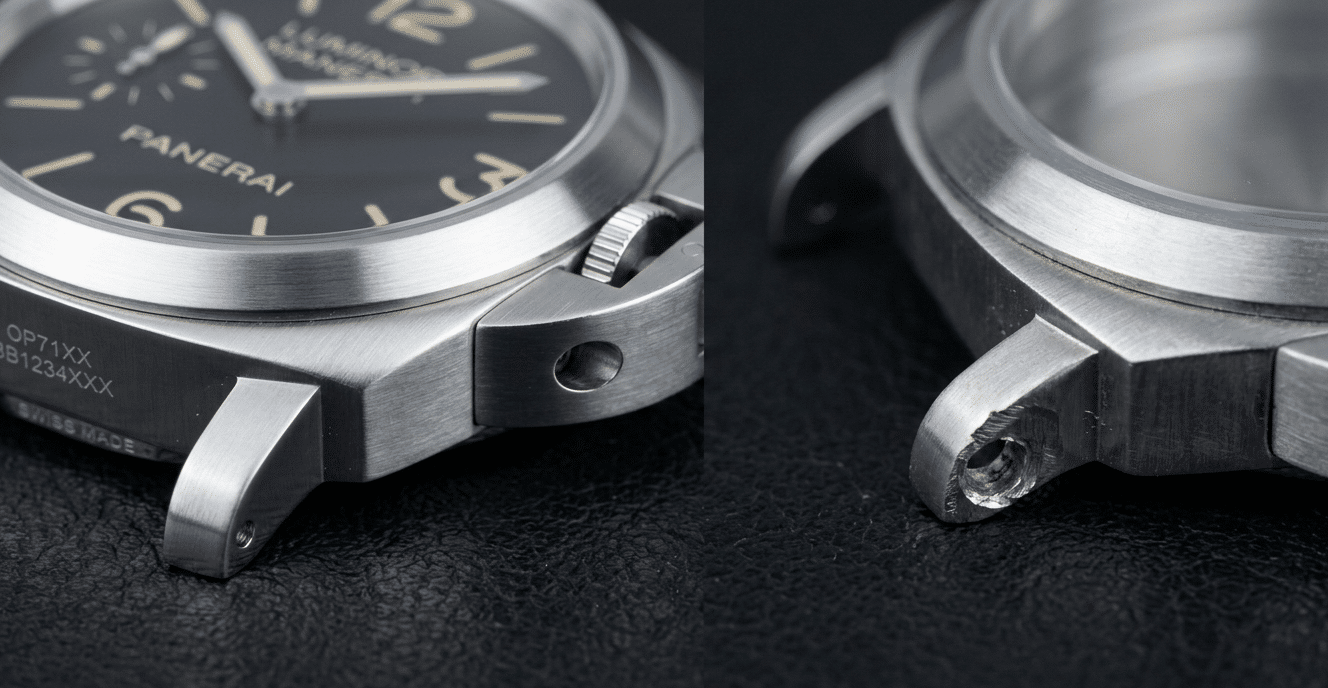
The spring bar lug holes, seemingly minor details, are critical indicators. On a genuine watch, these holes demonstrate impeccable precision. You’ll find a perfectly concentric bore, sharp, clean edges, and a consistent depth across all four lugs. Often, there’s a subtle, polished inner bevel – a detail that demands high-grade, multi-axis CNC machining and often multiple passes to achieve perfectly without introducing micro-burrs. This isn’t just aesthetic; it ensures the spring bar seats correctly and securely. In contrast, non-genuine examples frequently exhibit tell-tale signs of cost-cutting. I’ve observed burrs, inconsistent chamfers, or rougher internal surfaces on many high-tier replicas, even those from reputable “super-clone” factories. These inconsistencies reveal simpler machining paths or omitted post-machining refinement steps. For instance, on a Panerai Luminor replica I inspected, the lug holes showed microscopic material displacement around the edges, a clear sign of a single-pass drill rather than a multi-stage process.
Crown Guard Contours and Recesses: Sculpted for Purpose
Crown guards, particularly prominent on watches like the Panerai Luminor, are sculpted features designed for both protection and ergonomics. Genuine guards feature fluid, ergonomic curves, perfectly symmetrical contours, and, depending on the finish, precise milling marks that transition seamlessly. The internal recess where the crown sits will often exhibit a fine, consistent polish or brushing, reflecting complex programming in the CNC process and careful hand-finishing. This isn’t just about looks; it contributes to the watch’s overall feel and functionality. Non-genuine crown guards, even from advanced factories like VS Factory, frequently exhibit uneven contours, shallow or irregular milling, and less refined internal surfaces. I’ve seen examples where the internal brushing was patchy or the curve felt slightly “off” to the touch, indicating simpler machining paths or a complete omission of final detailing steps. Insight Anchor: A watchmaker in Dallas who services these movements regularly pointed out that the asymmetry in crown guard machining is a recurring tell on certain Panerai replicas, particularly those from earlier batches of the VS P.9000 clone, where one side might be 0.1-0.2mm thicker at the base than the other.
Case Side Brushing and Polishing Transitions: The Sharp Divide
The interplay between brushed and polished surfaces on a watch case is a hallmark of high-end finishing. Genuine cases display razor-sharp demarcation lines where these finishes meet, with uniform grain direction in the brushing and mirror-like, distortion-free polishing. This requires precise masking and often hand-finishing to achieve. Any deviation, even under magnification, is a red flag. Non-genuine watches often show blurred transitions, inconsistent brushing patterns, or wavy polishing that distorts reflections. This can point to less precise masking techniques, automated polishing processes that lack the human eye’s discernment, or even inferior material hardness that makes sharp transitions difficult to achieve without chipping. When comparing a genuine Submersible with a V6 Factory replica, the polished chamfers on the genuine piece caught light with perfect linearity, whereas the replica’s chamfers showed a subtle waviness, causing reflections to distort slightly.
Expert Authentication Insight
To effectively diagnose these details, you’ll need a high-magnification loupe (10x-20x) and a focused LED light source. For lug holes, shine the light directly into the hole and examine the inner wall for any micro-burrs or inconsistencies in the internal chamfer. For crown guards, run a fingernail lightly along the inner curve; any subtle irregularities in the machining or finish will be tactilely apparent. Observe how light reflects off the surfaces; distortion in reflections, especially on polished areas, is a critical tell.
Dial & Hand Execution: The Face of Authenticity
The dial and hands are the primary interface between the watch and its wearer. It’s here that minute imperfections can quickly betray non-genuine origins and manufacturing shortcuts, as these elements are often produced and assembled under extremely tight tolerances.
Applied Indices and Logo Alignment: Micro-Architectural Precision
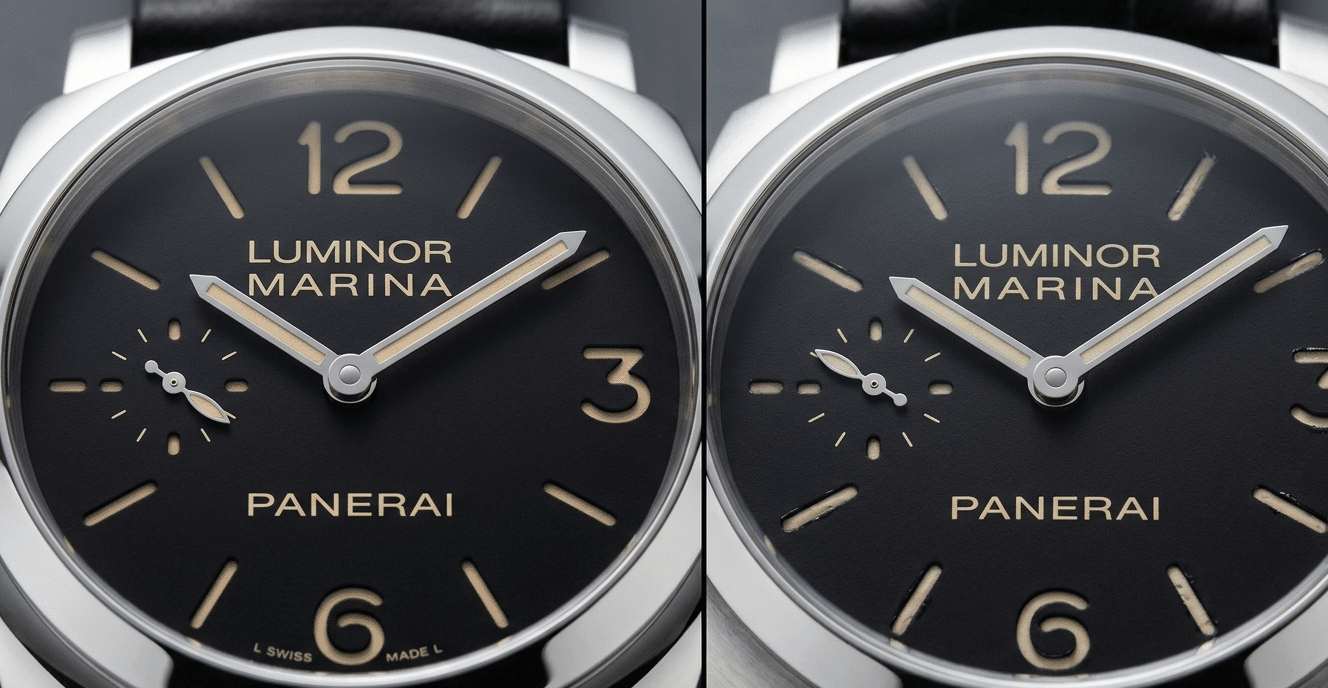
Applied indices and logos are miniature sculptures, each requiring precise application. On genuine pieces, you’ll find perfect alignment, consistent height, and often subtle, clean chamfers on the indices themselves. These are secured with minimal, precise adhesive, virtually invisible even under magnification. The spacing between elements will be mathematically exact. Non-genuine dials, however, frequently show slight misalignments, inconsistent adhesive residue (sometimes visible as a faint sheen or squeeze-out around the base), or less refined edges on the indices. This indicates less precise pick-and-place machinery, manual application without tight tolerances, or simply a lower standard of quality control. Insight Anchor: On a high-quality VS Factory Luminor Marina replica I examined, the date window’s alignment was consistently 0.1-0.2mm too high compared to the genuine, a common tell that few notice without direct comparison or a keen eye under magnification.
Lume Application and Texture: The Glow of Quality
Luminous material, particularly Panerai’s signature sandwich dials, requires meticulous application. Genuine lume is typically applied smoothly, with consistent thickness and a clean, crisp edge against the underlying dial. This reflects careful masking and application techniques. The texture, even under magnification, should be uniform. Non-genuine lume, especially on budget models but sometimes even on higher-tier replicas, may show uneven application, bubbling, or a grainy texture. The color and glow intensity can also differ significantly due to cheaper lume compounds or less controlled application. I’ve seen many replicas where the lume appears almost “puffy” or slightly raised, lacking the smooth, integrated look of the genuine.
Hand Finishing and Pinion Stacks: The Moving Parts
The hands are not just pointers; they are finely finished components. Genuine hands are flawlessly polished, brushed, or chamfered, with sharp, precise edges that catch the light beautifully. The central pinion stack – where the hands are mounted – will be tight, perfectly centered, and often features a polished cap. Any manufacturing marks are virtually absent. Non-genuine hands, in contrast, may show residual stamping marks, poor polishing (sometimes appearing hazy or streaky), or inconsistent chamfering. The pinion stack might be slightly loose, off-center, or lack the refined cap, indicating inferior stamping processes, less precise deburring, or cheaper assembly.
Expert Authentication Insight
For dial and hand details, a 15x-20x loupe is indispensable. Focus on the base of applied indices from multiple angles; this will reveal any glue squeeze-out or inconsistent gaps where the index meets the dial surface. To check lume uniformity, activate the lume with a strong light source and immediately observe the glow in a dark environment, checking for consistent brightness and color saturation across all markers and hands. Finally, observe the central hand stack for any vertical play or off-center alignment of the hands – a subtle wobble or an uneven gap can be a clear indicator.
Movement Finishing (Visible Calibers): Beyond Decoration
For watches equipped with a display caseback, the movement’s decorative and functional finishing offers a profound window into a manufacturer’s philosophy. This isn’t merely about aesthetics; it’s about the integrity of engineering and the painstaking effort, or lack thereof, invested in components that are not always immediately visible.
Bridges and Plates: Anglage and Grain Consistency
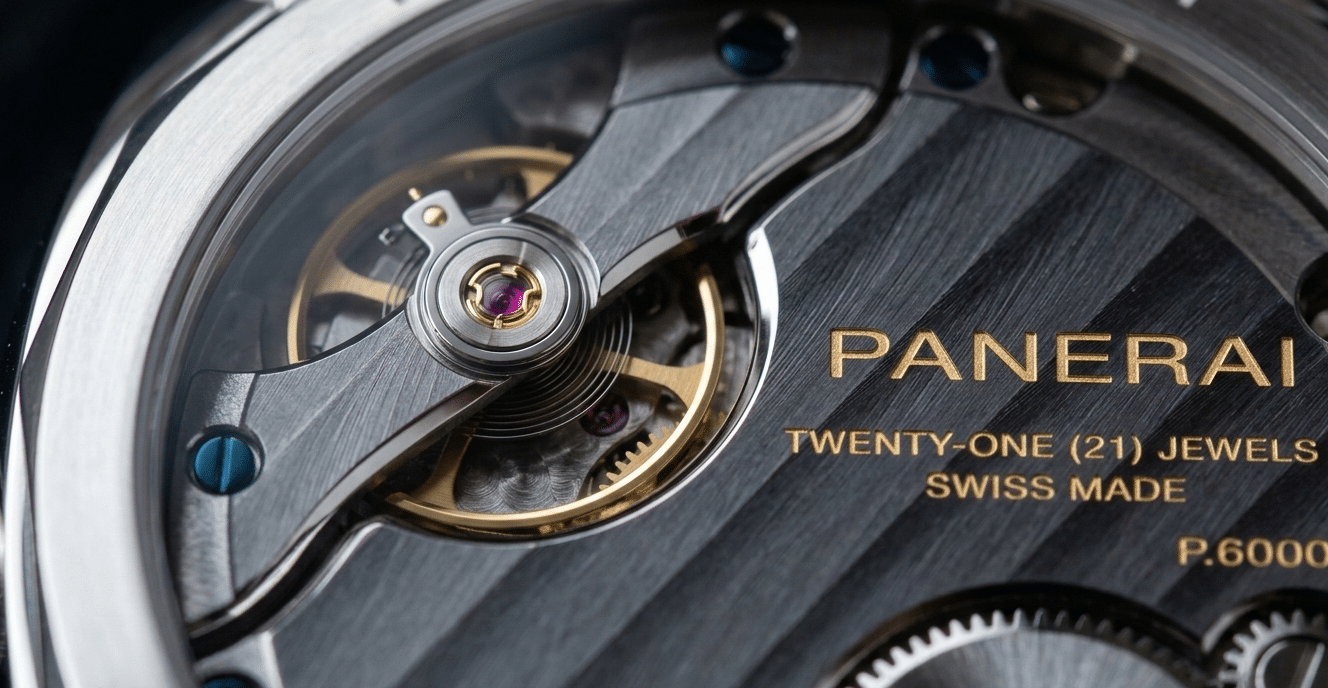
The quality of anglage, or beveling, on the edges of bridges and plates, is a critical tell. Genuine luxury movements often feature hand-finished or precisely machine-beveled anglage that catches and reflects light continuously as the watch is tilted. This process requires specialized tools and significant skill, often involving multiple polishing steps. The result is a crisp, brilliant line that delineates the edges. Similarly, surface grains like Côtes de Genève (Geneva stripes) or perlage (circular graining) on genuine movements are uniform, deep, and precisely spaced, demonstrating meticulous application and consistency across the entire surface.
Non-genuine movements, in contrast, frequently display poorly executed or inconsistent anglage. These bevels may appear dull, uneven, or even absent in places. Often, they are the result of a single, less precise machine pass or even chemical etching rather than true mechanical beveling and polishing. The grains, if present, are typically shallower, less defined, and may show inconsistencies in spacing or depth, betraying automated processes that lack the final human refinement.
Screw Heads and Jewels: Small Details, Big Tells
Even the smallest components, like screw heads and synthetic ruby jewels, reveal much. Genuine movement screws are meticulously finished. This might include polished heads, chamfered edges, and perfectly cut slots, often with a thermal bluing treatment that creates a vibrant, consistent blue color. These precise characteristics are vital for official Panerai authenticity; polished screw slots, for instance, prevent burrs that could flake off into the movement. Jewels, which serve as low-friction bearings, are precisely set within polished countersinks, exhibiting clear, consistent color and transparency.
Non-genuine screws, however, often show signs of mass production shortcuts. They may have rough, unpolished surfaces, unevenly cut slots, or inconsistent bluing (if present) that chips or fades easily. The jewels might be poorly set, appearing cloudy, off-color, or merely as decorative inserts rather than functional, precisely toleranced bearings. In some cases, the countersinks around the jewels are rough or completely absent, indicating a lack of attention to crucial mechanical details.
Rotor and Balance Wheel Details: Dynamic Indicators
For automatic movements, the rotor is a prime candidate for scrutiny. Genuine rotors often feature complex engravings, precise brand logos, and sophisticated finishing like sunburst patterns or perlage, sometimes with gold or platinum weighting segments. The balance wheel, the heart of the movement, will display intricate regulation mechanisms, fine polishing on its spokes, and a high degree of precision in its construction and adjustment. Even on a Panerai P.9000 clone from VS Factory, while functionally impressive, the deep engraving and intricate finishing of a genuine rotor will generally surpass its replica counterpart under close inspection.
Non-genuine rotors frequently exhibit crude or shallow engraving, less refined patterns, or even inaccurate branding. The balance wheels often lack the fine finishing or functional micro-adjustments seen in genuine calibers, utilizing simpler, less precise designs and components. While they may function, the attention to detail in the dynamic components is significantly diminished, reflecting a focus on basic functionality over refined horological craftsmanship.
Expert Authentication Insight
To conduct a thorough inspection, use a 20x-30x macro lens or a high-power loupe, coupled with a focused LED light source. Observe how light reflects off the bridge bevels; genuine anglage will produce a continuous, bright line even as you slowly change the viewing angle. Pay close attention to the edges of screw slots for any micro-burrs or inconsistencies in bluing. For jewels, use a light to check their transparency and consistent color, and ensure they are precisely seated within their plates. Any sign of rough edges, inconsistent finishes, or a lack of precise detail in these areas is a strong indicator of non-genuine manufacturing. The “imperfections of perfection” in genuine hand-finishing are incredibly difficult for machines to replicate consistently.
Bracelet & Clasp Construction: Tangible Quality and Ergonomics
The bracelet and clasp are perhaps the most tactile components of a watch, constantly interacting with the wearer. Their construction quality directly impacts comfort, longevity, and overall perceived value, making them prime areas where manufacturing shortcuts in non-genuine pieces become evident.
Link Articulation and Screw/Pin Fitment: Fluidity vs. Rigidity
A genuine watch bracelet exhibits exceptional fluidity. When held vertically, it should drape smoothly and effortlessly, conforming to the wrist without stiffness or excessive lateral play between links. The individual links are precisely machined, and any screws or pins used for adjustment sit perfectly flush with the surface, indicating tight tolerances and meticulous assembly. There should be no visible gaps or unevenness.
Non-genuine bracelets, by contrast, often feel stiff, rattly, or even cheap. They may not drape naturally, instead holding a rigid shape. Visible gaps between links, or screws/pins that protrude or are recessed, are common tells. This points to inferior machining, less precise manufacturing of individual link components, or hurried assembly processes that fail to achieve the tight tolerances of authentic pieces. For example, a genuine Panerai bracelet will have a distinct heft and smooth articulation that budget replicas struggle to match, even if they use similar 316L steel.
Clasp Engravings and Internal Mechanism: Functional Art
The clasp, the primary point of interaction, is a microcosm of the watch’s overall quality. Genuine clasps feature crisp, deep, and consistent engravings of logos and text. The internal locking mechanism operates with precision, often showcasing refined machining, polished surfaces on contact points, and robust spring-loaded components. The act of opening and closing a genuine clasp should produce a satisfying, crisp click and smooth, secure engagement.
Non-genuine clasps frequently fall short. Engravings may be shallow, blurry, or inconsistent in depth, sometimes appearing laser-etched rather than deeply stamped or milled. The internal mechanism often feels rough, flimsy, or less secure. Parts may show signs of crude stamping, rough edges, or less precise fitment, leading to a less satisfying haptic feedback, a dull click, or even a tendency to accidentally disengage. This is a clear indicator of cost-cutting in design and manufacturing.
Polishing and Brushing Consistency on Links: Uniformity in Detail
The application and transition of polished and brushed surfaces across individual links and the clasp is another critical detail. Genuine bracelets maintain a uniform grain direction in brushed areas and a distortion-free, mirror-like finish in polished sections. Crucially, the demarcation lines between these finishes are razor-sharp and consistent, requiring precise masking and multiple finishing steps. For instance, a genuine Panerai Luminor bracelet will have perfectly aligned brushing on the top surfaces of the links that meets polished edges with no bleed-over.
Non-genuine bracelets often exhibit uneven brushing patterns, cloudy or wavy polishing that distorts reflections, and blurred or inconsistent demarcation lines between finished surfaces. This lack of precision suggests less sophisticated finishing equipment, hurried processes, or a failure to apply the necessary multi-stage treatments that define genuine quality. These inconsistencies are often visible to the naked eye under good lighting.
Expert Authentication Insight
Perform a “drape test”: hold the bracelet by the clasp and let it hang. A genuine bracelet will fall fluidly without resistance. Run a fingertip over all screw and pin heads to check for flushness; any protrusion or recess is a red flag. Operate the clasp multiple times, listening for crisp clicks and feeling for smooth, secure engagement. Visually inspect the internal components of the clasp for tool marks, rough edges, or flimsy parts. The overall “feel” and weight of the bracelet are subjective but powerful indicators that are difficult for non-genuine manufacturers to replicate perfectly.
Crystal, Gasket, and Bezel Integration: Sealing the Deal
The interface where the case meets its critical components—the crystal, gaskets, and bezel—is paramount for optical clarity, water resistance, and the watch’s overall integrity. Flaws in these areas can compromise both performance and authenticity.
Crystal Clarity and Edge Finishing: The Window to the Soul
The sapphire crystal on a genuine luxury watch is optically perfect, serving as a distortion-free window to the dial. If present, any anti-reflective (AR) coating is typically applied to the interior surface only, creating a subtle blue tint when viewed at an angle but appearing largely invisible straight on. The crystal itself fits flush and seamlessly into the bezel or case, with precisely finished edges.
Non-genuine crystals, even if made of sapphire, may exhibit slight optical distortion, a visible AR tint (often purple or green) that is applied to both sides, or an uneven, poorly finished edge. A common tell is a crystal that doesn’t sit perfectly flush, showing a slight gap or unevenness where it meets the case. This indicates lower-grade sapphire material, less precise cutting, or inadequate fitting procedures. For example, a Panerai Luminor Due’s crystal should have an interior-only AR coating, and any deviation or visible tint on the exterior would be suspect.
Bezel Action and Alignment (Rotating Bezel): Haptic Feedback
For watches with rotating bezels, the action and alignment are crucial. A genuine rotating bezel will have a distinct, firm, and satisfying click with each increment, offering consistent rotational resistance and absolutely no play or wobble. When rotated, the bezel insert’s markers will align perfectly with the dial markers, reflecting a robust internal mechanism with precise detent springs or ball bearings.
Non-genuine bezels often feel loose, gritty, or exhibit excessive play. The clicks may be weak, inconsistent, or even absent. A significant red flag is misaligned bezel markers when clicked into position, or a bezel that feels “spongy” rather than crisp. These issues stem from lower quality detent springs, imprecise machining of the bezel teeth, or a generally inferior internal mechanism, all of which compromise both functionality and the tactile experience.
Gasket Visibility and Compression: The Hidden Guardian
While typically hidden, the integrity of gaskets can often be inferred. Genuine watches employ perfectly seated, often invisible, gaskets that ensure optimal water resistance and protect the movement from dust and moisture. The fit of the crystal and caseback should be tight and secure, implying proper gasket compression.
Non-genuine watches may show signs of compromised gasket integrity. This could manifest as uneven gasket material subtly protruding from the case seams, an inconsistent gap between components, or a less secure crystal/caseback fit that suggests inadequate compression. In some cases, a faint, chemical rubber smell might emanate from poorly sealed non-genuine pieces, a telltale sign of cheaper gasket materials and insufficient sealing. Such issues directly compromise the watch’s water integrity, making it vulnerable even to minor splashes.
Expert Authentication Insight
For the crystal, shine a bright LED light across its surface at various angles. Look for any subtle distortions, cloudiness, or inconsistencies in the AR coating (especially if it appears on the exterior or has an incorrect hue). For rotating bezels, listen carefully to the click sound, feel the rotational resistance, and then visually check the alignment of the bezel insert markers against the dial markers from a straight-on perspective. Gently press on the crystal’s center; there should be no perceptible movement or creaking, which would indicate poor gasket compression or an imprecise fit. Remember, while you shouldn’t submerge a watch to test water resistance, these visual and tactile cues are strong indicators of its potential integrity.
Caseback Engravings & Hallmarks: The Signature of Provenance
The caseback of a watch, often overlooked, serves as a critical canvas for a brand’s identity and manufacturing integrity. Its engravings, etchings, and hallmarks are not mere decoration; they are signatures of provenance, offering tangible clues to a watch’s authenticity. A thorough examination of these details, particularly a best Panerai super clone factory comparison, can reveal significant discrepancies between genuine and non-genuine pieces.
Depth and Definition of Engravings: The Embossed Truth
Genuine watch engravings, whether text, logos, or serial numbers, are typically executed with exceptional precision. They are often deeply milled or precisely laser-etched, resulting in characters with sharp, clean edges and uniform depth. This creates a tactile, three-dimensional quality that reflects meticulous manufacturing processes. The fonts used are specific to the brand and model, with consistent spacing and alignment.
Non-genuine watches frequently struggle to replicate this level of crispness and depth. Their engravings may appear shallow, lacking the distinct relief of genuine counterparts. Sometimes, a non-genuine piece might use a surface-level laser etching where a deep milling process is expected on the genuine article. This can lead to rounded edges, inconsistent character depth, or irregular spacing. For example, a genuine Panerai caseback will feature deep, uniform engravings for text like “OFFICINE PANERAI,” whereas a non-genuine might show softer edges or varying depths under magnification.
Expert Authentication Insight
Utilize a 10x to 20x magnification loupe and a focused LED light source. Shine the light at an oblique angle across the engraved surfaces. Genuine engravings will cast sharp, uniform shadows, clearly delineating the edges of each character and revealing consistent depth. Run a soft, non-abrasive probe (like a plastic toothpick) lightly over the engravings; you should feel distinct, sharp edges. Pay close attention to any microscopic burrs, “puddling” of material at the base of letters, or areas where the engraving appears to fade or lose definition. These are tell-tale signs of inferior engraving processes.
Hallmarks and Stamping Quality: Regulatory Authenticity
Precious metal hallmarks (e.g., for gold, platinum, or even specific steel alloys) are miniature, highly detailed stamps applied by official assay offices or the manufacturer itself. These markings attest to the material’s purity and often include specific symbols indicating the country of origin, the metal type, and the year of assay. They are incredibly intricate and demand precise striking pressure and tooling.
Non-genuine manufacturers often fail spectacularly in replicating these tiny, complex details. Their hallmarks may be crude, poorly defined, or incorrect in design. They might appear as soft, blurry impressions, or lack the micro-details present in genuine stamps. In some cases, hallmarks might be entirely absent where they should be present, or incorrect ones might be used. This not only signifies a lack of manufacturing precision but also a disregard for legal compliance.
Expert Authentication Insight
This is a high-stakes area requiring meticulous attention. Before inspection, research the specific hallmarks relevant to the watch’s stated material and origin (e.g., Swiss gold hallmarks, U.S. platinum stamps). Under high magnification (20x-30x), compare the suspected hallmark to verified images of genuine examples. Look for soft or blurred edges, missing micro-symbols, or incorrect proportions within the stamp. The striking should be uniform, creating a consistently deep impression without deforming the surrounding metal. Any deviation from the known genuine detail is a significant red flag.
Serial Number Placement and Font: The Unique Identifier
Every genuine luxury watch bears a unique serial number, a crucial identifier for tracking, warranty, and authentication. The brand dictates the serial number’s exact location, font, size, spacing, and engraving method (e.g., deep engraving, laser etching, or stamping). This consistency is maintained across production runs for a specific model and period.
Non-genuine watches frequently betray themselves through inconsistencies in serial number application. They might use an incorrect font, display irregular spacing between digits or letters, or place the serial number in an incorrect location on the caseback or lug. The engraving method itself can be a tell: a non-genuine piece might feature a dot-matrix laser etching when the genuine model is known for continuous-line deep engraving, or vice-versa. These seemingly minor details are often overlooked by counterfeiters but are glaringly obvious to an expert eye.
Expert Authentication Insight
Always cross-reference the serial number’s font, size, spacing, and exact location against high-resolution images of genuine examples from the same production year. Pay close attention to the method of application; for instance, if a genuine serial is deeply engraved, a shallow laser etch on a suspected non-genuine piece is an immediate concern. Inconsistent spacing between digits or characters, or a serial number that appears “off-center” or misaligned within its designated area, are common indicators of non-genuine origin. Even the subtle burrs or unevenness around the edges of etched characters can be a giveaway.
The Evolving Replication Landscape: A 2026 Perspective
The landscape of non-genuine watch manufacturing is in constant flux, driven by technological advancements and market demand. In 2026, the challenges for authentication are more complex than ever, requiring a deeper understanding of both genuine manufacturing philosophies and the evolving capabilities of replica producers.
Advanced CNC & Laser Finishing: The Illusion of Precision
By 2026, non-genuine factories have access to highly sophisticated multi-axis Computer Numerical Control (CNC) machines and advanced laser etching/engraving systems. This technology enables them to achieve a level of superficial precision that can mimic genuine case geometries, brushing patterns, and even some intricate decorative elements with alarming accuracy. External surfaces, curves, and basic transitions can appear remarkably clean and well-executed.
However, the illusion often breaks down under scrutiny. Genuine finishing processes involve not just precise machining but often multiple passes with different tooling, specific post-machining refinements, and a deep understanding of material behavior. While non-genuine CNC can replicate the appearance* of a finish, it frequently lacks the underlying complexity of these multi-stage processes. This can lead to subtle differences in how light reflects off a surface, the tactile feel of an edge, or the exact definition of an internal angle. For example, a non-genuine case might have an aesthetically pleasing brushed finish, but the individual brush strokes might lack the uniformity or depth of a genuine one, or the transition to a polished surface might be slightly blurred rather than razor-sharp.
Expert Authentication Insight
Never rely solely on initial visual impressions. Focus your macro-level examination on areas that demand complex multi-axis machining and intricate post-processing. Pay particular attention to the transition zones* where different finishes meet (e.g., the sharp line between a brushed case side and a polished bezel). Examine the *sharpness of internal angles* and the *consistency of grain direction* within brushed surfaces. A 20x loupe is indispensable for detecting the slight rounding on an edge that should be razor-sharp, or a subtle deviation in the consistency of a brushed pattern. The way light plays across these complex surfaces often reveals the fundamental differences in manufacturing approach.
Material Science Imitation & Coatings: Beyond the Surface Color
The sophistication of non-genuine production in 2026 extends beyond mere visual replication to an increasing focus on material science. Counterfeiters are now regularly employing higher-grade stainless steels (such as 316L, which Panerai utilizes for many models), experimenting with ceramic composites for bezels, and utilizing more durable PVD (Physical Vapor Deposition) or DLC (Diamond-Like Carbon) coatings. This means that simply looking for “off” colors or obvious material differences is becoming less reliable as an authentication method.
Authenticating in this environment requires an understanding of how genuine materials behave*—their specific hardness, scratch resistance, density, and how light interacts with their unique microstructure. For instance, a non-genuine bronze watch might use an alloy that patinas in a similar way to a genuine one, but its overall density, machining characteristics, or long-term stability might still differ. Similarly, a ceramic bezel on a non-genuine piece might look correct in color, but it might lack the specific resonant “ring” or extreme scratch resistance of a genuine ceramic component.
Expert Authentication Insight
Develop a “tactile memory” for genuine materials. Gently tap a genuine ceramic bezel; it produces a distinct, high-pitched resonance. Handle a genuine titanium case; it feels lighter than steel but with a specific, almost “warm” touch. Compare the suspected piece side-by-side with a known genuine example, if possible, to assess the material’s interaction with light—the specific sheen, reflectivity, and depth of color. For coated surfaces, check for uniformity and resistance to minor abrasion (though be cautious not to damage the piece). For materials like bronze, observe the patina development over several months; some replica alloys might patina too quickly, too slowly, or with an incorrect hue compared to the genuine.
The Human Element: Still the Ultimate Barrier to Replication
Despite the relentless march of automation and advanced machinery, the true pinnacle of luxury watchmaking in 2026 still heavily relies on the irreplaceable human element. The skilled artisan performing intricate anglage on movement bridges, the meticulous hand-polishing of tiny screw heads, or the precise, multi-stage alignment of delicate dial elements introduces a level of nuanced perfection and consistency that machines, even advanced ones, struggle to replicate consistently at scale. This human touch often results in subtle “imperfections of perfection”—microscopic tool marks unique to a craftsperson, or a hand-polished bevel that catches light with a specific, continuous brilliance that automated processes cannot perfectly mimic.
Furthermore, genuine manufacturers maintain far more stringent, multi-tiered quality control processes, often involving multiple human inspections at each stage of production. This rigorous oversight catches minute flaws that non-genuine production, focused on speed and volume, typically misses. This multi-stage human refinement and stringent quality assurance collectively represent the “secret sauce” that non-genuine production, for all its technological gains, cannot yet fully bottle.
Expert Authentication Insight
Focus your attention on areas that are traditionally known to require extensive human intervention and skilled craftsmanship. For watches with display casebacks, scrutinize the anglage (beveling) on movement bridges and plates. Genuine anglage, whether hand-finished or precisely machine-assisted, will show a continuous, bright, and distortion-free reflection along the entire bevel, even as the viewing angle changes. Non-genuine often exhibit unevenness, dull spots, or a “stamped” appearance that lacks the depth and consistency. Examine the intricate polishing of small screws, the precision of jewel settings, and the delicate application of dial elements. Look for subtle variations that indicate a human touch (which is a hallmark of genuine quality) versus robotic monotony (which can be a sign of non-genuine attempts to mimic human work without true artistry). These nuanced details remain the most formidable barrier for even the most advanced non-genuine producers.
In the complex and often deceptive world of luxury watches, true authenticity lies not just in a brand name or a first impression, but in the unwavering consistency and integrity of every minute detail. As non-genuine manufacturers continue to refine their techniques, the onus falls on the discerning buyer to elevate their scrutiny. By systematically applying macro-level examination to critical finishing areas—from the depth of caseback engravings to the nuanced perfection of hand-finished movement components—you equip yourself with the most effective defense against sophisticated non-genuine pieces in 2026.
This multi-point visual authentication checklist, combined with a developed “tactile memory” for genuine materials and finishes, empowers you to confidently assess a watch’s provenance. However, for high-value acquisitions or when any doubt lingers, always seek a professional, independent authentication from a reputable watchmaker or expert. Investing the time in this detailed scrutiny is not merely about avoiding a financial mistake; it is about honoring the intrinsic craftsmanship and genuine value that define true luxury watchmaking.