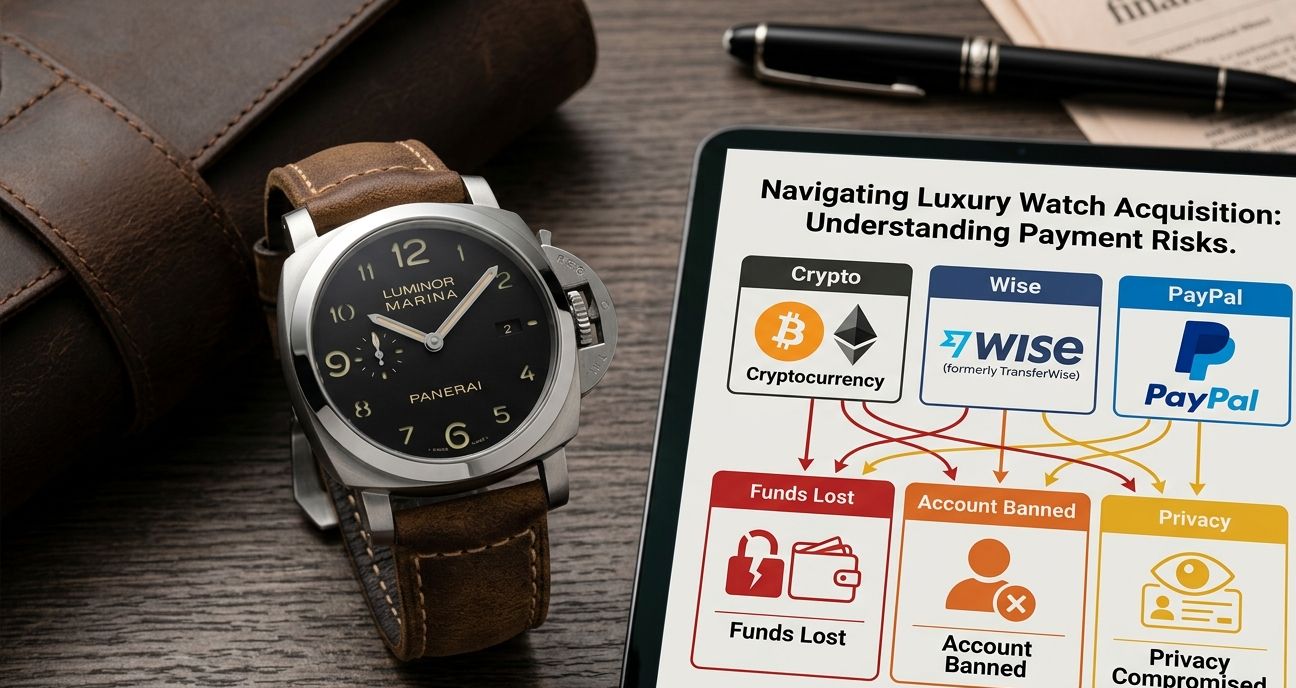
Imagine you’ve just found the perfect Panerai Super Clone. You’ve vetted the Trusted Dealer (TD), seen the Quality Control (QC) photos, and, understanding crucial Panerai QC points, are ready to send your hard-earned cash. You choose what you believe is the “safest” payment method, only to have your funds disappear, your identity exposed, or your payment account permanently banned. This isn’t a hypothetical fear; it’s a common outcome for buyers navigating the murky waters of the replica watch market without a clear understanding of payment risks.
In this world, “safest” isn’t a simple label. It’s a complex calculation of trade-offs, where protecting your funds might expose your privacy, and safeguarding your account might mean sacrificing buyer recourse. Generic payment advice falls flat when dealing with illicit goods. Here, we’ll dissect the real risks and advantages of Crypto, Wise, and PayPal (Goods & Services) for your replica Panerai order, helping you make an informed decision based on your personal risk tolerance.
The payment landscape for replica watches is unlike any other consumer transaction. Traditional safeguards and consumer protections, which you might take for granted when buying legitimate goods, are largely absent or actively undermined. Understanding this unique context is the crucial first step in mitigating your risk as a buyer.
The Illicit Context: Why Standard Buyer Protections Fail
When you purchase a replica watch, you are operating in a legal gray area. While personal possession of counterfeit goods is rarely prosecuted in the U.S., the act of buying and importing them, and the seller’s act of producing and distributing them, often violate intellectual property laws and international trade regulations. This fundamental illegality means that the standard consumer protections offered by banks, credit card companies, and payment processors are effectively void.
If you initiate a chargeback or dispute for a replica watch, you cannot truthfully claim “item not as described” without admitting you knowingly purchased a counterfeit. Admitting this violates the Acceptable Use Policies (AUPs) of most financial institutions, leading them to side with the seller (if they’re even involved in the dispute) or, more likely, to close your account due to policy violations. In essence, the very nature of the transaction means you forfeit the conventional safety nets designed for legitimate commerce.
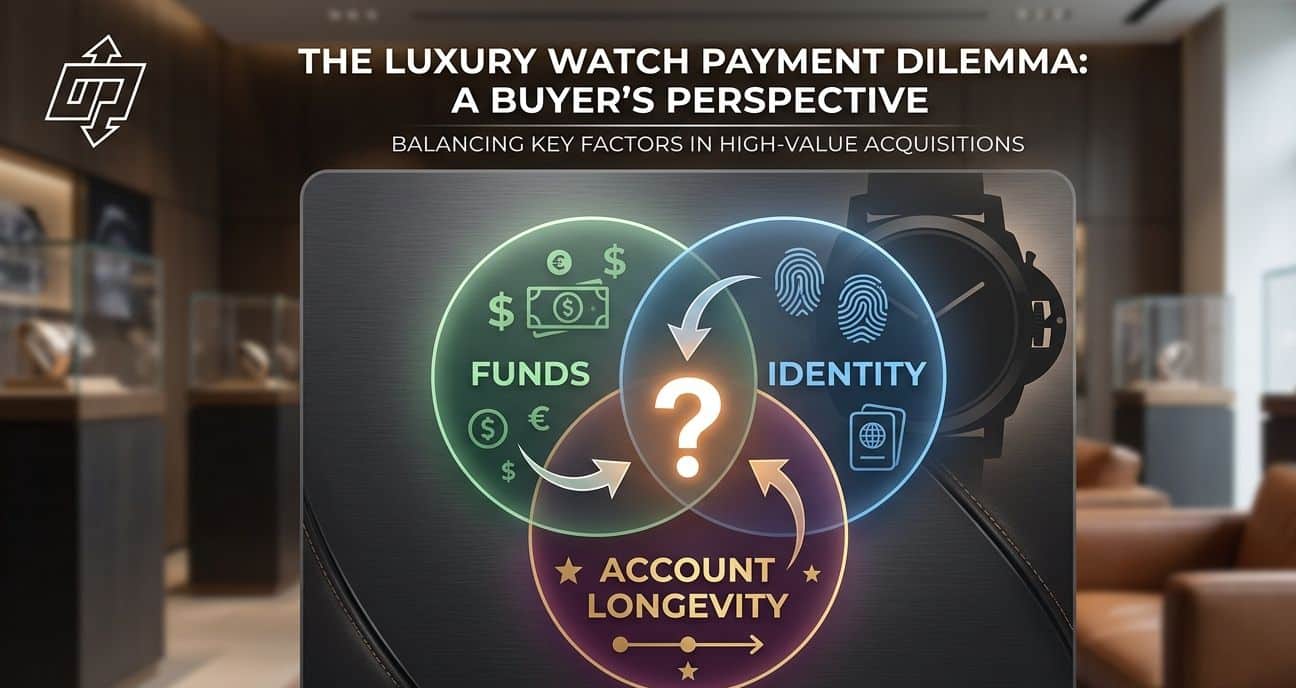
The Replica Buyer’s Core Dilemmas: Funds, Identity, or Account Longevity
For buyers of replica watches, the payment process introduces three primary risk vectors, and often, you can only prioritize two at the expense of the third:
- Direct Financial Loss: This is the most obvious risk – losing your money to a scammer who never ships, or receiving a product significantly different from what was promised. Without robust buyer protection, recovering lost funds can be impossible.
- Compromise of Personal Identifying Information (PII): Sharing your name, address, email, phone number, and banking details with potentially illicit operators or through less secure channels can expose you to identity theft, targeted scams, or being flagged by authorities for engaging in illicit trade.
- Payment Platform Account Suspension: Using mainstream payment services for replica purchases can lead to your account being flagged, frozen, or permanently banned. This can impact your ability to use these services for legitimate transactions, affecting your financial life beyond replica purchases.
The “safest” payment method for you will depend on which of these three dilemmas you prioritize.
Trusted Dealers (TDs) and Their Payment Preferences: An Operational View
Trusted Dealers (TDs) are not operating legitimate businesses. Their primary goal is to move product, minimize their own legal exposure, and maximize profit. Their payment preferences are a direct reflection of their operational risk management:
- Irreversibility: TDs strongly prefer payment methods that are irreversible once sent. This protects them from chargebacks and ensures they retain funds, even if a buyer is unhappy or tries to dispute the purchase.
- Low Fees: Every transaction fee cuts into their already tight margins. They favor methods with lower processing costs, which often means methods that offer fewer protections.
- Reduced Exposure: TDs want to avoid scrutiny from financial regulators, payment processors, and law enforcement. Methods that offer greater anonymity or are harder to trace are often preferred.
- Speed: Quick access to funds allows them to pay factories, manage inventory, and maintain cash flow.
Understanding these motivations helps explain why TDs often push for certain payment methods and actively avoid others, particularly those that offer strong buyer protections like PayPal Goods & Services.
Expert Authentication Insight
Before committing to any payment method, always cross-reference the TD’s stated payment options against community-verified lists. Reputable replica watch forums like RWI (Replica Watch Info) or RWG (Replica Watch Guide) maintain extensive FAQs and buyer guides that list common payment methods accepted by known TDs. If a TD asks for a payment method that is not widely accepted, not listed in these community resources, or seems unusually obscure, treat it as an immediate red flag. This could indicate a new or unvetted seller, or even a scammer trying to exploit less common payment rails.
PayPal Goods & Services: The Illusion of Safety for Replica Orders
PayPal’s Goods & Services (G&S) feature is often perceived by new buyers as the safest option due to its prominent “Buyer Protection.” However, in the context of replica watch purchases, this perceived safety is largely an illusion, fraught with significant risks for both buyer and seller.
PayPal’s AUP and Account Bans: The Sword of Damocles
PayPal operates under a strict Acceptable Use Policy (AUP) that explicitly prohibits transactions involving “counterfeit goods,” “illegal products,” or “items that infringe or violate any copyright, trademark, right of publicity or privacy or any other proprietary right under the laws of any jurisdiction.” When you use PayPal G&S for a replica watch, you are directly violating this policy.
If PayPal discovers this violation—whether through a dispute, keyword flagging in transaction descriptions, or internal review—the consequences can be severe. Both the buyer’s and seller’s accounts are at high risk of permanent closure, funds freezing, and potential legal action. For the buyer, this “Sword of Damocles” means that while you might initially feel protected, the very act of seeking that protection can lead to the loss of your PayPal account, which can be a significant inconvenience for legitimate online transactions.
The Chargeback Conundrum: Buyer Protection vs. Seller Risk
The PayPal dispute process, designed to protect buyers of legitimate goods, becomes a double-edged sword in the replica market:
- For the Buyer: If you open a dispute (e.g., “item not as described” or “item not received”), you face a dilemma. If you truthfully state it’s a replica, PayPal will almost certainly close the case against you due to AUP violation. If you lie and claim it’s a genuine watch that’s faulty, you risk PayPal investigating further and discovering the truth, leading to account closure. Furthermore, proving “not as described” for a replica without admitting its illicit nature is virtually impossible, as you cannot provide a legitimate basis for comparison or claim.
- For the Seller (TD): TDs view PayPal G&S as extremely high risk. Even if a buyer loses a dispute, the act of a dispute itself can trigger PayPal’s fraud detection algorithms, leading to their account being flagged or permanently banned. For TDs who rely on these accounts to receive payments, the risk of losing an entire payment channel and potentially thousands of dollars in frozen funds far outweighs the benefit of a single sale. This is why most reputable TDs actively avoid G&S.
TD Avoidance Strategies: Why PayPal G&S is Rarely a Direct Option
Given the immense risk of account bans and chargebacks, reputable Trusted Dealers have developed clear strategies to avoid PayPal G&S:
- Outright Refusal: Many TDs simply do not offer PayPal G&S as a payment option. They understand the severe consequences and would rather lose a sale than risk their operational accounts.
- Insistence on “Friends & Family” (F&F): This is a common tactic. PayPal F&F payments are designed for personal transfers between known parties and offer absolutely zero buyer protection. By pushing for F&F, TDs eliminate their chargeback risk, but at the cost of stripping the buyer of any recourse whatsoever. If you send money via F&F and the watch never arrives or is not as described, PayPal will not help you.
- Third-Party or Proxy Accounts: Some less scrupulous or desperate TDs might use temporary, “mule,” or third-party PayPal accounts. These add another layer of risk for buyers, as there’s no direct link to the TD, making communication and accountability even harder if issues arise.
Expert Authentication Insight
If a Trusted Dealer insists* on PayPal Friends & Family, or directs you to an obscure third-party payment method not widely accepted or vetted by the replica community, consider this a critical security diagnostic. This is a massive red flag. While some TDs might offer F&F to reduce their own risk, an insistence on it means they are prioritizing their safety over yours, leaving you with zero recourse. An obscure payment method, especially one you haven’t seen on major forum lists, could indicate a scammer or a TD operating under extreme secrecy due to past issues, both of which increase your risk significantly. Trust is paramount in this market; such demands fundamentally erode it.
Wise (formerly TransferWise): Balancing Cost and Traceability for Super Clones
Wise (formerly TransferWise) has emerged as a popular option for international money transfers due to its competitive rates and user-friendly interface. For replica watch buyers, it offers a balance between cost-efficiency and traceability, sitting somewhere between the high-risk, high-protection illusion of PayPal G&S and the absolute irreversibility of cryptocurrency. Beyond payment methods, understanding the landscape of suppliers is equally vital; a comprehensive trusted dealer checklist can guide buyers through factory comparisons and dealer screening.
Cost-Efficiency and Exchange Rates: The Buyer’s Financial Advantage
One of Wise’s primary appeals for international replica purchases is its financial advantage for the buyer:
- Lower Fees: Wise typically charges significantly lower transaction fees compared to traditional bank wires, which can often run $30-$50 USD or more per transfer. For a ~$500 replica, these savings are substantial.
- Real Exchange Rates: Unlike many banks that add a hidden markup to exchange rates, Wise uses the mid-market exchange rate (the one you see on Google). They charge a small, transparent fee on top of this. This can save buyers anywhere from 2-5% on the total cost of an international purchase compared to conventional banking methods, making it a very attractive option for those looking to maximize their replica budget.
- Transparency: Wise provides a clear, upfront breakdown of all fees and the exact exchange rate, so you know precisely how much the recipient will receive.
Traceability and Regulatory Compliance: The Privacy Trade-off
While Wise offers cost benefits, it comes with a significant privacy trade-off. Wise is a fully regulated financial institution, subject to “Know Your Customer” (KYC) and Anti-Money Laundering (AML) regulations in every jurisdiction it operates. This means:
- Full Traceability: All transactions conducted through Wise are linked to real identities. Your bank account is linked to your Wise account, and the recipient’s bank account (or Wise account) is linked to their identity. There is a clear, undeniable paper trail for every dollar moved.
- Reporting Obligations: Wise, like any bank, is obligated to report suspicious transactions or transfers exceeding certain thresholds to financial authorities. While a single ~$500 replica purchase is unlikely to trigger an alarm, repeated transactions or larger sums could draw attention.
- Privacy Concerns: For buyers concerned about personal identifying information (PII) leakage or potential financial scrutiny related to purchasing illicit goods, Wise offers very little privacy. Your identity and the nature of your purchase (albeit disguised as a generic transfer) are recorded and accessible by Wise and potentially by regulatory bodies.
Limited Reversibility: A Step Above Crypto, A Step Below PayPal
Wise’s dispute resolution mechanisms are less robust than PayPal’s G&S but offer slightly more recourse than pure cryptocurrency transactions:
- Generally Irreversible: Once a Wise transfer is successfully completed and the recipient has collected the funds, it is extremely difficult, if not impossible, to reverse. There is no built-in “buyer protection” for goods not received or not as described, as there is with PayPal G&S.
- Limited Fraud Investigation: Wise might* investigate if there’s clear evidence of account hacking or a transfer being sent to the wrong recipient due to a system error. However, if you knowingly send money to a TD who then fails to deliver or sends a sub-par product, Wise will likely state that the transaction was authorized by you and cannot be reversed. Their role is to facilitate transfers, not to mediate disputes over goods.
- Better than Crypto (Slightly): The only slight advantage over crypto is that if a TD account is truly fraudulent and the funds are still “pending” or haven’t been picked up, there’s a slim chance Wise could intervene. But once the funds are in the recipient’s hands, consider them gone if a dispute arises.
Expert Authentication Insight
Before initiating any Wise transfer, meticulously cross-verify the recipient’s name and details provided by the TD against any public information or community feedback. Scammers frequently use new or slightly altered recipient names to avoid being tracked. If the TD provides a personal name for the Wise transfer that doesn’t align with their established identity (e.g., a known company name or a consistently used personal name in community reviews), or if the details seem inconsistent, proceed with extreme caution. This verification step helps ensure your funds are going to the intended (and hopefully legitimate) Trusted Dealer, reducing the risk of outright theft.
Cryptocurrency: The Anonymity vs. Irreversibility Conundrum for Replica Buyers
For buyers of replica watches, cryptocurrency, particularly Bitcoin and stablecoins like USDT, often gets touted as the ultimate solution for anonymous and secure payments. This brief investigative focus will offer a comprehensive analysis of using cryptocurrencies for replica watch payments, emphasizing the trade-off between enhanced privacy/anonymity and the absolute irreversibility of transactions, alongside the practical execution challenges buyers face.
Pseudo-Anonymity and Privacy Benefits: Shielding Identity
One of the primary appeals of cryptocurrency in the replica market is its perceived ability to shield a buyer’s identity. Unlike traditional banking systems, which are inherently tied to real-world identities, crypto transactions operate on a blockchain. This means payments are not directly linked to your name, bank account, or physical address. Your personal identifying information (PII) is not directly transmitted with the payment itself. For buyers concerned about financial institutions flagging their accounts, or simply wishing to keep their purchasing habits private, this pseudo-anonymity is a significant draw. It decouples the payment from traditional banking identities, appealing directly to those worried about PII leakage or future financial scrutiny.
Absolute Irreversibility: The Zero-Protection Reality
The flip side of cryptocurrency’s decentralized nature is its absolute irreversibility. Once a crypto payment is broadcast to the blockchain and confirmed, it is final. There is no central authority to appeal to, no “chargeback” button, and no mechanism for recovering funds if something goes wrong. This immutable nature of blockchain transactions means that if a Trusted Dealer (TD) fails to ship, sends the wrong item, or simply disappears, your funds are gone. This is the stark reality: you have zero recourse within the cryptocurrency system itself. For the buyer, this represents the highest possible risk of monetary loss, as the payment system offers no built-in protection against fraud or non-delivery.
Execution Complexity and Volatility: User Error and Market Risk
Beyond the fundamental irreversibility, using cryptocurrency for replica purchases introduces practical challenges that can lead to significant losses. The learning curve for setting up and managing crypto wallets, understanding different networks (e.g., ERC-20, TRC-20 for USDT), and executing transactions can be steep. A common and devastating user error is sending funds to an incorrect wallet address; a single wrong character means your funds are permanently lost to an unknown address. Furthermore, the price volatility of cryptocurrencies, especially Bitcoin, can introduce an unexpected financial risk. The value of your payment could fluctuate significantly between the time you agree on a price with a TD and the moment your payment is confirmed, potentially costing you more or less than anticipated in fiat terms. Even stablecoins, while designed to minimize volatility, are not immune to minor fluctuations or network congestion issues that can delay transactions.
Expert Authentication Insight
For crypto payments, double-check the recipient wallet address character by character before confirming the transaction; a single incorrect character means irreversible loss of funds. Better yet, use the copy-paste function and then visually verify the first few and last few characters against what the TD provided.
The Replica Payment Risk Matrix: Matching Method to Your Priority
Choosing the “safest” payment method for a replica watch order isn’t about finding a universally perfect option; it’s about aligning the payment method with your personal risk tolerance. This brief investigative focus aims to develop a practical framework, a risk matrix, that allows buyers to choose the “safest” payment method based on their individual priorities, whether that’s fund loss, privacy, or account security.
Prioritizing Fund Safety: Which Method Minimizes Monetary Loss?
If your absolute top priority is minimizing the risk of monetary loss from a TD failing to ship or delivering a product significantly different from what was ordered, then traditional payment methods with strong buyer protection offer the most theoretical safety. PayPal Goods & Services, despite its risks to both buyer and seller in the replica context, provides the most robust dispute resolution mechanism and the potential for chargebacks. However, this protection is often voided by the illicit nature of the goods. Wise offers limited avenues for investigation in cases of clear fraud, but no guaranteed recovery. Cryptocurrency, as discussed, offers virtually no recourse. Therefore, for fund safety, a method with a clear, albeit often compromised, dispute process is technically superior, but the reality of replica purchases means even these protections are tenuous.
Prioritizing Privacy: Shielding Your Identity and Purchase History
For buyers who prioritize keeping their personal identity and purchase history separate from their replica watch transactions, the landscape shifts dramatically. Cryptocurrency offers the highest degree of pseudo-anonymity, as transactions are not directly linked to your personal data. While exchanges require KYC (Know Your Customer) for fiat on/off-ramps, the transaction itself on the blockchain is detached from your personal identity. Wise, as a regulated financial institution, requires full KYC and transparently links all transactions to your identity, making it highly traceable. PayPal, similarly, is fully tied to your identity, and transactions are visible to the platform, making privacy a non-starter if you’re concerned about your purchase history being tracked by a financial entity or potentially flagged due to AUP violations.
Prioritizing Account Longevity: Avoiding Bans and Suspensions
The risk of having your payment accounts flagged, frozen, or even permanently banned is a significant concern for replica buyers. If maintaining the longevity of your payment accounts (PayPal, Wise, crypto exchange) is paramount, then methods less prone to scrutiny are preferable. PayPal carries the highest risk for both buyer and seller in the replica market due to its strict Acceptable Use Policy against illicit goods. Engaging in replica transactions can lead to immediate account suspension. Wise, while regulated, generally has less aggressive monitoring for specific product types, focusing more on anti-money laundering (AML) compliance. However, large or frequent international transfers could still draw attention. Using cryptocurrency from a reputable exchange for fiat conversion might still expose your identity to the exchange, but the direct crypto transaction itself is less likely to trigger a ban on your personal bank account or primary financial services, assuming you’re not using funds directly linked to illicit activities to buy crypto.
Expert Authentication Insight
Construct a personal “risk priority matrix” (Funds, Privacy, Account Longevity) and assign a score (1-5, with 5 being highest priority) to each factor based on your personal tolerance, rather than relying on generalized advice. This self-assessment will clarify which payment method aligns best with your specific concerns.
Beyond the Rails: Smart Strategies for Mitigating Replica Payment Risk
While the choice of payment method is crucial, it’s only one component of a broader risk mitigation strategy in the replica watch market. This brief investigative focus provides actionable advice and best practices that transcend the specific payment method, focusing on buyer behavior, due diligence, and communication to reduce overall transaction risk, regardless of how you pay.
Vetting Your Trusted Dealer (TD): The Foundation of Security
The single most important factor in mitigating risk is the integrity and reliability of your Trusted Dealer (TD). No payment method, however “safe,” can fully protect you from a dishonest seller. Therefore, extensive research into a TD’s reputation, longevity, and community feedback, which often includes consulting a Panerai replica buying guide, is the absolute foundation of security. This means delving into multiple replica watch forums (e.g., RWI, RepTime) to check long-term member reviews, read historical threads, and verify their standing within the community. Look for consistent positive feedback over several years, transparent communication, and a track record of resolving issues fairly. A TD’s established reputation is your best, and often only, real form of insurance.
Documentation and Communication Protocols: Your Best Defense
Clear, documented communication with your TD is your best defense against misunderstandings and potential disputes. Before any payment, ensure all details of your order are explicitly confirmed in writing (email, forum PMs, WhatsApp chats). This includes the specific model, factory, movement, and any custom requests. Always request high-quality QC (Quality Control) photos of your specific watch* before it ships. These photos should clearly show the dial, case, movement (if visible), timegrapher results, and any potential flaws. Understand and confirm the TD’s shipping terms, insurance policy (if any), and return/exchange procedures *before* you commit funds. This creates a paper trail that, while not enforceable in a court of law for illicit goods, serves as leverage in community-based dispute resolution and clarifies expectations.
Staged Payments and Smaller Orders: Testing the Waters
For new buyers, or when dealing with a TD for the first time, it can be wise to “test the waters” before committing a large sum. Consider initially placing a smaller, less expensive order for a less critical item (e.g., a strap, a lower-cost replica) to evaluate the TD’s communication, shipping efficiency, and overall service. For high-value items, inquire about the possibility of partial payment options. While many TDs prefer full upfront payment, some might be open to a deposit followed by the remainder upon QC approval. This staged approach allows you to build trust with the TD and reduces your upfront financial exposure, giving you a chance to assess their reliability before fully committing to a significant purchase.
Expert Authentication Insight
Always request a timestamped QC video of your actual watch* (not just photos) before final payment, ensuring the watch’s details match the ordered specifications and the TD is actively handling the order. This makes it harder for a TD to use stock photos or misrepresent the condition of the watch.
The Evolving Landscape of Replica Payments: What’s Next for Super Clone Orders
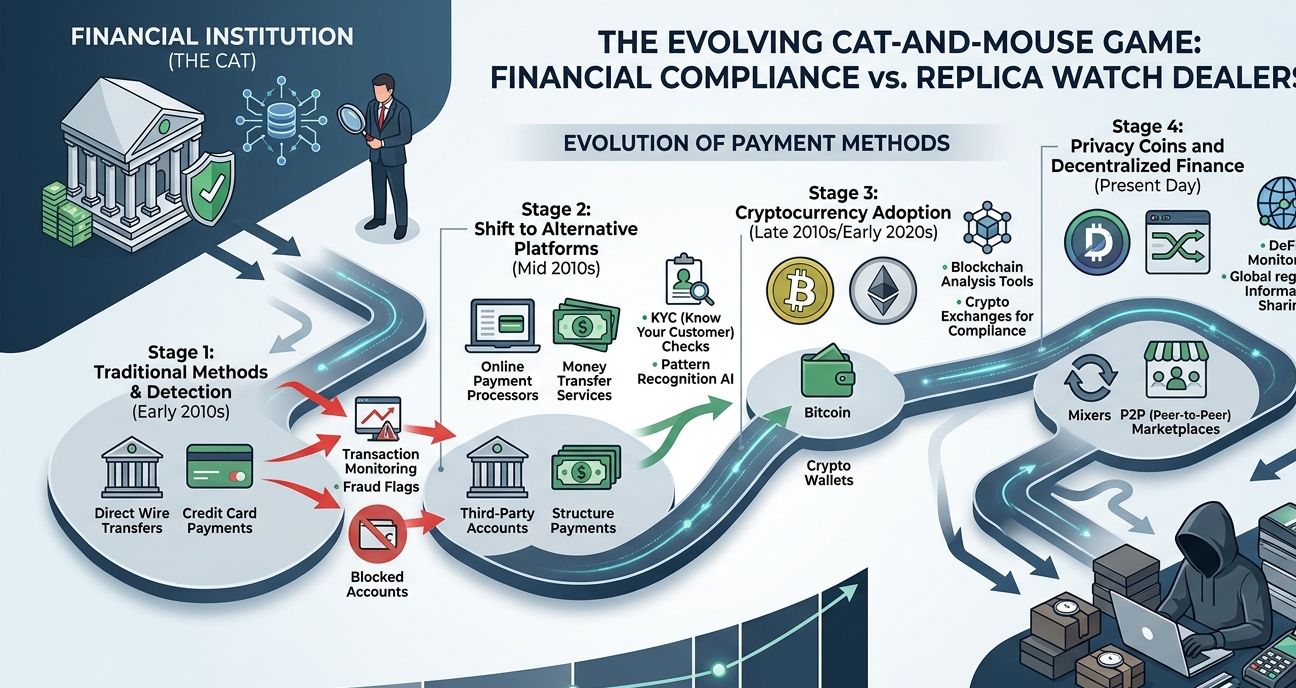
The replica watch market, particularly for high-demand items like Panerai super clones, operates in a constant state of flux. Payment methods are not static; they evolve in response to regulatory pressures, technological advancements, and the ongoing tug-of-war between financial institutions and the illicit trade. For buyers, understanding these shifts is critical because the “safest” option today may not hold true tomorrow.
Increasing Scrutiny from Financial Institutions
Traditional financial institutions, including banks and payment processors like PayPal and Wise, are under increasing pressure to combat illicit trade, money laundering, and intellectual property infringement. This means their fraud detection and compliance systems are becoming more sophisticated. What was once a discreet transaction might now trigger automated flags.
For replica watch buyers, this manifests in several ways. PayPal’s Acceptable Use Policy (AUP) is enforced with greater vigilance, leading to more frequent account bans for both buyers and sellers involved in replica transactions. Even Wise, while offering cost-effective international transfers, operates within a regulated framework. Banks are employing advanced AI and machine learning algorithms to identify suspicious transaction patterns, even those disguised with generic descriptions. This heightened scrutiny means that payment methods offering traditional consumer protections (like chargebacks) are becoming riskier for TDs to accept and for buyers to use without risking account closures or flagging their financial activities. The operational reality for TDs is that they must continuously adapt their payment channels to avoid freezing of funds or direct legal action, which often pushes them towards less traceable and less reversible options.
Emerging Payment Technologies and TD Adaptations
As traditional payment rails become more challenging, the replica market, like other grey and black markets, is exploring and adopting emerging financial technologies. Stablecoins, such as USDT or USDC, built on blockchain technology, offer the price stability of fiat currency while retaining some of the pseudo-anonymity and irreversibility of cryptocurrencies. For TDs, stablecoins reduce volatility risk compared to Bitcoin and offer faster settlement than traditional bank wires.
Privacy coins, like Monero (XMR), take anonymity a step further, making transactions significantly harder to trace. While not yet mainstream in the replica world due to complexity, their adoption could increase if regulatory pressure on standard cryptocurrencies intensifies. Decentralized exchanges (DEXs) also offer a way to trade crypto without centralized oversight, further complicating tracking.
For buyers, these technologies present a steep learning curve and new risks. While they might offer enhanced privacy, they typically come with absolute irreversibility, meaning zero recourse if a TD fails to deliver. The complexity of managing wallets, understanding network fees, and navigating decentralized platforms adds layers of potential user error, turning what seems like a cutting-edge solution into a higher-risk proposition for the unprepared. TDs adopt these to maintain operational fluidity and offer alternatives when traditional methods fail, but they inherently shift more risk onto the buyer.
The Continuous Cat-and-Mouse Game: Buyer Vigilance is Key
The dynamic between replica sellers and financial gatekeepers is a perpetual cat-and-mouse game. As one door closes, another opens, often through technological innovation or exploitation of regulatory gaps. Buyers should not expect a “set it and forget it” payment strategy. The “safest” method you used six months ago might now be compromised, riskier, or simply unavailable.
This continuous evolution means that buyer vigilance is not just recommended, it’s essential. Relying on outdated advice or assuming consistency in payment options can lead to significant financial loss, identity exposure, or account suspension. The market demands adaptability and a proactive approach to staying informed about current practices and risks.
Expert Authentication Insight
Before any transaction, regularly check reputable replica watch forums (like RWI or RWG) for updated payment method advisories and TD-specific payment requirement changes. These communities are often the first to report shifts in the payment landscape, flag problematic methods, or endorse new, relatively safer alternatives.
The choice of payment method for your Panerai super clone order hinges entirely on your personal risk tolerance and what you prioritize most. There is no universally “safest” option, only a series of calculated trade-offs.
If your top priority is maximizing fund safety and potential recourse, PayPal Goods & Services might* seem appealing, but be acutely aware of its substantial risk of account bans for both you and the TD, and the high likelihood of TD refusal due to their own exposure. If you prioritize a balance of cost-efficiency and some level of financial oversight, Wise offers competitive exchange rates and is a regulated entity, but prepare for full traceability of your funds and limited recourse once the transfer is initiated.
If your top priority is privacy and pseudo-anonymity, cryptocurrency (like USDT or Bitcoin) is the most viable option, but prepare for absolute irreversibility of funds once sent, a steeper learning curve, and potential price volatility. If your top priority is account longevity across traditional financial platforms, you should lean towards Wise or Crypto, and entirely avoid PayPal for replica purchases.
Ultimately, no payment method offers absolute safety in the illicit replica market. True risk mitigation comes from diligent Trusted Dealer (TD) vetting, maintaining clear communication, documenting everything, and profoundly understanding the precise trade-offs you are making with each transaction. The ultimate “safest” payment is the one that aligns with your personal risk tolerance and an informed understanding of its limitations, supported by continuous vigilance in a constantly shifting landscape.