
The allure of a Panerai watch is undeniable: its robust, distinctive aesthetic, deeply rooted in Italian naval history, commands attention. For many enthusiasts, the replica market offers a gateway to this iconic design without the significant financial commitment of a genuine piece. But the journey often doesn’t end with a factory-fresh replica. When issues arise, understanding replica watch warranty claims becomes crucial. Instead, it begins a quest for what many call “perfection” – pushing the boundaries of a replica to achieve greater realism and reliability through customization.
This pursuit of perfection, however, is a nuanced path. It requires distinguishing between purely aesthetic enhancements that bring a replica closer to its genuine counterpart visually, and functional upgrades that improve its mechanical integrity and longevity. Setting realistic expectations is paramount, as the world of Panerai replica modification is fraught with both impressive achievements and potential pitfalls. Our focus here is to equip you with the knowledge to navigate this complex landscape, understanding what’s genuinely achievable and what might lead you down a path of diminishing returns or outright disappointment.
Identifying Replica Deficiencies: Where Mods Begin
Even the best Panerai replicas, particularly those from top-tier factories like VS Factory (VSF) or XF Factory, aren’t flawless out of the box. These subtle imperfections, often referred to as “tells,” are precisely what drive the modding community. Common deficiencies include:
- Crystal Clarity: Stock replica crystals, even sapphire, can sometimes lack the precise optical characteristics, correct anti-reflective (AR) coating tint, or proper doming of a genuine Panerai. This can lead to unwanted reflections or a slightly “flat” appearance.
- Crown Guard (CG) Shape: The iconic Panerai crown guard is a complex piece of machining. Replicas might exhibit minor asymmetries, slightly rounded edges, or less refined lever pin mechanisms compared to the crisp, precise lines of a genuine piece. For instance, some VSF models have been noted for minor CG asymmetry under magnification.
- Dial Printing & Lume: While XF is often lauded for its dial accuracy, even top-tier replicas can have minor inconsistencies in font crispness, lume application, or color. Older batches might have lume that’s slightly greener than the cream tone of vintage genuine models or the bright white of modern ones.
- Movement Decoration: Through a display caseback, replica movements, despite often being impressive clones, rarely match the intricate finishing, perlage, blued screws, or specific engravings found on a genuine Panerai caliber. This is a significant “tell” for those with a keen eye.
Understanding these starting points is crucial. A VSF P.9000 clone, for example, offers an excellent base movement, while XF often provides a superior foundation for dial-centric mods. Choosing a replica with fewer fundamental flaws means your modding budget goes further and yields more impactful results.
Defining “Upgrade”: Visual Fidelity vs. Mechanical Integrity
Not all modifications are created equal. It’s essential to differentiate between those that enhance the watch’s visual accuracy and those that improve its underlying performance and reliability:
- Visual Fidelity Upgrades (Aesthetic Enhancements): These mods aim to make the replica look more like a genuine Panerai. Examples include swapping out a stock crystal for a gen-spec sapphire with correct AR coating, reshaping the crown guard for more accurate contours, reluming the dial and hands with superior Super-LumiNova for a brighter, longer-lasting glow, or replacing the hands with more accurately shaped ones. These modifications directly address the “tells” visible to the naked eye or under magnification.
- Mechanical Integrity Upgrades (Performance Enhancements): These focus on the internal workings of the watch, improving its accuracy, longevity, and functionality. Key examples include regulating the movement on a timegrapher to achieve chronometric performance, proper lubrication of critical components to reduce friction, or even a full movement swap for a higher-grade clone or genuine movement. While these might not be immediately visible, they significantly impact the ownership experience, ensuring the watch keeps better time and lasts longer.
A truly successful modding project often involves a strategic blend of both. A watch that looks perfect but can’t keep time or breaks down frequently is just as disappointing as one that performs flawlessly but still has obvious replica tells.
The Modder’s Philosophy: Enhancing, Not Compromising
A skilled and reputable modder operates with a philosophy of enhancement, not compromise. Their goal is to elevate the replica without introducing new points of failure. This means:
- Maintaining Structural Integrity: Any modification, especially to the case or crystal, should be executed in a way that doesn’t weaken the watch’s construction. This includes proper handling of case materials, precise component fitment, and avoiding unnecessary material removal.
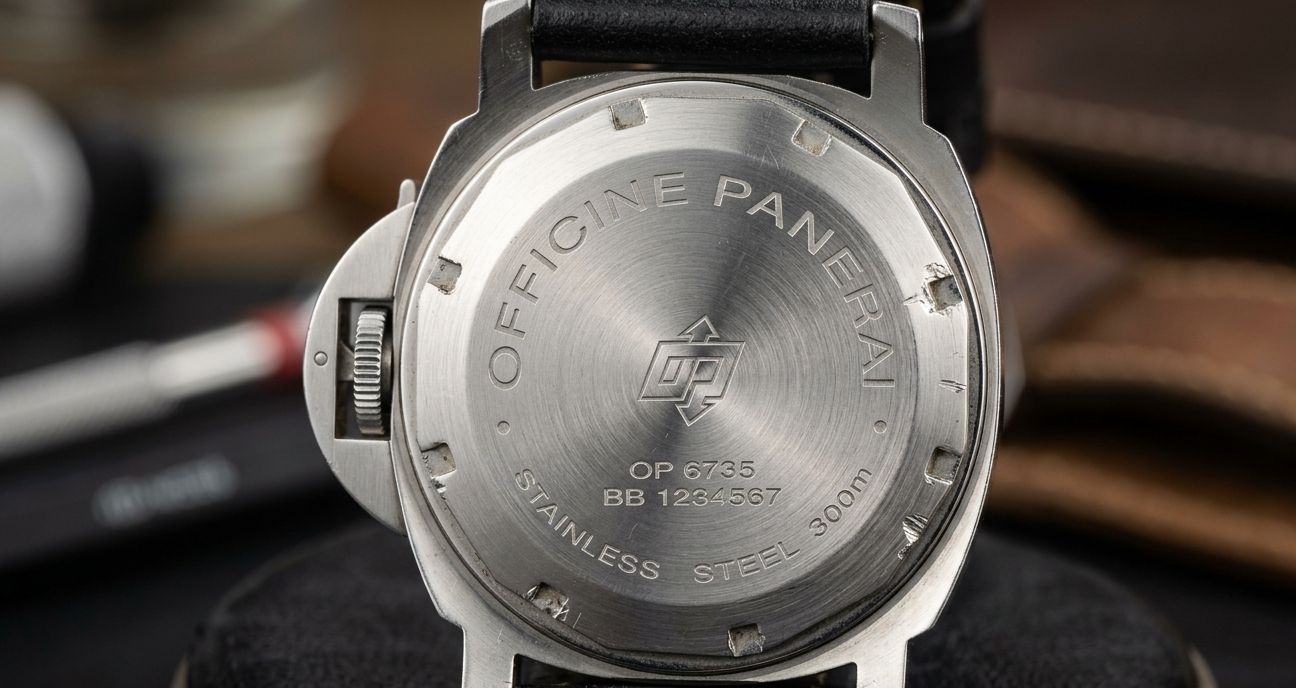
- Preserving Water Resistance: Panerai watches are known for their robustness and water resistance. A good modder understands that crystal swaps, crown guard work, or caseback removal can compromise this. They will use appropriate gaskets, apply sealants correctly, and ideally, perform pressure testing to ensure the watch remains water-resistant after modification. Many top-tier replicas from VSF are rated for 50-100m, and a modder should aim to maintain or even improve upon this.
- Using Appropriate Tools and Techniques: Professional modders invest in specialized tools—like precise caseback openers, crystal presses, movement holders, and timegraphers—to perform work cleanly and accurately, minimizing the risk of scratches, dust intrusion, or damage to delicate components.
The best modders approach each replica not as a cheap imitation, but as a project with potential, respecting the engineering and design of both the genuine and replica components they are working with. Their expertise lies in knowing where to push and where to exercise caution.
Expert Authentication Insight
When assessing a modded replica, a quick visual scan can reveal a lot about the quality of the work. Look for tell-tale signs of amateur handling: misaligned components (e.g., dial slightly off-center, hands not perfectly parallel), dust or lint trapped under the crystal (a common indicator of an unclean workspace), or visible tool marks on the caseback notches, lugs, or crown guard. These small details often betray a lack of proper tooling, an unclean environment, or hurried work, signaling potential issues with water resistance or long-term reliability.
Aesthetic Transformations: Crystal, Case, Dial, and Hand Upgrades
For many Panerai enthusiasts, the initial foray into modding often begins with aesthetic improvements. These are the modifications that most directly impact the watch’s visual fidelity, making it harder to distinguish from a genuine piece at a glance. However, even seemingly straightforward visual mods carry technical nuances and potential pitfalls that buyers should understand.
Crystal Swaps: Sapphire Clarity, AR Coatings, and Gasket Sealing
The crystal is the window to the watch, and its quality significantly impacts the overall appearance. Stock replica crystals, even those made of sapphire, often fall short of genuine Panerai specifications. A common and impactful mod is a crystal swap, often replacing the stock crystal with a higher-quality, genuine-spec sapphire.
- Clarity and Domed Profile: Genuine Panerai crystals often have a subtle domed profile and superior optical clarity that enhances dial legibility. Aftermarket sapphire crystals can replicate this, offering a significant visual upgrade over flatter or less clear stock alternatives.
- Anti-Reflective (AR) Coatings: Genuine Panerai typically uses an anti-reflective coating on the interior surface of the crystal only. This provides glare reduction without making the crystal prone to scratches on the exterior. Many replica crystals, especially older or budget versions, might have AR on both sides (which can scratch easily) or an incorrect tint. A proper crystal swap ensures the correct interior-only AR coating, often with a subtle blue tint when viewed at an angle, mimicking the genuine effect.
- Gasket Sealing and Water Resistance: This is a critical, often overlooked aspect. A crystal swap requires careful removal and proper seating of the new crystal, along with a fresh, correctly sized gasket. Improper seating or a damaged gasket will severely compromise water resistance. A skilled modder will always pressure test the watch after a crystal swap to ensure its integrity, typically to 50-100 meters, which is a sensible limit for most modded replicas.
The cost for a high-quality aftermarket sapphire crystal (often sourced from specialists) and professional installation, including pressure testing, can range from $150-$300, depending on the crystal type and modder’s rates. This is a worthwhile investment for visual authenticity and peace of mind.
Crown Guard Reshaping and Lever Pin Modifications
The distinctive crown guard (CG) is a signature Panerai feature, and its precise execution is a major “tell” for replicas. Many stock replicas, even VSF, can have minor imperfections: slightly less sharp angles, a less refined curve, or a lever pin that doesn’t sit perfectly flush or operate with the crispness of a genuine.
- Reshaping Process: This intricate mod involves carefully filing and polishing the replica’s crown guard to achieve gen-like contours and sharpness. It requires a steady hand, specialized tools, and a deep understanding of genuine Panerai aesthetics. The goal is to correct any asymmetries or overly rounded edges, giving the CG a more authoritative presence.
- Lever Pin Nuances: The lever pin, which secures the crown, can also be modified or replaced. This might involve adjusting its length, refining its pivot point, or ensuring it locks with a satisfying click. Some modders will even swap in custom-made pins for a tighter, more authentic feel.
- Risks and Precision Tooling: This is a high-risk modification if not executed perfectly. Damage to the case material, uneven reshaping, or misalignment of the lever mechanism can permanently mar the watch. Precision tooling, such as miniature files, polishing wheels, and specialized jigs, are essential to achieve a clean, gen-like finish without damaging the surrounding case. Expect to pay $100-$250 for expert CG reshaping.
Dial Reluming and Handset Replacement: Lume Quality and Alignment
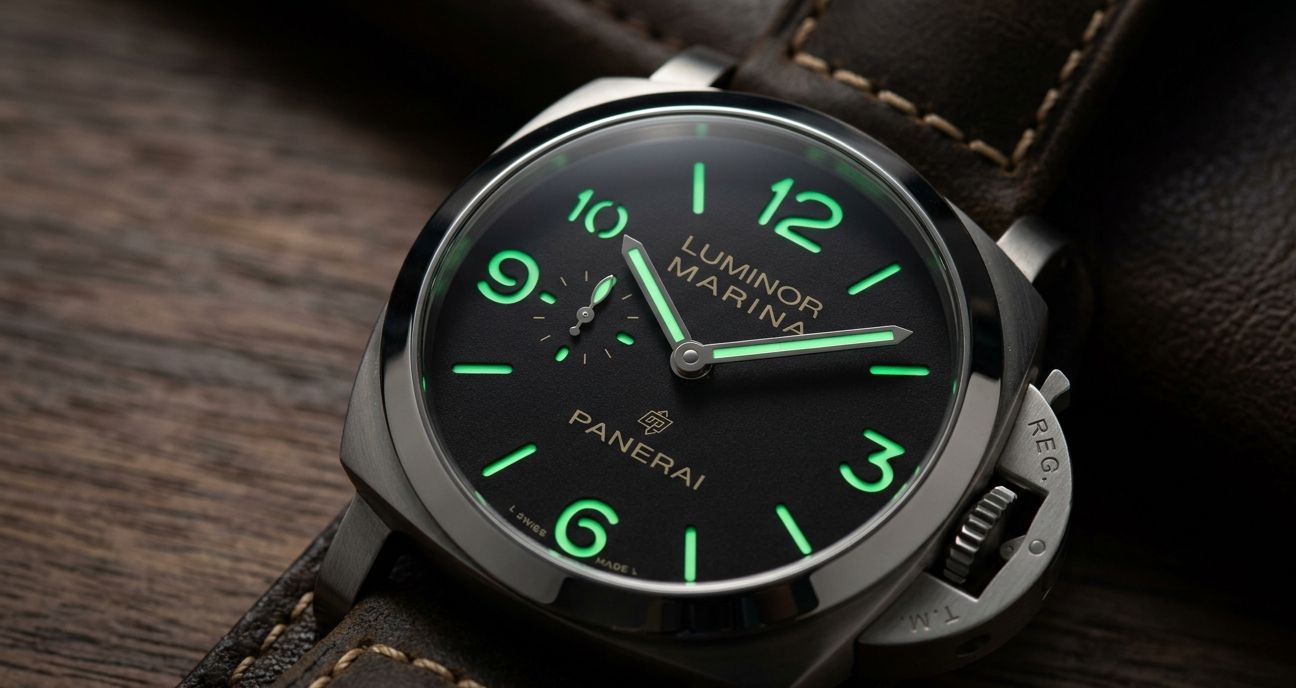
Lume quality is a significant differentiator between genuine and replica Panerais. Genuine Panerai often uses Super-LumiNova with a distinct color (cream for vintage, bright white for modern) and a long-lasting, even glow. Replica lume, even from top factories like XF (known for good dials), can sometimes be weaker, uneven, or of the wrong color.
- Superior Lume Application: Dial reluming involves carefully removing the existing lume and applying high-grade Super-LumiNova (e.g., BGW9 for blue-white glow or C3 for green glow, matched to gen specifications). This ensures a brighter, more consistent, and longer-lasting glow, often exceeding the 6-8 hours of many stock replicas and closer to the 8-10 hours of genuine pieces. The technique requires precision to avoid bleeding outside the markers and to achieve an even thickness.
- Handset Replacement and Alignment: Replica hands can sometimes have slightly incorrect shapes, finishes, or lume application. Swapping them for more accurate aftermarket hands or reluming the existing ones is a common upgrade. The challenge lies in achieving perfect handset alignment, ensuring all hands are parallel and correctly positioned relative to each other and the dial. This is a delicate operation, as improper handling can scratch the dial or bend the hand post.
A comprehensive dial and handset relume, including sourcing quality lume, can cost between $180-$350, depending on the complexity of the dial and the number of hands. This mod dramatically improves the watch’s night-time legibility and aesthetic authenticity.
Strap, Buckle, and Tube Upgrades: Enhancing Wearability and Security
While often overlooked, the strap and its components play a huge role in the overall feel and security of a Panerai. Many stock replica straps, while visually similar, lack the quality, comfort, and durability of genuine or high-end aftermarket options.
- High-Quality Aftermarket Straps: Upgrading to a genuine leather, custom rubber, or even canvas strap significantly enhances comfort and wrist presence. These straps often use superior materials and construction methods, providing a more luxurious feel and better durability than standard replica offerings.
- Gen-Spec Buckles: Replica buckles can sometimes have less precise engraving, a coarser finish, or a less robust feel. Swapping to a gen-spec buckle, or even a genuine buckle if budget allows, completes the look and improves security.
- Spring Bars and Lug Tubes: Panerai’s lug system, often featuring screw-in bars or robust spring bars, is crucial for strap security. Replicas can sometimes have thinner spring bars or poorly fitted lug tubes, leading to potential strap detachment or unsightly gaps. Upgrading to stronger spring bars or precisely machined lug tubes (which screw into the case to hold the strap) enhances both durability and the flush fit of the strap to the case, addressing the 0.5-1mm gaps sometimes seen on replicas.
A quality aftermarket strap can range from $50-$200, while gen-spec buckles or lug tube upgrades might add another $30-$100. This is an accessible and highly effective way to improve the daily wearability and perceived quality of a modded Panerai.
Expert Authentication Insight
When evaluating aesthetic mods, pay close attention to the details. For a crystal, check its edges for proper, flush seating against the bezel; any gaps or unevenness suggest poor installation. Examine the crown guard’s contours under magnification for symmetry and crispness, ensuring no tool marks or uneven polishing. These points are crucial for a thorough Panerai replica buying guide. Activate the dial’s lume with a UV light and inspect for evenness of application, correct color, and consistent glow across all markers and hands. Finally, check the strap attachment points: the strap should fit snugly against the lugs with minimal or no gap, and the spring bars or tubes should feel secure, without any play.
Movement Mastery: VS/XF Compatibility and Performance Optimizations
Beyond external aesthetics, the true heart of any watch lies in its movement. For Panerai replicas, particularly those from VSF and XF, the clone movements have reached remarkable levels of accuracy and visual fidelity. However, there’s always room for optimization, and in some cases, a full movement swap can elevate a replica to an entirely new echelon of performance. This section delves into the intricacies of Panerai replica movements and the potential for modification.
VSF and XF Base Movements: Understanding Their Strengths and Limitations
The Panerai replica market is largely defined by the quality of its clone movements, primarily from VSF and XF. Understanding their characteristics is the first step in any movement-related modification:
- VS Factory (VSF) P.9000/P.9010 Clones: VSF is renowned for its groundbreaking P.9000/P.9010 clone movements, which are true reverse-engineered copies of Panerai’s in-house automatic calibers. These movements offer:
- Gen-like Appearance: Near-identical aesthetic through the display caseback, including bridge layout and rotor design.
- Reliable Performance: Boasting a 70-72 hour power reserve (matching genuine’s 72 hours), bidirectional winding, and a correct 28,800 vph frequency.
- Functional Accuracy: The P.9010 clone features a true “traveler” GMT function with an independently jumping hour hand, a significant achievement.
- High Part Compatibility: Approximately 85% parts compatibility with genuine Panerai movements, making service and repair more feasible for skilled watchmakers.
Known limitations for VSF P.9000 clones sometimes include a slightly bold date wheel font or minor finishing differences under extreme magnification.
- XF Factory (XF) P.3000 Clones & Decorated Movements: XF, while known for its dials, also produces excellent movements, particularly the P.3000 manual-wind clone. They also use decorated versions of other movements:
- P.3000 Manual-Wind: Used in Radiomir and classic Luminor models, this clone achieves a respectable 65-68 hour power reserve with correct small-seconds positioning.
- Decorated ETA/Valjoux Clones: For some models, XF (and other factories like ZF) may use decorated Asian 7750 or 6497 clones to mimic the look of Panerai calibers. These are often reliable but might not offer the same gen-like architecture as VSF’s true clones.
A common community sentiment is: “XF’s dials are still the best in the industry. If you care about dial accuracy, XF wins. If you care about movement, VS wins.” This highlights the different starting points for modding.
For most buyers, a VSF P.9000 clone provides an exceptional base that needs minimal internal modification beyond regulation. However, understanding the nuances allows for targeted upgrades.
Precision Regulation and Lubrication: Achieving Chronometric Performance
Even the best clone movements can benefit from professional regulation and lubrication. While a stock VSF P.9000 might run within +5 seconds/day, a skilled watchmaker can often achieve even tighter tolerances, moving into chronometer-level performance.
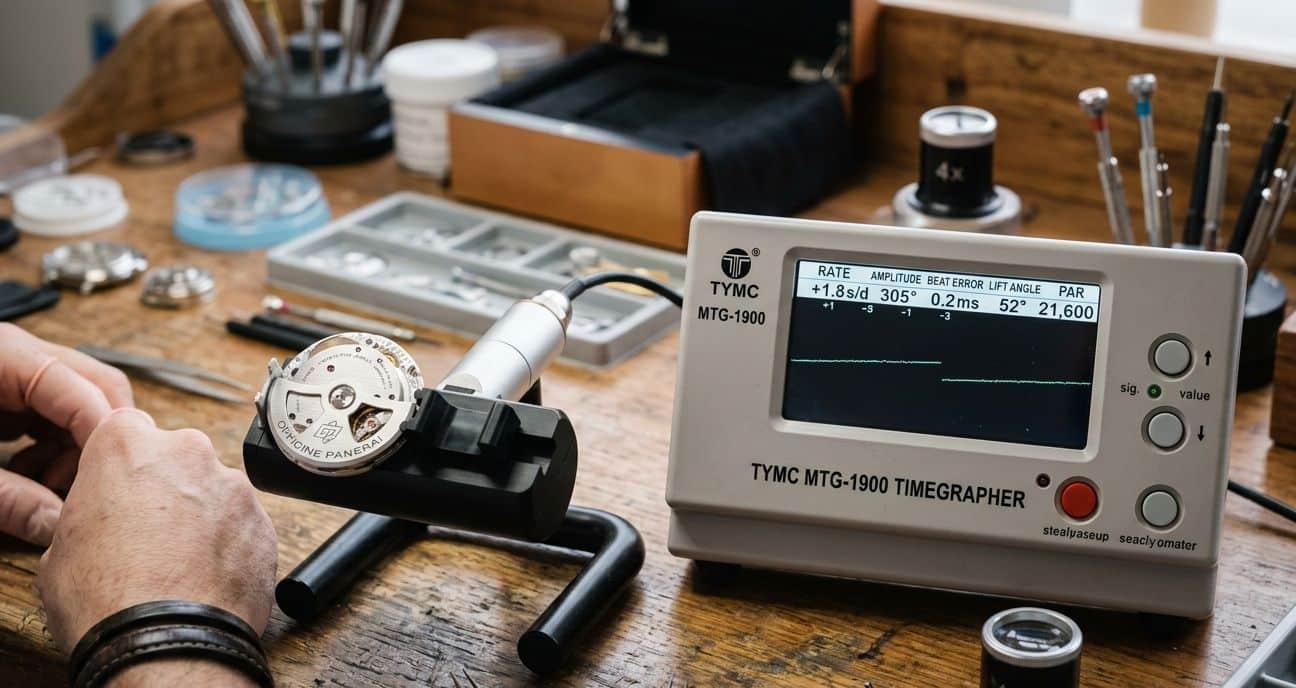
- Timing Machine Regulation: A watchmaker uses a timegrapher to measure the movement’s rate, amplitude, and beat error in multiple positions (e.g., dial up, dial down, crown up). By making micro-adjustments to the balance wheel, they can regulate the watch to run within a tighter range, often aiming for +/- 2-5 seconds per day. This significantly improves timekeeping accuracy.
- Proper Lubrication (Oiling): Movements require precise lubrication of critical friction points (e.g., escapement, balance staff pivots, barrel arbors). Over time, or with factory assembly that might use suboptimal lubricants, these can dry out or become contaminated. A full service involves disassembling, cleaning, and re-oiling the movement with high-quality synthetic lubricants. This reduces friction, extends the movement’s lifespan, and can improve amplitude and power reserve.
A professional movement service, including regulation and lubrication, for a clone Panerai movement typically costs $165-$275 (a 10% markup from the reference’s $150-$250), a worthwhile investment for long-term reliability and accuracy.
Movement Swaps: Compatibility Challenges and Donor Movement Sourcing
For some enthusiasts, the ultimate movement upgrade is a full swap, replacing the replica movement with a genuine (e.g., ETA 6497, Valjoux 7750) or a higher-grade, often Swiss-made, clone. This is a complex and costly endeavor, fraught with compatibility challenges:
- Dial/Hand Fitment: Different movements have different post sizes for hands and different date window positions. A movement swap might require custom hands or even a new dial to ensure proper fit and alignment.
- Stem Height Adjustments: The stem that connects the crown to the movement must align perfectly. Differences in movement height or crown tube position can necessitate custom stem cutting or even modifications to the case or crown tube.
- Case Modifications: While less common with Panerai due to its larger case sizes, some movements might require case modifications (e.g., movement ring, caseback clearance) to fit correctly.
- Donor Movement Sourcing: Sourcing genuine ETA 6497 or Valjoux 7750 movements can be challenging and expensive, often costing $400-$700 (a 10% markup from $400-$700 in the reference) for a used but functional unit.
The community strongly advises caution with budget GMT Panerais that use fragile modified ETA movements. As the reference states, these are often “timebombs.” A full movement swap is typically reserved for those seeking the highest possible mechanical authenticity and are prepared for significant costs and potential complications.
Rotor and Bridge Modifications: Aesthetic Embellishments and Functional Risks
For replicas with display casebacks, the movement’s appearance is part of the overall illusion. Modders often seek to enhance this through rotor and bridge modifications:
- Custom Rotor Engravings: Replica rotors, even on VSF clones, might lack the precise engravings or branding of a genuine Panerai. Modders can apply custom engravings or even replace the rotor with a more accurate aftermarket version to match the genuine aesthetic.
- Bridge Decorations: Genuine Panerai movements often feature perlage (circular graining) or Geneva stripes on their bridges. While clone movements have improved, their finishing is rarely as refined. Modders can attempt to apply similar decorative patterns, though this is a highly specialized skill.
- Functional Risks: These aesthetic modifications are not without risk. Any alteration to the rotor can affect its balance, leading to inefficient winding or excessive wobble. Modifications to bridges must be done carefully to ensure clearances for moving parts are maintained and no debris enters the movement. For example, the P.4000 clone micro-rotor’s less refined finishing is a target for modders, but care must be taken not to impair its winding efficiency.
These mods are generally for enthusiasts who prioritize visual authenticity through the caseback and are willing to accept the associated costs and potential mechanical risks. Prices vary widely based on the complexity and the modder’s expertise, from $50 for a simple rotor swap to several hundred for intricate bridge decoration.
Expert Authentication Insight
To truly assess a modded movement, a timegrapher is indispensable. Measure the amplitude (typically 280-310° for a healthy movement), beat error (ideally under 0.5ms), and rate (seconds per day) in multiple positions. This reveals the movement’s health and the effectiveness of any regulation. Visually, inspect the movement’s finishing through the display caseback (if present) for consistency, cleanliness, and the presence of proper lubrication (a tiny, clear drop on pivots, not excessive pooling). Gently test for rotor play; excessive lateral movement can indicate a worn bearing or improper installation. If a movement swap was performed, verify the dial and hand alignment are perfect, and the date change functions correctly.
The “Franken-Watch” Frontier: When Custom Builds Cross the Line
The pursuit of perfection in Panerai replica modding often walks a fine line between enhancement and compromise. While strategic upgrades can elevate a watch significantly, there’s a point where modifications become detrimental, creating what collectors term a “franken-watch.” This section explores that threshold, identifying when custom builds undermine reliability and authenticity rather than improving them.
Defining “Franken”: Beyond Simple Part Swaps
The term “franken-watch” conjures images of incompatible parts haphazardly forced together, and in the replica world, it’s a fitting descriptor for builds that prioritize an illusion of authenticity over functional integrity. A well-executed mod integrates components seamlessly, often improving upon factory flaws. A franken-build, however, combines disparate elements—perhaps a VSF case, an XF dial, aftermarket hands, and a generic ETA movement—without the necessary adjustments or understanding of inter-component compatibility. The result is a watch that might look “close enough” at a glance but suffers from compromised functionality, poor sealing, or premature failure due to incorrect dimensions, misaligned parts, or incompatible movement architecture.
Reliability Compromises: Water Resistance, Power Reserve, and Durability
Improper modifications introduce critical vulnerabilities that can severely degrade a watch’s performance and longevity. These aren’t just cosmetic issues; they impact the fundamental purpose of a timepiece:
- Water Resistance: A common casualty of amateur modding. Incorrect gasket seating (e.g., crystal, caseback, crown tube), overtightened screws, or even microscopic tool marks on sealing surfaces can breach the watch’s water barrier. While a genuine Panerai Luminor Marina is rated to 300m, a poorly modded replica might struggle to withstand a hand wash, leading to moisture ingress and movement damage.
- Power Reserve: A movement that experiences excessive friction due to misalignment or poorly fitted components will struggle to maintain its power reserve. This can be caused by a dial rubbing against the hands, hands rubbing against each other, or a movement that isn’t properly secured and lubricated. The VS P.9000 clone, for instance, should deliver 70-72 hours, but a franken-build might see that drop to 40-50 hours, indicating internal drag.
- Durability: Forced fitment, stripped screw threads, or compromised case integrity from aggressive reshaping can lead to premature mechanical failure. Many budget GMT Panerais, for example, used fragile GMT modules that were prone to breaking, turning an “upgrade” into a time bomb.
The goal of modding should be to enhance, not to introduce new points of failure.
The Diminishing Returns of Over-Modding
Every modification comes with a cost: financial, time, and the inherent risk of damage during the process. There’s a point where the cost and effort involved in further modifications yield minimal, if any, discernible improvements in realism or performance. For instance, chasing a microscopic difference in dial font that requires a custom print run might cost hundreds of dollars while introducing the risk of damaging the existing dial or receiving a sub-par replacement. To make informed decisions and avoid common pitfalls, a detailed buying guide is essential. Beyond a certain level of accuracy, often achieved with a few key upgrades (crystal, relume, movement regulation), additional mods can introduce more problems than they solve. The watch becomes less reliable due to repeated opening, component swaps, and the cumulative risk of human error, transforming a functional timepiece into an unreliable showpiece.
Expert Authentication Insight
Physical diagnostic: When assessing a potentially franken-built Panerai, an expert looks for inconsistencies. This includes mismatched part finishes (e.g., a highly refined genuine crown on a rough replica case), visible gaps between components (crystal-to-case, caseback-to-case), and clear signs of forced fitment such as scratches, bent parts, or stripped screw heads. A comprehensive inspection includes a pressure test to verify water resistance integrity, as compromised sealing is a hallmark of a poorly assembled franken-watch. The goal is to see if the sum of the parts creates a cohesive, functional whole, or a fragile assembly of disparate elements.
Beyond the technical aspects of modding, buyers must understand the crucial non-technical “red lines” that govern the replica watch scene. These involve significant legal, ethical, and resale implications that, if ignored, can lead to severe consequences.
Misrepresentation Risk: The Peril of Selling as “Genuine”
The most critical “red line” in the replica watch world is attempting to sell a modded replica as a genuine timepiece. This is not just unethical; it carries severe legal ramifications. In the U.S., federal law (18 U.S.C. § 2320) prohibits trafficking in counterfeit goods, with penalties including up to 10 years imprisonment and $2 million in fines. Even if a modded replica incorporates genuine Panerai parts—a genuine crown, a genuine movement, a genuine dial—it remains, at its core, a counterfeit watch if the case or other primary components are replica. The act of misrepresenting it as authentic constitutes fraud and trademark infringement, exposing the seller to criminal charges and civil lawsuits from the brand owner (Richemont, in Panerai’s case). The intent to deceive is the key factor, and adding genuine parts to a replica does not magically transform it into an authentic watch.
Resale Disclosures: Transparency in the Secondary Market
If you plan to sell a modded replica, transparency is not just good practice—it’s essential to avoid legal and ethical pitfalls. Full disclosure means clearly outlining every aspect of the watch’s modified status. This includes:
- Original Factory: State the base replica factory (e.g., “VSF base PAM005”).
- Modified Components: List every part that has been changed, specifying its origin (replica, aftermarket, or genuine). For example: “Aftermarket double-domed sapphire crystal, relumed XF factory dial, genuine ETA 6497 movement swap.”
- Build History: Provide details about who performed the modifications, when, and what work was done.
- Unequivocal Statement: Clearly state that the watch is a replica and is not* a genuine Panerai timepiece.
Failing to disclose these details, even if unintentional, can be interpreted as misrepresentation and lead to disputes, chargebacks, and reputational damage.
Platform Policies and Community Standards
The sale and discussion of replica watches are heavily regulated by various platforms. Mainstream online marketplaces like eBay, Chrono24, and even general watch sales forums such as Reddit’s r/Watchexchange strictly prohibit the sale of counterfeit goods. Attempting to list a modded replica, even with full disclosure, will likely result in the listing being removed and your account being suspended or banned. Specialized replica watch forums (e.g., RWI, RepTime) do allow discussion and sale of replicas, but they enforce stringent rules regarding clear labeling, accurate descriptions, and explicit disclosure of a watch’s replica status. Misrepresenting a watch’s factory origin or the extent of its modifications within these communities can lead to immediate and permanent bans.
Understanding “Gray Market” Liabilities
Operating within the “gray market” of replica watches means abandoning the consumer protections typically afforded to buyers in legitimate transactions. There is no official warranty, no regulatory body to appeal to, and no legal recourse for defects, misrepresentation, or outright fraud. The principle of “buyer beware” is paramount. If you purchase a modded replica that turns out to be faulty or misrepresented, your options for resolution are limited to the goodwill of the seller or modder. Furthermore, while purchasing a replica for personal use is not a federal crime in the U.S., importing one is unlawful. U.S. Customs and Border Protection can seize goods regardless of intent, meaning your investment can be lost at the border with no compensation.
Expert Authentication Insight
Physical diagnostic: Verifying disclosures on a modded replica requires meticulous cross-referencing. An expert would demand all available documentation: original purchase receipts, communication logs with the modder, and detailed “before and after” photographs of the work. This information is then cross-referenced against the physical watch itself. Are the described components present? Does the condition match the timeline? Are there any discrepancies between the seller’s claims and the physical evidence? A reputable seller will provide this information proactively; any hesitation should be a significant red flag.
Choosing Your Modder: Expertise, Tooling, and Track Record
The success of any Panerai replica modification hinges almost entirely on the skill and integrity of your chosen modder. This is not a task for an amateur. Selecting the right professional requires due diligence beyond forum hype, focusing on tangible evidence of capability and accountability.
Assessing Modder Capability: Beyond Forum Hype
A modder’s true expertise goes far beyond a forum username or a few nice pictures. When evaluating potential candidates, focus on their specific experience with Panerai replicas. Do they understand the nuances of VS Factory’s P.9000 clone versus XF’s P.3000? Can they articulate the challenges of a crystal swap on a Luminor Due versus a Submersible? A skilled modder should be able to explain complex technical processes, including potential risks and trade-offs, in a clear and understandable manner. They should demonstrate a deep understanding of different factory movements, their common flaws, and the most effective ways to address them. Ask specific questions about their approach to water resistance, movement regulation, and component sourcing—their answers will reveal their depth of knowledge.
Essential Tooling and Workshop Standards
Professional modding requires professional tools and a controlled environment. A reputable modder will operate in a clean, dust-free workspace, ideally with specialized lighting and magnification. Key equipment includes:
- Timegrapher: Essential for accurate movement regulation, measuring beat rate, amplitude, and beat error in multiple positions.
- Pressure Tester: Crucial for verifying water resistance after any case opening or crystal swap. Without this, water ingress remains a significant risk.
- Precision Instruments: Specialized case opening tools, movement holders, staking sets, and high-quality tweezers are vital to avoid damaging delicate components.
- Part Sourcing: A good modder has established relationships with reliable suppliers for quality aftermarket crystals, gaskets, lume, and potentially genuine parts.
The presence of such tools and a commitment to workshop cleanliness indicate a modder’s dedication to quality and attention to detail, minimizing the risk of accidental damage or contamination.
Documented Results and Client Testimonials
Before committing to a modder, thoroughly review their portfolio. Look for high-resolution “before and after” photographs of their past work, paying close attention to detail shots of crown guards, dial lume, crystal seating, and movement finishing. Are they transparent about the entire process, perhaps offering detailed build logs or progress photos? Beyond their own portfolio, seek out independent client testimonials and reviews on specialized watch forums. Look for consistent positive feedback regarding their quality of work, communication, and adherence to timelines. Be wary of modders with limited portfolios or overly generic testimonials.
Communication, Warranty, and Accountability
Clear communication is the bedrock of a successful modding experience. Your modder should be responsive, provide detailed explanations, and set realistic expectations regarding project scope, timelines, and costs. Request a clear, itemized quote upfront, and clarify whether any potential unforeseen issues will incur additional charges. Crucially, discuss their warranty policy: what is covered, for how long, and what actions might void it (e.g., opening the watch yourself, exposing it to water beyond its tested resistance). A reputable modder will stand behind their work and offer a reasonable period of accountability for any issues arising from their modifications.
Expert Authentication Insight
Physical diagnostic: To “authenticate” a modder, scrutinize their online presence and community reputation. Cross-reference their stated capabilities with concrete examples of their work and the experiences of others. Do their before/after photos genuinely reflect improvements, or merely different angles? Are they willing to engage in detailed technical discussions? A modder who is transparent, confident in their abilities, and willing to provide detailed build logs and answer specific questions about their process is generally a safer bet than one who relies on vague claims or avoids direct interaction.
The journey into modded Panerai replicas can be incredibly rewarding, offering a path to a highly personalized and realistic timepiece. However, it’s a path fraught with technical challenges, ethical dilemmas, and significant financial risks. Before embarking on a custom build, ask yourself these critical questions:
- What is my primary motivation? Am I seeking ultimate realism, improved reliability, or simply a unique expression of personal taste? Understand that these goals can sometimes conflict.
- What is my budget, and what is my risk tolerance? Are you prepared for potential unforeseen costs, delays, or even irreparable damage to your watch?
- What are my expectations for resale? Am I comfortable with full and transparent disclosure that this is a modded replica, and do I understand the limitations on its resale value and platform eligibility?
- Have I thoroughly vetted my chosen modder? Is their expertise proven, their tooling adequate, and their communication transparent? Do they offer a clear warranty on their work?
The replica modding scene is, by its nature, a “buyer beware” environment. While the pursuit of Panerai perfection can lead to stunning results, it demands informed decisions, ethical considerations, and a realistic understanding of what’s truly achievable. Choose wisely, disclose fully, and proceed with clear eyes.