
Introduction: The Setup Defines the Santos
You’ve decided on a Cartier Santos replica. You’ve picked your size and dial color, but before finalizing your purchase, a Santos Dumont vs. Santos replica comparison is essential for understanding movement details and case finishing standards. You’re ready. But there’s one final, seemingly simple choice that will fundamentally alter the watch you own: bracelet or leather strap?
This isn’t a question of aesthetics. It’s a question of identity. The wrong choice doesn’t just look off—it feels wrong. It turns a confident statement into an awkward compromise. Many buyers, drawn to the Santos’s iconic design, find themselves disappointed after purchase, sensing a disconnect they can’t quite place. Often, the issue isn’t the watch. It’s the setup.
Choosing the bracelet isn’t just choosing metal; it’s choosing the watch’s original, integrated architectural intent. Choosing the strap isn’t just choosing leather; it’s choosing to reconfigure the Santos into a more classic, two-piece format, with all the trade-offs that entails. This decision dictates weight, balance, silhouette, and even how the watch communicates on your wrist.
Forget which one looks better in a seller’s photo. We’re dissecting which one wears better, functions better, and ultimately, which one delivers the experience you’re actually buying.
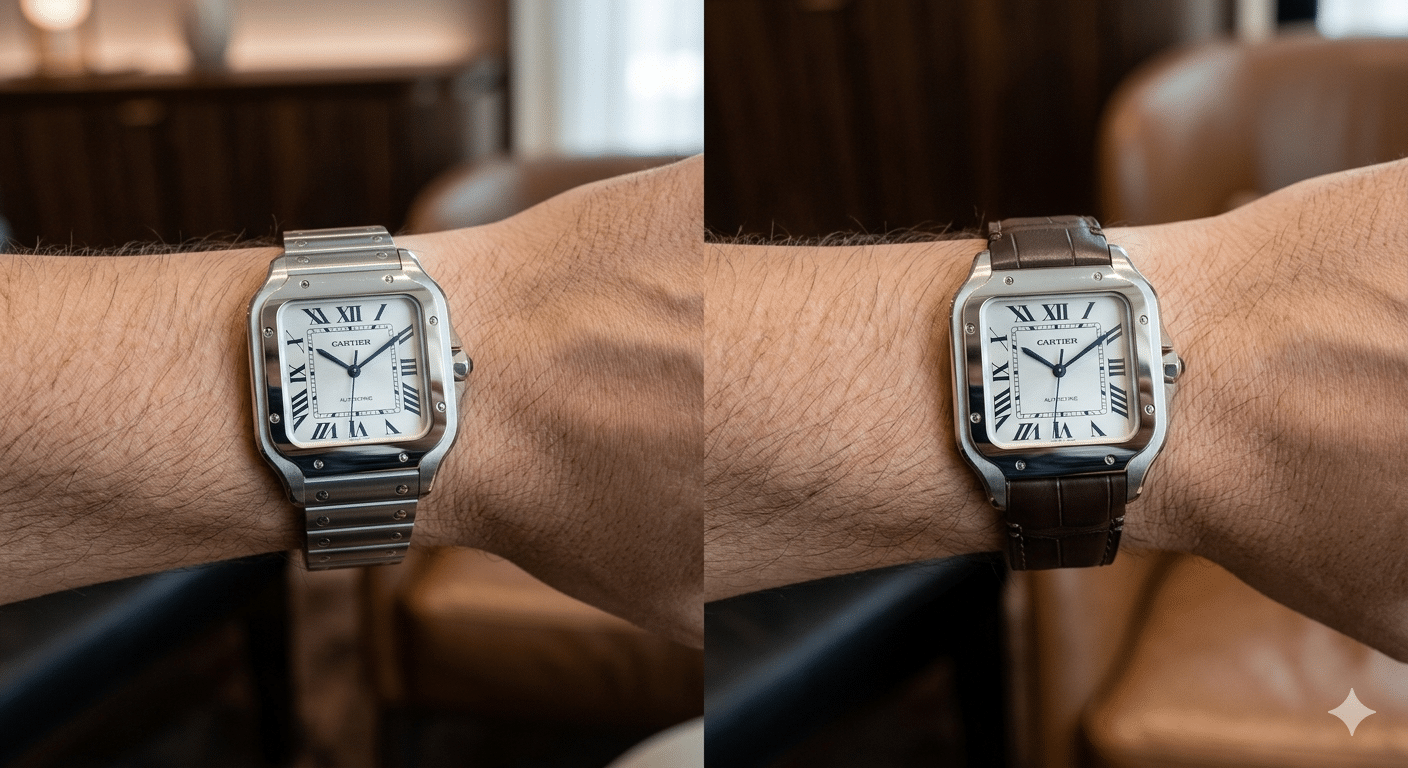
The Architectural Core: Why the Santos Bracelet Isn’t an Accessory
To understand the Santos, you must understand its bracelet. This isn’t an add-on; it’s the foundation. The 1978 redesign that birthed the modern Santos wasn’t just a new case—it was the invention of an integrated bracelet that flowed directly from the bezel’s screws. The bracelet is the completion of the thought. On a replica, getting this right—or getting it wrong—is everything.
When you choose the bracelet, you are choosing the watch as a single, cohesive unit. The sensation is of a solid, intentional object that lands on your wrist with a unified heft. The weight is distributed evenly along the entire circumference, creating a low, secure center of gravity. It feels anchored, not perched.
The “Integrated” Illusion and Replica Reality
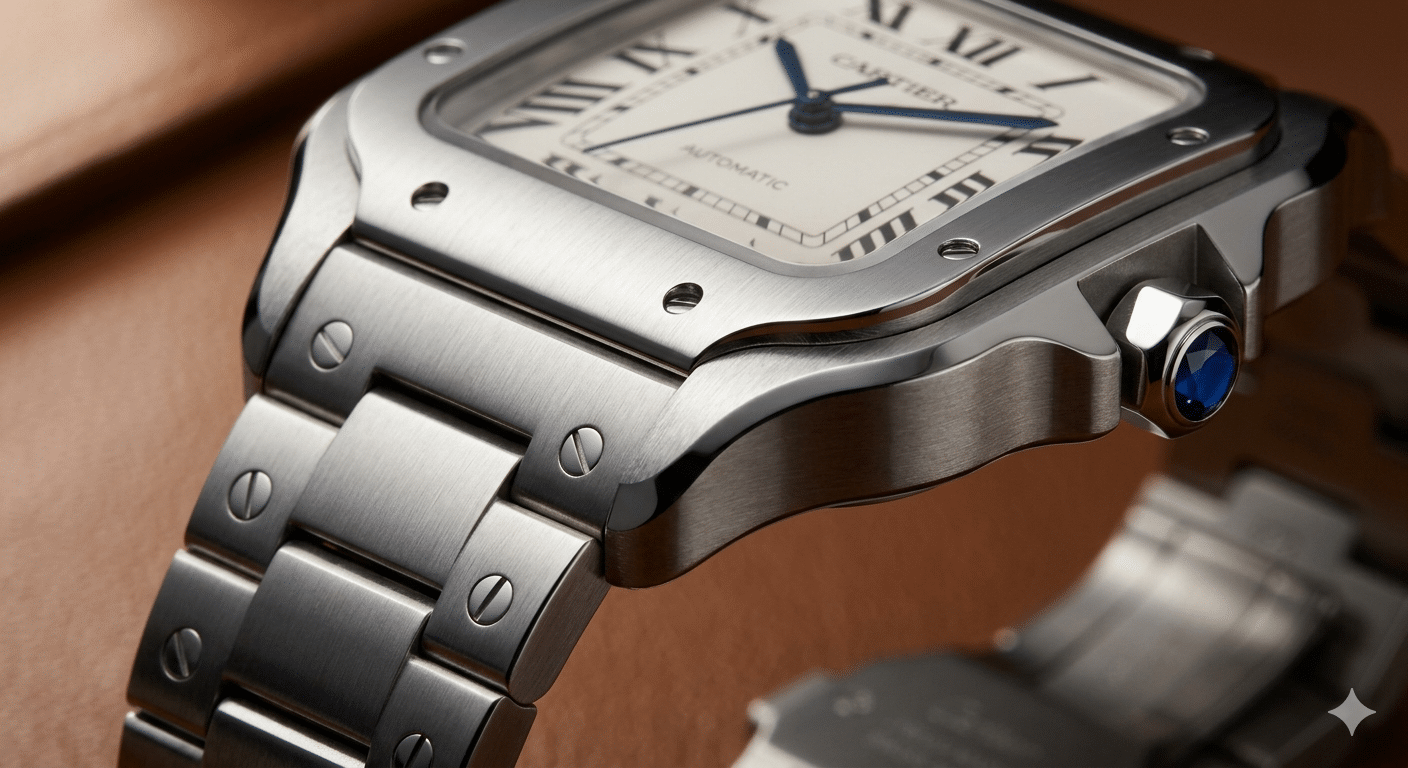
The magic—and the primary point of failure for replicas—lies in the first link. On a genuine Santos and the best replicas (from factories like GF or 3KF), the first link is not just attached; it’s sculpted to continue the line of the case, creating a seamless, fluid descent onto the wrist. The transition is visually uninterrupted.
Cheaper replicas fail here catastrophically. The end link is often a separate, poorly machined piece that sits at a sharp angle to the case, creating a visible “step” or gap. This breaks the architectural illusion instantly. Instead of a single flowing form, you get a case clumsily glued to a bracelet. It’s the difference between a cantilevered bridge and a plank laid across two rocks. For the Santos, the bracelet’s integration is not a detail—it’s the entire premise.
Weight Distribution: Feeling the Mass
A proper Santos bracelet doesn’t just look integrated; it wears integrated. The weight, typically between 130-150 grams for a full bracelet setup, is carried along the entire underside of your wrist. This creates a balanced, substantial feel that is surprisingly comfortable for its heft. It’s a confident presence.
Contrast this with a strap setup. The weight—now concentrated almost entirely in the watch head—pulls from the lugs. On a smaller wrist, this can create a subtle but constant “top-heavy” sensation, where the watch wants to rotate around your wrist. The bracelet eliminates this pivot point, locking the mass in place.
Expert Authentication Insight
The most telling physical test of a high-quality Santos replica bracelet isn’t just visual; it’s tactile. Grasp the watch head and gently flex the bracelet sideways. A genuine or top-tier replica bracelet will have a specific, fluid lateral flex. The links articulate smoothly, draping in a controlled curve without pinching or kinking. The sound is a muted, solid shush* of metal on metal.
A cheap replica bracelet feels stiff and blocky. It resists lateral movement, won’t form a smooth curve, and produces a tinny, hollow rattle. This test reveals the quality of the link engineering, the pins, and the finishing—all the things that separate a structural component from a decorative chain.
The Leather Strap: A Transformation, Not Just a Change
Putting a Santos on a leather strap is not a simple swap. It is a fundamental re-contextualization. You are deliberately dismantling the watch’s core architectural statement in favor of something more traditional, more adaptable, and arguably, more conventional. The sharp, industrial statement of the bracelet softens. The watch becomes less of a “wrist object” and more of a “case on a band.” This isn’t inherently bad—it’s just a completely different proposition.
The strap acts as a conversion kit, shifting the visual and physical weight upward. Suddenly, all attention is on the square case, the bezel, and the Roman numerals. The watch appears thinner, lighter, and more isolated on the wrist. But you must ask: does this increase versatility, or does it simply dilute the Santos’s most distinctive feature?
From Monobloc to Two-Piece: The Silhouette Shift
The most immediate change is visual. The continuous metal line from lug to clasp is severed. The Santos case transforms from the anchor of an integrated structure into a distinct “pod” sitting atop the strap. This breaks the horizontal flow, often making the watch wear smaller and visually lighter. For those with slender wrists (sub-6.5 inches), this can be a blessing, as it avoids the potential overwhelm of a full metal bracelet’s presence.
However, it also introduces a pivot point—the spring bars—that the original design philosophy sought to eliminate, a trade-off that becomes clearer in a detailed Cartier Santos replica guide focused on real-world functionality. The watch is no longer a rigid, unitary form. It gains articulation, which can feel more natural for some, but it loses that signature, solid-as-a-ingot wrist feel.
The Strap Quality Multiplier Effect
On a bracelet, a replica’s flaws can be partially masked by the complexity and shine of the metalwork. On a strap, there is nowhere to hide. The strap acts as a stark frame, putting the case finishing under a microscope.
A poorly finished case—with soft edges, uneven polishing, or misaligned bezel screws—becomes glaringly obvious on a strap. Conversely, a replica with exceptional case finishing (crisp bevels, perfect polish, sharp screw slots) truly shines. The strap configuration ruthlessly amplifies the quality—or lack thereof—of the case itself. Your choice of strap setup directly impacts how critical you need to be about the factory’s case work.
Expert Authentication Insight
Authentic Cartier Santos leather straps are not flat strips of leather. They are engineered with a specific, tapered curvature that precisely matches the profile of the case where they meet. This creates a seamless, gapless transition that looks built-in, not added on.
On a replica, this is a critical fail point. Inspect the gap between the strap end and the case. A low-quality strap will be flat and straight-cut, leaving a visible, wedge-shaped gap. It screams “aftermarket.” The best replica straps (often sourced separately) mimic the genuine article with a pre-curved shape that hugs the case, making the connection look intentional and refined. It’s a small detail that has an outsized impact on perceived cohesion and quality.
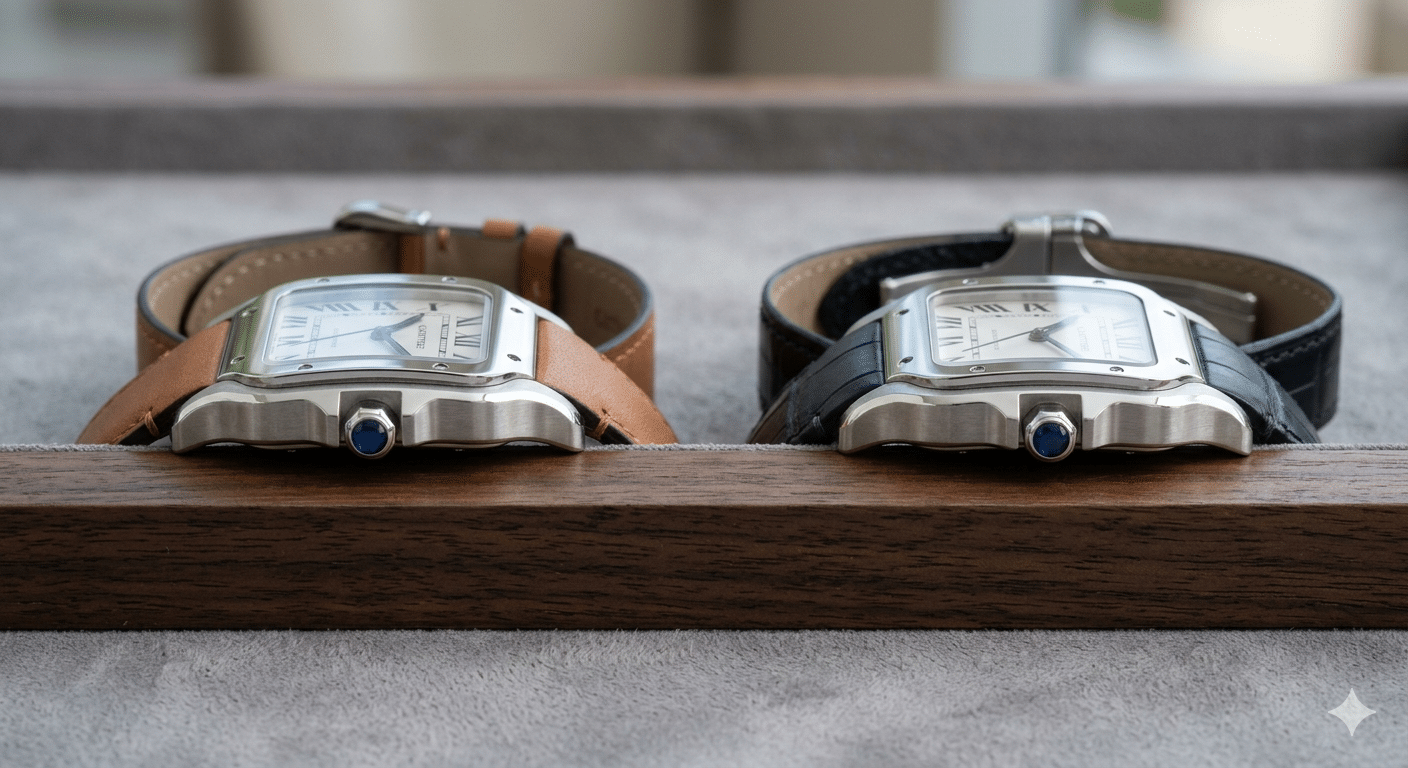
Head-to-Head: The Daily Wear Breakdown
Forget marketing shots. The real test happens between 9 AM and 6 PM. Here’s where the theoretical differences between a Santos on a bracelet and one on a strap translate into physical reality. This isn’t about preference; it’s about performance under daily conditions.
Comfort Over 8+ Hours: Clasp vs. Buckle, Rigidity vs. Flex
The all-day experience is a study in opposites. A well-fitted steel bracelet is a system of distributed pressure. Its weight is spread across your wrist, and once the micro-adjustments are dialed in, it can feel like a secure, second skin. The downside? Metal conducts temperature. On a cold morning, it’s an icy shock. On a hot day, it can feel clammy. The biggest practical nuisance is hair-pulling from imperfectly finished link edges—a common flaw in lower-tier replicas.
The leather strap presents a different profile. It’s immediately softer and more breathable. There’s no thermal shock. However, the pressure is concentrated in two bands: one under the buckle and one opposite it. After hours, you might feel a “hotspot” from the buckle pressing into your wrist. Leather also absorbs sweat, which can degrade the material over time and cause stretching. The comfort of a strap is front-loaded; it feels great initially but requires more long-term maintenance and can become less comfortable as it ages and conforms unevenly.
Formal Suit vs. Casual Wear: Which Setup Actually Adapts?
Conventional wisdom says leather for formal, steel for casual. With the Santos, that wisdom is often wrong. The polished, integrated Santos bracelet is fundamentally a piece of modernist jewelry. Its unity and reflective quality align perfectly with the clean lines of a suit jacket and cuff. It reads as a single, intentional object—a coherent accessory. The leather strap, by breaking that metal continuity, can ironically make the watch feel more casual. It turns the Santos from an architectural statement into a “square-cased field watch.” On a strap, especially a grained one, the Santos can look at home with a polo shirt but slightly disjointed under a crisp French cuff.
The “Forgetting It’s There” Test
The holy grail of watch comfort is the moment you forget you’re wearing it. Each setup gets there via different routes. A high-quality bracelet, once settled and at skin temperature, achieves a neutral, uniform presence. Its rigidity becomes a non-issue because it moves as a single unit with your wrist. A strap, with its inherent flex, is always reminding you it’s there through subtle shifts and pressure points. It’s never truly “forgotten,” but its constant, gentle flex can be preferable to the occasional pinch or chill of metal. The winner depends on your sensitivity: if you dislike any constraint, a perfect bracelet wins. If you dislike cold, hard uniformity, a broken-in strap wins.
Expert Authentication Insight
The tactile quality of the closure mechanism is a dead giveaway. For the bracelet, operate the deployant clasp. A genuine Cartier clasp engages with a dampened, precise, and quiet snick. Replica clasps are a symphony of flaws: they can be loose and wobbly, require excessive force (feeling stiff and cheap), or produce a scratchy, grating sound. Check the micro-adjustment pin: it should slide in and out of cleanly drilled holes with positive engagement, not wobble in a sloppy, oversized channel.
For the strap, forget the leather—look at the buckle. Under a macro lens or loupe, examine the “Cartier” engraving. Genuine engraving is deep, with crisp, sharp walls and a clean bottom. Replica engraving is almost always shallower, with fuzzy, rounded edges where the tool skipped or vibrated. The font weight and spacing are also frequently off. A bad buckle betrays a strap—and by extension, the watch—instantly.
The Replica-Specific Compromises
This is where the theoretical meets the manufacturing reality. In the genuine world, the bracelet is a masterpiece. In the replica world, it’s the component with the widest quality delta. Your choice here isn’t just aesthetic; it’s a direct bet on factory capability.
When a Cheap Bracelet Kills the Vibe
A poor replica bracelet doesn’t just feel bad—it dismantles the entire Santos identity. Hallmarks of failure are unmistakable: sharp, unfinished link edges that catch on everything; hollow links that feel tinny and collapse under slight pressure; a clasp that misaligns or feels like a child’s toy; and a jarring visual “step” where the end link meets the case, destroying the integrated illusion. The sound is a giveaway—a genuine bracelet has a muted, solid rustle, while a cheap replica rattles like a bag of loose change. If you’re looking at a replica from a lower-tier factory, the bracelet isn’t an asset; it’s a liability. In this scenario, opting for the leather strap configuration isn’t a style choice—it’s damage control.
The Factory Hierarchy: Who Nails the Bracelet?
Not all factories are created equal, and the bracelet is the ultimate differentiator. For the modern Santos, two names dominate:
- GF Factory: Historically the benchmark for the Santos bracelet. Their execution of the alternating brushed and polished center links is consistently sharp, and the integration with the case is superb. The overall feel is solid and coherent. This is often the “safe” choice for bracelet-first buyers.
- 3KF Factory: A formidable contender that often excels in movement replication. Their bracelet quality is very high, with excellent finishing and a secure clasp action. The choice between GF and 3KF for the bracelet often comes down to minor details and which factory’s specific version of the case shape you prefer.
Other factories like BV or KZ may offer the model, but their bracelets often fall short in the critical areas of link articulation, edge finishing, and clasp quality. For a comprehensive analysis of these differences and other critical aspects like movement selection, your decision here is clear and should be informed by the detailed criteria in this Cartier Santos super clone guide: if the integrated bracelet is your goal, your budget must align with GF or 3KF.
The “Buy Bracelet, Add Strap Later” Strategy
This is the most common and often wisest path for the replica buyer. It acknowledges a key asymmetry: it’s easy to buy a great aftermarket leather strap, but it’s impossible to buy a perfectly integrated Santos bracelet after the fact. The bracelet version comes with the proprietary, curved end links that seamlessly mate with the case. Purchasing the watch on a strap typically means you get straight spring bars and standard lugs—you can never truly retrofit the integrated bracelet look.
Therefore, buy the bracelet version from a top factory (GF/3KF). This secures the most complex and critical component. Then, source a high-quality aftermarket leather strap (from a maker like Ziczac or Delugs) for a fraction of the cost of a genuine strap. This gives you both configurations, with the bracelet being the authentic, factory-original piece.
Expert Authentication Insight
The most consistent flaw across all but the best replicas is in the brushing and polishing on the bracelet links. On a genuine Santos, each link has a satin-brushed center flanked by mirror-polished bevels. The transition between these two finishes is razor-sharp and perfectly linear. On replicas, this transition is almost always soft and rounded. The polishing wheel bleeds over onto the brushed surface, creating a fuzzy, undefined border. Under a loupe or in sharp light, this lack of precision is glaring. It’s a finishing shortcut that even good factories sometimes take, and it’s the first place an informed eye will look.
Your Wrist & Your Life: The Decision Matrix
Now, let’s filter everything through the lens of you. Your physiology and daily routine will dictate which theoretical advantages actually matter.
For the Sub-6.5″ Wrist: The Proportionality Equation
If your wrist is under 6.5 inches, the calculus changes. A Santos bracelet, with its visual heft and additional links draping down, can easily overwhelm a slender wrist. It can make the watch look and feel top-heavy, like a medal on a chain. The leather strap, by eliminating the weight and visual bulk below the lugs, allows the square case to sit as a distinct, proportional object. It often makes a medium Santos wear more elegantly. The strap becomes a tool for visual balance, not just a style alternative.
The Office Worker vs. The Active Professional
Your environment is a deciding factor.
- The Office Worker (Sedentary, Climate-Controlled): Here, the bracelet’s downsides are minimized. Temperature is constant, so no thermal shock. Minimal movement reduces the chance of hair-pulling. The bracelet’s formal, jewelry-like cohesion shines under office lighting and against dress shirts. It’s the ideal setting for the integrated look.
- The Active Professional (On-the-Go, Variable Conditions): If your day involves moving between locations, outdoor walks, or temperature shifts, the strap’s advantages mount. Breathability prevents sweat buildup. The lack of thermal conductivity is a comfort win. The flexibility can be kinder during typing, driving, or other repetitive motions. The watch also transitions more easily from a work setting to a casual evening.
If You Own Mostly Leather-Strap Watches Already…
Think about collection diversity. If your box is full of watches on leather, the Santos on a bracelet offers a fundamentally different wearing experience—the solidity, the cool weight, the seamless construction. It’s not just a new watch; it’s a new type of object on your wrist. Conversely, if you already have several steel-bracelet sports watches, the Santos on a strap provides a lighter, more classic, and visually distinct alternative. Don’t duplicate experiences; use this choice to add a new texture to your collection.
Expert Authentication Insight
Don’t neglect the case back. While independent of the strap/bracelet choice, its quality is a bellwether for the entire build. A high-quality replica will have deeply stamped, crisp engraving with clear font weight. A low-quality replica will have shallow, laser-etched-looking markings that appear faint and fuzzy. This matters more for the bracelet version because if the factory cut corners on the hidden case back, they almost certainly cut more corners on the highly visible, complex bracelet finishing. A perfect case back doesn’t guarantee a perfect bracelet, but a poor one almost guarantees other flaws.
The Verdict: It’s Not About Preference, It’s About Purpose
Let’s cut through the noise. The decision between a Santos on bracelet or leather isn’t a matter of taste; it’s a question of which watch you actually want to own. This choice doesn’t accessorize the Santos—it defines it.
The steel bracelet isn’t an option; it’s the essence. It delivers the watch’s full architectural statement, that singular, integrated weight and wrist presence that makes a Santos a Santos. But in the replica world, this comes with a critical condition: you must pay for the privilege. The bracelet is the most complex, most expensive, and most telling component to replicate well. A subpar bracelet—with its hollow links, tinny rattle, and clumsy end links—doesn’t just feel cheap; it actively undermines the entire design philosophy. It turns a statement into a compromise.
Therefore, the bracelet is non-negotiable for only one buyer: the one committed to sourcing from a factory like GF or BVF, where the investment (typically around $800 USD for a top-tier example) goes into nailing that fluid articulation, precise clasp action, and seamless integration. For this buyer, the goal is ownership of the complete icon, and the premium is the entry fee.
The leather strap, however, is a strategic play. It’s not a downgrade; it’s a recalibration. It transforms the watch from a bold, architectural monobloc into a more adaptable, classic square-dress piece. It forgives a smaller wrist, sidesteps the pitfalls of a mediocre bracelet, and offers genuine versatility. The strap shifts the burden of quality almost entirely onto the case finishing. Here, a mid-tier replica can often succeed, as a well-executed dial and case can shine on a quality aftermarket strap, while a poor bracelet has nowhere to hide.
Your decision, then, follows a simple, brutal logic:
Choose the bracelet if: Your wrist is 6.75 inches or larger, you demand the authentic, unitary Santos experience, and your budget allows for a ~$800 USD investment in a factory known for bracelet excellence (GF, BVF). You are buying the bracelet; the watch attached to it is a bonus.
Choose the leather strap (or plan to add one) if: Your wrist is under 6.75 inches, you prioritize comfort and cross-context versatility, you’re testing the Santos waters with a more modest budget, or you simply distrust replica bracelet quality. You are buying a Santos-inspired case and dial, and the strap is your tool for personalization.
Most buyer regret stems from a mismatch: pairing a profound design intention with the wrong physical execution. The bracelet is the uncompromising vision. The strap is the pragmatic adaptation. Your purpose—to own the icon or to wear the idea—dictates the path. Choose based on that, and you won’t just pick a configuration. You’ll get the watch you intended.