
The Santos Skeleton: Not Just a Santos, It’s a Different Game Entirely
Let’s be clear from the start: a Cartier Santos Skeleton replica is not just a regular Santos with a see-through dial. It is a fundamentally different beast, operating under a completely distinct set of rules, success criteria, and failure points. The standard Santos rep is a game of millimeters and color matching—get the case shape right, the screws aligned, and the dial printing crisp, and you’re 90% of the way to a convincing piece. This foundational knowledge of mid-tier Cartier Santos authentication methods is crucial. The skeleton version, however, transforms that game. It’s no longer about hiding imperfections; it’s about achieving a perfect, harmonious illusion where every single component is on display. The stakes are exponentially higher because the beauty and the risk are directly, inseparably linked.
The allure is undeniable. The genuine Santos Skeleton is a masterpiece of modernist watchmaking, where the iconic Roman numerals are carved from the dial itself, becoming the very structure of the watch. It’s architectural, light, and mesmerizing. This is the visual payoff that draws collectors in. But in the replica world, that open architecture acts like a high-powered microscope. A slightly misaligned numeral on a solid dial might go unnoticed. On the skeleton, it disrupts the entire geometric balance. A poorly finished movement bridge isn’t hidden under a dial; it’s the centerpiece of the watch. The replication challenge isn’t just about copying parts; it’s about replicating a feeling of precision and luxury that is incredibly fragile.
This guide exists to answer the central question this watch poses: Given these extreme challenges, who should even consider buying one, and what absolutely must you get right to avoid total disappointment? This isn’t an entry-level purchase. It’s a high-stakes gamble for the seasoned enthusiast who understands the rules of compromise and is chasing a specific, breathtaking aesthetic.
The Allure: What Makes the Genuine Santos Skeleton So Captivating
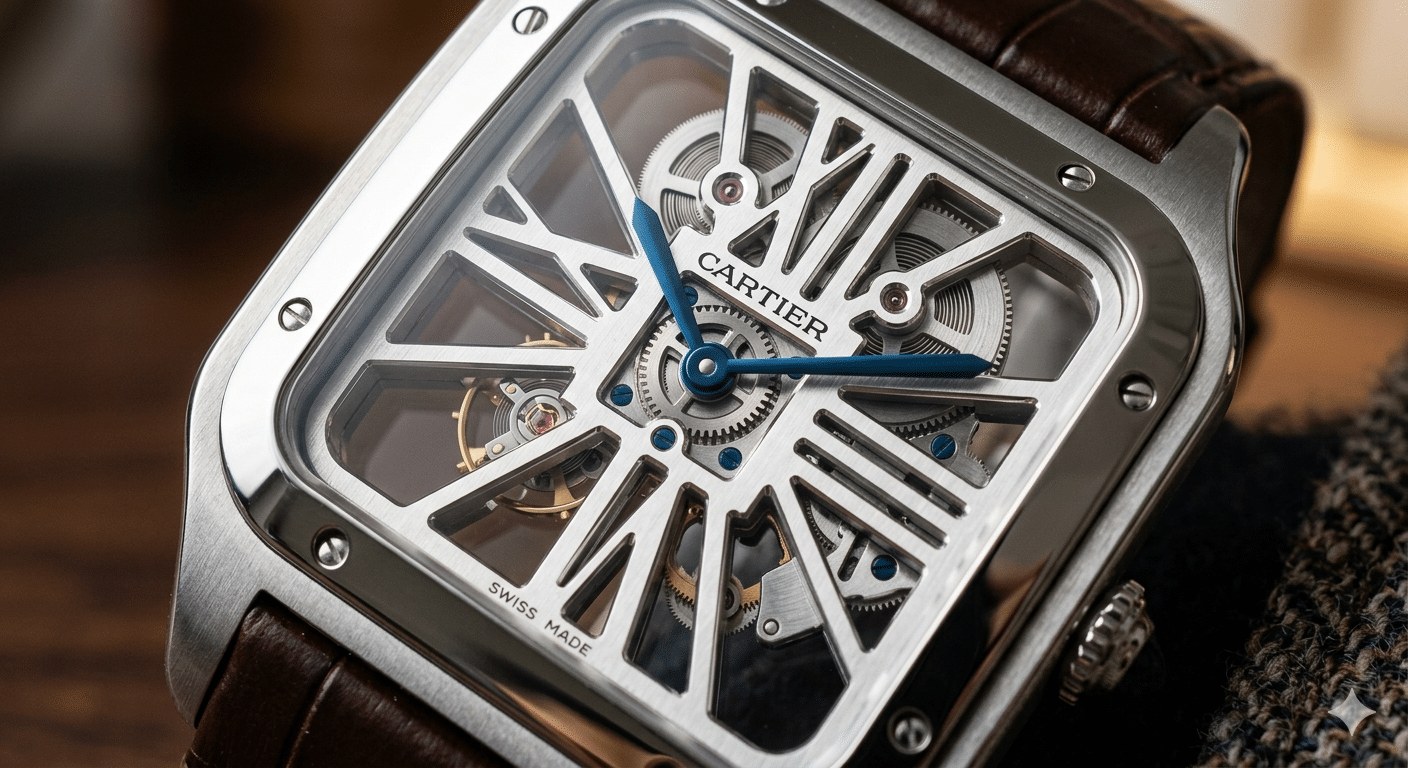
The magic of the genuine Santos Skeleton lies in its deceptive simplicity. Cartier didn’t just cut holes in a dial. They re-imagined the watch’s DNA. The Roman numerals, the most iconic element of a Santos, are transformed from applied markers into the load-bearing skeleton of the movement bridge. This creates a stunning visual paradox: the watch appears impossibly light and airy, yet structurally rigid. The open space isn’t empty; it’s framed and given meaning by the negative space. On the wrist, it plays with light in a way a solid dial never could, offering a constantly shifting view of the mechanical heart within. This is the dream replica buyers are chasing—not just a watch, but a piece of mechanical jewelry.
The Replication Challenge: Why This Dial Is a Manufacturing Nightmare
Replicating this effect is where the dream meets the cold reality of manufacturing tolerances. A standard replica dial is a printed or applied layer. A skeleton dial is a precision-milled component that must serve as both aesthetic face and structural element. The tolerance for error is near-zero. The inner angles of the numeral “V” must be laser-sharp, not rounded by worn CNC tooling. The thickness of each numeral bridge must be perfectly uniform, or the dial will look warped. The finishing on the visible movement plates behind the numerals must mimic genuine perlage (circular graining) and bevelling, not just a flat, stamped texture. Every shortcut taken is magnified tenfold by the open design.
Expert Authentication Insight
The single most telling detail on a low-tier skeleton rep is the finishing of the movement visible through the dial. On a genuine Santos Skeleton (housing the Calibre 9611 MC), the perlage is fine, even, and applied with a consistency that looks like fine sand. On most replicas, the perlage is often blotchy, with inconsistent grain size, or worse, completely missing in areas, revealing raw, unfinished metal. Under a 10x loupe, the difference is stark. Furthermore, the transition between the brushed top surfaces of the numeral bridges and their polished sides is often poorly defined on replicas, losing the crisp, architectural edge that defines the genuine article.
Why the Skeleton Dial Is the Ultimate Replica Stress Test
If the case and movement of a standard rep are the foundation and engine, the skeleton dial is the entire facade, structure, and interior—all visible at once. It becomes the ultimate stress test for a factory’s capability. Flaws that would be minor or hidden elsewhere become glaring, in-your-face failures here. This section breaks down why.
Roman Numeral Precision: When “Close Enough” Isn’t Close at All
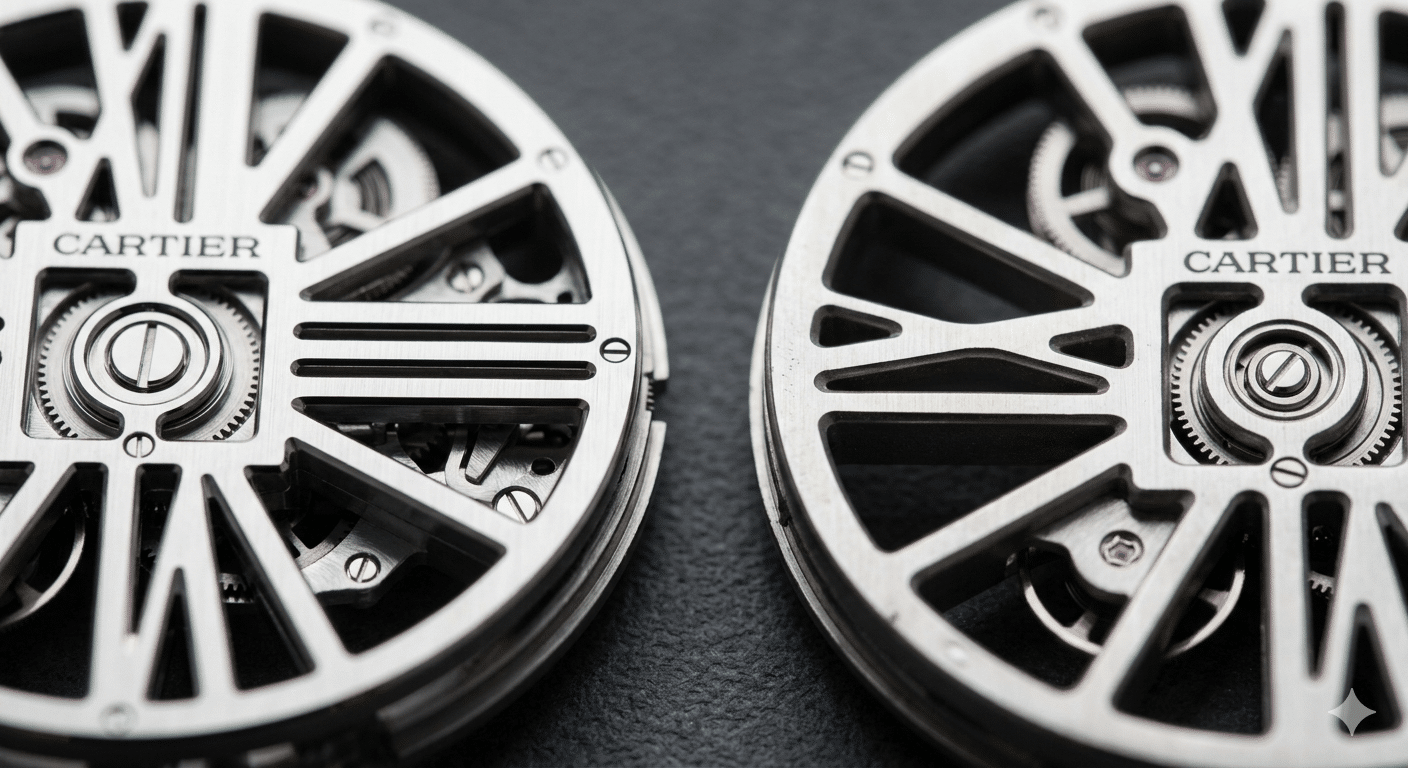
On a solid dial, a Roman numeral that’s 5% too thick is a nitpick. On a skeleton dial, it’s a catastrophic failure of proportion. The numerals are the skeleton. Their width, the curvature of their serifs, the exact spacing between them and the edge of the dial—these aren’t decorative elements; they are the core geometry of the watch. A replica that gets this even slightly wrong loses the entire elegant, balanced look. The eye, drawn into the open space, has nowhere to hide from these disproportions. It immediately registers as “off,” even if the viewer can’t articulate why.
Movement Bridge Finishing: The Decorated Heart on Display
In a solid-dial Santos, the movement is irrelevant (and wisely hidden). Here, the movement’s top plates and bridges are the dial background. This demands a level of decorative finishing that most replica factories reserve for display casebacks on other models. We’re talking about perlage, anglage (bevelled edges), and sometimes Geneva stripes. The replica typically uses a decorated Japanese Miyota or Seiko movement. The quality of this decoration—the fineness of the graining, the depth and polish of the bevels—is paramount. A flat, stamped pattern or a coarse, glittery perlage screams “replica” from a foot away, completely undermining the luxury illusion the skeleton design is meant to create.
Dial Depth and Visual “Air”: Avoiding the Flat, Stamped Look
A successful skeleton dial has a sense of three-dimensional depth. You should feel like you can look into the watch, past the numerals, and see layers of mechanics. Cheap replicas often fail here, presenting a dial that looks like a single, flat piece of metal with holes cut in it. This “flat” look kills the magic. Achieving depth requires proper construction: the numeral bridges must be raised above the base plate, and the movement underneath must be set at a lower level. If everything is crammed too close together, the watch loses its visual breath and appears cheap.
Expert Authentication Insight
A quick but effective test is the “porthole” effect. Hold the watch and look at the dial from a slight angle. On a high-quality replica or the genuine piece, you’ll see distinct layers: the raised crystal, the plane of the Roman numeral bridges, and the sunken plane of the movement decoration below. Light will play across these different levels. On a low-quality rep, the view will appear flat and two-dimensional, with all elements seemingly on the same plane. This lack of architectural depth is one of the fastest visual giveaways.
The Movement: The Centerpiece That Can’t Be an Afterthought
This is the heart of the matter. In a skeleton watch, the movement isn’t a hidden engine; it’s the starring actor on stage. Its performance is judged not on timekeeping alone (though that matters) but on its visual appeal. A poorly decorated movement in a skeleton Santos is more damaging than a low-beat movement in a Submariner rep—because you’re looking at it all the time.
Finishing Quality: Perlage, Bevelling, and the Illusion of Luxury
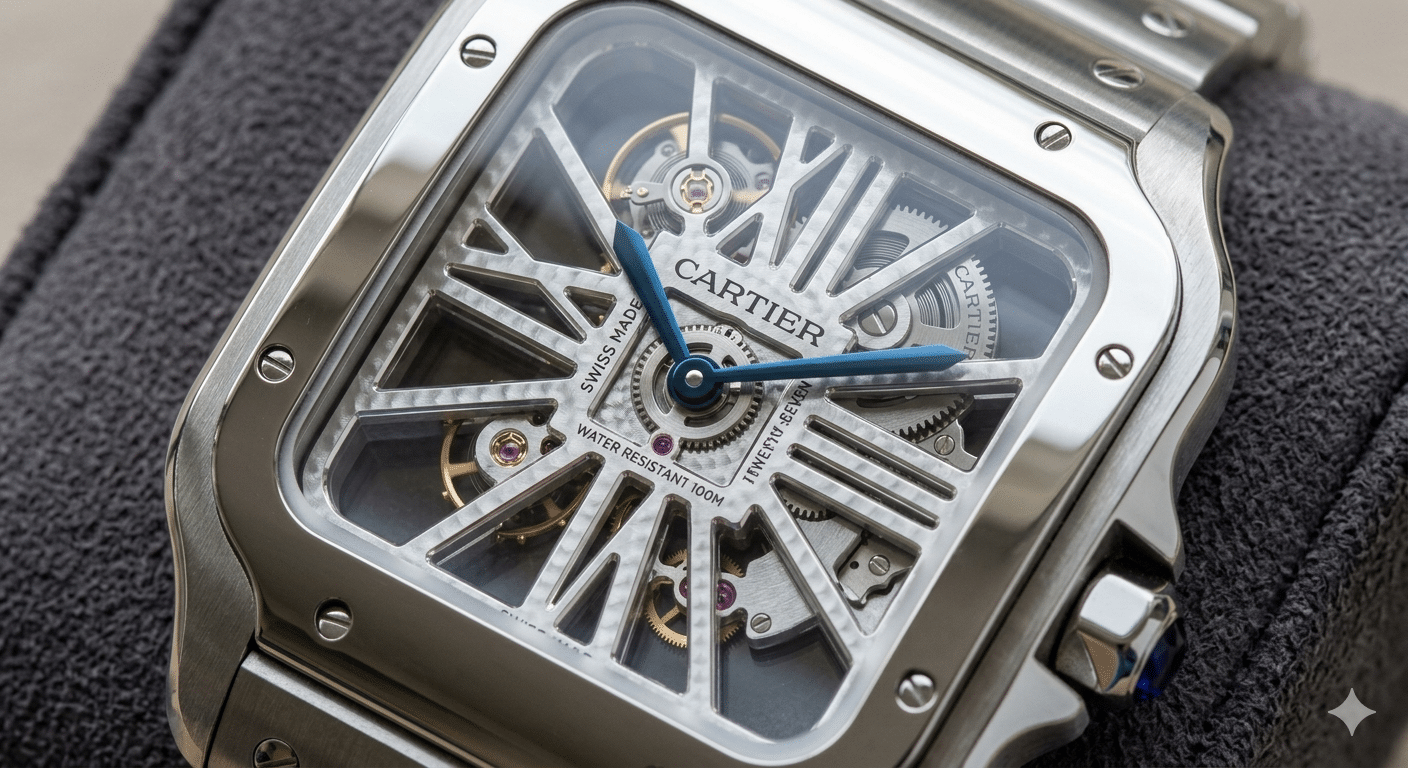
The standard workhorse here is a decorated Miyota 9015 or similar. The decoration aims to mimic the higher-end finish of the genuine Cartier calibre. Key areas to scrutinize:
- Perlage (Circular Graining): It should be fine, even, and cover all visible plates consistently. Blotchy, uneven, or overly large graining is a telltale sign of cost-cutting.
- Bevelling (Anglage): The edges of the bridges should have a polished, angled finish. On genuine and top-tier reps, this is a sharp, clean line that catches the light. On lower-tier reps, these edges are often just broken (slightly rounded) with a machine, lacking the polished gleam.
- Engraving: Any text on the bridges (“Cartier,” “Swiss Made,” etc.) should be deeply and cleanly engraved, not laser-etched (which appears pale and shallow).
Plating and Color: Getting the Tone of Grey/Gold Right
The movement plates are often plated in rhodium (silvery-grey) or gold tone to match the case. Color matching is critical. A nickel-colored movement in a rose gold case is an instant tell. More subtly, the shade of grey or gold must be correct. Many replicas have a movement that is too yellow, too pink, or too cold compared to the case finish. Under different lighting, this mismatch can become painfully obvious.
The Rotor Question: Noise, Wobble, and Visual Mass
The automatic rotor is a practical and visual consideration. The Miyota 9015 is known for a rotor that can be audible—a noticeable whirring or grinding sound when it spins. In a quiet room, this can be distracting. Visually, inspect the rotor’s decoration. Is it solid metal with proper engraving, or a lightweight, cheap-looking piece? Does it wobble excessively on its bearing? A poorly executed rotor undermines the feeling of quality every time you move your wrist.
Expert Authentication Insight
Conduct a simple sound and sight test. First, gently rotate the watch near your ear. A well-finished movement in a properly sealed case will have a muted, swift whir. A lower-quality build will often produce a louder, grinding “zzz” from a less refined rotor bearing. Second, block the dial with your finger and look at the rotor through the caseback (if present) or observe its edge through the skeleton dial. The rotor’s finish is frequently where factories save money—look for shallow, laser-etched logos instead of deep engraving, and a lack of perlage or polishing on the rotor itself.
Case and Bracelet: The Foundation the Delicate Dial Rests Upon
On a solid-dial watch, you can forgive a slightly soft bezel screw or a bracelet with a bit too much flex. The dial is the star. On a skeleton Santos, the case and bracelet are the gallery walls and the frame holding a priceless, delicate painting. Any flaw in the foundation distracts from and devalues the centerpiece. The external parts must be impeccable to support the illusion.
Polished Bezel and Screws: The Frame for the Masterpiece
The polished bezel with its iconic eight screws isn’t just branding; it’s a mirror-like frame that reflects light onto the skeleton dial. The polish must be flawless—deep, mirror-like, and free of hazing or fine scratches from the factory. The screws must be perfectly aligned (slots all oriented the same way) and sit flush without gaps. Any imperfection here draws the eye away from the intricate dial and towards a sloppy frame.
Bracelet Quality and “Haptic Feedback”
The Santos bracelet, with its fluid articulation, needs to feel solid and precise. A flimsy, loose, or tinny-feeling bracelet is a disaster on a skeleton model. It makes the entire watch feel cheap, directly contradicting the delicate artistry of the openworked dial. The links should move smoothly but without lateral play. The QuickSwitch release buttons should operate with a firm, positive click. This “haptic feedback” is crucial—the touch and feel must reinforce the visual premium, not undermine it.
Expert Authentication Insight
Run your fingernail lightly across the transition where the highly polished bezel meets the vertically brushed case middle. On a genuine or high-end replica, this is a razor-sharp, clean boundary. On lower-quality versions, you’ll often feel a slight ridge, a rounded edge, or see evidence of over-polishing that has blurred the distinct finish lines. This detail, while small, is a reliable indicator of overall case finishing quality.
The Factory Hierarchy: Who Even Attempts This, and Who Gets Close?
The Santos Skeleton replica market is not crowded. It’s a specialized, high-difficulty niche. Only a few factories have attempted it with any seriousness, and each comes with significant trade-offs. There is no “perfect” version, only different sets of compromises.
The Established Player: GF Factory
GF厂 (GF Factory) has been the longstanding go-to for standard Santos models and naturally attempted the skeleton. Their strength traditionally lies in case construction and bracelet quality. For the skeleton, they often use a Miyota 9015 with a decorated rotor. The main critique of GF’s offering has been the visual clarity of the dial. Some batches have been noted for a slightly milky or reflective crystal, or a lack of depth in the movement decoration, which can make the dial look flat and less “open” than the genuine article. Their case and bracelet, however, are typically top-tier.
The Newer Challenger: BVF Factory
BVF厂 (BVF Factory), a newer but aggressive player, has also entered the skeleton arena. They have focused on improving the dial clarity and movement decoration visibility, sometimes at the expense of other details. Their crystal may be clearer, but the tone of the movement plating (especially on rose gold models) can sometimes be off—leaning too pink or too pale. The alignment of the skeletonized numerals is generally good, but consistency can vary. They represent a different balance of priorities.
The Trade-Off Matrix: Movement vs. Dial vs. Case
Choosing between factories becomes a question of which flaw you’re most willing to tolerate:
- Prioritize Case/Bracelet Solidness: GF might be the safer bet, accepting that the dial may lack some “wow” factor.
- Prioritize Dial Openness & Visual Pop: BVF could be the choice, but be prepared to scrutinize the movement color and finer case details.
- Avoid: Unknown factories or sellers claiming “1:1 Supreme Edition.” The skeleton is complex enough that only established factories with a track record should be considered. Prices for these top-tier attempts are typically in the $750-$850 USD range, reflecting the higher complexity.
Expert Authentication Insight
The most telling factory comparison is in the hand-to-dial relationship. Find high-resolution photos of a genuine Santos Skeleton and a replica from each factory. Zoom in on the area where the sword-shaped hands overlap the skeletonized hour markers. On the genuine piece, the length and proportion of the hands create a perfect visual balance within the open framework of the numerals. On replicas, the hands are often a fraction too short or too long, disrupting this harmony. Comparing this single detail across factory QC photos can reveal which factory paid more attention to the holistic design, not just individual parts.
The Buyer Profile: This Is NOT Your First Santos Replica
This is the most critical filter. The Santos Skeleton replica is not for everyone. In fact, it’s only for a very specific type of buyer. Misjudging your own profile here is the fastest path to regret.
The Ideal Candidate: The Experienced Collector’s Novelty
The right buyer already owns several high-quality replicas, understands their inherent compromises, and has a stable “daily wearer.” They are captivated specifically by the skeleton aesthetic and see this watch as a “fun” piece, a mechanical curiosity, or a dress watch for special occasions. They appreciate the attempt at artistry and are willing to accept visible flaws in exchange for a unique look. They enjoy the hunt for the best possible version and will scrutinize QC photos with a knowing eye.
The Poor Candidate: The First-Time Buyer’s Potential Regret
The worst candidate is someone looking for their first or only “nice” replica, or someone seeking “the best Santos” regardless of model. This buyer expects near-perfection for their money and will be hyper-focused on flaws. For a deeper technical breakdown of the specific design and functional differences between these iconic models, which directly influences perceived quality and flaw assessment, the detailed Cartier Santos Dumont vs Santos de Cartier replica comparison is essential reading. The skeleton will torture them. If you are the type to examine your Submariner’s rehaut engraving alignment with a loupe, this watch will give you an aneurysm. The disappointment potential is extremely high.
The Mindset Requirement: Appreciating the “Art Attempt”
You must value the attempt as much as the result. You are not buying a 1:1 tool watch; you are buying a decorative object that mimics high horology. Your satisfaction should come from wearing a beautiful, complex design that sparks conversation, not from achieving forensic invisibility. This requires a philosophical shift.
Expert Authentication Insight
Here is a simple psychological diagnostic: Before purchasing, ask yourself: “Am I excited by the challenge of finding a good skeleton Santos, or do I just want a beautiful watch to arrive perfectly?” If your answer is the latter, immediately redirect your funds to a solid-dial Santos from GF or BVF. You will get a 95%+ accurate watch that delivers reliable satisfaction. The skeleton path is for those who find the gamble part of the appeal.
The Verdict: Is the Beauty Worth the Risk and Compromise?
So, after all that, is it worth it? The answer is a conditional, nuanced yes—but only for a very specific person.
The Scale of Compromise: What You’re Really Signing Up For
You are not buying a watch that will fool a knowledgeable watchmaker at three feet. You are buying a piece of wrist-worn art that captures, perhaps 80-85%, of the genuine article’s breathtaking design. You are trading the reliable, near-perfect satisfaction of a solid-dial Santos replica for the volatile, uneven pleasure of the skeleton. The flaws will be visible: the movement finishing won’t be perfect, the dial depth might fall short, the color might be a shade off. You must be at peace with this.
The Final Recommendation: A Conditional “Yes”
The Cartier Santos Skeleton replica is worth it only if:
- You are an experienced replica collector who understands and accepts standard compromises.
- You are specifically, passionately drawn to the skeletonized aesthetic and no solid dial will do.
- You view it as a secondary, novelty piece in a collection, not your primary daily watch.
- You have the patience to source from a trusted dealer, scrutinize QC photos for the major flaws (misaligned numerals, terrible movement finish), and set realistic expectations.
For everyone else—the first-time buyer, the perfectionist, the person who just wants “a nice Santos”—the path is clear: buy the impeccable, solid-dial version. It is the wiser, safer, and ultimately more satisfying choice.
Expert Authentication Insight
The final test is not under a loupe, but on the wrist. Wear it for a full day. Does the visual complexity and play of light bring you continuous joy? Or does your mind keep drifting to the slightly off-color of the movement or the soft edge on a numeral? Your emotional response after 24 hours of ownership is the only authenticity that truly matters. The Cartier Santos Skeleton replica isn’t a product you simply buy; it’s an experience you choose, with all its potential for delight and disappointment fully on the table. Choose knowingly.
The Santos Skeleton: Not Just a Santos, It’s a Different Game Entirely
Let’s be clear from the start: the Cartier Santos Skeleton replica is not simply a Santos with a see-through dial. It’s a fundamentally different category of replica, one that trades the reliable, high-satisfaction gameplay of a standard model for a high-stakes gamble where the rules are stricter and the margin for error is virtually nonexistent. The allure is undeniable—the genuine article is a masterpiece of architectural jewelry, a geometric ballet of steel and space. But that very beauty is what makes the replica such a treacherous proposition. Here, beauty and risk are not just related; they are directly, painfully proportional.
The emotional pull is powerful. The skeletonized Santos transforms a toolish, industrial design into something ethereal. The solid Roman numerals, once anchored to a guilloché or grained base, become freestanding girders of time, floating within a metallic cage. It’s watchmaking as modernist sculpture. This is what hooks you. The cold, mechanical reality of replicating it, however, is a brutal exercise in precision manufacturing. A standard Santos replica succeeds by hiding its compromises: a slightly misaligned date wheel sits behind a date window; a caseback engraving that’s a fraction too shallow is hidden against your wrist; a movement with the wrong finish is entirely concealed. The skeleton Santos has nowhere to hide. Every component is on display, and the “game” shifts from concealing imperfections to achieving a near-perfect illusion of harmony, depth, and refinement. The failure mode isn’t a broken gear; it’s the instant, gut-punch realization that what’s on your wrist looks like a replica, not a Cartier.
The Allure: What Makes the Genuine Santos Skeleton So Captivating
The genuine Santos Skeleton works because of a ruthless coherence. The cut-out Roman numerals aren’t just holes in a plate; they are structural elements with perfectly chamfered inner edges that catch the light. The exposed 1847 MC caliber bridges are finished with a fine, consistent graining (perlage) that provides a soft, luxurious backdrop. The dial has a palpable sense of depth—the numerals exist on a plane above the movement, creating a layered, three-dimensional effect. The color of the rhodium or gold plating is uniform and rich, not flat or washed out. It feels less like a watch and more like a kinetic art piece engineered to millimeter-perfect tolerances. This is the standard. This is the dream the replica is trying to sell you.
The Replication Challenge: Why This Dial Is a Manufacturing Nightmare
Replicating this is a nightmare because it multiplies every single point of failure. A standard rep factory operates on a “good enough” principle for most details. On a skeleton, “good enough” is a failure. The tolerance for a misaligned screw on the bezel is measurable in tenths of a millimeter. The tolerance for a mis-cut Roman numeral is near-zero, because your eye, drawn into the open space, will follow the lines of the ‘X’ or ‘V’ directly to any wobble, any uneven thickness, any rounded corner that should be sharp. The entire watch becomes a porthole focusing a beam of light onto its own flaws. What was a minor footnote in a solid-dial review becomes a deal-breaking headline.
Expert Authentication Insight
The first and most telling area an authenticator examines is the intersection of the Roman numerals with the chapter ring. On the genuine piece, these junctions are crisp, laser-sharp, and perfectly perpendicular. On probably 95% of skeleton replicas, even high-tier ones, these corners show minute rounding or a slight “step” due to CNC tooling wear or a less aggressive milling pass. Under a 10x loupe, this is often the fastest tell. It’s not about the watch keeping bad time; it’s about the geometry betraying itself before it even ticks.
So, the central question this article must answer is stark: Given these unforgiving challenges, who should even consider buying one, and what absolutely must you get right to avoid total disappointment?
Why the Skeleton Dial Is the Ultimate Replica Stress Test
If the standard Santos replica is a test of general competence, the skeleton version is a final exam in micro-engineering and aesthetic judgment. It takes every minor flaw that a solid dial would forgive and magnifies it into a glaring, unmissable tell. Understanding these specific stress points is the key to managing your expectations and evaluating what you’re actually buying.
Roman Numeral Precision: When “Close Enough” Isn’t Close at All
This is ground zero. On a solid dial Santos, a Roman numeral that’s a hair too thick or a fraction imperfect in its serif is virtually invisible. On the skeleton, each numeral is a freestanding sculpture. The width of each stroke, the balance of positive and negative space within the ‘IIII’ or ‘IX’, and most critically, the sharpness of every internal corner must be perfect. A standard rep CNC machine cutting a solid dial plate can get away with a slightly worn tool. Cutting the delicate, complex negative space of a skeletonized ‘V’ requires fresh, precision-ground tools and perfect programming. Most replicas fail here, producing numerals with slightly rounded inner corners or uneven stroke widths that, from even a normal viewing distance, make the dial look “soft” and lacking the architectural crispness of the original.
Movement Bridge Finishing: The Decorated Heart on Display
In a solid-dial watch, the movement’s finish is irrelevant. Here, it is the backdrop of the entire composition. The genuine Cartier 1847 MC (or 9619 MC) features a fine, even application of circular graining (perlage) across the main plates and bridges. On replicas, this finishing is almost always the weakest link. The perlage is often too large, too shallow, or inconsistently applied, looking blotchy or like cheap bubble wrap under magnification. The beveling on the edges of the bridges—a subtle but crucial luxury touch—is frequently either missing entirely or executed as a crude, polished slope rather than a distinct, angled chamfer. This isn’t a hidden movement; it’s the dial. A poorly finished bridge is like hanging a masterpiece painting on a lumpy, unpainted wall.
Dial Depth and Visual “Air”: Avoiding the Flat, Stamped Look
The magic of a good skeleton watch is the illusion of depth—the sense that you are looking into a miniature machine, not at a stamped metal plate. The genuine Santos achieves this by having the Roman numerals exist on a separate plane above the movement bridges, with a clear gap between them. Lower-quality replicas compress this space. The numerals appear to be almost stamped into* the movement plate, eliminating that crucial sense of layered dimensionality. The watch looks flat, cheap, and two-dimensional. Furthermore, the sapphire crystal must be absolutely pristine and anti-reflective coated to maximize this sense of depth and “air”; a milky or overly reflective crystal kills the effect, making the intricate dial work look muddy.
Expert Authentication Insight
A quick, devastating test for dial depth and finishing: Tilt the watch under a strong, direct light source (like a desk lamp). On a high-quality replica or the genuine article, you’ll see distinct, sharp shadows cast by the raised numerals onto the movement bridges below, and the perlage will sparkle with a fine, granular texture. On a low-tier rep, the shadows will be weak or non-existent (indicating minimal depth), and the bridge finishing will reflect light in dull, uneven patches. This visual flatness is often more of a tell than any single measurement.
The Movement: The Centerpiece That Can’t Be an Afterthought
In the world of solid-dial replicas, the movement is a functional secret. A reliable Seiko NH35 or a Chinese 2824 clone is a triumph because it ticks unseen. In the Santos Skeleton, the movement is thrust into the spotlight. Its decoration isn’t an added bonus; it is* the dial’s primary visual component. Therefore, evaluating a skeleton rep’s movement is less about technical prowess (though that matters) and almost entirely about its ability to convincingly play the role of a luxury, finely finished caliber.
Finishing Quality: Perlage, Bevelling, and the Illusion of Luxury
As mentioned, the perlage (circular graining) is the biggest giveaway. Genuine haute horlogerie finishing aims for a fine, consistent texture—think perfectly uniform beach sand. Most replica skeletons use a modified Miyota 9015 or a similar base movement, and the perlage applied is often coarse, with circles that are too large and inconsistently spaced, resembling bubble wrap or an orange peel texture. The second major failure point is the beveling, or anglage, on the edges of the movement bridges. On the genuine piece, these are sharp, polished bevels that catch the light with a clean, linear gleam. On reps, this bevel is frequently just a slightly rounded, polished edge, or worse, completely absent. This lack of defined light play makes the movement look machine-stamped rather than hand-finished.
Plating and Color: Getting the Tone of Grey/Gold Right
The Santos Skeleton comes in steel (rhodium-plated movement) and rose gold (gold-plated movement) variants. The color and tone of this plating are critical. Genuine rhodium plating has a cool, steely, almost whitish-grey sheen. Replica rhodium plating often leans too warm, giving a slightly yellowish or dull grey cast. For the gold models, matching Cartier’s distinctive rose gold hue—a subtle pinkish-copper tone—is notoriously difficult. Replica gold plating is often too yellow, too copper, or too pale. In the open architecture of the skeleton dial, this color mismatch is glaring, as the tone of the movement bridges is directly compared to the tone of the case and bezel, which are usually much better matched to the genuine article.
The Rotor Question: Noise, Wobble, and Visual Mass
The rotor is a dual-aspect flaw: auditory and visual. The Miyota 9015, a common workhorse in these reps, is known for a rotor that can be noisy—a high-pitched, grinding whirr during wrist motion. In a quiet room, this can be distractingly audible. Visually, replica rotors are often either overly decorated with laser-etched logos that lack depth, or too plain. They can also appear visually “heavy” or unbalanced compared to the genuine rotor’s design. Since the rotor is partially visible through the skeletonized dial and caseback, its appearance and sound become part of the overall experience, for better or worse.
Expert Authentication Insight
Perform this two-part diagnostic: First, listen. In a quiet setting, gently rotate the watch near your ear. A high-quality replica with a well-lubricated and adjusted movement will produce a smooth, light, almost silent whirring. A lower-tier version will often emit a louder, gritty, or raspy “zzzz” sound from a less refined rotor bearing. Second, look. Block the dial with your hand and examine the rotor through the caseback. Check the engraving. Genuine and high-end replicas use deep, crisp engraving. Common replicas use shallow, laser-etched markings that look flat and lack shadow. The rotor’s finish—often a simple circular brushing—is another area where cost-cutting is immediately visible.
Case and Bracelet: The Foundation the Delicate Dial Rests Upon
With a solid-dial Santos replica, a few minor sins in the case and bracelet can be forgiven. The eye has a complete, opaque surface to focus on, and small imperfections in finishing or fit get lost in the overall impression of a solid tool watch. The skeleton version offers no such grace. Here, the case and bracelet are no longer just functional components; they are the literal and figurative frame for a delicate, intricate masterpiece. Any flaw in this frame doesn’t just exist—it actively undermines the illusion of the complex, expensive artwork it’s meant to showcase. The supporting actors must deliver an Oscar-worthy performance, or the entire production falls apart.
Polished Bezel and Screws: The Frame for the Masterpiece
The Santos’s bezel, with its iconic exposed screws, is its most recognizable feature. On a skeleton, this polished frame is in constant visual dialogue with the open-worked dial. The standard for precision is exponentially higher. On a typical rep, slightly uneven polishing or a screw slot that isn’t perfectly aligned with its radial axis is a nitpick. On the skeleton, it’s a glaring architectural error. The light play across the high-polish surfaces must be crisp and clean, reflecting the intricate dial within, not diffusing into a blurry haze because of a soft edge or over-polished transition.
The screws themselves become critical focal points. Their slots must be machined cleanly, with sharp, defined edges. On lower-tier attempts, these slots can appear shallow, rounded, or inconsistently finished. Because the eye is drawn through the open dial to the bezel’s edge, any imperfection in this polished ring becomes a beacon announcing the watch’s true nature. It’s the difference between a precisely cut gemstone setting and a piece of costume jewelry.
Bracelet Quality and “Haptic Feedback”
The bracelet on a Santos Skeleton replica carries a psychological weight that its solid-dial sibling does not. A flimsy, lightweight, or rattly bracelet doesn’t just feel cheap—it makes the delicate, intricate dial look and feel cheap by association. This is precisely why consulting a comprehensive Cartier Santos super clone guide is invaluable, as the heft and solidity of a properly sourced bracelet provide the necessary counterbalance and foundation for the visual lightness of the skeletonized face.
This is about haptic feedback—the tangible sensation of quality. The links should articulate smoothly, without lateral play or a tinny sound. The SmartLink adjustment system should operate with a firm, precise click, not a vague, mushy movement. A poorly made bracelet introduces a cognitive dissonance: you’re looking at something presenting as high-art horology, but it feels like a toy on your wrist. That disconnect is instant and total. For the illusion to hold, the bracelet must provide a sense of unwavering solidity, convincing your sense of touch that it’s supporting something valuable.
Expert Authentication Insight
The most telling test for case quality on a skeleton Santos isn’t a visual one—it’s a tactile one. Run your fingernail lightly across the junction where the highly polished, flat bezel meets the vertically brushed case middle. On the genuine article and the best replicas, this transition is a razor-sharp, clean break—you can feel a distinct, crisp edge. On many replicas, even some claiming to be top-tier, this edge is slightly rounded or softened from over-polishing. This creates a blurred, less-defined transition that catches the light differently and immediately signals a lower level of finishing care. It’s a fundamental failure in executing the Santos’s core architectural language.
The Factory Hierarchy: Who Even Attempts This, and Who Gets Close?
The market for a standard Santos replica is crowded. For the skeleton, it’s a ghost town with only a couple of serious inhabitants. This isn’t a model every factory tackles because the failure rate—both in production and customer satisfaction—is so high. The few that do attempt it are playing a different game, specializing in high-difficulty pieces. Evaluating them requires ignoring their general reputation and judging them solely on their performance with this specific, punishing model. There is no perfect version, only a series of calculated compromises.
The Established Player: GF Factory’s Focused Effort
For years, GF Factory has been the default, and often the only, answer for a Santos Skeleton replica. Their strength lies in a foundational understanding of the Santos case and bracelet, which they carry over from their excellent solid-dial models. The case construction is typically solid, the bracelet articulation is good, and the overall proportions feel correct. Their primary investment seems to have been in the movement decoration. The perlage (circular graining) on the main plate is often finer and more consistent than on cheaper attempts, and the beveling on the movement bridges, while not gen-level, shows an effort to mimic the genuine Cartier 1847 MC’s architecture.
However, GF’s version has a persistent, glaring flaw: the sapphire crystal. It frequently has a slight milky or greyish tint, or exhibits excessive anti-reflective coating that gives it a cloudy appearance under certain lights. This single flaw catastrophically undermines the entire point of a skeleton watch—visual clarity and depth. It’s like viewing a masterpiece through a dirty window. Furthermore, the tone of the movement plating (whether rhodium or rose gold) can sometimes be off—too sterile or too pink—failing to capture the warm, rich hue of the genuine finish.
The New Challenger: BVF’s Refined Approach
BVF (Beverly) Factory, a powerhouse in regular Santos reps, has entered the skeleton arena with a version that directly addresses GF’s weak points. Their crystal is generally superior—clearer, with better anti-reflective coating that disappears more effectively, granting a more unobstructed view of the dial. The dial itself, specifically the cut-out Roman numerals, can sometimes exhibit sharper, more precise edges, improving the geometric purity of the design.
But BVF’s compromise often lies in the movement decoration. To hit a competitive price point (around $750-$850 USD), the finishing on the visible movement parts can be less refined. The perlage might be coarser or less even, and the engraving on the rotor and bridges can look shallower or less crisp. It’s a trade-off: better window, weaker artwork. They also, like many, struggle with perfect alignment of the skeletonized chapter ring with the minute track, a detail that becomes painfully obvious in the open space of the dial.
The Trade-Off Matrix: Movement vs. Dial vs. Case
Choosing between the limited options boils down to prioritizing which flaw you can best tolerate, as perfection is off the table.
- If dial clarity and “wow factor” are your priority: BVF’s clearer crystal gives its skeleton dial an immediate visual advantage. It looks more expensive at first glance because you can see deeper into it.
- If movement aesthetics and finishing cohesion matter more: GF’s more carefully decorated movement, despite the sometimes-cloudy crystal, may satisfy the itch for a more “complete” look when examining the watch closely.
- If case and bracelet quality are non-negotiable: Both are competent, but GF has a longer track record of consistent Santos case construction. Scrutinize Quality Control photos for both.
Avoid any factory not named here that claims a “1:1 best edition.” The skeleton Santos is a niche product with high production costs; unknown factories are almost certainly selling inferior versions of GF’s or BVF’s work, or worse, low-tier attempts with stamped, flat-looking dials and painted-on “skeleton” details.
Expert Authentication Insight
The most reliable way to visually distinguish a top-tier rep from a mid-tier one—and all reps from the genuine article—lies in the harmony between the hands and the skeletonized hour markers. Place a high-resolution image of a genuine Santos Skeleton next to a rep. Zoom in on where the sword-shaped minute hand overlaps the open-worked Roman numeral at, say, the 8 or 9 o’clock position. On the genuine watch, the hand’s length and the cut-out of the numeral are perfectly proportioned; the hand glides over the empty space with elegant clearance. On most replicas, the hands are a fraction of a millimeter too short or too long. This tiny miscalculation disrupts the entire balanced geometry of the dial. It’s a subtle tell, but on a watch where the dial is everything, it’s a fundamental failure of design replication.
The Buyer Profile: This Is NOT Your First Santos Replica
This is the most important filter in the entire decision-making process. The Cartier Santos Skeleton replica is not a watch; it’s a category of experience, and it is spectacularly ill-suited for a large portion of the replica-buying audience. Misunderstanding your own profile here is the fastest route to disappointment and a watch that will never leave your box.
The Ideal Candidate: The Experienced Collector’s Novelty
The right buyer for this watch is someone with a specific resume. They likely already own a flawless solid-dial Santos from BVF or GF and understand its near-perfect execution. They have other high-quality replicas in their collection and are intimately familiar with the common compromises—the slightly off lume, the acceptable bezel play, the rotor noise. They are not buying the skeleton to get “the best Santos.” They are buying it precisely because it is not the best—it’s the most interesting, challenging, and artistically ambitious. For them, the skeleton is a fascinating novelty, a conversation piece, and a testament to how far replication can (and cannot) go when pushed to its aesthetic limits. They appreciate the “art attempt” and can enjoy it for what it is, flaws and all.
The Poor Candidate: The First-Time Buyer’s Potential Regret
Conversely, the worst possible buyer is someone entering the replica world, drawn by the stunning photos of the skeleton, thinking it represents the pinnacle of the Santos line. They want a “grail” piece. They will scrutinize every millimeter, compare it obsessively to genuine macro shots, and be devastated by the compromised movement finishing, the potential crystal tint, or the hand alignment. If you are the type of person who checks your Submariner’s rehaut engraving alignment with a loupe, this watch will give you an aneurysm. It is designed to be enjoyed from a slight distance, in motion on the wrist, not under forensic examination. As a first and only replica, it sets an impossible standard and highlights every shortcoming of the genre.
The Mindset Requirement: Appreciating the “Art Attempt”
Owning this watch requires a philosophical shift. You are not purchasing a product that promises perfection. You are acquiring an object that represents a high-risk, high-reward attempt at replicating one of watchmaking’s more beautiful feats of design. Your satisfaction must come from the overall effect—the way light plays through the dial on your wrist, the architectural statement it makes, the engineering curiosity it represents—not from a checklist of 1:1 accuracy. You must value ambition over execution, concept over flawless detail.
Expert Authentication Insight
The final, most crucial test is psychological, not physical. Before you commit to buying a Santos Skeleton replica, conduct this self-diagnostic: Are you genuinely excited by the challenge of finding a “good enough” example, of hunting through QC photos for the best crystal and the least-offensive movement finish? Or do you simply want a beautiful, complex watch to arrive at your door in a state of near-perfection? If your answer is the latter—if you desire a seamless, worry-free experience of luxury design—then you are not the target customer. Walk away. Purchase a solid-dial Santos from BVF instead. You will get 95% of the genuine experience with 5% of the hassle. The skeleton demands that you meet it on its own complicated terms.
The Verdict: Is the Beauty Worth the Risk and Compromise?
After dissecting the skeleton’s every vulnerability, we arrive at the final, unavoidable question. The answer is not a simple yes or no. It’s a conditional, profile-dependent verdict that hinges entirely on what you, as a buyer, are truly seeking.
This watch exists in a different category of ownership. It’s not about acquiring a faithful copy of a tool; it’s about acquiring a fragment of an aesthetic ideal, knowing full well it’s an imperfect fragment. The calculus is stark: you are trading the reliable, near-perfect satisfaction of a solid-dial Santos replica for the volatile, uncertain pleasure of a skeleton. One offers 95% accuracy with 95% peace of mind. The other offers 85% accuracy with a 100% chance of being a conversation piece—for better or worse.
The Scale of Compromise: What You’re Really Signing Up For
Let’s be brutally clear about the contract. When you buy a Santos Skeleton replica, you are explicitly signing up for the following:
- Heightened Scrutiny: Every glance at your wrist will be a micro-inspection. You will notice the slightly soft bevel on a movement bridge, the minute mismatch in the gray tone of the plating, or the fractional misalignment of a Roman numeral. This is inherent to the design.
- Acceptance of “Good Enough”: You are buying the best available attempt, not a perfect execution. The “best” factory version is a collection of clever compromises—a better crystal here, a more accurate font there, but always a trade-off elsewhere.
- Premium for Problems: You will pay significantly more—often pushing toward the $800 mark for the top-tier attempts—for a watch that is, by its very nature, less convincing than a $400 solid-dial Santos from a factory like GF or BVF.
- The Psychological Burden: This is not a “set it and forget it” watch. It requires a mindset that finds charm in the attempt, not frustration in the shortfall.
In return, you get the single most visually arresting watch in the Santos replica lineup. You get a piece of mechanical theater on your wrist that the solid-dial versions can never match. You buy into the idea, the architecture, the sheer audacity of the skeletonized form.
The Final Recommendation: A Conditional “Yes”
So, is it worth it? The answer is a firm, conditional yes—but only under these non-negotiable conditions:
- This is not your first replica rodeo. You should already own and be satisfied with at least one high-quality replica from a major factory. You need to have a baseline understanding of standard replica compromises before tackling this advanced course.
- You are a Santos enthusiast, not just a watch buyer. Your desire is specifically for the skeleton aesthetic within the Santos line. If you just want “a nice Cartier,” the solid-dial is your unambiguous, superior choice.
- You value art over accuracy. Your primary metric for satisfaction is the joy of the visual spectacle, not the checklist of 1:1 perfection. You appreciate it as a beautiful object inspired by Cartier, not a flawless forgery of it.
- You have a trusted dealer and the stomach for QC. You must be willing to scrutinize high-resolution photos, potentially reject a first attempt, and communicate specific concerns (e.g., “check the alignment of the VII and X numerals”).
If any of these conditions is not met, the answer instantly flips to a resounding no. For the first-time buyer, the detail-obsessive, or the person who simply wants a beautiful watch that works flawlessly, the solid-dial Santos is not just the safer choice—it’s the smarter, more satisfying, and ultimately more luxurious choice.
Expert Authentication Insight
The final test is not conducted with a loupe, but on the wrist over time. Do not judge the watch in the QC photos alone. Wear it for a full day. In the office, in casual light, at dinner. Does the intricate dance of light through its open heart consistently bring you a spark of pleasure? Or does your eye keep getting snagged on that one slightly crooked numeral, that one bridge with a less-than-perfect finish?
That internal reaction after 24 hours of ownership is the only authenticity that matters. The skeleton replica’s success isn’t measured against the genuine article in a safe; it’s measured against your expectations on your arm. If the flaws fade into the background and the beauty takes center stage, you’ve won the gamble. If the flaws are all you can see, you’ve bought a lesson. This is the essential, personal risk that defines the entire endeavor.
Your decision, therefore, crystallizes into one of two paths:
Path A: The Connoisseur’s Gamble. You walk in eyes wide open. You accept the higher cost, the elevated risk, and the certain imperfections. You do it for the love of the form, the engineering intrigue, and the unique pleasure of owning the Santos line’s most daring expression. You buy it as a second Santos, a piece of mechanical art for your collection, not as a daily driver or a first impression.
Path B: The Collector’s Wisdom. You recognize that the highest form of replica enjoyment often comes from flawless execution of a simpler design. You opt for a solid-dial Santos—a watch that, in its best iterations, is virtually indistinguishable from the genuine article on the wrist. You get 95% of the Cartier style with 5% of the headache. You enjoy impeccable craftsmanship, total confidence, and the quiet satisfaction of a perfect illusion.
The Cartier Santos Skeleton replica is not merely a product you purchase. It is an experience you choose to undertake, with all its potential for delight and disappointment fully on the table. Its value isn’t found in its proximity to a genuine Cartier, but in its ability to captivate you, despite—or perhaps because of—its beautiful, inherent flaws.