
Introduction: The Cartier Movement Trap and How to Escape It
You’re staring at two listings for the same Cartier Santos replica. One boasts a “Swiss Sellita SW200,” promising heritage and rock-solid reliability. The other touts a “Super Clone 1847 MC,” offering perfect visual fidelity to the genuine calibre. To understand what top factories actually use, including quartz and mechanical options, a detailed analysis of quartz Cartier replica movements provides crucial context. The price difference is a few hundred dollars. You’re paralyzed. Which one is the “better” movement?
This is the trap. You’re asking the wrong question first.
For a Cartier replica—a watch defined by elegance, slim profiles, and wrist-hugging comfort—obsessing over movement provenance or clone “purity” before anything else is a direct path to disappointment. The “best” movement isn’t the one with the most impressive pedigree on paper. It’s the one that disappears. Its primary job is not to be a topic of conversation but to enable the correct case design and wearing experience.
That Swiss Sellita might be a robust workhorse, but if it forces the case to balloon 1.5mm thicker than a genuine Santos, you’ve bought a clumsy caricature. That super clone might look perfect under a loupe, but if its proprietary architecture makes it unserviceable by any local watchmaker, you’ve purchased a future paperweight.
This guide is a complete reset. We’re dismantling the old, prestige-driven hierarchy and rebuilding your evaluation logic from the ground up, based on what actually determines whether your watch feels right on the wrist and survives past the first year. The new priorities are ruthlessly practical: thickness, case integration, reliability expectations, and serviceability. Let’s escape the trap.
Priority #1: Thickness – The Non-Negotiable Foundation
For any other watch brand, thickness might be a consideration. For Cartier, it is the foundation. The brand’s entire design language—from the fluid curves of the Ballon Bleu to the sleek integration of the Santos bracelet to the minimalist profile of the Tank—is built on elegance and proportion. A movement that adds unnecessary height doesn’t just make the watch feel bulky; it destroys its visual DNA and screams “replica” from across a room.
Consider the numbers. A genuine Cartier Santos Medium (ref. WSSA0062) is approximately 8.8mm thick. A genuine 42mm Ballon Bleu is about 11mm thick. These are not suggestions; they are the physical parameters that define the watch’s character. A common, reliable movement like the Miyota 9015 is roughly 3.9mm thick by itself. Once housed in a case with a crystal and caseback, it can easily push a Santos replica over 10mm—a visually obvious and tactilely wrong increase of over 1mm.
The rule is simple: If the movement choice forces the case to exceed the genuine specification by more than ~0.5mm, it is the wrong movement for that watch, full stop. No amount of “Swiss made” branding or decorative perlage compensates for a silhouette that’s fundamentally off.
Case Study: The Santos and the Thickness Compromise
The Santos is the perfect crucible for this debate. Its flat caseback and integrated bracelet design mean any extra thickness is not just seen but felt along the entire underside of your wrist. A Miyota 9015-based replica, while mechanically sound, often results in a case nearing 10mm. The alternative? Factories might use a slimmer base movement, like an ETA 2892 (or its Asian clones), or invest in a customized “super clone” of Cartier’s 1847 MC calibre, which is architecturally thin. The latter can achieve a profile within 0.2-0.3mm of genuine, preserving the watch’s essential elegance. The choice isn’t about “good vs. bad” movements; it’s about which movement serves the design.
The “Thin Movement” Myth: Decoding Factory Claims
Be deeply skeptical of listings that just say “ultra-thin movement.” True thinness is a product of movement architecture, not marketing. An ETA 2824 is inherently thicker than an ETA 2892. A standard Chinese automatic is thicker than a Japanese quartz. Don’t take their word for it. The only metric that matters is the final, measured case thickness. A reputable dealer should be able to provide this spec. If they can’t or won’t, assume the worst.
Expert Authentication Insight
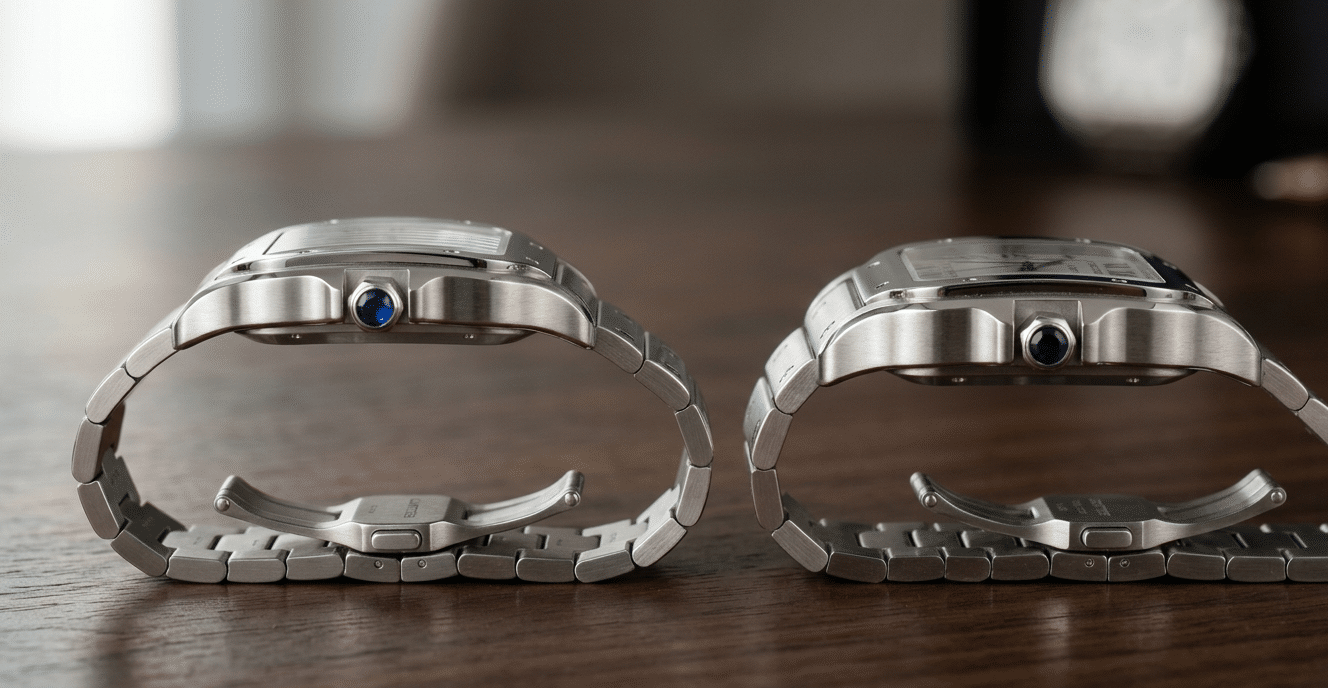
Physical diagnostic: The side-profile test. This is the single most telling check for a Cartier replica. Place the watch on its side on a flat, even surface. Using a digital caliper, measure the total case height from the top of the crystal to the bottom of the caseback. Compare this to the published genuine specification. A discrepancy greater than 0.7mm is a significant visual tell, especially on dress-focused models like the Tank or Santos. On the wrist, this feels like a slab instead of a sliver.
Priority #2: Case Integration & Dial Functionality
So the movement fits inside the case without making it obese. The next hurdle is whether it fits with the watch. Every movement has a “footprint”—a fixed layout for its stem (where the crown attaches), date wheel, and any subsidiary dials. If this footprint doesn’t match the dial and case it’s being paired with, you get functional and visual flaws no amount of decoration can hide.
The most common victim is the date window. Generic Asian automatic movements are designed for a generic date window position. A Cartier dial has its date window in a very specific location. If the factory just slaps a Cartier dial on top of a standard movement, the date numerals will be misaligned—too high, too low, or clipped at the edges. It’s an instant tell. A proper build will use a movement with a custom date wheel or a modified movement where the date disc has been repositioned to align perfectly.
This principle extends to everything. A crown that sits too proud or too sunken into the case because the stem height is wrong. Subdials on a chronograph model that are spaced incorrectly. In these cases, a “lesser” movement that has been correctly modified for the job is infinitely superior to a “superior” movement that’s been crammed in with spacer rings and hope.
The Date Wheel Alignment Problem
This is the signature failure of poor integration. Examine the date numeral at the 3 o’clock position (or wherever the model places it) under slight magnification. Is it perfectly centered in the window, with even spacing on all sides? Or is it riding high, dipping low, or skewed to one side? Perfect alignment is a hallmark of a factory that cared about integration. Misalignment is the hallmark of a parts-bin assembly. It’s a small detail you’ll notice every single day.
Special Complications: When a Simple Movement Fails
For simpler time-and-date Cartiers, movement adaptation is challenging but possible. For models with genuine complications—like a moon phase, annual calendar, or skeletonized movement—the game changes completely. Here, you often face a binary choice: a dedicated, complex clone movement that actually replicates the genuine complication’s layout and function (which is rare and expensive), or a fantasy quartz movement with printed subdials that do nothing. There is rarely a good, reliable mechanical middle ground. This makes replicas of pieces like the Rotonde or high-complication Calibre models exceptionally risky.
Expert Authentication Insight
Physical diagnostic: The date change and alignment check. First, observe the date change mechanism. Slowly advance the hands to midnight. A quality movement will execute a crisp, rapid change typically within 15 minutes of midnight. A slow, sluggish rollover that starts hours early is a sign of a low-grade movement. Second, with a loupe or macro lens, scrutinize the date numeral’s position within its window. It should be centered both horizontally and vertically. Any clipping of the numerals or obvious asymmetry is a direct result of poor movement-to-dial integration and is a permanent flaw.
Priority #3: Reliability & Serviceability – The Ownership Reality
Let’s dismantle a comforting fantasy: the idea that slapping a “Swiss” label on a movement inside a replica Cartier guarantees trouble-free ownership. This belief is often the most expensive mistake a buyer can make. True reliability isn’t a brand; it’s a combination of design robustness, assembly quality, and—most critically—serviceability. The single most important question to ask about any replica movement isn’t “How long will it last?” but rather, “What happens when it eventually needs service?”
Consider this: a grimy, decades-old ETA 2824 salvaged from a donor watch and dropped into a new replica case is, in function, far less “reliable” than a fresh, clean, and properly assembled Japanese Miyota 9015. The former carries the wear of unknown history; the latter starts with a known, modern baseline. Obsessing over origin misses the point. You’re not buying a movement in a vacuum; you’re buying a complete object that will one day require maintenance. The movement that is easiest to fix is, paradoxically, often the most reliable long-term investment.
The Serviceability Hierarchy: From Universal to Proprietary
Not all movements are created equal when they stop ticking, and understanding the distinctions requires a solid grasp of **Cartier replica movement claims in product listings**, a topic covered in depth here. Your repair options form a clear, three-tier hierarchy that should directly influence your choice.
- Tier 1: The Universal Workhorses. This includes genuine Swiss ETA/Sellita calibers and Japanese Miyota (e.g., 9015) movements. Any competent watchmaker in the world can service these. Parts are cheap, plentiful, and standardized. If it fails, it’s a quick, affordable fix. This is the gold standard for worry-free ownership.
- Tier 2: The Common Clones. These are the ubiquitous Asian clones of the ETA 2824/2836 family. While not identical to their Swiss inspiration, they are so widespread that most replica-savvy watchmakers have experience with them. Generic parts are often interchangeable, making repairs feasible and reasonably priced. It’s a step down in universal support, but not a dead end.
- Tier 3: The Proprietary Super Clones. Here lies the potential trap. A movement like a cloned Cartier 1847 MC is engineered to look perfect through a display caseback. Its architecture, however, is often unique. If a proprietary gear or spring breaks, you cannot walk into a shop and get a replacement. Your options shrink to: finding a niche specialist (expensive), sourcing a donor movement (difficult), or sending the entire watch back to China (time-consuming and risky). What you gain in visual fidelity, you may pay for in future headaches.
The hierarchy is simple: the more specialized the movement, the narrower your exit ramp when something goes wrong.
Setting Realistic Expectations: Power Reserve and Accuracy
Forget COSC-certified precision. In the replica world, consistency trumps absolute accuracy. A movement that runs a stable -12 seconds per day is superior to one that fluctuates between +5 and -25 seconds. The former is predictable and can often be regulated; the latter indicates instability that may signal deeper issues.
For automatic movements, expect a power reserve of 40+ hours as a sign of good health. Anything significantly less suggests inefficient winding or need for service. Daily rate deviations between +/-10 to +/-25 seconds per day are common and acceptable for the price point. “Chronometer-grade” claims are pure marketing fluff. The goal is a movement that performs predictably within a reasonable band, not one that matches a genuine Cartier’s engineering tolerances.
Expert Authentication Insight
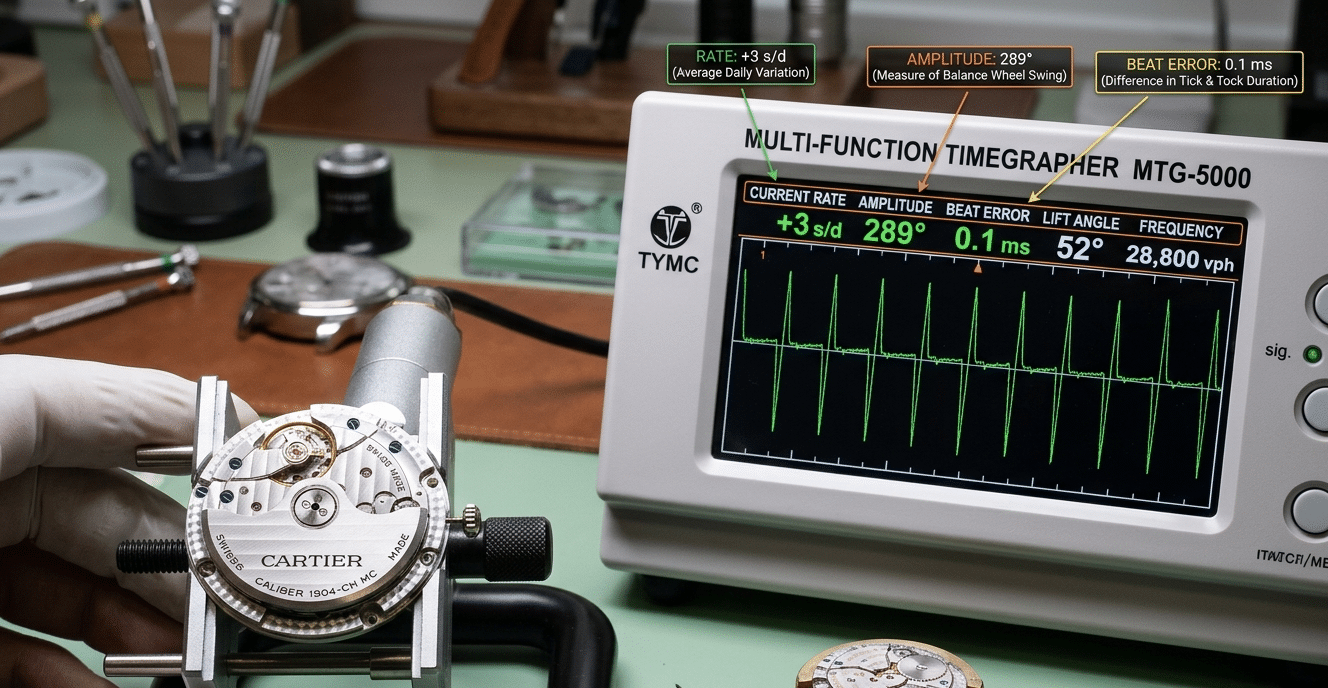
Physical diagnostic: The amplitude and beat error test. This is the definitive health check that moves beyond the eye test. A watchmaker’s timegrapher measures the movement’s “amplitude”—the swing of the balance wheel. A healthy, fully wound automatic should read between 250 and 310 degrees. Low amplitude (below 220°) indicates friction, dirt, or magnetisation, meaning it needs service soon. “Beat error” measures the symmetry of the tick-tock; it should be below 0.5 milliseconds. High beat error means the balance isn’t swinging evenly, affecting accuracy and longevity. These two numbers tell you more about the movement’s real-world reliability than any brand name on the rotor.
Priority #4: The “Character” Test – Does the Movement Suit the Watch?
Beyond specs and service manuals lies the intangible: the movement’s character must match the watch’s soul. A Cartier is an exercise in refined illusion—a piece of jewelry that happens to tell time. The wrong movement doesn’t just fail technically; it fails emotionally by shattering that illusion at the most intimate level: on your wrist.
Think of the watch’s purpose. A Cartier Tank is silent, slender, and elegant. Its movement should be unobtrusive—a whisper-quiet quartz or an ultra-thin automatic. A grinding, noisy rotor in a Tank is a conceptual betrayal; it turns a discreet accessory into an audible announcement. A Santos de Cartier, however, is a sport-elegant hybrid. Its movement should feel robust, with a solid winding action to match the frequent strap changes its QuickSwitch system invites. A Ballon Bleu is a soft, curved sculpture of light. Any hint of mechanical roughness—a gritty stem, a wobbly crown—breaks its serene, liquid character. Ask yourself: “What single flaw would most ruin the experience of wearing this specific watch?” That’s your movement’s character test.
Rotor Noise: The Silent Killer of Elegance
For a dress watch, rotor noise isn’t a minor quirk; it’s a fatal design flaw. In a quiet room, the whirring and grinding of a poorly finished rotor is impossible to ignore. It’s the sound of the illusion crumbling. As a rule, unmodified or lower-grade Asian clone movements (particularly some older Seagull calibers) are notorious for this. Well-lubricated Miyota 9015 movements or higher-quality ETA clones tend to be significantly quieter. If you’re considering a watch meant for quiet environments—meetings, dinners, a theater—insist on a movement known for silent operation, or opt for a quartz version where this issue simply doesn’t exist.
Winding and Setting Feel: The Tactile Experience
The crown is your primary interface with the watch. Its feel is a direct report on the movement’s internal quality. Winding should offer smooth, consistent resistance with a subtle, refined ratcheting sound. Setting the time and date should feel precise and deliberate, with clear, positive clicks. Grittiness, vagueness, looseness, or a crown that wobbles are red flags. They indicate poor finishing, improper lubrication, or loose tolerances within the keyless works. This tactile feedback is the difference between interacting with a precise instrument and fiddling with a crude toy.
Expert Authentication Insight
Physical diagnostic: The sound and feel audit. In a silent room, hold the watch close to your ear and gently rotate it. Listen. A smooth, almost inaudible swoosh is ideal. Any pronounced grinding, scraping, or loud spinning is a mark against it. Next, manually wind the crown (if it’s an automatic). It should feel firm and even, not gritty or loose. Finally, pull the crown out to set the time. The action should be crisp, and the hands should move with immediate, precise response. A high-quality movement feels damped and controlled; a poor one feels loose, rough, and disconnected.
The “Super Clone” Movement Deep Dive: Hype vs. Reality
The term “super clone” is a siren song. In the Cartier context, it typically refers to a movement engineered to visually and dimensionally mimic a specific Cartier calibre, most commonly the 1847 MC found in models like the Santos. Its advantages are real: it often delivers perfect case thickness and flawless dial function alignment (date window, sub-dials). The decoration—perlage, Geneva stripes, branded rotors—can be stunningly close to genuine through a display caseback.
But this perfection comes with a Faustian bargain. To achieve that 1:1 appearance, these movements are often built on proprietary architectures. They are not simply decorated versions of a Miyota 9015. This uniqueness is their Achilles’ heel for serviceability. When (not if) a proprietary click spring or reversing wheel fails, you cannot source a generic replacement. Your watch becomes a complex, expensive paperweight unless you can find a specialist or return it to its origin. Furthermore, their long-term reliability is less proven than decades-old workhorse designs like the ETA 2824 or Miyota 9015.
The verdict is conditional: a super clone movement is an excellent choice only if its primary advantage—visual and dimensional fidelity—is non-negotiable for you, and you consciously accept the potential service trade-off. It’s a premium paid for authenticity, not for durability.
Cartier 1847 MC Clone vs. Miyota 9015: A Practical Comparison
Let’s apply the priority framework to a real-world Santos dilemma:
- Thickness & Integration: The 1847 MC clone wins, unequivocally. It allows the replica case to match the genuine Santos’s slim profile (often ~8.8mm) and ensures perfect date wheel alignment.
- Reliability & Serviceability: The Miyota 9015 wins. It’s a battle-tested, globally understood workhorse. Any watchmaker can service it with cheap, available parts. Its reliability is a known quantity.
- Cost & Character: The Miyota is significantly less expensive. Its rotor can be slightly noisier, which matters less on the sportier Santos but is a point for the clone if silence is paramount.
There is no universal “best.” The clone is for the buyer who prioritizes visual perfection and is willing to bet on its longevity. The Miyota is for the pragmatic owner who values proven mechanics and easy repair above all else.
When a Super Clone is Actually Superfluous
This is the critical cost-saving insight: for any Cartier with a solid caseback—which includes most Tanks, the Ballon Bleu, and many Santos models—a super clone movement is functionally wasted money. You are paying a premium for exquisite decoration that you, and everyone else, will never see. All that matters is that the movement is thin enough, reliable, and properly integrated with the dial functions. In these cases, a standard, serviceable movement like a Miyota 9015 or a Seagull 2824 clone is the intelligent, cost-effective choice. The “super” in super clone only matters if you can see it.
Expert Authentication Insight
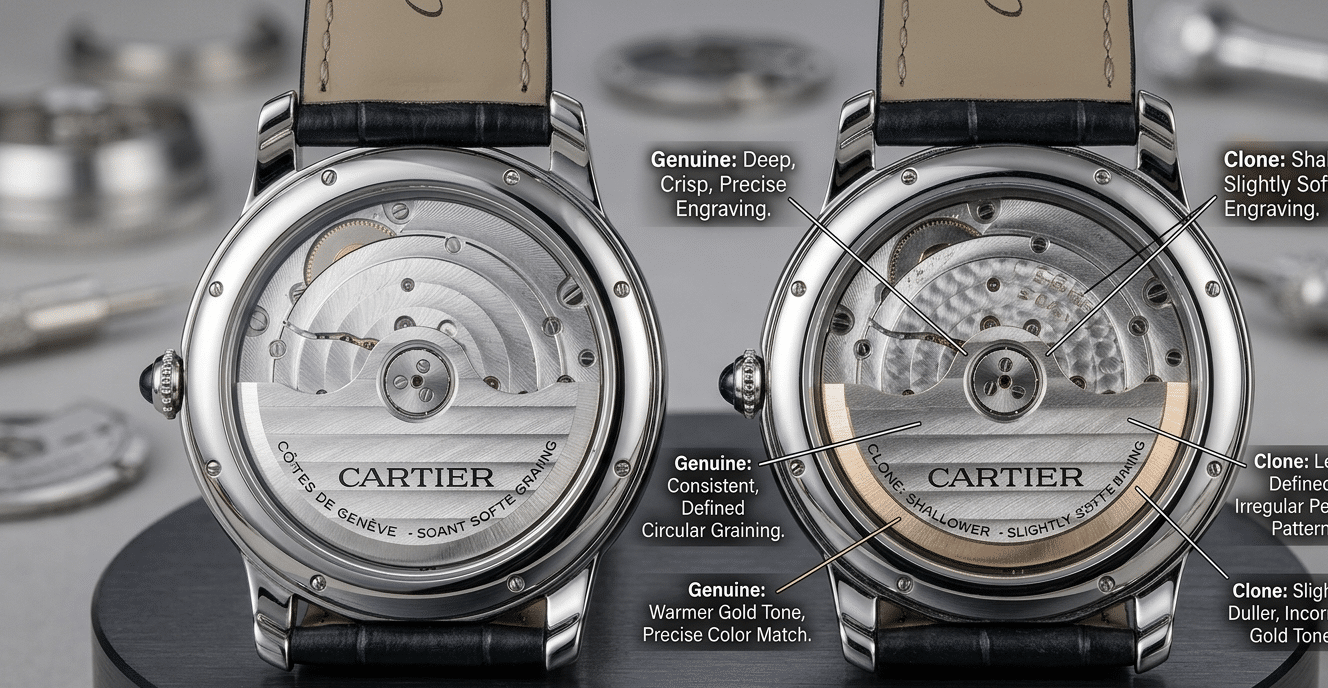
Physical diagnostic: The caseback removal test (for display casebacks). If you have a display caseback, this is where the clone is judged. Under magnification, compare the movement to genuine photos. Scrutinize the depth and sharpness of the Geneva stripes or perlage, the font and depth of the “Cartier” engraving, the color of the tungsten rotor weight (should be a dark grey, not shiny steel), and the color of the synthetic jewels (often a darker red in clones versus a brighter ruby red in genuine). On a closed caseback, this test is meaningless—your evaluation must rely entirely on the watch’s profile, functionality, and feel.
The Swiss Movement Question: Recontextualizing the “Holy Grail”
The idea of a “Swiss movement” carries a powerful allure. It’s a stamp of horological legitimacy, a promise of centuries of engineering tradition, and a one-word answer to the question of quality. In the replica world, it’s often marketed as the ultimate upgrade—the final step toward a “perfect” watch. It’s time to dismantle that myth, especially for Cartier.
For a Cartier replica, a Swiss movement is rarely an upgrade. More often, it’s a costly misstep that introduces new problems while solving none. The prestige is a phantom; the reality is a series of practical compromises that directly undermine the goals of a good replica: correct proportions, reliable function, and sensible value.
The Thickness Problem Revisited: ETA 2824 vs. Cartier Design
This is the fundamental, physics-based conflict. Cartier’s design language is built on elegance and slenderness. A genuine Cartier Santos Medium is about 8.8mm thick. A Ballon Bleu 42mm is around 11mm thick. These dimensions are non-negotiable elements of the watch’s character.
Now, consider the workhorse Swiss automatic, the ETA 2824-2. Its height is approximately 4.6mm. When you add a dial, hands, case crystal, and caseback, you are almost mathematically destined to exceed the genuine watch’s thickness unless drastic and often visually compromising modifications are made to the case. To fit a 2824 into a case meant for a thinner movement, factories must either create a thicker mid-case or use a prominently domed caseback—both of which alter the watch’s silhouette and on-wrist presence. For a comprehensive technical breakdown of these engineering compromises, including comparisons between different Cartier super clone movements, you can see how these modifications fundamentally change the profile. You are, quite literally, paying a premium to make the watch look and feel less like a Cartier.
Compare this to the purpose-built alternatives. A Miyota 9015 is about 3.9mm thick. A customized clone of Cartier’s 1847 MC can be engineered to match the genuine movement’s 3.6mm profile. These movements exist in a world that respects Cartier’s design constraints. The Swiss option often forces you to abandon the very proportions you’re trying to replicate.
The Service Paradox
Here lies the great irony. Yes, a genuine Swiss ETA or Sellita movement is, in a vacuum, more serviceable than an Asian clone. Any competent watchmaker can work on it, and parts are ubiquitous. This is the core of the argument for Swiss: long-term peace of mind.
But let’s examine the economics. A top-tier replica with a reliable Japanese or Asian clone movement might cost around $800. The same watch, spec’d with a “Swiss” movement, can easily jump to $1,500 or more. You are paying nearly double upfront for that serviceability.
Now, if that Swiss movement needs a service in three years, you’re looking at a cost of $200-$400. That service bill alone is 25-50% of the cost of simply buying a new replica with a fresh Asian movement. You’ve created a scenario where the cost of maintaining the “superior” component approaches or exceeds the replacement cost of the entire watch. The financial logic collapses. You’re not investing in longevity; you’re prepaying for a repair on an asset that depreciates to zero.
Expert Authentication Insight
Physical diagnostic: The rotor engraving and bridge finish check. If you are inspecting a watch advertised with a Swiss movement, this requires a loupe and a keen eye. Remove the caseback. A genuine, modern ETA or Sellita movement will have crisp, laser-engraved logos on the rotor. The bridges will exhibit fine, consistent Geneva stripes (Côtes de Genève) or perlage (circular graining). The finish will be clean and sharp. In a replica context, a “Swiss” movement is often an old, refurbished, or even frankened unit. Telltale signs include: soft or stamped (not laser-etched) logos on the rotor; missing or poorly executed Geneva stripes; visible scratches or tool marks on the bridges; or a rotor that appears too light (stainless steel instead of the heavier tungsten alloy used in genuine modern rotors). The absence of quality finishing doesn’t just suggest a lower-grade movement—it suggests you may have paid a Swiss premium for a movement that is neither new nor in spec.
Building Your Decision Framework: A Flowchart for the Mind
Forget searching for a universal “best” movement. The right question is: “What is the most coherent movement choice for the specific watch I want and my personal priorities?” Replace paralysis with a simple, four-step interrogation.
1. Model First: What Cartier am I buying? This is not a trivial question. A Tank Solo demands utter thinness and silence. A Santos de Cartier needs robustness and a slim profile to work with its bracelet. A Ballon Bleu with a closed caseback has zero need for a beautifully decorated movement. The model dictates the non-negotiable physical requirements.
2. Caseback: Is it open (exhibition) or closed (solid)? This single factor dramatically alters the value proposition of a “super clone” movement. If the caseback is solid, you never see the movement. Paying extra for a visually perfect clone of a Cartier calibre is largely wasted money. All that matters is its thickness, reliability, and function.
3. Priority Pyramid: Rank these three needs for this specific purchase:
Perfect Profile: Is achieving the genuine watch’s exact thickness and silhouette the absolute top priority?
Easy Service: Is long-term, low-cost, local serviceability the most important factor?
Lower Cost: Is getting the best overall value and minimizing upfront investment the key goal?
4. Movement Match: Your answers above funnel you toward a logical choice.
• Perfect Profile + Closed Caseback: A thin, reliable workhorse (Miyota 9015, Seagull ST2130) is the intelligent choice.
• Perfect Profile + Open Caseback: This is the sole, justifiable domain of the “super clone” movement. You accept its serviceability trade-off for visual perfection.
• Easy Service + Any Caseback: A Miyota 9015 or Swiss Sellita SW200 (if verified new) is your benchmark. They are the global standard for repairability.
• Lower Cost + Any Caseback: A reliable Asian clone (e.g., a 2824 clone) offers the best value. Avoid the cheapest, unknown movements.
Example Walkthrough: Choosing a Movement for the Ballon Bleu 42mm
Let’s apply the framework. The gen Ballon Bleu 42mm is ~11mm thick with a closed caseback.
Step 1 & 2: Model is Ballon Bleu 42mm, closed caseback. Visual movement cloning is irrelevant.
Step 3: You prioritize Easy Service and Lower Cost. Perfect Profile is important but not if it sacrifices repairability.
Step 4: The “super clone” 1847 MC is eliminated (overkill, expensive, harder to service). A Swiss ETA 2824 is eliminated (too thick, expensive, questionable provenance). The strongest contenders are a Miyota 9015 or a Seagull ST2130 (2824 clone). Both can be fitted to achieve near-gen thickness. The Miyota may cost $50-$100 more but has a slight edge in global serviceability. The decision hinges on whether that service edge is worth the small premium to you.
Verdict: For most buyers, the Miyota 9015 version represents the optimal blend of correct profile, proven reliability, and serviceability for this model.
The Budget Reality Check
Align your expectations with the market’s price architecture. As of 2025, a general tier structure exists:
• $400 – $600: Entry-level replicas with basic Asian automatics. Higher risk of poor regulation, rotor noise, and failure.
• $600 – $800: The sweet spot for quality. Houses reliable Japanese (Miyota) or Chinese (Seagull) workhorse movements in well-finished cases.
• $800 – $1,200: The domain of advanced “super clones” with customized calibres and/or verified, higher-end base movements.
• $1,200+: Where “Swiss movement” upgrades typically reside. As argued, this tier often delivers diminishing or negative returns.
Your budget should guide your tier, and your tier should manage your expectations. Expecting Swiss perfection at $600 is a path to disappointment.
Expert Authentication Insight
Physical diagnostic: The holistic assessment. Before you commit to any purchase, you must be able to answer four questions for your specific model: 1) What is the target, genuine case thickness? 2) Does the date wheel (if present) need custom positioning to align perfectly? 3) What is my acceptable level of serviceability risk? 4) Which movement type (workhorse, super clone, Swiss) satisfies points 1-3? A reputable dealer should be able to provide concrete answers—especially precise case measurements—to support their claims. If they can’t or won’t, it’s a major red flag.
Conclusion: From Specs to Coherence – The New Movement Logic
The journey through movement choices for a Cartier replica is a journey from noise to signal. We began by discarding the hollow prestige of labels like “Swiss” and the vague promise of “clone.” We rebuilt the priority list from the ground up, based on what actually affects the watch on your wrist: its thickness, its functional integration, its long-term behavior, and its overall character.
The goal is no longer to find the “best” movement in some abstract ranking. The goal is to find the most coherent movement—the one that disappears into its role, allowing the Cartier design to speak for itself. The best movement is the one you never have to think about. It doesn’t make the watch too thick. It doesn’t have a misaligned date. It doesn’t whirr loudly in a quiet room. It doesn’t force you into a costly, convoluted repair scenario for a watch that cost a fraction of the genuine article.
This new logic renders the old debates obsolete. “Swiss vs. Asian” is the wrong dichotomy. The right question is always: “Does this movement serve the watch?” Does it enable the correct proportions? Does it deliver reliable, appropriate function? Does its cost and service profile make rational sense for a replica? When you apply this filter, the choice often becomes clear, and the marketing hype fades into the background.
You started this search asking, “Which movement is best?” You should finish it asking, “Which movement is right?” That shift in perspective is everything. It’s the difference between buying a spec sheet and acquiring a watch that feels resolved, authentic, and quietly confident on your wrist. Now, you know what to look for first.