
The Santos Thickness Imperative: Where Thicker Movements Fail
The Cartier Santos is not a watch that forgives excess. Its identity is built on a sleek, integrated silhouette—a square of polished steel that’s meant to slide under a cuff and sit flush against the wrist. This isn’t a chunky dive watch or a layered chronograph; its wearing experience is its entire point. The moment the caseback pushes the watch up and off the wrist, that experience is broken, a critical factor explored in detail regarding 2892-style Cartier replica movements. This is the non-negotiable constraint that dictates everything, and it’s the first reason the Miyota 9015 won.
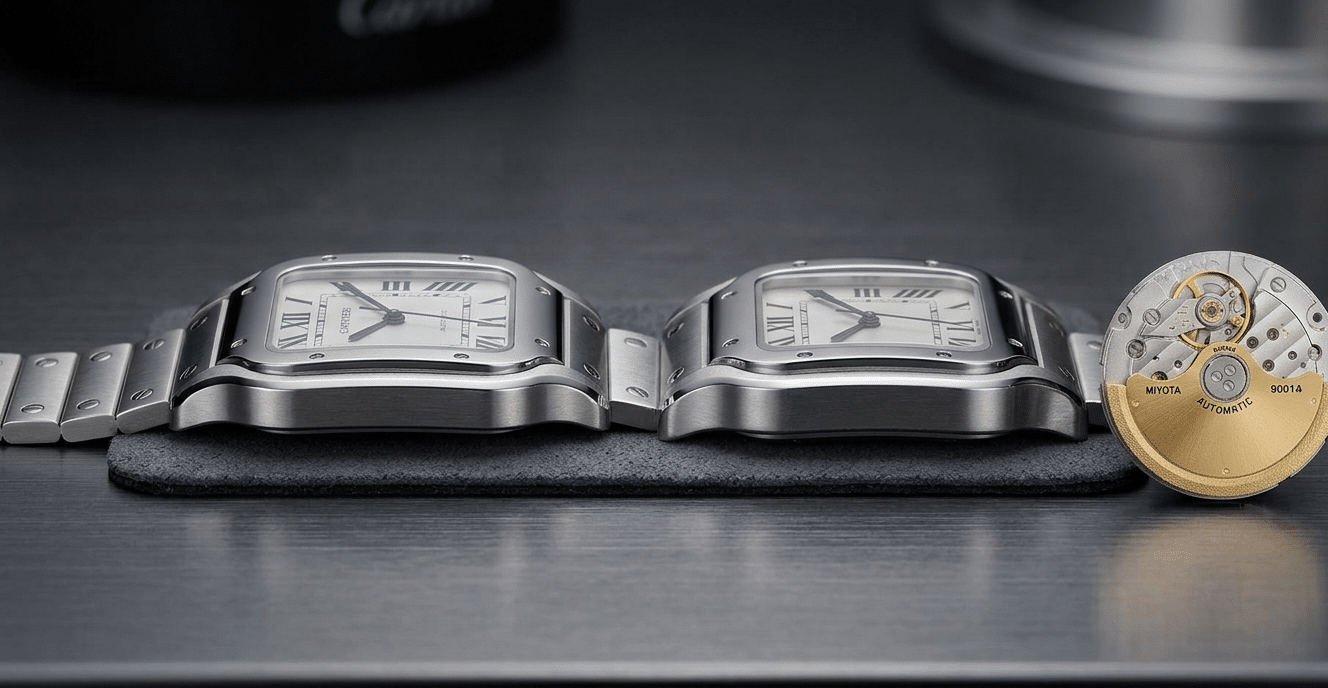
The math is brutally simple. The modern Santos de Cartier Large, the replica’s target, measures about 8.83mm to 9.08mm in thickness. To achieve that, the movement inside cannot be a suggestion; it must be a precise, sub-4mm component. The Miyota 9015 clocks in at 3.9mm. This isn’t just a good number; it’s the only viable number that allows the replica to exist as a coherent object.
The 3.9mm Ceiling: A Santos Case Law
Think of the case as a sealed unit. You have the crystal on top, the caseback on the bottom, and a fixed volume in between for the movement, dial, and hands. The Santos’s caseback is flat, offering zero room for a movement to protrude. Every fraction of a millimeter in movement height translates directly to overall case thickness. The 9015’s 3.9mm profile, combined with a thin dial and crystal, allows factories like GF to hit the genuine 9.08mm spec. Any movement taller than this ceiling doesn’t just make the watch thicker; it forces a complete redesign of the case’s proportions, turning a sleek integrated design into a top-heavy, clumsy block.
The NH35 Comparison: A Deal-Breaker in 1.4 Millimeters
The most popular alternative base movement, the Seiko NH35, is an excellent workhorse. It is also 5.32mm thick. That 1.42mm difference is a chasm. Plug an NH35 into a Santos case, and you are instantly looking at an overall thickness pushing 10.5mm or more. On paper, 1.4mm sounds trivial. On the wrist, it’s the difference between a watch that disappears and a watch that announces its presence with every awkward tilt. It feels wrong. It looks wrong. It betrays the fundamental design language of the Santos. For a super clone that prioritizes visual and tactile fidelity, the NH35 is a non-starter.
Clone Movement Thickness: The Fantasy vs. The Physical Reality
The romantic ideal is a true clone of Cartier’s in-house 1847 MC calibre. But the fantasy collides with physics and economics. A true, functional clone movement thin enough to fit doesn’t exist at scale. The attempts that do surface are often thicker prototypes or unreliable novelties. Even if one could be engineered, the cost would be astronomical, defeating the purpose of a replica. The choice factories faced was stark: pursue movement “purity” and create a watch that fails its primary design brief, or use the 9015 and create a watch that actually wears like a Santos. They chose wearability.
Expert Authentication Insight
The thickness check is one of the first, fastest physical tells for a replica. While a perfect 9.08mm profile won’t fool a master watchmaker with the case open, it will pass the immediate, critical “on-wrist” test that defines 99% of a watch’s life. A factory that gets the thickness wrong has failed at the most basic level of replication. The 9015 isn’t chosen because it’s the best movement in the world; it’s chosen because it’s the only movement that allows the replica to pass this fundamental, non-negotiable test of proportion.
Winding & Stability: The Daily-Wear Engine
Once the movement fits, it has to work. The Santos isn’t a museum piece; it’s designed as a daily companion. Its movement needs to be the mechanical equivalent of a reliable engine: start when you need it, run without complaint, and not leave you stranded. This is where the Miyota 9015 transitions from a dimensional necessity to a performance solution.
Unidirectional Winding: A Flaw or a Feature for Reliability?
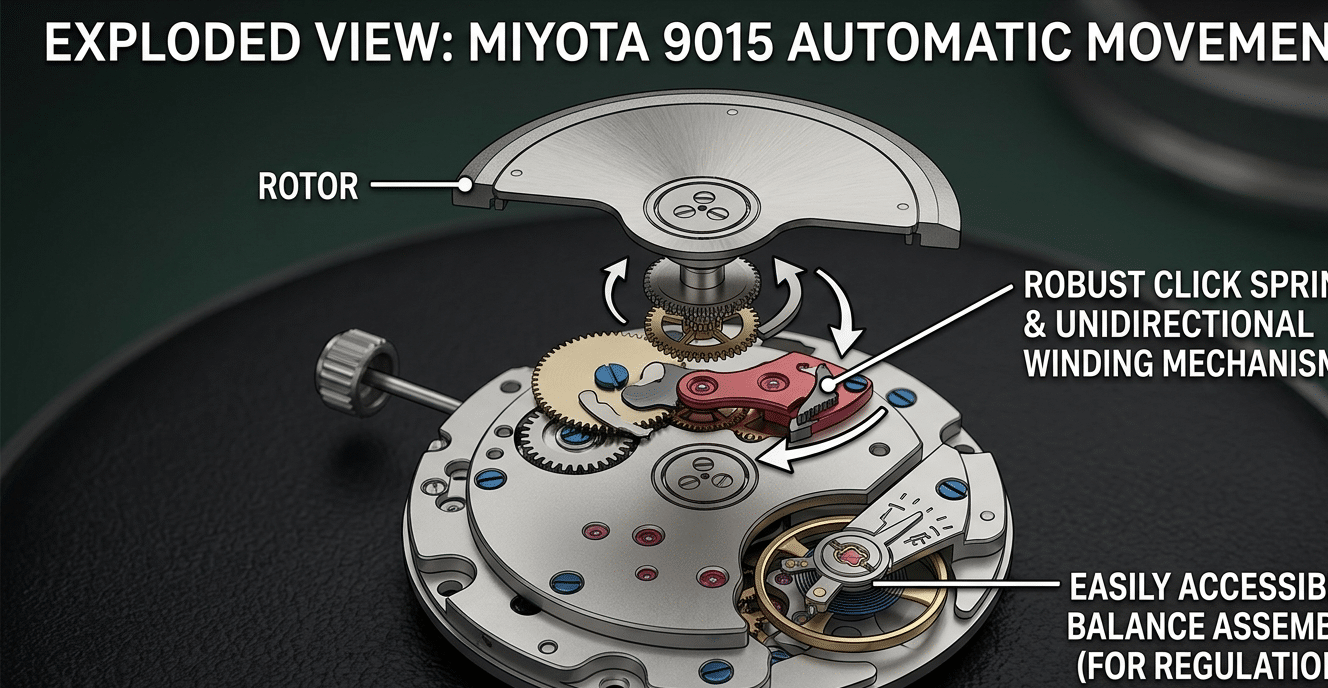
The 9015 uses a unidirectional winding system. On paper, this is less efficient than a bidirectional system—the rotor only winds the mainspring when moving in one direction. In practice, for a daily-wear automatic, this is a non-issue. The real advantage is robustness. The unidirectional design uses a simpler click mechanism that is less prone to the slippage and failure that can plague the more complex reversing wheels in some clone movements. For a watch you put on every morning, reliability isn’t about theoretical maximum winding efficiency; it’s about the certainty that the action of your wrist will translate, day after day, into stored power.
Rotor Noise: The Trade-Off Buyers Actually Experience
Yes, the 9015 rotor can be heard. It’s a faint, rapid whirring sound when you shake the watch sharply. In a silent room, you might notice it. This is the movement’s most commonly cited “flaw.” But let’s reframe it: it’s the audible signature of a simple, durable winding system that works. The trade-off isn’t between silence and noise; it’s between a faint, known operational sound and the potential for a silent rotor that simply stops engaging after a year. For a daily-wear piece, most owners will gladly accept the former. The noise becomes a non-issue within days, while a broken winding system renders the watch useless.
Positional Stability vs. Chronometer Fantasies
No one is buying a Santos replica for its chronometer-grade timekeeping. They’re buying it for the design. The 9015 delivers exactly what’s needed: positional stability good enough for daily life. A properly serviced 9015 (which many top factories do before assembly) will typically run within +10/-20 seconds per day. More importantly, its rate doesn’t swing wildly depending on whether it’s sitting dial-up or crown-down on your nightstand. This consistency means you can pick it up in the morning and it will be roughly as accurate as when you took it off. It provides predictable, “set-it-and-forget-it” performance, which is the only kind of performance that matters for a watch in this role.
Expert Authentication Insight
The true measure of a movement in a replica like this isn’t its peak spec sheet performance, but its baseline reliability and consistency. Watchmakers who handle these replicas note that out-of-the-box 9015s can be noisy and dry, but a simple service—re-lubricating the rotor bearing and regulating the balance—dramatically improves both sound and accuracy, a process detailed in our Seagull 2824 replica movement guide. This serviceability is key. The movement has a known, stable architecture that responds predictably to maintenance, unlike many clone calibres which are black boxes of unpredictable longevity.
The Service Reality: Repairability Over Purity
This is the quiet, long-term logic that separates a disposable fantasy from a wearable object. The romance of a “true clone” movement evaporates the moment something goes wrong. The Miyota 9015’s greatest strength isn’t on the spec sheet; it’s in its future.
Ask yourself: what are you really buying? A watch for a few photos, or a watch to wear for years? If it’s the latter, then the movement inside must have a path forward when it eventually needs attention. The 9015 provides that path. A clone of Cartier’s 1847 MC does not.
The Clone Movement Dead End: When “Accuracy” Means “Disposable”
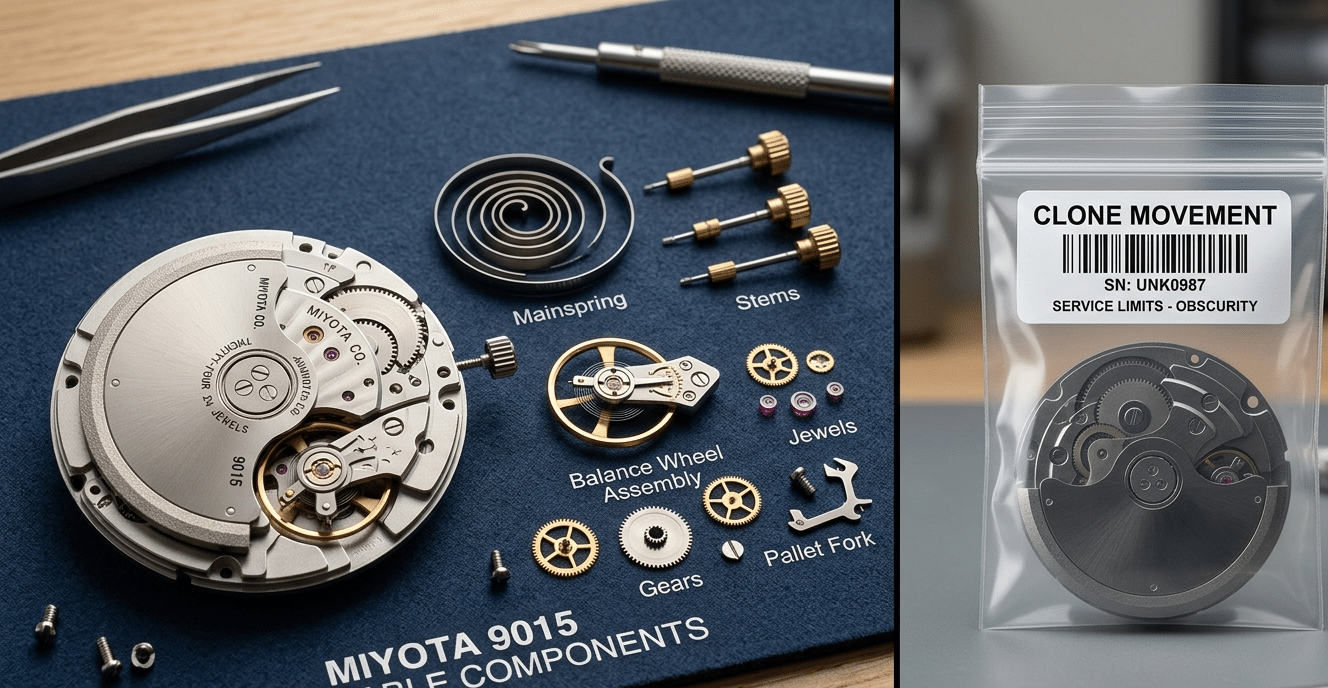
A clone movement is a cul-de-sac. There are no technical documents. No supply of spare parts. No watchmaker outside a tiny, specialized niche will even attempt to fix it. If a reversing wheel fails or a gear teeth strips, your options are bleak: scour obscure forums for a donor movement from another broken watch, or buy a completely new watch. This turns your “super clone” into a consumable product with a hard expiration date. The pursuit of visual purity on the inside has made the entire watch functionally fragile.
9015 Parts Ubiquity: From Main Street to eBay
The Miyota 9015 is the Honda Civic of watch movements. Its parts are everywhere. A complete new movement can be had for under $100. Individual components—a stem, a click spring, a balance staff—cost pennies and are available from dozens of suppliers worldwide. This ubiquity is a superpower. It means any competent local watchmaker can service it. It means a simple regulation or cleaning doesn’t require a specialist. It means a broken watch isn’t a tragedy; it’s a $50 and one-week repair. This accessibility fundamentally changes the ownership proposition from a risky novelty to a maintainable timepiece.
Future-Proofing Your Purchase: The Value of a Serviceable Movement
Factories like GF that use the 9015 aren’t taking a shortcut; they’re building in an escape hatch for the owner. They are prioritizing the long-term viability of the watch over a short-term marketing point. This is a profoundly practical form of quality. A “super clone” shouldn’t just look like the genuine article for a few months; it should function* as a reliable watch for years. The 9015 ensures that. When you buy a Santos with this movement, you’re not just buying a case and a dial; you’re buying the certainty that your investment is protected against a simple mechanical failure. That’s a feature no clone movement can offer.
Expert Authentication Insight
From a service perspective, the choice is clear. Watchmakers report that servicing a 9015 in a replica is a straightforward, 30-minute job with a predictable outcome and cost. Servicing a mystery clone movement is an hours-long diagnostic puzzle with an unknown prognosis and no guarantee parts can be found. The factories know this. By standardizing on the 9015, they create a product with a known, manageable lifecycle cost. This isn’t a compromise on quality; it’s a deliberate design choice for sustainability, ensuring the watch they sell you today doesn’t become a paperweight tomorrow.
Factory Economics & Consistency: Building at Scale
The story of the Miyota 9015 in the Cartier Santos replica isn’t just one of technical fit; it’s a masterclass in industrial pragmatism. This movement’s dominance is the invisible engine that makes the entire high-quality replica project commercially viable, transforming it from a bespoke fantasy into a product you can actually buy. It’s the reason a watch with this level of finish doesn’t cost $2,000, but rather, sits in the $700-$800 range.
The Supply Chain Advantage: No Custom Movement Bottlenecks
The 9015 is a commodity. Factories like GF can order it by the thousands from a stable, predictable supply chain. There are no custom tooling delays, no proprietary parts shortages, and no reliance on a single, fragile clone movement workshop that could vanish overnight. This is a non-negotiable advantage. Developing a true, thin clone of the Cartier 1847 MC movement would require an R&D investment in the millions, for a component that, in a closed-caseback watch, offers zero visual return. The 9015 removes that financial insanity and logistical nightmare, allowing factories to focus their capital and attention on what you actually see and feel: the case, dial, hands, and bracelet.
Batch-to-Batch Consistency: What Factories (and Buyers) Really Need
For a factory, predictability is everything. The 9015 delivers a known quality threshold and performance envelope every single time. When a watchmaker on the assembly line installs a 9015, they know its dimensions, its winding behavior, and its basic tolerances. This translates directly to you, the buyer. It means the Santos replica you receive isn’t a lottery ticket. Its timekeeping will fall within a known range. Its power reserve will be consistent. The rotor will sound a certain way. This batch-to-batch reliability is a hidden feature that benefits the end user as much as the manufacturer—it’s the foundation of a trustworthy product.
Cost vs. Benefit: Where the R&D Money Actually Went (The Case & Dial)
This is the critical reallocation of resources. The money not spent on a vanity clone movement is the money that was spent on perfecting the Santos’s iconic bezel screws, achieving the correct brushed/polished finish on the case, nailing the sunburst texture of the dial, and engineering the “QuickSwitch” bracelet system. The factories made a brutally logical choice: invest in the parts that define the watch’s identity and wearing experience. The movement is a functional component; the aesthetics are the product. The 9015 enables that priority. Choosing a more “authentic” but problematic movement would have meant compromising on the visual and tactile qualities that make a super clone convincing in the first place.
Expert Authentication Insight
From a commercial forensic perspective, the choice is transparent. A true clone movement project for a single watch model is a money pit with no competitive ROI. The consistent use of the 9015 across multiple high-tier Santos batches from major factories like GF is a clear market signal. It indicates a settled, mature production solution. For authenticators, this consistency is itself a data point—it means the replica ecosystem has standardized around a known, stable component, reducing variables and making the overall product more predictable, for better or worse, as detailed in a comprehensive Cartier super clone movements explained analysis.
The “Alternatives” That Weren’t: A Tour of Missed Fits
To understand why the 9015 won, it’s just as important to see why every other plausible contender lost. Each alternative fails to solve the Santos’s unique equation, breaking on one of the essential pillars: thickness, reliability, serviceability, or cost.
The Thickness Disqualifier: Seiko’s Fatal Flaw
The Seiko NH35 is a legendary workhorse in the replica world, beloved for its robustness and low cost. But for the Santos, it’s a non-starter. Its 5.32mm height is a deal-breaker. In a watch where the genuine article is about 8.5mm thick, adding nearly 1.5mm of extra movement height would destroy the sleek, integrated profile. The resulting watch would be a chunky, top-heavy slab, immediately feeling wrong on the wrist. No amount of reliability can compensate for a fundamental failure of proportion.
The Clone Mirage: Accuracy You Can’t Maintain
The dream of a “true clone” Cartier 1847 MC movement is seductive but hollow. Even if a Chinese factory engineered a visually identical, dimensionally correct clone (a massive if), it would create two insurmountable problems. First, reliability would be a complete unknown, a first-generation experiment living on your wrist. Second, and more critically, it would be a service dead end. No parts, no technical documents, no watchmaker willing to touch it. You’d own a watch with a perfectly authentic-looking heart that, upon failure, becomes a very expensive paperweight. It’s accuracy without a future.
The Swiss Fantasy: When the Cure Costs More Than the Disease
What about a Swiss ETA 2892 or Sellita SW300? On paper, it’s the perfect solution: thin, reliable, serviceable, and prestigious. In reality, it’s economically absurd. Sourcing genuine Swiss movements in volume is prohibitively expensive and legally fraught. Using one would easily double or triple the cost of the replica, pushing it into a price bracket where its very reason for existing evaporates. You’d be paying a premium for a hidden component in a replica, a contradiction that makes no logical or financial sense. It solves a technical problem by creating a much larger commercial one.
Expert Authentication Insight
The absence of these alternatives in the market is the most telling evidence. If a thinner, reliable, serviceable clone or a cost-effective Swiss option existed, the competitive factories would have adopted it. The fact that the entire high-end Santos replica ecosystem has converged, independently, on the Miyota 9015 is a powerful market verdict. It silently proves that every other path was explored and rejected for concrete, unsolvable reasons related to physics, economics, or long-term ownership logic.
The Verdict: Coherence Over Romance
The discussion about the Miyota 9015 in a Cartier Santos replica often starts with the wrong question: “Why didn’t they use a better movement?” The correct question is: “What does this specific watch need to be successful?” The 9015 isn’t the default by accident; it’s the answer by design.
The Pillars of the Santos Replica: How the 9015 Holds Them Up
Every successful super clone is built on four pillars: correct proportions (it must wear like the genuine article), daily reliability (it must work without fuss), long-term serviceability (it must be repairable), and commercial viability (it must be producible at a sensible price). The Miyota 9015 is the only movement that simultaneously supports all four. A different movement might excel in one area—like the Swiss option’s serviceability or a clone’s visual mimicry—but it invariably collapses two others, undermining the entire project.
Wearability as the Ultimate Metric
Ultimately, the Santos is an object meant to be worn. Its value is experienced on the wrist, not on a spec sheet. The 9015 enables that experience. It provides the thinness for elegance, the winding efficiency for daily readiness, and the repair network for lasting peace of mind. It transforms the replica from a static display piece into a dynamic, usable accessory. This is engineering in service of experience, not ideology.
Expert Authentication Insight
The final, pragmatic perspective is this: in the hierarchy of what makes a replica convincing, the movement is low on the list for a closed-caseback watch like the Santos. The primary triggers for detection are visual—dial print, case finish, hand construction, and overall proportions. By securing the movement’s role as a silent, reliable enabler of the correct proportions and a worry-free ownership cycle, the factories have wisely prioritized the areas that matter most. The 9015’s role is to be forgotten, allowing the design of the Santos to be remembered.
The Buyer’s Framework: When you evaluate a Santos replica, you are not choosing a movement in isolation. You are choosing a complete, wearable object. Filter your decision through these three non-negotiable goals: It must disappear on the wrist like the genuine article. It must start when you put it on. It must be fixable if it breaks. The Miyota 9015 is the only movement that delivers this trifecta. Therefore, it is not a compromise or a default—it is the correct, and in many ways, the only logical answer. Its victory is not a story of settling, but of solving.