
Introduction: The Super Clone Mirage in a $100K+ World
The genuine Richard Mille watch is an exercise in extremity. It’s a $200,000 to $2 million statement built on avant-garde case engineering, complex skeletonization, and exotic material science. The proposition of a “super clone” for a few hundred dollars isn’t just tempting; it feels like a logical hack of an irrational market, a notion explored in depth regarding the complexity of Richard Mille super clones. This is where the fantasy begins, and where the buyer’s first mistake is often made: believing the marketing language.
The term “super clone” is an aspirational label, not a technical certification. In the replica ecosystem, it’s a moving target of implied perfection, thrown around with wild inconsistency. For a watch like a Richard Mille, where the case is the movement’s chassis and the architecture is the decoration, the very idea of “cloning” becomes a philosophical puzzle. What exactly is being copied? The look, the feel, the engineering, or just the silhouette from a social media post?
This article isn’t about condemning the replica market. It’s a forensic breakdown. We’re dissecting the “super clone” and “1:1 perfect” claims for Richard Mille replicas into their component parts—case, skeleton, materials, function—and holding each against the cold light of manufacturing reality. The goal is to replace hype with hierarchy, giving you the tangible benchmarks to separate genuine approximation from clever marketing. The first lesson is the hardest: in this world, the case is everything, and it’s where the first, most critical lie is often told.
Case Curvature & Architecture: The First and Most Critical Lie
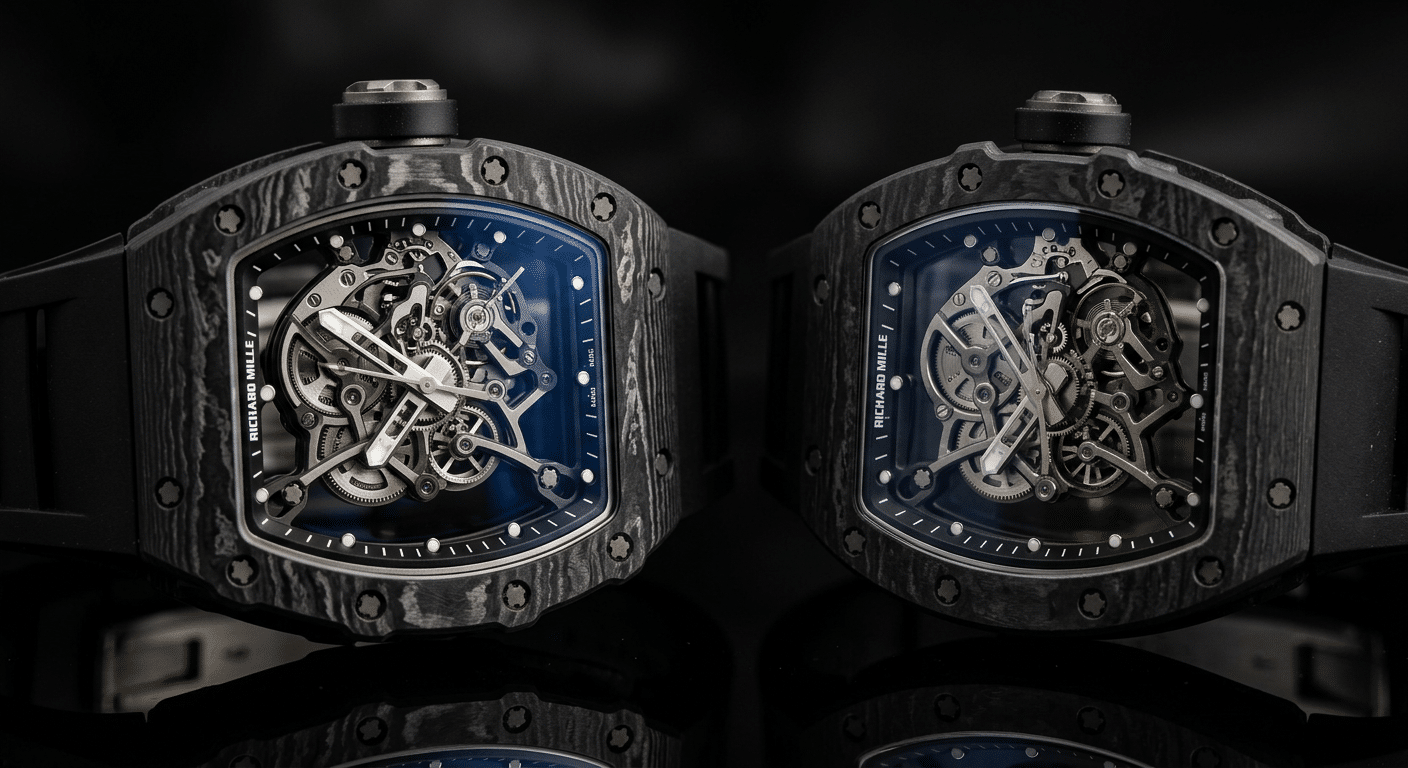
If you only learn one thing, let it be this: the case is the soul of a Richard Mille. It’s not a container for the movement; it’s an integrated, often monocoque, architectural element. This is the single greatest differentiator between a convincing replica and a cheap fantasy piece. Most “super clone” claims fail here first, not because of a misprinted logo, but because the fundamental geometry is a simplified forgery.
Think of it this way: if a genuine RM case is a carbon-fiber monocoque chassis, most replicas are a body kit bolted onto a generic steel frame. The difference isn’t just visual; it’s structural, tactile, and immediately apparent on the wrist.
The Silhouette Test: Thickness and Profile Illusion
The most common and glaring failure is thickness. A genuine RM 011 Felipe Massa chronograph is 16.15mm thick. Its most common replica, built on a Shanghai 7750 movement, balloons to 18-19mm. That 2-3mm is a canyon in terms of wrist presence and comfort, creating a slab-sided, top-heavy profile. For ultra-thin models like the RM 67-02, the gap is even more absurd—some replicas are over 16mm thick against a genuine spec of 7.8mm.
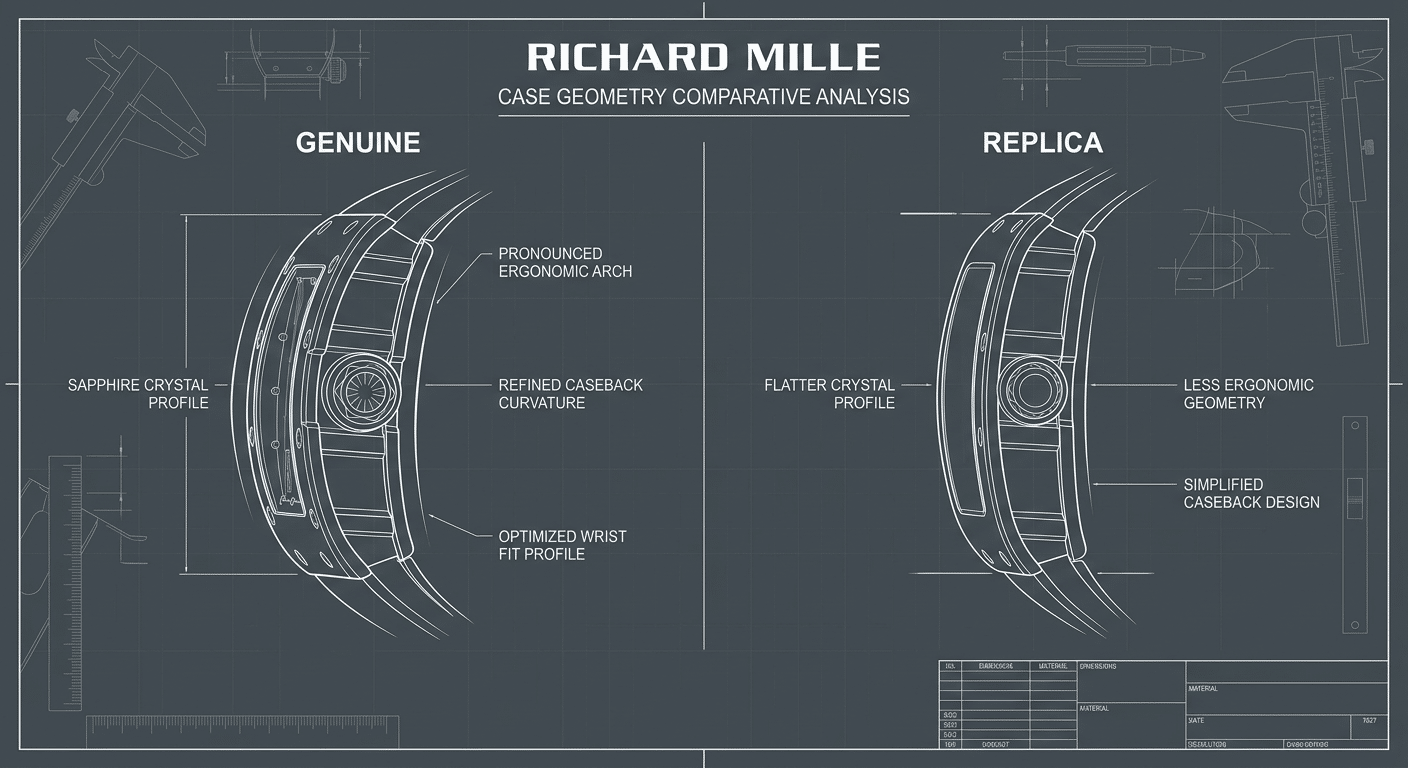
But it’s not just a number. It’s the profile. The gentle, continuous curve that flows from the bezel, over the caseband, and into the caseback is a compound surface that’s fiendishly expensive to machine accurately. Replicas often flatten this curve, creating harsh transitions or an overall “taller” look that loses the sleek, organic feel of the original. From the side, this is the fastest tell.
Lug Geometry: Where the Strap Meets the Case (and Often Fails)
The lugs on a Richard Mille are not an afterthought. They are sculpted extensions of the case, with precise angles that dictate how the strap integrates and how the watch hugs the wrist. Incorrect lug geometry is a silent killer of the illusion. When the angle is off—even by a few degrees—the strap doesn’t flow naturally. It may buckle, gap, or pull awkwardly, making the watch wear like a blocky toy rather than a fitted instrument.
Spring bar hole placement is another giveaway. On a genuine RM, these are drilled with surgical precision in relation to the case curvature. On replicas, they are often placed slightly too high, too low, or at the wrong angle, again disrupting the seamless integration of strap to case. It’s a detail you feel before you see.
Caseback Contour: The Hidden Tell of Simplified Engineering
Few people examine the caseback of a skeleton watch as closely as the dial, but its contour is a dead giveaway. A genuine RM caseback is rarely flat. It’s curved to follow the shape of the wrist, often with subtle channels or contours that match the internal movement structure. This is expensive, complex CNC machining.
Replica cases, in their drive for cost-effective production, frequently feature a simplified, flatter caseback. This not only affects comfort but also alters the entire watch’s center of gravity on the wrist. It’s a hidden compromise that screams “replica” to anyone who has handled the genuine article.
Expert Authentication Insight
Physical diagnostic: The shadow-line test. Place the watch on a flat surface with a single light source to the side. Observe the shadow line that runs along the case’s flank. On a genuine RM, this line will be a smooth, continuous curve. On a replica with a flattened profile, the shadow will break or show an inconsistent curvature. For lugs, use a digital angle finder app on your phone. Measure the angle of descent from the case edge to the spring bar hole. A deviation of more than 3-5 degrees from the genuine spec (often available in technical drawings online) is a clear indicator of simplified, inaccurate construction.
Skeleton Layout & Bridge Geometry: The Art of Negative Space
Moving past the case, the next great deception lives behind the crystal. A skeletonized watch isn’t just a movement with holes; it’s a meticulously calibrated composition of negative space. The bridges aren’t just functional; they are the primary visual element. Here, “super clone” claims often dissolve upon inspection, revealing a fundamental misunderstanding of what makes a Richard Mille movement visually coherent.
The core conflict is between a decorated plate and a constructed skeleton. The former is a stamped metal cover glued over a standard movement. The latter is an attempt to actually build a movement architecture that mimics the original’s layout. The difference is night and day.
Bridge Design: From Shape to Surface Finish
Genuine RM bridges are skeletal, sharp, and finished with a combination of satin brushing, polished bevels, and sometimes a dark PVD coating (simulating grade 5 titanium). Their shapes are specific and purposeful—angular, asymmetrical, and forming a distinct graphic pattern.
Replica bridges are often the wrong shape: too thick, too rounded, or simply a generic “skeleton” pattern that only vaguely recalls the real thing. The finishing is another layer of separation. Where the gen has razor-sharp, polished bevels, replicas have soft, rolled edges. The surface finishing is often a single, flat texture instead of the multi-step process that gives genuine bridges their depth and visual pop.
Jewel and Gear Placement: The Map of the Movement
The placement of the ruby jewels and the visible gears is the “map” of the movement. On a genuine RM, this layout is a result of the movement’s actual gear train. Every jewel marks a pivot point; every visible gear is part of the functional architecture.
On replicas using a decorative plate, this map is often fiction. Jewels may be placed in visually “correct” spots that don’t correspond to any underlying pivot. Gears may be printed on the plate or be non-functional decorations. Even on better replicas using a modified base movement (like a Seiko NH05 for RM 035 clones), the gear and jewel placement is a compromise, forced to fit the constraints of the donor movement, which is a key point detailed in the Richard Mille super clone buyer guide. This leads to subtle but telling misalignments.
The Depth Illusion: How Genuine RMs Create Layers
A genuine skeletonized movement has depth. You can see multiple layers of gears and bridges stacked beneath the main plate, creating a three-dimensional, architectural view. This is achieved through sophisticated construction and finishing.
Most replicas are fundamentally two-dimensional. The decorative plate sits on top, and everything beneath it is a dark, indistinct void. There is no layering, no sense of mechanical depth. It’s a poster, not a sculpture. This flattening of the visual field is one of the most immediate signs that you’re not looking at a complex mechanical movement.
Expert Authentication Insight
Physical diagnostic: The symmetry and alignment test. Using a high-resolution macro photo (ask your dealer for one), draw imaginary lines through the center of key visual elements: the main bridge, the balance wheel, and the larger jewel settings. On a genuine RM, these lines will create a coherent, balanced, and intentional geometric pattern. On a replica with a generic or poorly copied layout, these elements will feel visually “crowded,” misaligned, or randomly placed. The pattern will lack the purposeful, almost architectural harmony of the original.
Material Illusion: Carbon, Quartz, Ceramic, and the Feel of Cost
This is where the “super clone” fantasy often collides with material science. A dealer can call a case “carbon TPT” or “ceramic,” but the word alone doesn’t conjure the substance. The gap between the name on a product page and the object in your hand is vast, defined by weight, sound, texture, and thermal properties—things you feel, not just see. Understanding this illusion is critical to setting a realistic price-value expectation. You’re not buying the material; you’re buying a visual and tactile impression of it.
Carbon Fiber: Weave, Depth, and the Myth of “TPT”
Let’s be unequivocal: no replica uses genuine Carbon TPT or Quartz TPT. That material is the proprietary result of an exclusive partnership between Richard Mille and Swiss company North Thin Ply Technology (NTPT). The genuine article involves hundreds of layers of micron-thin carbon or quartz filaments, each rotated 45 degrees, cured under high pressure and heat into a solid block, and then CNC-milled. The result is a deep, three-dimensional, wood-grain-like pattern with no repeats—a structural element that can be tapped, machined, and threaded directly.
Top-tier replicas from factories like APS or ZF use what’s called forged carbon. It’s a legitimate composite, but the process is different: short, random carbon fibers are mixed with resin and injection-molded. The pattern is more chaotic, often with a “marble” or “swirl” effect, and can lack the precise, layered depth. Lower-tier pieces might use simple carbon fiber sheets or, in the worst cases, hydrographic printing—a film with a carbon pattern applied over plastic or metal. The tells are visual and tactile: a flat, glossy, or overly uniform pattern, a lack of deep texture you can feel with a fingernail, and edges that might show a different material beneath.
Ceramic: Weight, Temperature, and Sonic Clues
Ceramic is another term that hides a multitude of sins. Genuine Richard Mille uses high-tech ceramics like ATZ (Alumina Toughened Zirconia), which are incredibly hard, scratch-resistant, and have a specific, dense heft. They also feel cooler to the touch than metal at room temperature and have a distinctive, high-pitched “clink” when tapped.
Replica ceramics vary wildly. The best, like those from BBR Factory for the RM 055, are actual zirconia ceramics, but the grade and sintering process differ. They’ll be hard and scratch-resistant but may have a slightly different weight or color tone (e.g., a “cheese white” that’s off by a shade). Many others use ceramic-coated metal, which is significantly heavier, feels warmer, and sounds duller when tapped. The cheapest are simply painted metal. The “tap test” with a fingernail is revealing: a genuine or high-grade ceramic case gives a sharp, resonant *ping*; coated metal gives a soft, muted *thud*.
Metal Finishes: Brushing, Polishing, and the Sheen of Quality
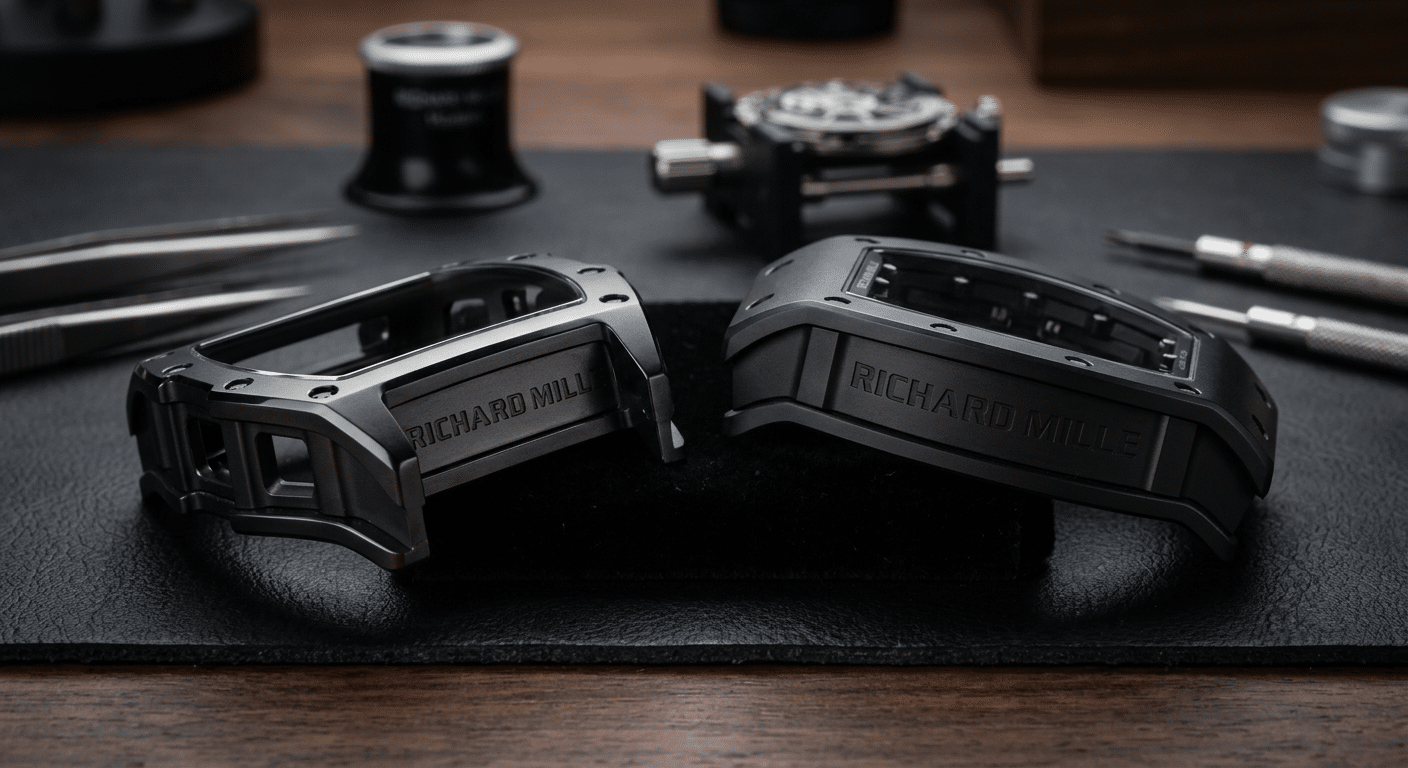
Even with metals like titanium, the finish is a dead giveaway. Genuine RM cases undergo dozens of finishing steps—specific types of sandblasting, satin-brushing, and polishing—to achieve a signature look that plays with light in a controlled way. Replica finishing is often simpler, faster, and less consistent.
The brushed surfaces may look too uniform or too harsh. Polished bevels might lack the razor-sharp, defined edge of the genuine article and can show microscopic polishing marks or a slightly orange-peel texture. On titanium models, the color itself is often wrong—genuine grade 5 titanium has a specific, warm grey hue under natural light, while replicas often use lower-grade alloys or coatings that appear cooler, flatter, or more silvery.
Expert Authentication Insight
Physical diagnostic: Use a multi-sense approach. First, the tap test: gently tap the case with a metal object like a pen. Listen. A high-pitched, crystalline ring suggests real, high-density ceramic. A dull thud suggests metal. Second, the thermal test: ceramic will feel cooler to the touch than ambient-temperature metal. Third, the visual depth test for carbon: under a bright light or macro lens, examine the pattern. Genuine NTPT/Quartz TPT has a deep, layered, non-repeating “grain.” Replica forged carbon has a more random, swirling, sometimes bubbly pattern. Printed carbon will look completely flat, with a visible film or pixelated pattern at the edges.
Functional Pretense: Complications, Crowns, and the “Working” Fantasy
A “super clone” implies total fidelity, but the functionality is where shortcuts are most blatant. This is the moment of truth when you interact with the watch beyond telling time. The crown, the pushers, the rotor—these are the interfaces where the engineering fantasy meets the mechanical reality of a replica. The disappointment of a non-functional button or a gritty crown action is a stark, tactile reminder of what you’re actually wearing.
The Crown: Shape, Action, and Rubber Detail
The crown on a Richard Mille is a signature design element, often a complex, multi-material component with a rubber insert. On a replica, this is frequently a point of failure. The shape might be subtly off—too bulbous, too flat, or with incorrect proportions. The threading can feel rough or cross-thread easily. Most damning is the rubber insert: on a genuine RM, it’s a specific, high-grade fluoroelastomer with a precise texture and flush integration. On replicas, it’s often a cheaper, glossier rubber that can be proud of the metal or recessed, with a different feel entirely. Turning the crown on a high-tier replica with a modified movement might feel acceptable; on one with a cheap base movement hidden under a decorative plate, it can feel gritty and vague.
Pusher Psychology: The Expectation of a “Click”
This is pure buyer psychology. You see chronograph pushers on an RM 011 replica. Your brain expects a crisp, mechanical engagement. What you get defines the tier of the watch. There are three realities:
- Dummy Pushers: They don’t press. They’re fixed, decorative elements. This is common on low-tier “super clone” claims.
- Working Meca-Quartz Pushers: The watch uses a hybrid movement like a Seiko VK64. The pushers click and the chronograph functions, but the central seconds hand ticks once per second (a quartz movement), not in the smooth sweep of a mechanical. It works, but it’s a different mechanism.
- Working Mechanical Pushers: Found in replicas using a Shanghai 7750 chronograph movement (like some RM 011s). They function, but often with a mushy, less precise feel, and the movement adds significant thickness. The genuine flyback function is never replicated.
The “super clone” marketing rarely specifies which of these three you’re getting.
The Rotor: Spinning Mass or Static Decoration?
On an automatic skeleton watch, the rotor is a central visual component. On a genuine RM, it’s a functional, free-moving mass that winds the mainspring. On many replicas—even some expensive ones—it’s a static, decorative piece of metal glued or screwed into place. It doesn’t move. You can turn the watch in your hand and it remains motionless. This is a critical check. A functional rotor will spin freely with a slight inertia when you rotate the watch. A fake rotor is dead weight. This isn’t just about function; a static rotor immediately reveals the movement beneath as a simpler, cheaper caliber that doesn’t support a peripheral rotor system.
Expert Authentication Insight
Physical diagnostic: The interaction protocol. For any watch with pushers, request a video of them being pressed and the chronograph hand moving. Observe the hand motion: a smooth sweep indicates a mechanical chronograph module (likely a 7750), a distinct tick-tick motion indicates a meca-quartz (like a VK64). For the rotor, ask for a video of the watch being gently tilted. A functional rotor will swing freely. A static “rotor” will not budge. For the crown, ask for a macro shot of the rubber insert and its integration with the metal—poor finishing here is a universal low-tier tell.
The Movement Reality: The Beating Heart of the Deception
This is the non-negotiable core truth that every buyer must accept: there is no such thing as a cloned Richard Mille movement inside a replica. The genuine calibers—with their grade 5 titanium bridges, free-sprung balances, and Chronofiable® certification—are utterly unattainable at the replica price point. The “super clone movement” is always, without exception, something else, a reality detailed in this comprehensive Richard Mille super clone guide. What you’re buying falls into one of three categories, each with profound implications for the watch’s appearance, thickness, and soul.
The Decorative Plate: A Super Clone’s Greatest Shame
This is the oldest and most common trick. A standard, off-the-shelf Chinese automatic movement—like a Seagull 2824 or a Miyota 9015—is fitted with a stamped, painted metal plate that has holes cut out to look like a skeletonized movement. The gears you see are part of the plate, not the actual movement. This is why the layout never quite matches the genuine RM’s architecture. The bridges are in the wrong places, the “gears” don’t align with anything underneath, and the whole affair has a flat, two-dimensional quality. It’s a costume. Any watch using this method automatically disqualifies itself from any serious “clone” discussion, regardless of how good the external case is.
Modified NH05 and Its Siblings: The Current “Best Effort”
This is the standard for today’s high-tier replicas from factories like APS and ZF. They start with a simple, skeletonized base movement—most commonly a Seiko NH05A or a Chinese clone of it. This movement has its own real gears and bridges in a rough skeleton layout. Factories then modify it: they reshape the existing bridges via CNC, add custom decorations, apply perlage or Geneva stripes, and often add a custom rotor. The result is a movement that has a functional architecture—the gears you see are real and turn—and a layout that approximates the genuine RM’s much more closely. The Dandong-made “RMUL2” clones powering the best RM 035 and 055 replicas are advanced examples of this approach. However, they are still fundamentally based on a simple, inexpensive movement core. They are not thin, lightweight, or technically related to a genuine RM caliber.
Thickness and Reliability: The Inevitable Compromises
The movement choice dictates the watch’s profile and longevity. The decorative plate adds height. The modified NH05, while more architecturally honest, is still a thick movement. This is why even the best RM 011 replicas are noticeably thicker than the gen—they house a bulky Shanghai 7750 chronograph movement. This unavoidable thickness is a permanent tell.
Reliability is the other trade-off. The decorated base movements are generally robust but unremarkable. The more complex modified movements, while impressive feats of reverse-engineering, are low-volume projects without the long-term testing and refined lubrication of a mass-produced Swiss caliber. Serviceability is a question mark; a local watchmaker may not touch it. The expectation should be for a functional lifespan of a few years, not decades.
Expert Authentication Insight
Physical diagnostic: The hand-wind and listen test. Gently wind the crown. A movement with a thick decorative plate often has a vague, gritty, or uneven feel with a “dead zone” before engagement. A modified base movement will feel smoother. More definitively, observe the beat rate. Film the seconds hand or balance wheel in slow motion. A standard Chinese automatic beats at 21,600 vibrations per hour (6 beats per second), a slower, more visible tick. Many genuine RM movements beat at 28,800 vph (8 beats per second), a faster, smoother sweep. If you see a slow, distinct tick in a skeletonized RM replica claiming to be a “super clone,” you’re looking at a standard movement underneath the decoration.
The Market Speak Decoder: “1:1,” “Perfect,” and Other Meaningless Phrases
The replica watch marketplace runs on a language of its own—a dialect of aspiration where adjectives are currency and precision is often the first casualty. To navigate it, you need a translator. This isn’t about cynicism; it’s about converting marketing hyperbole into tangible, verifiable questions. When every watch is advertised as the “best,” “latest,” and “most 1:1,” the terms lose all meaning. Your job is to restore it.
Forget what a dealer says the watch is. Focus on what they can show it does, and what they are willing to specify it’s made of. The most powerful tool you have isn’t your credit card; it’s your skepticism.
From Hype to Reality: Translating the Top 5 Claims
Let’s decode the lexicon. Treat these not as statements of fact, but as prompts for investigation.
- “1:1 Perfect Clone” / “Super Clone”: This is the zenith of replica marketing speak. Translation: “This is the best visual approximation currently in mass production from a specific factory.” It does not mean dimensionally, materially, or mechanically identical. It signals an attempt to replicate the overall silhouette and dial layout more closely than a budget “shitter.” Your follow-up question should always be: “1:1 compared to what? Show me a side-by-side with a gen photo.”
- “Same as Genuine Material (e.g., Carbon TPT, Ceramic)”: This is almost always technically false but visually aspirational. Translation: “The case is made from a type of carbon fiber composite or zirconia ceramic.” It will not be Swiss-made NTPT Carbon TPT or the specific ATZ ceramic alloy Richard Mille uses. The grade, manufacturing process, density, and finish will differ. Ask: “Can you provide a macro shot of the material texture?”
- “All Functions Work”: A classic trap. Translation: “The watch tells time.” For a time-only model, that’s true. For a chronograph, it could mean a true mechanical module, a meca-quartz hybrid (like a Seiko VK64), or it could be a complete lie with dummy pushers. You must specify: “Does the chronograph start, stop, and reset correctly? Please send a video.”
- “Latest Version / V4, V5, V6…”: This indicates iteration, not perfection. Translation: “The factory has corrected one or more flaws identified by the community in the previous batch.” This is positive—it shows responsive manufacturing—but “V7” is not a quality score. It means there were six prior versions with known issues. Ask: “What were the specific improvements from the last version?”
- “Super Clone Movement” / “Cloned Caliber”: The most misunderstood term. Translation: “A decorated or modified standard movement (like a Seagull 2824 or Seiko NH05) with bridges shaped to look somewhat like a Richard Mille movement.” No replica contains a true, top-to-bottom cloned RM caliber with grade 5 titanium plates. It is a cosmetic and architectural exercise, not a mechanical one.
Factory Names as Marketing: What “ZF” or “APS” Actually Promises
Factory names (ZF, APSF, BBR) are not quality certifications; they are brand names for manufacturing consortiums. They promise a certain consistency of approach and a known starting point. “ZF” means the watch will likely come from a certain supply chain with that factory’s specific interpretation of case thickness, carbon pattern, and movement decoration. It is a shorthand for a cluster of decisions, not a guarantee.
However, these names are also marketing tools. A “U mi” watch is, by all credible accounts, a ZF product under a different name, sometimes positioned as a “higher-end studio” piece. The label can be used to justify a price premium or signal a new batch. Your focus should be on the tangible outputs of that factory for the specific model you want, not the aura of the name. A factory’s reputation is built on a specific model (e.g., ZF for the RM 35-02, APS for the RM 055 NTPT), not across its entire catalogue.
The Forum Hype Cycle: How Consensus Becomes Exaggerated
Online forums are invaluable for research but are themselves engines of hype. The cycle is predictable: a new model drops from a respected factory; early adopters post glowing reviews (“This is incredible!”);
a consensus forms that this is the “NWBIG” (Not Worth Buying Gen) king; criticism is softly muted because no one wants to admit a $800 purchase is flawed; the hype solidifies into “fact.”
This creates a distorted echo chamber. The language escalates: “good” becomes “great,” “great” becomes “uncalloutable,” and “the best available” morphs into “perfect.” Remember, most forum posters are enthusiasts, not horologists. They are comparing the replica to photos of the genuine article, not to the genuine article on their wrist. The hype reflects joy of ownership and community approval more than forensic analysis. Use forums to identify known flaws and version differences, not to absorb final judgment.
Expert Authentication Insight
The “Specification Request” Protocol: Transform yourself from a passive buyer into an active inspector. When a dealer makes a claim, your response should be a request for specific, non-promotional evidence. This tests the claim and the dealer’s transparency.
- For case thickness: “Please provide a side-profile photo with a digital caliper or a ruler clearly showing the measurement at the thickest point.”
- For material authenticity: “Can you send a macro video panning across the case surface in natural light to show the carbon fiber weave/ceramic finish?”
- For function: “Please send a video showing the chronograph seconds hand start, stop, and reset to zero smoothly.”
- For movement: “Can I see a timegrapher screenshot showing the beat rate and amplitude?”
A reputable dealer will provide this. Hesitation, blurry photos, or deflective answers are your first and most important quality control check. The evidence is always more telling than the adjective.
Conclusion: So, What Are You Actually Buying?
After deconstructing the claims, the materials, and the mechanics, the final question remains: what’s actually in the box for your money? You are not buying a Richard Mille. You are buying a complex, often ingenious, but always compromised facsimile. The intelligent purchase is made by understanding and ranking those compromises. Here is your decision filter, in order of non-negotiable priority:
- The Case & Silhouette: This is the foundation. If the watch sits on your wrist like a clumsy brick because the curvature, thickness, and lug geometry are fundamentally wrong, nothing else matters. No amount of fine movement decoration can overcome a flawed profile. This is the first and most critical visual tell, even from across a room. Verdict: If the case shape isn’t convincingly close, walk away.
- The Movement Truth: Accept the reality. You are choosing between a decorated plate, a modified base movement, or a hybrid. A decorated plate (over a Seagull 2824) offers the lowest cost and the least architectural integrity. A modified base (like an NH05) offers a more believable skeleton layout at a higher price. Know which one you’re getting, and understand that “super clone movement” is a fantasy.
- The Skeleton Illusion: Given the movement reality, judge the visual trick. Does the layout of bridges, gears, and open space create a balanced, coherent pattern that feels like the genuine article from a foot away? Don’t get lost in microscopic finishing flaws; look at the overall geometry and depth. Is it a convincing stage set?
- The Material Expectation: You are buying the impression of carbon fiber or ceramic, not the patented, molecular-level substance. Judge it on whether the visual effect pleases you—the depth of the weave, the color, the sheen—not on whether it matches the technical data sheet of a $100,000 material. Manage your expectations at the atomic level.
- The Functional Reality: Verify every single function described. Assume time and date only, unless proven otherwise. For chronographs, know the mechanism: true mechanical (rare), meca-quartz (common), or dummy (unacceptable at this price). The disappointment of a non-functional pusher is a stark reminder of the replica’s nature.
The term “super clone” is not a destination; it’s a direction. It describes a watch that makes fewer and smaller compromises on the impossible journey toward replicating a micromechanical masterpiece. Your goal is not to find perfection, because it does not exist. Your goal is to find the version where the compromises are the most acceptable to you.
Armed with this hierarchy, you stop shopping for marketing promises and start evaluating tangible objects. You learn to ask the right questions, demand the right photos, and see past the forum hype. This knowledge doesn’t ruin the replica; it liberates you to appreciate a good one for what it truly is—a fascinating, wearable piece of industrial mimicry—and frees you from the disappointment of what it is not. You buy the best available illusion, with your eyes wide open.