
Introduction: The Illusion of Complexity in Richard Mille Replicas
There’s an undeniable, visceral pull to a Richard Mille. It’s not subtle. It’s a statement of extreme engineering, a mechanical spectacle worn on the wrist. For the replica buyer, that spectacle is the entire point. You’re not paying for heritage or stealth; you’re paying for the visual bang-for-buck of a six-figure aesthetic at a four-figure price, a concept best understood through a detailed Richard Mille super clone price guide that breaks down what you really get at different price tiers. The skeletonized dial, the maze of gears, the technical bravado—it’s all there, screaming for attention.
But here’s the cold, hard reality that separates a satisfying purchase from an expensive paperweight: replicating that visible complexity at 0.3% of the cost isn’t an act of precision engineering. It’s an act of strategic compromise, clever deception, and, often, outright fabrication.
When you peer through that sapphire caseback and see all those bridges, gears, and ruby jewels, a critical question emerges: What are you actually buying? Are you buying a watch with working complications, or are you buying a beautifully decorated timepiece with a few functional extras and several expensive-looking liabilities? This isn’t a review of the APSF RM 35-02 or the ZF RM 055. This is a pre-purchase reality check—a forensic audit of functional claims in the high-stakes world of Richard Mille replicas.
The RM Aesthetic: A Replica Maker’s Dream and Nightmare
On the surface, the RM design language is a replica maker’s dream. The brand’s identity is built on exposed mechanics. There’s no ornate guilloché dial to perfectly replicate, no sunburst finish to match. It’s all right there, in the open. The challenge, and the nightmare, lies in the coherence of that openness.
A genuine Richard Mille movement, like the RMUL2 or CRMA6, is a study in architectural integrity. Every bridge has a load-bearing purpose. Every gear is part of a precise, efficient train. The negative space is deliberate, creating a sense of lightness and strength. Replica factories can easily CNC machine a plate that looks like an RM movement. The dream is selling the look. The nightmare is engineering the function that logically explains that look.
Why “Looks Complicated” Is the Easiest Part to Fake
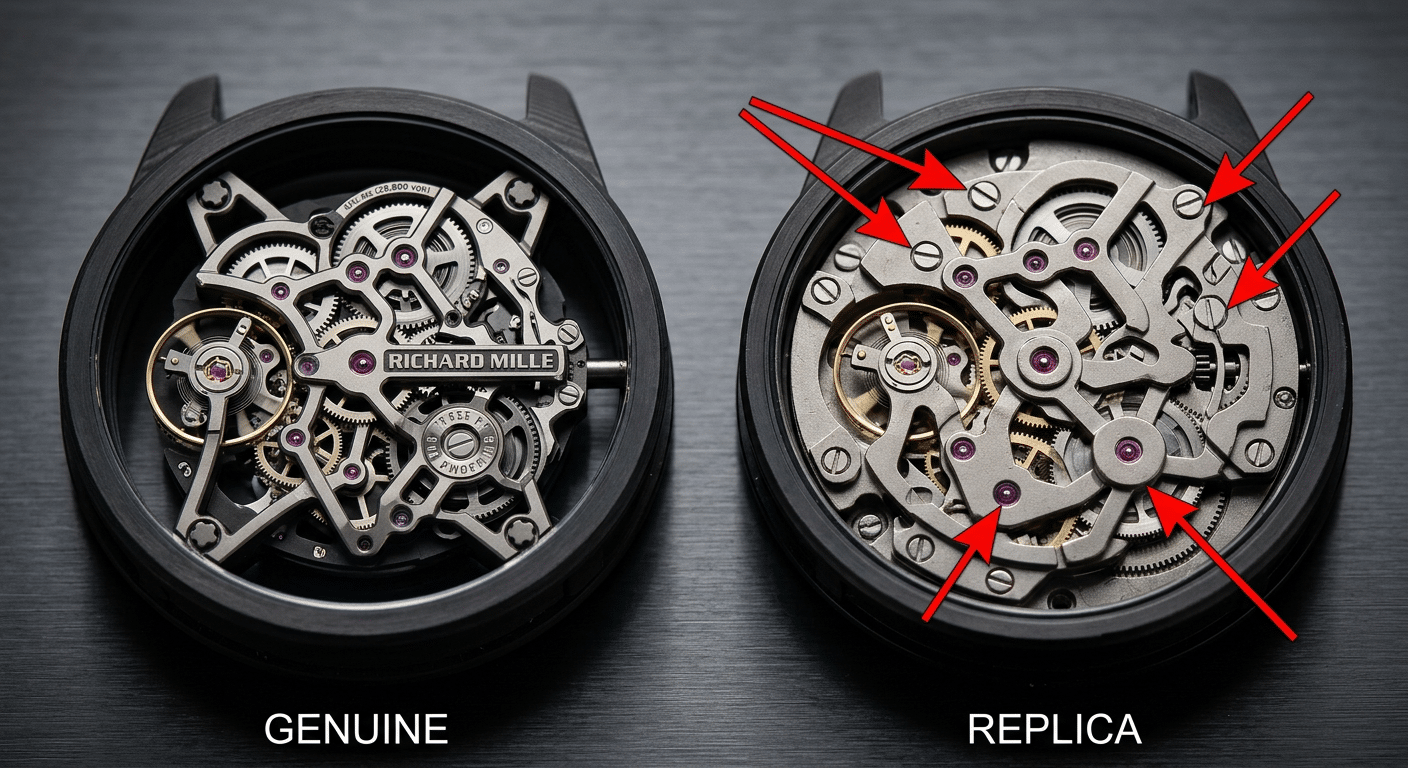
This is the fundamental truth of the high-end replica: visual complexity is cheap. Adding a non-functional, decorative gear costs pennies. Sculpting a bridge that mimics the shape of a genuine titanium support but is made from soft brass and holds nothing of consequence is simple. The factory’s goal is to pass the “glance test”—to create a visual density that overwhelms the untrained eye with a sense of mechanical legitimacy.
This creates the central deception. A watch can be brimming with visual information—gears upon gears, layered plates, sharp anglage—and still be, at its heart, a simple time-only movement with a decorative shell on top. The complication isn’t in the mechanics; it’s in the theater.
Expert Authentication Insight
The most immediate tell in any skeletonized replica isn’t a single flawed screw or a slightly off font. It’s the relationship between parts. Genuine movements have a logical, almost minimalist, flow of energy from the barrel to the escapement. Replicas often have visual clutter—extra gears that lead nowhere, bridges that exist only to fill space, and jewel settings that don’t correspond to actual pivot points. Under a loupe, the difference is one of purpose versus decoration.
The Tourbillon Trap: The Ultimate Test of Replica Ambition
If the skeletonized look is the siren song, the tourbillon is the rocky shore. For a replica buyer, it represents the pinnacle: the ultimate complication, the moving sculpture, the undeniable flex. It’s also the single most reliable way to turn a four-figure watch into a worthless, unrepairable brick.
Let’s demystify it, not as a horological marvel, but as a component in a replica. You are almost certainly facing one of two realities:
1. The “Faux-billon”: This is pure theater. The watch has a static, non-rotating cage fixed to the movement. Inside that cage, a standard balance wheel oscillates back and forth. From a few feet away, it has the “look” of a tourbillon—a visible balance wheel inside a framework. It’s a decorative module, adding zero functional value and significant points of failure for dust ingress and impact damage.
2. The Functional Time Bomb: This is the real, rotating tourbillon cage. And it is a trap. Building a reliable, shock-resistant tourbillon is one of watchmaking’s greatest challenges. Building one to sell for under $1,000 is an exercise in catastrophic compromise. The tolerances are microscopic, the lubrication is critical, and the assembly requires a watchmaker’s touch. Replica tourbillons are assembled on production lines, not at benches. They are astonishingly fragile. A slight bump, a sudden jolt, or simply the wear and tear of its own rotation can cause the cage to warp, a jewel to dislodge, or the hairspring to tangle. When it fails—and it often does within months—it typically jams the entire escapement, stopping the watch dead. Finding someone who can, or is willing to, service a replica tourbillon is nearly impossible, and the cost will far exceed the watch’s value.
The advice is brutal but simple: Consider any working replica tourbillon a temporary, kinetic art installation. Appreciate its mesmerizing spin while it lasts, but do not for a second rely on it as a timekeeping organ or expect it to survive the rigors of actual wear.
Identifying a “Faux-billon”: The Quick Visual Checks
You don’t need to be a watchmaker to spot a fake tourbillon. The most common type, the “faux-billon,” is easily exposed. Look for the cage itself—the metal structure that should hold the balance wheel and escapement. In a real tourbillon, this entire cage rotates, typically completing one revolution per minute. In a “faux-billon,” that cage is stationary. Only the balance wheel inside it moves, beating back and forth. If the outer structure doesn’t move relative to the dial and case, it’s a decoration, not a complication.
The Grim Reality of a “Working” Replica Tourbillon: Service Life and Failure Modes
Assume a lifespan measured in months, not years. The primary failure points are the cage bearings (which become gritty and seize), the hairspring (which deforms or catches on the cage), and the shock absorption (which is virtually nonexistent). When it fails, the repair is rarely a simple cleaning. It often requires a complete replacement of the tourbillon carriage assembly—a part that is factory-specific, rarely sold separately, and difficult to install. Most watchmakers will refuse the job. You are left with a very expensive, very broken sculpture.
Expert Authentication Insight
Ignore the seller’s description of “1:1 working tourbillon.” Perform the tilt-and-watch test. Hold the watch in your palm and gently tilt it in different directions. A genuine (or true replica) tourbillon’s cage will rotate smoothly and continuously, using gravity to change its orientation. A “faux-billon” will show only the balance wheel oscillating inside a stone-dead, stationary cage. Even with a real rotating cage, watch for a jerky, stuttering, or uneven rotation—a sure sign of poor construction and imminent failure.
Chronograph Functions: Pushers That Push Your Luck
Moving from the spectacular to the (theoretically) practical, the chronograph is a function a buyer might actually want to use. This is where the replica game shifts from outright theater to a spectrum of compromised functionality. A chronograph isn’t one thing; it’s a system: pushers, a clutch, a coupling lever or column wheel, a series of additional gears, and a reset hammer. Replicating this system reliably is exponentially harder than making a hand sweep around a dial.
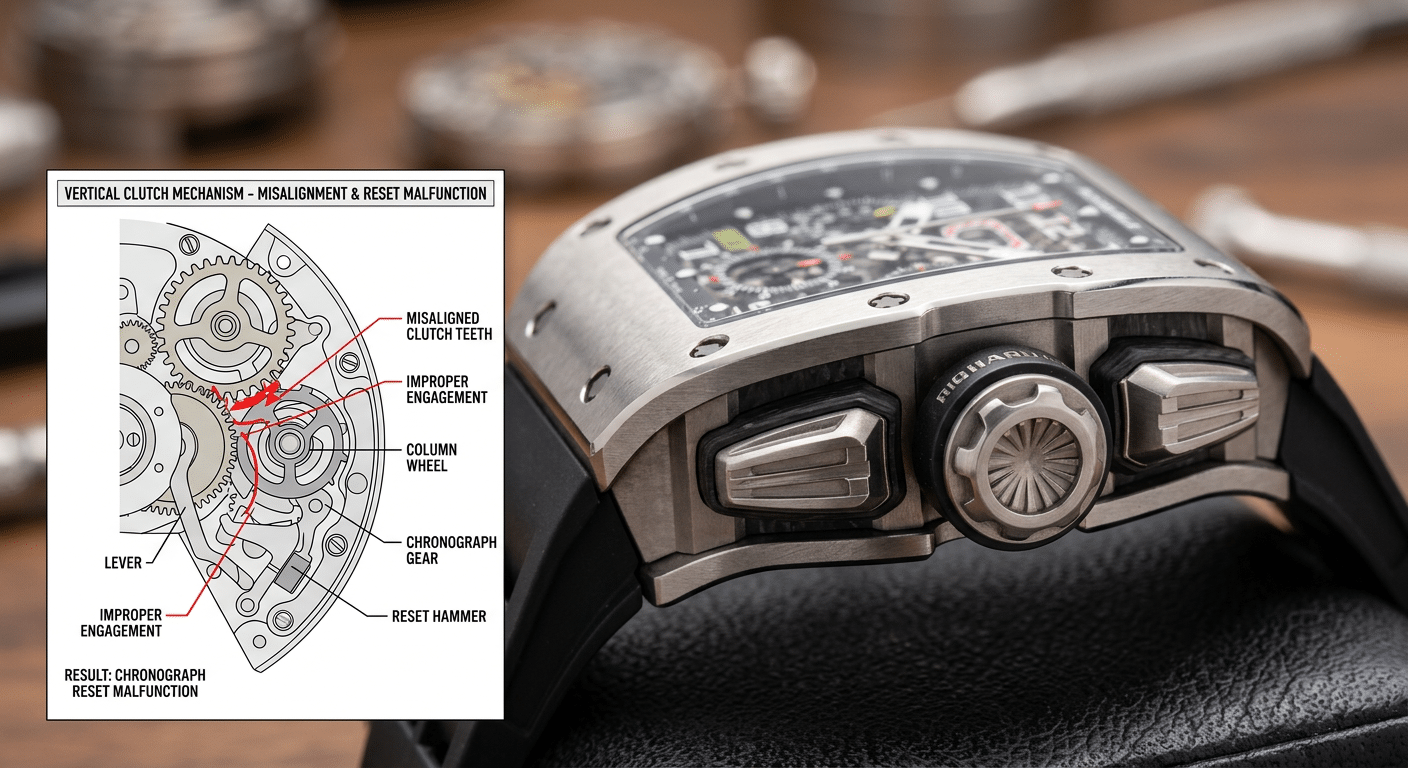
Most “chronograph” Richard Mille replicas, like the popular RM 011 models, use a modified base movement—often a Seagull ST19 or a Shanghai 7750—over which a skeletonized, RM-style plate is fitted. The pushers may actuate, the seconds hand may start and stop, but the experience is a world apart, especially when considering the detailed evolution of super clone movements. The pusher feel is often mushy, with vague engagement and long travel. The reset can be misaligned, leaving the hand a degree or two off zero—a constant, irritating reminder of the compromise.
The worst-case scenario, common in cheaper models, is a chronograph seconds hand that is simply fixed to the running seconds post. The pushers do nothing; the sub-dials are frozen. It’s a complete facade. The critical warning is this: Using a replica chronograph regularly is the single fastest way to necessitate a repair. The added stress on the movement’s gear train and the fragility of the add-on module make it a liability, not a tool.
The Spectrum: From Fixed Hand to Fully Functional (But Fragile)
Quality here exists on a steep slope:
- Dead Pushers, Fixed Hand: Pure decoration. The chronograph hand is a running seconds hand. Avoid completely.
- Functional but Flawed: The pushers work, but reset is sloppy, the action feels crude, and long-term reliability is poor. This describes most modified 7750-based RM reps.
- Surprisingly Functional: Seen in some higher-tier models with better-integrated modules. The action is acceptable, reset is near-perfect, but it remains the most fragile part of the movement. Treat it as a party trick, not a daily driver.
Feeling the Difference: Pusher Feedback as a Quality Indicator
The tactile feedback of the pushers is a direct window into the quality of the chronograph module. A well-made chronograph has a crisp, two-stage feel: a light initial pressure to engage the clutch, followed by a definite, satisfying click to start or stop. The reset should be a firm, single-action snap. In a replica, you’ll often feel a long, spongy travel with a vague engagement point, or a gritty, grinding sensation. This isn’t just an aesthetic flaw; it’s a symptom of loose tolerances and poor lubrication that predicts early failure.
Expert Authentication Insight
The most telling test is the reset function. Start the chronograph, let it run for a full 30 seconds, stop it, and then press the reset pusher. Observe the chronograph seconds hand meticulously. Does it snap back precisely to the 12 o’clock position? A high-quality movement will. In a mid-tier replica, you’ll often see a consistent drift of a few seconds mark—it might always reset at 58 seconds, for example. This indicates a poorly aligned reset hammer or clutch. In the worst cases, the hand won’t move at all, or will jump erratically, signaling a disconnected or broken mechanism. This simple test reveals more about internal quality than any sales pitch.
Power Reserve Indicators: Often the First Lie You’ll See
Of all the complications a Richard Mille replica attempts to simulate, the power reserve indicator is the one most likely to be a complete fiction. It’s a perfect storm: it looks mechanically sophisticated to a novice, it’s relatively simple to fake, and it’s a key part of the “technical instrument” aesthetic. What you’re usually getting isn’t a gauge of your mainspring’s tension, but a tiny piece of mechanical theater designed to close the sale.
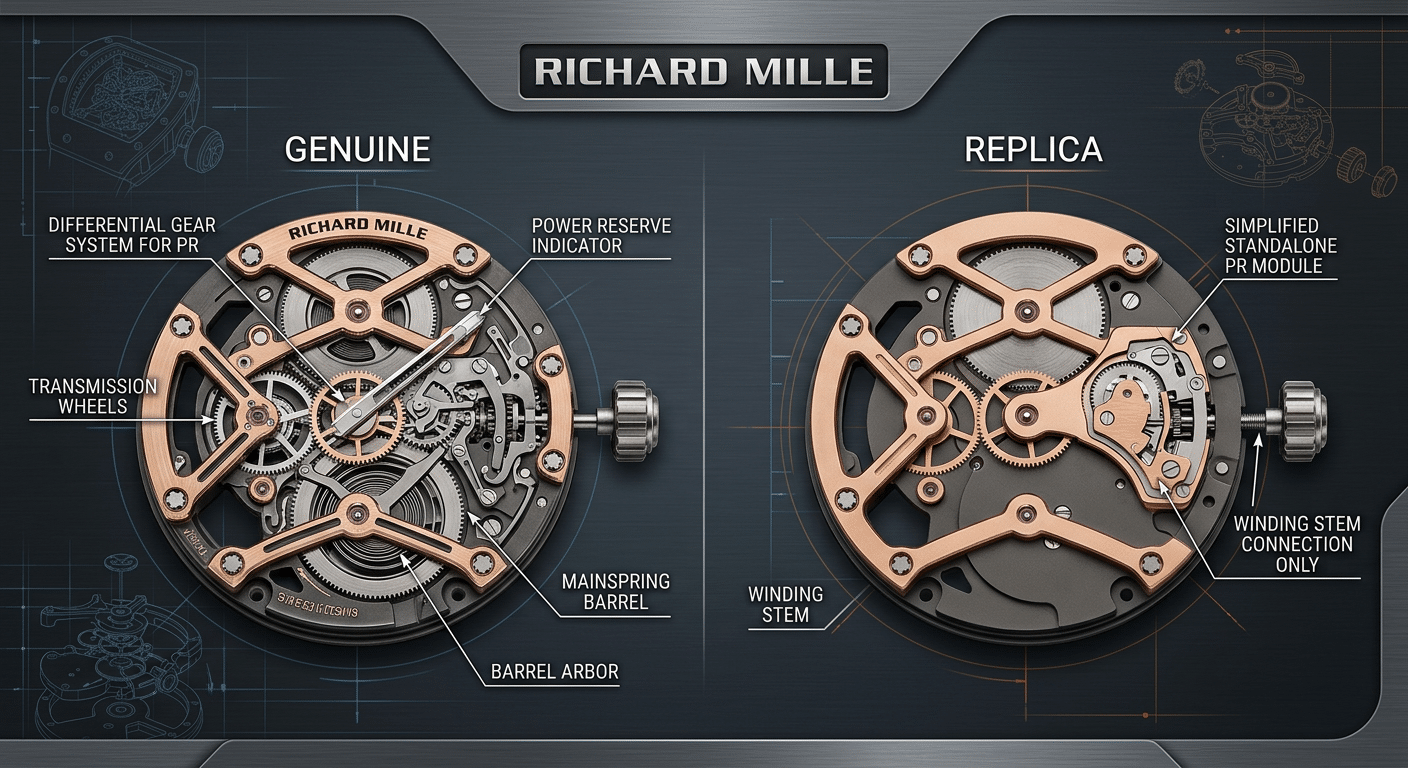
A genuine power reserve is a direct, calibrated link to the mainspring barrel. As the spring unwinds, a series of reduction gears moves the hand gradually from “Full” to “Empty.” In a replica, this integrated system is almost always absent. Instead, factories install a simple, standalone module—often just a tiny auxiliary spring linked directly to the winding stem. When you turn the crown, this separate spring winds and moves the hand in a smooth, linear arc, completely independent of the actual power in the main movement. It’s a convincing pantomime, but it tells you nothing about how much run time you have left.
How Fake Power Reserves Are Built: The Simple Module Trick
The construction is brutally straightforward. Behind the dial, next to the actual movement, sits a small add-on mechanism. It typically consists of its own tiny spring and a basic gear train that is triggered exclusively by the act of winding the crown. This is why the hand often moves with a perfectly steady, metronomic sweep as you wind—it’s mechanically divorced from the variable tension of the mainspring. In the cheapest executions, the hand is simply fixed in place, forever pointing optimistically at the 50-hour mark. The goal isn’t function; it’s to complete the visual blueprint of a complex watch.
The Winding Test: Exposing a Dummy Indicator in 30 Seconds
You don’t need a watchmaker to spot this. The most damning test requires only patience. Wind the watch 30-40 times to move the power reserve hand to “Full.” Then, set it aside and let it run until it stops completely. Now, look at the power reserve hand. If it’s a fake, disconnected module, the hand will still be sitting proudly at “Full” or somewhere along the scale, blissfully unaware that the watch is dead. A genuine—or even a properly linked replica—indicator will have tracked down to “0” or “Empty.” This disconnect is the single most definitive proof of a decorative complication.
Expert Authentication Insight
Conduct the disconnection test. Wind the watch 20-30 times to move the PR hand. Then, let the watch run down completely until it stops. If the power reserve hand is still pointing anywhere but “0” or “Empty,” it’s a fake, disconnected indicator. A genuine linked indicator will follow the mainspring’s discharge. For an even quicker check, after winding it to the midpoint, give the case a firm tap with your finger. A fake module’s hand can sometimes jump or settle into a different position, revealing its loose, non-integrated nature.
Date Displays and Skeletonization: Where Form Cripples Function
The Richard Mille aesthetic is a war on clutter. Every bridge is skeletonized, every gear is exposed. This pursuit of visual transparency comes at a direct cost to the simplest of functions: telling the date. In a replica, the date window isn’t an afterthought; it’s an architectural casualty. The extreme skeletonization that makes the watch so compelling to look at often renders its date completely useless in practice.
The problem is one of real estate and priority. On a genuine RM, the date disc, its window, and the changing mechanism are meticulously integrated into the movement architecture. In a replica, where the goal is to mimic the look of a multi-layer, open-worked caliber for $800, the date is frequently an awkward add-on. The date disc is often a flimsy, poorly printed ring tucked beneath a dial that wasn’t truly designed to accommodate it. The result is a function that is, at best, a struggle to read and, at worst, a point of rapid failure.
The Legibility Sacrifice: Why Replica RM Dates Are Often Unreadable
Forget the romance of a complication; can you even read the number? On many replica RMs, the answer is a frustrating “barely.” The date window is frequently a tiny, poorly defined cutout that doesn’t properly frame the numeral. The printing on the date disc can be misaligned, fuzzy, or suffer from low contrast against the background. Since the dial is largely open, there’s often no clean, solid-colored backdrop behind the date window to make the number pop. Instead, you’re trying to read a white number superimposed over a confusing tapestry of gears and bridges. In low light, it becomes a guessing game. This isn’t a minor flaw; it’s the complete negation of the function’s purpose.
Skeleton Bridges as Structural Vulnerabilities, Not Just Decor
This compromise extends beyond the dial to the very bones of the watch. Those beautiful, skeletonized movement bridges aren’t just for show on a genuine RM; they are precision-machined from grade 5 titanium or other high-performance alloys, engineered for strength and rigidity. In a replica, they are typically stamped or CNC-milled from softer brass or base-grade steel, then plated to look the part.
This has a critical mechanical consequence: structural weakness. These thin, ornate bridges are stress points. A minor impact that a solid movement plate would shrug off can bend or crack a poorly made skeletonized bridge. When that happens, it’s not just a cosmetic issue—it can misalign gears, bind the gear train, and stop the watch dead. The very feature that sells the watch’s technical drama becomes its most likely point of mechanical failure.
Expert Authentication Insight
Inspect the date change at midnight. Use the crown to advance the time and watch the date changeover. In a good replica, it will snap over near midnight. In a poor one, it may begin changing hours early, get stuck mid-change, or the number will be visibly misaligned in the window. This indicates a low-quality date mechanism. For the bridges, look for rough, unfinished edges on the underside of the movement visible through the case back. Genuine finishing, even on internal surfaces, is meticulous. Ragged machining is a telltale sign of cost-cutting and potential weak points.
The Base Movement Truth: The Engine Beneath the Drama
Strip away the decorative plates, the faux-complications, and the skeletonized glamour, and every Richard Mille replica is built atop a humble, mass-produced Chinese base movement. This is the non-negotiable core truth. The breathtaking facade you see through the sapphire is just that—a facade, mounted onto a workhorse engine that costs a fraction of the watch’s total price. The long-term reliability, timekeeping accuracy, and serviceability of your $1,000 “super clone” hinges entirely on the quality of this $50-$150 base caliber and how well the decorative superstructure is glued to it.
Forget the factory names and “RMUL2-clone” marketing for a moment. The vast majority of RM replicas are built on a short list of proven, industrial movements. The manual-wind models often use a Shanghai 3L series or a Hangzhou 7000-series base. Chronographs frequently rely on the Seagull ST2555. Tourbillons are built on Hangzhou 6460 or Seagull ST8000 bases. These are not bad movements—they are the backbone of the entire mid-range Chinese watch industry. But they are simple, utilitarian engines never designed to be the heart of a $300,000 spectacle. The factory’s skill lies in machining a new set of skeletonized bridges that bolt onto this base, redirecting its gears to power subsidiary dials and hiding its mundane origins.
Common Base Movements and Their Known Failure Points
Each common base movement brings its own quirks and failure patterns. The Shanghai 3L, for instance, is robust but can be noisy and is known for having a weaker mainspring that can lose tension over time. The Seagull ST2555 chronograph movement is a workhorse, but its clutch and column wheel can become gritty with poor lubrication, leading to chronograph seconds hand stutter or reset issues. For a more comprehensive breakdown of these and other clone calibers, the Richard Mille super clone guide provides essential analysis. The Hangzhou 6460 tourbillon base is a marvel of mass-production, but its tiny, fast-beating tourbillon cage is notoriously fragile; a sharp knock can bend the cage supports, causing it to stop. Understanding the base is understanding the watch’s inherent limitations.
Module Integration: The Source of Most Functional Problems
The greatest point of failure is rarely the base movement itself. It’s the interface—the literal and figurative friction point—where the factory’s custom skeletonized module meets the stock movement. This is where tolerances stack up, where misalignment happens, and where poor lubrication shows its face first. That chronograph that feels mushy? It’s likely the custom lever system binding against a poorly machined bridge. That power reserve indicator that sticks? It’s the simple module’s gears meshing poorly with the motion works. The watch stops after a light bump? A decorative bridge may have shifted and is now rubbing against a balance wheel. The more complex the facade, the more potential points of failure in the integration.
Expert Authentication Insight
Listen and feel. Manually wind the watch. A well-finished base movement with good module integration will feel smooth with consistent, light resistance. A poor one will feel gritty, jerky, or have points of extreme stiffness. Gently shake the watch near your ear. The sound of the rotor is normal. A symphony of loose, rattling, or grinding sounds (beyond the rotor) suggests poor module attachment, loose screws, or poorly fitted components—a clear warning of future failure. The tactile and auditory experience of the crown and the sound of the movement in motion are more honest indicators of internal quality than any visual inspection of the decoration.
A Realistic Buyer’s Hierarchy: What to Prioritize
After dissecting the mechanical theater, it’s time to build a practical buying framework. The goal isn’t to find a perfect watch—that doesn’t exist—but to make an intelligent compromise. Your budget and desire for drama should dictate your priorities, not marketing claims. Here is the functional hierarchy, from non-negotiable foundation to high-risk spectacle.
1. Timekeeping & Winding: The Non-Negotiable Foundation
This is the absolute baseline. The watch must run, wind smoothly, and keep time within a reasonable margin (think ±15 to ±30 seconds per day). If the base movement—whether a Dandong clone or a modified Seagull—feels gritty, slips, or stops randomly, nothing else matters. This is the engine; everything else is bodywork. A stunning skeletonized facade built on a failing movement is a paperweight.
2. Case & Crystal Quality: The Wrist-Feel Multiplier
This is where your money buys tangible quality. A well-machined case, proper water resistance (even if just for hand-washing), and a sapphire crystal with anti-reflective coating directly impact durability and daily enjoyment. A solid case that feels precise and a crystal that disappears are more valuable to your long-term satisfaction than a faux-complication that adds nothing but potential failure points.
3. Simple Date Function: A Tempered Bonus
If present, treat a date window as a nice-to-have that often comes with headaches. Expect potential misalignment, poor legibility against the skeletonized dial, or a sluggish changeover. If it works cleanly, consider it a win. If it’s flawed, it’s a minor, expected compromise. Never let a faulty date function kill a deal on an otherwise solid watch.
4. Chronograph: A Fragile Party Trick
Consider a working chronograph a potential extra that actively reduces the watch’s projected lifespan. The pushers are common failure points, and the added module is a complexity multiplier. If you must have it, use it sparingly—for timing a parking meter, not a lap at Le Mans. The tactile feedback (or lack thereof) when you press the pushers is a direct indicator of internal build quality.
5. Power Reserve Indicator: Assume It’s Decorative
Until proven otherwise through the winding and drain-down tests, operate under the assumption that any power reserve indicator on a replica RM is a dummy complication. It’s often the first and most blatant lie. A watch that fails this basic truth test should make you question every other “functional” claim.
6. Tourbillon: The High-Maintenance Art Piece
This is the apex of risk. A working replica tourbillon is a mesmerizing, temporary kinetic sculpture with a high probability of catastrophic failure. It is not a reliable timekeeping device. Its presence exponentially increases the cost, fragility, and eventual unserviceability of the watch. Buy it for the visual drama alone, with the understanding that its operational life is measured in months, not years.
The “Safe Bet” Configuration vs. The “Show Piece” Configuration
Your choice boils down to two paths. The Safe Bet prioritizes longevity and wearability: a time-only or simple date model from a top-tier factory like APS or ZF, with a reliable base movement and excellent case construction. You’re buying a spectacular-looking watch that tells time.
The Show Piece is about maximum visual impact at the expense of reliability: a tourbillon from EUR or a complex chronograph. You’re buying a conversation-starting wrist sculpture with a mechanical heart you don’t fully trust. There is no middle ground that offers both bulletproof reliability and high complication; you are choosing a point on this spectrum.
Budget Allocation: Where Your Money Actually Goes
Understand what you’re paying for. In a $800 replica from a top factory, your money is primarily buying: the case material and machining (~40%), the movement and its decoration (~30%), the crystal and strap (~20%), and the factory’s profit and dealer margin (~10%). Chasing a “working” tourbillon for an extra $300 means that $300 is almost entirely allocated to a single, hyper-fragile component that dominates the risk profile. Ask yourself if that allocation matches your priorities.
Expert Authentication Insight
The most revealing quality check happens before you ever look through the caseback. Make your final decision with the crown and pushers. Manually wind the watch. The action should be smooth, with consistent, light resistance. Setting the time should feel precise, not gritty or vague. Press the chronograph pushers (if present); they should have a crisp, defined click. A watch that feels solid, smooth, and precise in these fundamental interactions is signaling better overall internal construction. A watch that looks spectacular but feels cheap and crude when you operate its basic controls is telling you everything you need to know about its priorities—and its lifespan.
Conclusion: Managing Expectations for the Long Haul
The pursuit of a Richard Mille replica is, fundamentally, an exercise in managed compromise. The perfect, fully-functional super clone at this level of mechanical and material complexity does not exist and likely never will. The genuine article’s value is rooted in proprietary materials, aerospace-grade machining, and painstaking hand-finishing—a realm inaccessible at the replica price point.
The path to satisfaction lies in a deliberate mindset shift. Buy the watch for the case, the dial, and the skeletonized *look* on your wrist. Appreciate the audacious design and the technical ambition of the replication. Then, and this is critical, consider any working complication—especially a tourbillon—as a temporary, fascinating bonus, not the core value proposition. It is a feature you hope survives, not one you rely on.
The Mindset Shift: From “Functional Replica” to “Wearable Art”
Stop trying to buy a cheap Richard Mille. You can’t. What you can buy is a spectacular-looking piece of wristwear that tells time. Frame it as wearable art inspired by hyper-mechanical design, not as a mechanical substitute. This shift transforms the experience from one of spotting flaws to one of appreciating the achievement within severe constraints. It turns potential disappointment into grounded satisfaction.
Final Verdict: The One Function You Must Demand
After all the analysis of tourbillons, chronographs, and power reserves, the final verdict distills to one non-negotiable demand: reliable timekeeping and winding. This is the single function that defines a watch as a watch. Everything else—every spinning cage, every sub-dial, every sweeping hand—exists on a sliding scale of risk, compromise, and decorative theater. Ensure the foundation is solid. If the watch tells the time reliably and feels robust in its basic operation, you have a successful purchase. Everything beyond that is a calculated gamble on visual drama. Buy accordingly.