
Understanding JB’s Niche: A Factory for Complexity, Not Convenience
In the ecosystem of replica Richard Mille watches, most conversations orbit around a few key players: ZF for its refined finishing, APS for its movement breakthroughs, and BBR for its historical innovations. These factories compete in a volume-driven race to perfect the “super clone” – watches like the RM 055 or RM 035 that are complex in appearance but, mechanically, are based on robust, time-only architectures. For a comprehensive analysis of factory comparisons and the market presence of these replicas, including a detailed real super clone guide, one must look beyond the mainstream. Then there’s JB Factory. To judge JB by the standards of that mainstream arena is to misunderstand its entire reason for being. JB is not a generalist contender in the super clone wars. It is a specialist workshop that enters the conversation only when the project shifts from refinement to fundamental engineering. Its relevance isn’t dictated by a tier of quality, but by a category of ambition.
Why JB Doesn’t Compete in the “Standard Super Clone” Arena
The economics are misaligned from the start. Factories like ZF and APS thrive on scale. They invest in perfecting a single, versatile clone movement—the Dandong RMUL2—and then deploy it across multiple popular models. Their business is about incremental refinement: better carbon patterns, sharper case engraving, more accurate strap texture. The profit is in volume, and the development cost is amortized over thousands of units. For a model like the RM 035, the challenge is polish, not invention.
JB operates on a completely different calculus. Its focus is on low-volume, high-complexity projects where the primary cost isn’t finishing, but fundamental R&D. While ZF is optimizing the bevel on a case screw for the 10,000th time, JB’s engineers are figuring out how to machine a functional tourbillon cage that won’t disintegrate during its first wind. The cost structure is inverted. JB’s expenses are front-loaded into solving mechanical puzzles that have no scalable solution. Consequently, its price point for a tourbillon model can approach or even exceed that of a top-tier APS super clone, yet offer far less “finished” reliability. For a buyer seeking the best daily-wear RM 055, this makes JB an irrational choice. Its value proposition is not convenience, but attempted conquest.
The Complexity Threshold: Where JB’s Engineering Becomes Relevant
So, when does JB become a necessary consideration? The filter is specific and unforgiving. It activates only when the genuine watch possesses a tangible mechanical or structural complexity that transcends a decorated movement.
1. Genuine Tourbillon Complications: This is the primary trigger. We are not talking about open-heart displays or fixed decorative cages. We mean a fully rotating, regulating tourbillon carriage. If the genuine model has one, the replica landscape instantly shrinks, and JB (alongside EUR Factory) becomes one of the only games in town.
2. Radical Case Architecture: Models like the RM 27 series, with their suspended movements anchored by braided cables, or the RM 56 with its fully sapphire case, present structural replication challenges that go far beyond milling a standard tonneau shape. These are multi-axis, multi-material puzzles where the case is integral to the movement’s function and survival.
3. Movement Replication Beyond the Base Plate: This is for watches where the movement isn’t just a skeletonized plate over a standard gear train. It involves replicating unique shock protection systems, complex bridge layouts, or gear trains that are part of the visual identity. The goal isn’t to look vaguely correct from three feet away; it’s to attempt a facsimile of the mechanical architecture itself.
If your target watch doesn’t cross one of these thresholds, JB is irrelevant. Its entire operation is built for this high-risk, high-difficulty niche.
Expert Authentication Insight
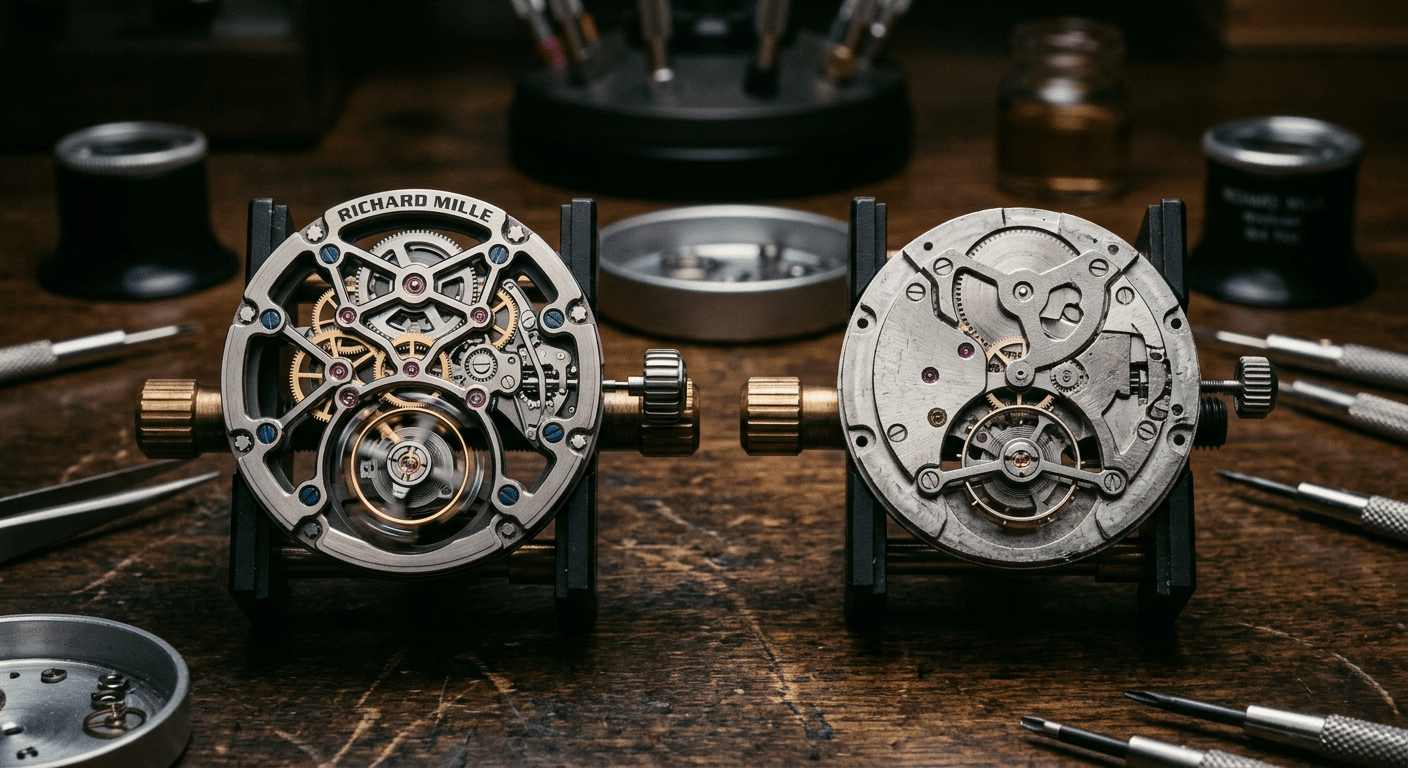
For a JB tourbillon, the primary physical diagnostic is the motion and regulation of the tourbillon cage itself. Under 10x loupe magnification, examine the cage’s rotation: a genuine (and well-made replica) tourbillon will have a smooth, continuous, and perfectly balanced rotation over its full cycle (typically 60 seconds). A flawed or “dummy” implementation will show stuttering, wobble, or an inconsistent rotational speed. Use a timegrapher to measure the beat rate; a true tourbillon’s regulation is inherently different and often less stable than a standard balance wheel, which can be a telling sign of real complexity versus a faux complication.
Decoding JB’s Technical Ambition: The Tourbillon as a Statement
To understand JB is to understand that its core ambition is the tourbillon. Not as a marketing bullet point, but as a mechanical statement of intent. In a market flooded with increasingly perfect clones of relatively simple watches, the tourbillon remains the final frontier—a complication so difficult to replicate that most factories don’t even attempt it. JB’s entire identity is wrapped up in this attempt. It’s not about achieving parity with a $500,000 genuine movement; it’s about the sheer scale of the endeavor itself.
Architecture Over Aesthetics: How JB Approaches Movement Replication
Where mainstream super clone factories prioritize visual fidelity from the outside in, JB’s approach—by necessity—starts from the movement architecture out. The question isn’t just “does it look like an RM tourbillon?” but “does it *function* like one, on a basic level?”
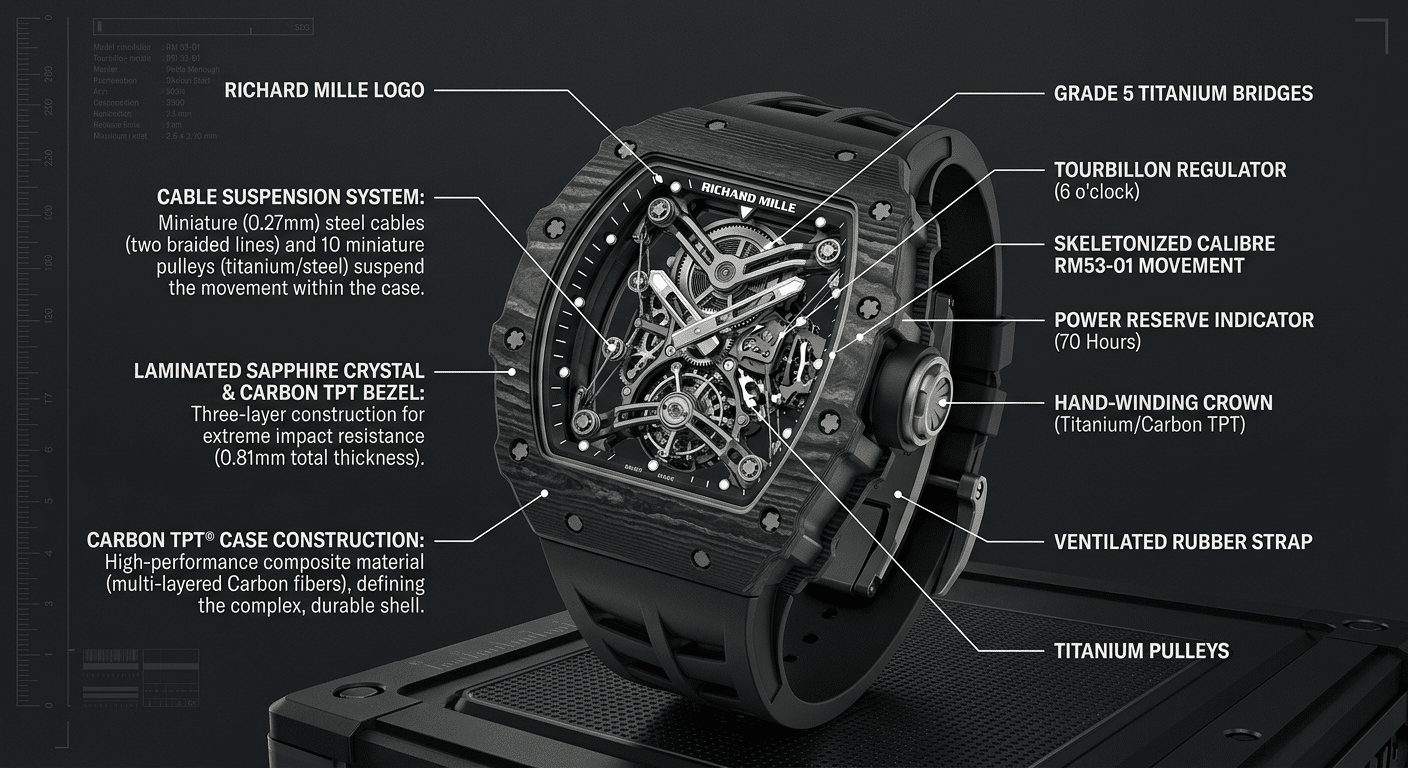
Take the RM 53-01, with its cable-suspended movement. A lower-tier approach would be to fix a generic tourbillon module to a decorative plate that mimics the cable look. JB’s attempt, while imperfect, involves creating a movement structure that is actually suspended from points within the case, attempting to replicate the genuine’s shock-absorbing principle. For the RM 56 sapphire case, the challenge is creating a movement and gear train that can be visually inspected from every angle, forcing a replication of the base plate and bridge layout that isn’t hidden behind opaque plates. JB’s methodology is fundamentally different: they are trying to build a watch, not just dress up a movement.
This contrasts sharply with the common practice of dropping a stock Seagull tourbillon module into a RM-shaped case. JB’s movements, often based on modified ST-80 series calibers, are re-worked to more closely follow the silhouette and bridge structure of the genuine RM caliber. It’s an architectural homage, not just an aesthetic one.
The Reliability Paradox of a Replica Tourbillon
This is the critical trade-off that every potential JB buyer must internalize. A functionally complex replica movement introduces exponentially more potential failure points than a robust, simple clone. This central theme of evaluating replica guide transitional super clone versions is directly applicable, as the delicate hairspring of a tourbillon, the additional gears in the carriage drive train, the precise alignment of the cage—each is a new vulnerability.
In this context, “reliability” has a different definition. It does not mean 10 years of trouble-free daily wear. It means the movement survives the assembly process, can be regulated to a reasonable accuracy (think ±20-30 seconds per day, with less stability than a standard balance), and withstands the gentle shocks of wristwear without the cage stopping or the hairspring tangling. These movements are fragile. They require a gentle hand, periodic regulation by a watchmaker familiar with tourbillons (replica or genuine), and the understanding that they are mechanical art pieces more than utilitarian timekeepers. Owning a JB tourbillon is accepting a higher level of stewardship and a lower threshold for frustration compared to the set-and-forget nature of a ZF RM 035.
Expert Authentication Insight
To assess the legitimacy of the tourbillon construction, disassembly is the only definitive method. However, a strong non-destructive proxy is to observe the movement’s behavior during manual winding and time-setting. A complex, multi-bridge tourbillon movement will have a distinct tactile feel—often a higher-tension winding resistance and specific, subtle feedback when setting the time—compared to a simpler, modular movement hidden behind a decorative facade. The sound of the rotor (if present) and the click of the crown gears can also be indicators of underlying complexity.
The JB Portfolio: Which Models Actually Showcase Its Value?
Applying the complexity filter to JB’s catalog separates the justified projects from the misguided. JB’s value is not uniform; it peaks on specific models where its engineering-focused ambition aligns with the genuine watch’s defining challenges.
Flagship Tourbillon Projects: RM 53, RM 56, and RM 27-02
These are JB’s raison d’être—the models where its attempt is not just relevant, but nearly essential for any replica enthusiast seeking that specific watch.
RM 53-01: The challenge here is dual: a real tourbillon *and* a suspended movement. JB’s version attempts to replicate the cable-suspension system, not just as a visual trick, but as a functional mounting point. The value is in tackling the architectural insanity of the genuine article, making it a centerpiece for collectors fascinated by the engineering.
RM 56-01/02: With its fully sapphire case, every component is on display. JB’s attempt forces a level of movement finishing and architectural replication that its other projects might not require. While the sapphire case quality won’t match genuine, the attempt to create a visually coherent “machine” inside it is where JB’s ambition shines.
RM 27-02 Rafael Nadal: This is perhaps the purest expression of JB’s niche. The genuine is an ultra-light, ultra-rigid, shock-resistant tourbillon. JB’s version focuses on replicating the distinctive, skeletal bridge layout of the RM27-2 caliber and the complex, integrated case structure. It’s a direct assault on one of RM’s most iconic technical statements.
High-Risk, Lower-Volume Complexities
Beyond pure tourbillons, JB ventures into models with extreme case construction or unusual complications that scare off volume-focused factories.
RM 028 Diver: This model’s value for JB lies in its deep-sea case construction. Replicating the layered case, the helium escape valve, and the overall robustness requires specialized tooling and low-volume CNC work that doesn’t interest ZF or APS. JB’s attempt is about conquering the form, even if the actual 300m water resistance is an unattainable fantasy.
RM 38-01 G-Sensor: While the functional g-force sensor is impossible to truly replicate, the model’s value for JB is in its complex case shape and dial layout. It represents another low-volume, high-difficulty project that mainstream factories ignore. The compromise is evident: you get the look and the tourbillon, but the central complication is decorative.
These models underscore JB’s role: they are the factory you turn to when the watch is so niche, so complex, or so unprofitable to produce at scale that no other major factory will commit. The compromise is inherent, but for the specific buyer, the attempt is the entire point.
Expert Authentication Insight
For non-tourbillon complex models like the RM 028, authentication shifts to case construction and material integrity. Use a digital micrometer to measure case thickness at multiple points, especially for layered or forged carbon cases. JB’s attempts at complex case geometries will often show tighter tolerances and more consistent material finishing (e.g., the pattern in forged carbon) compared to factories that only produce simpler case shapes. Check the screw-down crown and case back engagement for precision of thread machining.
The Cost of Complexity: Pricing, Value, and Realistic Expectations
Stepping into JB Factory’s world means confronting a financial reality that operates on a different plane from the mainstream super clone market. This isn’t about paying a 20% premium for better finishing; it’s about funding an entirely different class of endeavor, a perspective further detailed in this comprehensive Richard Mille replica factory guide. Purchasing a JB complex piece is not an upgrade—it’s a different category of investment, with its own distinct calculus of risk, reward, and required commitment.
Understanding the JB Price Premium: What You’re Actually Paying For
When a JB tourbillon replica carries a price tag that can be double or triple that of a top-tier APSF RM 055, you are not simply buying a “better” watch. You are underwriting a specific and costly production reality. Break down the cost, and it reveals why these pieces exist in such a narrow niche:
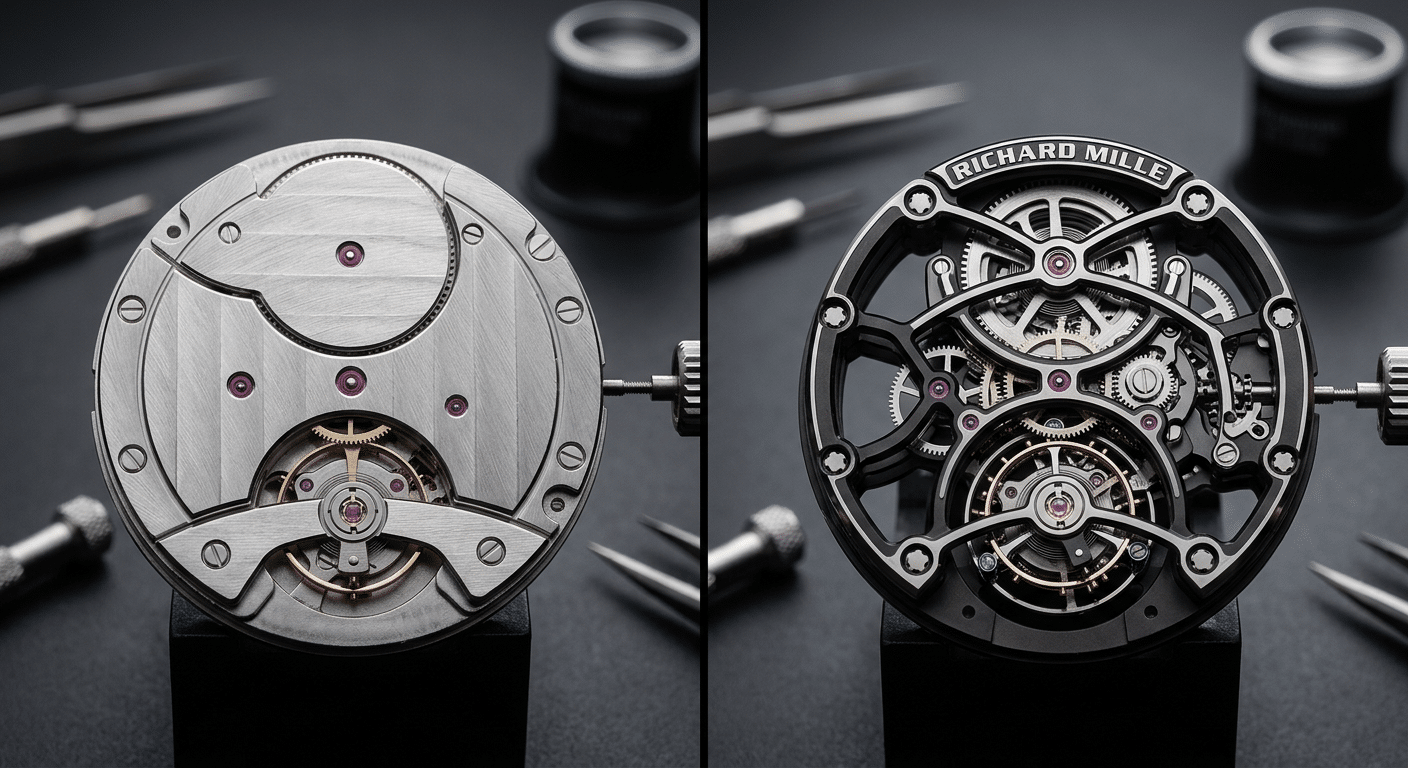
- Micro-Scale R&D: While ZF or APS amortizes the development cost of an RMUL2 clone across thousands of units, JB’s budget is spread over perhaps a few hundred pieces of a specific tourbillon model. The engineering hours spent reverse-engineering a functioning tourbillon cage or a suspended movement architecture are immense and have no economy of scale.
- Specialized, Low-Volume Tooling: The bizarre case shapes of an RM 53 or the sapphire assembly of an RM 56 require custom CNC programs, molds, and finishing jigs that will never see the production volume of a standard RM tonneau case. This tooling cost per unit is astronomically high.
- The Risk Premium: This is the most critical factor. The assembly and regulation of a complex replica movement have a significantly higher failure rate. A percentage of movements will be dead on arrival or fail shortly after assembly. That cost—of dead stock, repairs, and replacements—is baked into the price of every unit that makes it out the door. You are literally paying for the privilege of attempting something that has a high chance of not working.
Contrast this with the super clone mainstream. Factories producing RM 055 clones benefit from perfected, mass-produced movements (Dandong RMUL2), standardized case construction, and streamlined assembly lines. Their business is about refinement and volume. JB’s business is about attempting the seemingly impossible, and that ambition has a steep, non-negotiable price of entry.
Setting Ownership Expectations: The “Project Watch” Mindset
This financial reality dictates the necessary ownership mindset. If you purchase a JB, you must abandon any notion of acquiring a trouble-free luxury replica. Instead, adopt the “project watch” mentality.
Think of it like acquiring a hand-built kit car or a vintage race engine. The value is in the engineering spectacle, the mechanical conversation piece, and the sheer audacity of the attempt. It is for the enthusiast who will derive as much pleasure from studying the movement through a loupe as from wearing the watch. This mindset accepts several core truths:
- It will require more care: These are fragile mechanisms. They are more susceptible to shock, magnetism, and positional error than a robust, simple clone movement.
- You need a watchmaker relationship: This is non-negotiable. You are not buying a disposable item. You are acquiring a mechanical artifact that will eventually need service, adjustment, or repair from someone competent enough to handle a complex tourbillon. The cost of ownership includes future service bills.
- It is not a daily beater: Even as a replica, a JB complex piece is a collector’s item, a weekend spectacle, a piece for watch meetups. Expecting it to be a set-and-forget daily companion is a direct path to disappointment and a broken movement.
In short, you are paying for a story and a mechanical experiment, not for convenience or reliability.
Expert Authentication Insight
The single most telling sign of a JB-level build’s ambition is often found in the documentation and packaging. While all replicas come with fake paperwork, JB’s complex models frequently include more detailed, model-specific “manual” inserts and warranty cards that mimic the genuine article’s materials and printing quality more closely. This ancillary effort—the attempt to replicate the entire experience—correlates directly with the overall investment in the project. Additionally, the quality of the travel case or box is often a tangible step above the standard replica fare, using better-grade leather or aluminum. It’s a subtle but consistent clue: the factory that invests in the unboxing experience is often the same one that invested in the mechanically complex heart of the watch.
Decision Framework: Is a JB Complex Build Right for You?
All of this analysis funnels down to one final, personal question. The following framework is designed to be a self-diagnostic tool. Be brutally honest with your answers.
The Buyer Profile for a JB Tourbillon
The ideal JB customer is a specific and rare breed. This person is:
- The Jaded Collector: Someone who already has a box of high-quality super clones from ZF, APS, and Clean. The pursuit of “another perfect Submariner or Royal Oak clone” has lost its luster. They are looking for a new, ultimate challenge—a “grail” replica that represents the frontier of what the replica world even attempts.
- The Mechanical Voyeur: A person fascinated by watch mechanics for their own sake. They value seeing a tourbillon cage rotate, understanding the suspension system of an RM 53, or appreciating the lattice work of an RM 27-02, regardless of the name on the dial.
- The Prepared Patron: A buyer who has already vetted and established a relationship with a skilled watchmaker willing to work on replicas. They have a budget that includes not just the purchase price, but a maintenance fund.
- The Story Buyer: For this person, the narrative is paramount. Owning a watch that says, “This is a replica of one of the most complex watches on earth, and a Chinese factory actually tried to build its heart,” is as important as the object itself. The attempt is the achievement.
When to Look Elsewhere: The Simplicity Filter
For the vast majority of replica buyers, JB Factory is an irrelevant and expensive distraction. Apply this simple filter:
If your goal is a reliable, visually convincing Richard Mille for daily wear—like an RM 035, 055, or 011—then investigating JB is a complete waste of your time and money. You are not in the market for a mechanical experiment; you are in the market for a well-executed accessory. For these models, the established leaders—APS Factory for the RM 055 NTPT, ZF Factory for the RM 035-02, KU Factory for the RM 011 chronograph—exist for a reason. They offer refined, reliable(ish), and cost-effective solutions that have been perfected over multiple generations. Direct your funds and research there without a second thought.
JB does not compete in that arena. Looking to them for a standard model would be like asking a Formula 1 team to build you a commuter sedan. It’s a mismatch of purpose and capability.
Expert Authentication Insight
The final, overarching authentication insight is one of philosophical alignment. A true JB-level complex replica won’t try to hide its nature upon close inspection by a knowledgeable enthusiast. Its value proposition is built on the attempt, not on perfect deception. Therefore, the ultimate “test” is a conversation with a knowledgeable dealer or forum member. A reputable source selling a legitimate JB project will be transparent about the movement’s origin (e.g., “Seagull ST-80 base with heavily modified tourbillon bridge”), its known quirks (“the power reserve is less than stated,” “avoid strong shocks”), and the realistic service expectations. They will manage your expectations, not inflate them with claims of “1:1 perfection.” This transparency and technical candor are, in themselves, the strongest markers of a legitimate high-complexity project. If a seller is only talking about how “unbelievable” and “undetectable” it is, you’re likely not talking to someone who understands what JB actually sells.
The JB Decision Filter:
- Is your target model a genuine tourbillon or does it have an exceptionally complex case/movement architecture (e.g., RM 27, 53, 56)? If NO, stop considering JB.
- Are you buying this as a primary watch for reliable, worry-free daily wear? If YES, JB is the wrong choice.
- Are you prepared for a higher cost, higher maintenance “project watch” experience because you value the engineering attempt itself? If YES, then—and only then—does JB Factory enter the realm of relevant consideration.
The final takeaway must be crystal clear: JB Factory is not a tier of quality; it’s a category of ambition. Its relevance is dictated entirely by the mechanical complexity of the watch in question and the specific, niche intentions of the buyer. For the right person and the right model, it’s the only game in town. For everyone else, it doesn’t even exist.