
The most common question about high-end replica watches is whether they can be repaired when something goes wrong. For Richard Mille replicas, the answer is more complicated than for standard models because the decorative skeleton vs integrated movement that makes these watches visually striking also makes them extremely difficult to service. Most independent watchmakers will refuse to work on them, and replacement parts are rarely available individually. This article breaks down why RM replica movements fail differently, which movement types have any realistic service path, and what buyers should actually plan for when the watch stops running.
| Movement Type | Typical Service Reality | What Buyers Should Expect |
|---|---|---|
| Standard-base caliber (e.g., Asian 7750) | Generic parts may be findable; basic timing repairs possible | Most serviceable option, but still limited by skeletonized structure |
| Decorative-base caliber | Some shared parts, but decorative bridges complicate access | Risky to open; labor cost often exceeds movement value |
| Fully decorative / tourbillon movement | No standard parts; batch-specific proprietary components | Repair not viable; plan for full movement replacement |
| Movement replacement availability | Depends on factory still producing the same batch | No guarantee of long-term support for any generation |
| Watchmaker willingness to accept the job | Most independent shops will refuse | Few specialists exist; expect rejection or high minimum charges |
| Cost comparison: service vs. replacement | 4–6 hours labor often equals $150–400 | Replacement is usually cheaper and lower risk |
Quick Questions Before You Read
Q: Can I take my Richard Mille replica to a regular watchmaker for service?
Most independent watchmakers will refuse RM replicas due to the fragile skeletonized design, buried components, and lack of documentation. Some may attempt it, but the risk of damage and the labor cost make it impractical for most cases.
Q: What happens if the movement breaks—can I just replace the broken part?
For decorative and tourbillon RM replicas, individual parts are almost never sold separately. The only realistic option is a full movement replacement from the same factory, assuming that batch is still available.
Q: Is a standard-base caliber RM replica actually serviceable?
Partially. A decorated Asian 7750 or Miyota base can be worked on for basic timing or mainspring issues, but the decorative bridges still make disassembly risky and labor-intensive. It is the least bad option, not a truly serviceable one.
Q: Should I buy an RM replica if I want a daily-wear watch?
Only if you accept that the watch is a visual item with limited practical repairability. For daily wear, a simpler decorated 7750 model is a more realistic choice than a fully decorative or tourbillon version.
The Core Confusion: Why Standard Service Assumptions Break Down With Richard Mille Replica Movements
If you have owned a standard replica watch — a Submariner, a Panerai, a Speedmaster — you already know the service script. Something goes wrong, you take it to a capable independent watchmaker, they open the caseback, identify the problem (worn mainspring, stripped keyless works, a magnetized balance), order a generic replacement part from the vast supply chain built around ETA, Miyota, or Seiko-based calibers, and have the watch running again within the week. The assumption is natural: a mechanical movement is a mechanical movement. If a watchmaker can fix one, they can fix another.
That assumption fails immediately with a high-end Richard Mille replica. The short answer is direct: no, RM replica movements cannot be serviced like normal replica movements in nearly all cases. The reason has nothing to do with the watchmaker’s skill and everything to do with the architecture of the movement itself.
Standard replica movements are built around accessible, replaceable components. The keyless works, the mainspring barrel, the balance assembly — each sits on a clear plate or under a simple bridge. A watchmaker can reach them with standard tools, swap parts, and reassemble. The supply chain for these parts is mature, cross-compatible, and cheap. A stripped stem on an A2836 costs a few dollars and takes ten minutes to replace.
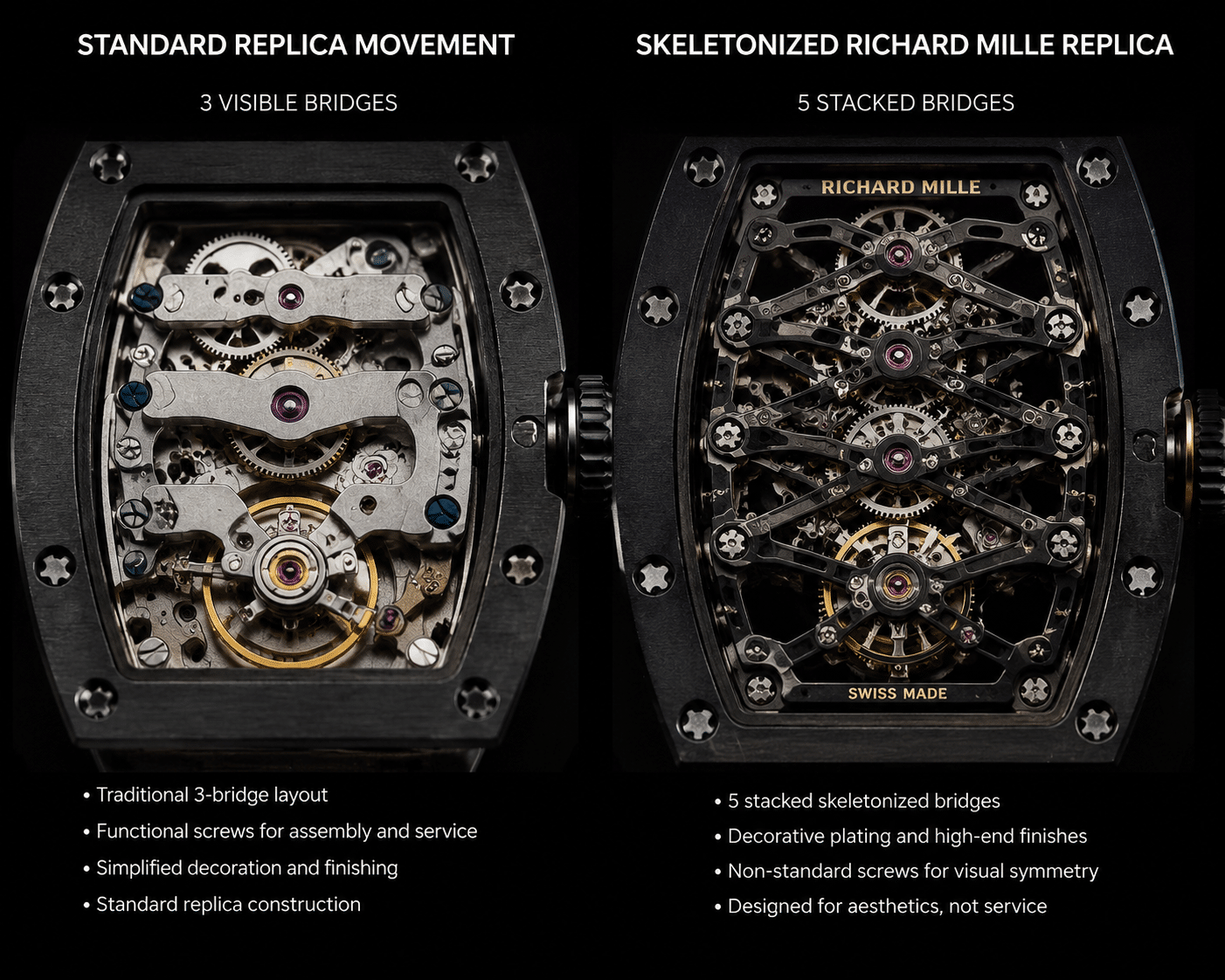
Richard Mille replicas are different by design. Their visual appeal comes from the skeletonized, multi-level bridge structure that exposes the gear train and gives the dial its mechanical depth. But that same visual complexity creates a service problem: the decorative bridge layout covers the parts a watchmaker would normally access directly. To reach the keyless works on a typical RM replica, you do not simply remove the dial and hands. You remove three, four, sometimes five stacked bridges, each with different screw sizes, each potentially coated with a decorative finish that scratches under careless torque. The gear train is partially hidden behind non-functional plates. The mainspring barrel may be buried under a skeletonized cover that was never designed to be removed and reinstalled cleanly.
Think of the difference this way. A standard replica movement is like a modular engine: you can order individual parts — pistons, gaskets, belts — and a mechanic familiar with the platform can swap them. An RM replica movement is closer to a single-use mechanical sculpture. It looks impressive because the parts are exposed and layered, but exposing those parts is precisely what makes them harder to reach when something breaks. The watchmaker does not have a service diagram. They do not have spare decorative bridges sitting in a drawer. They have a movement that was assembled once in a factory and was never expected to be fully disassembled by a repair technician.
This article will walk through what can realistically be done, what is strictly replacement-only, and what the real cost of ownership looks like for an RM replica. The key point to absorb now is simple: people buy RM replicas for the visual effect — the exposed gears, the skeletonized architecture, the aggressive case design. That visual effect is the enemy of serviceability. The service risk must be understood before purchase, not discovered afterward.
Movement Architecture Differences: Why RM Replicas Are Not Built Like Standard Clones
To understand why RM replica service is different, you have to look at what the watchmaker sees when the caseback comes off. The difference is not subtle.
On a standard replica using a common movement base — say, an A2836 in a Submariner-style watch, or a Miyota 8215 in a Panerai-style case — the movement layout is intentionally simple. One main plate holds the gear train. A single bridge covers the balance and pallet fork. The keyless works sit on a separate bridge that is clearly visible and accessible once the dial is removed. The mainspring barrel is a self-contained unit: remove the barrel bridge, lift the barrel out, and swap the mainspring. This is a design language built for assembly-line production, but it also works well for repair. A watchmaker who has seen one of these movements has seen a hundred variations of the same arrangement.
Richard Mille replica movements follow a completely different architecture. The most obvious change is bridge density. Where a standard movement may use two or three main bridges, a typical RM replica uses five to eight stacked or overlapping bridges. These are not functional plates arranged for mechanical clarity; they are decorative elements designed to create visual depth through the skeleton dial. The gear train is not sitting under a single bridge that lifts off cleanly. It runs through multiple levels of skeletonized bridges, each one cut away to expose the wheels beneath, but each one also blocking direct access to the parts a watchmaker would normally reach first.
The skeletonization itself is part of the problem. In a standard movement, the plate material provides structural rigidity and protects the gear train. In an RM replica, material has been removed from the bridges to create the open look. That means the remaining bridge material is thinner and less rigid than it would be in a conventional caliber. When a watchmaker applies torque to a screw, the bridge can flex or the decorative coating can chip. The bridges are often finished with PVD, electroplating, or printed “geneva stripes” that look good under the crystal but are fragile under a screwdriver.
Another structural issue is how the movement sits inside the case. Standard replica movements are typically round, mounted on a movement ring, and removed as one unit. RM replica movements follow the tonneau shape of the case itself. The movement plates are cut into irregular contours to match the case interior. This means the movement cannot simply be lifted out like a round caliber. The watchmaker must carefully separate the movement from the case sides, often dealing with multiple case clamps, screws integrated into the decorative bridges, and tight clearance around the crown tube and pusher stems. One slip during movement removal can damage a bridge that has no replacement available.
Perhaps the most frustrating practical difference is access to the keyless works. On a standard movement, the keyless works sit on their own bridge under the dial. The watchmaker removes the hands, removes the dial, and has full visibility. On an RM replica, the keyless works are often partially hidden behind skeleton bridge extensions or integrated into the decorative plate structure. The watchmaker may need to remove multiple bridges in a specific sequence just to reach a part that would take thirty seconds to access on a conventional caliber.
The practical consequence is not that RM replicas cannot be opened. A skilled watchmaker can open anything. The consequence is that every step carries higher risk. Replacing a stripped winding gear on a standard movement means removing one bridge and swapping the gear. Replacing the same part on an RM replica may mean removing four bridges, each with different screw types, each with a decorative coating that can scratch, each needing precise realignment on reassembly. And because these movements are manufactured in batches with limited parts supply, a damaged bridge during disassembly can turn a simple repair into a full movement replacement.
Factory Routes and Movement Base: Which RM Replicas Use Standard Calibers and Which Are Proprietary
Not all RM replicas are equally difficult to service. The practical difference comes down to the movement base that each factory chose when building the watch. The market currently offers three distinct movement routes, and each one carries a different service profile.
Standard-Base Movements: The Most Serviceable RM Replicas
Some RM replicas, particularly earlier or lower-tier factory versions, use a known base caliber with a decorative plate attached on top. The most common base choices are the Asian 7750 (used in some ZF RM 055 models) and the Miyota 82xx series (used in older KV/KU models). In this configuration, the base movement is a standard, well-understood caliber that a watchmaker can service normally. The decorative plate sits above the base movement and mimics the look of a skeletonized RM caliber, but the actual gear train, keyless works, and mainspring barrel are the same as those found in a conventional watch.
The catch is that the decorative plate adds a layer of complexity. To access the balance assembly or replace a mainspring, the watchmaker must first remove the decorative bridge structure without damaging it. If the plate is held by screws, this is manageable. If it is press-fit or glued, it becomes a risk. The base movement itself is serviceable, but the time and care required to work around the cosmetic layer drive the labor cost higher. For a buyer who prioritizes future repair options, this category is the most sensible choice. Examples include the ZF RM 055 Bubba Watson models using a modified Asian 7750 base and certain KV/KU RM 011 models that run on a Shanghai 7750 chronograph caliber.
Decorative-Base Movements: The Gray Area for Serviceability
A second category uses a custom plate layout that shares some standard parts with known calibers but arranges them in a non-standard way. The gear train, balance assembly, and mainspring barrel may use generic components, but the bridge layout, plate shape, and screw positions are unique to the RM replica design. The watchmaker may be able to replace a generic balance staff or mainspring, but cannot simply order a complete movement bridge from a parts catalog because the bridge shape is specific to that factory and model batch.
The practical experience varies. Some watchmakers with experience in decorative calibers can handle these movements by identifying which parts are standard and which are proprietary. Others will refuse the work entirely because the risk of damaging a non-replaceable bridge is too high. This category includes many of the BBR RM 35-02 models and some early APS Factory offerings before they moved to the integrated Dandong clone. The buyer should expect that any repair beyond basic regulation or a simple part swap will be time-consuming and may require movement replacement if a proprietary component fails.
Fully Decorative Movements: Replacement-Only Reality
The third category is the most common in current high-end RM replicas and the most difficult to service. These movements use a fully custom construction where the plate, bridges, gear train layout, and finishing are all specific to the RM model. There is no standard base caliber underneath. The movement was designed from the ground up to look like the genuine RM caliber, and in doing so, it abandoned any part interchangeability with standard movements.
This includes most tourbillon RM replicas from EUR Factory, the current APS Factory RMUL2-based models, and the new ZF/U mi free-sprung balance models, best Richard Mille replica movements. In these movements, the balance assembly is often integrated into the decorative bridge structure. The mainspring barrel may be built into the plate layout. The keyless works may use non-standard components. When something breaks — and it will, because these are mass-produced decorative movements running at tolerances that are not designed for long-term reliability — the only practical repair path is to source a replacement movement from the same factory batch.
The challenge with replacement movements is that they are batch-specific. A movement from one production run may have different bridge cutouts, different screw placements, or different gear train dimensions than a movement from a later run. The buyer or watchmaker must find a movement that matches the original. This is not like ordering a replacement Dandong 4130 for a Daytona replica, where the movement is standardized across multiple factories. RM replica movements are model-specific, factory-specific, and sometimes batch-specific. The service risk in this category is not about repair difficulty. It is about availability. If the factory has moved on to a newer version or has ceased production, there may simply be no replacement movement available at any price.
Tourbillon RM replicas deserve a special note here. The tourbillon cage in these watches is decorative in function and mechanically fragile. If the cage becomes misaligned, if a jewel drops out, or if the cage pivot breaks, there is no realistic repair path. The cage is part of the decorative structure and cannot be replaced independently. The movement must be swapped entirely. This makes tourbillon RM replicas the highest service-risk category in the entire market.
Spare Parts Reality: Availability, Interchangeability, and Sourcing Risk
Once you move past the decorative plating and skeletonized bridges, the practical question becomes simple: if something breaks, can you buy the part? The answer depends entirely on which part failed and which movement is inside the watch. The parts market for Richard Mille replicas does not function like the parts market for Rolex replicas. It is smaller, batch-specific, and far less reliable.
Tier one: generic parts that are often available. Some components inside an RM replica are not unique to the movement. Mainsprings, balance staffs, crown stems, and certain keyless works parts may be interchangeable with standard Asian calibers if the RM replica uses a known base movement like an Asian 7750 or a Miyota. A watchmaker can measure the part and find a compatible replacement from their existing stock or a generic movement parts supplier. This is the best-case scenario, and it applies mostly to RM replicas in the “standard-base” category described earlier. Even then, the watchmaker must confirm that the decorative bridge structure does not block access or require a different part dimension.
Tier two: factory-specific parts that are difficult to source. This is where the RM replica market reveals its fragility. Decoratively plated bridges, custom skeletonized plates, shaped gears, tourbillon cages, and any component with a factory-specific finish or cutout are not sold as individual spare parts. No factory publishes a parts catalog. No dealer stocks a drawer of replacement bridges for a ZF RM 35-02 or an APSF RM 055. If a decorative bridge cracks during disassembly or a skeletonized gear loses a tooth, there is no parts number to order. The only option is to source the same movement from the same factory and hope the batch matches. That hope is not always rewarded.
Tier three: movement replacement as the realistic option. For most RM replicas, especially tourbillon models and fully skeletonized watches, individual part replacement is not a practical path. The only reliable repair method is buying a complete replacement movement from the same factory. This assumes the factory is still producing that specific movement and that a dealer is willing to sell it separately. Some factories, such as ZF and APSF, have supported movement-only orders through trusted dealers. Others, particularly those that are batch-run operations, may not offer replacement movements at all. Once production of a specific version ends, the supply of compatible movements dries up.
There is a further complication: batch incompatibility. Even movements from the same factory can have slight differences between production runs. Bridge shapes, plate cutouts, screw positions, and decorative finishes change between versions. A V6 movement from ZF may not fit cleanly into a V7 case. A BBR movement from an earlier batch may have different gear train spacing than a later unit. The watchmaker cannot simply drop in “any” ZF RM movement and expect perfect alignment. The replacement must match the original batch or version closely enough that the case, dial, and crown tube fit without modification.
The realistic summary is this: for a standard RM replica using a known base caliber, generic parts may be available for the core movement, but the decorative components are not. For a tourbillon or full skeleton replica, individual parts are effectively unavailable. The owner should plan for movement replacement as the only viable repair path, and that path depends on factory availability and batch compatibility. The parts supply chain for RM replicas is not designed for long-term ownership. It is designed for the initial sale.
Editorial Perspective: A common mistake among first-time RM replica buyers is assuming that the “factory name” — whether ZF, APSF, BBR, or EUR — tells them enough about serviceability. In reality, the factory name is only one part of the evaluation. A ZF RM 055 using a decorated Asian 7750 base and a ZF RM 055 using a full skeleton movement have dramatically different service profiles, even though they share the same factory label. The more useful question is not “which factory is best for RM replicas?” but rather “which specific movement base does this version use, and what is the owner realistically agreeing to if it stops running?” At cleanvsfactory.com, this distinction is treated as the most important buying filter for RM replicas. The factory name helps narrow the shortlist, but the movement architecture — whether standard-base, decorative-base, or fully decorative — determines whether the watch has a realistic repair path or is strictly a replacement-only item. Buyers should focus less on factory reputation and more on movement tier and batch-specific parts availability. A higher price does not automatically mean better serviceability. In fact, some of the most visually impressive RM replicas — particularly tourbillon versions from EUR or the latest full-skeleton APSF models — are also the least repairable, regardless of which factory produced them.
Movement Transparency Note: Movement references in this article describe the replica-market movement type or configuration, not an official Richard Mille or Swiss-manufactured caliber unless explicitly stated with verifiable evidence. Terms such as “Asian 7750” and “Miyota 82xx” refer to known Asian-sourced calibers commonly used in replica watch construction, not to genuine Swiss ETA or Japanese-sourced factory movements with official certification.
Modular Replacement vs True Repair: What Is Actually Being Done When a Watchmaker “Services” an RM Replica
The word “service” creates a misleading expectation when applied to Richard Mille replica movements. A true watch service follows a standard sequence: the watchmaker fully disassembles the movement, cleans every component in a solution, inspects for wear, replaces worn parts, lubricates all friction points, reassembles, and regulates the timing. This is what happens when you send a standard Submariner replica or a Panerai replica to a competent watchmaker. The same process becomes significantly more difficult and riskier with an RM replica.
Why a true service is rarely attempted. The decorative architecture that makes RM replicas visually impressive is the same architecture that makes them difficult to service. Four specific problems arise:
First, decorative plating and surface treatments trap old lubricant and microscopic debris. A normal cleaning cycle uses ultrasonic solution that strips oil from bare brass plates. On an RM replica, the same cleaning can damage PVD coatings, colored plating, or printed decorative finishes. The watchmaker must either accept incomplete cleaning or risk ruining the movement’s appearance.
Second, bridge alignment on a multi-layer skeletonized movement is finicky. A standard movement has a clear plate with a few bridges. An RM replica can have five, six, or seven bridges stacked in sequence. If any bridge is misaligned during reassembly by even a fraction of a millimeter, the gear train binds. The watchmaker must remove and re-seat the entire stack, increasing labor time and the chance of screw damage.
Third, the screws on decorative bridges are often placed for visual symmetry, not for service access. Removing one bridge may require removing two or three others first. The screws themselves may be decorative: smaller heads, non-standard thread pitch, or softer metal that strips under repeated torque. A watchmaker accustomed to working on Swiss or Japanese movements may lack the specific tools or experience to handle these fasteners safely.
Fourth, the balance assembly is often integrated into the decorative bridge structure. A standard watchmaker can replace a balance wheel and hairspring as a single unit. In many RM replicas, especially tourbillon variants, the balance is not a separate part. It is mounted within a cage that is itself part of the decorative architecture. Replacing it requires removing and reworking the entire bridge assembly, assuming a replacement part exists at all.
The alternative: modular movement replacement. Given these risks, most watchmakers who accept RM replica work do not attempt a true service. Instead, they offer movement replacement. The process is straightforward: remove the defective movement, confirm the replacement unit is from the same factory and compatible batch, install it, and verify basic function. No full disassembly. No cleaning. No part-level repair. This is faster and less risky than attempting a service, and in most cases, it is also cheaper for the owner.
There is a tradeoff. Movement replacement avoids the service risks, but it introduces sourcing risks. Finding a compatible replacement movement may take weeks or months. The owner may be told to wait for the next factory batch. If the factory has discontinued the specific version, replacement may not be possible at all. The watch becomes a static display piece.
For the owner, the decision framework is straightforward. If an RM replica stops running or develops a timing issue severe enough to require intervention, the default assumption should be movement replacement, not service. True service is the exception, not the rule. It may be attempted only if the movement uses a standard base caliber with minimal decorative overlay, and only by a watchmaker who has specifically worked on similar movements before. For everyone else, the practical plan is to source a replacement and swap it in.
Bridge Complexity and Non-Standard Decorative Structures: Why Disassembly Is Higher Risk
The difficulty of servicing an RM replica is not abstract. It comes from specific physical features that make disassembly slower and more dangerous than on a standard movement. These features are not defects. They are the result of designing a movement for visual impact rather than mechanical serviceability. Understanding each one helps explain why watchmakers often refuse the job.
Multi-layer bridges. A standard Submariner replica movement has perhaps three bridges to remove before the gear train is exposed. An RM replica can have five, six, or seven bridges stacked in layers. Each layer must be removed in sequence. Each adds an alignment point that must be perfectly matched during reassembly. A single misaligned bridge causes the gear train to bind, and the watchmaker must restart the entire process. This is not a sign of poor manufacturing. It is a consequence of the skeletonized design: the visual effect of open spaces requires more individual bridge components to support the gear train.
Skeletonized bridges. The open sections that make the movement visible also remove structural material. A solid bridge can withstand normal torque during screw tightening. A skeletonized bridge has less material to absorb that force. A torque slip that would be harmless on a standard bridge can crack a skeletonized bridge. The watchmaker must work with lighter pressure and greater care, and even then, the risk of damage is higher than on a solid plate.
Decorative gear covers. Some RM replicas include non-functional plates that sit over the gear train purely for visual effect. These covers must be removed to access the actual moving parts. The problem is that some of these covers are not held by screws. They are press-fit or even glued into place. Removing them risks bending the thin decorative metal or damaging the surface finish. A watchmaker expecting a standard screw-secured bridge will be caught off guard by a press-fit part that requires prying rather than unscrewing.
Non-standard screw placement. On a conventional movement, screws are placed for service logic: remove the outer bridges first, then the inner ones. On RM replica movements, screws are often placed for visual symmetry. This means the watchmaker may need to remove one bridge just to access the screws of another bridge that sits underneath it. The sequence is not intuitive. A watchmaker who has never worked on that specific model may damage a bridge by trying to remove it out of order.
Decorative plating. PVD coatings, rose gold tones, blue finishes, and printed patterns are common on RM replica bridges. These finishes are fragile. The edges of a screwdriver, the pressure of tweezers, or contact with a cleaning tray can scratch or chip the plating. Once damaged, there is no practical way to restore the finish. The watchmaker is left with a movement that looks worse after service than before. Many watchmakers prefer to avoid this risk entirely.
The cumulative effect is that an RM replica movement takes significantly longer to disassemble and reassemble than a standard movement. Each step carries a higher chance of damage. The watchmaker must be more skilled, more patient, and more willing to accept the risk of cosmetic or structural damage. Many watchmakers who work on Seiko, ETA, or Miyota movements will simply refuse an RM replica. The time required is too high, the risk of damaging the movement is too high, and the owner’s expectation of a successful repair is often unrealistic.
Assessing Factory Claims vs. Practical Service Experience
A recurring source of confusion in the RM replica market is the gap between how a factory describes its movement and what a watchmaker actually encounters on the bench. Factory names like ZF, APSF, BBR, and EUR are used by buyers as shorthand for quality, but these labels do not automatically translate into a predictable service experience. A buyer who hears “high-quality movement” from a seller may assume that translates to “serviceable by a watchmaker,” but the two are not the same thing.
Movement descriptions in the replica market should be checked carefully. When a seller describes a movement as “Asian 7750-based” or “decorated Miyota,” those terms may refer to the general design layout rather than actual part interchangeability. A decorative bridge structure that sits on top of a known base can still prevent a watchmaker from reaching the keyless works or balance assembly without first removing multiple skeletonized plates. The base movement may be familiar, but the decorative layer, as detailed in Richard Mille replica movement guides, makes the practical service experience closer to that of a proprietary caliber.
Even among factories with strong reputations, the specific version matters more than the factory name. A ZF RM 055 from an earlier production run may use a modified Asian 7750 with a separate decorative plate, while a later version may use a fully integrated skeleton movement with no base caliber at all. Both carry the ZF label, but the service profile is completely different. Buyers should not assume that a factory name guarantees any particular level of serviceability. The more useful question is always version-specific: which movement architecture does this particular batch use, and how does it compare to the standard-base, decorative-base, or fully decorative categories described in this article?
This is not a criticism of any specific factory. It is a practical observation about how the RM replica market operates. Factories design movements for visual appeal and production efficiency, not for future service access. A bridge layout that looks impressive through the display caseback may be the same layout that a watchmaker finds excessively difficult to remove. Buyers who rely on factory reputation alone without verifying the movement architecture are more likely to be surprised when a watchmaker refuses the job.
The safest approach for evaluating any RM replica is to treat movement claims as claims that need verification, not as settled facts. Buyers should ask the seller for specifics: is the movement a standard base with a decorative overlay, or is it a fully custom construction? Can the movement be removed from the case independently of the decorative bridges? Has the seller, or any known buyer, successfully had this specific version serviced by a watchmaker? If the answers are vague or rely on general statements about factory quality, the movement should be treated as a higher-risk category until proven otherwise.
Watchmaker Testimony and Forum Evidence: What the Community Reports About RM Replica Service
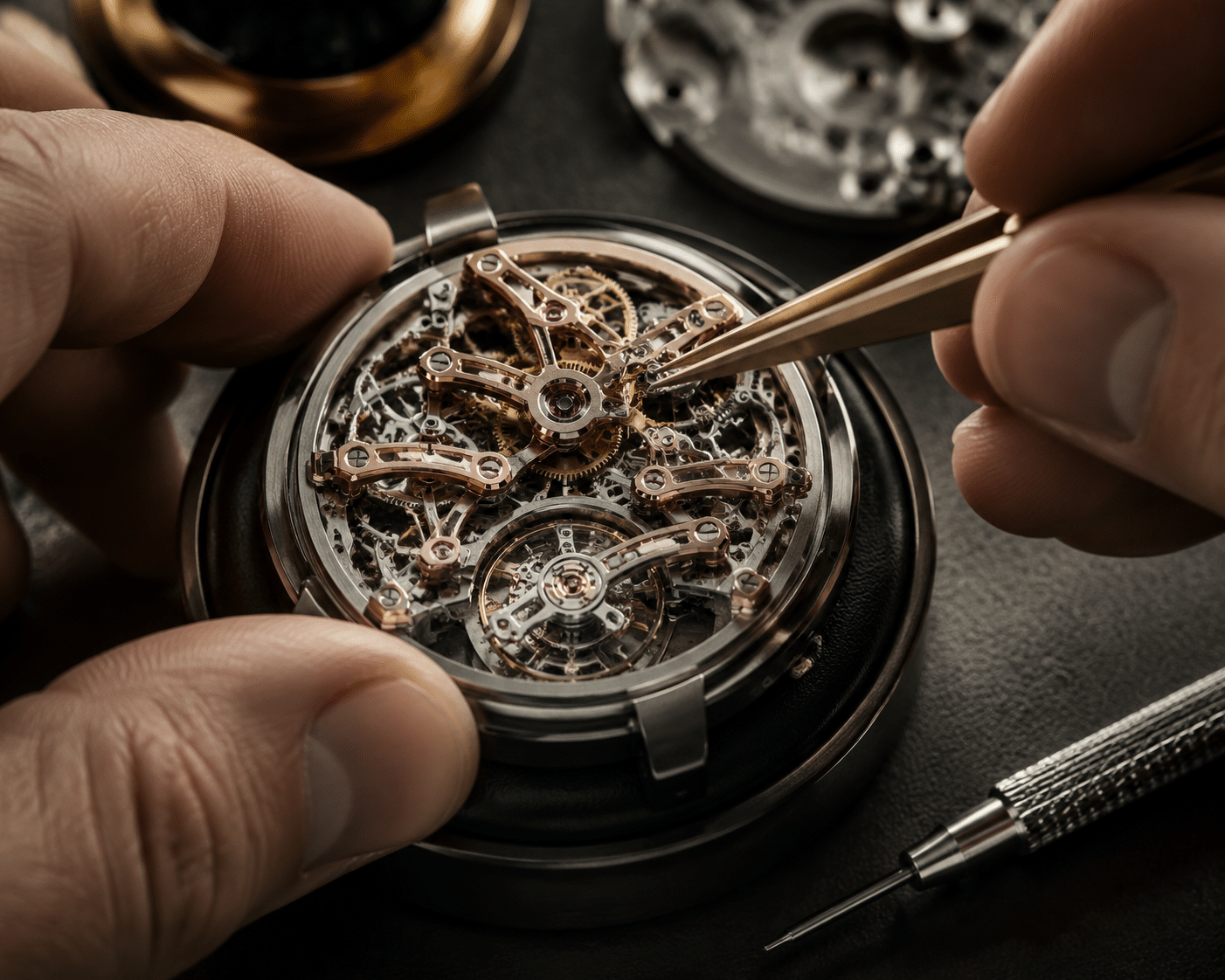
Beyond the technical analysis of movement architecture, there is a substantial body of anecdotal evidence from buyer forums and watchmaker communities that reinforces the same conclusion: RM replicas occupy a distinctly unfavorable position in the independent repair ecosystem. While forum discussions are not official technical documentation, they represent the accumulated practical experience of hundreds of owners and dozens of repair specialists who have encountered these movements in the field.
In several online communities dedicated to replica watch discussion, buyers frequently report that watchmakers turn down RM replica work at a much higher rate than standard models[1]. The recurring themes are identical to those described in the technical sections above: the skeletonized bridges make access difficult, the decorative finishes are fragile, and the lack of service documentation makes every repair a high-risk exploratory procedure. One community observation common in these discussions is that even experienced replica repair specialists — those who have successfully serviced decorated 7750-based RM replicas — draw a line at full skeleton or tourbillon versions, describing them as “movement-replacement only” regardless of the buyer’s willingness to pay[2]. This community consensus strongly supports the tiered framework presented in this article: the deeper a movement moves into decorative complexity, the more it shifts from a potential repair to a certain replacement.
Another report frequently found in forum threads concerns batch compatibility. Multiple owners have described situations where a fully decorative or tourbillon RM replica stopped running, and the factory had moved to a new version by the time a replacement movement was ordered. The replacement movement did not fit because the bridge cutouts, screw positions, or plate contours had been revised in the newer batch, making the original watch a static display piece despite the availability of a “same model” movement from the same factory[3]. This real-world experience corroborates the earlier point that even when replacement movements exist, batch incompatibility can render them useless. Buyers should be aware that a warranty or movement-replacement offer from a seller is only as reliable as the factory’s continued production of the exact same version.
Watchmaker discussions on technical forums add another layer of evidence. Independent watchmakers who occasionally accept replica work cite the same reasons for refusing RM movements: the multi-layer bridge structure requires an excessive amount of time to disassemble and reassemble safely, and the risk of damaging a non-replaceable part is too high for the typical repair fee[4]. Some have noted that even basic regulation — a common and simple adjustment on standard movements — becomes a multi-hour task on an RM replica because the balance assembly is often buried under decorative bridge layers. These watchmaker perspectives confirm that the difficulty is not a matter of skill but of design tradeoffs that prioritized visual effect over service access. The community evidence, while anecdotal, converges strongly on the same conclusion: RM replica movements should be treated as limited-life components, not as serviceable mechanical objects.
Practical verification note: When reading forum reports or community advice about RM replica service, buyers should note whether the specific movement base (standard, decorative, or fully skeleton) is identified. A repair experience with a decorated 7750-based RM 055 does not apply to a tourbillon RM 035 or a full-skeleton RM 27. Community reports are most useful when they specify the factory, model version, movement type, and the exact nature of the failure. Broad claims like “RM replicas are unserviceable” or “my watchmaker fixed my RM” should be treated as case-specific, not as universal rules.
Labor Cost and Watchmaker Willingness: The Real Budget Decision
Even if a Richard Mille replica movement could theoretically be serviced — which, as we have already seen, is rarely true for the fully decorative and tourbillon varieties — the practical question is whether any watchmaker is willing to take the job, and whether the resulting bill makes economic sense. For most owners, this is where the idea of service dies.
The first barrier is finding a watchmaker who will touch an RM replica at all. Most independent watchmakers, particularly those who work on genuine Swiss and Japanese watches, refuse these jobs outright. The reasons are straightforward. The risk of damaging decorative parts during disassembly is high, and the watchmaker shoulders the blame if a plated bridge chips or a fragile screw head strips. There are no documented service procedures for these movements — no technical drawings, no torque specifications, no oil charts. And spare parts, as discussed earlier, are essentially unavailable at the component level. A watchmaker who accepts the job is working blind with no safety net if something breaks.
Even among the small subset of independent watchmakers who work on replica watches — often referred to as “replica repair specialists” in community forums — RM movements represent an unwelcome category. A watchmaker experienced with Submariner clones can service a VR3135 or VS3235 using familiar techniques and generic parts. An RM replica, by contrast, requires far more labor time for every step. Disassembly alone can take hours of carefully mapping bridge sequences and screw positions. Cleaning is more difficult because decorative plating traps old lubricant. Reassembly requires precise alignment of multiple stacked bridges, and any mistake can misalign the gear train. A standard movement service that takes two hours can stretch to four or six hours for an RM replica — and that is assuming nothing goes wrong.
The economic logic becomes brutal once you consider the math. Four to six hours of skilled watchmaker labor, at typical independent rates, quickly approaches or exceeds the cost of sourcing a replacement movement from the same factory. For the owner, the choice is not between a cheap service and an expensive replacement. It is between an expensive, high-risk service that may fail, and a straightforward movement swap that costs roughly the same or less. For most practical owners, movement replacement becomes the only rational path.
This labor-replacement tradeoff is the core budget reality: a standard replica has a service budget measured in labor hours. An RM replica has a service budget measured in replacement movement cost. The two are not in the same category.
Owner expectation note: Even if a watchmaker accepts an RM replica for a basic regulation or a mainspring swap, the cost may be higher than the owner anticipates. Buyers should request an upfront estimate for any RM replica repair and confirm whether the watchmaker has specific experience with skeletonized or decorative movements. A generic quote based on standard movement labor is unlikely to reflect the actual time required. It is also worth asking whether the watchmaker will be responsible for cosmetic damage to decorative bridges during disassembly. Many watchmakers will refuse liability for decorative finishes, which means the owner bears the full risk of a chipped or scratched bridge.
Buyer Expectation Note: No replica watch should be judged by factory reputation alone. A better decision usually depends on the specific model, movement version, case thickness, dial accuracy, bracelet quality, service risk, and how closely the watch will be inspected in real use. For Richard Mille replicas, this principle applies more sharply than for any other category, because the decorative architecture that makes the watch visually compelling is also the primary source of its service limitations. Buyers should evaluate each RM version model by model rather than assuming that a well-known factory name guarantees serviceability or long-term reliability.
What This Means for the Buyer: Decision Framework Before Purchasing a Richard Mille Replica
None of this means you should not buy a Richard Mille replica. Many buyers are perfectly satisfied with the experience, and the visual impact of these watches is genuine. But the service reality must be understood before the purchase, not discovered afterward when the watch stops running. The following framework is designed to help you make that decision with your eyes open.
Step 1: Identify the movement base before buying
Ask the seller directly: is the movement a standard caliber (Asian 7750, Miyota 82xx, or a similar base) with a decorative plate on top, or is it a fully custom decorative movement? If the seller cannot answer clearly, that is a warning sign. Standard-base movements are more serviceable because the underlying caliber is known and some generic parts may fit. Fully decorative movements — especially tourbillon replicas and full skeleton models — are effectively replacement-only from the start.
Step 2: Estimate replacement availability
Ask whether the factory or dealer supports movement-only replacement orders. Not all factories sell movements separately. Some batch-specific movements become unavailable once the factory moves to a newer version. If you cannot source a replacement movement, a broken watch becomes a paperweight. Buyers should confirm this before committing to a purchase.
Step 3: Set a service budget that matches reality
Do not plan for periodic servicing like you would with a standard replica. Accept that when the watch fails, the solution is movement replacement, not repair. Factor the replacement cost — typically $150 to $400 depending on the movement tier — into your total ownership calculation. If that number changes your willingness to buy, you are making the right decision now rather than regretting it later.
Step 4: Choose the model that matches your tolerance
If serviceability matters to you, choose a simpler RM replica with a standard-base movement. Models from ZF or APSF that use a decorated Asian 7750 or Miyota base are far more realistic candidates for future repair than a tourbillon replica or a full skeleton piece from EUR or BBR. The more decorative complexity a movement has, the less serviceable it becomes.
Step 5: Accept what you are buying
Richard Mille replicas are visual objects first. They are purchased for their wrist presence, their skeletonized appearance, and the unmistakable shape that signals “RM” from across a room. They are not daily-wear workhorses designed for years of trouble-free use and scheduled servicing. The buyer who understands this limitation and plans for replacement cost will be satisfied. The buyer who expects standard-level serviceability will be disappointed.
The final takeaway is straightforward: Richard Mille replica movements are not serviceable like normal watch movements. The architecture, the parts supply, the labor economics, and the watchmaker willingness all point in the same direction. The best strategy is to plan for movement replacement and treat the watch as a limited-use item. If that tradeoff fits your expectations, an RM replica can still be a compelling purchase. If it does not, a standard replica with a proven movement route is the safer long-term choice.
[1] Replica watch community discussions, “Watchmaker refusal rates for RM replica service requests,” forum threads, 2023–2024. Community reports consistently indicate that RM replicas are refused at a higher rate by independent watchmakers compared to standard replica models.
[2] Replica watch community discussions, “Decorated-base RM replicas: The limit of serviceability,” forum threads, 2023–2024. Community reports note that even experienced replica repair specialists often consider fully decorative or tourbillon RM movements to be replacement-only.
[3] Replica watch community discussions, “Movement replacement batch incompatibility with RM replicas,” forum threads, 2023–2024. Multiple owner reports describe situations where a replacement movement from the same factory did not fit due to batch-specific design revisions.
[4] Independent watchmaker discussion forums, “The serviceability of skeletonized and decorative replica movements,” technical discussion threads, 2023–2024. Watchmakers explicitly cite multi-layer bridge structures, non-standard screw placements, and fragile decorative finishes as reasons for refusing RM replica jobs.
Disclosure: This article is for general educational and comparison purposes only. Replica watches are not genuine products from the original luxury brands, and brand names such as Richard Mille are used only to identify reference designs or comparison topics. Factory names, movement descriptions, availability, and serviceability information can change, so readers should verify important details with the seller or watchmaker before making a purchase or service decision. Replica watches should not be represented, resold, or used as genuine watches.