
Many buyers assume a high-end AP super clone comes from one famous factory in one city, but AP factory naming shows why that view is too simple. AP-style replicas are usually the result of a divided supply chain: metalwork may come from one region, movement work from another, while Guangzhou or Hong Kong references may relate more to coordination, routing, QC, or distribution than actual manufacturing.
This matters because AP designs expose small weaknesses quickly. Case thickness, bezel screw seating, bracelet articulation, clasp feel, dial texture, date position, rotor behavior, and movement route can say more about the watch than a factory label or city claim. The practical judgment here is not “which city is best,” but how to read the evidence of the specific watch before deciding whether a version is worth buying.
Replica watches should be clearly understood as replica-market products, not genuine watches from the original luxury brands. In this article, Audemars Piguet and AP are used to identify the genuine reference design being discussed; those names do not imply authorization, endorsement, production involvement, or affiliation with the original luxury watch brand.
| Claim or Detail | What It Usually Means | Buyer Check |
|---|---|---|
| Guangzhou label | Often coordination, dealer route, QC, or distribution | Ask for full QC photos, not just a factory name |
| Shenzhen or Dongguan parts | May relate to CNC work, case, bezel, bracelet, or clasp production | Inspect case profile, brushing, bevels, and bracelet fit |
| Shanghai or Dandong movement route | Affects thickness, date position, rotor behavior, and service risk | Confirm movement type and check caseback/display details if relevant |
| Hong Kong reference | Often packaging, shipping, or dealer transit context | Do not treat it as proof of better manufacturing |
| New batch or known factory name | Useful starting point, but not a quality guarantee | Compare the actual watch: dial alignment, bezel screws, clasp, and consistency |
| Visually accurate clone movement | May improve appearance but not always ownership convenience | Balance display realism against reliability and serviceability |
Quick Questions Before You Read
Q: Does a famous factory name prove the AP super clone is better?
No. It can identify a version or seller route, but the actual QC evidence matters more.
Q: Is Guangzhou where the whole watch is made?
Usually not. It is more often a coordination, dealer, QC, and distribution hub.
Q: What should be checked first on an AP-style replica?
Start with case thickness, bezel screw seating, bracelet fit, dial alignment, and date position.
Q: Is a clone movement always the better choice?
Not always. It may look closer, but reliability, rotor noise, thickness, and servicing risk still matter.
The Short Answer: High-End AP Super Clones Are Network-Built, Not Made in One Place
High-end AP super clones made in China are usually not the product of one hidden building doing every job from raw steel to final packaging. The more accurate way to understand them is as a divided supply chain: parts are produced or finished in different manufacturing clusters, movements may come from separate movement ecosystems, assembly may be coordinated elsewhere, and the watch may pass through dealer and logistics channels before it ever appears in a buyer’s QC photos.
This matters because many buyers ask the wrong first question. They ask, “Which factory made it?” as if the factory name alone explains the whole watch. In the Audemars Piguet replica watches market, a factory label can represent a production route, a version identity, a movement arrangement, or a dealer-facing shorthand. It does not always mean every case, dial, bracelet, movement, screw, rotor, clasp, and package came from one vertically integrated facility.
AP is especially sensitive to this network structure. A Royal Oak super clone is not like a simple round watch where a decent dial and a reliable movement can carry most of the impression. The Royal Oak’s octagonal bezel, exposed screw heads, integrated bracelet, sharp case bevels, tapisserie-style dial, and relatively thin case profile all depend on different production skills. If one layer is strong and another is weak, the final watch can look impressive in front photos but feel less convincing on the wrist.
Why the One-Factory Story Misleads Buyers
The one-factory story is convenient, but it creates bad expectations. A buyer hears a familiar replica watch factory name and assumes the watch must be consistent across every batch. Then two watches under the same label arrive with slightly different brushing, different datewheel centering, a louder rotor, or a bracelet that does not articulate the same way. That variation is not always because the seller lied about the name. Sometimes it is because the upstream component lot, movement route, assembly handling, or finishing standard changed.
For AP replicas, the factory name is useful, but it is not the complete answer. It may tell you the market-facing identity of the version, the general quality tier, or the expected movement family. It does not automatically prove the source of the case, the dial maker, the bracelet finishing route, or the exact assembly standard of the individual watch you are reviewing.
The non-obvious point is that a distributed high-end AP replica supply chain can produce a stronger watch than a simple one-room operation. Specialized machining, dial production, bracelet work, movement decoration, and final assembly require different skills. The weakness is coordination. The better the coordination, the more convincing the finished watch. The weaker the coordination, the more likely you see batch inconsistency even when the advertised factory name stays the same.
The Main Supply Chain Layers Behind an AP Super Clone
A high-end AP replica supply chain usually has several layers. The visible watch is the final result of those layers being brought together, not proof that all work happened in one place.
- Case and bezel machining: The Royal Oak case depends on flat planes, sharp transitions, and accurate bezel geometry. Poor machining shows quickly because the design has very few curves to hide mistakes.
- Bracelet and clasp construction: The integrated bracelet is one of the hardest parts to make convincing. Link shape, taper, articulation, screw fit, brushing, and clasp feel all affect daily-wear realism.
- Dial and marker work: The tapisserie-style dial is a major visual trap. A dial can look acceptable in seller photos but still lack depth, clean marker placement, or correct texture under normal light.
- Movement sourcing or modification: Movement route affects case thickness, date behavior, rotor sound, display-back appearance, and service risk. Decoration alone does not make a movement better to own.
- Assembly and regulation: A good parts set can still become an average watch if hands, dial, datewheel, bezel, bracelet, and movement are not assembled and checked properly.
- QC handling and dealer flow: The watch the buyer sees in QC photos may reflect not only factory output but also dealer selection, batch timing, and how carefully issues are filtered before presentation.
- Packaging and logistics: Packaging location or shipping origin can confuse buyers, but it does not prove where the movement, case, dial, or bracelet were manufactured.
At CleanVSFactory, we usually treat AP super clone evaluation as a version-and-evidence question, not only a factory-name question. The most useful question is not simply “where are AP super clones made?” but “which production route produced this specific watch, and does the evidence support the claim?”
How to Map a Supply Chain Claim to Visible Evidence
A practical way to read an AP super clone claim is to connect each statement to the part of the watch it should affect. If a seller emphasizes precision machining, the evidence should appear in the bezel geometry, lug transition, side profile, screw seating, and bracelet end-link fit. If the claim is about a higher movement route, the evidence should appear in case thickness, date position, crown behavior, rotor layout, and the specific movement photo rather than only in a text description.
This mapping method helps buyers avoid two common mistakes. The first is dismissing every factory or city reference as meaningless. These labels can still be useful when they point to a known route or version. The second is treating a label as proof. A factory comparison is most useful when it is tied to the specific reference, version, movement, and visible execution details rather than treated as a universal ranking.
Evidence Standard for Reading City and Factory Claims
Because replica-factory information is usually informal, buyer-facing, and difficult to verify independently, city and factory claims should be treated as clues rather than documented manufacturing records. A seller may describe a watch as Guangzhou stock, Shenzhen parts, a Dandong movement route, or a Hong Kong shipment, but each phrase points to a different layer of the chain. None of those phrases proves the full origin of the case, bracelet, dial, movement, or final assembly by itself.
A more defensible way to evaluate the claim is to connect it to observable evidence. If a seller claims a higher-end AP route, the QC set should show the parts that justify that claim: clean side profile, even bezel screw seating, consistent brushing, coherent bracelet fit, a movement photo where relevant, and a version description that does not rely only on hype. If the photos do not support the claim, the claim should be discounted even if the factory name sounds familiar.
Official brand information can help buyers understand the design language and proportions of the authentic Audemars Piguet model family, but it cannot prove that a replica has the same construction, finishing, movement, water resistance, or legal status. Likewise, movement specifications can explain what a movement family is designed to do, but they do not prove what is inside a specific replica unless that individual watch has been clearly inspected. This boundary is important because many poor buying decisions come from treating marketing language as evidence.
Factory Name Clarification: Factory names and city references in the replica watch market are buyer-facing labels used to describe routes, versions, batches, or dealer channels. They should be treated as practical market clues, not as official brand affiliations, audited manufacturer identities, or guarantees that every AP-style watch under the same name will have identical parts, finishing, movement configuration, or QC consistency.
What This Means Before You Judge a Factory Claim
Before trusting a factory claim, separate the label from the watch in front of you. A strong factory reputation can point you in the right direction, but it should not override QC evidence. For AP, the actual watch should be judged through the dial texture, bezel screw seating, case thickness, bracelet fit, clasp feel, date position, movement route, and consistency with the claimed version.
The safest buyer mindset is skeptical but not paranoid. A city name, factory name, or version name can help frame expectations, but none of them should be treated as a guarantee. The watch itself has to make sense as a complete build. If the seller claims a high-end AP version but the side profile is too thick, the tapisserie texture looks flat, the bezel screws sit unevenly, or the movement photo does not match the advertised route, the factory label should carry less weight.
The clear judgment is this: for high-end AP replicas, factory identity matters, but supply chain execution matters more. The most coherent batch is usually the one where the case, bracelet, dial, movement, and assembly standard are aligned. A famous label attached to mismatched parts is still a risky purchase.
Editorial Perspective: For AP super clones, CleanVSFactory treats factory names, city claims, seller descriptions, and QC photos as signals rather than final proof. A buyer should narrow the decision to the exact reference, version, movement route, and intended use. A Royal Oak that looks strong in front photos may still be a poor daily-wear choice if the bracelet is stiff, the case is too thick, the rotor is noisy, or the movement route is harder to service. The more useful judgment is not “which factory is famous,” but whether this specific build balances visual accuracy, reliability expectations, price, and after-sale risk in a way that matches the buyer’s expectations.
Guangzhou: The Assembly, Dealer, and Distribution Center
Guangzhou is often the city buyers hear first because it is one of the most visible centers in the replica watch trade. For AP super clones, Guangzhou is best understood as a coordination and market-facing hub: assembly flow, dealer communication, version circulation, QC photo handling, packaging readiness, and distribution often pass through networks connected to the city.
That does not mean every AP clone is fully manufactured in Guangzhou. A watch may be sold through a Guangzhou replica watch market channel, checked by a dealer there, assembled or finished through a related route, and still contain components or movements sourced from other regions. Confusing “passed through Guangzhou” with “made entirely in Guangzhou” is one of the easiest ways buyers misunderstand the high-end AP replica supply chain.
The practical value of Guangzhou is not that it proves quality by itself. Its importance is market concentration. When batches enter circulation, version names spread, QC photos are produced, and dealers start describing a watch as a certain factory version, Guangzhou-linked channels often become part of the buyer-facing story. That visibility makes the city sound like the origin of everything, even when it is only one layer in the chain.
Why Guangzhou Often Becomes the Name Buyers Hear First
Buyers hear Guangzhou first because dealers and distribution networks are easier to see than upstream component suppliers. A case maker, dial supplier, bracelet processor, or movement source may never be mentioned. The dealer who sends QC photos is visible. The market channel that circulates the batch is visible. The city tied to that flow becomes the simple answer, even when the real supply chain is more complicated.
This is why “Guangzhou AP clone” can mean several different things. It may mean the watch was assembled through a Guangzhou-connected route. It may mean the dealer handling the watch is based there. It may mean the batch was distributed through a Guangzhou network. It does not automatically mean the case, dial, bracelet, and movement were manufactured inside Guangzhou.
For buyers, the main risk is over-reading the city name. Guangzhou can be a useful clue about market flow, but it is not a quality stamp. A weak AP replica can pass through Guangzhou, and a strong AP super clone can also pass through Guangzhou. The city explains how watches move through the market; it does not replace inspection of the actual watch.
Assembly and Final Handling Versus Original Manufacturing
Assembly and final handling are different from original manufacturing. This distinction matters more on AP than on many other replica watches because small assembly choices can change the final impression. A dial that is slightly rotated, a datewheel that sits low, a bezel screw that is not seated cleanly, or a bracelet that feels stiff at the first link can turn an otherwise strong parts set into a disappointing watch.
Guangzhou’s role often sits closer to the final stages buyers can see: dealer handling, QC presentation, version labeling, and movement of inventory. Some assembly or finishing checks may also be tied to these networks. But upstream work such as precision machining, bracelet production, dial manufacturing, or movement development can come from elsewhere. A buyer should not assume the final handling city tells the full origin story.
This also explains why two watches with the same advertised factory label can arrive with different personalities. One may have cleaner case brushing but a slightly rough clasp. Another may have a better dial but a louder movement. Those differences can come from component lots, assembly standards, or batch timing rather than a totally different named factory.
How Guangzhou Can Affect Batch Consistency
Guangzhou can affect batch consistency because it is where market pressure, dealer selection, and version circulation often become visible. If demand for a popular Royal Oak super clone spikes, batches may move faster. Faster circulation can reduce the amount of filtering before watches reach buyers. If component supply changes, the same version name may continue while small details shift.
For AP, those shifts can be subtle but meaningful. A batch may keep the same dial color and movement claim while the bracelet brushing looks slightly different. A later lot may have improved tapisserie texture but less consistent bezel screw seating. A watch may be described with the same factory name, yet the side profile, clasp action, or rotor sound tells a more complicated story.
The buyer takeaway is simple: Guangzhou is important because it helps explain how AP clone batches enter the market, not because it guarantees the quality of the watch. Treat Guangzhou-related claims as supply chain context. Then judge the specific piece by QC photos, version details, movement route, and the physical details that make an AP convincing in daily wear.
Shenzhen: Precision Components, CNC Work, and Small-Part Manufacturing
Shenzhen’s relevance in the AP super clone supply chain is tied to precision manufacturing capacity. It is not useful to claim that every important AP replica part comes from Shenzhen, but it is reasonable to understand the city as part of the broader ecosystem for CNC replica watch parts, small components, technical machining, and tolerance-sensitive production.
That matters because AP-style watches punish sloppy component work. A Submariner-style case can hide small imperfections inside rounded surfaces and a familiar bezel shape. A Royal Oak-style case is less forgiving. The flat bezel, exposed screw heads, angular case, integrated bracelet, and visible brushing transitions make small inaccuracies much easier to see.
This is where buyers often misjudge the word “CNC.” CNC machining can produce accurate shapes, but it does not automatically produce good finishing. A case can be cut to a respectable outline and still have soft bevels, uneven brushing, poorly seated screws, or bracelet links that do not articulate cleanly. For AP, machining is only the beginning. The watch still needs correct finishing, assembly, and quality control to feel convincing.
Why AP Case Geometry Demands Better Component Control
The Royal Oak case is built from geometry more than decoration. Its identity comes from the octagonal bezel, broad flat surfaces, crisp bevels, visible gasket line, strong lugs, and bracelet integration. If those elements are slightly off, the watch does not merely have a small flaw; it loses the architectural character that makes an AP recognizable.
Precision component control affects more than dimensions on paper. Bezel shape determines how the watch catches light. Case bevels determine whether the watch looks sharp or rounded. Crown parts affect how solid the watch feels during winding and setting. Bracelet links affect whether the watch drapes naturally or sits like a stiff metal cuff.
The non-obvious issue is that AP case accuracy is not only about diameter and thickness. Buyers often ask whether a 15500-style replica is close to the correct millimeter measurement, but the wrist impression can still fail if the bezel plane, chamfer width, lug transition, or bracelet head-link fit is wrong. A watch can be “close” in size and still look off in shape.
Small Parts That Make or Break the AP Look
Small parts carry more weight on an AP than buyers expect. The bezel screws are a good example. On a high-end AP replica, they need to sit evenly, appear flush, and maintain consistent orientation and spacing. If one screw looks high, tilted, or visually heavier than the others, the eye goes straight to it because the bezel is the face of the watch.
The crown is another detail that affects perceived quality. A soft crown shape, weak engraving, or awkward crown fit can make an otherwise strong case feel cheap. Bracelet links matter even more. Each link has to maintain the visual flow from the case, with consistent gaps, smooth articulation, and brushing that does not fight the case finishing.
Dial furniture also belongs in this small-part category, and in any assessment of Chinese AP super clones, applied markers, hands, logo placement, and date frame alignment are not merely dial details. On a Royal Oak, the dial is a grid, so misalignment is easier to catch. If the tapisserie-style pattern, markers, and date window do not line up cleanly, the watch can look unsettled even from normal viewing distance.
Component Details to Inspect in QC Photos
For QC photos, buyers should not only ask whether the watch is from a known factory. They should look for component evidence that supports the claim. Start with the bezel screws: check whether they are seated evenly, whether any screw appears proud of the bezel, and whether the spacing looks balanced around the octagon.
Then check the case brushing direction and bevel definition. The flat surfaces should not look cloudy or randomly brushed, and the polished chamfers should not look overly rounded. On AP-style watches, soft bevels are more damaging than many dial-printing flaws because they change the whole case personality.
Bracelet inspection is just as important. Look at the first links near the case, the gap consistency between links, the bracelet taper, and whether the clasp appears to close cleanly. A strong dial paired with a poor bracelet is not a good AP purchase; the bracelet is part of the design, not an accessory.
Finally, check dial marker alignment and date position. A slightly imperfect macro detail may not matter in daily wear, but a crooked marker on a grid-style dial or a visibly low datewheel will be noticed often. The best judgment is not “does one photo look good?” but “do the case, bezel, bracelet, dial, and movement route make sense as one coherent build?”
QC photos reduce uncertainty, but they do not remove every risk. Buyers should review the exact watch where possible, including dial printing, marker alignment, bezel screw seating, side profile, bracelet fit, clasp finishing, datewheel centering, crown position, and movement or caseback photos when relevant. Factory labels and stock photos alone are not enough for a reliable judgment.
Dongguan: Metal Processing, Case Work, and Bracelet Manufacturing Capacity
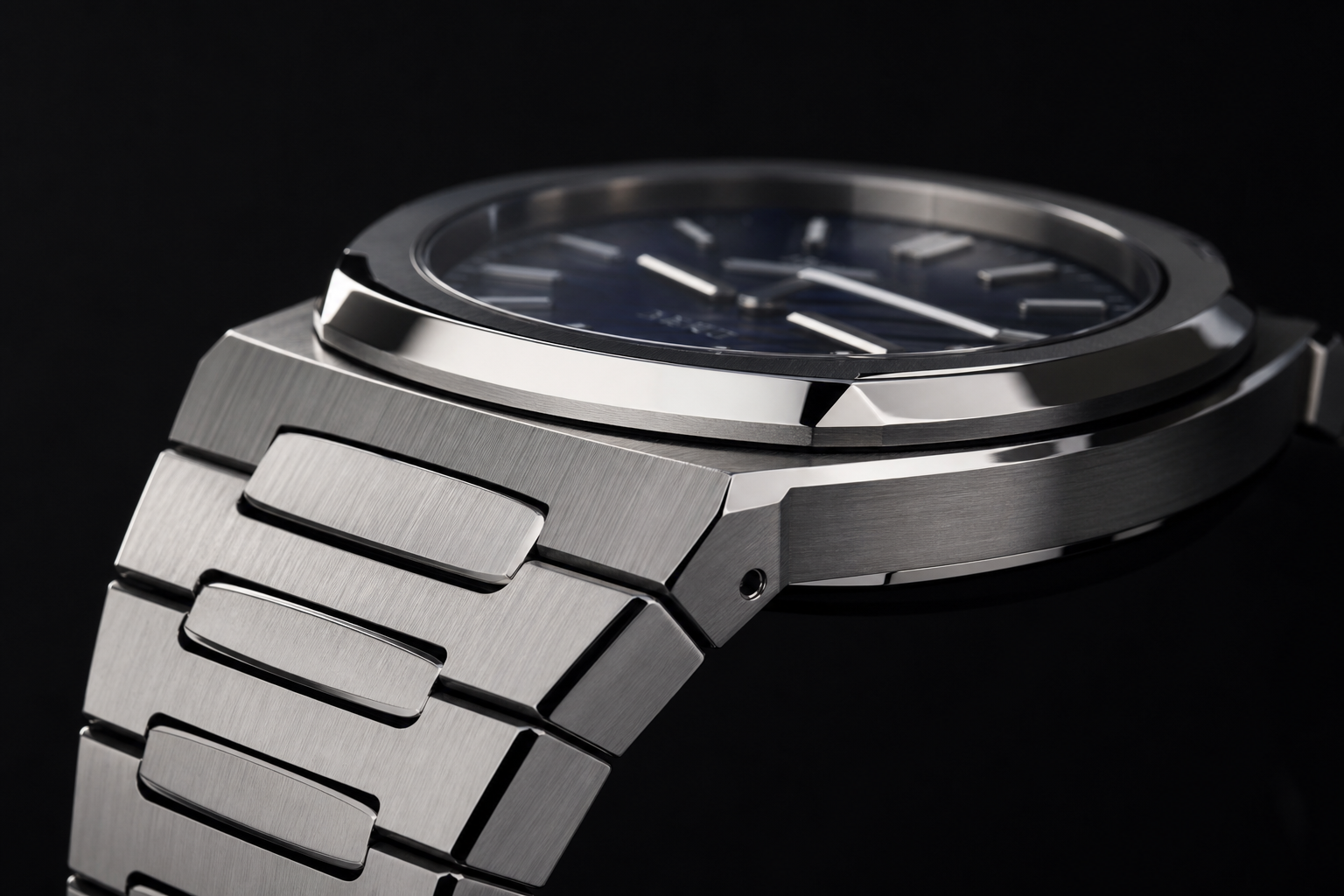
Dongguan matters in the AP super clone supply chain because Audemars Piguet-style watches are unusually dependent on metalwork. On many replica watches, the case is mostly a container for the dial and movement. On a Royal Oak-style watch, the stainless steel case, bezel, bracelet, bevels, and clasp are the design itself. If the metal processing is weak, the watch does not simply look slightly less refined; it loses the sharp architectural character that makes an AP visually convincing.
This is where Dongguan watch case manufacturing becomes relevant. Dongguan has a deep industrial base for metal processing, surface treatment, hardware production, and case-related manufacturing. That does not mean every AP replica case is made there, and it should not be treated as a magic origin label. The practical point is simpler: the type of industrial capacity found around Dongguan supports the physical shell of many high-end replica watch projects, especially where brushed finishing, polished bevels, bracelet components, and clasp machining require repeatable production rather than one-off handwork.
For buyers, the important lesson is that AP replica bracelet production is not a minor accessory issue. A Royal Oak bracelet can make a watch feel expensive or crude before anyone looks closely at the dial. A strong dial paired with a stiff, noisy, sharp-edged bracelet still feels wrong on the wrist. This is why AP clones are less forgiving than many round-case Rolex replicas. A Submariner-style bracelet can hide small tolerance issues more easily; a Royal Oak integrated bracelet displays them across every link.
Why the Royal Oak Bracelet Is Harder Than It Looks
The Royal Oak bracelet is difficult because it is not a separate strap attached to a case. It is a continuation of the case geometry. The first links must flow from the case without a visible break, the taper has to look natural, and every link has to articulate smoothly while keeping consistent gaps. If one link is slightly too thick, too flat, or brushed in the wrong direction, the whole bracelet looks less coherent.
This is the non-obvious reason why two AP super clones with similar front-facing photos can feel very different in person. A straight dial photo hides bracelet drape. Wrist wear does not. The bracelet has to curve around the wrist with a controlled looseness: too tight and it feels rigid; too loose and the link gaps look cheap. This balance depends on link machining, screw fit, edge finishing, and the accuracy of the head-link connection near the case.
Polished bevels are another trap. On a good AP-style bracelet, the polished chamfers should run cleanly along the edges of the brushed links. If the bevels are too rounded, the watch loses the crisp Royal Oak profile. If they are too sharp or uneven, the bracelet can feel harsh and can catch hair or skin. Some buyers obsess over dial color first, but in daily wear the bracelet feel often matters more. A slightly imperfect blue tone may only bother you under comparison photos; a rough bracelet bothers you every time you put the watch on.
Royal Oak Offshore models are a different problem. Many Offshores use rubber straps or chunkier case constructions, so the integrated bracelet challenge is reduced, but the metalwork burden does not disappear. The case, bezel, pushers, crown guards, and clasp hardware still need clean finishing. Offshore replicas can look impressive because of their size, yet that size also makes poor bevel work, uneven brushing, and thick case walls easier to notice from the side.
Case Finishing as a Supply Chain Weak Point
Case finishing is one of the easiest places for a multi-city supply chain to lose consistency. A case blank may be machined well, but the final brushing and polishing can still soften the edges. That matters on AP replicas because the Royal Oak depends on sharp transitions: satin-brushed flat surfaces, mirror-polished bevels, angular lugs, and a thin case profile that should not look swollen from the side.
The most common buyer mistake is treating case thickness as only a movement issue. Movement height is important, but case finishing can visually exaggerate thickness. A slightly thick mid-case with softened bevels will look heavier than its measurements suggest. Conversely, a case with clean side brushing, controlled chamfers, and a properly integrated caseback can wear more convincingly even if it is not perfect under calipers.
Brushing direction is also more important than many buyers expect. On a Royal Oak-style case, the brushing should look deliberate and linear, not cloudy or circular. Uneven brushing across the bezel, case flank, and bracelet can make the watch look assembled from mismatched parts. This is where metalwork quality becomes a supply chain issue rather than just a factory-name issue. If one batch uses different finishing hands, different abrasive treatment, or different bracelet component lots, the same factory label can produce watches with noticeably different wrist presence.
Clasp feel is another practical signal. Buyers often check the outside of the bracelet but ignore the clasp until the watch arrives. A weak clasp action, rough internal edges, shallow engraving, or loose closure can make an otherwise convincing AP-style replica feel unfinished. The clasp does not need to be overpraised as “genuine-like” to be acceptable, but it should close securely, sit flush, and avoid sharp or gritty contact points.
The sensible way to judge this part of the supply chain is not to ask whether a case came from Dongguan, Shenzhen, or another metalworking area. Ask whether the finished watch shows disciplined metal finishing. On an AP super clone, bracelet articulation, brushing consistency, bevel control, side profile, and clasp machining carry more buying value than a vague city claim.
Shanghai and Dandong: Movement Development, Modification, and Clone Movement Influence
Shanghai and Dandong enter the AP super clone discussion through movement routes. This is one of the biggest hidden reasons two watches can look similar in seller photos but behave differently in ownership. An AP clone movement is not just a technical line in a listing. It affects case thickness, date position, rotor feel, display-back appearance, power reserve expectations, serviceability, and sometimes the whole proportion of the watch.
Shanghai has been associated in the market with more developed clone movement projects and movement modification work, while Dandong is often discussed as an important Chinese replica watch movement source for certain modern clone routes. The exact movement used in a specific AP replica should always be checked at version level, because factory claims change and different batches may not use the same route. The buyer-relevant point is not to memorize a city as “good” or “bad.” The point is to understand that movement architecture can decide whether the case shape works.
AP exposes movement compromises more than many watches. A Royal Oak 15400 or 15500 has a relatively slim case, a visible caseback on many versions, and a dial layout where date position and hand stack must sit correctly. If a base movement needs thick decorative plates or awkward repositioning, the watch may become thicker, the rotor may sound rougher, or the movement view may look less convincing. The front of the watch might still photograph well, but the side profile and caseback tell a different story.
Why Movement Origin Matters More on AP Than on Some Simpler Replicas
On simpler closed-caseback replicas, a reliable base movement can be a rational compromise even if it is not visually close to the original caliber. AP is less forgiving because many Royal Oak references invite the buyer to look through the caseback. The movement is part of the visual experience, and more importantly, it has to physically support the correct case proportions.
This is why older plate-modified routes often created a clear tradeoff. A dependable automatic base movement could keep the watch running reasonably well, but the decorative plate added height and did not always place the visible architecture where buyers expected it. The result could be a watch with acceptable front-side appearance but a thicker case, louder rotor, or display back that looked more like an imitation of a movement than a coherent caliber.
Integrated clone-style routes can reduce some of these compromises when they are well executed. They may allow better case thickness, more accurate balance placement, improved date behavior, and a more credible movement view. But this does not automatically make them safer in every ownership sense. A newer clone movement can look better and still have less long-term service history, more parts uncertainty, or greater variation from batch to batch.
At CleanVSFactory, we usually treat the movement as part of the fit between model and buyer, not as a trophy specification. A more visually accurate AP clone movement is attractive, but if the buyer wants a low-stress daily watch, rotor noise, winding feel, service access, and date reliability matter just as much as bridge engraving.
Decorated Movement Versus Better Ownership Experience
A decorated movement can improve the view through a caseback, but decoration is not the same as mechanical quality. Engraved bridges, gold-tone rotors, and plates can make the watch look closer in photos, yet those parts do not guarantee better lubrication, cleaner assembly, stronger winding efficiency, or longer power reserve. In some cases, decoration adds complexity without improving daily reliability.
This distinction matters because many AP buyers are drawn to open casebacks. They want the watch to look correct from both sides. That is understandable, but the caseback is only one part of ownership. A movement that looks impressive but arrives dry, has a noisy rotor, changes date inconsistently, or runs with weak power reserve will become frustrating quickly. A less visually ambitious but stable movement may be more sensible for a buyer who values daily use over caseback accuracy.
Power reserve claims should be read carefully. Some clone movement listings cite specifications close to the genuine movement, but real-world performance can vary depending on assembly, lubrication, regulation, and unit condition. The safer expectation is to treat advertised reserve as a target, not a guarantee. If a seller cannot explain the movement route clearly or uses only generic terms like “best clone movement,” the buyer should slow down.
Rotor noise is another practical clue. Some base movements, especially certain thin automatic routes used under decorative plates, are known for audible free-spinning rotor behavior. A loud rotor does not always mean the movement is failing, but it changes the ownership experience. On an AP-style watch with a refined visual design, a cheap-sounding rotor can break the illusion faster than a small dial-printing flaw.
Movement Claims Need Narrow Verification
Movement names in replica listings should be handled carefully because the same external model description can be used with different internal routes over time. A seller may use terms such as clone movement, decorated movement, Asian automatic, Shanghai route, Dandong route, or upgraded movement, but those descriptions are not interchangeable. The buyer should ask what the movement claim specifically means for the watch being offered, not for a previous batch or a different reference.
The most useful evidence is not a dramatic movement label; it is consistency between the claim and the watch. Case thickness, crown position, date window placement, rotor layout, bridge appearance, and display-back photos should all make sense together. If a watch is advertised as a higher-end clone movement but the case looks unusually thick or the movement photo appears generic, the safer conclusion is that more evidence is needed before paying a premium.
Even when a movement route is visually closer to the authentic architecture, buyers should not treat that as proof of equal durability, equal service standards, or equal performance. Replica movement ownership depends on individual assembly, lubrication, regulation, parts availability, and the willingness of a watchmaker to work on it. For daily use, a modest but stable movement route may sometimes be more practical than a more ambitious route with uncertain service support.
Movement Transparency Note: Movement references in this article describe replica-market movement routes, decorations, base platforms, or clone-style configurations. They should not be read as official Audemars Piguet calibers or Swiss-manufactured movements unless a specific watch has verifiable evidence supporting that claim. Buyers should judge the movement by the actual version, case thickness, date position, rotor behavior, service risk, and QC photos where applicable.
Movement Route to Verify
Before judging an AP super clone, buyers should verify the claimed movement route, not just the factory name. The basic questions are straightforward: what movement is claimed, whether it is a clone-style architecture or a base movement with decoration, whether the expected case thickness matches that route, and whether the date behavior is consistent with the model being offered.
Movement photos should match the version being discussed. Generic caseback photos are not enough, especially for models that have gone through multiple versions or movement changes. Check whether the rotor shape, bridge layout, balance position, and engraving style align with the seller’s claim. The goal is not to use the watch for deceptive authentication; it is to avoid paying for a movement upgrade that is not actually present.
For AP replicas, the safest question is not “which movement sounds most advanced?” but “which movement route supports the right thickness, acceptable reliability, and realistic service expectations for this specific reference?” That answer may change between a 15400, 15500, 15202-style Jumbo, Offshore chronograph, or newer chronograph build.
Tianjin: A Major Mechanical Movement Source Behind Some Replica Routes
Tianjin should be understood as part of China’s broader mechanical movement ecosystem, not as the place where high-end AP super clones are generally finished or assembled. Its relevance is movement supply. A Tianjin mechanical movement, or a movement influenced by that wider supply environment, may appear in different replica watch routes as a base, a modified movement, or a component of lower to mid-tier builds depending on the model and factory strategy.
This distinction matters because buyers often ask whether movement source affects reliability. It does, but not in the simple way many people assume. A familiar replica watch movement source can be helpful if the movement is stable, parts are easier to replace, and watchmakers are more comfortable servicing it. But once that movement is decorated, modified, cased into a thin AP-style case, or paired with different calendar and rotor arrangements, the final ownership experience can change significantly.
For AP-style watches, Tianjin’s importance is usually indirect. It represents the practical logic of using established automatic movement platforms where a full clone movement is not necessary, not available, or not cost-effective. This can be rational in some replicas, but it can also create compromises in thickness, rotor feel, date position, or caseback appearance.
Base Movement Logic in Replica Watch Production
A base movement is attractive to replica producers because it is already functional, available at scale, and easier to build around than a completely new clone architecture. It may be regulated, decorated, modified with plates, fitted with a different rotor, or adapted to match a specific dial layout. In lower and mid-tier AP replicas, this approach can keep cost down and improve basic serviceability.
The tradeoff is that AP cases were not designed around generic movement convenience. A Royal Oak-style case has strict proportions, and the movement has to fit the case rather than the case looking swollen to fit the movement. If the base movement requires extra layers for decoration or calendar repositioning, the watch may gain thickness. If the rotor system is not well matched, the watch may sound or feel less refined than its exterior suggests.
This is where base movement versus clone movement becomes a real buying decision. A base movement route can be easier to service and more predictable in simple watches. A clone movement route can be more visually and dimensionally convincing in high-end AP replicas. Neither route is automatically better. The better choice depends on whether the buyer values daily stability, display-back accuracy, case thinness, lower price, or reduced ownership risk.
Why a Familiar Movement Source Can Still Produce Different Results
Even when two watches use movements from a similar source category, they can perform differently after casing, regulation, decoration, and final QC. One unit may have acceptable winding efficiency and date change, while another may arrive noisy, poorly regulated, or short on power reserve. The source of the movement is only the beginning of the story.
Casing matters more than buyers think. A movement that performs well on a bench can behave differently inside a tight case if the rotor clearance is marginal, the stem alignment is imperfect, or the caseback tolerances are not clean. Decoration can also introduce issues if plates interfere with service access or create misleading expectations about the movement underneath.
For AP-style models, the practical inspection points are simple: does the movement support the advertised case thickness, does the crown wind smoothly, does the date change cleanly, does the rotor sound reasonable, and is the beat rate appropriate for the claimed model route? These checks tell the buyer more than a city name alone.
The clear judgment is this: Tianjin’s movement ecosystem can contribute useful mechanical foundations, but a familiar movement source does not guarantee a strong AP super clone. The final result depends on how that movement is adapted, finished, assembled, and matched to the case. In AP replicas especially, the movement should be judged as part of the whole watch architecture, not as an isolated origin claim.
Hong Kong: Packaging, Transit, and International Logistics Bridge
Hong Kong is often mentioned in AP super clone discussions, but buyers should be careful about what that mention actually proves. In many cases, Hong Kong replica watch logistics are part of the final movement of the product, not evidence that the watch case, bracelet, dial, or movement was manufactured there. A Royal Oak-style replica may have mainland-made components, mainland assembly, and a Hong Kong-related packaging or transit step before it reaches an overseas buyer.
This matters because origin language is easy to misunderstand. If a seller says a watch “comes from Hong Kong,” that may describe a dealer route, a packaging point, a shipping origin, or an export-facing handoff. It does not automatically mean Hong Kong is the production center behind that AP clone. For buyers trying to judge real quality, the better question is not where the tracking label first appears, but whether the actual watch has the right case thickness, bracelet fit, dial execution, movement route, and QC consistency.
Why Shipping Origin Is Not the Same as Manufacturing Origin
Shipping origin confusion is one of the most common mistakes in reading the high-end replica watch supply chain, because high-end Audemars Piguet replica origins are often obscured by dealer routing, packaging, and logistics layers. Hong Kong can appear in tracking, communication, packaging, or dealer handling even when the upstream work happened elsewhere. That is normal in a divided supply chain. It is also why a tracking location should never be treated as proof of manufacturing origin.
For an AP super clone, this distinction is especially important because the quality is not created by the final shipping point. The Royal Oak case profile, bezel screw seating, integrated bracelet feel, tapisserie-style dial, and movement architecture are determined much earlier in the chain. Hong Kong may help move the finished product outward, but it does not explain whether the bracelet links were well finished, whether the case is too thick, or whether the decorated movement matches the claimed version.
A practical judgment: if a seller leans heavily on “Hong Kong” as a quality signal but provides weak QC photos or vague movement information, the city claim is not doing real buyer work. It may sound cleaner or more international, but it does not replace evidence of the watch itself.
Packaging Can Improve Presentation Without Changing the Watch
AP clone packaging can make a watch feel more complete, especially for buyers who care about presentation. Boxes, protective stickers, hang tags, cards, sleeves, and dealer-prepared accessories may create a more polished delivery experience. But packaging is not the watch. It does not improve the brushing on the case, sharpen the polished bevels, fix a misaligned datewheel, or reduce rotor noise.
This is where many first-time buyers overvalue the wrong part of the purchase. A well-packed Royal Oak super clone with clean stickers and accessories can still have a weak bracelet, uneven bezel screw depth, a flat-looking dial, or a movement that does not match the advertised route. Conversely, a less dramatic presentation can contain a better-built watch. Packaging can support final presentation, but it should sit below QC evidence in the buyer’s decision hierarchy.
The cleanest way to read Hong Kong’s role is this: it may be a logistics bridge and presentation point, not a quality guarantee. Treat packaging style, shipping origin, and city references as context only. The actual AP super clone quality still lives in the metalwork, dial, movement, assembly, and version control.
Buyers should also separate logistics language from ordering terms. A route, label, or packaging location does not explain return, repair, shipping, customs, or after-sales conditions. Those terms should be confirmed directly before ordering, while the watch itself should still be judged through QC photos, movement information, and model-specific execution.
How the Multi-City Supply Chain Shapes AP Clone Quality
A multi-city supply chain can produce a more convincing AP super clone, but it also explains why two watches sold under the same factory name may not feel identical. One production route may combine a strong dial supplier, good case finishing, a stable movement route, and careful assembly. Another batch may keep the same factory label but shift one upstream component or assembly standard, creating a watch that looks similar in listings but weaker in hand.
This is the real reason replica watch batch inconsistency is so important with AP. The Royal Oak is not forgiving. A small change in brushing texture, bezel screw seating, bracelet link tolerances, or movement thickness can affect the entire impression. On a simpler round watch, a minor case or bracelet variation may disappear on the wrist. On an AP-style case, the design exposes those changes immediately.
The Upside: Specialized Parts Can Create a More Convincing Watch
The best argument for network production is specialization. A high-end AP replica does not need every part to come from one building to be good. In fact, the stronger examples usually depend on different strengths coming together: precise small-part machining, competent case and bracelet finishing, a movement route that supports the right thickness, and final assembly that does not damage the work done upstream.
When this coordination works, the result can be much stronger than a simple one-shop build. The bezel sits flatter, the bracelet drapes with fewer awkward gaps, the clasp feels less rough, and the dial texture catches light more convincingly. This is why a serious factory label can matter: not because it proves a single physical origin, but because it may represent better coordination across multiple suppliers and handlers.
The non-obvious point is that AP super clone quality is often the quality of coordination, not just the quality of individual parts. A good dial inside a poorly proportioned case will still look off. A sharp case paired with a stiff bracelet will not deliver the Royal Oak wrist presence. A visually decorated movement may impress through the caseback but still create ownership frustration if the rotor is noisy or the date behavior is inconsistent.
The Downside: A Small Supplier Change Can Shift the Whole Batch
The same structure that allows specialization also creates version drift. A factory name may remain stable while the dial lot, bracelet finishing process, clasp component, movement batch, or final assembly team changes. The result is not always a dramatic downgrade. More often, the difference appears in small details: slightly different brushing grain, a clasp that closes with less confidence, a date that sits a hair low, or a rotor that sounds louder than expected.
This is why “newer batch” is not automatically better. Some updates genuinely improve a model, especially when they correct case thickness, dial texture, or movement layout. Other updates simply reflect component availability. A buyer who assumes every new release is an upgrade may miss a better earlier batch or accept a watch with weaker finishing because the version label sounds current.
At CleanVSFactory, we usually treat factory names as a starting point, not a verdict. For AP, the safer evaluation is factory plus model plus version plus movement route plus actual QC photos. Leaving out any one of those pieces makes the decision too dependent on marketing language.
Why AP Designs Reveal Supply Chain Weakness Quickly
AP is harder than many buyers expect because the case and bracelet are not just supporting parts; they are the design. The octagonal bezel, exposed screw heads, flat brushed planes, polished chamfers, integrated bracelet, and tapisserie-style dial all sit in direct visual conversation with each other. If one part is weak, it affects the whole watch.
Bezel screw issues are a good example. If the screws are too proud, unevenly seated, or visually too close to the crystal, the watch can look wrong even before a buyer notices the dial. Bracelet fit is another. A Royal Oak bracelet that is too stiff, too loose, or uneven at the first link changes the entire wrist presence. Case thickness also matters more than sellers admit, especially on thinner Royal Oak references where a fraction of a millimeter can make the case side look heavier.
The dial creates its own risk. A good tapisserie-style pattern can carry the watch visually, but if the markers are slightly crooked, the date window is off, or the printing is too heavy, the geometric layout makes those flaws easier to see. AP designs reward precision and punish inconsistency. That is why supply chain quality shows up faster here than on many other replica watches.
How Price Should Be Read in a Distributed AP Supply Chain
Price differences in AP super clones can be real, but they are not self-explanatory. A higher price may reflect a more accurate movement route, better bracelet finishing, a thinner case, limited batch availability, stronger dealer filtering, or simply seller margin and market hype. Buyers should avoid assuming that the most expensive listing is automatically the most coherent build.
For this category, the useful price question is what the extra cost is supposed to buy. If the premium is for a clone-style movement, the buyer should verify whether the case thickness, display-back layout, date position, and rotor behavior actually benefit from that route. If the premium is for a newer batch, the buyer should check whether the update improves a known weakness or only changes the version label. If the premium is for a famous factory name, it should still be tested against the individual QC set.
A lower-priced AP replica is not automatically bad either, but the buyer should understand the likely compromise. It may use a simpler movement, a thicker case, less refined bracelet articulation, weaker clasp finishing, or a less convincing dial texture. Some buyers may accept those compromises for occasional wear or photos. For regular wrist time, bracelet comfort, rotor sound, crown feel, and date reliability usually become more important than a small saving at purchase.
Prices can change by factory label, version, movement, seller channel, and availability, so exact comparisons should be verified at the time of purchase. A useful comparison should match the same reference style, factory version, movement configuration, bracelet or strap type, and QC standard rather than comparing two listings only by the headline name.
What Buyers Should Check When a Seller Mentions a Factory or City
Factory and city claims should never be ignored, but they should not lead the decision. “Guangzhou,” “Shenzhen,” “Hong Kong,” or a familiar factory name may tell you something about the market route, but they do not prove the quality of the specific watch being offered. AP super clone QC should start with evidence: the actual watch, the actual version, the actual movement route, and the visible construction details.
The mistake is treating replica watch factory claims like a shortcut. They are useful only when they line up with what the photos show. If the claim says high-end AP super clone but the case side looks too bulky, the bezel screws are poorly seated, the dial texture looks flat, or the movement photo does not match the advertised route, the label is not enough to save the watch.
Factory Name First, Evidence Second Is the Wrong Order
A factory name can narrow the field, but it should not end the evaluation. AP replicas vary too much by reference, version, and batch for name-based buying to be safe. A factory may be strong on a 15500-style Royal Oak and less convincing on an ultra-thin Jumbo-style model or a chronograph. Another factory may offer better bracelet finishing but use a movement route that creates a different ownership tradeoff.
The better order is simple: identify the claimed factory and version, then test the claim against QC photos. Does the dial layout match the reference? Does the date sit properly? Is the case thickness plausible for the model? Is the bracelet fit consistent? Does the caseback or movement view support the movement description? If the photos are too limited to answer those questions, the buyer is being asked to trust a label rather than judge a watch.
A city claim should be treated even more cautiously. Hong Kong may mean transit. Guangzhou may mean dealer handling or distribution. Shenzhen may be used loosely to imply precision manufacturing. None of those words guarantees case finishing, movement stability, or batch consistency.
AP-Specific QC Points That Reveal the Real Build
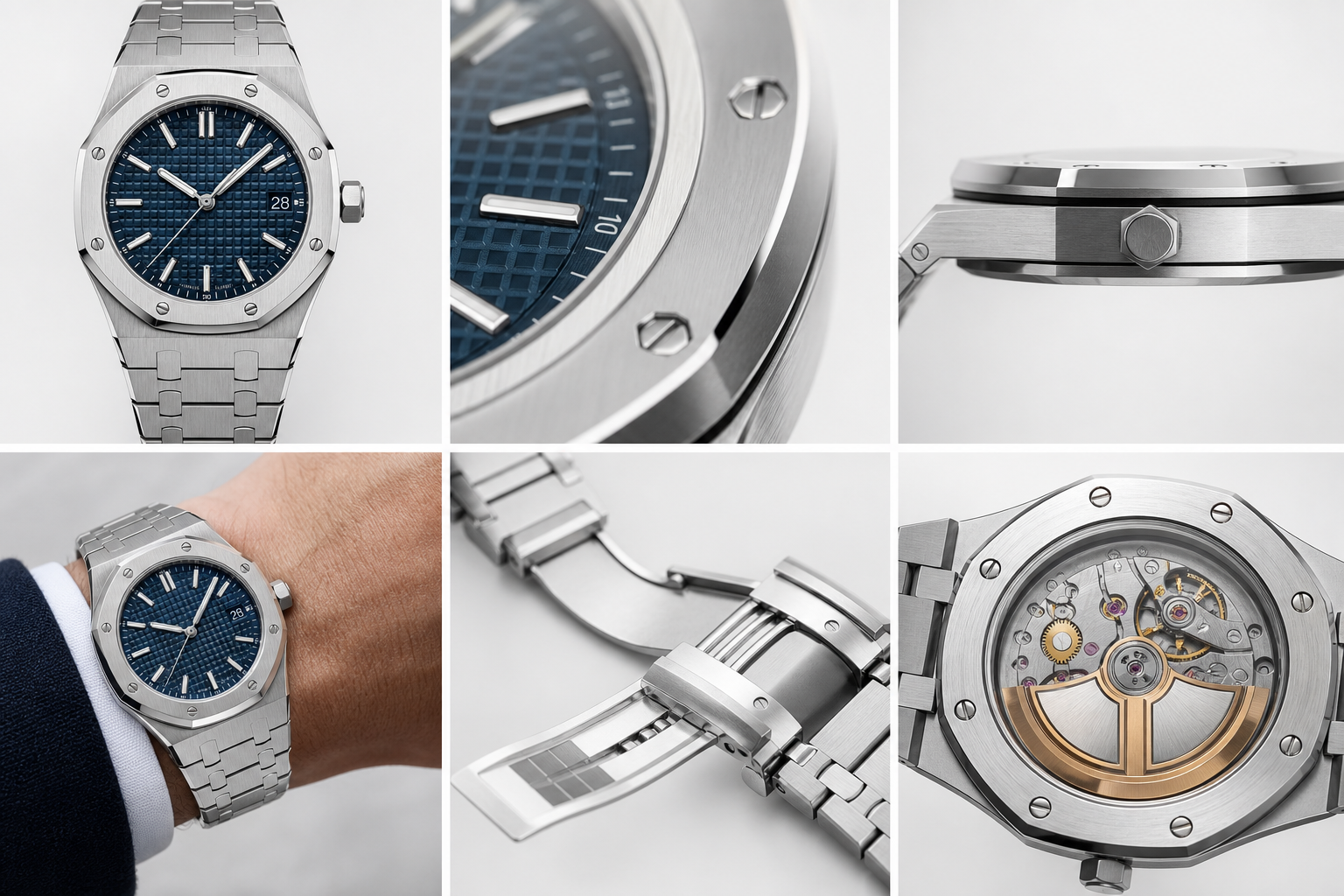
The first QC priority on an AP-style replica is geometry. Look at the watch straight on and check whether the bezel sits evenly, the eight visible screw heads are consistently seated, and the dial markers line up cleanly with the tapisserie-style grid. A small marker tilt can be more visible on a Royal Oak than on many round watches because the dial pattern gives your eye a built-in reference grid.
Next, check the side profile. Case thickness is one of the fastest ways to separate a convincing build from a merely attractive photo watch. A case that looks too slab-sided can ruin the Royal Oak silhouette, even if the dial color is appealing. This matters especially on thinner references, where buyers often focus on the dial and forget that the case edge is visible every time the watch is worn.
The bracelet deserves equal attention. Check the first link connection, link gaps, taper, clasp fit, and whether the bracelet looks fluid rather than rigid. Royal Oak bracelet quality is not only about shine or brushing; it is about how the bracelet integrates with the case. A well-finished case with a stiff or uneven bracelet will still feel wrong on the wrist.
Movement appearance should be judged with restraint. A decorated movement can look more attractive through a display back, but decoration alone does not prove reliability. For daily use, the more useful questions are whether the movement route matches the claimed version, whether the case thickness makes sense, whether date change behavior is known for that route, and whether buyers should expect rotor noise or service sensitivity.
Different Buyers Should Not Use the Same AP Checklist
A first-time buyer, a photo-focused buyer, and a daily-wear buyer may reach different conclusions about the same AP replica. A photo-focused buyer may care most about dial color, bezel shape, marker alignment, and caseback appearance. A daily-wear buyer should give more weight to bracelet comfort, clasp security, winding feel, date behavior, rotor noise, and whether the movement route is likely to be serviceable if problems appear.
Beginners should be especially cautious with complicated AP-style builds. Chronographs, openworked dials, perpetual-calendar-style layouts, skeletonized models, and very thin Jumbo-style cases usually add more points of failure than a simpler three-hand Royal Oak-style watch. A complicated dial can hide weaknesses in photos, but it can also create more alignment, hand clearance, subdial, and movement-routing issues.
Collectors who already understand replica-market tradeoffs may accept a more ambitious movement route because they value visual architecture and caseback realism. A buyer who only wants a comfortable occasional watch may be better served by a more stable and easier-to-maintain route, even if the movement view is less dramatic. The better choice is not universal; it depends on use case, tolerance for service risk, and how closely the watch will be inspected.
For buyers comparing several AP super clone offers, the safest method is to build a small evidence file for each candidate: claimed factory, claimed version, movement route, case thickness expectation, dial color and texture, bracelet photos, clasp photos, side profile, caseback, and any known batch notes. This makes the decision less emotional and reduces the chance of paying extra for a name that the actual watch does not support.
QC Photos Should Answer Specific Questions
Good QC photos should help the buyer answer practical questions, not merely create excitement. For an AP-style replica, front, side, bracelet, clasp, crown, caseback, and movement-related photos matter more than staged beauty shots. A straight-on dial photo can show alignment, but it cannot fully reveal bracelet drape, case thickness, clasp quality, or rotor layout.
Buyers should ask for angles that match the weaknesses of the model. For a thin Royal Oak-style reference, side profile and caseback thickness are important. For a bracelet model, first-link fit and clasp finishing matter. For an open caseback model, the movement photo should be specific to the offered watch rather than a generic catalog image. For a chronograph-style replica, subdial spacing, pusher alignment, and hand reset behavior deserve more attention.
If a seller avoids detailed QC or only repeats the factory name, the buyer has less evidence to work with. That does not automatically prove the watch is poor, but it increases uncertainty. In a category where small differences in batch and movement route matter, uncertainty should affect the price a buyer is willing to pay and the risk they are willing to accept.
How to Use Traceability Without Overclaiming
Traceability in the AP super clone market should be used to understand quality and risk, not to imply official brand approval or to represent a replica as an authentic watch. Factory names, movement routes, and city references are replica-market tools for comparison. They are not official Audemars Piguet affiliations, authorized production records, or proof that a watch shares the same construction as a genuine reference.
Claims such as “perfect,” “same as genuine,” or “guaranteed to pass inspection” should be treated with caution. A more reliable comparison looks at the actual model version, movement configuration, finishing details, and available QC evidence. The safest use of factory and movement information is to avoid overpaying or misunderstanding quality, not to support misrepresentation.
Risk Boundaries Buyers Should Confirm Before Ordering
Beyond factory name, movement route, and city claim, buyers should confirm the practical terms of the purchase directly with the seller. Return terms, repair options, shipping expectations, customs risk, payment process, and after-sales support can vary by seller and should not be assumed from a factory label, a QC photo set, or a city reference. A strong-looking AP replica can still be a poor purchase if the buyer misunderstands what support is available after delivery.
Water resistance should not be assumed from the model name or appearance. A Royal Oak Offshore-style replica may look sporty, and a Royal Oak-style case may appear well sealed, but that does not prove swimming, diving, or daily water exposure is safe. Buyers should confirm whether the specific watch has been tested and should treat replica watches more cautiously around water than genuine watches designed, tested, and serviced through official channels.
Buyers should also avoid using replica-market information to imply authenticity. A strong super clone may look convincing in normal wear, but close inspection can still reveal differences in finishing, movement architecture, case proportions, bracelet feel, dial details, or service compatibility. The purpose of factory and movement information is buyer education and risk reduction, not to represent a replica watch as genuine.
Final Takeaway: The Real Origin Is the Supply Chain, Not One City
The most accurate answer to where high-end AP super clones are really made in China is not one city name. Guangzhou may be important for coordination, dealer flow, QC handling, and distribution. Shenzhen may contribute precision component capability. Dongguan may matter for metal processing, case work, bracelet parts, and finishing capacity. Shanghai and Dandong may be tied to movement development, modification, or clone-style movement routes. Tianjin may contribute to the broader movement ecosystem. Hong Kong may function as a logistics, packaging, or transit bridge.
None of those locations alone proves the quality of a specific AP replica. The actual watch is a result of how those layers come together. A convincing Royal Oak-style super clone requires disciplined case geometry, clean bezel screw seating, controlled brushing, bracelet articulation, accurate dial layout, a movement route that supports the right case architecture, and final QC that catches obvious problems before the buyer sees the watch.
The practical conclusion is buyer-focused: do not buy an AP super clone only because a seller names a city, factory, or movement route. Use those claims as starting points, then verify them against the specific watch. In this category, trust should come from visible evidence, model-by-model comparison, movement transparency, and realistic expectations rather than from broad origin claims.
If the case, bracelet, dial, movement, and QC evidence all support the version being offered, the supply chain story becomes useful context. If those details do not line up, the city name and factory label should not carry the decision. For AP super clones, the strongest build is not the one with the loudest origin claim; it is the one where the whole watch makes sense as a coherent, inspectable replica-market product.
Disclosure: This article is for general educational and comparison purposes only. Replica watches are not genuine products from the original luxury brands, and brand names are used only to identify reference designs or comparison topics. Factory names, movement descriptions, prices, availability, QC details, seller policies, and version information can change, so readers should verify important details with the seller before making a purchase decision. Replica watches should not be represented, resold, or used as genuine watches.