
Choosing an AP-style replica by factory name alone can be misleading because two watches from the same factory and model line may not show the same finishing, bracelet feel, movement behavior, or QC consistency, especially when discussions of Chinese AP super clones mix real batch evolution with price trajectory claims. This article explains why batch variation happens, why “latest batch” does not automatically mean better, and why a true version update is different from a normal production run with small changes in parts, assembly, or inspection standards.
Replica watches should be clearly understood as replica-market products, not genuine watches from the original luxury brands. Brand names are used here for reference and comparison only; they do not imply authorization, endorsement, or affiliation with Audemars Piguet or any other original luxury watch brand.
The practical takeaway is to judge the actual watch in front of you, not only the reputation attached to it. AP designs make small issues easier to notice: bezel screw seating, brushing direction, bevel definition, bracelet edges, dial alignment, date centering, and tapisserie execution all matter. The article helps separate acceptable batch differences from warning signs that may affect daily wear, reliability, or buyer satisfaction.
| Decision Point | What to Check | Buyer Judgment |
|---|---|---|
| Factory reputation | Use it to narrow options, not to approve blindly | A known factory reduces risk but does not guarantee the unit |
| Batch claims | Compare recent QC examples and current stock photos | “Latest batch” is only useful if the visible details improved |
| Case and bezel | Bezel geometry, screw seating, brushing, bevels, side profile | Royal Oak-style cases reveal finishing problems quickly |
| Dial inspection | Markers, logo placement, printing, date centering, tapisserie | Treat dial color cautiously because lighting can distort it |
| Bracelet and clasp | Link articulation, sharp edges, clasp tolerance, integration | Wearability issues can matter more than tiny visual differences |
| Movement condition | Rotor noise, winding feel, cleanliness, power reserve signs | Same advertised movement can still vary by assembly condition |
Quick Questions Before You Read
Q: Is the newest AP replica batch always the safest choice?
No. A newer batch may improve some details, but it can also show rushed finishing or different supplier-related variation.
Q: Should factory name decide whether I accept a watch?
No. Factory reputation helps shortlist options, but the final decision should come from the specific QC photos and functional signs.
Q: Which AP details should be checked first in QC?
Start with bezel screws, dial alignment, brushing consistency, bracelet fit, clasp tolerance, and visible movement condition.
Q: Are small differences between batches always a problem?
Not always. Minor dial tone shifts or slight bracelet stiffness may be acceptable, but crooked markers, damaged screws, sharp edges, or rough winding are stronger warning signs.
Editorial Perspective: For AP replicas, the useful question is rarely “which factory is best overall?” A better question is whether the specific watch shown in QC has the right balance for the buyer’s use: visual sharpness, bracelet comfort, movement behavior, and acceptable batch consistency. At cleanvsfactory.com, AP factory comparisons are treated as model-specific and batch-specific judgments because the same APSF, ZF, APF, or VS label can describe watches with different dial runs, bracelet finishing, movement preparation, and inspection standards.
Evidence Boundaries for AP Factory Batch Claims
Because replica-factory information is often informal, buyer-facing, and difficult to verify independently, this article does not treat any factory name as official proof of quality, movement origin, material grade, water resistance, or long-term durability. Names such as APSF, ZF, APF, and VS can be useful market shorthand, but they should be read as comparison labels rather than guarantees from a recognized manufacturer.
When this guide discusses batch behavior, supplier variation, movement preparation, or QC inconsistency, it is describing practical buyer-side evaluation logic. It is not claiming access to factory production records, internal supplier contracts, pressure-test data, or authenticated movement inspection results. That distinction matters because a buyer can make a more careful decision without pretending that every claim in the replica market can be proven like an official brand specification.
Official Audemars Piguet information can help a buyer understand the design language, model family, and general visual expectations of the authentic Royal Oak or Royal Oak Offshore. It should not be used to prove that a replica watch has the same finishing, materials, movement performance, warranty support, serviceability, or legal status. The defensible approach is to compare visible execution carefully while keeping a clear separation between an authorized watch and an imitation product.
Traceability Terms Used in This Guide
To keep the comparison clear, “factory,” “batch,” “version,” and “movement route” should be read as replica-market terms rather than official Audemars Piguet terminology. A factory name helps identify the market source being discussed, a batch describes a production run or supply period, a version suggests a more intentional update, and a movement route describes the advertised mechanical configuration used inside that replica model.
This wording is important because it prevents one common mistake: treating a replica-market label as if it were official documentation. A buyer can use these terms to ask better questions and compare watches more carefully, but they do not prove brand authorization, genuine movement origin, identical materials, or consistent finishing across every unit. The most traceable decision is the one that connects the label to visible evidence: QC photos, recent examples, movement images where relevant, and the specific details seen on the actual watch.
The Misconception: Same AP Factory Does Not Mean Identical Output
“Same factory, same AP model” is not the same thing as “same individual watch.” That is the first misunderstanding behind AP factory batch variation. A buyer may order a replica Audemars Piguet Royal Oak from APSF, ZF, APF, or VS Factory after seeing strong reviews, then receive QC photos that look slightly different from another buyer’s watch from the same model line. One dial may look cleaner. One bracelet may appear better finished. One bezel may have neater screw seating. The factory name is the same, but the physical watch is not produced as a single unchanging object.
This is where many buyers make the wrong assumption. A factory label is useful, but it is not a factory label guarantee. Replica watch production depends on parts batches: dials, cases, bezels, bracelet links, screws, crystals, hands, datewheels, and movements. Those parts may come from different production runs or suppliers over time. Assembly quality may also vary between runs. The result is the familiar buyer complaint: same factory different quality, even when the advertised reference appears identical.
A simple Royal Oak example makes the issue easier to see. Two buyers choose the same 15500-style replica from the same factory. The first receives a watch with clean dial printing, centered markers, and bracelet edges that feel reasonably soft for a replica AP. The second receives QC photos showing a slightly uneven logo position, rougher bezel screw heads, and links that look less refined at the edges. This does not automatically mean the factory is “bad” or that the first buyer was lucky enough to receive a different model. It often means they received different individual units from different parts or assembly conditions.
The better buying mindset is not “which factory name solves everything?” but “which current batch and which individual watch am I actually being shown?” This distinction matters more with AP replicas than with many simpler replica watch designs because the Royal Oak and Royal Oak Offshore are unforgiving. Their appeal depends on flat surfaces, sharp transitions, visible screws, patterned dials, and integrated bracelets. Small production differences do not hide easily.
Why Factory Labels Are Useful but Incomplete
Factory names still matter. APSF, ZF, APF, VS Factory, and other market-known names can help a buyer narrow the search and avoid obvious low-tier options. They tell you which production network, movement route, finishing standard, and model focus you may be dealing with. For an AP buyer, that is a useful starting filter.
But the label is incomplete because it does not describe the exact replica watch in front of you. It does not confirm which dial batch was used, how cleanly that case was brushed, whether the bracelet edges were finished evenly, or whether the movement was handled well before casing. It also does not tell you whether the seller’s photos show a recent unit or an older review sample from a stronger batch.
This is why cleanvsfactory.com generally treats factory reputation as the first step, not the final decision. A factory can be strong for a certain Royal Oak reference and still release uneven individual watches. The practical buyer checks factory, batch timing, and QC condition separately. Skipping the last two steps is how buyers end up surprised by a watch that technically came from the “right” factory but does not match the examples they studied online.
Factory Name Clarification: Factory names such as APSF, ZF, APF, and VS are replica-market reference labels that can help buyers organize comparisons, but they are not official brand affiliations or guarantees of identical quality across every watch. The same label should still be checked against current batch photos, visible finishing, movement route, and the exact QC evidence for the individual unit.
How AP Designs Make Small Differences More Visible
Audemars Piguet-style designs expose inconsistency quickly because the watch does not rely on soft curves or simple polished surfaces. The Royal Oak is built around geometry. The octagonal bezel, exposed screw layout, brushed case planes, polished bevels, tapisserie dial, and integrated bracelet all sit in direct view. If one element is slightly rough, it can affect the whole impression.
This is different from a more forgiving replica watch where a minor dial tone shift or bracelet finishing difference may disappear on the wrist. On a Royal Oak replica, the dial texture catches light constantly. The bezel screws sit like reference points around the case. The bracelet flows directly from the case, so stiffness, sharpness, or uneven finishing is not just a comfort issue; it changes how the watch wears and presents itself.
The clear judgment is this: for AP replicas, factory choice reduces risk, but it does not erase batch variation. Buyers who rely only on the factory label are looking at the broad reputation. Buyers who review the actual watch are looking at the real product they may receive.
What “Batch Variation” Means in Replica AP Production
A replica watch batch is a production run, not a promise that every unit will be identical. In replica AP production, batch variation means that one run of watches may differ from another because of component supply, finishing workflow, assembly tolerance, movement preparation, or QC standards at that moment. The differences may be small, but on a Royal Oak or Offshore they can be visible enough to change the buyer’s confidence.
An AP replica production batch may use a dial run with a slightly different color tone, a case batch with cleaner or rougher brushing, a bracelet finishing pass that leaves sharper edges, or a movement batch that is noisier or less carefully lubricated. None of these changes has to be dramatic. The important point is that several small variables can stack together. One watch looks crisp and balanced; another from the same factory and model line looks slightly less convincing.
This is also why “latest batch” should not be treated as a magic phrase. Sellers and reviewers may use it to describe current stock, but the phrase alone does not prove better quality. A new batch can improve one detail and introduce unevenness elsewhere. The only useful question is what the current watch shows in QC photos and whether recent buyer examples support the same quality level.
Supplier Changes Can Be Invisible in the Listing but Visible on the Watch
One reason batch variation frustrates buyers is that supplier changes are rarely announced clearly. A seller listing may still use the same factory name, same reference number, same movement description, and same sample photos while the actual production run uses a slightly different dial supplier, bracelet finishing source, crystal batch, hand set, or datewheel batch. The listing looks unchanged, but the watch in QC can reveal small differences.
This is especially relevant for AP replicas because several parts have to match each other visually. A slightly different crystal height can change reflections over the tapisserie dial. A different datewheel print can make the date window look less centered or less clean. A bracelet batch with rougher underside finishing may not change the front view, but it changes daily comfort. These are practical ownership differences, not just collector-level details.
For buyers, the useful response is not to assume every supplier change is bad. Some changes may improve a model. The safer approach is to compare the current QC set against recent examples of the same factory and model, then ask whether the differences are visible in normal use, likely to affect comfort, or tied to movement behavior. Factory name is the starting signal; the actual part execution is the evidence.
Batch Difference Versus Version Update
A batch difference is not always the same as a version update. A version update usually means an intentional change: a revised dial texture, corrected case profile, updated bracelet construction, modified movement decoration, or improved datewheel. The factory is trying to change the product.
A batch difference is more ordinary and less formal. It may simply mean the dial supplier changed slightly, the brushing was less consistent that week, the crystal batch sits a touch differently, or the assembly tolerance was not as tight on certain units. Buyers often confuse these two situations. They see one QC set that looks different and assume the model has been “upgraded” or “downgraded,” when it may just be normal inconsistency inside the same production cycle.
The distinction matters because a real version update can change whether a model is worth considering, while ordinary batch inconsistency changes how carefully you should inspect the individual watch. If the factory revised a known flaw, older reviews may be less useful. If the issue is batch inconsistency, even a good review of the same version does not protect every buyer from a weaker unit.
A Practical Traceability Record for Batch Comparisons
When comparing two AP replicas from the same factory, it helps to create a simple record rather than relying on memory or forum impressions. Note the advertised factory name, model reference style, dial color, claimed version or batch wording, movement route, date of QC photos, and the exact details visible in the images. This makes the comparison more traceable because the buyer can see whether the decision is based on current evidence or on an older reputation.
The same record should separate what is claimed from what is visible. “APSF 15500 blue dial latest batch” is a claim. Centered markers, clean logo placement, acceptable datewheel position, evenly seated bezel screws, smoother bracelet edges, and movement decoration matching recent examples are visible observations. A buyer does not need internal factory records to make a better decision; the key is to avoid treating one broad factory label as if it explains every part of the watch.
Why One Batch Can Improve While Another Slips
Quality does not always move in a straight line. A later batch is not automatically better, and an older batch is not automatically worse. Replica AP production depends on supply and timing. If the dial run improves but bracelet finishing becomes rougher, the watch may photograph better while wearing worse. If case brushing improves but assembly QC becomes looser, the watch may look strong from one angle and disappointing from another.
Demand pressure can also affect consistency. Popular AP references, especially blue-dial Royal Oak models, can attract heavy buyer attention. When factories push output to meet demand, QC tolerance may become less predictable. That does not mean every high-demand batch is poor, but it does mean buyers should be cautious about assuming forum excitement equals stable production quality.
The non-obvious point is that batch variation can improve and slip at the same time. A watch can have a better dial than the previous run but a less comfortable bracelet. It can have a cleaner case shape but weaker movement preparation. AP replicas should be judged as a complete object, not as a single advertised upgrade.
Version Details to Confirm
Before relying on a review, confirm what version or batch is actually being shown. Ask whether the QC photos are from current stock, compare them with recent buyer photos when available, and avoid using year-old reviews as proof of today’s output. For AP replicas, recent evidence is more useful than old reputation because dial runs, bracelet finishing, and assembly consistency can change quietly.
- Confirm the advertised factory and model reference, but do not stop there.
- Ask whether the watch shown is from the current batch or an older sample.
- Compare QC photos against recent buyer examples, not only polished review photos.
- Separate a declared version update from ordinary batch inconsistency.
- Do not assume “latest batch” means “best batch” without photo evidence.
How to Build a More Reliable Batch Comparison
A stronger batch comparison should use several recent examples rather than one attractive photo. One clean QC set proves only that a clean unit exists. It does not prove that the whole batch is equally consistent, and it does not prove that another seller’s stock is from the same run. Buyers should compare multiple current photos when possible, especially for high-visibility areas such as the dial, bezel screws, bracelet finishing, and clasp fit.
It also helps to separate seller-supplied sample photos from individual QC photos. Sample photos often show a representative or especially clean example, while QC photos show the actual watch being offered. A buyer who compares today’s individual QC photos with old sample images may reject a normal unit unfairly or accept a weaker unit because the listing looked strong. The fairer comparison is current unit against current unit, under similar lighting and angles.
The most useful evidence is specific rather than emotional. Instead of saying “this batch looks worse,” note whether the markers are less centered, the bezel screws look rougher, the tapisserie appears flatter, the bracelet edges look sharper, or the clasp alignment looks weaker. Specific evidence makes the decision more defensible and prevents a buyer from being pushed around by hype, anxiety, or a factory name alone.
Dial Color, Tapisserie Texture, and Printing Are Common Batch Difference Points
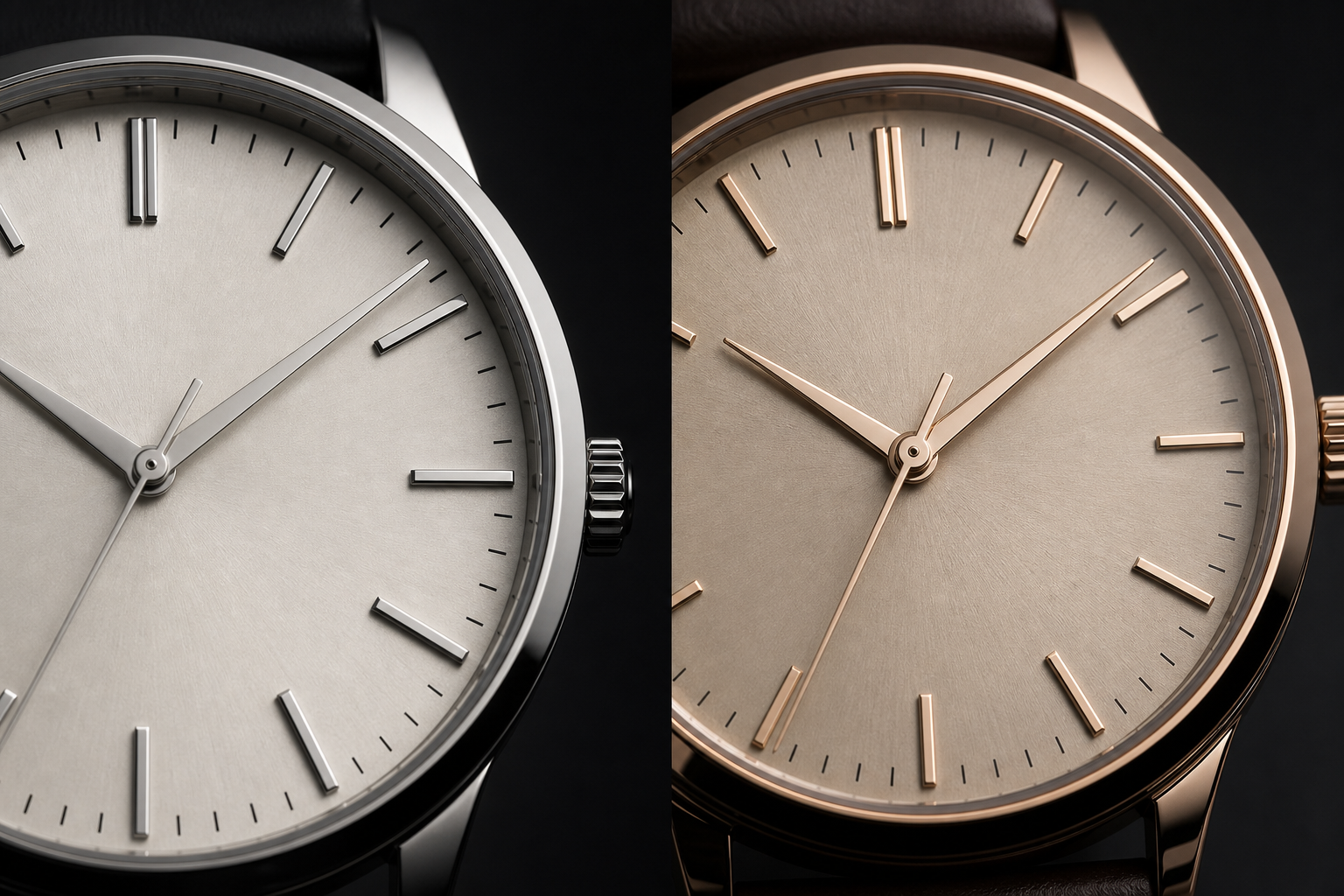
The AP replica dial is one of the first places batch variation becomes obvious. Royal Oak and Royal Oak Offshore watches do not have plain, forgiving dials. The color, tapisserie texture, printing weight, applied markers, logo position, and date window all interact. If one of those details shifts, the whole dial can feel different even when the case and bracelet are acceptable.
This is why buyers often say the dial looks different in QC. Sometimes the difference is real. Sometimes it is lighting. A blue AP replica dial may look deep navy in one photo, bright electric blue in another, and slightly purple under warm indoor lighting. Grey, green, black, and white dials can also shift depending on camera exposure, LED temperature, angle, and reflections from the crystal. Judging color from one photo is risky.
Color tolerance should be treated differently from alignment tolerance. A slight tone difference may be acceptable if the dial is otherwise clean and the photo conditions are not neutral. Crooked hour markers, poor logo placement, uneven printing, or a visibly messy tapisserie grid deserve more concern. Those are not just “camera angle” issues in the same way color can be.
Color Tone Can Shift Across Dial Runs
AP-style dial color is difficult because it depends on more than paint. The tapisserie surface changes how light breaks across the dial. A blue Royal Oak replica can look darker at the edges, lighter in the center, or more saturated depending on whether the dial has a sunburst effect, how deep the texture is, and what lighting the QC photo uses.
Across dial runs, the same factory may produce slightly different blue, grey, green, black, or white tones. Blue usually receives the most scrutiny because it is the most iconic Royal Oak color and the easiest for buyers to compare against online photos. But online comparison can mislead. A dealer’s warm desk light, a phone camera’s automatic color correction, or a tilted crystal reflection can make a good dial look wrong.
The practical approach is to judge dial color with restraint. If the tone is only slightly warmer, darker, or lighter in a single QC set, ask for a more neutral photo before treating it as a serious flaw. If multiple recent examples from the same batch show the same off-tone color, then it is more likely a real tapisserie dial batch issue rather than a photography problem.
Tapisserie Texture Is Harder to Keep Consistent Than Buyers Expect
The tapisserie pattern is where AP replicas become model-specific. On a Royal Oak, the dial is not just a background; it is one of the main design elements. Grande Tapisserie, Petite Tapisserie, and Méga Tapisserie patterns all create depth and rhythm across the dial. If the squares look too flat, too sharp, too soft, or unevenly stamped, the watch immediately feels less refined.
Batch variation can show up as differences in grid depth, pattern sharpness, cleanliness between squares, or how the dial catches light. One batch may have a crisper grid and stronger visual depth, while another may look flatter or slightly dirty under macro photos. Buyers sometimes focus only on color and miss texture, but texture often matters more to the perceived quality of a Royal Oak replica.
The judgment here is clear: a small color shift may be tolerable, but weak tapisserie execution changes the whole personality of the watch. A Royal Oak replica with a dull or uneven dial pattern rarely feels convincing in daily wear, even if the factory name is respected.
Printing, Logo, and Marker Alignment Need Separate Attention
Dial color, dial texture, and dial alignment should be judged separately, especially when comparing AP super clone quality tiers across different factory batches and dial manufacturing standards. A buyer may reject a dial for color when the real issue is crooked markers, or accept a nice color while ignoring a poorly positioned logo. These are different problems with different consequences.
Printing should look clean and evenly weighted. The AP logo should sit straight and balanced within the dial layout. Hour markers should point correctly and not appear rotated, floating, or unevenly spaced. If the model has a date window, the date should sit reasonably centered. On a tapisserie dial, even a small marker issue can become easier to notice because the grid gives the eye a built-in alignment reference.
Do not let an attractive dial color distract from construction errors. A strong blue tone does not rescue crooked hour markers. A clean tapisserie pattern does not excuse a visibly tilted logo. For AP replica dial QC, the safer order is simple: first check alignment and printing, then judge texture, then interpret color with lighting in mind.
Bezel Screws, Case Brushing, and Edge Finishing Can Change from Batch to Batch
On an AP-style replica, the case is not a neutral container for the dial. It is one of the first places where batch variation becomes obvious. The Royal Oak case is built around flat planes, hard edges, brushed surfaces, polished bevels, and the octagonal bezel. If one production batch receives cleaner brushing and better screw finishing, the watch can look sharp and controlled. If the next batch is rushed or uses less consistent case parts, the same model from the same factory can look softer, rougher, or less expensive immediately.
This is why Royal Oak case finishing matters more than many buyers expect. A Submariner-style case can hide small finishing inconsistency because the shape is rounded and the bezel dominates the view. A Royal Oak cannot hide as easily. The bezel screws, the brushed case, the polished bevels, and the edge transitions all sit in open view. When AP replica bezel screws look rough or the case brushing looks uneven, the watch loses its clean architectural feel even if the dial itself is acceptable.
Why the Royal Oak Bezel Magnifies Small Finishing Errors
The octagonal bezel is unforgiving because it gives the eye eight hard reference points. Each side should look clean, flat, and evenly finished. If the brushing direction changes slightly, if a bevel looks rounded, or if one edge catches light differently from the others, the watch can feel inconsistent in a way that a casual front photo may not fully explain.
The polished bevels are especially important. They do not need to be genuine-level hand finished to be a convincing replica watch, but they do need to be clean enough to define the case shape. A weak batch often shows bevels that look too soft, too wide, too narrow, or slightly wavy under angled light. That kind of flaw is not just a macro-photo issue. On the wrist, the Royal Oak depends on the contrast between satin brushing and polished edges. If that contrast is muddy, the watch looks flatter and less precise.
Minor finishing variation is normal in this market. The practical red flag is not that one bevel looks slightly different under harsh lighting. The red flag is when the bezel and case lose their geometry: uneven brushing, rounded edges, inconsistent bevel width, or visible tool marks. For Royal Oak case finishing, clean geometry matters more than obsessing over one tiny surface mark.
Screw Finishing Matters More Than Buyers Realize
AP replica bezel screws get too much attention for slot direction and not enough attention for actual finishing quality. Buyers often treat screw alignment as a simple pass-or-fail point, but the more useful question is whether the screws look clean, evenly seated, and consistently finished across the bezel.
A good batch should show screw heads that sit flush or nearly flush, without obvious burrs, damage, dark gaps, or chewed edges. The slots should look cut cleanly rather than torn. If one or two screws appear sunken, raised, scratched, or different in finish from the others, it can make the whole bezel look careless. This is one of those details that becomes more annoying after ownership because the bezel is always visible when checking the time.
Some variation in screw appearance can be acceptable, especially under magnified QC photos. What is less acceptable is rough screw work that suggests poor handling during assembly. A Royal Oak replica with strong dial execution but damaged-looking bezel screws is usually not the cleaner choice. The screws are part of the visual identity of the watch, not a small hidden component.
Case Profile and Side Views Should Not Be Ignored
Front-facing QC photos can make an AP replica look better than it is. The dial may appear centered, the bezel may look symmetrical, and the screws may seem acceptable. The side profile often tells a different story. It shows whether the bezel sits cleanly on the midcase, whether the case thickness feels controlled, and whether the brushing continues properly across the case flank.
This is where batch differences often become easier to read. One batch may have a cleaner bezel-to-case transition, while another may show a slightly proud bezel, uneven side brushing, or a case edge that looks too sharp. These details affect wrist presence. A Royal Oak or Offshore with a bulky or poorly finished side profile can feel less convincing even if the straight-on photo looks strong.
Sharp case edges also deserve attention. AP-style watches are supposed to have defined geometry, but there is a difference between crisp finishing and uncomfortable sharpness. If the edge looks unfinished or overly aggressive, it may not show as a major flaw in photos, but it can affect daily wear. For buyers comparing the same AP factory across different batches, side shots are one of the best ways to separate a clean unit from a merely average one.
Case and Bezel Checks
- Front view: Check bezel symmetry, screw consistency, and whether the octagonal shape looks balanced rather than slightly distorted by camera angle.
- Angled view: Look for brushing direction, polished bevel cleanliness, and whether the transitions between brushed and polished surfaces look controlled.
- Side view: Review case thickness, bezel seating, midcase brushing, and whether the case profile looks clean from crown side and non-crown side.
- Close-up screw view: Check for rough screw heads, damaged slots, uneven seating, dark gaps, or inconsistent finishing across the eight visible screws.
Bracelet Sharpness, Link Articulation, and Clasp Feel Often Vary on AP Replicas
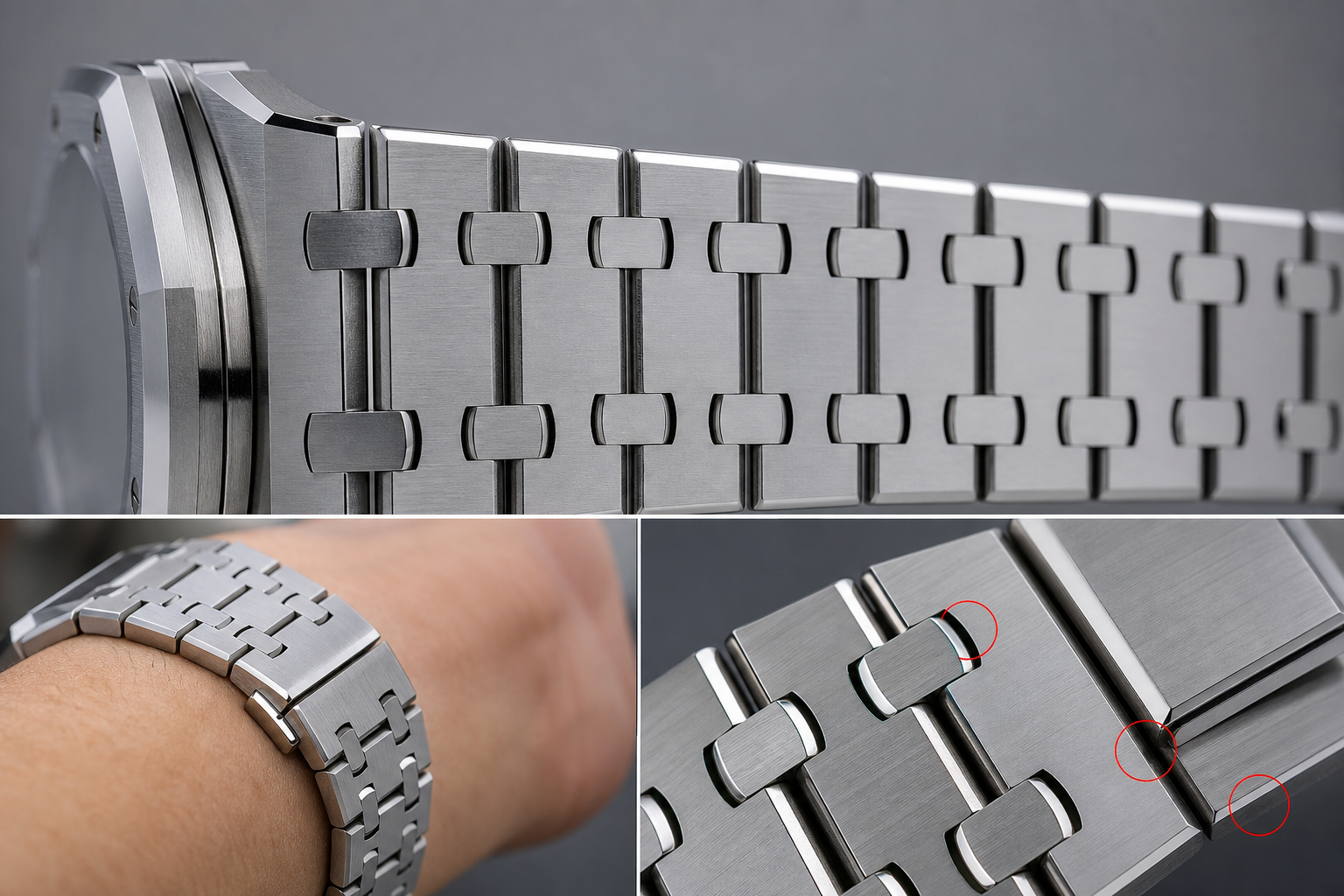
The AP replica bracelet is one of the biggest reasons two watches from the same factory can feel different even when the front photos look almost identical. A Royal Oak bracelet is not a simple steel strap. It is a chain of small shaped links with brushed top surfaces, polished bevels, tight gaps, and many articulation points. If one batch receives better finishing and assembly, the bracelet feels controlled and wearable. If another batch is less refined, the bracelet can feel sharp, gritty, stiff, or slightly loose.
This is where photo-based buying can mislead people. An AP replica bracelet may look acceptable in a straight-on image because the overall shape is correct. The real test is how the links move, how the edges feel against the wrist, and whether the clasp closes with confidence. Royal Oak bracelet finishing is both visual and tactile. A watch can pass casual visual inspection and still disappoint in daily wear if the bracelet feels harsh.
Why Integrated AP Bracelets Are Difficult to Finish Consistently
The integrated bracelet is difficult because every link has to continue the design language of the case. The brushed links should flow from the case, the polished bevels should catch light cleanly, and the link gaps should allow movement without looking sloppy. That is a lot of small metal surfaces to finish consistently across multiple production runs.
Batch variation often appears in the small transitions. One batch may have softer edges and smoother link movement. Another may show rougher brushing, uneven bevel brightness, or links that do not articulate as naturally. None of this requires the factory to change the model name or version label. It can happen simply because the bracelet finishing pass, link supplier, or assembly tolerance is not identical from one run to the next.
Acceptable firmness should not be confused with poor articulation. A new AP replica bracelet can feel slightly tight at first, especially if the links have close tolerances. That is different from links that feel gritty, bind at certain angles, or refuse to drape naturally around the wrist. For daily wear, link movement matters more than a tiny visual flaw that only appears under macro photos.
Sharp Edges Can Be a Bigger Daily-Wear Issue Than Small Dial Flaws
Buyers often worry about tiny dial differences while ignoring bracelet comfort. That priority is sometimes backwards. A small color shift or minor printing difference may only bother you in photos. A sharp bracelet edge bothers you every time the watch moves on the wrist.
Bracelet sharpness usually shows up around link corners, underside edges, and clasp contact points. Some crispness is part of the Royal Oak design, but a bracelet should not feel unfinished or cutting. If the bracelet feels sharp enough that you notice it immediately, the watch may become a poor daily choice regardless of how good the dial looks.
This is one of the clearest examples of why the “same factory, same model” label is not enough. Two AP replicas can share the same reference, same advertised movement, and same factory name, yet one feels smoother and the other feels rough. For many buyers, the smoother bracelet is the better watch even if the dial difference between the two is small.
Clasp Tolerance Can Change the Whole Wearing Experience
The clasp is another batch-sensitive area because it combines finishing, fit, spring tension, and tactile feedback. A good clasp should close securely and feel predictable. It does not need to feel like a genuine AP clasp, but it should not feel vague, loose, or fragile. If the clasp feels weak, the entire watch feels cheaper.
Clasp variation can show up as a soft snap, uneven closure, visible gaps, or a release action that feels inconsistent. Some clasps are firm when new and settle slightly with use. That is usually acceptable. A clasp that feels loose from the start or does not close cleanly deserves closer review because it affects confidence during daily wear.
Photos can help, but they cannot fully prove clasp feel. A clasp may look clean and still feel weak in hand. This is why buyer reports sometimes conflict even for the same AP factory batch: one unit may have a tight, satisfying closure, while another feels less secure. If there is one bracelet-area detail worth taking seriously beyond appearance, it is clasp tolerance.
Movement Cleanliness, Lubrication, Rotor Sound, and Power Reserve Are Not Always Equal
Movement variation is harder to judge than dial or case variation because it is not always visible in QC photos. Two watches can be advertised with the same AP replica movement route and still behave differently after delivery. One may wind smoothly, run quietly enough, and hold a reasonable reserve. Another may have a loud rotor, rough winding feel, weak power reserve, or signs of careless handling. The factory label does not guarantee that every individual movement receives the same preparation.
This does not mean every movement concern should cause panic. Replica watch movements are not regulated or finished to the same standard as genuine luxury calibers, and some mechanical noise or variation is expected. The real issue is separating normal ownership characteristics from signs of poor movement cleanliness, weak lubrication, or careless assembly. For AP replicas, this matters because many models use display casebacks or case designs where the movement route is part of the buyer’s decision.
Movement language should be read cautiously unless the specific watch has clear supporting evidence. A seller’s movement description can help explain the advertised route, but it does not prove cleanliness, lubrication quality, service history, authentic architecture, or long-term reliability. Decoration visible through a caseback may make a movement look closer to an expected layout, but decoration alone should not be treated as proof of mechanical equivalence with an authentic AP caliber.
Movement Transparency Note: Movement references in this article describe replica-market movement routes, decoration, or configurations used for comparison purposes. They should not be read as claims of an official Audemars Piguet caliber, brand-supplied movement, or Swiss-manufactured movement unless there is separate verifiable evidence for the specific watch being discussed.
Same Advertised Movement Does Not Mean Same Condition
A movement description tells you the route being used. It does not tell you the condition of the movement inside your individual watch. Cleanliness, lubrication, rotor installation, hand setting, date mechanism adjustment, and general handling can vary from unit to unit. This is why two buyers can report different experiences with the same factory and same model line.
Movement photos can help catch obvious problems, such as visible debris, damaged screws, crooked rotor installation, or suspiciously different movement decoration from what was advertised. But they cannot prove long-term reliability. A movement can look clean in a photo and still be dry, poorly lubricated, or inconsistently adjusted. The reverse is also true: a movement photo may look ordinary, but the watch may run acceptably in normal use.
At Clean VS Factory, we usually treat movement choice as an ownership-risk question, not just a specification line. The better movement route is not only the one that looks more accurate through the caseback; it is the one that supports the correct case proportions, offers reasonable serviceability, and avoids obvious daily-use frustration.
Rotor Noise and Winding Feel Are Ownership Signals
Rotor sound is one of the most common complaints on AP-style replicas, especially on models using thinner automatic movements with decorative architecture or modified winding systems. A little rotor noise does not automatically mean the movement is failing. Some movements are naturally more audible than others, and case construction can amplify sound. But a loud grinding, scraping, or rattling noise should not be ignored.
Winding feel also matters. A healthy-feeling movement should not feel sandy, sticky, or harsh through the crown. Some resistance is normal, especially on automatic movements with different winding architecture, but rough winding can suggest poor lubrication or assembly inconsistency. This is difficult to evaluate before delivery because QC photos do not capture tactile feedback.
The non-obvious point is that rotor noise and winding feel affect how expensive the watch feels more than many visual details do. A Royal Oak replica can look impressive on the wrist, but if the rotor sounds like it is spinning loosely every time you move your arm, the ownership experience becomes less satisfying. This is why movement condition is part of batch quality, not a separate afterthought.
Power Reserve Claims Should Be Treated Carefully
Advertised power reserve is one of the easiest specifications to overtrust. A factory or seller may list a reserve based on the movement type, but real-world performance can vary depending on movement condition, lubrication, mainspring health, winding efficiency, and how fully the watch was wound. A weak power reserve does not always mean the movement route is wrong, but it does mean the individual watch may need closer attention.
Buyers should also be careful when comparing reports. One owner may manually wind the watch fully before testing. Another may wear it lightly at a desk and assume the automatic rotor fully charged the mainspring. These are not the same test. For an AP replica movement, a meaningful power reserve complaint is usually repeated poor performance after a proper full wind, not a single short run after casual wear.
Power reserve is especially important for buyers who rotate watches. If the watch stops quickly after a day off the wrist, the convenience factor drops. For daily wear, stable winding behavior and predictable running often matter more than chasing the most impressive advertised reserve number.
Movement Claim Traceability Beyond the Caseback View
A display caseback can make movement comparison easier, but it can also create false confidence. Bridge shape, rotor engraving, jewel color, and decoration can help identify the advertised movement route, yet they do not prove lubrication quality, internal wear, regulation, shock handling, or long-term serviceability. A movement that photographs well may still have practical weaknesses, while a less decorative but stable route may be better for some daily-wear buyers.
For AP replicas, movement traceability should include several questions: does the advertised route match recent examples from the same model, does it support the correct case thickness, does the date position make sense, does the rotor look properly installed, and are there visible signs of debris or damage? Those checks do not guarantee reliability, but they reduce the chance of accepting a watch based only on a decorative movement name.
Movement Route to Verify
- Advertised movement type: Confirm the movement route being claimed for the specific AP model, especially if the reference has existed in multiple versions.
- Movement photo consistency: Compare the visible bridge layout, rotor style, and decoration with recent examples of the same factory batch when possible.
- Visible cleanliness: Look for obvious debris, damaged screws, loose-looking parts, or unusual marks in movement photos, while remembering that photos cannot prove lubrication quality.
- Date-change behavior: If the model has a date, confirm that the date sits properly and changes normally during basic function checks where available.
- Serviceability expectations: Treat long-term reliability as a risk-managed expectation, not a guarantee. A more complex or newer movement route may look attractive but can be harder to judge without real ownership feedback.
High-Demand AP Models Can Become Less Consistent When Production Is Rushed
A high-demand AP replica is not automatically worse, but it is more exposed to inconsistency. When a popular Royal Oak replica, Offshore replica, dial color, or newly updated version gets heavy attention, the factory has more pressure to produce quickly. That pressure can affect component supply, assembly pace, finishing time, and QC tolerance. The factory may still be capable, but the rushed production batch can show a wider spread between the best unit and the weakest unit.
This is why buyers sometimes see conflicting reports on the same factory and same reference. One early buyer posts a clean watch with a well-centered dial, even brushing, and a decent clasp feel. Another buyer receives the same model line a few weeks later and sees a slightly shifted marker, rougher screw heads, or a bracelet that feels sharper than expected. Both experiences can be real. The mistake is assuming the first strong example represents every watch from that run.
The most practical judgment is this: demand pressure should make you more careful, not automatically negative. A hot AP batch can still produce excellent examples, but it gives buyers less reason to accept weak QC just because the factory name is respected.
Why Popular Colors and References Can Show Uneven Results
Blue Royal Oak dials, newly released green dials, popular 15500-style models, and current Offshore chronographs often attract faster buyer demand than slower-moving colors or references. When one version becomes the “latest hot model,” factories may need more dial stock, more bracelet sets, more case parts, and more movement preparation in a short window. If any supplier run varies slightly, the final watches may not all land at the same quality level.
Color is a good example because it is easy for buyers to notice but difficult to judge perfectly from photos. A blue dial can shift under warm light, cool LED light, or angled reflections. But demand can also create real dial-run differences: slightly different saturation, less consistent sunburst effect, or uneven texture sharpness. The buyer should not reject every small tone difference, but if the same hot color shows repeated reports of weak printing, marker inconsistency, or strange texture, that is no longer just a lighting issue.
References with more visible construction also suffer more under pressure. A simple dial-side photo may hide the problem, but a Royal Oak depends on the whole object working together: dial, bezel, screws, brushing, bracelet, and clasp. If production is being pushed hard, small shortcuts in finishing become easier to feel on the wrist than to notice in one promotional photo.
Forum Hype Can Outrun Real Batch Evidence
Forum excitement often moves faster than stable batch evidence. A few clean QC sets can make a new AP release look safer than it really is, especially when buyers are waiting for a factory to “finally fix” a known flaw. The danger is not that early reviews are useless. The danger is treating them as proof that every later unit will be equally clean.
Early photos usually show the best-looking examples because those are the watches people are happiest to share. Weak units may appear later, after more buyers receive watches from the same production cycle. That is why reviews can feel inconsistent: the first reports may reflect strong samples, while later reports reveal the normal spread of the batch.
At Clean VS Factory, we tend to treat early hype as a signal to inspect more carefully, not as a reason to inspect less. A factory update can be real, but a real update still needs current QC evidence. If a seller or reviewer says “latest batch,” the useful question is not only whether it is latest; it is whether the actual watch in front of you shows the improvements buyers are discussing.
Rushed Output Can Affect Both Visual and Mechanical Areas
Production pressure does not only affect the obvious visual pieces. A rushed batch can show uneven dial alignment, less refined case brushing, rougher screw finishing, tighter or sharper bracelet links, inconsistent clasp snap, or less careful movement preparation. These are not always dramatic failures. More often, they are small compromises that add up and make one watch feel less refined than another from the same factory.
Mechanical behavior is especially easy to overlook because most QC photos focus on the dial and case. A movement can look acceptable in a still photo but arrive with rough winding, more rotor noise, weaker reserve, or inconsistent date behavior. Those issues are not always caused by demand pressure, but rushed preparation can make them more common.
The buyer’s decision should change during a hot release cycle. Do not rely on factory reputation alone, and do not assume the newest batch is automatically the best batch. Wait for multiple recent examples when possible, compare QC photos from the same period, and be more selective with alignment, finishing, and clasp condition. Popularity reduces patience in the market; it should not reduce your standards.
Why Price Differences Do Not Always Prove Better Batch Quality
When two sellers quote different prices for what appears to be the same AP factory and same model, many buyers assume the higher price must mean a cleaner batch. Sometimes price can reflect a different movement route, stronger finishing, limited availability, sourcing difficulty, or seller margin. But price can also reflect market demand or simply the fact that a popular AP reference is hard to source at that moment.
This is why price should be treated as one signal, not final proof. A more expensive Royal Oak replica still needs the same QC review: dial alignment, tapisserie execution, bezel screw condition, case brushing, bracelet comfort, clasp tolerance, and visible movement condition. Paying more does not automatically remove batch variation. A lower price also does not automatically mean the watch is worse if the unit shown is clean and the movement route matches the buyer’s expectations.
The more useful comparison is value for the intended use. If the buyer wants a daily-wear AP replica, a slightly more expensive unit with smoother bracelet finishing and a more predictable movement, alongside clearer high-end AP replica origins, may be more sensible than a sharper-looking photo piece with rough clasp action. If the buyer mostly cares about wrist shots, dial texture and bezel finishing may sit higher than rotor sound. Price only becomes meaningful after the buyer understands what the extra money is supposed to improve, and buyers should confirm return, repair, shipping, and after-sales terms before ordering because those terms vary by seller.
QC Photos Matter More Than Factory Reputation Once the Model Is Chosen
Factory reputation helps you narrow the field. It does not decide the individual watch. Once you have chosen the model and likely factory, AP replica QC photos become the strongest evidence you have because they show the specific unit being offered, not the best example from an old review or a factory display image.
This matters more on AP replicas than on many simpler watches. A Royal Oak QC check cannot be limited to asking whether the watch came from APSF, ZF, APF, VS, or another known maker. The individual watch can still show a crooked marker, uneven bezel screw appearance, questionable date alignment, poor bracelet fit, or a clasp that looks roughly finished. A respected factory reduces risk, but QC photos decide whether this particular unit deserves acceptance.
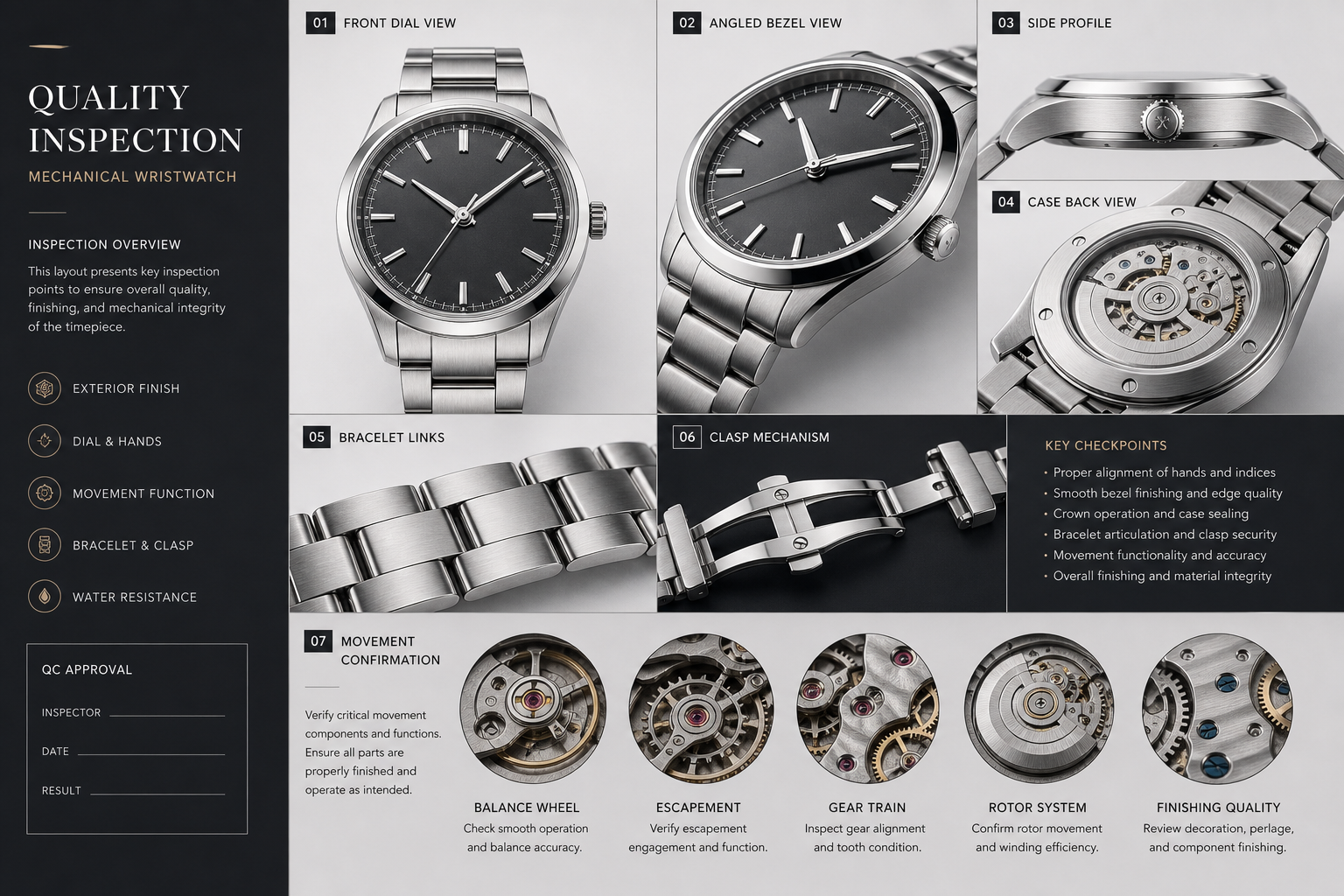
A useful AP review order is simple: start with the dial, then move to bezel and screws, then case and bracelet integration, then clasp and movement confirmation. Photos can catch obvious problems. They cannot guarantee long-term reliability, waterproofing, or perfect mechanical health, so they should be treated as a quality screen, not a promise.
Water resistance deserves special caution in QC discussions. A genuine AP model’s stated water-resistance rating, when available from official brand material, should not be used to assume that a replica has the same sealing, gasket condition, pressure-test result, or post-assembly integrity. For replica watches, water resistance should be treated as unverified unless the individual watch has been pressure-tested by a competent watchmaker after purchase.
Front Dial Photos Should Show Symmetry and Alignment
The straight-on front dial photo is the first image to study because it reveals the watch’s basic symmetry. On a Royal Oak-style dial, the hour markers, logo placement, date window if present, tapisserie layout, and printed text must all work together. A small camera tilt can create distortion, but a genuinely crooked marker or visibly off-center date does not become acceptable just because the factory is well known.
Buyers often focus too much on dial color in the first photo. Color matters, especially on blue, grey, green, and white AP-style dials, but alignment is usually the higher-priority QC decision. A slightly warm photo can make a dial look different from reality. A marker leaning toward the edge or a logo sitting visibly off-balance is a more concrete problem.
The front photo should also show whether the tapisserie grid looks centered and orderly. It does not need to match a genuine AP dial under macro inspection, but it should not look dirty, smeared, or poorly printed at normal viewing size. If the seller only provides angled glamour shots, ask for a neutral straight-on image before judging the watch.
Side Photos Reveal Thickness, Bezel Fit, and Bracelet Integration
AP replicas cannot be judged from the front alone. The side profile tells you whether the case looks balanced, whether the bezel sits cleanly, and whether the bracelet integrates naturally into the case. On Royal Oak and Offshore designs, thickness and side finishing affect wrist presence immediately. A watch can look strong from the dial side and still feel bulky or poorly finished from the side.
Side photos are also useful for spotting uneven bezel seating or a midcase that looks rougher than expected. The Royal Oak’s flat surfaces and bevels create strong light lines, so sloppy brushing or a soft transition can become more visible from an angle than from the front.
The bracelet connection deserves attention in the same side view. If the first link sits awkwardly, the end-link area looks uneven, or the bracelet does not articulate cleanly from the case, the watch may wear worse than the front photo suggests. This is one of the most common ways a decent-looking AP replica becomes disappointing in daily use.
Clasp and Bracelet Photos Help Predict Wearing Comfort
Clasp and bracelet photos are not decorative extras. They help predict whether the watch will feel comfortable or irritating on the wrist. AP-style bracelets have many small link surfaces, polished bevels, brushed flats, and articulation points. If the finishing is rough or the clasp tolerance is weak, the ownership experience suffers even if the dial looks good.
Look for visible sharpness around link edges, uneven brushing, poorly finished screw areas, and a clasp that appears misaligned or loosely seated. A new bracelet may feel firm at first, but it should not look crude or poorly assembled. If the clasp appears uneven in photos, that issue often becomes more annoying after delivery because it is touched every time the watch is worn.
Bracelet QC is where buyers should be less forgiving than they often are. A tiny dial tone difference may be forgotten after a week. A sharp bracelet edge or unreliable clasp will remind you every time the watch goes on the wrist.
Seller Descriptions Should Be Checked Against What Photos Actually Show
Seller descriptions such as “latest batch,” “best version,” “updated dial,” or “improved bracelet” can be useful clues, but they should not replace inspection. The buyer should ask what the statement refers to. Did the factory revise the dial print? Did the bracelet finishing change? Was the movement route updated? Or is the seller simply describing current stock with familiar marketing language?
QC photos are useful because they turn broad claims into checkable details. If a seller says the bezel screws are improved, the photos should show cleaner screw heads and more even seating. If the dial is described as corrected, the markers, logo, date, and tapisserie should support that claim. If the movement is presented as a better route, the case thickness, caseback view, and basic function checks should make sense for that movement choice.
The safest reading is balanced: seller labels and factory claims help organize the comparison, but they are not final proof. A buyer should accept the watch because the individual QC set supports the claim, not because the description uses the strongest wording.
QC Photos to Request
- Straight-on dial photo: Best for checking marker alignment, logo position, date centering, printed text, and overall dial symmetry.
- Angled dial and bezel photo: Useful for seeing tapisserie texture, crystal reflection, bezel finishing, and screw appearance.
- Side profile photo: Helps judge case thickness, bezel seating, midcase finishing, crown-side shape, and bracelet integration.
- Close-up bezel screw shots: Important for checking screw head condition, seating, and obvious rough finishing.
- Bracelet photos: Should show link finishing, articulation, end-link fit, brushing consistency, and possible sharp edges.
- Clasp photo: Helps evaluate clasp alignment, engraving cleanliness, closure fit, and rough finishing around the folding parts.
- Caseback or movement photo if relevant: Useful for confirming the advertised movement route and spotting obvious debris, damage, or mismatched decoration.
Do not expect QC photos to prove everything. They cannot fully show winding feel, rotor sound, power reserve, or long-term durability. Their job is to identify visible issues before you accept the individual watch condition.
Before making a decision, buyers should review real QC photos where available, including dial printing, hand alignment, bezel position, datewheel centering, bracelet fit, clasp engraving, case thickness, and overall finishing. Factory labels and stock photos alone are not enough for a reliable judgment.
How to Separate Acceptable Batch Variation from Real Red Flags
Not every difference between AP replicas is a serious defect. Some batch variation is normal in this market, especially with dial tone, lighting response, bracelet stiffness, and small finishing differences. The buyer’s job is not to chase a perfect replica watch. The job is to separate acceptable batch variation from AP replica red flags that will affect ownership satisfaction.
The hierarchy matters. A slightly cooler grey dial in one QC set may be tolerable. A badly seated bezel screw, crooked marker, sharp bracelet, loose clasp, or visibly contaminated movement is a different category. One affects preference; the other affects quality and daily wear.
The most useful question is not “is this flaw visible under macro?” It is “will this bother me every time I look at or wear the watch?” On AP-style watches, tactile issues often matter more than small photo-dependent color differences.
Usually Acceptable Differences
Minor dial tone variation is usually acceptable if the dial remains clean, balanced, and consistent across normal lighting. AP-style blue, grey, black, green, and white dials can look different depending on camera exposure and light temperature. A one-photo color mismatch should not automatically become a rejection-level issue unless recent examples show a clear pattern of poor dial color from the same batch.
Small photo-angle distortions are also common. A bezel screw or marker can look slightly off if the camera is tilted, the crystal catches glare, or the watch is not level. This is why a straight-on dial photo matters. If the concern disappears in a better-aligned image, it is probably not a real defect.
Slight bracelet stiffness can be normal on a new AP replica bracelet, especially with integrated designs. It becomes more concerning only when the links look gritty, poorly finished, stuck, or uneven. Normal replica-level finishing limits should be accepted if the watch is clean, comfortable, and visually coherent. Expecting genuine AP hand-finishing is not a realistic QC standard.
Issues That Need Closer Review
Questionable date centering deserves a second look, especially on models where the date window sits close to dial texture or printed details. A date that appears slightly high or low may be caused by angle, but if it remains visibly off in multiple straight photos, it becomes a quality concern.
Uneven screw appearance also needs closer review. AP bezel screws are a sensitive area because rough heads, poor seating, or inconsistent finishing can make the entire bezel look cheaper. Minor variation is normal, but a screw that looks damaged, sunken, protruding, or heavily scratched should not be ignored.
Slightly rough clasp action is harder to judge from photos, but visible misalignment or crude finishing around the clasp should raise caution. The same applies to inconsistent brushing on the case or bracelet. If one surface looks much rougher than the rest, the watch may have come from a less carefully finished unit within the batch.
Movement photos also require measured judgment. A movement image can confirm the broad route and reveal obvious debris or damage, but it cannot prove long-term reliability. If the photo is blurry, cropped, or does not match the advertised movement style, ask for clarification before treating the QC as complete.
Red Flags That Can Affect Ownership Satisfaction
Severe marker misalignment is a real red flag on a Royal Oak-style dial. The geometric case and tapisserie layout make crooked markers easier to notice than on many round watches. If the marker visibly leans or sits out of position in a straight photo, the issue will likely bother the owner long after the excitement of receiving the watch fades.
Visibly damaged bezel screws, rough screw heads, or poor screw seating should also change the decision. The octagonal bezel is one of the first things people notice on an AP-style watch. If the screws look abused before the watch is even worn, the piece already starts with a compromised impression.
Sharp bracelet edges are more serious than many buyers expect. A small dial flaw may be seen only in photos, but a rough bracelet is felt every day. If link edges look crude, the bracelet does not articulate evenly, or the clasp appears loose and poorly seated, the watch may become uncomfortable regardless of how good the dial looks.
Movement contamination, obvious loose parts, or major power reserve concerns are also red flags. A noisy rotor alone is not always enough to reject a watch, especially with certain movement routes, but rough winding, visible debris, inconsistent date behavior, or strongly weak reserve should be treated as ownership-risk issues rather than cosmetic quirks.
A sensible acceptance standard is not perfection. It is balance. Accept minor variation that is photo-dependent or unlikely to affect daily wear. Slow down for uncertain alignment, screw, clasp, or movement questions. Be willing to reject the unit when the flaw is obvious, tactile, or likely to make the watch frustrating after the first week.
Documenting QC Evidence Before You Accept the Watch
One practical way to reduce confusion is to document the QC evidence before making the final decision. Save the seller’s individual QC photos, the written description, the advertised factory name, the stated movement route, and any specific batch or version wording. This does not make the watch risk-free, but it gives the buyer a clearer record of what was actually shown and promised at the time of acceptance.
Documentation is also useful when comparing two examples from the same factory. If one watch has a cleaner dial but a sharper bracelet, while another has a slightly weaker dial photo but better case and clasp finishing, the choice becomes a trade-off rather than a vague feeling. AP replicas often require this kind of trade-off because the watch is judged through several surfaces and tactile points, not one headline feature.
Buyers should avoid treating edited promotional images, old review photos, or unrelated factory examples as proof of the unit they are about to receive. The most defensible evidence is the current QC set for the exact watch, supported by recent examples from the same model family when available. That standard keeps expectations realistic and prevents the common mistake of comparing a real unit against an idealized sample.
What to Save for a Traceable Decision
A useful QC record does not need to be complicated. Save the original QC photos, any close-up images requested later, the seller’s written factory and movement description, and a short note of the specific concerns reviewed before acceptance. If a dial color concern was clarified by an extra neutral-light photo, keep that photo with the first set. If the movement route was confirmed by a caseback image, keep that image with the written movement description.
This record is not about proving that a replica is equivalent to an authentic watch. It is about reducing confusion if questions arise later and helping the buyer learn from one purchase to the next. Over time, a buyer who compares documented QC sets becomes better at spotting batch patterns, seller wording that is too vague, and details that matter more in daily wear than they appear to matter in a listing.
The Practical Takeaway: Judge the Factory, the Batch, and the Individual Watch
The safest way to judge AP replica quality is to separate three things that buyers often collapse into one: the factory name, the current batch, and the individual watch shown in QC. Factory reputation matters, but it is not the final answer. A Royal Oak replica or Offshore replica from a respected factory can still arrive with a weaker dial, rougher bracelet, less clean bezel work, or a movement that feels less refined than another watch from the same model line.
This is the main lesson behind factory batch QC: same factory and same model do not guarantee identical quality. AP-style watches make this especially obvious because the design has very little room to hide uneven execution. Flat brushed surfaces, polished bevels, tapisserie texture, exposed bezel screws, integrated bracelet links, and clasp feel all sit in plain view. A small production slip that might be less noticeable on a simpler watch can change the whole impression of a Royal Oak-style case and bracelet.
For buyers asking how to decide or which is the best batch to choose, the practical answer is not to chase a factory name alone. Use the factory name to narrow the field, use recent batch evidence to understand what is currently being produced, and use the individual QC set to judge the actual watch in front of you. That three-step approach reduces more risk than relying on an old review, a forum shortcut, or a seller’s factory label.
Factory Name Narrows the Search
A factory label such as APSF, ZF, APF, or VS is useful because it tells you where to start. Some factories have stronger track records in certain AP model families, and ignoring that history would be careless. Factory reputation can help avoid obvious low-tier options, outdated movement routes, or models with known structural compromises.
But the factory name is only a filter, not a guarantee. A strong factory can still have uneven production, supplier changes, finishing inconsistency, or rushed output on a hot reference. A weaker individual unit from a respected batch is still a weaker watch. This is why a buyer should not treat “same factory same model” as proof that the watch will match the best photos seen online.
At Clean VS Factory, we usually treat factory reputation as the first layer of risk reduction, not the final decision. It helps answer “which options are worth considering,” but it does not answer “is this specific watch acceptable.” For AP replicas, that second question matters more than many buyers expect.
Current Batch Evidence Shows What Is Actually Being Produced
Recent QC examples are usually more useful than old praise. A review from six months ago may describe a different dial run, a different bracelet finishing pass, a different crystal batch, or a different movement preparation standard. Even if the model name has not changed, the current batch may not behave exactly like the watch shown in an older comparison.
This is where many buyers misread the market. They search for the “best AP factory,” find a strong review, and assume every later unit will match that sample. That is not how batch-sensitive replica watch production works. The better question is: does the current batch still show the same strengths, or have new weaknesses appeared in dial alignment, bezel screw condition, brushing consistency, bracelet comfort, clasp feel, or movement cleanliness?
Current batch evidence should come from recent buyer photos, recent QC sets, and consistent observations across more than one watch. One beautiful photo proves that a good unit exists. It does not prove that every unit from that batch is equally clean. For AP replica watches, repeated consistency is more valuable than one impressive example.
Individual QC Decides the Watch in Front of You
The final decision should be based on the individual watch, not the label attached to it. Once the factory and model are chosen, the QC photos become the most important evidence. They show whether the dial is straight, whether the bezel work is acceptable, whether the bracelet integration looks clean, whether the clasp appears properly fitted, and whether any visible movement-side issues deserve concern.
This does not mean every small imperfection should trigger rejection. Replica AP watches still operate within replica production limits, and minor photo-dependent differences are normal. The key is to separate harmless variation from flaws that will bother you every time you wear the watch. A slight dial tone shift may be acceptable. A crooked marker, damaged screw head, sharp bracelet edge, unstable clasp, or obviously dirty movement is a different level of concern.
The buyer’s expectation also matters. If you want a daily-wear Royal Oak replica, bracelet comfort and clasp feel may matter more than a tiny macro-level dial difference. If you care most about visual sharpness in photos, dial texture and bezel finishing may carry more weight. If you dislike mechanical uncertainty, movement condition and serviceability should sit higher in the decision. There is no universal “best batch” unless it fits the way the watch will actually be used.
The practical framework is simple: choose a credible factory, verify the current batch, then judge the individual QC without excuses. That approach will not make an AP replica perfect, but it will prevent the most common mistake: assuming a famous factory name automatically guarantees the same watch someone else received.
Responsible Buyer Expectation
A strong AP-style replica can be enjoyable as a design-inspired daily wearer, but it should still be understood as an imitation product with limits. Close inspection may reveal differences in finishing, movement architecture, materials, water resistance, servicing convenience, bracelet feel, or dial execution compared with an authorized Audemars Piguet reference. It should not be represented as genuine or treated as a substitute for authorized retail.
CleanVSFactory’s editorial approach is to make replica watch decisions more traceable by connecting factory claims to visible details, movement behavior, version differences, and practical QC checks. The goal is not to make broad claims about perfection, but to help buyers understand what can be checked, what remains uncertain, and why the same AP factory can still produce different quality batches.
Disclosure: This article is for general educational and comparison purposes only. Replica watches are not genuine products from the original luxury brands, and brand names are used only to identify reference designs or comparison topics. Factory names, movement descriptions, prices, availability, QC details, seller policies, and version information can change, so readers should verify important details with the seller before making a purchase decision. Replica watches should not be represented, resold, or used as genuine watches.