
The AP Royal Oak 15400 is not a simple “which factory is better” choice. Compared with the 15500, this model puts more pressure on movement layout, case thickness, dial balance, and display-back credibility, especially when JF Factory AP history remains a relevant benchmark for understanding why older 15400 executions still influence factory comparison, collection history, and buyer expectations. APS and ZF both have clear strengths, but they solve different buyer priorities: APS is more convincing when the caseback and clone 3120-style architecture matter, while ZF remains attractive for exterior finishing, bracelet feel, brushing, and daily wrist comfort.
This comparison helps separate factory reputation from the details that actually affect the 15400 buying decision. The key is not choosing a name blindly, but checking whether the specific watch proves its strengths in QC photos: side profile, bezel screws, date position, dial printing, bracelet integration, clasp fit, and movement layout. The better choice depends on whether you value movement-side realism or exterior refinement more.
Brand names are used here to identify the genuine reference design being discussed. APS and ZF Royal Oak 15400 replica watches are not genuine Audemars Piguet watches, are not authorized by Audemars Piguet, and should not be represented, resold, or used as authentic watches. The purpose of this comparison is buyer education: understanding factory-version tradeoffs, movement claims, QC details, and realistic ownership limits.
| Buyer Priority | APS Tends To Fit Better When | ZF Tends To Fit Better When |
|---|---|---|
| Display-back credibility | Clone 3120 layout and balance position matter most | Movement view is less important than exterior finish |
| Case profile | Thinner, reference-aware proportions are the focus | Sharp geometry and case finishing are the focus |
| Dial inspection | Check logo, “AUTOMATIC,” date, markers, and tapisserie carefully | Check the same details; batch variation still matters |
| Bracelet and clasp feel | Acceptable only if QC shows clean links and fit | Often stronger for wrist comfort and finishing consistency |
| Final decision point | Choose if architecture accuracy is the main concern | Choose if daily wear refinement is the main concern |
Quick Questions Before You Read
Q: Is APS automatically better for the AP 15400?
No. APS has a stronger movement-side argument, but dial, case, bracelet, and screw QC still decide the final piece.
Q: Why does the movement matter more on the 15400?
The 15400 has a display back, so layout, balance-wheel position, and visual architecture are easier to judge.
Q: Why would someone still choose ZF?
ZF can be the better fit for buyers who care more about exterior finishing, bracelet comfort, brushing, and daily wear feel.
Q: What should be checked first in QC photos?
Start with side thickness, dial/date alignment, bezel screws, bracelet integration, clasp fit, and clear caseback movement photos.
Why the AP Royal Oak 15400 Needs Its Own APS vs ZF Comparison
The APS vs ZF AP 15400 question should not be treated as a recycled 15500 comparison. The Royal Oak 15400 has its own visual balance, its own movement expectations, and its own set of mistakes that can make a strong-looking super clone AP feel wrong once you know the reference. If a buyer asks which factory is better for 15400, the answer cannot come from a broad “ZF is better finished” or “APS has better AP movements” shortcut. This reference needs a more specific reading.
The 15400 matters because it sits in a different place from the newer 15500. It is a discontinued AP reference with classic Royal Oak proportions, a slimmer impression, the familiar “AUTOMATIC” text on the dial, and a display caseback that makes the movement side part of the watch’s identity. Buyers who like the 15400 are usually not just chasing a 41mm Royal Oak shape. They often want the older dial layout and the more restrained profile that made the 15400 feel less open and less modern than the 15500.
That changes the factory comparison. A 15500 discussion often leans toward the newer Cal. 4302 layout, larger movement architecture, different dial spacing, and a more open lower dial. The 15400 depends on the Cal. 3120 look, the balance of the date and 3 o’clock marker, the “AUTOMATIC” text placement, and the case thickness that keeps the watch from becoming too bulky. A factory that performs well on one Royal Oak generation does not automatically win on the other.
Official Audemars Piguet Royal Oak information is useful for understanding the authentic design family’s exposed geometry, integrated bracelet language, Grande Tapisserie dial vocabulary, and current 41mm Royal Oak positioning, but it should not be used as proof that any APS or ZF replica reaches the same specification, finishing standard, or water resistance as an authorized watch.[1] In this article, authentic-brand facts are used only as reference boundaries; the replica decision still depends on the actual factory version, seller documentation, and QC photos.
The 15400 Is Not Just an Older 15500
The common mistake is to describe the 15400 as the previous 15500. On paper, that sounds harmless. In replica watch buying, it leads to poor decisions. The 15400 has a different dial rhythm: the “AUTOMATIC” text occupies space above 6 o’clock, the 3 o’clock hour marker remains part of the layout, and the dial feels more compact than the 15500. If the printing weight, logo height, date position, or marker spacing is even slightly off, the front of the watch can lose the calm symmetry that makes the 15400 appealing.
The movement expectation is also different. The 15400 is tied to the Cal. 3120 family, so the AP 15400 replica is judged by whether the movement-side architecture supports that identity. On a closed-back watch, many buyers can ignore movement layout if the dial is strong. On a Royal Oak 15400, the display back makes the movement a visible part of the comparison. The buyer may not stare at the caseback every day, but an obviously mismatched movement route weakens the whole point of choosing this reference over a simpler front-only replica.
Proportion is the other major separator. The 15400 should feel thin, flat, and controlled for a 41mm integrated-bracelet sports watch. If the case gains too much height, the Royal Oak profile changes quickly. It becomes less like the discontinued classic reference buyers are trying to capture and more like a generic angular sports watch with Royal Oak styling. That is why case thickness is not a minor spec-sheet detail here; it is part of the watch’s visual credibility.
Why Factory Reputation Can Mislead on This Reference
APS and ZF both have real arguments in AP replicas, but the factory name alone is not enough. ZF has a strong reputation for exterior finishing and bracelet feel across many Royal Oak discussions. APS has become closely associated with integrated AP clone movements and architecture-focused upgrades. Both reputations matter, but neither should be applied blindly to the Royal Oak 15400.
For this model, the better question is not “Which factory is better for AP?” It is “Which factory handles the 15400’s specific weaknesses with fewer compromises?” That means judging the case, dial layout, caseback presentation, movement architecture, and wearing impression together. A watch can have attractive brushing and still lose points if the 15400 movement layout looks wrong. Another can have a stronger movement-side argument but still disappoint if the bracelet feels crude or the dial balance is off.
A traceable APS vs ZF comparison should move from the broad factory label to the exact version being offered. Ask whether the watch is an older batch, a revised batch, or a seller-described “latest version,” then connect that claim to visible evidence: case height, caseback architecture, rotor shape, datewheel position, dial printing, bezel screw seating, bracelet gap, and clasp finishing. If the version claim cannot be matched to real photos, it should be treated as marketing language rather than a reliable buying signal.
At Clean VS Factory, we usually separate factory reputation from reference suitability for exactly this reason. The 15400 is a good example of why a popular factory answer can become misleading when the buyer does not first define what the model is supposed to get right. For this reference, APS vs ZF is not a fan ranking. It is a tradeoff between architecture credibility and exterior refinement, and that tradeoff only makes sense when judged through the standards of the 15400 itself.
Factory Name Clarification: Factory names in the replica watch market are buyer-facing labels that can help organize comparisons, but they are not official brand affiliations, audited manufacturer identities, or guarantees of identical quality across every model or batch. APS and ZF should be judged through the specific 15400 version, visible QC details, movement configuration, and seller-provided photos.
Editorial Perspective: For cleanvsfactory.com, the useful question is not whether APS or ZF is “the best AP factory” in a general sense. The Royal Oak 15400 should be judged as a model-specific replica watch decision: the clone 3120-style movement, case thickness, balance-wheel position, “AUTOMATIC” dial layout, bracelet finishing, and actual QC photos all carry different weight depending on whether the buyer wants display-back credibility or daily-wear comfort. Factory labels, seller descriptions, and price differences are helpful signals, but they should not be treated as final proof without checking the individual watch.
The Standards That Matter Most on a Royal Oak 15400 Super Clone
A Royal Oak 15400 super clone should be judged in a hierarchy, not by a loose list of details. The highest-impact points are movement architecture and case thickness because they shape whether the watch feels like a credible 15400 at all. After that come the visible daily-wear signals: dial layout, date placement, bezel screw presentation, bracelet finishing, and caseback execution. Treating every flaw as equal is a beginner mistake. Some issues are macro-photo annoyances; others change the identity of the watch.
The reason AP 15400 accuracy is difficult is that the Royal Oak design does not hide much. The bezel is flat and geometric. The bracelet is integrated and highly exposed. The dial has a strict grid pattern. The caseback displays the movement. There are no soft curves or busy decorative elements to distract from incorrect thickness, weak brushing, uneven screws, or a poorly matched movement layout. On this model, small errors stack up quickly.
The most useful way to evaluate an AP 15400 is to ask what each detail affects. Movement layout affects caseback credibility. Case thickness affects the wrist profile. The “AUTOMATIC” dial affects reference correctness. Date alignment affects front-facing neatness. Bezel screw alignment affects geometric order. Bracelet finishing affects daily comfort and whether the watch feels refined rather than merely shaped correctly.
Movement Architecture and Display-Back Credibility
The clone 3120 movement question matters because the 15400 has a display caseback and a known movement identity. Buyers do not need to become watchmakers, but they should understand why architecture is more than decoration here. The balance wheel position, bridge layout, rotor presentation, and overall movement footprint all contribute to whether the watch looks coherent from the back.
A decorative movement that looks acceptable at a glance may still feel less convincing if the architecture does not support the 15400 layout. This is especially true for informed buyers who already know why older Miyota-based Royal Oak replicas were criticized: the movement could make the case thicker and place visible elements in positions that did not match the genuine reference’s visual logic. A stronger clone 3120 route does not guarantee perfect reliability or genuine-level finishing, but it can remove one of the biggest reference-specific weaknesses.
Official movement specifications can help buyers understand why movement height, diameter, hand position, beat rate, and winding functions matter, but they cannot prove what is inside a particular replica watch. For example, Miyota’s official 9015 page documents a thin automatic movement with published technical specifications, while Sellita’s SW200-1 technical document describes that movement family’s construction and service information; neither source verifies any APS, ZF, or seller claim about an individual AP 15400 replica.[2][3]
The judgment is straightforward: on the 15400, movement architecture carries more weight than it would on many closed-back Rolex-style replicas. If the buyer cares about the caseback view, the movement route should be checked before getting distracted by dial color or bracelet shine.
Movement Transparency Note: Movement references in this article describe replica-market movement routes, architecture claims, or configuration checks, not official Audemars Piguet calibers or brand-certified components. Buyers should use clear caseback photos, version details, and realistic service expectations to reduce uncertainty rather than relying on movement names alone.
Case Thickness and Royal Oak Proportion
Case thickness is the second major standard because the Royal Oak 15400 depends on a flat, elegant side profile. A thick Royal Oak does not simply measure wrong; it wears wrong. The octagonal bezel, mid-case, caseback, and integrated bracelet are supposed to form a low, architectural shape. When the case becomes too tall, the watch starts to sit above the wrist instead of flowing into the bracelet.
This is where buyers often misjudge photos. A straight-on dial image can make almost any high-end AP 15400 replica look promising. The side profile tells a harsher truth. If the mid-case looks swollen, the bezel stack looks heavy, or the caseback adds obvious height, the watch loses the classic Royal Oak proportions that make the 15400 desirable in the first place.
For this reason, case thickness should be treated as a credibility issue, not a minor specification. A slightly weaker macro detail on the dial may be acceptable if the overall wrist profile is right. An obviously thick case is harder to forgive because it changes the whole silhouette.
Dial, Date, Bezel, and Bracelet as Daily-Wear Signals
After movement architecture and thickness, the front-facing and wrist-facing details decide how satisfying the watch feels in real use. The “AUTOMATIC” text should sit naturally within the lower dial, not look too heavy, too low, or visually detached from the rest of the printing. The logo and markers need to work with the tapisserie grid rather than fight it. The date should be centered enough that the eye does not catch it every time the wrist turns.
Bezel screws are another visible signal, but buyers should be realistic. Camera angle and lighting can exaggerate small differences. The important point is not to demand impossible perfection from a replica watch, but to avoid obvious unevenness, poor seating, or a bezel that looks careless on a design built around octagonal symmetry.
The bracelet may matter even more in daily wear than buyers expect. The Royal Oak bracelet is not an accessory attached to the case; it is part of the case design. Brushing direction, polished bevel consistency, end-link fit, clasp feel, and link articulation all influence whether the watch feels refined or simply looks like a Royal Oak from a distance. A strong 15400 should not rely on one good feature. It needs enough consistency across movement logic, profile, dial, bezel, and bracelet to feel convincing as a whole.
How to Weight the Tradeoffs Before Choosing
A practical 15400 decision should start with intended use. If the watch is mainly for photos, occasional wear, or comparison with reference images, the movement-side layout, caseback view, and dial symmetry may matter more because those are the details that stand out under inspection. If the watch is meant for regular wear, bracelet comfort, clasp confidence, edge finishing, and case profile may become more important than a movement bridge shape the owner only checks occasionally.
This distinction matters because visual accuracy and daily reliability are not the same buying priority. A watch can look strong in front-facing seller photos but feel sharp, stiff, or top-heavy on the wrist. Another watch can have a more convincing movement layout while still requiring careful QC for date alignment, screw seating, bracelet fit, and rotor behavior. The best choice is the one whose compromises match the buyer’s actual use, not the one attached to the more fashionable factory name.
Compliance-Safe Evaluation Framework
A careful factory comparison should not be read as an authentication guide or as a claim that one replica can replace an original luxury watch. The safer way to use this article is to build a checklist for judging visible quality and ownership risk: what the watch claims to be, what the QC photos actually show, where the factory version may be strong, and which parts still require caution. That approach protects the buyer from overpaying for vague factory language without encouraging anyone to present a replica-market watch as genuine.
CleanVSFactory’s buyer-facing approach is to make replica watch comparison clearer by connecting factory names, movement claims, visible QC details, version differences, and realistic ownership limits. It does not certify APS, ZF, Audemars Piguet compatibility, official servicing access, or guaranteed performance. The most reliable comparison remains model-specific and evidence-based: exact reference, exact factory version, clear photos, confirmed movement route, and written seller terms where available.
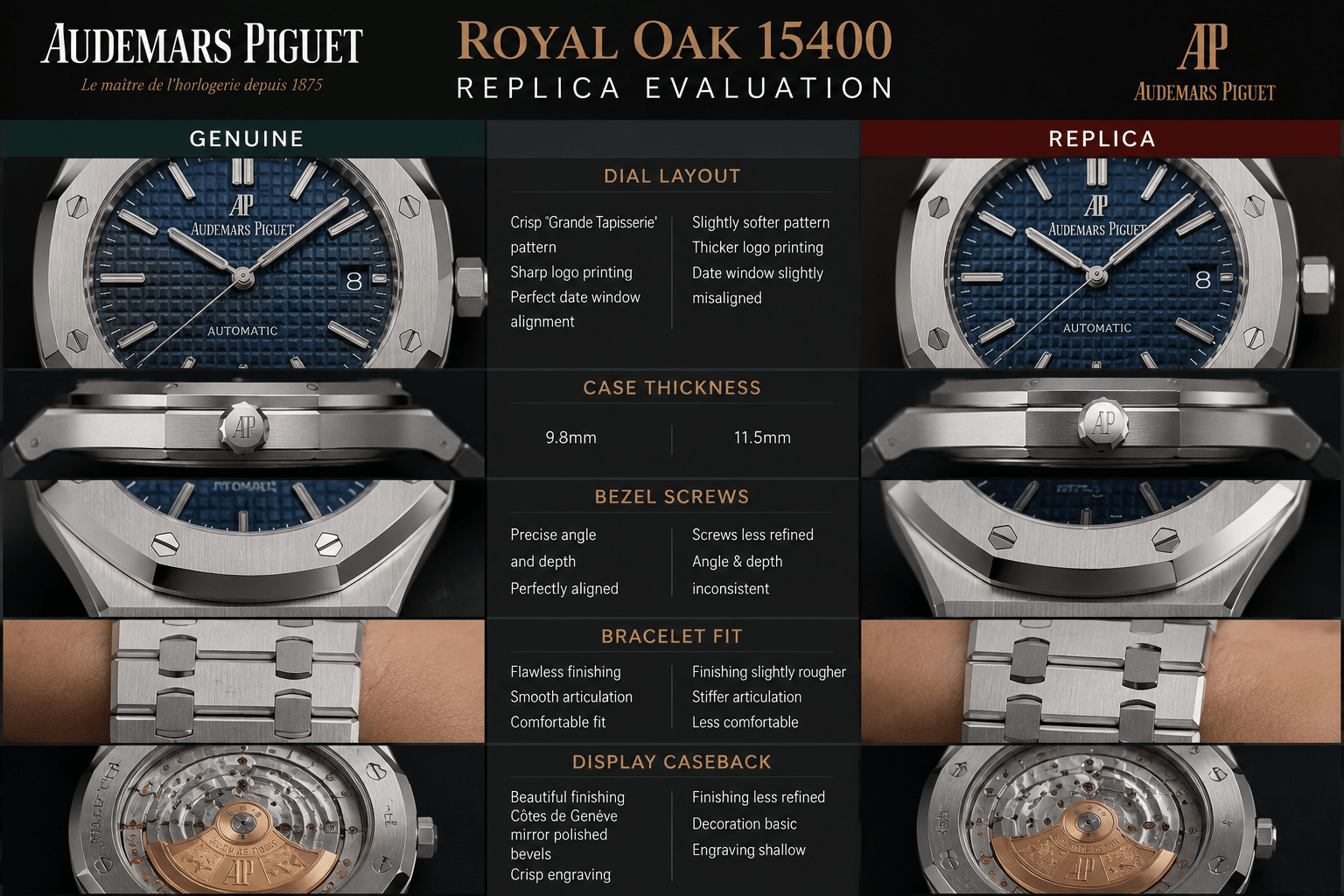
APS AP 15400 Strengths: Why Movement Architecture Gives It a Serious Case
The strongest argument for the APS AP 15400 is not that APS is automatically the better AP factory. It is that this reference rewards the type of improvement APS is known for: movement architecture that better supports the Royal Oak 15400’s identity. For buyers who care about the clone 3120 architecture, balance wheel location, and caseback view, APS has a serious case before bracelet finishing or dial color even enter the discussion.
This matters because the 15400 is one of the AP replicas where the movement-side presentation is not a background detail. The display caseback exposes whether the watch is built around a movement route that makes sense for the reference. A more convincing AP 15400 movement layout can also help support the correct case profile, which is part of why movement architecture and external proportion are connected on this model.
The caution is equally important: movement appearance is not the same as perfect mechanical equivalence. A clone 3120-style movement can improve layout credibility, but buyers should not assume that it has genuine-level finishing, guaranteed long-term durability, or easy serviceability in every market. APS’s strength on the Royal Oak 15400 should be understood as a reference-specific advantage, not a free pass on QC.
Clone 3120 Layout and the Balance-Wheel Question
Informed buyers look at the balance-wheel position because it is one of the easiest ways to separate a more reference-aware 15400 build from an older-style movement solution. The Royal Oak 15400 is associated with the Cal. 3120 architecture, and the caseback makes that architecture part of the buying experience. If the movement layout looks visibly off, the watch may still look good from the front, but the 15400-specific illusion breaks from the back.
APS’s appeal is that its 15400 argument starts from this architecture question rather than treating the movement as a hidden engine. That is the right priority for this reference. A buyer choosing the 15400 usually wants the classic Royal Oak package: the balanced dial, the slimmer profile, and the display-back movement view working together. If one of those elements contradicts the others, the watch feels less coherent.
This is also why the APS Factory Royal Oak 15400 should be judged differently from a model where exterior finishing is the only real concern. The balance-wheel question is not collector nitpicking. It is a visible architecture issue on a watch that invites the owner to look through the caseback.
Caseback Appearance as a Real Buyer Factor
Some buyers dismiss the caseback because other people rarely see it. That logic is too simple for the 15400. The caseback is part of why this reference attracts movement-aware buyers. Even if the watch is worn mostly for its front-facing Royal Oak design, the owner still sees the rotor, bridges, balance area, and movement decoration whenever the watch is off the wrist.
A good caseback view does not make a replica watch identical to the genuine watch, and it should not be used for deceptive resale or authentication misuse. Its value is different: it makes ownership feel more consistent. When the dial, thickness, and caseback all point toward the same reference, the watch feels less compromised. When the back tells a different story from the front, the compromise becomes harder to ignore.
For buyers asking whether APS is better for AP 15400, this is the clearest reason APS deserves attention. If the buyer’s priority is the 15400 movement-side experience, APS’s movement-architecture case is more meaningful than a generic factory reputation claim.
Where APS Still Needs QC Attention
APS should not be accepted blindly just because the movement route is attractive. The Royal Oak exposes too many surfaces for that. Dial alignment, date placement, bezel screw presentation, bracelet consistency, and case finishing still need careful review. A strong movement-side layout does not fix a crooked date, uneven screw appearance, rough bracelet edges, or brushing that looks inconsistent from link to link.
The most common buying mistake with APS is to treat the clone 3120 argument as if it settles the whole watch. It does not. It settles one of the most important questions for the 15400, but the front and wrist-facing experience, especially factors like AP 15500 dial texture and bracelet finishing, still determine whether the piece is enjoyable day to day. Buyers should look for a watch where APS’s architectural advantage is supported by clean external execution.
The practical judgment is this: APS is especially compelling for the AP 15400 when the buyer values movement layout and display-back credibility, but the individual watch still has to prove itself. On this reference, the best APS example is not just the one with the right movement story. It is the one where that story is matched by a well-aligned dial, controlled case profile, tidy bezel, and bracelet finishing that does not feel like an afterthought.
ZF AP 15400 Strengths: Where Exterior Finishing Still Makes a Strong Argument
The case for the ZF AP 15400 is not that it automatically solves every 15400 problem. Its strongest argument is simpler and more practical: ZF often appeals to buyers who judge the Royal Oak from the front, the side, and the wrist before they judge it through the display back. On a watch as exposed as the Royal Oak 15400, that is not a shallow priority. The brushed case, polished bevels, tapisserie dial, bezel screw presentation, bracelet articulation, and clasp feel are the parts the owner interacts with every day.
This is where ZF Factory Royal Oak 15400 versions can still make sense even when APS has the stronger movement-architecture narrative. A Royal Oak does not hide weak exterior work. The flat bezel catches light immediately, the bracelet is part of the case design, and every edge is supposed to look intentional. If a buyer cares most about wrist presence, finishing consistency, and daily wearing feel, ZF deserves a serious look rather than being dismissed only because the 15400 has a movement-side discussion.
Case and Bezel Finishing on a Watch That Shows Every Edge
The Royal Oak case is unforgiving because it has almost no soft visual areas. A round watch can sometimes hide average finishing behind curves and reflections. The 15400 cannot. The octagonal bezel, brushed mid-case, polished bevels, and visible screw layout all sit in clean geometric lines, so inconsistent brushing or rounded bevel transitions show quickly under normal light.
ZF’s exterior-finishing reputation matters most here. Buyers looking at ZF 15400 finishing should focus on whether the brushing runs cleanly across the bezel and case, whether the polished bevels look even from lug to lug, and whether the bezel screws sit neatly without looking sunken, proud, or randomly angled in the photo. Tiny screw-angle differences can be exaggerated by camera position, but a generally uneven bezel presentation is not something to ignore on this reference.
The non-obvious point is that good Royal Oak finishing is not only about shine. Over-polished bevels can look attractive in seller photos but make the watch feel less sharp and less architectural on the wrist. The better ZF examples usually work because the watch keeps that flat, industrial Royal Oak character instead of becoming too rounded or jewelry-like.
Bracelet Feel as Part of the Royal Oak Identity
The Royal Oak bracelet is not an accessory attached to the watch; it is half of the design. This is why ZF 15400 bracelet quality can matter more in daily wear than a buyer first expects. A convincing dial and case still feel disappointing if the bracelet is stiff, sharp, loose at the end links, or inconsistent in its brushed and polished transitions.
For buyers asking whether ZF is better for AP Royal Oak models, the more useful question is whether ZF’s bracelet feel matches their priority. On the 15400, the bracelet should drape smoothly, sit flat enough on the wrist, and transition into the case without a distracting gap at the first links. The clasp should close with reasonable confidence, and the finishing should not feel aggressively sharp along the sides of the links.
This is also one of the areas where QC photos have limits. Photos can show end-link fit, screw condition, brushing direction, and clasp engraving, but they cannot fully show articulation or comfort. If your priority is daily wear, this limitation matters. A movement-side advantage is less meaningful if the watch feels awkward every time it goes on the wrist.
The Movement-Side Tradeoff Buyers Should Not Ignore
ZF’s external strengths do not erase the 15400’s caseback expectations. This reference is tied closely to the Cal. 3120 look, the balance-wheel position, and the thinner architecture that helped define the original Royal Oak 15400. A watch can look excellent from the dial side and still be less satisfying to an informed buyer if the movement-side layout does not match the reference well enough.
That is the tradeoff. ZF can be the more attractive choice for a buyer who mainly values exterior refinement, bracelet feel, and the front-facing impression. But if the buyer spends time looking at the caseback or specifically wants the cleaner clone 3120 argument, ZF’s finishing advantage should not be treated as a complete answer. For the 15400, the best decision is not “ZF is better for AP” or “APS is better for AP.” It is whether the individual watch proves the strength you are actually paying attention to.
Movement and Caseback Comparison: Clone 3120 Accuracy vs Ownership Practicality
The AP 15400 clone 3120 discussion matters because this is not a closed-back sports watch where the movement can be treated as an invisible engine. The Royal Oak 15400 caseback is part of the experience. If the architecture looks wrong, the display back becomes a weakness rather than a feature. This is why APS has the stronger argument when the buyer’s top priority is movement layout and Royal Oak 15400 caseback credibility.
At the same time, movement accuracy and ownership practicality are not the same thing. A more convincing layout can help the watch look closer to the correct 15400 architecture, but it does not automatically guarantee quiet winding, perfect serviceability, stable long-term performance, or consistent power reserve from every unit. Buyers should separate what a movement photo can show from what only ownership or service experience can reveal.
Why Balance-Wheel Position Matters on the 15400
The balance-wheel position is a bigger issue on the 15400 than many buyers realize. Through the display caseback, informed eyes are not only looking for decorative bridges or a gold-tone rotor. They are checking whether the movement architecture roughly supports the reference. On older plate-modified routes, the visible layout could look like a movement wearing a costume. On a stronger clone 3120 route, the watch has a more coherent caseback impression.
This is where APS usually has the cleaner technical argument. If the balance wheel sits where the 15400 buyer expects it to sit, and the case thickness also stays in the right visual range, the watch feels more purpose-built rather than adapted around a generic base movement. That does not make it identical to the genuine movement, and it should not be described that way. It simply removes one of the more obvious architecture-level weaknesses that hurt earlier Royal Oak 15400 replicas.
ZF’s position depends on version and movement route confirmation. Because ZF can be strong externally, buyers sometimes give less attention to the movement side. That is a mistake on this reference. The 15400 is exactly the kind of replica watch where a beautiful bracelet and case can still leave a buyer dissatisfied if the caseback view does not match the expectation they had when choosing this model.
What Movement Photos Can and Cannot Prove
Movement photos are useful, but they are not magic. A caseback photo can help confirm the broad layout, rotor style, bridge decoration, jewel placement impression, and whether the claimed movement route looks consistent with the version being offered. It can also reveal obvious problems such as the wrong movement-side layout, poor engraving, an odd rotor shape, or finishing that looks unusually rough even by replica standards.
What the photo cannot prove is just as important. It cannot confirm that the movement will run well for years, that the rotor will stay quiet, that the winding feel will be smooth, or that the power reserve will match the advertised expectation. It also cannot tell you whether the movement arrived clean, properly lubricated, or easy for a local watchmaker to service. A movement can look correct enough through the Royal Oak 15400 caseback and still need realistic ownership expectations.
For this reason, the most sensible judgment is conditional. APS is the more logical choice if the buyer ranks clone 3120 architecture, balance-wheel position, and display-back credibility above all else. ZF remains competitive if the buyer accepts a movement-side tradeoff in exchange for stronger visible exterior execution, but that tradeoff should be accepted consciously, not hidden behind factory reputation.
Movement Route to Verify
Before accepting either APS or ZF, buyers should ask the QC process to confirm the claimed movement route through clear caseback photos. The important checks are the overall bridge layout, balance-wheel position, rotor presentation, decoration style, and whether the version being offered matches the seller’s description. This is not about using the watch for authentication or resale claims. It is simply about making sure the replica watch you are considering matches the technical basis that influenced your decision.
A good movement-side photo should be straight, well lit, and close enough to judge layout without relying on heavy zoom or seller wording. If the caseback photo is avoided, blurry, or inconsistent with the claimed AP 15400 clone 3120 route, that is a decision-changing warning sign. On this reference, the caseback is not a bonus detail. It is one of the reasons the 15400 comparison exists in the first place.
Movement Ownership Tradeoffs Beyond the Caseback View
The movement should also be judged by ownership risk, not only by visual architecture. A clone 3120-style route may improve caseback credibility and help with thickness, but buyers should still ask practical questions: is the rotor known to be noisy, does the movement have a reasonable power reserve, is the date change stable, and can the movement be serviced locally if something goes wrong? These points may matter more for a daily wearer than the last few percent of bridge decoration accuracy.
This is especially important for first-time AP buyers because complicated or less common movements can create more uncertainty than simpler three-hand replicas. The 15400 is not as mechanically complicated as a chronograph or perpetual calendar, but its display-back architecture still makes the movement choice part of both the visual and ownership decision. A buyer who wants the lowest practical risk should not confuse a better-looking movement with a maintenance-free movement.
Dial and Date Details: The “AUTOMATIC” Layout Is Not a Small Issue
The AP 15400 dial accuracy conversation should start with the “AUTOMATIC” text because this is one of the clearest ways the 15400 separates itself from the 15500. On the 15400, the lower dial has a specific visual balance: AP logo and branding at the top, date at 3, hour marker presence, and “AUTOMATIC” sitting in a way that keeps the dial from feeling empty or crowded. If that text is too heavy, too low, too high, or poorly spaced, the whole dial can feel off even before the buyer understands why.
This is why the Royal Oak 15400 AUTOMATIC dial is more than a printing detail. The dial has a grid texture, applied markers, polished hands, a framed date window, and strong case geometry around it. Those elements either work together or fight each other. APS and ZF should be judged by the actual dial balance of the watch being offered, not only by factory reputation. A strong case and bracelet cannot fully rescue a dial that looks visually tense.
Text Weight, Logo Position, and Dial Balance
The 15400 dial is deceptively simple. There are no chronograph subdials and no complicated calendar displays to distract the eye, so the printed elements carry more weight. The AP logo, brand text, minute track, “AUTOMATIC” line, and “SWISS MADE” area need to sit naturally against the tapisserie pattern. If the printing is too bold, the dial looks heavier than it should. If it is too faint, the watch can look flat and under-finished.
For APS and ZF, the decision should come down to the specific dial in the QC photos. ZF may present a polished, clean front-facing package, while APS may appeal because the reference architecture is stronger elsewhere. But on the dial side, neither factory name should replace visual inspection. Look for centered logo placement, even print weight, clean minute markers, and an “AUTOMATIC” line that feels integrated rather than stamped as an afterthought.
The non-obvious trap is judging the dial only by color. Blue, black, white, and grey dials each behave differently under lighting, and seller photos can exaggerate saturation. Text placement and dial balance are often more reliable QC indicators than color alone, because a slightly shifted print or awkward lower-dial spacing remains visible in normal use.
Date Window Placement and Wheel Alignment
The date window is one of the fastest ways a Royal Oak 15400 dial loses credibility. The aperture sits at 3 o’clock, close to the marker structure and the tapisserie grid, so poor centering is easy to notice. A date that sits too high, too low, or too far to one side can make the dial look cheaper even if the rest of the watch is well finished.
AP 15400 date alignment should be checked across more than one date if possible, because a single number can hide wheel-position issues. Some dates naturally look more centered than others because of numeral shape, so buyers should not overreact to one slightly imperfect photo. But a consistently crooked date, a font that looks too thick, or a wheel that sits visibly deep under the window is worth treating as a real flaw.
This is one area where QC photos are very helpful. A straight-on dial photo tells more than an angled beauty shot. If the dealer only provides slanted photos, ask for a cleaner front view before deciding. On the 15400, date placement is not a tiny macro-only issue; it sits exactly where the eye checks the dial during normal time reading.
Hands, Markers, and Tapisserie Texture
The hands and markers need to look crisp because they sit over one of the hardest dials to replicate convincingly. The tapisserie dial should have enough texture to create depth, but not so much sharpness that it looks stamped and harsh. Genuine Royal Oak dials have a smoother light play than any replica can fully reproduce, so the practical goal is not perfection. The goal is a dial that looks balanced and consistent under normal lighting.
Hour markers should be straight, evenly applied, and visually aligned with the grid and minute track. Hand length should feel natural, especially the minute hand reaching toward the track without looking short or awkward. Lume color should be consistent between hands and markers, though buyers should keep expectations realistic; replica lume usually does not match the longevity or evenness of the original watch.
Between APS and ZF, the better dial is the one with fewer visible tensions: clean printing, centered date, balanced “AUTOMATIC” placement, tidy markers, and a tapisserie texture that does not dominate the watch. If you are choosing based on dial QC, prioritize these front-facing signals over broad claims about which factory is generally better. The 15400 rewards a careful eye because its dial leaves very little room for sloppy alignment.
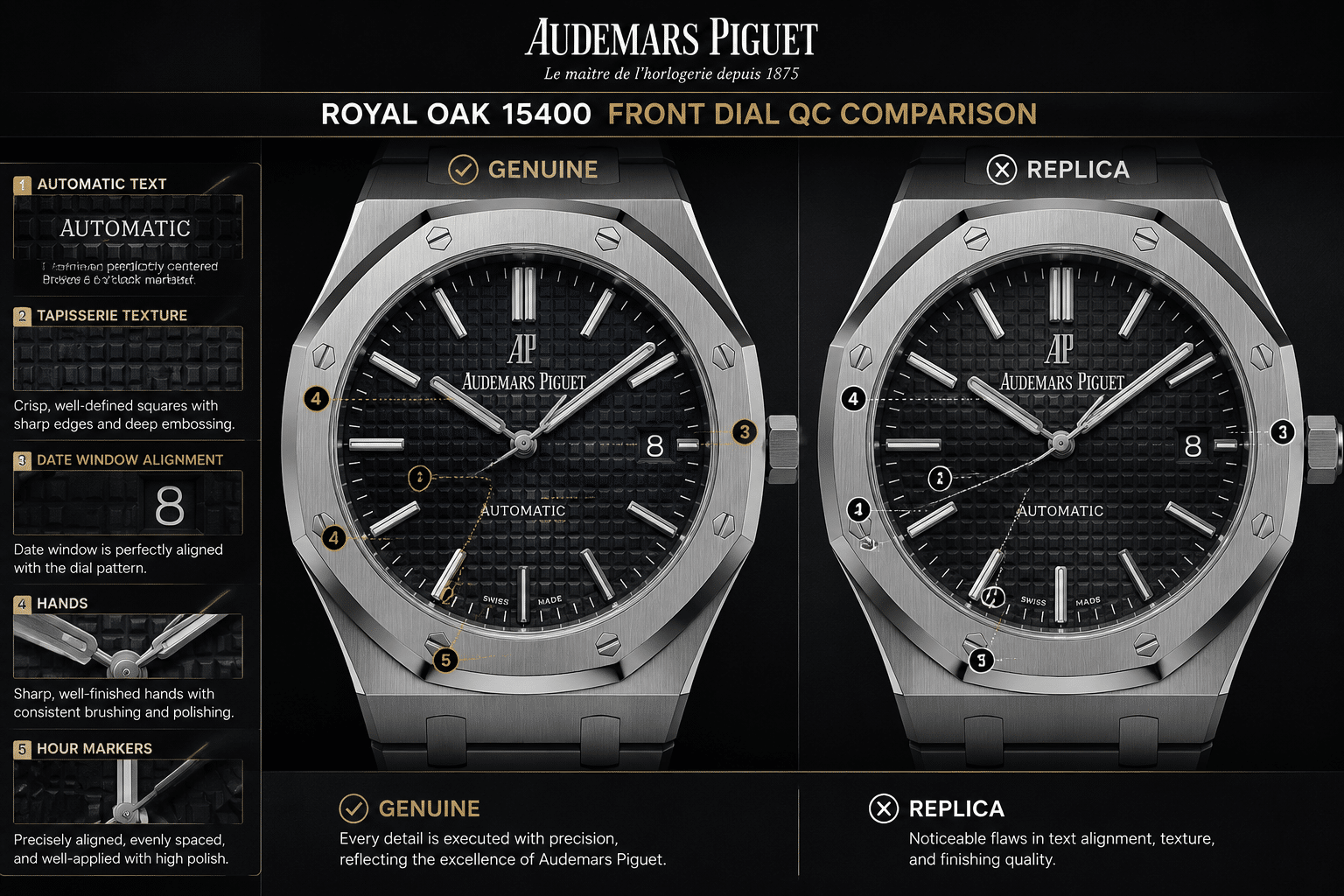
Case Thickness, Bezel Screws, and Royal Oak Geometry
The AP 15400 case thickness is not a minor specification. On the Royal Oak 15400, thickness controls the whole impression of the watch because the design is flat, angular, and visually exposed from almost every angle. A Submariner-style case can hide a little extra height under its bezel and caseback. A Royal Oak cannot. If the mid-case is too tall, the bezel appears heavier, the bracelet transition looks less natural, and the watch loses the low, architectural stance that makes the 15400 more appealing than many larger modern Royal Oak references.
This is where the APS vs ZF AP 15400 comparison becomes more than a finishing debate. APS has a stronger case when the movement route supports a thinner and more convincing Royal Oak 15400 case shape. ZF, depending on version and batch, may still compete through cleaner exterior finishing and sharper surface transitions. The buyer should not judge this category from a front dial photo alone. A straight-on image can make both watches look acceptable; the side profile is where the case architecture usually tells the truth.
Why Thickness Changes the Entire 15400 Impression
The Royal Oak 15400 works because it has a broad, flat presence without looking blocky. If the case height creeps upward, the watch begins to feel like a simplified sports watch wearing a Royal Oak costume rather than a properly proportioned 15400. The bezel can look stacked on top of the mid-case, the caseback can appear too proud, and the transition into the integrated bracelet becomes less fluid.
For this reason, a 15400 thickness check should be treated as a credibility check, not just a comfort check. The buyer is really asking whether the movement, case, bezel, and caseback were designed as one package. APS has an advantage here when its clone 3120 architecture allows the case to stay closer to the expected 15400 profile. ZF’s exterior work can still look very good, but if a particular piece shows extra visual height in side photos, the finishing alone will not fully rescue the silhouette.
A practical judgment: if the side profile looks heavy, do not talk yourself into the watch because the dial photo is attractive. On a Royal Oak 15400 replica, a thick side profile is one of the flaws that remains visible every time the watch sits on the wrist.
Bezel Screws and Octagonal Symmetry
The octagonal bezel is unforgiving because it gives the eye eight fixed reference points. Bezel screws, polished bevels, brushing direction, and crystal opening all sit inside a strict geometric frame. A small inconsistency that might disappear on a round watch can become obvious on a Royal Oak because the design invites the eye to compare one corner with the next.
Bezel screw alignment should be checked, but it should be checked intelligently. Camera angle, lens distortion, and light reflection can make a screw slot look slightly off when the actual watch is acceptable. What matters more is the overall pattern: are the screws seated evenly, are they visually centered within their recesses, does one screw look noticeably rotated or raised compared with the others, and does the bezel itself sit flat against the case?
Neither APS nor ZF should be treated as immune here. ZF often appeals to buyers because its brushing and polished bevel transitions can look more refined, especially around the bezel edge. APS can be strong when the geometry is supported by the correct architecture underneath. The best individual watch is the one where the octagonal bezel looks calm and balanced, not the one with the louder factory reputation.
Side Profile and Lug Integration
Royal Oak side profile QC is essential because the 15400’s front view hides too much. From the side, the buyer can judge the thickness of the brushed mid-case, the height of the bezel, the way the caseback sits, and whether the first link flows naturally from the case. This is also where poor lug integration becomes visible. If the transition looks stepped, pinched, or overly stiff, the watch will feel less coherent even if the front-facing dial is strong.
Pay attention to the line running from the case flank into the bracelet. On a convincing Royal Oak 15400 case shape, the watch should feel like one continuous object rather than a case with a bracelet attached afterward. The polished bevels should define the geometry without looking rounded or swollen. The brushed mid-case should look controlled, not soft or cloudy. ZF may have the edge on some pieces for surface refinement, while APS may hold the more persuasive argument when case architecture and thickness are judged together.
Case and Bezel Checks
- Side-profile photo: Check whether the case looks low and flat or visually thick through the mid-case and caseback.
- Straight-on bezel view: Confirm the octagonal bezel looks symmetrical and not visually shifted around the dial opening.
- Bezel screw alignment: Look for one or two obvious outliers rather than obsessing over tiny angle differences caused by photography.
- Mid-case brushing: Review whether the brushed surface is even and whether polished bevels remain clean instead of rounded.
- Lug and first-link transition: Make sure the case and bracelet connection looks integrated, not awkwardly separated.
Bracelet and Clasp Feel: Where ZF May Still Win Daily Wear
The AP 15400 bracelet quality matters more than many buyers expect because the Royal Oak bracelet is not just a strap. It is part of the case design, part of the visual identity, and part of the wearing experience. A 15400 can have a convincing dial and a respectable movement layout, but if the bracelet feels stiff, sharp, or poorly finished, the watch becomes less enjoyable in daily use.
This is where ZF still makes a serious argument. For buyers comparing ZF bracelet vs APS bracelet, ZF may be the more attractive choice when the priority is exterior finishing, bracelet articulation, and wrist comfort. That does not erase APS’s movement-side advantage on the 15400, but it does change the decision for buyers who rarely look at the caseback and care more about how the watch feels through a full day of wear.
Bracelet Articulation and Wrist Comfort
A good Royal Oak replica bracelet should not feel loose and rattly, but it also should not feel like a rigid steel cuff. The links need enough articulation to wrap naturally around the wrist while keeping the flat, integrated look that defines the model. If the bracelet is too stiff, the watch can sit awkwardly, especially on smaller or flatter wrists. If the link edges are too sharp, the watch may feel impressive in photos but annoying after several hours.
ZF’s reputation in this area is meaningful because Royal Oak bracelet finishing is one of the hardest parts of the watch to fake convincingly. The brushing has to run cleanly across multiple surfaces, the polished bevels need to catch light without looking over-rounded, and the link gaps need to appear consistent. APS has improved and should not be dismissed, but if two examples are otherwise close, the better bracelet can be the more important daily-wear difference.
The non-obvious point is that bracelet comfort cannot be fully proven by QC photos. Photos can show link consistency, end-link fit, and obvious finishing problems, but they cannot tell you exactly how the bracelet drapes on your wrist. In practical factory comparison, Audemars Piguet replica factories are often judged partly by visible bracelet neatness, because it remains the buyer’s best available clue before handling the watch.
Clasp, End Links, and Finishing Consistency
The clasp should close cleanly and sit flat without looking bulky or misaligned. On a Royal Oak 15400, a weak clasp feel does not usually show in a glamour photo, but it becomes noticeable every time the watch is put on or removed. Buyers should check whether the clasp blades appear centered, whether the exterior clasp surface matches the bracelet brushing, and whether engravings or finishing look unusually rough for the claimed factory version.
End links deserve the same attention. Poor end-link fit breaks the integrated design faster than most small dial flaws. The first bracelet link should not show a distracting gap, uneven height, or strange angle against the case. This is especially important because the Royal Oak does not visually separate case and bracelet the way a traditional lugged watch does.
For finishing consistency, compare the brushed surfaces across several bracelet links. One mismatched link, cloudy brushing, or uneven bevel can make the bracelet feel lower-grade than the rest of the watch. ZF may win buyers here when its bracelet finishing looks more uniform, but the correct conclusion is still piece-specific: a strong APS bracelet is preferable to a weak ZF example with visible link or clasp issues.
When Bracelet Quality Should Outweigh Movement Layout
Bracelet quality should outweigh movement layout for the buyer who wants a Royal Oak 15400 as a daily wearer rather than as a caseback-focused comparison piece. If the watch will spend most of its time on the wrist in normal settings, bracelet feel, clasp confidence, and exterior finishing may affect satisfaction more often than balance-wheel position or movement decoration.
This does not mean the movement route is unimportant. It means priorities matter. A buyer who enjoys the technical side of the 15400 and regularly checks the display back will likely remain drawn to APS. A buyer who wants the most pleasant front-facing and wrist-facing experience may reasonably lean toward ZF if the bracelet, clasp, and exterior finishing are cleaner in the available QC set.
At Clean VS Factory, we usually separate “more accurate on paper” from “better to live with.” The 15400 is a good example: APS can make the stronger architecture argument, while ZF can still be the more satisfying daily-wear choice for someone who values bracelet execution above movement-side correctness.
QC Risk Map: What to Check Before Accepting an APS or ZF 15400
AP 15400 QC should confirm the factory’s claimed strength, not simply decorate the buying process. If you choose APS for architecture, the Royal Oak 15400 QC photos should support the case thickness and caseback story. If you choose ZF for exterior finishing, the photos should prove the bracelet, bezel, brushing, and clasp are actually strong on that individual watch. The factory name narrows the field, but it does not approve the piece by itself.
The 15400 is especially sensitive to QC because its flaws compound. A slightly thick case, a mildly uneven bezel screw, a date that sits low, and a bracelet gap may each seem tolerable alone. Together, they can make the watch feel less refined than expected. The goal is not to reject every tiny imperfection. The goal is to identify which flaws affect the Royal Oak’s visible structure and which are mostly camera-angle noise.
Before making a decision, buyers should review real QC photos where available, including dial printing, hand alignment, bezel position, datewheel centering, bracelet fit, clasp engraving, case thickness, caseback finishing, and movement layout. Factory labels and stock photos alone are not enough for a reliable judgment on the Royal Oak 15400.
QC photos can reduce uncertainty, but they do not guarantee perfection, future reliability, water resistance, or that every visible detail has been captured accurately. Lighting, camera angle, compression, and seller photo selection can all affect what the buyer sees. A stronger QC process is one that includes multiple angles, clear caseback photos, side-profile views, bracelet and clasp detail, and enough time for the buyer to ask focused follow-up questions before accepting a watch.
Front Dial Photos: Date, Text, Hands, and Bezel
Start with a straight-on dial image. Check the date alignment first because a visibly high, low, or crooked date is hard to ignore once noticed. Then look at dial printing, including the logo, minute track, and “AUTOMATIC” text, but do not re-judge the entire dial from a tilted photo. For the bezel, review whether the octagonal shape is centered, whether the screws look evenly seated, and whether one screw appears obviously different from the rest.
Hand alignment should also be checked in a practical way. If the hands are set near a clean reference point, they should not look noticeably misaligned. Minor photo perspective can mislead, but a clear mismatch between minute and hour hand position should not be ignored. The same applies to the bezel screws: one slightly odd reflection is not a red flag; a repeated pattern of uneven seating or a visibly rotated outlier deserves caution.
Side and Bracelet Photos: Thickness, Fit, and Finishing
Side-profile photos are mandatory for this reference. They show the AP 15400 case thickness, the height of the bezel, the depth of the caseback, and whether the mid-case looks proportionate. If the watch looks too tall from the side, a perfect-looking front photo will not solve the problem. This is one of the most important differences between reviewing a Royal Oak and reviewing a more forgiving round sports watch.
Bracelet and clasp photos should show link consistency, end-link fit, brushing direction, polished bevel continuity, and clasp alignment. QC photos cannot fully reveal tactile feel, but they can expose poor construction. Look for uneven gaps, twisted first links, mismatched brushing, or a clasp that does not appear to sit flush. These issues matter because the Royal Oak replica bracelet is central to both visual quality and daily comfort.
Caseback Photos: Movement Route and Layout Confirmation
The caseback photo is useful because the 15400 has display-back expectations. It can help confirm whether the movement route, rotor presentation, bridge layout, and balance-wheel position match what the seller or factory version claims. This is especially relevant if the buyer is choosing APS for clone 3120 architecture or comparing a ZF version that may share movement sourcing depending on batch.
A caseback photo cannot prove long-term reliability. It will not tell you whether the movement is properly lubricated, how stable the power reserve will be, or whether rotor noise will appear after use. What it can do is confirm that the visible architecture is not obviously inconsistent with the claimed version. Treat it as layout verification, not a promise of mechanical perfection.
Price Differences and Seller Claims Should Be Read Carefully
If an APS 15400 and a ZF 15400 are priced differently, the higher price does not automatically identify the better watch. The difference may reflect the movement route, current availability, batch demand, seller margin, after-sale risk, or simply the fact that one version is harder to source at that moment. Price is a signal worth noting, but it should be checked against the actual watch: case thickness, dial execution, bracelet finishing, caseback layout, and the completeness of the QC set.
Seller descriptions can also compress too much into one phrase. “Latest version,” “clone 3120,” or “best factory” should lead to verification, not blind acceptance. For the 15400, useful proof is practical and visual: clear movement photos, side-profile shots, straight dial images, bracelet and clasp views, and consistency between the claimed factory/version and what the photos show. If the evidence is incomplete, the buyer is taking on more risk regardless of factory name.
Red Flags Before You Decide
- Obvious date misalignment: A date that sits visibly crooked, too high, or too low will be noticed in normal wear.
- Uneven bezel screw presentation: One badly seated or visually inconsistent screw can disrupt the Royal Oak’s geometric face.
- Heavy side profile: A case that looks too thick from the side weakens the classic 15400 silhouette.
- Poor bracelet fit: Large gaps, awkward first-link angles, or inconsistent finishing reduce both appearance and comfort.
- Movement-side mismatch: A caseback layout that contradicts the claimed version is a serious warning, especially on a display-back 15400.
- Over-clean marketing photos only: If there are no usable side, bracelet, clasp, and caseback views, the QC set is not enough for this reference.
Evidence Boundaries: What Sources Can and Cannot Prove
Because APS, ZF, and other replica-factory discussions are usually based on buyer photos, seller claims, and community comparison rather than official factory disclosures, the safest approach is to treat factory reputation as a practical signal, not as verified manufacturing evidence. A source about an authentic Audemars Piguet Royal Oak can help explain the official design language, but it cannot prove that a replica uses the same material, movement finishing, bracelet tolerances, water resistance, or quality control process.
The same restraint applies to movements. A movement specification sheet can explain the official dimensions and functions of a Miyota or Sellita caliber, but it cannot confirm that a specific APS or ZF watch contains that caliber, a clone of it, or a correctly serviced example. Buyers should therefore ask for movement photos and version confirmation, while still understanding that photos do not prove future reliability, lubrication quality, water resistance, or local service access.
Water resistance deserves separate caution. Do not assume that a Royal Oak replica is safe for swimming, showering, or sports use because the authentic model family has official water-resistance claims or because a seller uses confident wording. Unless the individual watch has been pressure-tested after purchase, water resistance should be treated as unverified. This is not a criticism of one factory over another; it is a realistic boundary for replica-watch ownership.
Legal, Trademark, and Disclosure Cautions
This article discusses imitation watches and replica-factory comparisons, not authorized Audemars Piguet products. Counterfeit-goods guidance from the USPTO explains the connection between counterfeit goods and trademark misuse, which is why buyers should avoid treating replica watches as genuine, authorized, or acceptable for deceptive resale.[4] The practical buyer takeaway is simple: enjoy the comparison as a replica-watch evaluation, but keep disclosure clear and never represent the watch as authentic.
Replica watches can also raise customs, import, seizure, resale, and disclosure issues depending on jurisdiction. U.S. Customs and Border Protection identifies intellectual property rights enforcement as a trade priority, and broader OECD reporting treats counterfeit trade as a cross-border issue rather than a harmless private-label market.[5][6] This is not legal advice and does not predict what will happen to any individual shipment, but it is a reason to avoid claims such as “customs safe,” “legal everywhere,” or “risk-free to import.”
For cleanvsfactory.com buyer guides, legal clarity also affects wording. APS, ZF, and other factory names should not be described as affiliated with Audemars Piguet, and no replica should be called genuine, authentic, authorized-grade, or identical to the original. The more accurate language is that these watches imitate the visual profile of an authentic design, with expected differences in movement behavior, finishing, warranty, serviceability, disclosure status, and legal risk.
Buying Boundaries: Policies, Water Resistance, and After-Sales Questions
Before ordering an APS or ZF AP 15400 replica, buyers should confirm practical terms directly with the seller instead of assuming them from factory reputation. Return options, exchange rules, repair support, timing expectations, payment process, shipping risk, and after-sales communication can vary by seller and situation. A factory comparison can help narrow the watch choice, but it does not verify the seller’s policy or guarantee how a specific order will be handled.
Water resistance should not be assumed from the Royal Oak design, the presence of a screw-down crown, or an authentic-reference specification. If water exposure matters, ask whether the specific replica watch has been tested and what the seller’s position is if moisture enters the case. Even when a seller provides a test result, replica watches should be treated more cautiously around water than genuine watches serviced and pressure-tested through official brand channels.
Price language also needs restraint. A higher price may reflect a more complex movement route, a newer batch, limited availability, seller margin, or stronger QC support, but it is not proof of a better watch by itself. Prices can change by factory label, version, movement configuration, seller channel, availability, and after-sales terms, so any APS vs ZF value judgment should be checked against the exact watch being offered at the time of purchase.
Which Buyer Should Choose APS, and Which Buyer Should Choose ZF?
If your main concern is how the AP Royal Oak 15400 looks and feels from the front and on the wrist, ZF still has a real case. If your priority is the 15400’s movement architecture and display-back credibility, APS is the more logical choice. That is the cleanest way to separate APS or ZF AP 15400 without falling into factory hype or treating either one as a universal best factory for AP 15400.
The important point is that the 15400 should be judged as a classic Royal Oak with its own standards. Buyers who focus on movement priority will usually care more about clone 3120 layout and balance-wheel position, while buyers who care more about exterior finishing will judge the watch by brushing, bracelet feel, and how confidently it wears in daily use. In practice, the better daily wearer is not always the better caseback watch.
The Movement-Focused Buyer
If you care about the caseback view, APS is usually the more sensible starting point. On the 15400, the movement is not a side issue because the display back exposes the architecture in a way that many other replica watches do not. For a buyer who notices whether the balance wheel sits where it should and whether the visible layout feels faithful to the reference, APS has the cleaner argument.
This is also where collector accuracy starts to matter more than casual wrist presence. A buyer who already knows the 15400 is a discontinued classic will often value the movement-side impression more than a slightly nicer first impression from across the room. If that is your mindset, APS usually makes more sense than ZF.
The Exterior-Finishing Buyer
If your priority is bracelet feel, case brushing, and the way the watch sits in normal wear, ZF remains very competitive. The Royal Oak design exposes every surface, so a factory that gets the visible finishing right can feel more convincing day to day even if it is not the stronger answer on movement architecture. For a buyer who mostly wants a better daily wearer, that tradeoff is reasonable.
ZF also fits the buyer who is less concerned with staring at the caseback and more concerned with how the watch reads on the wrist. That is a legitimate preference on the 15400, especially if you know you will judge the watch by texture, integration, and wrist presence rather than by technical layout details.
The Buyer Who Wants the Lowest Practical Risk
The safest individual watch is usually the one that matches your priorities and passes QC cleanly, not the one with the louder reputation on forums. Batch variation still matters, and a strong factory name does not rescue a weak piece. If the dial, case profile, bracelet fit, and caseback photos look better on one specific watch, that watch can be the lower-risk choice even if it is not the more hyped option.
For first-time Royal Oak buyers, that usually means keeping the decision simple: choose APS if the movement-side realism matters most, choose ZF if the exterior package matters most, then let QC decide whether the piece is worth accepting. The wrong move is buying purely on factory reputation and assuming the 15400 will sort itself out.
Final Verdict: APS vs ZF for the AP Royal Oak 15400
The APS vs ZF AP 15400 verdict is not complicated once you separate the watch into what actually matters. APS has the stronger case if your top priority is clone 3120 credibility, caseback accuracy, and a layout that feels right for this reference. ZF stays highly relevant if you value bracelet finishing, visible refinement, and the overall wearing experience more than movement-side correctness.
That is why there is no single best AP 15400 replica factory for every buyer. The 15400 is not the 15500, and trying to apply 15500 factory logic here usually leads to the wrong conclusion. On this reference, clone 3120, case thickness, and display-back presentation carry more weight than broad factory reputation.
A responsible final decision should also include expectation management. A strong APS or ZF Royal Oak 15400 can be satisfying as a replica-market watch, but it is not a substitute for authorized retail, official servicing, or authentic-brand ownership. Close inspection may still reveal differences in case finishing, bracelet tolerances, dial texture, movement decoration, water resistance, and long-term serviceability, so the watch should be purchased and described with that boundary in mind.
If You Prioritize Architecture, APS Has the Cleaner Argument
APS is the better fit for buyers who look at the 15400 as a technical object first. If movement layout, balance-wheel position, and display-back credibility are the details you will notice every time you pick up the watch, APS is the more defensible choice. It is the better answer for buyers who want the watch to make sense from both the front and the back.
If You Prioritize Wearing Feel, ZF Still Deserves Attention
ZF still deserves attention if your buying logic is more about exterior refinement than movement architecture. A Royal Oak lives or dies by how its surfaces, bracelet, and wrist presence come together, and that is where ZF can still be very attractive. For some buyers, that is the better AP 15400 option because it affects daily wear more directly.
QC Is the Tie-Breaker on This Reference
QC should decide the final answer. The accepted piece needs to prove its strengths in dial photos, case photos, bracelet photos, and caseback photos, because batch variation can easily erase the advantage you thought you were buying. If the watch does not support the factory’s claimed strengths on the actual QC set, the better factory name does not matter.
References
[1] Audemars Piguet, “Royal Oak 15510ST Official Specifications,” official product page for the current 41mm Royal Oak with Grande Tapisserie dial and official model information, available at Audemars Piguet Royal Oak 15510ST Official Specifications.
[2] Miyota, “Miyota 9015 Official Movement Specifications,” official movement manufacturer page documenting the 9015 caliber’s published technical specifications, available at Miyota 9015 Official Movement Specifications.
[3] Sellita, “SW200-1 Official Technical Documentation,” official technical document for the Sellita SW200-1 movement family, available at Sellita SW200-1 Official Technical Documentation.
[4] United States Patent and Trademark Office, “Counterfeit Goods Basics,” government educational resource explaining counterfeit goods and trademark-related issues, available at USPTO Counterfeit Goods Basics.
[5] U.S. Customs and Border Protection, “Intellectual Property Rights,” official CBP trade page describing intellectual property rights enforcement as a customs priority, available at U.S. CBP Intellectual Property Rights.
[6] OECD, “Mapping Global Trade in Fakes 2025,” international report on counterfeit trade and cross-border fake-goods risks, available at OECD Mapping Global Trade in Fakes 2025.
Disclosure: This article is for general educational and comparison purposes only. Replica watches are not genuine products from the original luxury brands, and brand names are used only to identify reference designs or comparison topics. Factory names, movement descriptions, prices, availability, QC details, seller policies, and version information can change, so readers should verify important details with the seller before making a purchase decision. Replica watches should not be represented, resold, or used as genuine watches.