
The AP 15202 Jumbo is not difficult to judge only because of its dial, bezel brushing, or bracelet finish. The real problem is that the genuine watch is built around an ultra-thin movement architecture, and AP power reserve claims often become part of the broader movement guide because most clone solutions cannot reproduce that structure without affecting the case. A watch may look clean from the front while still showing compromises in thickness, caseback depth, crown position, hand height, date seating, and how flat it wears on the wrist.
This article focuses on why the 15202 remains a difficult replica choice even when factory finishing improves. It helps separate cosmetic upgrades from meaningful architectural progress, explains why movement route matters more here than on many thicker Royal Oak models, and shows which checks buyers should prioritize before choosing a Jumbo-style clone over safer references such as the 15400, 15500, or 15510.
Evidence note: This guide does not treat factory marketing names, seller labels, decorated rotors, or “A2121” wording as proof that a replica has reproduced the genuine movement architecture. Because reliable public documentation for replica-factory construction is limited, the article uses cautious buyer-facing language and focuses on what can be evaluated from the watch itself: case profile, crown placement, date depth, hand height, caseback layout, and the consistency of QC photos.
Brand and replica-market boundary: Audemars Piguet and Royal Oak names are used here to identify the genuine reference design being discussed. Replica watches and super clone watches are not genuine Audemars Piguet products, are not made or approved by the original brand, and should not be represented, sold, or serviced as authentic watches.
| Buyer Check | Why It Matters on the 15202 | Practical Judgment |
|---|---|---|
| Movement route | The Jumbo character depends on ultra-thin architecture, not just decoration. | Do not treat “A2121” labeling or rotor decoration as proof of a solved build. |
| Side profile | Extra movement thickness can change the caseback, mid-case, and wrist presence. | Ask for side QC photos, not only front dial shots. |
| Crown and hand height | Movement thickness can shift crown position and raise the hand stack. | Check alignment carefully; these flaws are harder to hide in real wear. |
| Date window depth | A mismatched movement can make the date sit too deep or look poorly integrated. | Review close-up QC images before judging the dial as acceptable. |
| Factory reputation | Older XF praise reflects relative progress, not a complete technical solution. | Verify the actual watch version instead of relying on historical reputation. |
| Beginner suitability | The 15202 has less margin for structural compromise than thicker Royal Oaks. | New buyers may be better served by 15400, 15500, or 15510 references. |
Quick Questions Before You Read
Q: Has any factory fully solved the AP 15202 clone movement problem?
Based on the article, no current factory has fully resolved the Jumbo’s ultra-thin movement architecture challenge.
Q: Are front-facing photos enough to judge a 15202 replica?
No. Front photos can hide thickness, caseback depth, crown position, hand height, and date seating issues.
Q: Is a modified Miyota-style movement automatically a bad choice?
Not automatically, but it is usually a structural compromise for this specific ultra-thin Jumbo design.
Q: Who should consider a 15202 clone?
It suits experienced buyers who specifically want the 39mm Jumbo look and accept visible or mechanical compromises.
The Real Reason the AP 15202 Jumbo Is Still Difficult to Clone
The AP 15202 clone movement problem is simple to state but difficult to solve: the Royal Oak Jumbo replica is not limited by dial color, bezel brushing, or bracelet finishing first. It is limited by the movement architecture inside the watch. No current factory has truly reproduced the ultra-thin Cal. 2121 structure in the way buyers often expect from advanced replica-market watches.
This matters because the 15202 is not a watch with extra room to hide compromises. The genuine Jumbo’s appeal comes from thinness, flatness, and balance. Its case sits low, the bracelet flows directly from the case, and the whole watch feels more restrained than larger Royal Oak references. If the movement is thicker or arranged differently, the factory has to compensate somewhere: case thickness, caseback depth, crown position, dial height, or overall wrist presence. Those changes may not jump out in one front-facing photo, but they change the watch as an object.
This is where many buyers misread the 15202. They compare blue dial tone, petite tapisserie texture, polished bevels, screw alignment, and bracelet sharpness, then assume the best-looking example is the “solved” Jumbo. Those details matter, but they do not answer the central question. The harder question is whether the watch is built around a credible ultra-thin movement route. For the 15202, the movement is not just the engine. It is the reason the Royal Oak proportions work.
That does not mean every 15202 replica is unattractive or useless. Some versions can look appealing from the front and may satisfy a buyer who mainly wants the Jumbo style. The problem is the ceiling. Compared with thicker Royal Oak models, the 15202 has less tolerance for shortcuts. A factory can improve the dial and bracelet while still failing to replicate the original architecture that makes the Jumbo feel like a Jumbo.
Why the Jumbo Exposes Problems Other Royal Oaks Can Hide
Thicker Royal Oak references give factories more room to work. A 15400, 15500, or similar larger Royal Oak can often accommodate a more common automatic movement route without the case profile becoming immediately awkward. There is more internal height, more dial-side space, and more freedom to use movement holders or decorative bridges without completely disrupting the watch’s identity.
The 15202 is less forgiving. Its slim case leaves very little margin. Add even a small amount of extra movement thickness and the compromise begins to travel through the whole watch. The mid-case may look taller. The caseback may sit deeper. The crown may appear slightly off in relation to the case band. The hands and date window can also feel visually different because the dial-side geometry is being adapted around a movement that was not designed like Cal. 2121.
This is why the question “is the 15202 a safe AP replica choice?” has a more cautious answer than many buyers expect. The Jumbo is beautiful, but it is not the easiest AP replica to execute. In practical terms, it is a watch where small dimensional differences matter more than they do on bolder, thicker Royal Oak models.
The Difference Between Visual Progress and Architectural Accuracy
The AP replica market has improved dramatically in visible areas. Dial printing is cleaner, tapisserie patterns are sharper, bezels are better brushed, bracelet finishing is less crude, and clasps often feel more refined than older generations. These improvements can make a Royal Oak Jumbo replica look convincing in seller photos, especially under flattering lighting.
But visual progress is not the same as architectural accuracy. A decorated movement can look more “AP-like” through a display back, but decoration does not automatically solve movement thickness, rotor layout, stem height, date positioning, or hand-stack proportions. For the 15202, those are not minor technical trivia. They are the difference between copying the appearance of the watch and building around the same design logic.
At CleanVSFactory, we usually separate cosmetic accuracy from construction suitability when evaluating a model like this. A watch can have a strong dial and still be the wrong mechanical match for the case concept. The 15202 is one of the clearest examples in the AP replica market: the factory movement limitation sets the ceiling before bracelet finishing or dial shade can finish the job.
How to Separate Evidence From Factory Storytelling
For the 15202, the safest evidence is not a broad claim that one factory is “best” or that a movement is “the same as genuine.” The safer evidence is visual and mechanical consistency across the exact watch being offered. If the seller can show a thin side profile, natural crown height, acceptable date seating, clean hand clearance, and a caseback that does not look artificially built up, the buyer has more useful information than a factory label alone can provide.
Buyer discussions can be helpful for learning which versions are often compared, but they should not be treated as technical verification. A forum post, dealer description, or old batch nickname may explain why a model became popular, yet it does not prove movement architecture, steel grade, water-resistance performance, long-term reliability, or equivalence to an authentic watch. On a difficult reference like the 15202, evidence should narrow the claim rather than enlarge it.
Editorial Perspective: For the AP 15202, a careful buyer should narrow every “best factory” claim to the actual version, movement route, and intended use. Factory reputation is useful as a starting signal, but it does not prove that a specific Jumbo clone has solved the thin movement problem. On this reference, CleanVSFactory treats the decision as a model-specific architecture question: does the movement allow the case, crown, date, hand height, caseback, and bracelet flow to support the Jumbo profile, or is the watch mainly a strong front-facing replica with hidden structural compromise?
Factory Names Are Market References, Not Technical Proof
Factory names in the replica watch market are useful buyer-facing references, but they should not be treated as official luxury-brand affiliations or automatic guarantees of quality across every model. For the AP 15202, this distinction is especially important because a factory name can describe a market reputation, an older batch, a seller’s sourcing claim, or a style of build, while the actual watch still depends on its specific movement route and case execution.
A traceable comparison should move from the label to the evidence: which reference is being offered, which version or batch is being shown, what movement configuration is inside, how the side profile looks, whether the crown height is natural, and whether the date and hand stack make sense. A factory comparison is most useful when it is tied to the specific watch and visible execution details rather than treated as a universal ranking.
Factory names are also easy to misuse in listings. A watch may be described with a familiar factory label while the photos show a different batch, a substituted movement, or a case profile that does not match the reputation attached to that label. For a difficult model like the 15202, the safer approach is to treat the factory name as a starting clue and then verify the actual sample through QC images, movement description, and side-profile evidence.
What Makes the Genuine AP 15202 Jumbo Different
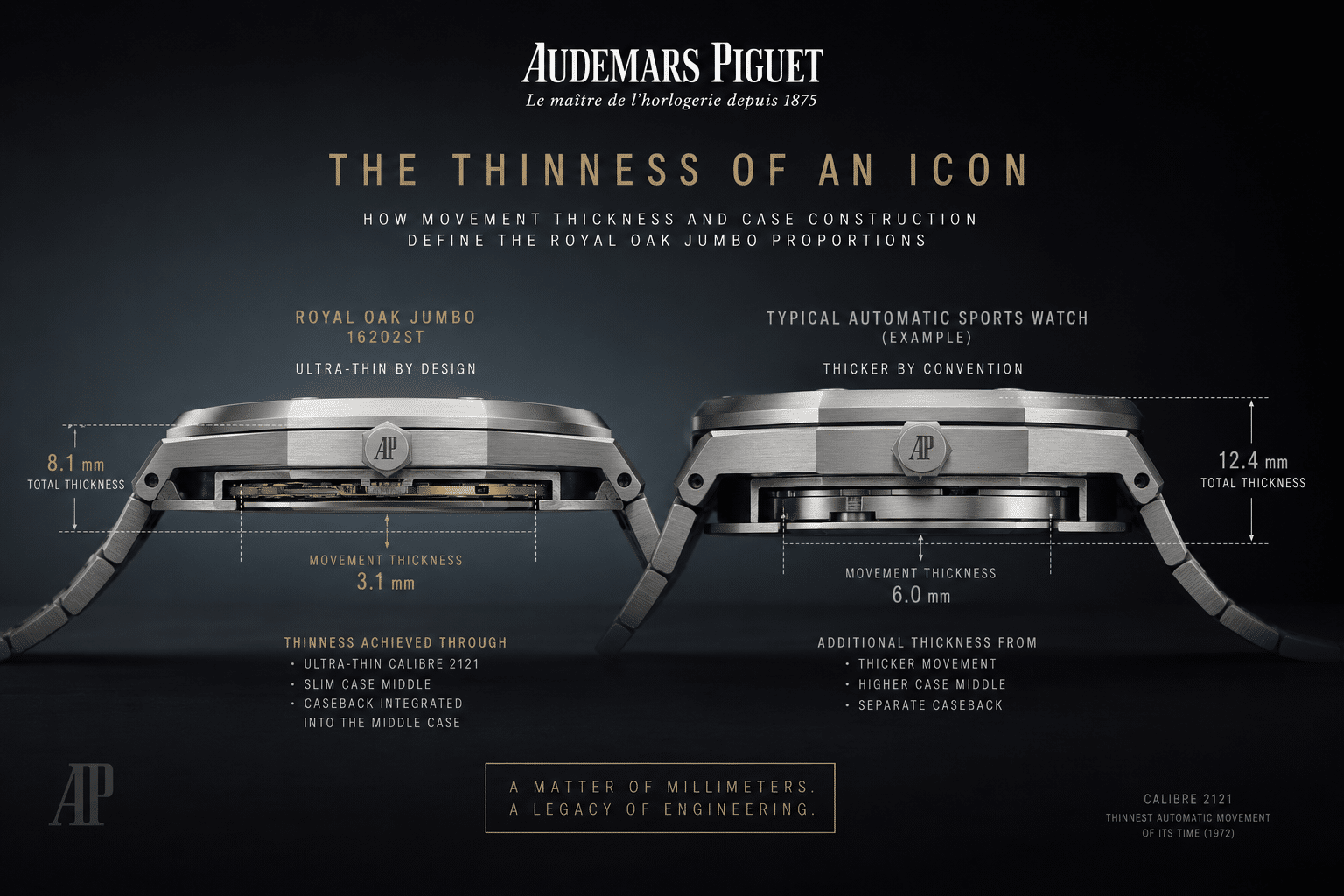
The AP 15202 Jumbo is different because it is built as a thin, flat, 39mm Royal Oak around the genuine Cal. 2121. That movement is not a background specification. It is the technical reason the case can remain so slim and the watch can wear with the restrained elegance collectors associate with the Jumbo line.
Exact dimensions should always be checked against current reference data, especially when comparing case thickness or movement thickness across sources. The practical point is more important than one number: the genuine 15202 depends on an extra-thin automatic movement, a no-seconds-hand dial layout, and a slim case profile that leaves very little room for mechanical substitution. A replica that uses a thicker or differently arranged movement is not just changing the inside of the watch. It is changing the foundation of the design.
This is why buyers should not treat the 15202 as simply a smaller Royal Oak. The watch has a different character. It is flatter, calmer, and more proportion-sensitive. A slightly bulky case on a large Offshore-style AP may be expected. A slightly bulky case on a Jumbo changes the entire message of the watch.
The Jumbo Is Not Just a Smaller Royal Oak
The 39mm size is part of the appeal, but it is not the whole identity. The Jumbo works because the diameter, case height, bezel, dial, and bracelet all feel controlled. It does not try to impress through thickness or mass. Its presence comes from proportion.
That is exactly what makes it difficult in the replica market. Larger Royal Oaks can absorb small inaccuracies because the design already has more visual weight. The 15202 has less camouflage. If the side profile is too heavy, the watch no longer reads as the same elegant, ultra-thin Royal Oak concept. It may still look like a Royal Oak from the front, but it loses the quiet flatness that defines the Jumbo.
Why the No-Seconds-Hand Layout Matters
The absence of a central seconds hand is often treated as a simple dial detail. It is more important than that. On the genuine AP 15202 Jumbo, the no-seconds-hand layout supports the restrained character of the watch and reflects the movement architecture behind it. The dial stays calm. There is no sweep to distract from the tapisserie, hands, and date.
For a replica buyer, this creates two practical issues. First, the missing seconds hand can make the front of the watch look cleaner and easier to replicate in photos. There is no obvious seconds sweep to judge. Second, it can hide the fact that the movement underneath may be a compromise route rather than a true Cal. 2121-style solution. A clean dial does not prove the movement architecture is correct.
The no-seconds design also changes how the watch feels during ownership. Crown operation, date behavior, winding feel, and rotor character become more noticeable because the dial offers fewer moving cues. A buyer who focuses only on the still photo may miss the fact that the Jumbo is judged as much by restraint and feel as by front-side appearance.
Case Thinness as the Core Design Feature
On the AP 15202, case thinness is not just a specification to quote. It is the core design feature. The slim profile controls how the watch sits on the wrist, how the bracelet drops from the case, how the bezel appears from the side, and how elegant the whole package feels under a cuff.
This is why the movement issue matters so much. If the movement route cannot support the correct thin case construction, the factory has to choose where to hide the extra height. Sometimes the caseback becomes deeper. Sometimes the mid-case looks heavier. Sometimes the front view remains attractive while the side profile tells a different story. None of these compromises automatically makes the watch unwearable, but they do make the Jumbo less convincing as a replica of this specific reference.
For buyers, the key decision is expectation. If you want a Royal Oak-style watch that looks sharp from the front, a 15202 replica may still be tempting. If you want the specific thin, flat, mechanically restrained character of the genuine Jumbo, the movement limitation becomes much harder to ignore.
Why Cal. 2121 Is the Heart of the Problem
Cal. 2121 is the heart of the problem because it is not easily replaced by a common automatic movement without consequences. The genuine Cal. 2121 is an ultra-thin Audemars Piguet movement with a distinctive architecture that supports the entire 15202 design. A true architecture-level clone would need to address movement thickness, rotor system, date mechanism, hand stack, stem alignment, and caseback presentation together. Decorating an existing movement is not enough.
This is the point many factory descriptions blur. A movement may be called “A2121” or described with 2121-style decoration, but the buyer should ask what that actually means. Is the movement architecture genuinely close to the original concept, or is it a more common automatic base adapted to fit the case and dressed to look closer through the back? Those are very different things.
The genuine 15202 is difficult because the movement and the case were designed to cooperate. In a replica, if the base movement starts thicker or places key components differently, every correction becomes a compromise. You can improve the bridge decoration, engravings, and rotor color, but you cannot fully decorate your way out of the wrong architecture.
What a Movement Claim Should and Should Not Prove
A movement label should be treated as a starting point, not a conclusion. If a listing says “2121 clone,” “A2121,” or “custom 2121,” the useful follow-up question is what part of the movement is actually being described. It may refer to bridge appearance, rotor decoration, a modified display-back layout, or a movement route intended to imitate the no-seconds, date-at-three behavior. None of those phrases automatically proves that the movement shares the genuine architecture, thickness, service behavior, or long-term performance.
For this reason, buyers should avoid paying a premium for movement wording unless the rest of the watch supports the claim. A credible 15202 build should show architectural consequences: the case should remain slim, the crown should sit naturally, the date should not look forced, the hands should not appear excessively high, and the caseback should look spatially coherent. If the watch fails those visible checks, decorative movement language should be discounted.
Movement Terminology Needs Careful Reading
Movement descriptions in the replica market should be checked carefully because they may refer to layout, decoration, clone architecture, or seller terminology rather than an official brand-manufactured caliber. A term such as “A2121” should not be read as confirmation that the watch contains a genuine Audemars Piguet movement, an official caliber, or a fully reproduced Cal. 2121 construction.
A more careful reading separates four different claims: whether the movement runs the watch functions, whether it visually imitates the caseback appearance, whether it allows a thin enough case profile, and whether it follows the genuine movement’s architecture. A listing may satisfy one or two of these points while failing the others. For the 15202, the third and fourth points are the most important because they determine whether the watch can preserve the Jumbo’s design logic.
Thinness Is Not Easy to Fake
Reducing apparent case height is not the same as reproducing a genuinely ultra-thin movement. A factory can shave case parts, use a thinner caseback, adjust the crystal height, or visually soften the side profile. Those choices may help the watch look better, but they do not change the basic height and layout of the movement inside.
This matters because the 15202 gives the movement very little vertical room. A thicker base movement forces the case to adapt. Even if the final difference sounds small on paper, it can be visible on a watch whose personality depends on flatness. The Jumbo does not need to be dramatically wrong to feel wrong. A little extra height can make the watch appear more like a standard Royal Oak than an extra-thin Jumbo.
The strongest judgment here is also the most practical one: if a buyer cares about the 15202 because of its ultra-thin identity, movement thickness should matter more than a slightly improved dial shade. The dial may catch attention first, but the case profile determines whether the watch carries the Jumbo character.
Movement Layout Affects More Than the Caseback
Many buyers think movement accuracy matters only when looking through the display caseback. That is too narrow for the 15202. Movement layout can affect the stem position, crown height, hand stack, date window relationship, rotor appearance, and even how the dial sits inside the case.
If the stem height is different, the crown may not sit in the same visual relationship to the case band. If the hand stack is taller, the center pinion and hand clearance can look heavier. If the date mechanism does not line up naturally with the dial design, the date may sit with a different depth or relationship to the window. If the rotor system is not architecturally close, the caseback view may look decorated but spatially wrong.
These are not separate flaws. They are connected symptoms of the same movement-route problem. A buyer who only checks whether the bridges have AP-style engraving is missing the larger issue. The better question is whether the movement layout supports the watch’s proportions from front, side, and back.
Movement Route to Verify
Before treating any AP 15202 as a serious Royal Oak Jumbo replica, verify the movement route being claimed. Do not stop at the phrase “Cal. 2121 clone” or “A2121.” Ask what the base movement is, whether it is an actual architecture-level solution or a modified automatic platform, and whether the case thickness and caseback presentation make sense with that claim.
A meaningful movement route should explain more than decoration. It should account for thinness, date layout, stem alignment, rotor design, and hand-stack behavior, especially when weighing AP chronograph movement risks against simpler three-hand builds before trusting any visual finishing claims. If the seller or factory description only shows a decorated caseback and gives no clear information about the base movement, treat the 2121 language cautiously.
This does not mean the watch must be rejected automatically. It means the buyer should price and judge it as a compromise-heavy 15202, not as a fully solved Cal. 2121 clone. For this model, that distinction is the difference between realistic expectations and disappointment after the watch is on the wrist.
Movement Transparency Note: Movement references in this article describe replica-market movement routes, decoration claims, and configuration choices, not an official Audemars Piguet caliber or a verified reproduction of the genuine Cal. 2121 architecture. Buyers should judge any “A2121” or “2121 clone” wording against visible case thickness, stem height, date position, hand stack, caseback depth, and the specific watch version being offered.
Reading Movement Photos Without Overreading Them
Movement photos can help, but they should be interpreted carefully. A caseback image may reveal bridge decoration, rotor finishing, jewel placement, screw color, or the general movement diameter, yet it may not reveal the actual base architecture or long-term service behavior. In the replica market, movement descriptions often describe appearance, layout, decoration, or seller terminology rather than an official brand-manufactured caliber.
A more traceable movement judgment compares the caseback photo with exterior consequences. If a movement is described as thin and 2121-style, the side profile should support that claim. If a seller emphasizes rotor decoration but the caseback looks deep and the crown position appears high or low, the decoration should not carry the decision. Movement trust in this model depends on whether the movement claim matches the whole watch, not whether one close-up image looks attractive.
Why Modified Miyota-Style Solutions Fall Short
The modified Miyota AP 15202 route is easy to misunderstand. A Miyota-style automatic movement can be a sensible, durable base in many replica watches, especially where the case has enough thickness to absorb the movement and any decorative plate work. The problem is not that every Japanese automatic-style platform is bad. The problem is that the AP 15202 movement route asks that platform to do something it was not designed to do: behave like an ultra-thin, architecture-specific Royal Oak Jumbo movement.
This is where buyers often make the wrong judgment. If the front view looks clean, the blue dial is attractive, and the bracelet finishing has improved, the watch may seem “solved.” But the Jumbo is not a normal Royal Oak with a different dial. Its case concept depends on very little vertical space. Once a thicker automatic movement is used, the factory has to manage that extra height somewhere. Usually that means compromises in the movement spacer, caseback depth, crown position, hand-stack height, date setting construction, or the way the movement is displayed through the back.
A Functional Movement Is Not the Same as the Correct Architecture
A modified Miyota-style movement can run, wind, change the date, and keep acceptable daily time. For a buyer who only wants a wearable watch with a Royal Oak Jumbo appearance, that may sound enough. But functionality is not the same as architectural accuracy. The AP 15202 is one of the few replica watch cases where the movement is not just an engine inside the shell; it defines whether the case can be thin, flat, and proportionally convincing.
This distinction matters because some seller descriptions use movement language too loosely. Terms like “A2121,” “custom 2121,” or “clone-style movement” may describe decoration or modification, not a true reproduction of the genuine movement layout. A decorated bridge or AP-style rotor can improve the caseback impression, but it does not automatically correct movement thickness, balance location, stem height, date mechanism position, or hand-stack geometry.
At CleanVSFactory, we usually separate movement reliability from movement suitability. A movement may be reliable enough in a thicker Royal Oak reference and still be the wrong technical match for the 15202 Jumbo. For this model, the buyer should ask less, “Does the movement work?” and more, “Does this movement allow the watch to keep the Jumbo’s proportions without obvious compensation?”
Why Thickness Creates a Chain Reaction
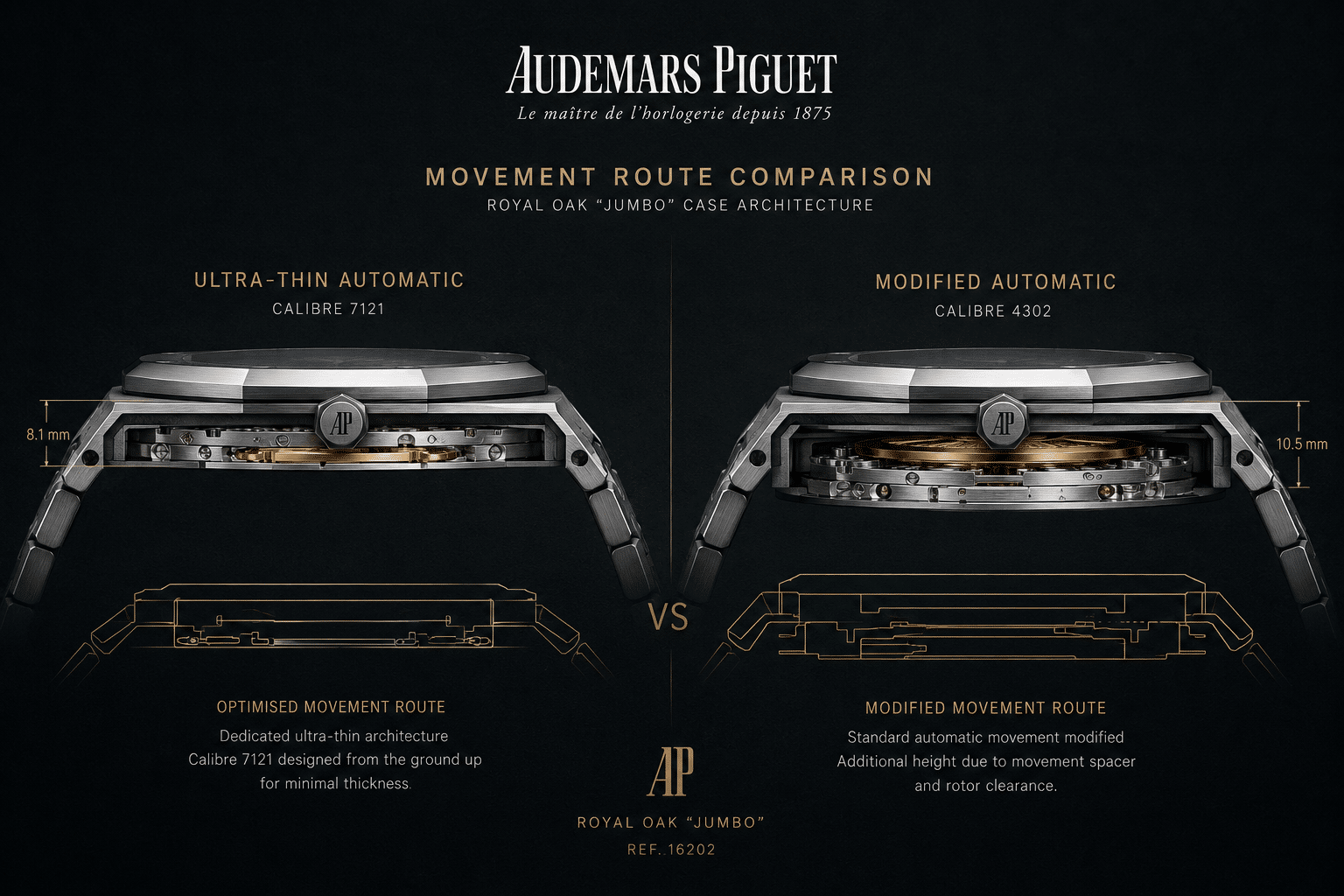
Movement thickness is not an isolated number. In a watch this thin, even a small increase can start a chain reaction. If the movement sits higher or needs a spacer, the dial may sit differently. If the dial height changes, the hands may need taller pinions. If the stem height does not match the case architecture cleanly, the crown position can look slightly off from the side. If the movement cannot sit low enough, the factory may deepen the caseback or subtly alter the mid-case profile.
This is why a front-facing photo can be misleading. The dial can look flat, the logo can sit correctly, and the bezel screws can appear acceptable, while the side profile quietly gives away the compromise. A slightly thicker caseback is not just a caseback issue. It changes how the watch sits against the wrist and how the thin Royal Oak silhouette reads in normal wear.
The most important buyer judgment is simple: if the 15202 replica needs too many case adjustments to house the movement, it has already moved away from the Jumbo’s design logic. It may still be an attractive Royal Oak-style replica, but it is not solving the core AP 15202 movement route problem.
Setting Behavior and Ownership Feel
Movement compromise also shows up in how the watch feels, not only how it looks. Crown operation, winding resistance, date setting behavior, and rotor noise all affect owner satisfaction. A Miyota-style base is known for practical reliability, but its winding character and rotor behavior can feel different from a thin, high-grade movement built for this case concept. Some units may have noticeable rotor spin or audible whirring, especially in quiet rooms or when the wrist moves sharply.
Date setting is another area where buyers should avoid assuming too much from marketing terms. If the movement has been modified to mimic a particular setting sequence, the feel may still not match the genuine architecture. Crown positions, date adjustment smoothness, and the sense of mechanical refinement can vary by version and assembly quality. None of this means the watch is unusable. It means the owner experience is different from what the Jumbo design suggests.
The practical takeaway is that a modified Miyota-style solution can be acceptable only if the buyer understands what movement compromise means. It is a functional route, not a full architectural solution. Buyers who expect the same thin-case confidence, quiet operation, and caseback realism associated with the original 15202 concept are usually the ones most disappointed.
Case Thickness, Hand Stack, and Caseback Realism Are Linked
The AP 15202 case thickness problem should not be judged as one isolated flaw. On the Royal Oak Jumbo, movement substitution tends to appear through several connected details at once: side profile, mid-case thickness, hand stack, date window depth, crown alignment, and Royal Oak Jumbo caseback presentation. A buyer who checks only one of these areas may miss the larger pattern.
This is the main reason a straight dial photo is not enough. A 15202-style replica can look balanced from the front because the octagonal bezel, petite tapisserie dial, and integrated bracelet create a strong visual identity. But the Jumbo’s credibility depends heavily on the way the case remains thin from the side. If the movement architecture forces the case to grow vertically, the watch may still photograph well while losing the flat, restrained feel that defines the model.
Side Profile Is the Fastest Place to See the Compromise
The side profile is usually the most revealing angle because it shows how the mid-case, bezel, crystal, and caseback work together. On a convincing Jumbo-style case, the watch should not look like a standard Royal Oak compressed into a smaller diameter. It should look thin by design, not thin only because the photo angle hides the back.
When a movement is too thick or needs extra spacing, the factory has limited choices. It can increase the caseback depth, adjust the mid-case, alter the internal seating, or create a visual taper that tries to disguise the added height. Some of these choices are subtle in photos, but they affect wrist presence. A deeper caseback can make the watch sit taller than expected even if the measured front diameter looks correct.
The buyer should not obsess over one claimed thickness number without context. A watch that is only slightly thicker on paper may still look wrong if the extra height is concentrated in the caseback or if the mid-case shape loses the flat Royal Oak line. For the AP 15202 case thickness question, distribution matters almost as much as the number.
Hand Stack and Date Window Depth Can Expose the Movement Route
The hand stack is another place where movement architecture becomes visible. If the movement requires taller pinions or different dial-side construction, the hands can sit higher than expected. This may not jump out in seller photos, but it changes the visual relationship between the dial, hands, and crystal. On an ultra-thin watch, excess vertical space around the hand pinion can make the dial side feel less refined.
Date window depth is equally important. The date should feel integrated into the dial plane, not buried too low or floating at an odd visual level. When the movement and dial are not naturally matched, factories may compensate with dial feet, spacers, datewheel positioning, or window framing. The result can be a date that technically works but looks less clean from angled views.
Crown alignment ties into the same issue. The stem has to meet the movement at the correct height. If the movement sits higher or lower than the case concept expects, the crown position may look slightly awkward from the side. This is not always dramatic, but on the 15202 it matters because the entire watch is built around thin, quiet proportions.
Caseback Decoration Cannot Fully Replace Movement Layout
A decorated caseback can make a replica more enjoyable, especially for buyers who like seeing AP-style rotor work and engraved bridges. But decoration is not the same as spatial accuracy. If the movement underneath is not arranged like the genuine architecture, plates and engraving can only cover part of the issue.
The most common misunderstanding is treating the display back as a surface design problem. It is really a layout problem. Rotor position, bridge shape, movement diameter, depth, balance location, and how the movement fills the case all contribute to caseback realism. A decorative plate may look attractive at first glance, but it cannot fully change the physical location of the working parts underneath.
This does not mean a decorated movement has no value. For many buyers, a cleaner caseback is better than a plain or obviously unrelated movement. But on the 15202, caseback improvement should be treated as cosmetic support, not proof that the movement problem has been solved.
What to Check Before You Decide
- Front view: Check whether the dial, hands, date window, bezel, and case shape look balanced together, but do not stop here.
- Side profile: Look for caseback depth, mid-case thickness, crystal height, and whether the watch still reads as a thin Jumbo.
- Crown position: Review the crown-side angle to see whether the stem height feels natural relative to the case.
- Hand stack: Look for excessive hand height or an overly tall center pinion that makes the dial side feel less thin.
- Date window depth: Check whether the date appears properly seated or visually too deep below the dial surface.
- Caseback presentation: Judge the movement display as a full layout, not only by rotor engraving or bridge decoration.
The best approach is pattern recognition. One small issue does not automatically ruin the watch, but several connected signs usually point back to the same movement-route limitation. For the 15202, the buyer should compare the front view, side profile, crown position, and caseback together before deciding whether the compromise is acceptable.
Why Dial Color and Bracelet Finishing Do Not Solve the Jumbo
AP 15202 dial color and Royal Oak bracelet finishing matter, but they are not the main reason the Jumbo remains difficult. This is where many buyers get pulled in the wrong direction. A better blue dial, sharper petite tapisserie texture, cleaner bezel brushing, and more comfortable bracelet can make the watch much more appealing in photos. They do not solve the movement-driven case architecture underneath.
The 15202 is not a model where decoration can carry the whole watch. Its appeal comes from restraint: a thin case, flat wrist presence, no seconds hand, and a bracelet that flows naturally from the case without making the watch feel bulky. Cosmetic improvements help only if the proportions underneath remain believable. If the case looks too tall or the caseback sits too deep, a more accurate dial shade will not fix the ownership impression.
Good Dial Work Can Make the Watch Look Convincing in Photos
A strong front photo can be persuasive. The blue dial is the emotional hook for many Royal Oak Jumbo buyers, and improvements in petite tapisserie texture, dial printing, logo placement, marker alignment, and sunburst effect can make a 15202 replica look far more refined than older examples. Under controlled lighting, a well-executed dial can make the watch appear closer than it really is as a complete object.
This is why dial-focused comparisons can become misleading. A buyer may compare blue tone, square depth, minute track printing, and hand finishing while ignoring whether the case can support the Jumbo identity. Those dial details are worth checking, but they mostly improve the watch from the front. The 15202’s hardest problem is not the first impression; it is whether the thin case architecture survives beyond the first photo.
A practical judgment: if two versions are similar in dial quality, the one with the more convincing case profile is usually the better 15202 choice. On this reference, proportion should outrank a small improvement in dial shade.
Bracelet Finishing Matters, But It Cannot Hide a Thick Case
The Royal Oak bracelet is important because it carries much of the watch’s character. Brushing direction, polished bevels, link articulation, clasp feel, and the way the integrated bracelet drapes around the wrist all affect the wearing experience. A rough bracelet can make even a visually strong replica feel less refined. A better bracelet can make the watch feel more cohesive and more comfortable.
But bracelet quality has a limit. It cannot hide a case that sits too tall for the Jumbo concept. In fact, a well-finished bracelet can sometimes make a thick case more noticeable because the bracelet flows flat while the watch head rises above it. The mismatch becomes a wrist-level problem rather than a macro-photo problem.
This is especially relevant for buyers coming from larger Royal Oak references. On a bolder Royal Oak, a little extra mass can feel acceptable because the design already has more presence. On the 15202, extra height changes the mood of the watch. The Jumbo is supposed to feel elegant and low, not simply smaller than a 41mm Royal Oak.
The Jumbo Rewards Proportion More Than Decoration
The AP 15202 rewards proportion more than decoration because the original design is quiet by Royal Oak standards. There is no chronograph layout to distract the eye, no oversized Offshore case, and no thick sports-watch stance to absorb compromises. The watch depends on balance: bezel thickness, case height, dial flatness, hand height, bracelet flow, and caseback depth all need to work together.
This is why the most attractive 15202 replica on a listing page is not always the smartest choice. A front photo may show a pleasing dial and clean bezel screws, while the side view reveals the real limitation. Buyers who prioritize the Jumbo’s design logic should treat dial and bracelet finishing as secondary filters after movement-route and case-profile judgment.
The balanced view is not that cosmetic quality is meaningless. A poor dial or stiff bracelet can still ruin the watch. But on the Royal Oak Jumbo replica, finishing upgrades are not a substitute for structural realism. The model is difficult because the movement, case, dial height, caseback, and bracelet have to support the same ultra-thin idea. If that idea is compromised, decoration can make the watch prettier, but not truly solved.
XF Factory History and Why Buyers Still Talk About It
XF Factory remains part of the AP 15202 discussion because its old Jumbo version occupied a very specific place in the replica market: it was one of the few serious attempts to make the Royal Oak Jumbo feel thin enough to resemble the idea of the original watch. That is why buyers still search for terms like XF Factory AP 15202 and XF 15202 Jumbo, even when they are not looking at a current production piece.
The important judgment is this: XF’s reputation should be treated as historical context, not as proof that the 15202 problem was solved. The old XF 15202 was respected because it narrowed some of the most obvious proportion gaps compared with thicker attempts, but it still did not create a true Cal. 2121 clone in the full architectural sense. For a buyer today, the useful lesson from XF is not “find XF at any cost.” It is that even one of the most discussed 15202 efforts was still fighting the same ultra-thin movement limitation.
Why XF Became Part of the 15202 Conversation
XF became important because the 15202 is not a normal Royal Oak replica problem. On many AP replicas, buyers can debate dial texture, bezel screw shape, brushing, clasp feel, or bracelet articulation and still have a watch that works reasonably well as a daily-wear object. The Jumbo is less forgiving. If the case becomes too thick, the whole character changes. XF gained attention because its version was closer to the thin-wrist impression buyers expected from the Jumbo than many earlier or more basic attempts.
That is why older forum posts often speak about XF with unusual respect. Buyers were not only praising a blue dial or a bracelet finish; they were responding to a version that looked more serious about the Jumbo’s slim profile. In AP replica comparison discussions, that matters. A Royal Oak Jumbo that wears like a thicker 15400-style case is not really solving the 15202 identity, even if the dial looks attractive from the front.
The non-obvious point is that XF’s reputation came from relative progress, not from eliminating the core problem. It was strong compared with the alternatives around it. That does not make it a clean mechanical answer to the genuine Cal. 2121 architecture.
Old Reputation Does Not Equal a Solved Cal. 2121 Clone
The main mistake buyers make with old XF discussions is reading praise as if it were a technical conclusion. A discontinued version can be the best-known historical attempt and still carry the same structural compromise. The 15202’s challenge sits inside the case: movement thickness, stem position, hand-stack height, date behavior, caseback depth, and movement layout all interact. Good exterior execution cannot erase those dependencies.
Some old XF-related descriptions may use movement names or “A2121” language in a way that sounds more complete than it is. Buyers should be careful here. A movement can be modified, decorated, or arranged to support a thinner case while still not being a true clone of the genuine Cal. 2121 architecture. That difference matters because the Jumbo is not only judged by whether it runs. It is judged by whether the movement allows the case to remain flat, balanced, and convincing from the side.
At CleanVSFactory, we usually separate a factory’s historical reputation from the movement route inside a specific model. That distinction is especially important with the XF 15202 Jumbo, because the factory name became stronger in memory than the technical limitation it was still working around.
How to Read Older Forum Praise Carefully
Older forum praise is useful, but only if the reader asks what was being compared at the time. A review calling an old batch “best” may mean best against thicker, less refined versions from that period. It may not mean best against every current factory option, and it certainly does not mean the watch reproduced the genuine movement architecture. In replica watch discussions, “best available” and “technically solved” are very different claims.
Buyers should also pay attention to batch language. An old batch, a discontinued version, a secondhand listing, and a dealer claim using the XF name are not automatically the same thing. Photos from one historical sample may not represent another watch being offered today. For the AP 15202, this matters because small differences in case thickness, caseback height, hand stack, and bracelet fit can change the impression more than they would on a larger Royal Oak.
If a seller or discussion thread leans heavily on XF history, the practical response is to ask for evidence, not nostalgia. Look for current photos of the actual watch, especially the side profile and caseback. Ask what movement route is inside. Treat old reputation as a clue that the version may be worth studying, not as a reason to ignore the Jumbo’s known movement limitation.
Version Traceability Matters More Than Factory Nostalgia
In super clone watch comparisons, the safer judgment is usually version-specific. A factory may be strong on one AP reference and weaker on another because case shape, dial construction, bracelet engineering, bezel finishing, and movement layout are not equally difficult across every model. The 15202 is a clear example: a factory that performs well on a thicker Royal Oak does not automatically solve the Jumbo.
For older XF-related pieces, traceability should include the actual sample being offered, not only the factory name. Buyers should compare the current photos against the claimed version, check whether the dial and caseback match the description, and confirm whether the movement information is specific or only repeated from old discussions. A used or hard-to-source 15202 can vary in condition, assembly quality, bracelet wear, rotor noise, and caseback presentation, so the decision should stay attached to the individual watch rather than to a remembered reputation.
QC Photos for the 15202 Should Focus on Proportion, Not Just Dial Cleanliness
AP 15202 QC photos should be reviewed differently from QC photos for a more forgiving Royal Oak reference. A clean dial is necessary, but it is not enough, because Audemars Piguet replica movements also influence case thickness, hand height, and caseback depth expectations. The Royal Oak Jumbo replica QC process should focus on proportion first: side profile, caseback depth, crown position, date window relationship, hand height, bracelet integration, and the way the case sits as one flat visual unit.
The strongest front-facing photo can hide the most important issue. A straight dial shot may show neat printing, aligned markers, and a pleasant tapisserie pattern, while the side view reveals that the watch has gained too much height or that the caseback looks deeper than expected. For the 15202, that is not a minor flaw. It affects the whole reason the Jumbo is desirable.
Before making a decision, buyers should review real QC photos where available, including dial printing, hand alignment, bezel position, datewheel centering, bracelet fit, clasp engraving, case thickness, crown alignment, caseback depth, and overall finishing. Factory labels and stock photos alone are not enough for a reliable judgment on the AP 15202.
Front Dial Photos Are Necessary but Not Enough
The front dial photo still matters. Buyers should check whether the petite tapisserie pattern looks centered and consistent, whether the AP logo and dial printing sit cleanly, whether the hour markers are properly aligned, and whether the hands appear clean and evenly placed. The date window deserves special attention because poor centering or a date disc sitting too deep can make the dial side look less refined even before the movement question enters the picture.
But the front view has a built-in limitation: it rewards cosmetic accuracy. A blue dial can photograph well. Brushing can look sharp under controlled lighting. Hands and markers can appear acceptable at normal viewing size. None of that proves the watch has the right case architecture. For the 15202, a buyer who approves QC based only on a beautiful dial photo is skipping the part of the watch most likely to disappoint in real wear.
Side Profile and Caseback Photos Carry More Weight on the Jumbo
The side profile photo is the most valuable QC angle for this model. It shows whether the case looks flat or bulky, whether the mid-case carries too much height, and whether the caseback creates a visible step that changes the Jumbo’s slim identity. A slightly imperfect brushing line may be tolerable. An obviously thick side profile is harder to forgive because it changes the watch’s basic character.
Crown position should be judged together with the case side. If the movement route forces a stem position that feels visually awkward, the crown can sit in a way that makes the whole case construction look less natural. The same logic applies to the caseback photo. Decoration may look attractive, but the buyer should look at depth, layout impression, rotor presentation, and whether the display back seems like it was built around the movement or simply made to cover a compromise.
A good QC review does not use one photo to “prove” the watch is good or bad. It looks for a pattern. If the dial looks clean but the case side is thick, the crown position feels off, and the date window appears too deep, those signs point to the same underlying issue: the movement route is shaping the watch more than the Jumbo design is.
Bracelet Fit Still Affects the Wearing Experience
The Royal Oak bracelet is not just decoration. On the 15202, the integrated bracelet has to flow from a slim case without making the watch feel stiff or top-heavy. QC photos should show the first links, end-link fit, clasp, and bracelet articulation. A bracelet with rough edges, uneven gaps, or poor first-link movement can make even a visually attractive case feel less convincing on the wrist.
Still, bracelet quality should not distract from the movement-driven case problem. A slightly sharp bracelet edge can sometimes be improved or tolerated by a buyer with realistic expectations. A case that looks too thick for the Jumbo cannot be corrected through clasp finishing. The bracelet should support the slim design; it cannot rescue it.
How to Treat Factory Labels, Seller Photos, and Price Claims
Factory labels and seller descriptions are useful signals, but they should not be treated as final proof on the AP 15202. A listing may use a familiar factory name, show clean dial photos, or describe the movement with 2121-style language, yet the actual watch still needs to be checked as a complete object. For this model, the most buyer-verifiable evidence is not the name in the title; it is whether the supplied photos show a believable side profile, natural crown position, acceptable date depth, and a caseback that does not look like it is compensating for a thicker movement.
Price also needs careful reading. A higher 15202 price may reflect better finishing, a more desirable batch, limited availability, seller margin, after-sale risk, or simply market hype around a discontinued or hard-to-source version. It does not automatically mean the movement architecture is more correct. Before paying more, the buyer should ask what the extra cost is buying: a better bracelet, improved dial, thinner case execution, clearer movement route, or only a stronger factory story.
This distinction matters more on the Jumbo than on many simpler replica watches. A watch that is excellent for photos may not be the best daily-wear choice if the movement is noisy, the case sits high, or the crown and date behavior feel compromised. A buyer choosing the 15202 should decide whether the goal is front-facing visual accuracy, daily reliability, or the closest possible Jumbo proportion, because one version may not satisfy all three priorities equally.
Seller Terms, Water Resistance, and After-Sales Questions
QC photos can reduce uncertainty, but they do not establish seller policies or physical testing results. Before ordering, buyers should confirm return terms, repair options, movement-service expectations, shipping terms, and after-sales support directly with the seller rather than assuming those protections are included. A factory label, decorated rotor, or strong photo set should not be treated as a warranty or service commitment.
Water resistance should not be assumed from the Royal Oak shape, screw construction, or caseback appearance. Unless the specific watch has been tested and the seller’s policy is clearly confirmed, a replica 15202 should be treated cautiously around water. Genuine-brand water-resistance claims and service standards do not transfer to replica-market watches.
QC Photos to Request
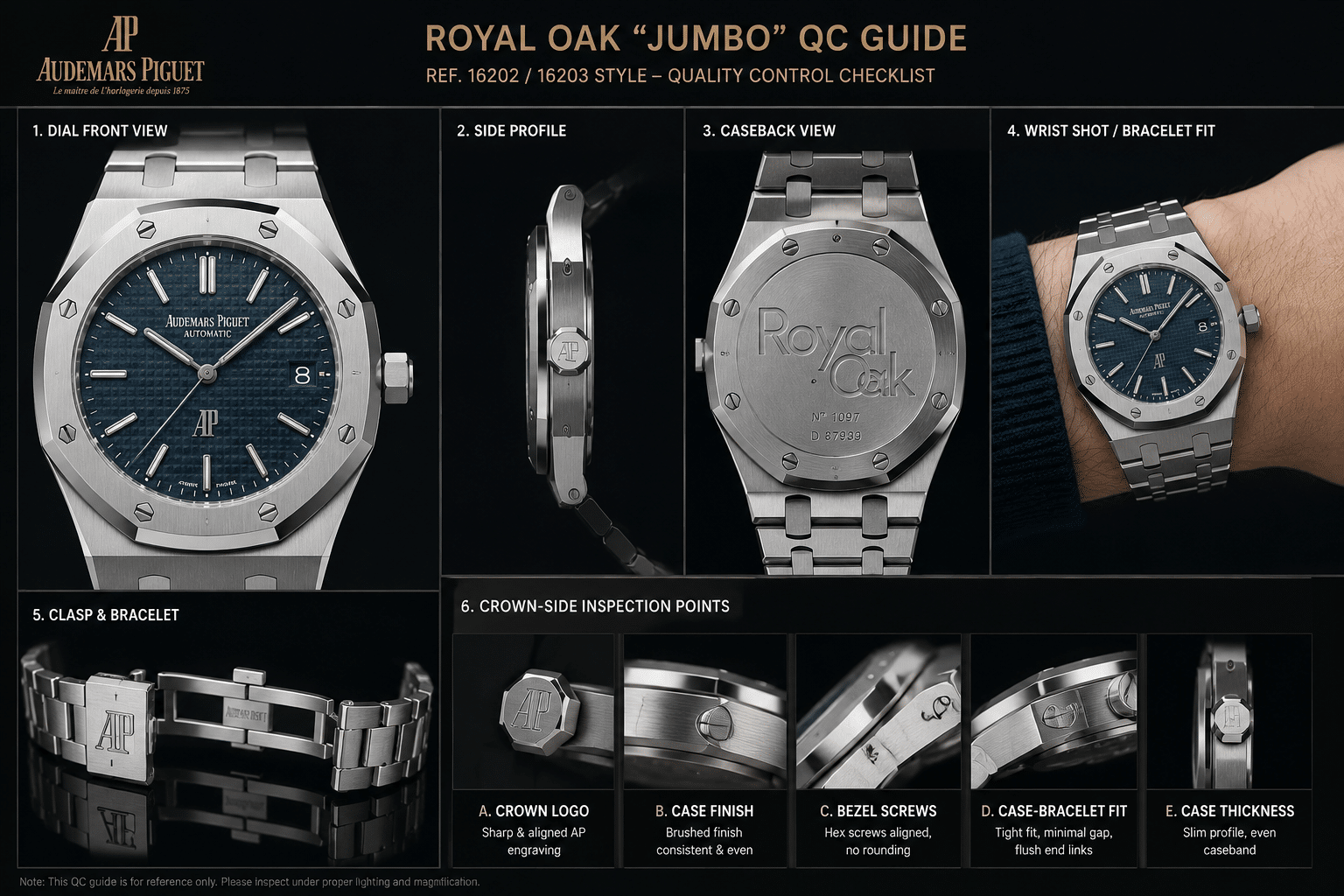
For an AP 15202 Jumbo replica, the minimum useful QC set should include a straight front dial photo, a crown-side profile photo, a non-crown-side profile photo, a caseback photo, a close-up of the date window, a clasp photo, and bracelet articulation photos showing how the first links fall from the case. A crown-side view is especially important because it connects case thickness, stem alignment, and overall side geometry in one angle.
Red flags include a visibly thick mid-case, a caseback that looks overly deep, a date that sits badly off-center, hands that appear unusually tall from an angled view, poor bracelet fit at the case junction, and a crown position that makes the case look mechanically forced. Minor dial dust, light brushing inconsistency, or small clasp engraving imperfections may be less important than those proportion issues, depending on the buyer’s tolerance.
QC photos cannot guarantee water resistance, long-term durability, or movement reliability. They are a way to decide whether the specific watch in front of you matches realistic expectations for this difficult reference. With the 15202, the safest QC mindset is simple: judge the watch as a slim architectural object, not only as a nice AP dial.
What QC Cannot Prove
QC images are useful, but they have limits. They cannot verify the exact movement origin, confirm pressure resistance, prove metal composition, guarantee long-term accuracy, or establish that the watch will perform like an authentic AP. They also cannot confirm whether a factory name in a listing matches the actual production source. For a model as sensitive as the 15202, QC should be treated as a risk-reduction step, not as a certification process.
Buyers should be especially careful with water-resistance assumptions. A replica Royal Oak-style watch should not be treated as safe for swimming, showering, or sports use unless the individual watch has been pressure-tested after purchase by a competent watchmaker. Genuine-brand specifications do not transfer to a replica, and a visually tight caseback or screw-down appearance is not proof of sealing quality.
Verification Note: When possible, buyers should review real photos of the exact AP 15202 replica being considered, including side-profile angles, crown alignment, date-window close-ups, clasp finishing, bracelet fit, caseback depth, and any available movement information. Stock photos, factory labels, and decorated rotor images can help with initial comparison, but they are not enough to verify whether a specific watch has acceptable Jumbo proportions.
How the 15202 Compares With Safer AP Replica Choices
The AP 15202 is more attractive to many purists, but it is not the most practical AP replica choice for many buyers who want the safest ownership experience. The reason is not that the Jumbo is unpopular or visually unappealing. It is because the 15202 gives factories very little room to hide movement substitution. Other Royal Oak references, especially thicker models such as the 15400, 15500, or 15510, are more forgiving because their case designs can accommodate available movement routes with fewer obvious proportion penalties.
This is where the AP 15202 vs 15400 replica comparison becomes more practical than emotional. The 15202 has the cleaner historical identity, smaller 39mm case, and extra-thin character. The 15400 and later 41mm Royal Oaks are less delicate, but that extra case volume helps the replica market. A thicker watch can absorb movement height, spacers, automatic winding architecture, and caseback presentation more naturally. The Jumbo cannot.
Why Thicker Royal Oaks Are More Forgiving
Thicker Royal Oaks give factories more mechanical tolerance. If a movement is not as thin as the genuine architecture, the case does not need to be stretched as dramatically to contain it. The dial side, hand stack, caseback, and crown position can often be arranged without making the watch look as obviously compromised. This does not mean every 15400, Royal Oak 15500, or Royal Oak 15510 replica is excellent. It means the design gives the factory more space to build a convincing watch around the movement options that actually exist.
The 15202 works in the opposite direction. Its appeal depends on the case being thin and flat. A small increase in thickness matters more because there is less visual mass to absorb it. On a bolder 41mm Royal Oak, a slight thickness compromise may blend into the watch’s stronger wrist presence. On the Jumbo, the same compromise can make the watch feel like it missed the central point of the model.
That is why factory consistency tends to feel more achievable on thicker AP references. Case machining, bracelet finishing, dial work, and movement integration still matter, but the design is not placing the same extreme demand on ultra-thin movement architecture.
When the 15202 Still Makes Sense for a Buyer
The 15202 still makes sense for a narrow type of buyer: someone who specifically wants the Jumbo look, understands the movement compromise, and is willing to judge the watch as a visually appealing replica-market interpretation of the design rather than a fully solved super clone watch. That buyer should care about side profile, caseback depth, and proportion, but also accept that no current factory has erased the movement limitation.
It may also make sense for a buyer who already owns or understands other AP replica options and wants the 15202 for its restrained dial layout, smaller case feel, and historical design language. In that scenario, the buyer is not expecting the easiest QC process or the most mechanically faithful architecture. They are choosing the Jumbo because the design itself matters enough to accept the known ceiling.
The wrong buyer for the 15202 is the one who expects the same maturity seen in stronger, thicker Royal Oak replicas. If the goal is low-stress daily wear, easier QC approval, and fewer structural concerns, the Jumbo is not the first place to start.
When a Different Royal Oak Reference Is the Smarter Route
A different Royal Oak reference is usually smarter when the buyer prioritizes reliability, easier factory comparison, and a more predictable ownership experience. The 15400, 15500, and 15510 families are more practical choices for many buyers because the movement expectations and case dimensions are less punishing. They may not have the same purist appeal as the Jumbo, but they are generally easier to evaluate and less dependent on an unsolved ultra-thin movement route.
For a safer first AP replica, the better decision is often to choose a reference where the available movements fit the case concept more naturally. This reduces the chance that one hidden compromise will affect five visible details at once. A buyer comparing daily-wear options should not ask only, “Which AP looks most iconic?” The better question is, “Which AP design gives the replica factory enough room to build a convincing and usable watch?”
The honest answer is that the 15202 is a beautiful but demanding target. For experienced buyers with specific taste, it can still be worth considering. For beginners or buyers who want a more rational AP clone with fewer surprises, a thicker Royal Oak is usually the safer route.
Realistic Expectations Before Choosing an AP 15202 Clone
The right AP 15202 clone expectations start with one uncomfortable point: the Royal Oak Jumbo can look beautiful as a replica watch, but it should not be treated as a fully solved Royal Oak Jumbo super clone. The front view may be attractive, the blue dial may be convincing enough in casual wear, and the bracelet may have improved finishing. None of that removes the central limitation. The Jumbo problem is movement architecture first, cosmetics second.
This does not mean every 15202 replica is a poor choice. It means the buyer has to understand what kind of choice it is. The 15202 is not the safest AP replica for someone who wants the least complicated ownership experience. It is a compromise-heavy model for buyers who value the Jumbo look enough to accept movement compromise, case-thickness sensitivity, caseback limitations, and tighter QC tolerance.
At CleanVSFactory, we usually separate visual attraction from daily-wear practicality when evaluating watches like this. The 15202 is a good example of why that distinction matters: a replica can be visually appealing and still be structurally less convincing than thicker Royal Oak references that give factories more room to work.
The Main Buyer Mistake Is Judging Only From the Front
The most common mistake is deciding too early from a straight dial photo. On the AP 15202, a clean dial image can hide the very issues that matter most: side profile, crown position, date-window depth, hand-stack height, and caseback presentation. A front photo tells you whether the watch is cosmetically attractive. It does not prove that the Jumbo’s thin architecture has been reproduced.
This matters because the genuine 15202 is not a loud watch. Its appeal comes from flatness, restraint, and balance. If the case sits slightly too thick, if the caseback appears built up, or if the dial-side geometry feels raised, the watch loses part of what makes the Jumbo special. On a larger or bolder Royal Oak, those compromises may be easier to live with. On the 15202, they are closer to the center of the design.
A buyer reviewing QC photos should therefore avoid treating dial cleanliness as the final answer. A small brushing inconsistency may be tolerable. A visibly heavy side profile is more important. A slightly imperfect bracelet edge may be less damaging than a case construction that fights the thin Jumbo identity. The hierarchy is different on this model, and that is where many buyers misjudge it.
The Safer Decision Depends on Your Tolerance for Compromise
If you are asking, “is the 15202 worth it,” the honest answer depends on what you expect from it. For a visual enthusiast who mainly wants the restrained 39mm Royal Oak look and understands the movement-route limitation, the 15202 can still be enjoyable. It has a unique wrist presence that larger Royal Oaks do not fully replace.
For a daily wearer, the decision is less straightforward. The movement compromise does not only affect technical pride; it can influence winding feel, rotor behavior, case construction, and long-term satisfaction. If you want a replica watch that feels less sensitive to small structural flaws, the Jumbo is not the easiest path.
For a beginner, the 15202 is usually not the best first AP replica choice. Beginners often judge by dial color, factory name, and the most attractive photo. The Jumbo demands a more experienced eye because its most important weaknesses are not always obvious in the first image. A first-time buyer who wants a safer AP super clone experience is usually better served by a Royal Oak reference where movement substitution or clone-movement execution does not fight the entire design concept.
For an advanced collector, the 15202 can make sense only if the compromise is already accepted before buying. That means you are not expecting a perfect Cal. 2121-style solution, not expecting genuine-level thinness in every respect, and not assuming that improved finishing solves the architecture. The model is more satisfying when approached as a visually appealing interpretation of the Jumbo, not as the final answer to the Jumbo problem.
Ownership Limits That Should Be Accepted in Advance
A replica watch should be evaluated with realistic ownership expectations. Even a strong super clone can have limits in water resistance, long-term movement stability, servicing convenience, parts availability, and close inspection compared with a genuine reference. On the AP 15202, those limits are more visible because the watch asks so much from a thin case and movement combination.
Before choosing this model, buyers should separate three goals: looking good in normal wear, matching the Jumbo’s ultra-thin architecture, and being easy to maintain over time. The 15202 may satisfy the first goal for some buyers, but the second and third goals are harder. A more transparent decision accepts those boundaries before purchase rather than discovering them after the watch is worn, opened, or compared side by side with a genuine reference design.
Misrepresentation and Authentication Boundaries
The purpose of factory and movement information is to help readers understand quality, version differences, and ownership risk, not to represent a replica watch as genuine. A strong 15202 replica may look convincing in normal wear, but close inspection can still reveal differences in finishing, movement architecture, case proportions, bracelet feel, dial details, or service compatibility.
Buyers should avoid any seller claim that suggests a replica can pass authentication, boutique inspection, professional service screening, or resale checks as an authentic Audemars Piguet watch. Those claims are not a reliable basis for purchase and can create serious trust and disclosure problems. The safer use of this information is to avoid overpaying, avoid misunderstanding movement claims, and make a clearer decision about whether the known compromises are acceptable.
Legal, Disclosure, and Authenticity Boundaries
This article discusses replica-market watches and buyer evaluation, not authorized Audemars Piguet products. Replica watches may raise trademark, customs, import, resale, and disclosure issues depending on jurisdiction, and buyers should not assume that purchase, shipment, ownership, or resale is risk-free. Nothing in this guide should be read as a statement that a replica watch is authorized, equivalent to, or endorsed by the original brand.
The same caution applies to resale and gifting. A replica should not be represented as authentic, serviced as authentic, or sold without clear disclosure. Even when a watch looks visually convincing, the differences in movement architecture, finishing, warranty status, serviceability, and legal status remain material. For the 15202 specifically, the movement limitation is not just a technical concern; it is part of why the watch should be discussed honestly as a replica rather than blurred into “same as genuine” language.
The Honest Verdict on the AP 15202 Clone
The AP 15202 remains one of the most elegant Royal Oak designs, but elegance is exactly why it is difficult to replicate. A thicker movement route, even a functional one, changes the way the whole watch has to be built. That affects visual accuracy, wrist feel, caseback realism, and the buyer’s QC tolerance.
No current factory has truly solved the 15202 in the way buyers often expect from more mature replica watch categories. Some versions may be more attractive than others, and some may be acceptable for buyers who understand the tradeoff. But the Jumbo should not be grouped casually with safer, more mature AP replica choices simply because the dial photo looks strong.
The practical verdict is simple: choose the AP 15202 clone only if you specifically want the Jumbo look and can accept that its core limitation is still unresolved. If you want a more forgiving AP replica for daily wear, easier QC, and fewer architecture-driven compromises, the smarter decision is usually a different Royal Oak reference. The mistake to avoid is buying the 15202 as if it were a solved super clone. It is desirable, but it remains one of the hardest AP replicas to get right.
Disclosure: This article is for general educational and comparison purposes only. Replica watches are not genuine products from the original luxury brands, and brand names are used only to identify reference designs or comparison topics. Factory names, movement descriptions, prices, availability, QC details, seller policies, and version information can change, so readers should verify important details with the seller before making a purchase decision. Replica watches should not be represented, resold, or used as genuine watches.